Bulgaria Passenger Vehicles Lubricants Market Analysis by Mordor Intelligence
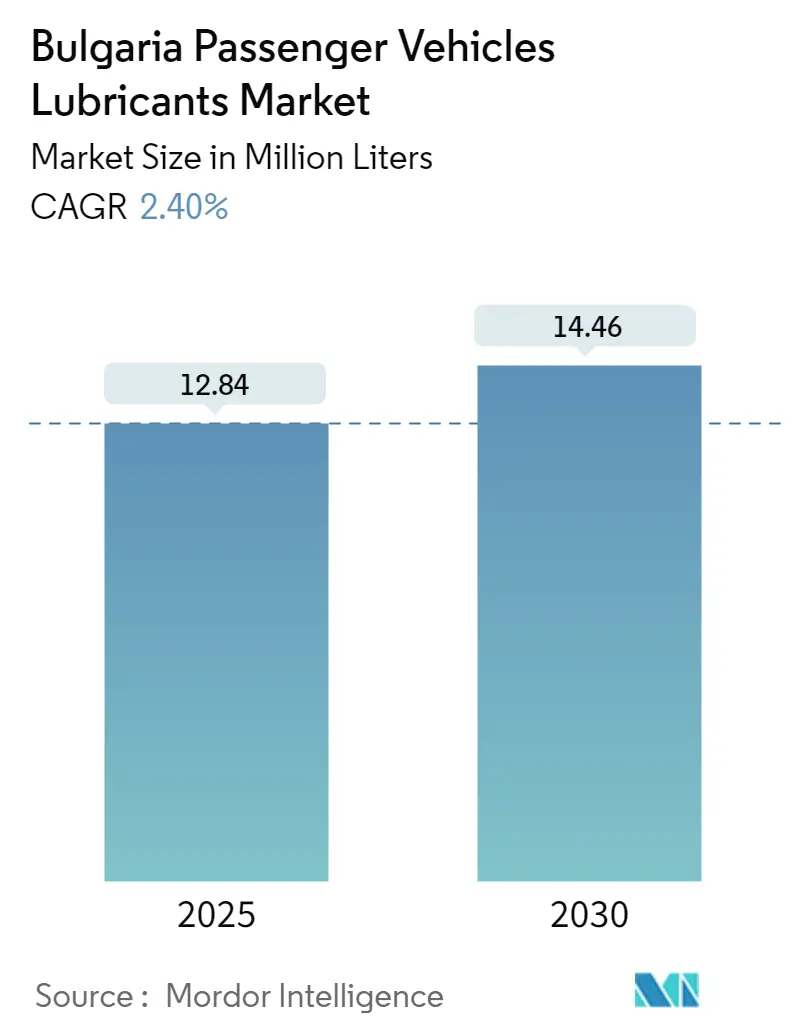
The Bulgaria Passenger Vehicles Lubricants Market size is estimated at 12.84 million liters in 2025, and is expected to reach 14.46 million liters by 2030, at a CAGR of 2.4% during the forecast period (2025-2030).
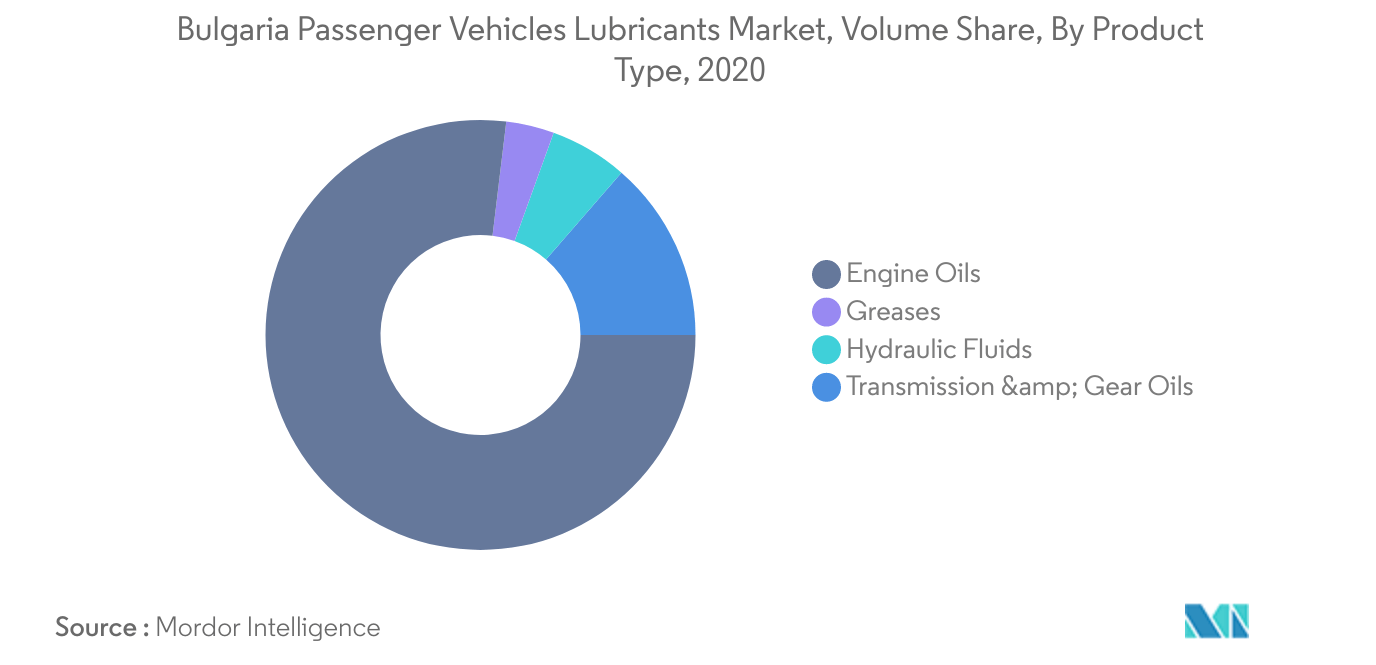
Largest Segment by Product Type - Engine Oils : Engine oils form the leading product type due to their high volume requirements and short drain intervals, as they are used in high-temperature and high-pressure applications.
Fastest Segment by Product Type - Hydraulic Fluids : In Bulgaria, the expected recovery in the imports, sales, and usage of used cars since 2021 is likely to drive the demand for hydraulic fluids during the forecast period.
Bulgaria Passenger Vehicles Lubricants Market Trends and Insights
Largest Segment By Product Type : Engine Oils
The share of the passenger vehicles (PV) segment in the automotive lubricants market decreased from 68.91% in 2015 to 66.41% in 2019. Consumption of lubricants in the PV segment however recorded a CAGR of 1.76% during 2015-2019. This trend was directly proportional to the number of vehicles in use.
In 2020, passenger car population increased by 0.82%, which was quite low compared to the growth rate in the past few years. The consumption of lubricants in the PV segment experienced a drop of 15.25% in 2020.
The increasing consumer preference to buy used cars is estimated to grow the population of cars in the future. Currently, Bulgaria does not have strict emission standards or a scrappage policy. Hence, few European countries tend to export their old vehicles to Bulgaria. As a result, the consumption in the PV segment is expected to record a CAGR of 1.79% during 2021-2026.
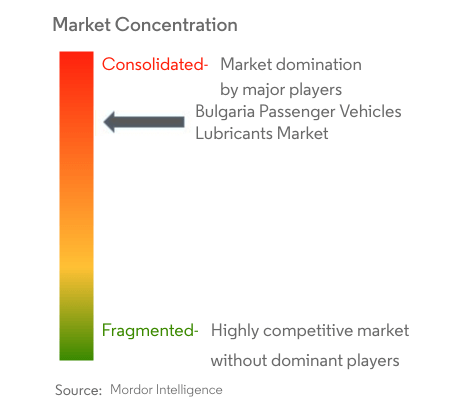
The Bulgaria Passenger Vehicles Lubricants Market is fairly consolidated, with the top five companies occupying 98.10%. The major players in this market are BP PLC (Castrol), ExxonMobil Corporation, Prista Oil, Royal Dutch Shell Plc and TotalEnergies (sorted alphabetically).
Bulgaria Passenger Vehicles Lubricants Industry Leaders
BP PLC (Castrol)
ExxonMobil Corporation
Prista Oil
Royal Dutch Shell Plc
TotalEnergies
*Disclaimer: Major Players sorted in no particular order
June 2021: TotalEnergies and Stellantis group renewed their partnership for cooperation across different segments. Along with the renewal of partnerships with Peugeot, Citroën, and DS Automobiles, the new collaboration extends to Opel, and Vauxhall as well. This partnership includes the development and innovation of lubricants, first-fill in Stellantis group vehicles, recommendation of Quartz lubricants, and shared usage of charging stations operated by TotalEnergies, among others.
April 2021: Texaco Lubricants introduced three new engine oils within the successful Texaco Havoline ProDS range, each with manufacturer approvals. The oils have been designed to provide enhanced wear protection even with a lubricant layer of 2 microns.
April 2021: Motul launched two engine oils, namely CLASSIC EIGHTIES 10W-40 and CLASSIC NINETIES 10W-30, for classic cars manufactured between the 1970s and 2000s.
Table of Contents for Bulgaria Passenger Vehicles Lubricants Industry Report
How big is the Bulgaria Passenger Vehicles Lubricants Market?
The Bulgaria Passenger Vehicles Lubricants Market size is expected to reach 12.84 million Liters in 2025 and grow at a CAGR of 2.40% to reach 14.46 million Liters by 2030.
What is the current Bulgaria Passenger Vehicles Lubricants Market size?
In 2025, the Bulgaria Passenger Vehicles Lubricants Market size is expected to reach 12.84 million Liters.
Who are the key players in Bulgaria Passenger Vehicles Lubricants Market?
BP PLC (Castrol), ExxonMobil Corporation, Prista Oil, Royal Dutch Shell Plc and TotalEnergies are the major companies operating in the Bulgaria Passenger Vehicles Lubricants Market.
What years does this Bulgaria Passenger Vehicles Lubricants Market cover, and what was the market size in 2024?
In 2024, the Bulgaria Passenger Vehicles Lubricants Market size was estimated at 12.53 million Liters. The report covers the Bulgaria Passenger Vehicles Lubricants Market historical market size for years: 2019, 2020, 2021, 2022, 2023 and 2024. The report also forecasts the Bulgaria Passenger Vehicles Lubricants Market size for years: 2025, 2026, 2027, 2028, 2029 and 2030.
Statistics for the 2025 Bulgaria Passenger Vehicles Lubricants market share, size and revenue growth rate, created by Mordor Intelligence™ Industry Reports. Bulgaria Passenger Vehicles Lubricants analysis includes a market forecast outlook for 2025 to 2030) and historical overview. Get a sample of this industry analysis as a free report PDF download.