
Market Overview
| Study Period | 2020 - 2031 |
|---|---|
| Forecast Data Period | 2026 - 2031 |
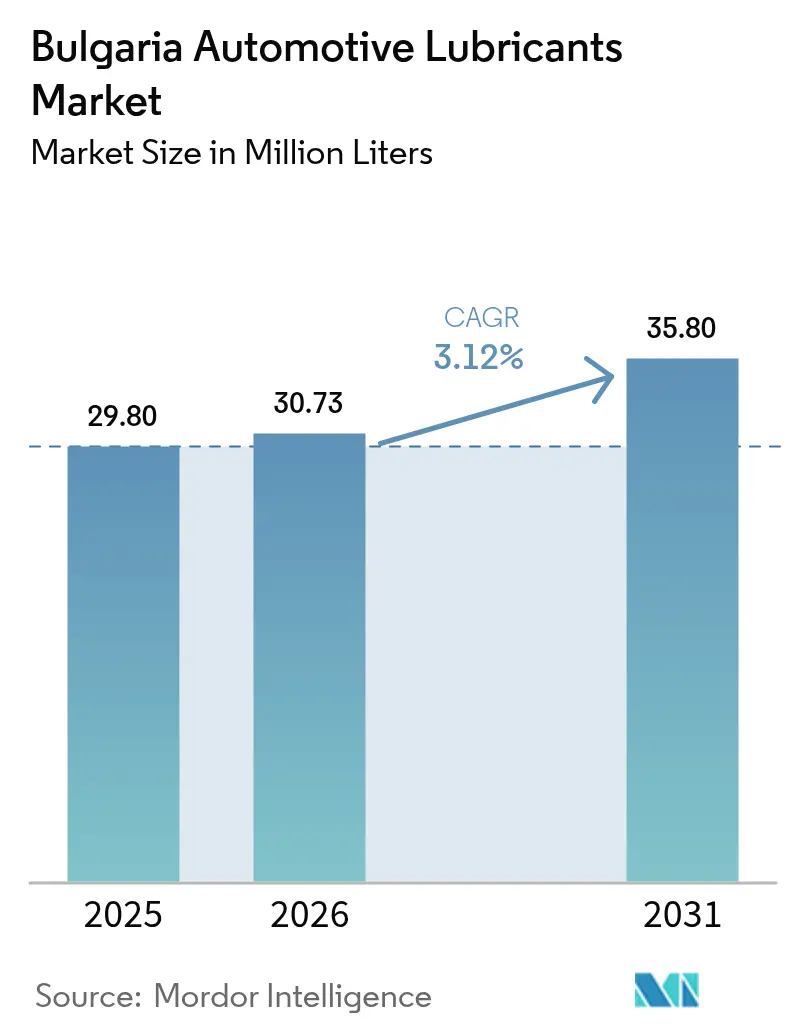
| Base Year Market Size (2025) | 29.80 Million liters |
| Market Volume (2026) | 30.73 Million liters |
| Market Volume (2031) | 35.8 Million liters |
| Growth Rate (2026 - 2031) | 3.12 % |
| Market Concentration | Medium |
Major Players *Disclaimer: Major Players sorted in no particular order Image © Mordor Intelligence. Reuse requires attribution under CC BY 4.0. | |
Bulgaria Automotive Lubricants Market Analysis by Mordor Intelligence
The Bulgarian Automotive Lubricants Market size is expected to grow from 29.80 million liters in 2025 to 30.73 million liters in 2026 and is forecast to reach 35.8 million liters by 2031 at 3.12% CAGR over 2026-2031. Strategic placement along the EU–Balkan freight corridor, an aging vehicle fleet, and delayed electrification compared with Western Europe anchor steady volume growth. International freight operations account majority of domestic road-transport activity, so long-haul trucks sustain demand for premium heavy-duty engine oils. Passenger-car owners are increasingly adopting extended-drain synthetics, yet high vehicle age keeps total lubricant consumption relatively resilient. Preparations for Euro 7 emission rules are accelerating the switch to low-viscosity, additive-rich formulations. Online direct-to-consumer channels expand access to branded products, while bio-based additive innovations enable brands to differentiate themselves under stricter EU Ecolabel criteria.
Key Report Takeaways
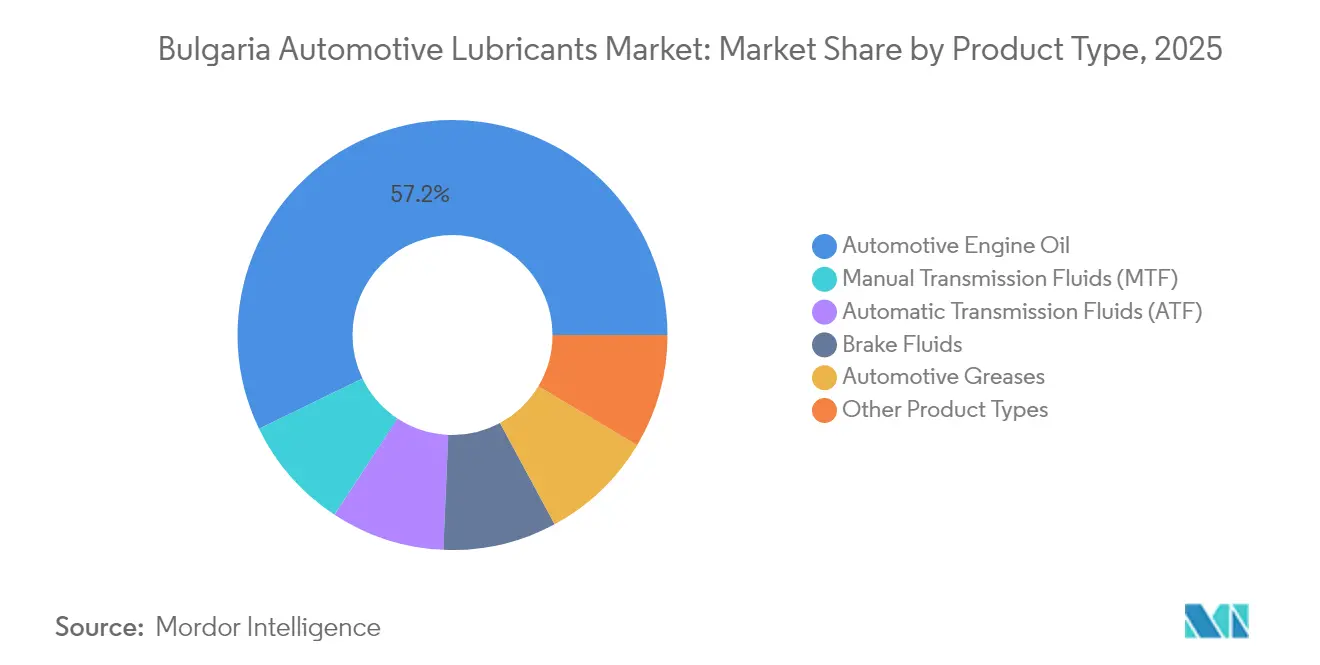
- By product type, engine oil led the Bulgarian automotive lubricants market with a 57.18% share in 2025, whereas automatic transmission fluids were projected to record the fastest growth at a 3.29% CAGR through 2031.
- By vehicle type, passenger vehicles accounted for 58.78% of the Bulgarian automotive lubricants market size in 2025, while commercial vehicles posted the highest 3.34% CAGR during the forecast period.
Note: Market size and forecast figures in this report are generated using Mordor Intelligence’s proprietary estimation framework, updated with the latest available data and insights as of 2026.
Bulgaria Automotive Lubricants Market Trends and Insights
Drivers Impact Analysis*
| Drivers | (~) % Impact on CAGR Forecast | Geographic Relevance | Impact Timeline |
|---|---|---|---|
| Ageing passenger-car parc and longer drain intervals | +0.8% | Sofia, Plovdiv metros and national fleet | Medium term (2-4 years) |
| Post-COVID freight boom in EU–Balkan corridor | +1.2% | National; spillover to Romania, Serbia, Greece | Short term (≤ 2 years) |
| EU Euro 7 low-viscosity compliance push | +0.6% | EU-wide with early adoption in commercial fleet | Long term (≥ 4 years) |
| Growing online DIY motor-oil culture | +0.4% | Urban centers, expanding to rural via e-commerce | Medium term (2-4 years) |
| Bio-based additive breakthroughs | +0.3% | EU regulatory space; Bulgaria rollout 2025-2027 | Long term (≥ 4 years) |
| Source: Mordor Intelligence | |||
Ageing Passenger-Car Parc and Longer Drain Intervals
The average Bulgarian passenger car typically operates well beyond its recommended retirement age, so owners prioritize cost-effective maintenance over vehicle replacement. Synthetics that allow service intervals of 15,000 km or more are gaining popularity; however, harsh stop-and-go city traffic often necessitates earlier oil changes. Higher-quality formulations, therefore, move in greater volumes per service, offsetting any downward effect from reduced workshop visits.
Post-COVID Freight Boom in EU–Balkan Corridor
Bulgarian heavy-goods vehicles now average 129,500 km annually, with cross-trade trips above 1,000 km[1]Eurostat, “Road freight transport by journey characteristics,” ec.europa.eu. Long-haul intensity demands multigrade engine oils and transmission fluids that meet a diverse slate of ACEA and OEM approvals, favoring brands with Europe-wide recognition. The freight surge lifts the Bulgarian automotive lubricants market through elevated drain frequency and higher average fill volumes.
EU Euro 7 Low-Viscosity Compliance Push
Euro 7 introduces crankcase emission monitoring down to 10 nm particles and extends durability targets to 160,000 km[2]Official Journal of the European Union, “Regulation (EU) 2024/1257 (Euro 7),” eur-lex.europa.eu. Lubricants must meet OEM specifications under real-world driving emissions tests, thereby elevating demand for low-viscosity 0W-20 and 0W-30 grades with robust antioxidant and antiwear packages. Suppliers that document sensor compatibility and particulate-filter protection gain a competitive edge in the Bulgarian automotive lubricants market.
Growing Online DIY Motor-Oil Culture
E-commerce platforms deliver wider choice and competitive pricing, encouraging motorists to perform basic oil changes at home. Instructional content improves product-selection accuracy, expanding premium-grade uptake beyond large cities. However, vendors must reinforce usage guidance to avoid warranty conflicts, particularly as Euro 7 rolls out.
Restraints Impact Analysis*
| Restraints | (~) % Impact on CAGR Forecast | Geographic Relevance | Impact Timeline |
|---|---|---|---|
| Accelerating BEV adoption in Sofia and Plovdiv | –0.4% | Urban charging-infrastructure hubs | Medium term (2-4 years) |
| Shrinking two-wheeler parc | –0.2% | National, acute in cities | Short term (≤ 2 years) |
| Surge in counterfeit lubricants via gray imports | –0.3% | Border regions, price-sensitive buyers | Short term (≤ 2 years) |
| Source: Mordor Intelligence | |||
Accelerating BEV Adoption in Sofia and Plovdiv
Battery-electric vehicle registrations declined in 2024, yet policy grants and charger rollouts in major cities indicate potential future volume gains. While the immediate impact on the Bulgarian automotive lubricants market is small, drivetrain electrification is gradually eroding demand for engine oils, shifting the focus toward e-axle gear oils, thermal-management fluids, and brake fluids compatible with regenerative systems.
Shrinking Two-Wheeler Parc
Urban modal shifts toward more comfortable passenger cars and improved public transit are reducing motorcycle registrations. Although two-wheelers consume modest lubricant volumes, their decline marginally restrains market growth.
*Our forecasts treat driver/restraint impacts as directional, not additive. The impact forecasts reflect baseline growth, mix effects, and variable interactions.
Segment Analysis
By Product Type: Engine Oil Dominance Drives Volume Growth
Automotive engine oil captured 57.18% of the Bulgarian automotive lubricants market share in 2025, a level sustained by dense freight traffic and an aged passenger-car fleet. Demand concentrates in multigrade SAE 10W-40 and 5W-30 synthetics that satisfy mixed fleets spanning Euro 3 to Euro 6 emission tiers. Automatic transmission fluids are expected to advance at a 3.29% CAGR, reflecting the rising consumer preference for automatic gearboxes and the shift in technology to eight- and ten-speed units that require specialist friction modifiers.
Synthetic and semi-synthetic blends continue to displace mineral formulations as Euro 7 promotes low-viscosity oils for fuel economy gains. Brake-fluid uptake benefits from the mandatory fitment of ABS and ESC, while power-steering fluid volumes decrease as electric steering systems proliferate. Niche greases for chassis and wheel bearings post stable gains tied to fleet expansion rather than technological change. Suppliers with broad ACEA C-grade portfolios and multipack SKUs retain an edge across Bulgaria’s fragmented retail landscape.



By Vehicle Type: Commercial Segment Accelerates Growth
Passenger cars accounted for 58.78% of the Bulgarian automotive lubricants market volume in 2025, driven by growth in new registrations and the dominance of ICE powertrains. Commercial vehicles, however, are poised for a faster 3.34% CAGR through 2031, as cross-trade heavy trucks average more than 129,000 km each year. High utilization rates result in shorter drain intervals and increased per-vehicle consumption of heavy-duty engine oils and driveline fluids.
Two-wheeler lubricant demand is under pressure from declining registrations, though rural delivery and agricultural niches sustain limited volumes. Future segment growth hinges on extended-drain synthetic penetration among light-duty vans and the introduction of Euro VI-E heavy-duty oil specifications, which emphasize lower sulfated ash and phosphorus levels to protect after-treatment devices.

Geography Analysis
Sofia accounts for the largest share of passenger-vehicle lubricant purchases, supported by higher household incomes and a dense network of service stations. Burgas anchors supply security through the Neftohim refinery, allowing consistent availability of both mineral and synthetic grades. Cross-border corridors with Romania, Serbia, and Greece generate continuous demand for heavy-duty lubricants that meet multiple OEM approvals, reinforcing the importance of pan-European brands in the Bulgarian automotive lubricants market.
Coastal regions combine maritime freight, tourism, vehicle traffic, and agricultural machinery, creating a diverse product mix profile. Mountainous areas impose extreme temperature swings and steep gradients, which favor premium multigrade synthetics with enhanced thermal stability. Border districts are grappling with counterfeit inflows, which lead to regional sales spikes for lower-priced, unverified products and prompt licensed distributors to intensify their education efforts.
EU cohesion fund road upgrade projects and Recovery and Resilience Plan financing will widen highways and logistics hubs, indirectly increasing lubricant volumes by stimulating commercial vehicle traffic. Nevertheless, uneven enforcement of waste-oil collection targets limits re-refined base-oil availability outside major cities, requiring brands to truck products back to centralized facilities for recycling.
Regulatory Landscape
Bulgaria automotive lubricants suppliers operate under EU chemicals and product-safety rules alongside national petroleum-product controls. For chemical substances and mixtures used in finished lubricants (base oils, additives, and packages), compliance follows EU REACH and CLP, with the Ministry of Environment and Water acting as the competent authority and enforcement aligned with European Chemicals Agency (ECHA) processes.
On the fuels and petroleum-products side, economic operators involved in handling and trading petroleum products must register under the Act on Administrative Regulation of Economic Activities related to crude oil and petroleum products, overseen by the Ministry of Economy and Industry. Standardization for petroleum products, lubricants, and additives is coordinated through the Bulgarian Institute for Standardization (BDS) via TC 67, which mirrors ISO/CEN frameworks, shaping how marketers document conformity and communicate product performance and quality to fleets, workshops, and retailers.
Value Chain Analysis
The value chain starts with base oil and additive procurement. Domestic petroleum infrastructure centered on Burgas (Neftohim) supports availability of hydrocarbon feedstock, while local blending is anchored by players such as Prista Oil Holding. Import flows complement domestic blending, especially for premium synthetics and OEM-approved fluids where additive systems and approvals are critical, while compliance-related obligations tied to oil-derived product stocks add working-capital and warehousing requirements for certain market participants.
Route-to-market is split between B2B fleet and workshop channels and fragmented retail and e-commerce, with authorized distributor networks playing a central role in brand reach and authenticity control. Omnicar BG distributing ExxonMobil products and Trans Oil 2008 Ltd distributing Eni products illustrate how distributor coverage supports both sales and compliance. Trade associations also support compliance monitoring and market discipline. Adjacent consumables such as SCR fluids intersect with lubricants through quality enforcement, and bodies such as the Bulgarian Association of Manufacturers and Importers of AdBlue (BAMIA) promote ISO 22241 alignment, reinforcing the broader shift toward specification-led purchasing in Bulgaria's service market.
Competitive Landscape
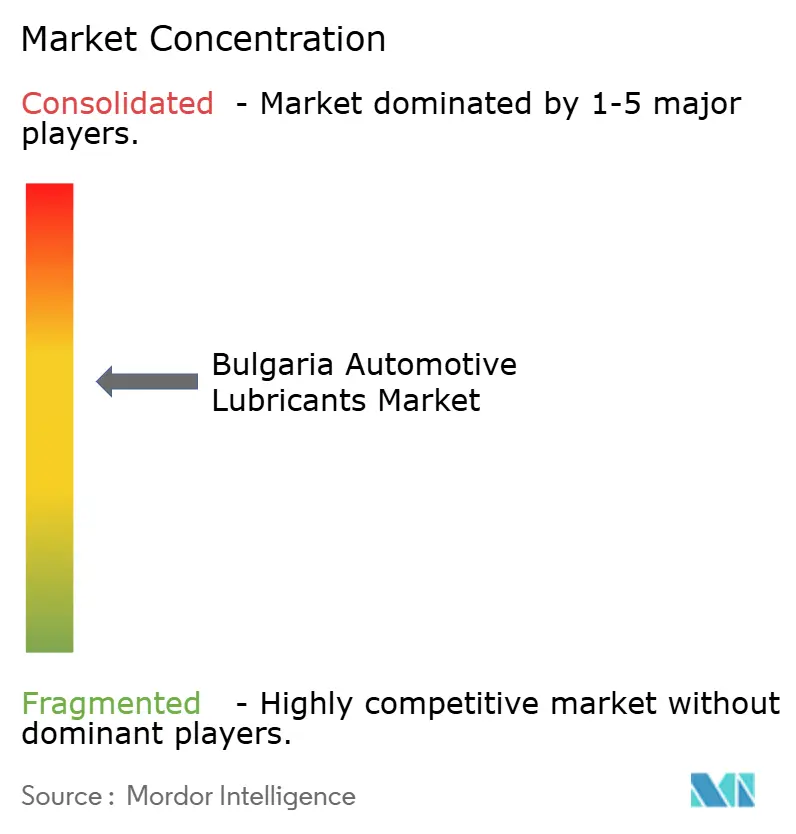
The Bulgarian automotive lubricants market is moderately consolidated. OMV employs a supply-chain security narrative, leveraging three regional refineries and robust warehousing to ensure delivery even during geopolitical disruptions. Across all tiers, firms invest in QR-based authenticity labels, e-commerce storefronts, and lubricant-condition monitoring as value-added services. Sustainability orientation now shapes competitive positioning. Brands capable of meeting EU-mandated 25% bio-carbon thresholds and supplying recycled-content packaging stand to gain shelf preference in major chains. Technical support for fleet Euro 7 compliance, coupled with countrywide used-oil take-back programs, further differentiates market leaders in Bulgaria’s environmentally evolving supply environment.
Bulgaria Automotive Lubricants Industry Leaders
Prista Oil
Shell plc
TotalEnergies
Exxon Mobil Corporation
Lukoil
- *Disclaimer: Major Players sorted in no particular order

Market Opportunities and Future Outlook
A near-term opportunity is tied to specification upgrades linked to Euro 7 (Regulation (EU) 2024/1257) and fleet compliance preparation. Workshops and fleets increasingly move toward low-viscosity, additive-rich engine oils and higher-performance driveline fluids. This creates room for suppliers that can document ACEA and OEM approvals consistently across mixed-age fleets and provide technical support for real-world emissions durability requirements, including particulate-filter and sensor compatibility, particularly in long-haul commercial operations where higher annual mileage increases the value of verified performance.
Supply security and channel control are also becoming differentiators, supporting opportunities for local blending, packaging, and tighter distributor governance. In 2026, Bulgaria maintained active oversight of Lukoil Neftohim Burgas through changes to the special commercial administrator, and the Commission for the Protection of Competition proposed a permanent fuel market task force under the Council of Ministers to monitor supply chain conditions. That focus keeps attention on storage continuity planning and traceability. Alongside this, online DIY purchasing and counterfeit pressure raise demand for authenticity tooling and controlled e-commerce storefronts, while used-oil collection gaps outside major cities leave room for programs that connect branded sales with take-back and compliance services.
Recent Industry Developments
- July 2026: TotalEnergies highlighted official OEM approvals across its Rubia and Agri lubricant ranges, aligning product positioning with stricter verification needs referenced in May 2026 VLS guideline updates. The communication supports a compliance-first buying cycle for high-utilization fleets and off-highway users, raising the bar for suppliers competing on documented approvals rather than price-only offers.
- April 2025: Shell signed a contract with the Bulgarian government to explore for oil and gas in the 4,000 sq km Block 1-26 Khan Tervel area in the Black Sea. The agreement signals longer-horizon interest in Bulgaria's upstream energy base, which can influence perceptions of local supply resilience and downstream brand presence across fuels and lubricants channels.
- June 2024: TotalEnergies Lubrifiants and Inter Cars Capital Group extended their long-term strategic partnership for an additional five years. The renewal strengthens multi-country distribution through an established automotive parts network, supporting availability of branded lubricants in workshops and retail points tied to service and parts ecosystems.


Research Methodology Framework and Report Scope
Market Definition and Coverage
For this methodology, the market covers automotive lubricants sold for use in on-road vehicles in Bulgaria, measured as the total lubricant volume consumed in the country across routine servicing and top-ups.
Scope exclusions: This sizing excludes industrial lubricants, marine lubricants, and fluids used only in off-road machinery that is not part of the on-road vehicle parc.
Segmentation Overview
- By Product Type
- Automotive Engine Oil
- 0W-XX
- 5W-XX
- 10W-XX
- 15W-XX
- Monogrades
- Other Grades
- Manual Transmission Fluids (MTF)
- Automatic Transmission Fluids (ATF)
- Brake Fluids
- Automotive Greases
- Other Product Types (Power Steering Fluid etc.)
- Automotive Engine Oil
- By Vehicle Type
- Passenger Vehicles
- Commercial Vehicles
- Two-Wheelers
Data Sources, Market Sizing, and Validation
Desk Research
Desk work starts by building the demand pool and the operating context for vehicle maintenance in Bulgaria, and then aligning it with lubricant usage patterns. We rely on public sources such as the National Statistical Institute of Bulgaria, Eurostat transport and trade tables, and customs import and export reporting, which help ground vehicle activity and lubricant movement over time.
To translate activity into lubricant demand, we also refer to sources such as ACEA parc and fleet indicators, and EEA emissions and fuel-related reporting that signals maintenance intensity. Technical literature and standards references are used to explain drain intervals and how viscosity grades are used in European fleets. Company annual reports, investor materials, and reputable press articles are used to sense-check channel shifts and product mix changes, while a paid subscription for company financials and a shipment level trade database are used selectively to confirm the direction of volumes and pricing ranges. These desk sources are illustrative only, and many other public references were consulted to collect data, validate assumptions, and clarify open questions.
Primary Interviews and Surveys
We conduct interviews and surveys in Bulgaria with lubricant distributors, service operators, fleet managers, vehicle dealers, and technical specialists. Their feedback helps clarify vehicle use, drain intervals, product mix, channel margins, and price movement. It also fills gaps in public data and supports the review of assumptions before sign-off.
Distribution of primary research fieldwork respondents
| Company type | Respondent position |
|---|---|
| Top tier: 29% | CXOs: 15% |
| Mid tier: 46% | Functional/Unit leaders: 34% |
| Smaller Players: 25% | Managers: 51% |
Market-Sizing & Forecasting
Sizing follows a top-down and bottom-up logic that is kept practical for a country market. On the top-down side, we reconstruct lubricant demand from the vehicle parc and annual usage, where parc by vehicle class is combined with average oil fill size, drain interval behavior, and estimated annual kilometers to reach total liters consumed.
To keep the model realistic, a few indicators are tracked as ongoing inputs, such as the age profile of the vehicle fleet, workshop service frequency, the share of synthetic and semi-synthetic oils in regular maintenance, and the mix shift between gasoline and diesel that affects viscosity and drain practices. We also reflect import intensity and channel changes (for example, workshop versus retail pulls) to avoid overstating consumption when stock movements occur.
Forecasts are built using scenario analysis that links fleet growth and aging, service intensity, and expected product mix upgrades to year-by-year volume changes. The results are then corroborated with selective bottom-up checks such as sampled price-per-liter ranges by product grade, distributor throughput conversations, and a limited roll-up of visible supplier activity. Where data is missing, the gap is handled through conservative penetration assumptions that are rechecked with interview feedback.
Data Validation & Update Cycle
Outputs are validated through multiple checks before sign-off. We compare model totals against independent signals like trade flows, reported lubricant production or sales cues where available, and workshop level servicing indicators, and then we investigate any sharp breaks that do not match fleet or maintenance realities.
A second analyst review is applied to key assumptions such as drain intervals, price progression, and product mix shifts, and re-contacts are triggered when the variance to external signals is material. Reports are refreshed annually, with interim updates when major events affect prices, trade, or fleet trends, and a final pre-delivery pass is done so clients receive the latest updated view.
Mordor Intelligence's Bulgaria Automotive Lubricants Market Size Versus Other Published Estimates
Published market sizes for Bulgaria automotive lubricants can differ even when the topic sounds similar, because the unit of measure, the boundary between automotive and total lubricants, and the timing used for prices and currency conversion are not handled in the same way.
The biggest gaps usually come from mixing value and volume without a clear bridge, or from using one average price for all lubricant types even when synthetic share and viscosity mix are changing. In this study, the volume base is kept stable, then value is derived using refreshed price-per-liter ladders and current-year currency timing. That output is cross-checked against trade and channel signals before finalizing the number, a cadence choice applied by Mordor Intelligence.
Benchmark comparison
| Source | Market Size | Gaps in Research Methodology |
|---|---|---|
| Mordor Intelligence | USD 29.80 M (2025) | |
| Trade Journal A | USD 36.20 M (2025) | Often reports a wider motor lubricants total that can include adjacent non-automotive lubricant uses, and it may apply a single blended price across grades, which can inflate value when the mix is shifting. |
| Regional Consultancy B | USD 24.10 M (2024) | Uses an earlier pricing window and exchange rate timing, and it can understate recent price-per-liter movement if inflation-linked adjustments and channel markups are not refreshed close to the current year. |
The spread in published values is mostly explained by how price timing, currency conversion, and what is counted as automotive are treated. By keeping the demand pool tied to the vehicle parc and service behavior first, and then layering a transparent price ladder check, we get a number that is easier to replicate and stress-test.


Key Questions Answered in the Report
What is the current volume of lubricants sold for vehicles in Bulgaria?
The Bulgarian automotive lubricants market size is 30.73 million liters in 2026.
How fast will demand grow over the next five years?
Total volume is forecast to post a 3.12% CAGR, reaching 35.8 million liters by 2031.
Which product category dominates domestic sales?
Engine oil accounts for 57.18% of the overall volume, largely due to an older fleet of ICE-heavy vehicles.
Why are commercial vehicles the fastest-growing segment?
Post-COVID freight expansion pushes heavy trucks to average 129,500 km annually, lifting lubricant change frequency.
How will Euro 7 regulations affect lubricant specifications?
Euro 7 drives the adoption of low-viscosity synthetics with advanced additive systems to meet tighter crankcase emission limits.
Page last updated on:


 Your data is secure and never sold or shared.


