
Building Retrofit and Modernization Market Size and Share
Market Overview
| Study Period | 2021 - 2032 |
|---|---|
| Market Size (2027) | USD 119.59 Billion |
| Market Size (2032) | USD 170.64 Billion |
| Growth Rate (2027 - 2032) | 7.37 % |
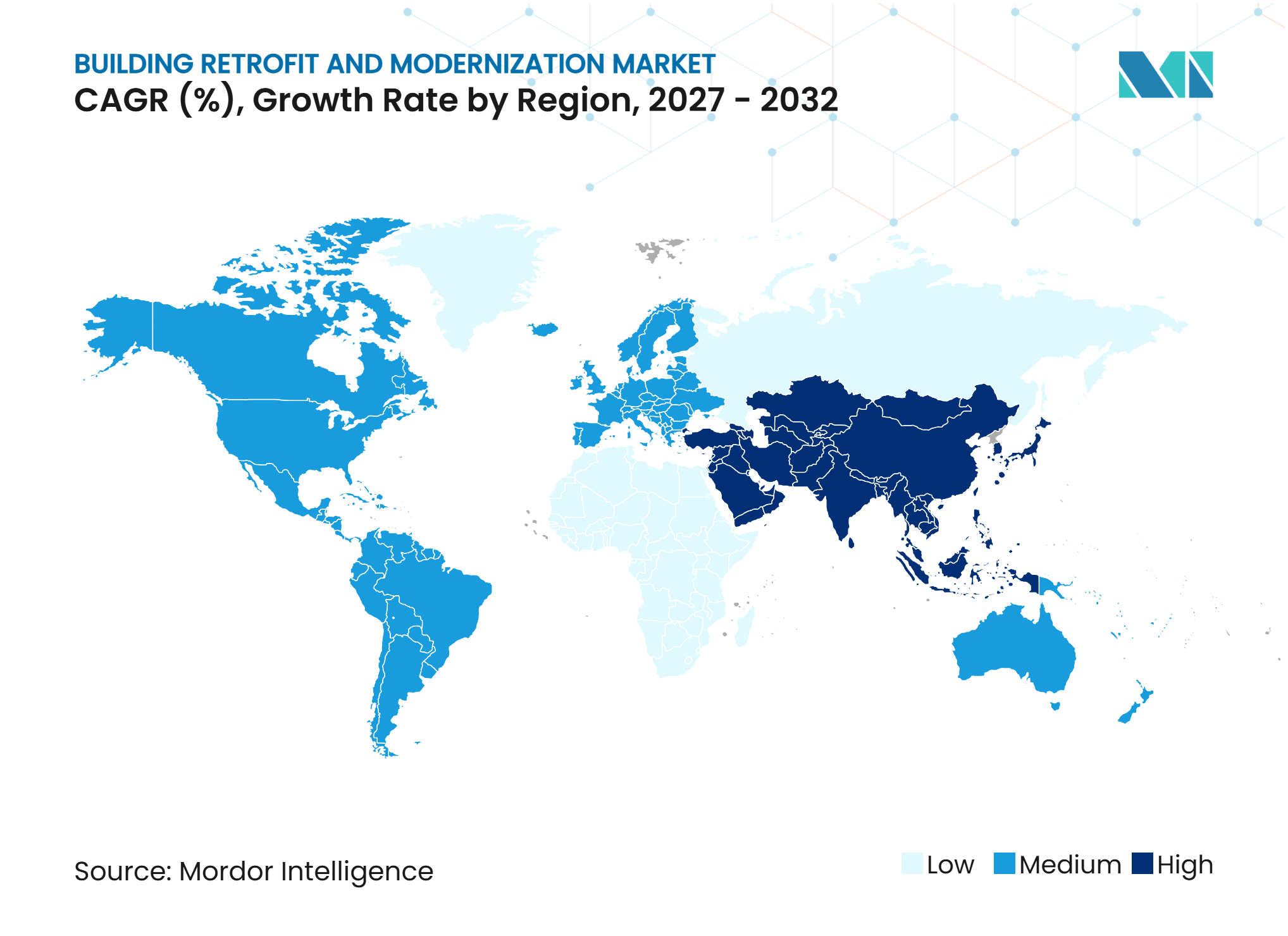
| Fastest Growing Market | Asia-Pacific |
| Largest Market | North America |
| Market Concentration | Medium |
Major Players *Disclaimer: Major Players sorted in no particular order Image © Mordor Intelligence. Reuse requires attribution under CC BY 4.0. | |
Building Retrofit and Modernization Market Analysis by Mordor Intelligence
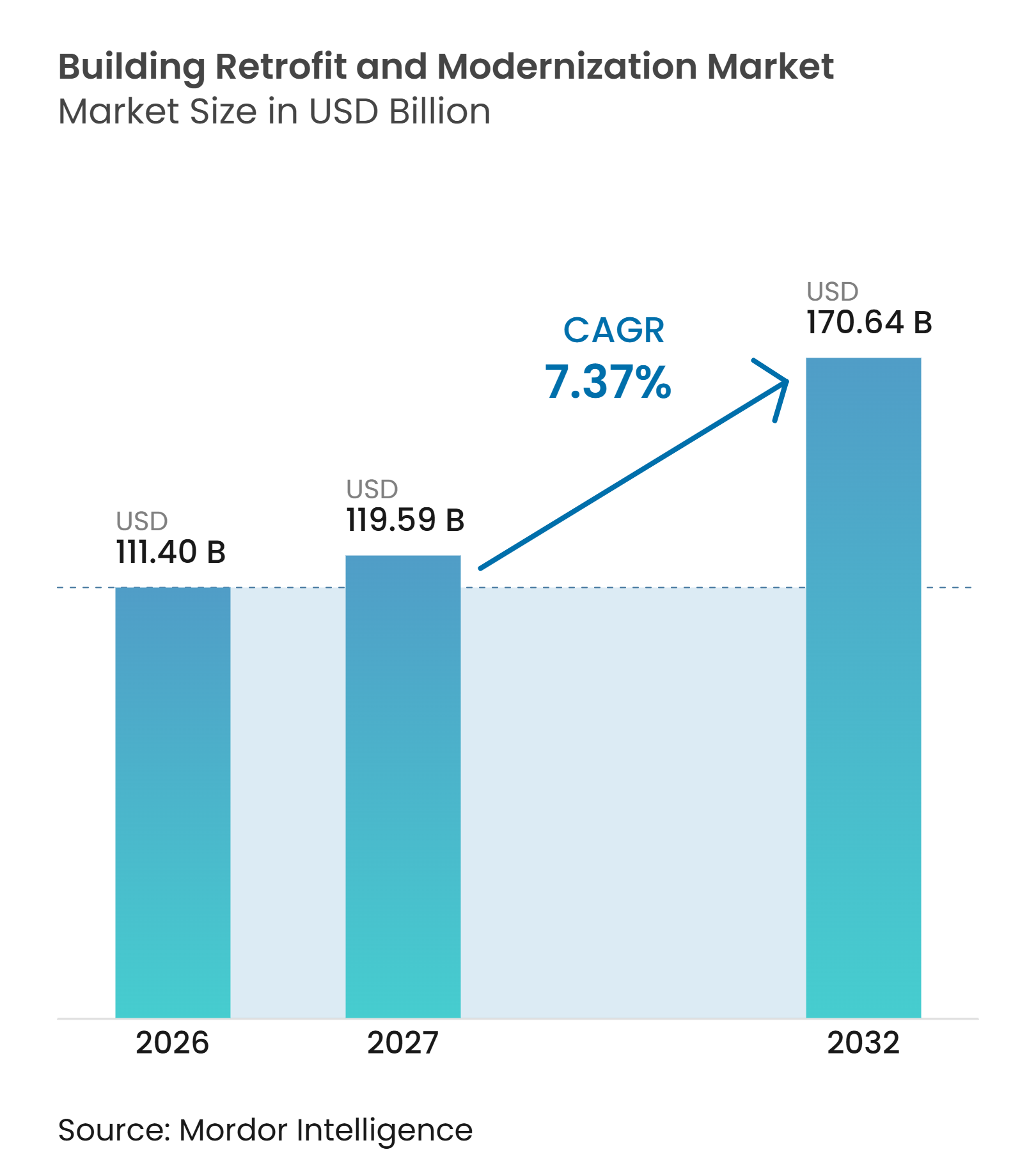
The Building Retrofit And Modernization Market size is projected to be USD 111.40 billion in 2026, USD 119.59 billion in 2027, and reach USD 170.64 billion by 2032, growing at a CAGR of 7.37% from 2027 to 2032.
Regulatory requirements are shifting from discretionary projects to compliance work in many major markets. Owners are also responding to older building systems, higher operating costs, and a need to keep buildings functional during extreme weather events. At the same time, lenders, investors, tenants, and public agencies increasingly expect more reliable energy data and clearer plans for asset improvement. This favors projects that combine heating, ventilation, and air conditioning upgrades with controls, insulation, and energy management. Service providers that can arrange financing and guarantee results have an advantage because they reduce risk for property owners, simplify procurement decisions, and provide a practical link between technical design, project delivery, and measured operating performance after installation. The Building Retrofit and Modernization Market also benefits from office conversions and public-sector upgrades, which broaden demand beyond routine energy work and create work for contractors, engineers, systems suppliers, and firms that specialize in building operations for public and private owners.
Key Report Takeaways
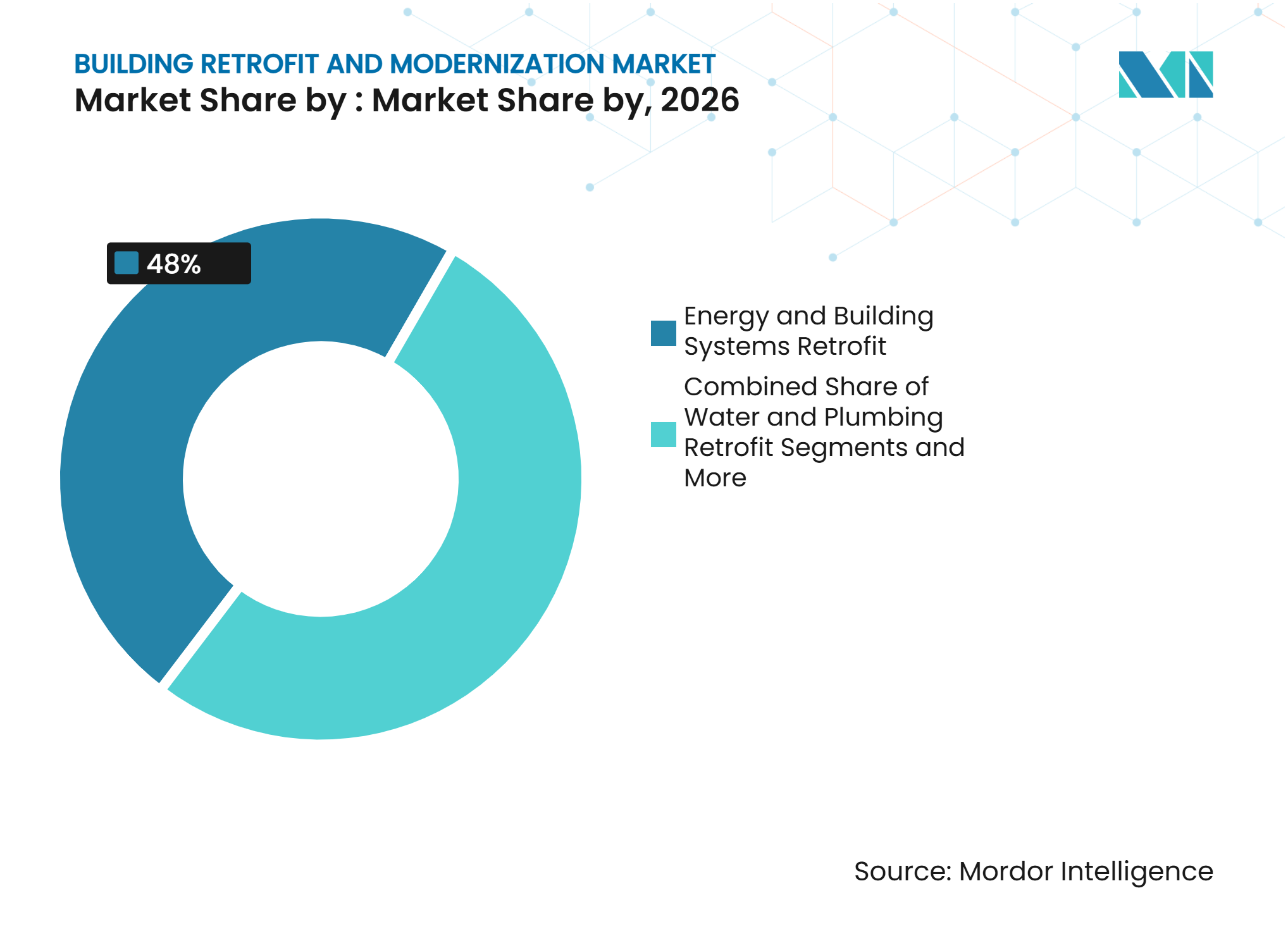
- By retrofit category, Energy and Building Systems Retrofit held 48.0% of the Building Retrofit and Modernization Market share in 2026 and is projected to expand at an 8.10% CAGR through 2032.
- By building type, Commercial Offices and Retail held 36.0% of the Building Retrofit and Modernization Market size in 2026, while Institutional and Public Buildings are projected to grow at an 8.72% CAGR through 2032.
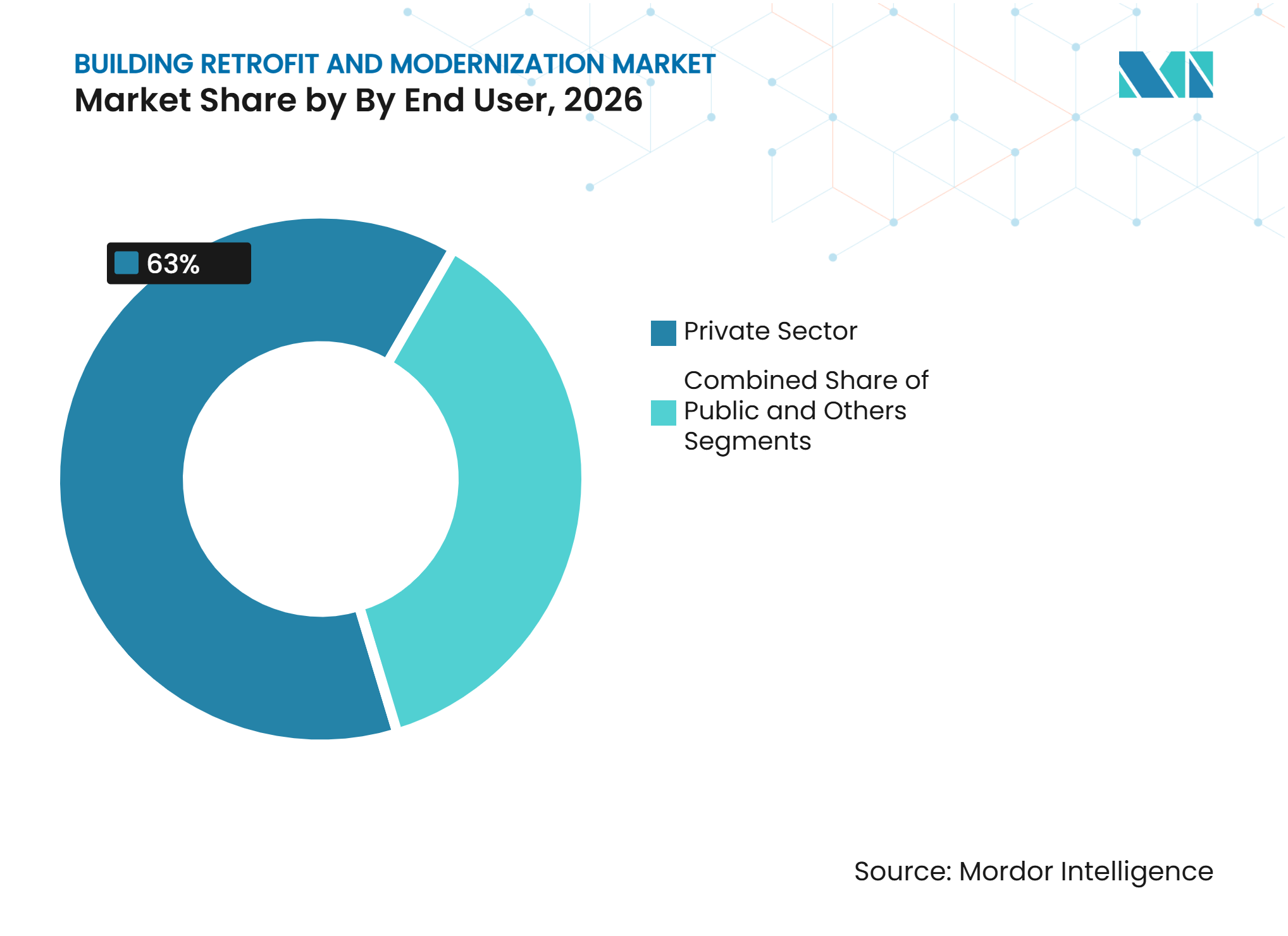
- By end user, the Private Sector held 63.0% of the Building Retrofit and Modernization Market share in 2026, while the Public Sector is projected to grow at an 8.36% CAGR through 2032.
- By geography, North America held 34.0% of the Building Retrofit and Modernization Market size in 2026, while Asia-Pacific is projected to grow at an 8.78% CAGR through 2032.
Note: Market numbers in this report are based on Mordor Intelligence's proprietary estimation framework, which combines nine months of actuals with Q4 projections for base year 2026.
Market Trends and Insights
Drivers Impact Analysis of Building Retrofit and Modernization Market*
| Drivers | (~) % Impact on CAGR Forecast | Geographic Relevance | Impact Timeline |
|---|---|---|---|
| Building Decarbonization Mandates | +2.5% | Global, especially the European Union, North America, Japan, and South Korea | Short term (≤ 2 years) |
| Aging Building Stock and Obsolescence | +1.8% | Global, with mature building stock in North America, Europe, and Northeast Asia | Long term (≥ 4 years) |
| Energy-Cost Reduction Pressure | +1.5% | Global, especially Asia-Pacific and Southern Europe | Medium term (2-4 years) |
| Resilience and Code-Upgrade Requirements | +1.0% | North America, core Asia-Pacific markets, and Middle East and Africa | Medium term (2-4 years) |
| Institutional ESG and Disclosure Requirements | +0.8% | North America, the European Union, and core Asia-Pacific markets | Short term (≤ 2 years) |
| Repurposing Underused Commercial Assets | +0.6% | North America, Western Europe, and Australia | Medium term (2-4 years) |
| Source: Mordor Intelligence | |||
Building Decarbonization Mandates Accelerate the Retrofit Imperative
The European Union's recast Energy Performance of Buildings Directive entered into force in 2024 and must be incorporated into national law by May 2026[1]. Member States must address the worst-performing 16% of nonresidential buildings by 2030, rising to 26% by 2033 under minimum energy performance standards. Renovation passports create a structured plan for staged upgrades and can support longer project pipelines for contractors. California’s 2025 Energy Code took effect in January 2026 and is expected to deliver USD 5 billion in cumulative energy savings over 30 years[2]. These rules make retrofit investment a compliance requirement for more owners and support steady project activity.
Aging Building Stock and Obsolescence Create a Structural Demand Floor
Older buildings need upgrades because their systems often do not meet current energy, safety, or operating requirements. The United Nations Environment Program identifies renovation rates as too low for international climate goals[3]. The Building Retrofit and Modernization Market therefore includes work on building systems, façades, insulation, plumbing, and safety features rather than energy equipment alone. Obsolescence can affect a building’s function, compliance position, and ability to retain tenants at the same time. This supports demand for modernization work even when owners are not responding to a single new rule. Owners also have to consider equipment reliability, tenant expectations, and the cost of deferring maintenance when setting their upgrade plans.
Energy-Cost Reduction Pressure Shifts Retrofit from Capital Spending to Operations Strategy
Energy costs are making retrofit decisions more closely tied to daily operating performance. Energy service companies, or ESCOs, are making retrofit decisions more closely tied to daily operating performance. An ESCO can design, finance, and operate an upgrade, then recover its fee from verified savings. This structure can help owners manage initial costs while improving the economics of heating, cooling, controls, and lighting projects. It also makes the project outcome easier to assess because contract terms link payment to documented results. The approach allows the Building Retrofit and Modernization Market to reach owners that may otherwise defer deep upgrades. It can also align the interests of technical providers and owners because both parties depend on a project that performs as planned.
Resilience and Code-Upgrade Requirements Broaden the Retrofit Scope
Resilience upgrades help buildings remain functional during severe weather, grid disruption, and other shocks. New Jersey launched the RETROFIT NJ program in 2025 to support large commercial, industrial, and institutional efficiency and decarbonization projects, with grants from USD 2.5 million to USD 12.5 million per project. Such programs can combine heating, ventilation, air conditioning, electrical, and envelope work in a single scope. Compliance requirements may also push owners to install monitoring and management systems that improve operating resilience. The broader scope increases the value of firms that can coordinate several building systems without interrupting normal use.
Restraints Impact Analysis of Building Retrofit and Modernization Market*
| Restraints | (~) % Impact on CAGR Forecast | Geographic Relevance | Impact Timeline |
|---|---|---|---|
| High Upfront Capital Requirements | -1.5% | Global, especially small and mid-sized owners in emerging markets and areas without incentives | Long term (≥ 4 years) |
| Disruption to Occupied Buildings | -0.6% | Global, especially occupied commercial and healthcare assets | Medium term (2-4 years) |
| Uncertain Payback in Low-Cost Energy Markets | -0.4% | Middle East and North Africa, parts of South America, and Southeast Asia | Long term (≥ 4 years) |
| Hidden Conditions in Existing Structures | -0.3% | Global, especially older buildings in North America and Europe | Medium term (2-4 years) |
| Source: Mordor Intelligence | |||
High Upfront Capital Requirements Constrain Market Scaling
High initial costs remain a major barrier when projects require several systems to be replaced at once. A 2025 peer-reviewed review identified upfront cost, limited financing, and uncertain returns as leading barriers to building decarbonization across building types and locations. Commercial Property Assessed Clean Energy, or C-PACE, financing in the United States reached USD 1.56 billion in originations during the first half of 2026. The European Commission states that EU member states estimate annual building-sector investment needs of more than USD 266.2 billion through 2030. Financing tools are expanding, but many owners still face a gap between available capital and the cost of comprehensive work.
Disruption to Occupied Buildings Limits Deep-Retrofit Throughput
Building work can interrupt tenants, patients, staff, and customers when systems must remain in service. The USD 37 million energy-efficiency retrofit at NYC Health + Hospitals/Lincoln Hospital used phased implementation to protect continuous healthcare operations. Heating, ventilation, air conditioning, electrical, and façade work may require night or weekend schedules. The Electric Power Research Institute identifies customer disruption as a key factor in whether commercial retrofit pathways can be scaled. Careful phasing can reduce this issue, but it adds planning, coordination, and delivery costs.
*Our forecasts treat driver/restraint impacts as directional, not additive. The impact forecasts reflect baseline growth, mix effects, and variable interactions.
Building Retrofit and Modernization Market Segment Analysis
By Retrofit Category:
Energy and Building Systems Retrofit Leads Current DemandEnergy and Building Systems Retrofit held 48.0% of the Building Retrofit and Modernization Market share in 2026. The category covers heating, ventilation, and air conditioning equipment, smart controls, lighting, and renewable-energy connections. It leads because savings can be measured against a building’s prior energy use, making the investment case easier to assess. Owners can also use these systems to meet energy rules and lower operating costs at the same time.
Electrification and digital controls are increasing the scope of this work. The move away from gas-dependent heating systems is increasing interest in electrified equipment and connected controls. Structural and Building Envelope Retrofit is gaining attention where façade and insulation rules tighten. At the same time, Energy and Building Systems Retrofit is also the fastest-growing retrofit category at an 8.10% CAGR through 2032. Water and Plumbing Retrofit, Accessibility and Life-Safety Retrofit, and other work remain necessary for specialized compliance needs. Together, these categories allow providers to expand a project from a basic equipment upgrade into a wider building modernization program. The ability to connect system upgrades with safety, water, and envelope needs gives building owners a more complete path for improving aging assets.



By Building Type:
Commercial Offices and Retail Retain Scale While Public Assets Grow FasterCommercial Offices and Retail held 36.0% of the Building Retrofit and Modernization Market share in 2026. Tenant expectations, energy rules, and demand for lower-carbon leases support upgrades in this segment. Office owners are also responding to changing space needs that require new layouts and building services. These factors keep commercial assets at the center of retrofit activity in major cities.
Institutional and Public Buildings is the fastest-growing building type and is forecast to expand at an 8.72% CAGR through 2032. Spain announced USD 403 million in June 2026 for energy refurbishment of public hospitals, health centers, schools, and public education centers. Large public portfolios allow agencies to group similar projects and use consistent procurement and performance requirements. Residential buildings, industrial facilities, warehouses, and other properties add demand where housing, production, and public programs overlap. Government funding helps this segment move faster because projects can be aggregated across large property portfolios. This aggregation supports standard designs, clearer planning cycles, and broader use of documented performance requirements. Public owners can also set common standards for equipment, monitoring, and maintenance across several sites.
By End User:
Private-Sector Owners Lead Demand While Public Spending Speeds UpPrivate-sector users held 63.0% of the Building Retrofit and Modernization Market share in 2026. Corporate reporting requirements, tenant needs, and energy performance contracts all encourage private owners to upgrade existing assets. ESCOs are important because they can connect technical upgrades to savings guarantees and financing structures. This gives portfolio owners a way to address several properties through a consistent delivery model.
The Public Sector is forecast to grow at an 8.36% CAGR through 2032. Public agencies are increasing work on schools, hospitals, offices, and other buildings where energy costs and service continuity are important. Other end users include housing associations, public-private partnerships, and nonprofit property portfolios. Blended finance may allow these ownership structures to undertake projects that do not fit standard ESCO contracts. Public procurement can also give smaller suppliers a route into large modernization programs through specialist delivery roles. The use of common reporting requirements may improve comparison of savings across these portfolios. It can also help public and mixed-ownership organizations prepare future upgrade programs using the operational results of earlier work.

Geography Analysis
North America
North America held 34.0% of the Building Retrofit and Modernization Market share in 2026. The region has building rules at municipal, state, provincial, and federal levels, which supports a deep pipeline of compliance projects. California’s 2025 Energy Code took effect in January 2026 and covers efficiency improvements in major renovations. The market also benefits from mature ESCO and Energy Savings Performance Contract structures, which can cover portfolios of public facilities. Energy Star and Leadership in Energy and Environmental Design, or LEED, certifications influence public procurement and private investment decisions.
Asia-Pacific
Asia-Pacific is forecast to grow at an 8.78% CAGR in the Building Retrofit and Modernization Market through 2032. Policy mandates, older office assets, and growing electricity needs are supporting demand across China, Japan, India, South Korea, and Southeast Asia. China’s green-building rules and its existing-building renovation targets support large domestic project volumes. South Korea’s zero-energy requirements for public buildings add another compliance factor. The region is creating opportunities for controls, heat pumps, building analytics, and energy-management services.
Europe, South America, and Middle East and Africa
Europe’s regulatory framework continues to support a large renovation pipeline. Draft National Building Renovation Plans submitted by European Union member states between December 2025 and May 2026 include annual renovation targets ranging from 0.7% to 5.7% of national building stock. In South America, the provinces of Santa Fe and Córdoba signed agreements in 2026 for hospital, school, and airport renovations targeting energy reductions of 40% to 53%. Middle East and Africa markets are smaller but have project-level potential as energy efficiency becomes tied to operating costs and infrastructure development. These regions may benefit from adapted financing models and technical standards as building regulations mature.
Competitive Landscape
Market Concentration
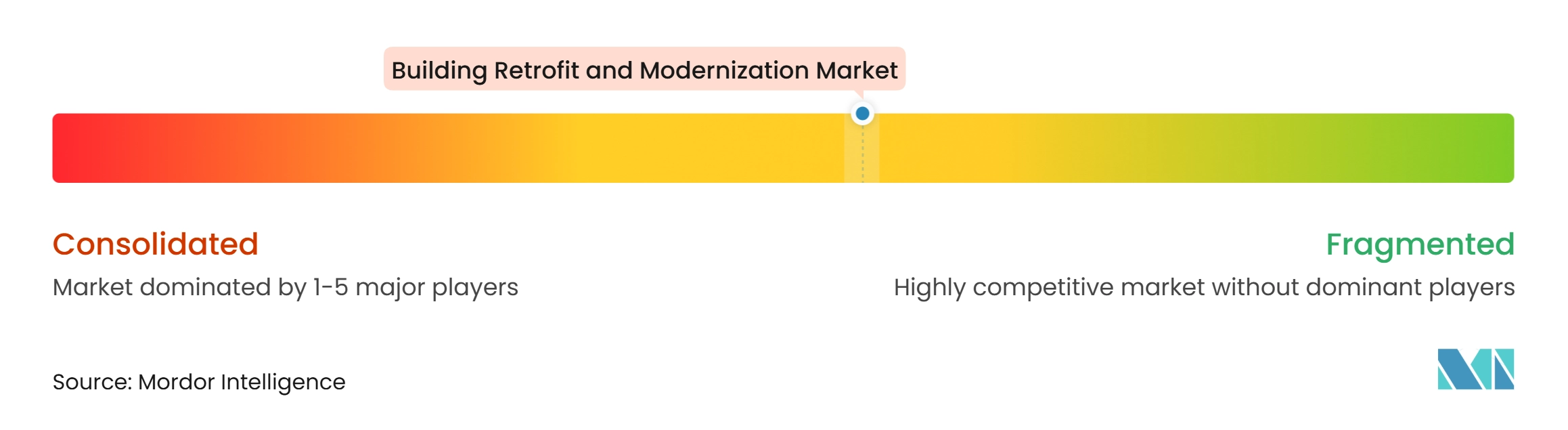
The Building Retrofit and Modernization Market is moderately consolidated among global construction, engineering, building-systems, and energy-service firms, while local execution remains fragmented. VINCI SA, Skanska AB, Bouygues Construction, Turner Construction Company, and STRABAG SE compete through integrated delivery capacity and broad geographic coverage. Ameresco, Inc., Trane Technologies plc, and Johnson Controls International plc add a performance-based model that can extend customer relationships beyond construction work. The result is a market where project execution, financing, and long-term building performance all matter. Firms with the ability to handle several systems together are better positioned for complex projects because owners often prefer a single party that can coordinate design, installation, commissioning, and ongoing service, reduce handoffs between trades, and maintain accountability when a project must protect normal building operations.
Technology is increasingly part of competitive differentiation. Building Information Modeling, or BIM, can improve scope definition and coordination before work starts. Digital twins and artificial intelligence-enabled energy management can help owners plan upgrades and track results after installation. ISO 50001 energy-management systems and EN ISO building-performance standards can favor providers with certified workflows and measurement-and-verification capabilities. These tools help limit delivery risk where upgrades involve controls, cooling, heating, and envelope work in the same building, and they can improve the handover from the construction team to the facilities team when savings depend on continued monitoring and informed operating decisions.
Companies are using acquisitions and specialist platforms to strengthen their position. Trane Technologies deployed USD 1.08 billion in acquisitions through October 2026 to expand its building optimization and heating, ventilation, and air conditioning capabilities. Elevion Group completed its acquisition of Techem Solutions GmbH in September 2026, expanding its contracting capability for energy-transition infrastructure. VINCI Construction also signed an agreement in January 2026 to acquire Fletcher Construction, strengthening its access to New Zealand’s construction and renovation activity. These actions show that scale, technical capability, and local delivery access are central to competition, allowing companies to bring specialized services into a wider project offer without requiring owners to manage several separate providers and supporting local relationships alongside corporate engineering resources and procurement capacity.
Building Retrofit and Modernization Industry Leaders
-
Turner Construction Company
-
Skanska AB
-
VINCI SA
-
Bouygues Construction
-
Kiewit Corporation
- *Disclaimer: Major Players sorted in no particular order
Building Retrofit and Modernization Market Companies Covered in this Report
- Turner Construction Company
- Skanska AB
- VINCI SA
- Bouygues Construction
- Kiewit Corporation
- AECOM
- WSP Global Inc.
- Arcadis NV
- Saint-Gobain S.A.
- Sika AG
- Owens Corning
- Kingspan Group plc
- ROCKWOOL A/S
- ABM Industries Incorporated
- Ameresco, Inc.
- Trane Technologies plc
- Johnson Controls International plc
- Carrier Global Corporation
- Lendlease Group
- STRABAG SE
Recent Industry Developments in Building Retrofit and Modernization Market
- November 2026: PSP Investments signed an agreement to acquire a 50% interest in Enercare Inc., a Canadian provider of essential home and commercial building infrastructure services, from Brookfield and institutional partners for USD 1.17 billion. The transaction expands a leading North American retrofit and home systems servicing platform, with both partners committed to Enercare's geographic and product growth.
- October 2026: Trane Technologies plc raised its full-year 2026 revenue guidance to 13.5% reported growth and 11% organic growth. The company disclosed USD 1.08 billion deployed year-to-date in acquisitions, reinforcing its artificial intelligence-enhanced building optimization and heating, ventilation, and air conditioning modernization strategy.
- September 2026: Elevion Group B.V. completed the acquisition of Techem Solutions GmbH, making Elevion Germany's second-largest heating contracting player for real estate. The combined platform will deliver end-to-end planning, financing, and operation of energy-transition infrastructure for building owners, accelerating Germany's building decarbonization pipeline.
Global Building Retrofit and Modernization Market Report Scope
Segmentation Overview
| Energy and Building Systems Retrofit |
| Structural and Building Envelope Retrofit |
| Water and Plumbing Retrofit |
| Accessibility and Life-Safety Retrofit |
| Others |
| Residential Buildings |
| Commercial Offices and Retail |
| Industrial Facilities and Warehouses |
| Institutional and Public Buildings |
| Others |
| Public |
| Private Sector |
| Others |
| North America | United States |
| Canada | |
| Mexico | |
| South America | Brazil |
| Argentina | |
| Chile | |
| Rest of South America | |
| Europe | United Kingdom |
| Germany | |
| France | |
| Italy | |
| Spain | |
| Russia | |
| Rest of Europe | |
| Asia - Pacific | China |
| India | |
| Japan | |
| South Korea | |
| Australia | |
| Rest of Asia - Pacific | |
| Middle East and Africa | United Arab Emirates |
| Saudi Arabia | |
| South Africa | |
| Nigeria | |
| Rest of Middle East & Africa |
| By Retrofit Category | Energy and Building Systems Retrofit | |
| Structural and Building Envelope Retrofit | ||
| Water and Plumbing Retrofit | ||
| Accessibility and Life-Safety Retrofit | ||
| Others | ||
| By Building Type | Residential Buildings | |
| Commercial Offices and Retail | ||
| Industrial Facilities and Warehouses | ||
| Institutional and Public Buildings | ||
| Others | ||
| By End User | Public | |
| Private Sector | ||
| Others | ||
| By Geography | North America | United States |
| Canada | ||
| Mexico | ||
| South America | Brazil | |
| Argentina | ||
| Chile | ||
| Rest of South America | ||
| Europe | United Kingdom | |
| Germany | ||
| France | ||
| Italy | ||
| Spain | ||
| Russia | ||
| Rest of Europe | ||
| Asia - Pacific | China | |
| India | ||
| Japan | ||
| South Korea | ||
| Australia | ||
| Rest of Asia - Pacific | ||
| Middle East and Africa | United Arab Emirates | |
| Saudi Arabia | ||
| South Africa | ||
| Nigeria | ||
| Rest of Middle East & Africa | ||
Key Questions Answered in the Report
What is the 2026 value of the Building Retrofit and Modernization Market?
The Building Retrofit and Modernization Market is valued at USD 111.40 billion in 2026, is projected at USD 119.59 billion in 2027, and is forecast to reach USD 170.64 billion by 2032 at a 7.37% CAGR.
Which retrofit category has the largest share?
Energy and Building Systems Retrofit leads with a 48.0% share in 2026, supported by demand for heating, ventilation, and air conditioning equipment, controls, and electrification.
Which building type is growing the fastest?
Institutional and Public Buildings are forecast to expand at an 8.72% CAGR through 2032, supported by public funding for schools, hospitals, and government facilities.
Why are building owners investing in modernization?
Key reasons include mandatory energy rules, older systems, operating-cost pressure, resilience needs, and investor disclosure requirements.
Which region is growing the fastest?
Asia-Pacific is projected to grow at an 8.78% CAGR through 2032, supported by policy mandates and modernization needs in large urban building stocks.
How do energy service companies support retrofit projects?
Energy service companies can arrange and deliver upgrades under contracts tied to verified energy savings, helping owners manage upfront cost and performance risk.