
Building Energy Management Systems Market Size and Share
Market Overview
| Study Period | 2022 - 2032 |
|---|---|
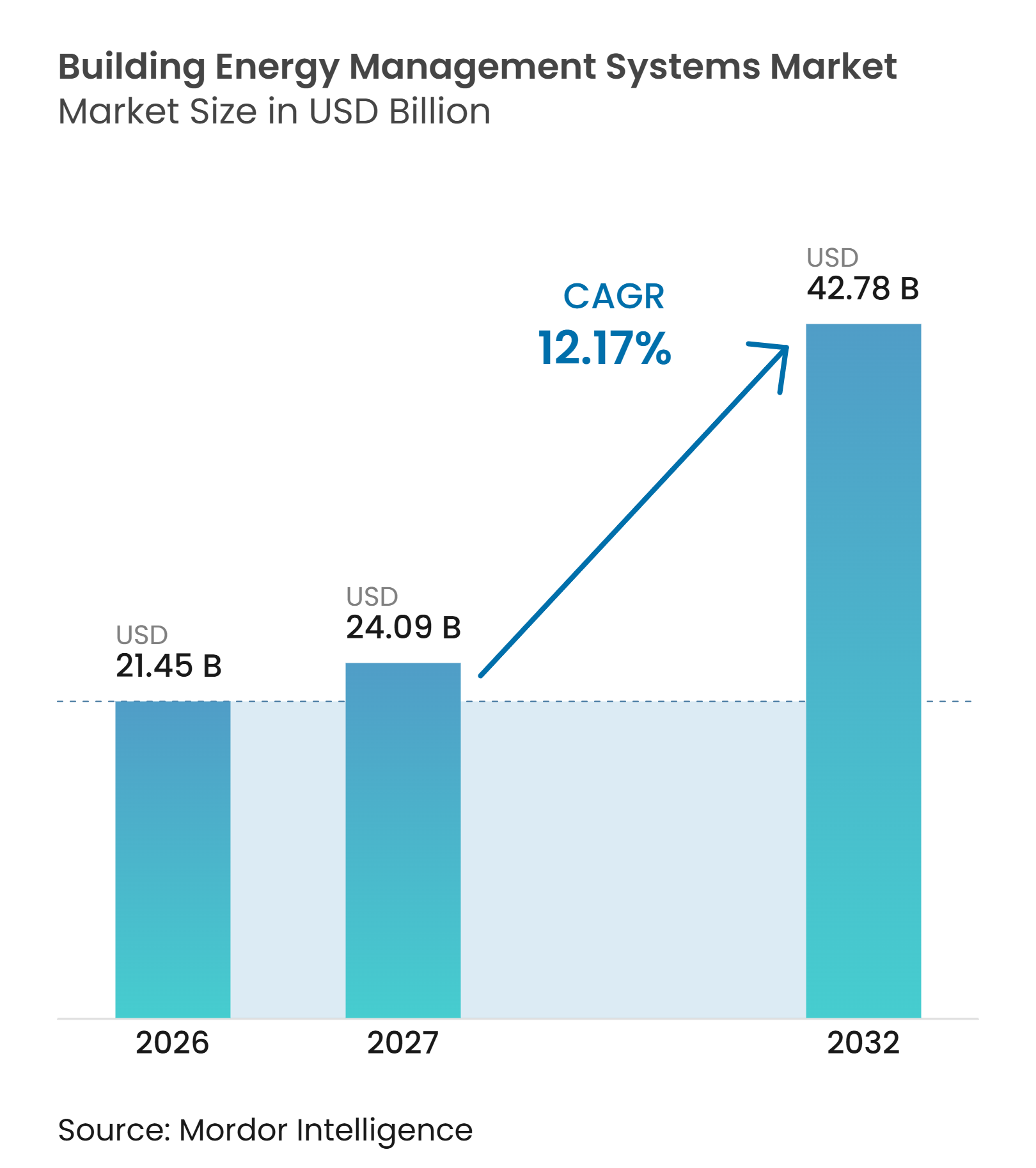
| Market Size (2027) | USD 24.09 Billion |
| Market Size (2032) | USD 42.78 Billion |
| Growth Rate (2027 - 2032) | 12.17 % |
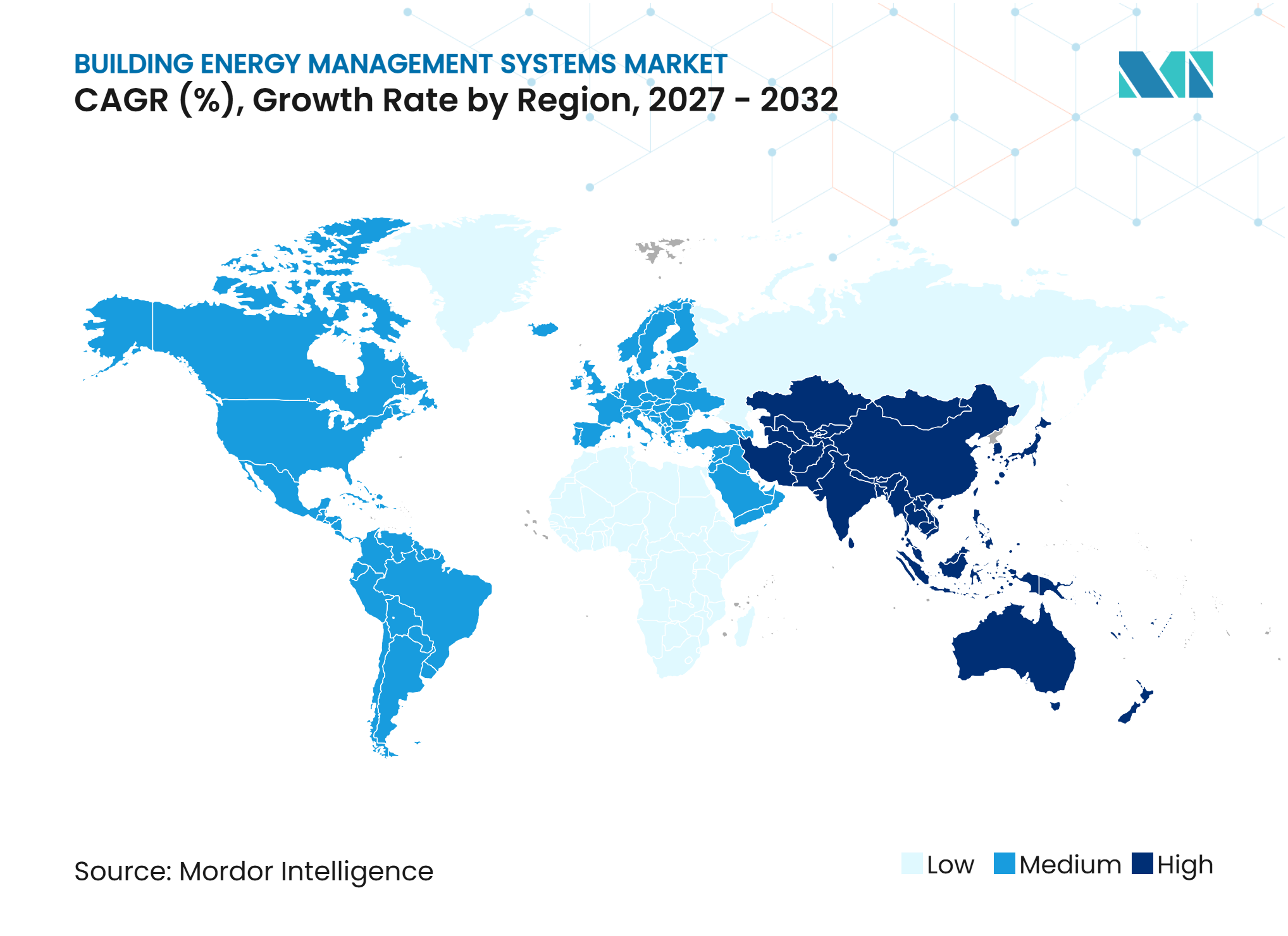
| Fastest Growing Market | Asia-Pacific |
| Largest Market | North America |
| Market Concentration | Medium |
Major Players *Disclaimer: Major Players sorted in no particular order Image © Mordor Intelligence. Reuse requires attribution under CC BY 4.0. | |
Building Energy Management Systems Market Analysis by Mordor Intelligence
The Building Energy Management Systems Market size is expected to increase from USD 21.45 billion in 2026 to USD 24.09 billion in 2027 and reach USD 42.78 billion by 2032, growing at a CAGR of 12.17% over 2027-2032. Buildings account for 30% of global final energy consumption and 26% of energy-related carbon dioxide emissions, which keeps operating efficiency high on the agenda for property owners and public agencies.[1] Tighter building rules in Europe, Japan, and North America are moving energy management from a discretionary project to a compliance-led investment for many facilities. At the same time, cloud systems, connected sensors, and AI-based analytics are making the Building Energy Management Systems market more practical for midsize sites that could not previously support a major integration project. Global energy efficiency progress rose to 1.8% in 2025 from 1.0% in 2024, supporting a broader pipeline for energy-saving building upgrades.[2] Suppliers are therefore combining control equipment with software, remote services, and demand-response functions to increase recurring revenue and reduce the need for complete replacement of equipment.
Key Report Takeaways
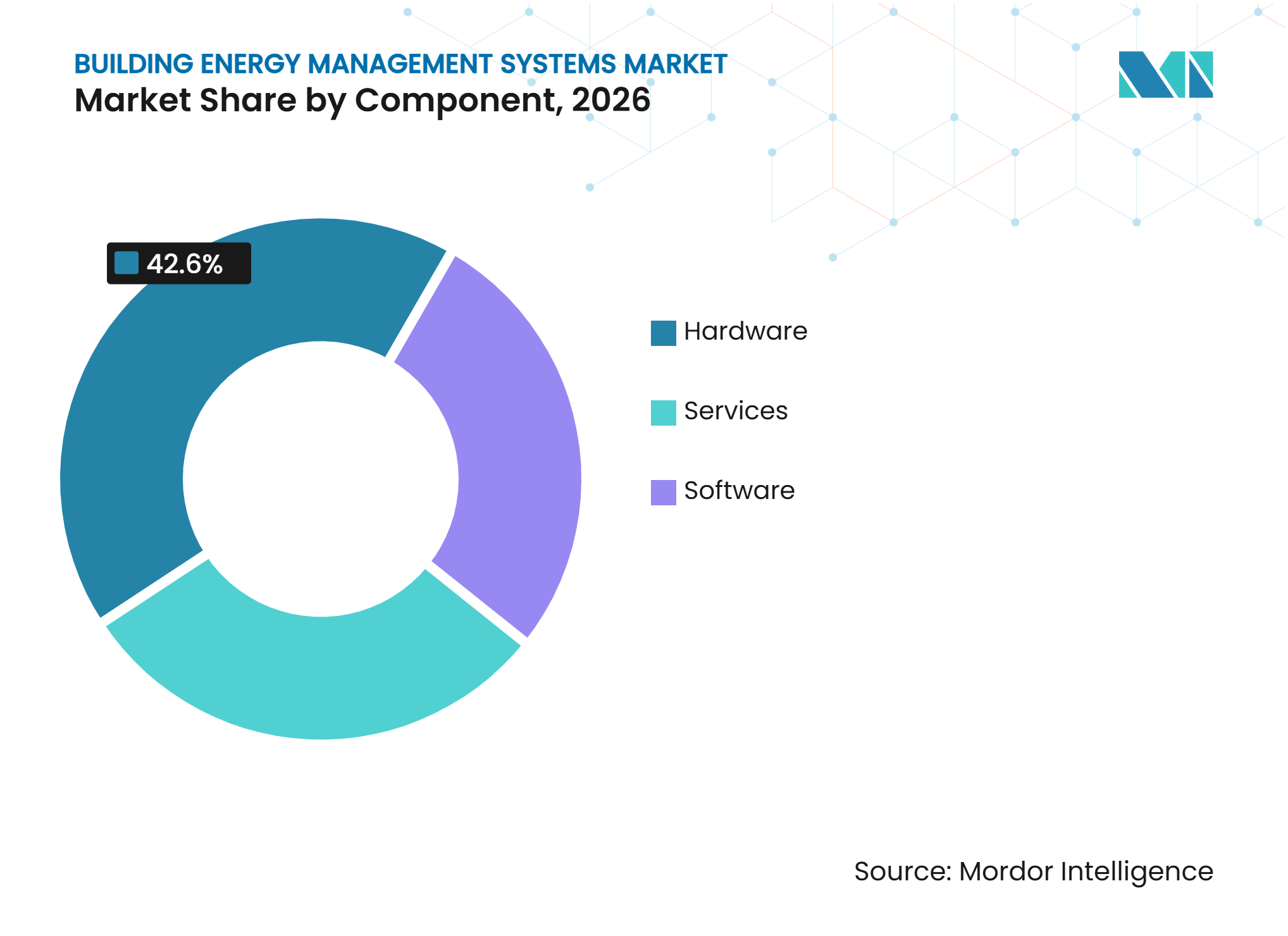
- By component, hardware held 42.6% of the share of the Building Energy Management Systems market in 2026, while software is forecast to grow at a 13.2% CAGR through 2032.
- By system type, Building Management Systems held 29.4% of the share of the Building Energy Management Systems market in 2026, while security and access control is forecast to grow at a 12.8% CAGR through 2032.
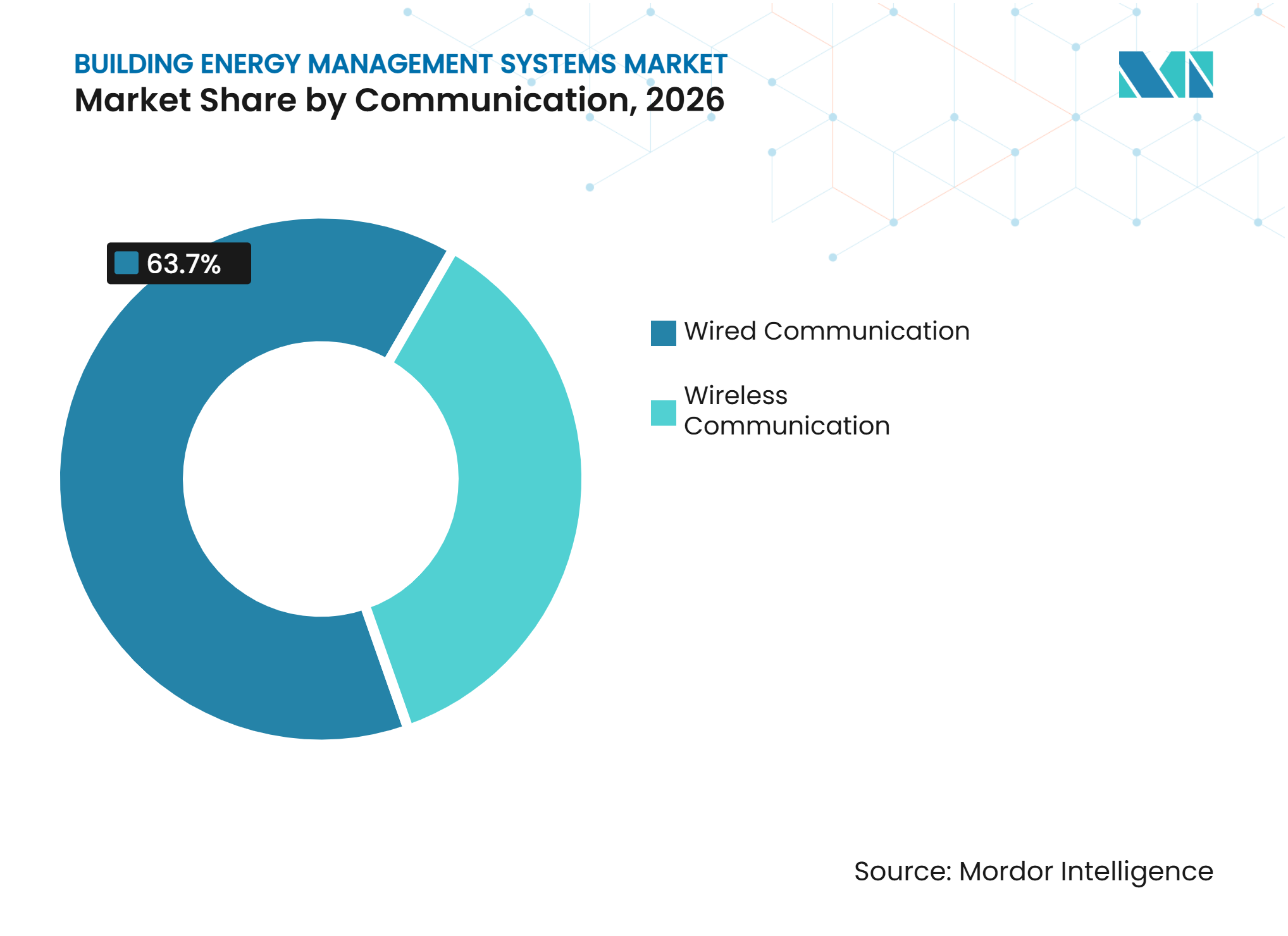
- By communication, wired systems held 63.7% of the share of the Building Energy Management Systems market in 2026, while wireless systems are forecast to grow at a 13.1% CAGR through 2032.
- By building type, commercial buildings held 57.1% of the share of the Building Energy Management Systems market in 2026, while residential buildings are forecast to grow at a 13.8% CAGR through 2032.
- By geography, North America held 34.8% of the share of the Building Energy Management Systems market in 2026, while Asia-Pacific is forecast to grow at a 13.6% CAGR through 2032.
Note: Market numbers in this report are based on Mordor Intelligence's proprietary estimation framework, which combines nine months of actuals with Q4 projections for base year 2026.
Market Trends and Insights
Drivers Impact Analysis of Building Energy Management Systems Market*
| Driver | (~) % Impact on CAGR Forecast | Geographic Relevance | Impact Timeline |
|---|---|---|---|
| Rising Energy Costs and Tariff Volatility | +3.5% | Global, heightened in North America and Europe | Short term (≤ 2 years) |
| Mandatory Energy Performance Standards and Building Codes | +2.2% | Europe, Japan, and North America | Medium term (2-4 years) |
| Cloud, IoT, and AI-Driven Building Optimization | +2.5% | Global, with early adoption in North America and Asia-Pacific | Medium term (2-4 years) |
| Smart Metering and Demand Response Integration | +1.2% | North America, Europe, and Australia, with spillover to Asia-Pacific and the Middle East and Africa | Medium term (2-4 years) |
| Building Retrofit and Deep Energy Renovation Programs | +1.0% | North America, Europe, and Japan | Long term (≥ 4 years) |
| Carbon Accounting and Mandatory Sustainability Reporting | +0.8% | Global, concentrated in Europe and North America | Medium term (2-4 years) |
| Source: Mordor Intelligence | |||
Rising Energy Costs, Smart Metering, and Demand Response Improve Project Economics
Energy and gas price volatility has made the Building Energy Management Systems market a practical capital allocation issue for commercial property portfolios. The U.S. Section 179D deduction provides USD 0.58 to USD 5.81 per square foot for eligible energy-efficient commercial building improvements completed in 2025.[3] These incentives can improve project economics for owners that previously faced long payback periods. Owners are also seeking demand forecasting and load-control functions, rather than only energy-saving equipment. This favors suppliers that can provide software services on existing equipment and support demand-response participation. ABB stated that integrated building automation for heating, ventilation, air conditioning, and lighting can reduce total building electricity use by 10% to 20%.
Mandatory Standards, Retrofits, and Sustainability Reporting Create Durable Demand
The revised Energy Performance of Buildings Directive requires building automation and control systems in larger EU nonresidential buildings, with a 70-kW threshold applying from 2027.[4] This changes some spending from an optional energy project into a required compliance measure. Japan extended Building Energy Conservation Act compliance to all new buildings from April 2025, which brought smaller structures into the policy framework. American Society of Heating, Refrigerating and Air-Conditioning Engineers (ASHRAE) 90.1, the International Energy Conservation Code, and state-level building performance standards serve a similar role in the United States. Carbon reporting requirements also increase the need for traceable energy data at building and equipment level. China’s housing ministry published a draft calculation method for energy savings from building automation and energy management systems in July 2025, indicating growing attention to measurement and verification.
Cloud, IoT, and AI-Based Controls Shorten Deployment Cycles
Cloud platforms, connected sensors, and AI-based analytics are reducing the time required to deploy building controls. Schneider Electric reported that its EcoStruxure Foresight Operation platform achieved 40% faster engineering cycles, 50% better operational efficiency, and 90% faster fault resolution in early deployment data. The Building Energy Management Systems market is moving toward software overlays that can work with installed equipment. This approach allows owners to pursue savings without replacing every legacy controller at once. It also gives suppliers a route to recurring revenue and longer customer relationships. Trane introduced its ARIA AI building agent with support for 14 or more languages, reducing the specialist knowledge needed to use advanced control functions.
Building Renovation Programs Expand the Addressable Installed Base
Renovation programs are extending building control demand beyond new construction. Older offices, public buildings, and mixed-use properties have high energy-saving potential but often require staged upgrades. The EU directive and national energy policies support renovation planning by defining future performance requirements. Wireless sensors and hybrid system designs can lower disruption in occupied buildings. Service contracts and energy-as-a-service structures can also shift part of the initial cost from the owner to a specialist provider. The commercial opportunity is strongest where suppliers can combine controls, financing support, commissioning, and ongoing performance management.
Restraints Impact Analysis of Building Energy Management Systems Market*
| Restraint | (~) % Impact on CAGR Forecast | Geographic Relevance | Impact Timeline |
|---|---|---|---|
| High Integration Costs and Extended Payback Periods | -2.1% | Global, acute in South America and the Middle East and Africa | Medium term (2-4 years) |
| Legacy OT/IT Protocol Gaps and Interoperability Constraints | -1.5% | Global, severe in markets with older building stock | Medium term (2-4 years) |
| Cybersecurity Risks and Data Privacy Compliance Costs | -1.0% | Global, with the highest regulatory pressure in Europe and North America | Long term (≥ 4 years) |
| Skilled Personnel Shortage in Building Controls | -0.8% | Global, critical in Asia-Pacific and developing markets | Long term (≥ 4 years) |
| Source: Mordor Intelligence | |||
High Integration Costs and Legacy Protocol Gaps Limit Midmarket Adoption
High integration costs remain a material restraint in the Building Energy Management Systems market, particularly for smaller owners and price-sensitive regions. Connecting heating, lighting, access control, and metering systems can require gateways, tailored middleware, and lengthy commissioning. Older systems based on proprietary forms of BACnet, Modbus, or LonWorks may not expose usable data to cloud applications. Some controllers also lack the processing capacity or firmware support needed for modern integrations. This leaves the oldest and least efficient facilities among the most difficult sites to upgrade. Energy-as-a-service contracts can address part of the cost problem, but their availability remains uneven outside North America and northern Europe.
Cybersecurity and Skills Requirements Raise the Cost of Connected Operations
Connected building controls require cybersecurity practices that many property owners have not traditionally managed. Siemens issued a May 2025 security advisory for a Desigo CC Installed Client vulnerability, showing that legacy building platforms can require active remediation as connectivity increases. Compliance factors such as the EU’s Network and Information Security Directive 2 (NIS2) framework and National Institute of Standards and Technology (NIST) guidance can increase planning, monitoring, and training requirements. These obligations are most demanding when older operational technology is connected to enterprise networks. A shortage of experienced building-control professionals can further delay design, commissioning, and maintenance in growing markets. Suppliers that provide secure architecture, remote support, and simpler operator tools are better placed to reduce these barriers.
*Our forecasts treat driver/restraint impacts as directional, not additive. The impact forecasts reflect baseline growth, mix effects, and variable interactions.
Building Energy Management Systems Market Segment Analysis
By Component:
Software Services Increase the Value of Installed SystemsHardware held 42.6% of the Building Energy Management Systems market share in 2026 because sensors, controllers, meters, and actuators remain necessary for system operation. Software is the fastest-growing component and is projected to expand at a 13.2% CAGR through 2032. The hardware base supplies the field data that supports higher-value optimization and automation services. The Building Energy Management Systems industry is shifting from equipment sales toward subscriptions for energy analytics, fault detection, and digital building tools. Schneider Electric stated that its EcoStruxure platform operates at 480,000 sites and is used by 40% of Fortune 500 companies.
Software can improve results from installed equipment without a complete replacement cycle. A January 2025 Bosch research study examined semantic data modeling for model predictive Heating, Ventilation, and Air Conditioning (HVAC) control, supporting better data structures in energy optimization. Trane Technologies reported USD 347.6 million in research and development spending in fiscal 2025, including investment in AI controls and digital tools. Hardware suppliers are responding by adding analytics through internal development and platform expansion. Software attach rates can offset pressure on equipment margins and give suppliers more predictable revenue.



By System Type:
Security and Access Control Become Part of Unified Building OperationsBuilding Management Systems accounted for 29.4% of the share of the Building Energy Management Systems market in 2026, reflecting their central role in coordinating heating, cooling, metering, and environmental controls. Security and access control is the fastest-growing system type, with a forecast CAGR of 12.8% through 2032. Owners increasingly want security, cyber resilience, occupancy information, and energy control within a shared operating platform. HVAC control remains the largest subsystem by deployment volume because it is directly tied to comfort and energy use. Trane stated that its AI Control system can reduce HVAC energy costs by up to 25% and carbon emissions by up to 40%.
Lighting controls continue to benefit from occupancy sensing and daylight-based operation. Siemens completed an energy transformation of Milan’s Pirelli 35 building in June 2025 using Desigo CC to coordinate HVAC, lighting, access control, and fire safety. Siemens reported 60% energy savings and an annual reduction of 2,000 metric tons of carbon dioxide at the site. The case shows why a common data model can improve results compared with separate building subsystems. It also raises the value of suppliers that can manage both physical access and energy data.
By Communication:
Wireless Technology Improves Retrofit FeasibilityWired systems commanded 63.7% of the share of the Building Energy Management Systems market in 2026 because core HVAC and safety applications require dependable, high-bandwidth connections. Wireless systems are expected to grow at a 13.1% CAGR through 2032. In occupied buildings, installing new cables through completed interiors can cost more than the related controls. Wireless devices can provide a practical route for room-level sensing, metering, and control upgrades. Delta Electronics Americas introduced its Delta Intelligent Building Technologies platform at AHR Expo 2025, including a LOYTEC wireless room controller.
Most mixed-age properties will use hybrid designs rather than a full shift to one communication method. Wired backbones continue to support central plant equipment where availability is essential. Wireless devices are more suited to edge sensing and room-level control where cables are disruptive or costly. ABB launched BuildingPro in more than 40 countries in 2025 with building automation and cloud-based multi-site energy management. The Building Energy Management Systems market remains open to suppliers that can support both wired infrastructure and wireless extension devices.

By Building Type:
Residential Systems Broaden Demand Beyond Commercial PropertiesCommercial buildings held 57.1% of the share of the Building Energy Management Systems market in 2026 because their large energy loads, lease structures, and reporting responsibilities support formal control projects. Residential buildings are forecast to grow at a 13.8% CAGR through 2032. Lower smart thermostat and gateway costs are bringing home energy management within reach of more households. Electric vehicle charging, rooftop solar, home batteries, and utility demand-response programs are increasing the value of connected residential controls. Carrier announced USD 1 billion in additional U.S. manufacturing investment in May 2025 for heat pump production and battery assembly tied to home energy management systems.
Institutional and government buildings provide a stable source of projects because public procurement rules and net-zero commitments can support multiyear programs. Industrial users are active in data centers, pharmaceutical facilities, and semiconductor plants, where energy can represent 30% to 50% of operating costs. These facilities need granular, auditable data to manage high-value equipment and comply with energy reporting obligations. Hitachi launched BuilMirai, also called HMAX for Building, in September 2025 for remote energy optimization, access management, and predictive maintenance. Building-type demand is becoming more varied, even though commercial properties remain the largest spending base.
Geography Analysis
North America
North America held 34.8% of the Building Energy Management Systems market share in 2026, supported by tax incentives, state building rules, and commercial property investment. The Section 179D commercial building deduction gives eligible projects USD 0.58 to USD 5.81 per square foot in 2025. California, New York, Massachusetts, and Colorado have building performance standards with enforcement provisions. Eaton deployed Brightlayer at Hartsfield-Jackson Atlanta International Airport within the USD 12.8 billion ATLNext modernization program. GridPoint secured USD 45 million in March 2025, including a USD 20 million anchor investment from Marunouchi Innovation Partners, to support expansion across commercial buildings and into Japan and South Korea.
Asia-Pacific
Asia-Pacific is projected to expand at a 13.6% CAGR through 2032, making it the fastest-growing regional part of the Building Energy Management Systems market size. New commercial and institutional construction, stronger codes, and data center development support demand across the region. China’s housing ministry published a July 2025 draft method for calculating energy savings from building automation and energy management systems. Japan extended energy conservation compliance to all new buildings from April 2025, including buildings below the previous 300 square meter exemption threshold. Mitsubishi Electric began AI-based air-conditioning optimization with Shimizu Construction at Serendie Street Yokohama in August 2025.
Europe, the Middle East and Africa, and Latin America
Europe has a legally defined demand pipeline because the EU directive requires building automation in nonresidential buildings above 70 kW by 2027 and calls for zero-emission new buildings from 2030. The Middle East and Africa show a split pattern, with Gulf projects supported by green-building requirements and broader African adoption limited by grid conditions and shortages of commissioning specialists. Johnson Controls introduced OpenBlue Workplace in the United Arab Emirates in June 2025 for government and commercial portfolios. Latin America remains smaller, with activity concentrated in Brazil, Mexico, and Chile where energy economics and voluntary LEED and Excellence in Design for Greater Efficiencies (EDGE) certification encourage efficiency investment.
Competitive Landscape
Market Concentration
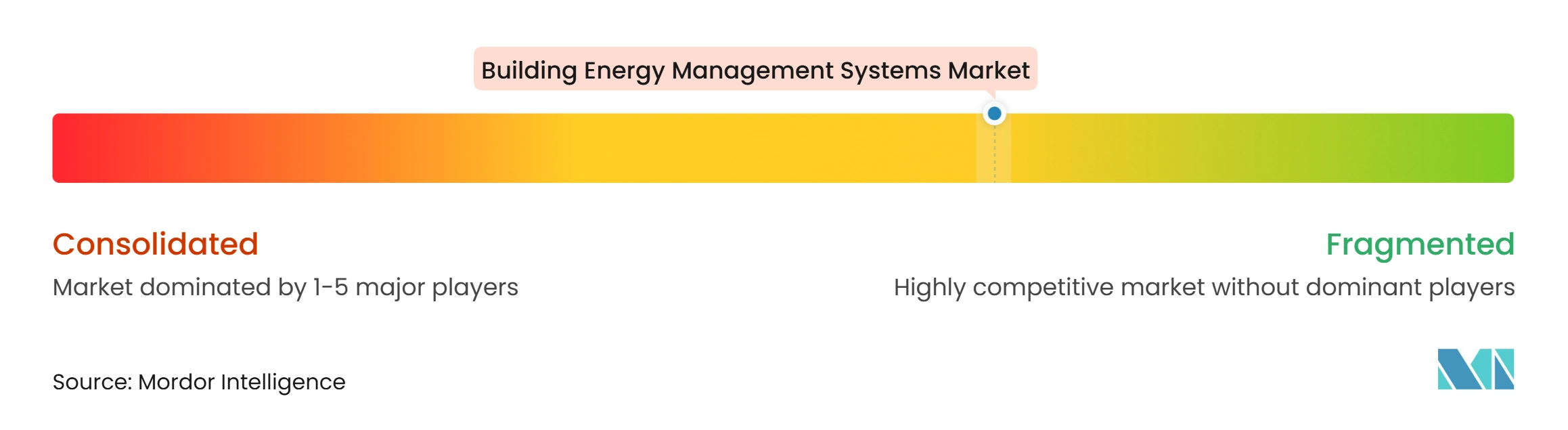
The Building Energy Management Systems market is moderately consolidated. Honeywell, Siemens, Schneider Electric, Johnson Controls, and Trane Technologies compete through broad control portfolios, global service networks, and integrated data platforms. Honeywell reported USD 7.4 billion in Building Automation revenue for fiscal 2025, with 13% year-on-year growth. These companies can connect HVAC, building management, security, and analytics under one commercial relationship. Competition is shifting from individual control devices toward the ability to manage data, services, and building outcomes over time.
Bosch completed its acquisition of Johnson Controls’ residential and light commercial HVAC assets and the Johnson Controls-Hitachi Air Conditioning joint venture in July 2025 for USD 8.1 billion. The transaction enlarged Bosch’s position in residential and smaller commercial comfort systems. Schneider Electric has expanded its EcoStruxure offer with software that brings energy, power, and building systems into one interface. Honeywell launched Connected Solutions AI in June 2025 for cloud-based energy management, predictive maintenance, and occupancy analytics. These moves show that established suppliers are pursuing software subscriptions and connected services alongside equipment portfolios.
Specialists increase pressure by working across third-party installed systems and targeting specific needs. Legrand launched its WEOZ platform in January 2025 for midsize commercial buildings and reported a 33% energy reduction at its Zaventem reference site. GridPoint supports demand response and energy management across more than 20,000 commercial buildings.
Building Energy Management Systems Industry Leaders
-
Johnson Controls International plc
-
Honeywell International Inc.
-
Siemens AG
-
Schneider Electric SE
-
ABB Ltd.
- *Disclaimer: Major Players sorted in no particular order
Building Energy Management Systems Market Companies Covered in this Report
- ABB Ltd.
- Azbil Corporation
- Carrier Global Corporation
- Delta Controls Inc.
- Delta Electronics, Inc.
- Distech Controls Inc.
- Eaton Corporation plc
- Emerson Electric Co.
- GridPoint, Inc.
- Hitachi, Ltd.
- Honeywell International Inc.
- Johnson Controls International plc
- KMC Controls, Inc.
- Legrand SA
- Mitsubishi Electric Corporation
- Planon Group
- Robert Bosch GmbH
- Schneider Electric SE
- Siemens AG
- Trane Technologies plc
Recent Industry Developments in Building Energy Management Systems Market
- October 2026: Honeywell Technologies launched Forge Cognition, an agentic AI and simulation platform for facility operations built with NVIDIA and Dell Technologies, targeting buildings, campuses, and industrial sites. Early pilot data at NVIDIA’s Voyager campus recorded up to a 90% reduction in unnecessary building management alerts and identified up to 10% potential energy savings through intelligent HVAC optimization.
- October 2026: Honeywell Technologies was selected by L&T Realty, the real estate division of Larsen & Toubro, to deploy Integrated Building Management System solutions across luxury housing and commercial projects in Mumbai and Chennai. The deployment includes one of the first applications of Honeywell Technologies Forge in Indian residential development, converging safety, security, and energy automation on a unified platform.
- September 2025: Hitachi launched BuilMirai, also called HMAX for Building, as a SaaS-based building management platform, combining remote energy optimization, access management, and predictive maintenance in a cloud-delivered subscription model. The product targets multi-site commercial portfolio owners across Japan and pan-Asian markets.
- August 2025: Mitsubishi Electric commenced AI-based air conditioning optimization at the Serendie Street Yokohama development in collaboration with Shimizu Construction, applying GENESIS64-based analytics to reduce HVAC energy consumption in a mixed-use urban development.
Global Building Energy Management Systems Market Report Scope
A Building Energy Management System (BEMS) is an IT- and computer-based control platform that uses sensors, smart meters, and automation hardware to monitor, analyze, and optimize a building's mechanical and electrical systems.
The building energy management systems market is segmented into component, system type, communication, building type, and geography. By component, the market is segmented into hardware, software, and services. By system type, the market is segmented into building management systems (BMS), energy management systems (EMS), HVAC control systems, lighting control systems, security and access control systems, and other systems. By communication, the market is divided into wired communication and wireless communication. By building type, the market is segmented into commercial buildings, residential buildings, industrial buildings, and institutional and government buildings. The report also covers the market size and forecasts for the global building energy management systems market across 26 countries in key regions. For each segment, the market sizing and forecasts have been provided on the basis of value (USD).
Segmentation Overview
| Hardware |
| Software |
| Services |
| Building Management Systems (BMS) |
| Energy Management Systems (EMS) |
| HVAC Control Systems |
| Lighting Control Systems |
| Security and Access Control Systems |
| Other Systems |
| Wired Communication |
| Wireless Communication |
| Commercial Buildings |
| Residential Buildings |
| Industrial Buildings |
| Institutional and Government Buildings |
| North America | United States |
| Canada | |
| Mexico | |
| Europe | Germany |
| France | |
| Italy | |
| Spain | |
| United Kingdom | |
| Poland | |
| Russia | |
| Rest of Europe | |
| Asia-Pacific | China |
| India | |
| Japan | |
| South Korea | |
| Australia | |
| Indonesia | |
| Vietnam | |
| Thailand | |
| Rest of Asia-Pacific | |
| South America | Brazil |
| Argentina | |
| Chile | |
| Rest of South America | |
| Middle East and Africa | Saudi Arabia |
| United Arab Emirates | |
| Egypt | |
| South Africa | |
| Morocco | |
| Rest of Middle East and Africa |
| By Component | Hardware | |
| Software | ||
| Services | ||
| By System Type | Building Management Systems (BMS) | |
| Energy Management Systems (EMS) | ||
| HVAC Control Systems | ||
| Lighting Control Systems | ||
| Security and Access Control Systems | ||
| Other Systems | ||
| By Communication | Wired Communication | |
| Wireless Communication | ||
| By Building Type | Commercial Buildings | |
| Residential Buildings | ||
| Industrial Buildings | ||
| Institutional and Government Buildings | ||
| By Geography | North America | United States |
| Canada | ||
| Mexico | ||
| Europe | Germany | |
| France | ||
| Italy | ||
| Spain | ||
| United Kingdom | ||
| Poland | ||
| Russia | ||
| Rest of Europe | ||
| Asia-Pacific | China | |
| India | ||
| Japan | ||
| South Korea | ||
| Australia | ||
| Indonesia | ||
| Vietnam | ||
| Thailand | ||
| Rest of Asia-Pacific | ||
| South America | Brazil | |
| Argentina | ||
| Chile | ||
| Rest of South America | ||
| Middle East and Africa | Saudi Arabia | |
| United Arab Emirates | ||
| Egypt | ||
| South Africa | ||
| Morocco | ||
| Rest of Middle East and Africa | ||
Key Questions Answered in the Report
What is the projected size of the Building Energy Management Systems market by 2032?
The Building Energy Management Systems market is forecast to reach USD 42.78 billion by 2032, growing at a 12.17% CAGR from 2027 to 2032.
Which component leads the Building Energy Management Systems market?
Hardware leads with 42.6% share in 2026 because sensors, controllers, meters, and actuators provide the installed operating base.
Which building type is growing fastest for energy management systems?
Residential buildings are projected to record the fastest growth, at a 13.8% CAGR through 2032, supported by connected home energy equipment.
Why are energy management systems important for commercial buildings?
They help owners respond to energy costs, meet building performance rules, collect auditable consumption data, and manage connected systems.
Which region leads demand for building energy management systems?
North America leads with 34.8% share in 2026, supported by tax incentives and state-level building performance standards.
What is driving adoption in Asia-Pacific?
New construction, stronger building rules, data center activity, and energy-efficiency policies are expected to support a 13.6% CAGR through 2032.