
Market Overview
| Study Period | 2021 - 2031 |
|---|---|
| Forecast Data Period | 2026 - 2031 |
| Historical Data Period | 2021 - 2024 |
| Growth Rate | 4.01 % |
| Market Concentration | Medium |
Major Players *Disclaimer: Major Players sorted in no particular order Image © Mordor Intelligence. Reuse requires attribution under CC BY 4.0. | |
Brazil LNG Market Analysis by Mordor Intelligence
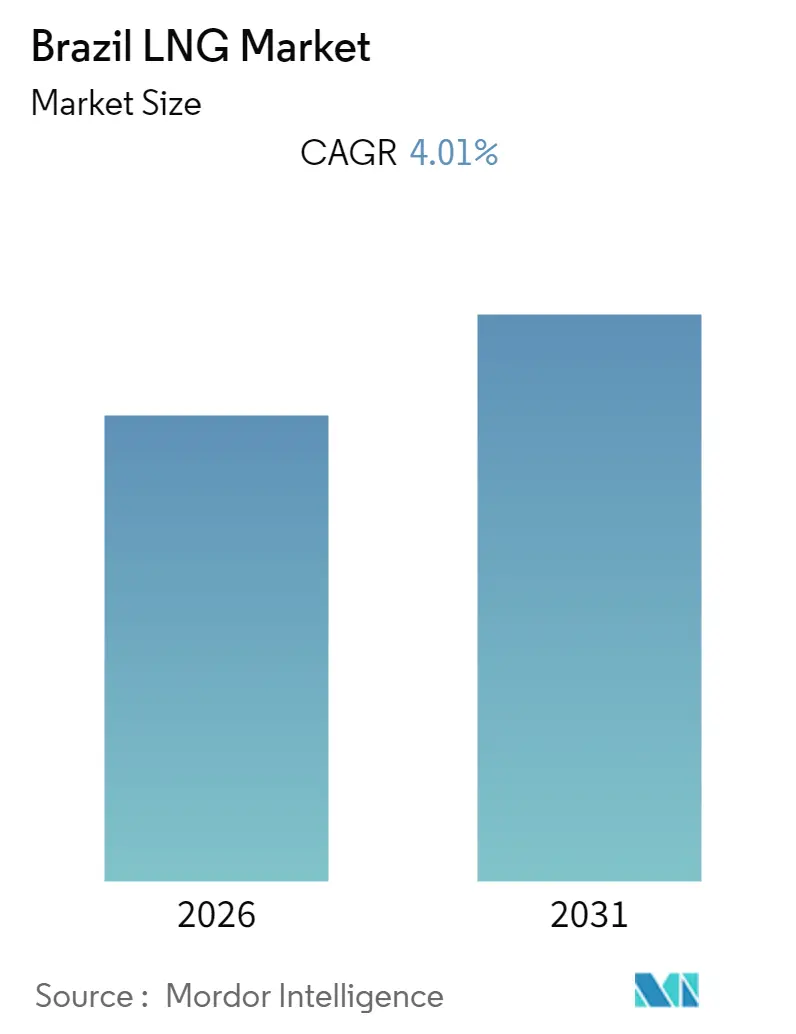
The Brazil LNG Market size is expected to register a CAGR of greater than 4.01% during the forecast period (2026-2031).
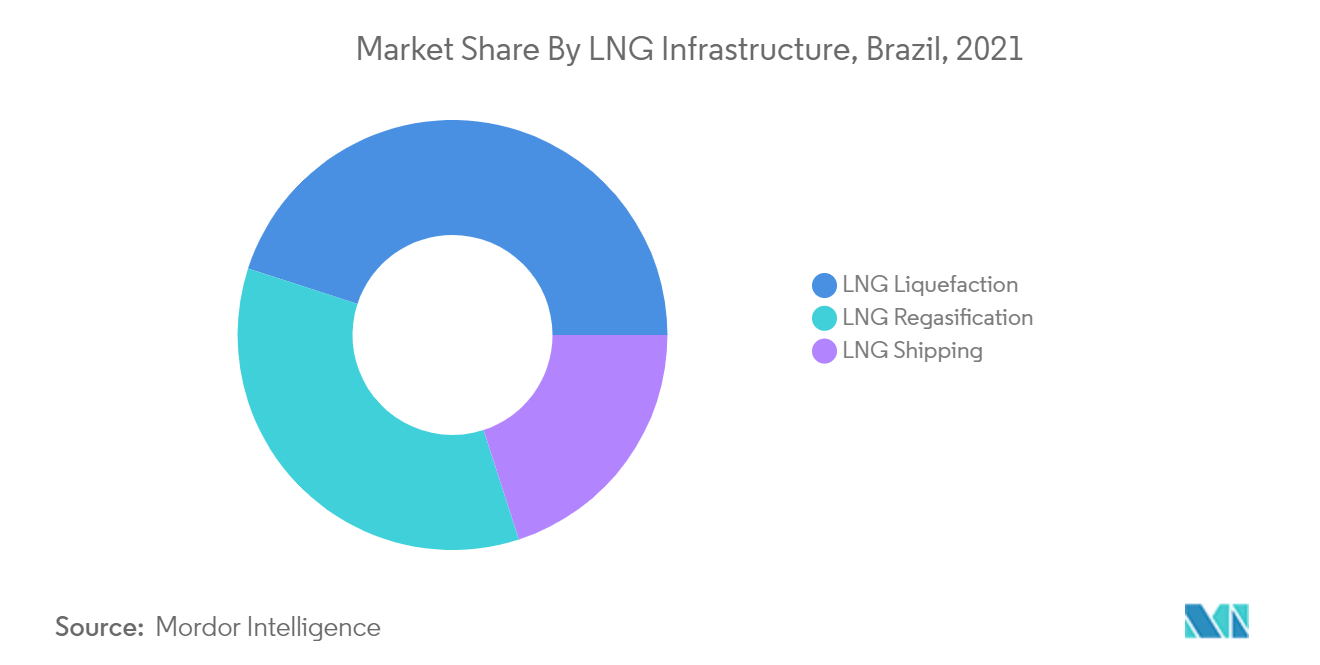
- The regasification sector is expected to witness significant growth during the forecast period, owing to the increasing investment in the LNG market.
- Brazil's New Gas Law (Law no 14.134/ 2021) establishes the foundations for developing a liquid and competitive gas market, which will now regulate the sector in Brazil and promote opportunities for natural gas and LNG players.
- Incresing investments in LNG projects is expected to drive the Brazil LNG market during the forecast period, with majority of the demand coming from numorous end use industries.
Note: Market size and forecast figures in this report are generated using Mordor Intelligence’s proprietary estimation framework, updated with the latest available data and insights as of 2026.
Brazil LNG Market Trends and Insights
Regasification Sector to Witness Significant Growth
- Brazil is emerging as South America's most dynamic LNG market with significant rise in the imports. Brazil's role as an increasingly important LNG market has gained impetus in 2021, owing to regulatory changes in the gas sector and continued problems in the hydro industry, which currently accounts for about 65% of the country's electricity generation.
- The first flexible liquefied natural gas (LNG) regasification terminal in Brazil, it is capable of transferring up to 7 million cubic meters per day of natural gas to the Guamaré-Pecém gas Pipeline (Gasfor). It supplies, mainly, the Ceará and Fortaleza thermal power plants. The terminal is owned and operated by state run Petrobras.
- The demand for LNG imports to Brazil via the Bahia regasification terminal grew in the second quarter of 2022 despite surging global natural gas prices. This is expected to grow significantly by the end of 2022.
- In December 2021, Excelerate Energy L.P. announced that it commenced natural gas deliveries to the Brazilian market at the Bahia Regasification Terminal (TR-BA) in Salvador to Bahia, Brazil. Excelerate's Floating Storage Regasification Unit (FSRU) Excelerate Sequoia, which has an LNG storage capacity of 173 400 m3, is delivering regasification services at TR-BA. The terminal has a regasification capacity of up to 700 million ft3/d.
- Furthermore, in October 2019, Gas Natural Açu (GNA) commenced the operations of a USD 1 billion LNG-to-power project. It also includes an LNG regasification terminal with a FSRU BW Magna. The FSRU has the capacity to store and regasify up to 21 million cubic metres per day.
- Hence, the above points indicate that regasification sector is expected to witnesse siginficant growth in the Brazil LNG market in the forecast period.
Increasing Investments in LNG Projects Expected to Drive the Market
- Investments in LNG terminals in Brazil will undergo radical changes in the coming years. The demand for LNG imports to Brazil via the Bahia regasification terminal grew in the second quarter of 2022, despite global natural gas prices surging.
- State-run oil company Petrobras built the three major LNG terminals operating in the country. Still, new projects from private sector firms are emerging as the participation in the oil and gas midstream, and downstream markets focus on deepwater exploration and production.
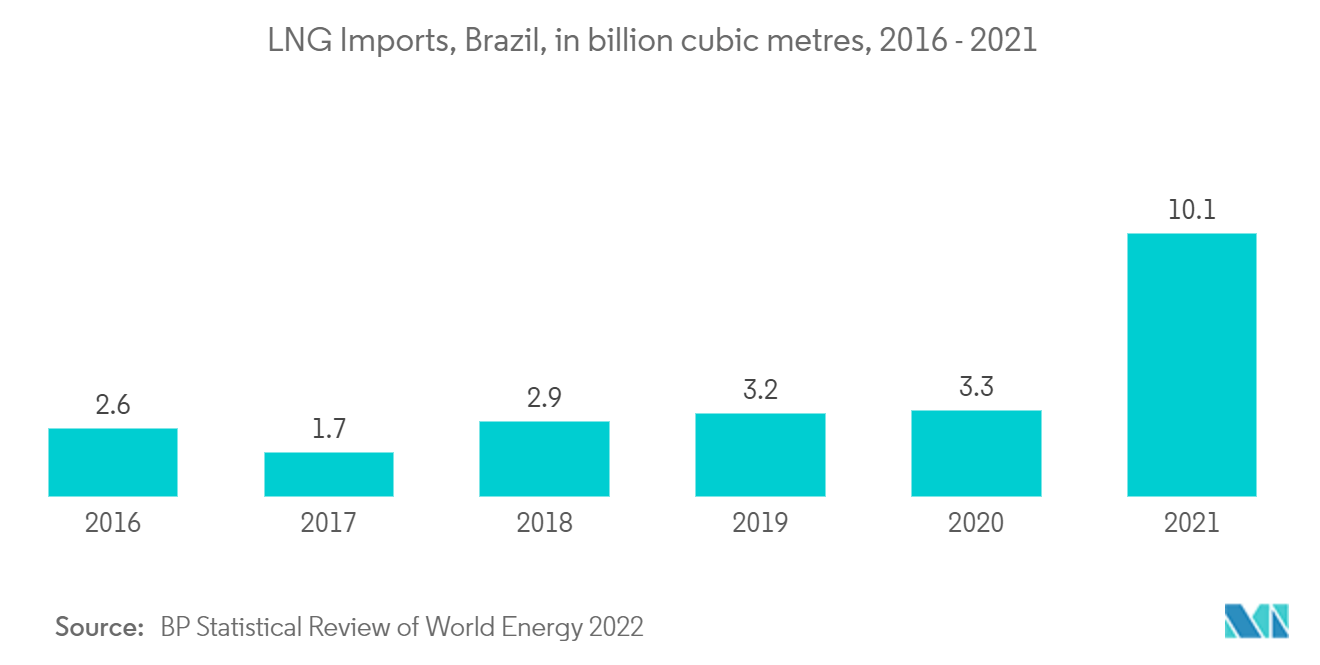
- Brazil has significantly increased the LNG imports in 2021. LNG Imports has reached 10.1 billion cubic metres in 2021, the imports has witnessed 206.1% growth compared to LNG imports in 2020 with 3.3 billion cubic metres.
- As per Golar LNG, the private sector investments are predicted to range around USD 500 million for the development of LNG Import Terminal, with approximately 300 direct and indirect new jobs expected to be generated in 2021.
- The Brazilian government launched the Novo Mercado De Gas (New Gas Market) program in the year 2019, which aims to revitalize the Brazilian Gas market to attract new investment in the sector by removing tax barriers and simplifying legislation. This is aimed at improving the natural gas flow, processing, transport, and distribution infrastructure. The New Gas market program is expected to streamline investments in this sector and drive the market.
- Hence, owing to the above-mentioned factors, the demand for the LNG market is likely to grow and significantly drive the market during the forecast period.
Regulatory Landscape
Brazil's LNG market operates under the New Gas Law (Law No. 14.134/2021) and its implementing framework, including Decree No. 10.712/2021 and subsequent updates such as Decree No. 12.153/2024. The National Agency of Petroleum, Natural Gas and Biofuels (ANP) is the primary regulator for authorizations related to LNG terminals and related midstream activities, while environmental licensing for terminal construction and operation is handled by IBAMA or relevant state environmental agencies depending on project scope.
The ruleset for LNG handling and market access has continued to evolve. ANP Resolution 971/2024 (published in July 2024) regulates bulk LNG conditioning and movement, replacing older provisions and setting out clearer requirements for LNG logistics. In June 2026, the ANP approved regulations to operationalize non-discriminatory, negotiated third-party access to essential gas infrastructure, including LNG terminals, pipelines, and processing units, aligning access principles with Article 28 of the New Gas Law.
Value Chain Analysis
Brazil's LNG value chain spans supply procurement (spot and term LNG), marine shipping, import terminals (predominantly FSRU-based regasification), and delivery into the transmission and distribution system for power generation and industrial end users. Petrobras has historically been central to LNG import and regasification infrastructure and remains a key operator within the midstream and downstream landscape, as the broader gas market structure shifts from a monopoly-based model toward an entry-exit model with third-party access provisions for essential facilities.
Alongside Petrobras, private participants have expanded the LNG import ecosystem through additional terminal and downstream initiatives, supported by companies such as New Fortress Energy, Compass Gas e Energia, and Terminal Gas Sul. Upstream gas supply that can influence LNG balancing needs and contractual strategies is anchored by large offshore developments involving major consortia, including the Libra Consortium (Petrobras, Shell, TotalEnergies, CNPC, CNOOC, and PPSA), as well as projects led by international operators such as Shell. Petrobras' Business Plan 2026-2030 also points to continued natural gas and liquids infrastructure development, reinforcing the link between offshore supply growth, gas processing and transport, and LNG imports as a flexibility tool.
Competitive Landscape
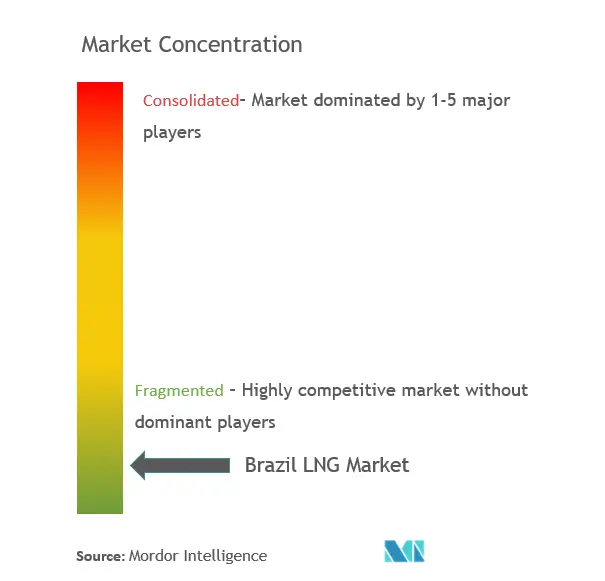
The Brazil LNG Market is moderately fragmented. The key players in the market include Petroleo Brasileiro S.A, BP plc, Chevron Corporation, ExxonMobil Corporation, Shell plc, and TotalEnergies SE, among others.
Brazil LNG Industry Leaders
-
Petroleo Brasileiro S.A
-
BP plc
-
Chevron Corporation
-
ExxonMobil Corporation
-
Shell plc
- *Disclaimer: Major Players sorted in no particular order
Market Opportunities and Future Outlook
Regulatory and infrastructure changes are creating clear headroom for new LNG logistics and capacity utilization models in Brazil. ANP Resolution 971/2024 provides a clearer basis for bulk LNG conditioning and movement, enabling small-scale LNG distribution by road, rail, and waterway to regions without pipeline access, and supporting route-to-market pathways for satellite regasification, industrial fuel switching, and distributed power solutions. On the infrastructure side, Brazil had LNG import capacity of about 5.1 Bcf/d as of August 2025, and the Suape FSRU project in Pernambuco is cited as adding 0.7 Bcf/d of regasification capacity, with completion targeted for early 2026.
Opportunities also depend on access changes and on upstream and midstream project pipelines that affect domestic gas availability and LNG balancing needs. In June 2026, the ANP approved rules for non-discriminatory, negotiated access to essential gas infrastructure, including LNG terminals and processing units, supporting third-party contracting strategies around existing assets and encouraging new market entry across import and regasification services as well as downstream supply. On the supply side, Petrobras' April 2026 FID for SEAP I in the Sergipe-Alagoas Basin, which includes an export gas pipeline, and the June 2025 award of exploration blocks in the Foz do Amazonas basin to consortia led by Petrobras, ExxonMobil, and Chevron reinforce continued upstream activity that can shift the import-versus-domestic supply mix and related LNG portfolio requirements.
Recent Industry Developments
- June 2026: ANP board approved new regulations for non-discriminatory, negotiated third-party access to essential natural gas infrastructure, including LNG terminals, flow pipelines, and processing units. The change expands downstream access for non-incumbents, potentially increasing competition and LNG throughput in Brazil.
- April 2026: Petrobras board of directors approved the Final Investment Decision for the SEAP I project in the Sergipe-Alagoas Basin. This offshore LNG-related expansion project supports Petrobras' LNG-linked gas supply growth and domestic gas integration strategy.
- March 2026: Shell Brazil signed contracts finalizing acquisition of additional rights in the Atapu and Mero pre-salt fields, and agreed to sell 20% of Orca to KUFPEC while maintaining operator stake. This anchors Shell's Brazil gas strategy, supporting increased LNG feedstock options and potential late-stage development via Orca.
Research Methodology Framework and Report Scope
Market Definition and Coverage
We define the Brazil LNG market as the value created from liquefying natural gas, transporting it as LNG, and receiving and regasifying it for end use inside Brazil, where revenues are counted across the LNG supply chain activities tied to the country.
Scope exclusions: We exclude domestic pipeline natural gas-only activities that are not directly linked to LNG liquefaction, LNG shipping, or LNG regasification services.
Segmentation Overview
- LNG Infrastructure
- LNG Liquefaction Plants
- LNG Regasification Facilities
- LNG Shipping
- Application
- Transportation Fuel
- Power Generation
- Others
- `
Data Sources, Market Sizing, and Validation
Desk Research
Desk research was used to set the factual base for LNG flows and the operating context in Brazil, and then it was used again to cross-check the model outputs. Public sources such as ANP publications, the Ministry of Mines and Energy planning documents (for example, the PDE series), and EPE energy balance and outlook material help us understand demand drivers like power dispatch sensitivity in dry years.
We also review sources such as UN Comtrade trade statistics for LNG import trends, shipping and terminal project disclosures on port authority and operator websites, and technical references from peer-reviewed energy journals that explain regasification and storage operating assumptions. To fill company and asset context gaps, we use items like audited filings, investor presentations, and credible business press, and then we selectively use paid subscriptions for company financials and intelligence, news and financials, patent databases, and shipment-level import/export datasets where they add clarity. This list is not exhaustive, and many other public and proprietary sources were used for data collection, validation, and research clarification.
Primary Interviews and Surveys
Primary work was used to validate what desk sources cannot consistently show, such as effective utilization, contracting structures, and realistic service pricing through the year. We spoke with a mix of terminal-side stakeholders, LNG logistics specialists, gas-to-power and industrial buyers, and other informed experts, so that assumptions could be corrected and then rechecked across Brazil's key consuming regions.
Distribution of primary research fieldwork respondents
| Company type | Respondent position |
|---|---|
| Top tier: 29% | CXOs: 12% |
| Mid tier: 56% | Functional/Unit leaders: 31% |
| Smaller Players: 15% | Managers: 57% |
Market-Sizing & Forecasting
Market sizing starts with a top-down build that reconstructs Brazil's LNG demand pool by linking gas-to-power needs and industrial gas demand to LNG import and regasification capability, followed by a translation into market value using service and commodity-linked pricing logic. To keep the numbers grounded, we corroborate totals with selective bottom-up approximations, such as sampled terminal throughput multiplied by service tariffs, plus checks on shipping and logistics cost bands, and then adjust where the two views disagree.
Key inputs that shape the model include LNG import volumes and seasonality, regasification capacity and typical utilization ranges, thermal power dispatch indicators during hydrology stress periods, assumed boil-off and handling losses, and currency timing for converting local pricing into USD where needed. When direct pricing is not visible for a given node, gaps are handled with a transparent proxy, usually a bracketed tariff range validated in interviews and anchored to comparable operating cost structures.
For forecasting, we rely on scenario analysis supported by expert consensus, since LNG demand in Brazil can swing based on rainfall, power system needs, and short-term fuel switching. Capacity additions, likely utilization ramps, and expected pricing progression are then applied year by year so the forecast remains traceable to observable drivers rather than a single trend line.
Data Validation & Update Cycle
Validation is done through triangulation across independent signals, and then through variance checks that flag results which do not fit the known operating reality. We compare modeled LNG volumes and implied prices against external metrics like trade values, terminal capacity logic, and power sector demand markers, and any large gaps are reviewed before sign-off.
A multi-step analyst review is followed so that assumptions, calculations, and unit conversions are checked consistently, and where material uncertainty remains, the primary experts are re-contacted to confirm the direction and magnitude. Reports are refreshed annually, with interim updates when material events occur, and a final pre-delivery review pass is completed so clients receive the latest updated view.
Mordor Intelligence's Brazil Lng Market Estimate Compared With Other Published Estimates
Published LNG market numbers for Brazil can look far apart because the underlying counting logic is not always the same, and some estimates mix infrastructure revenues with commodity import values. Differences also show up when one publisher sizes only LNG terminals, while another includes shipping, small-scale distribution, or even broader natural gas activity.
The benchmark table shows a spread that mainly comes from what is included and how volume is converted into USD, where under Mordor Intelligence's model the scope is aligned to LNG liquefaction, LNG shipping, and LNG regasification activities, instead of folding in non-LNG pipeline gas revenues or unrelated downstream services. Variations can also come from whether a base case versus a stress case is used for gas-to-power driven LNG imports, how fast tariff and contract pricing is assumed to move, and whether FX conversion is done using annual averages or point-in-time rates.
Benchmark comparison
| Source | Market Size | Gaps in Research Methodology |
|---|---|---|
| Mordor Intelligence | USD 0.00 B (2025) | |
| Industry Association A | USD 2.64 B (2024) | Often reflects import value for gas (FOB/CIF) and can include non-LNG natural gas imports, so the number behaves like a trade-value series rather than LNG chain service revenue. |
| Global Consultancy B | USD 8.18 B (2026) | Uses a broader boundary that may bundle LNG infrastructure spending and wider gas market value, and it can assume aggressive demand growth and higher price progression without clear utilization and tariff checks. |
Taken together, the comparison suggests the biggest driver is scope, followed by how import volumes and tariffs are translated into USD for a specific year. By keeping the model tied to observable LNG flows, capacity use, and defensible pricing ranges that can be rechecked, we end up with a market value that is easier to repeat and explain.
Key Questions Answered in the Report
What is the current Brazil LNG Market size?
The Brazil LNG Market is projected to register a CAGR of 4.01% during the forecast period (2026-2031)
Who are the key players in Brazil LNG Market?
Petroleo Brasileiro S.A, BP plc, Chevron Corporation, ExxonMobil Corporation and Shell plc are the major companies operating in the Brazil LNG Market.
What years does this Brazil LNG Market cover?
The report covers the Brazil LNG Market historical market size for years: 2020, 2021, 2022, 2023, 2024 and 2025. The report also forecasts the Brazil LNG Market size for years: 2026, 2027, 2028, 2029, 2030 and 2031.