
Brazil Lime Market Analysis by Mordor Intelligence
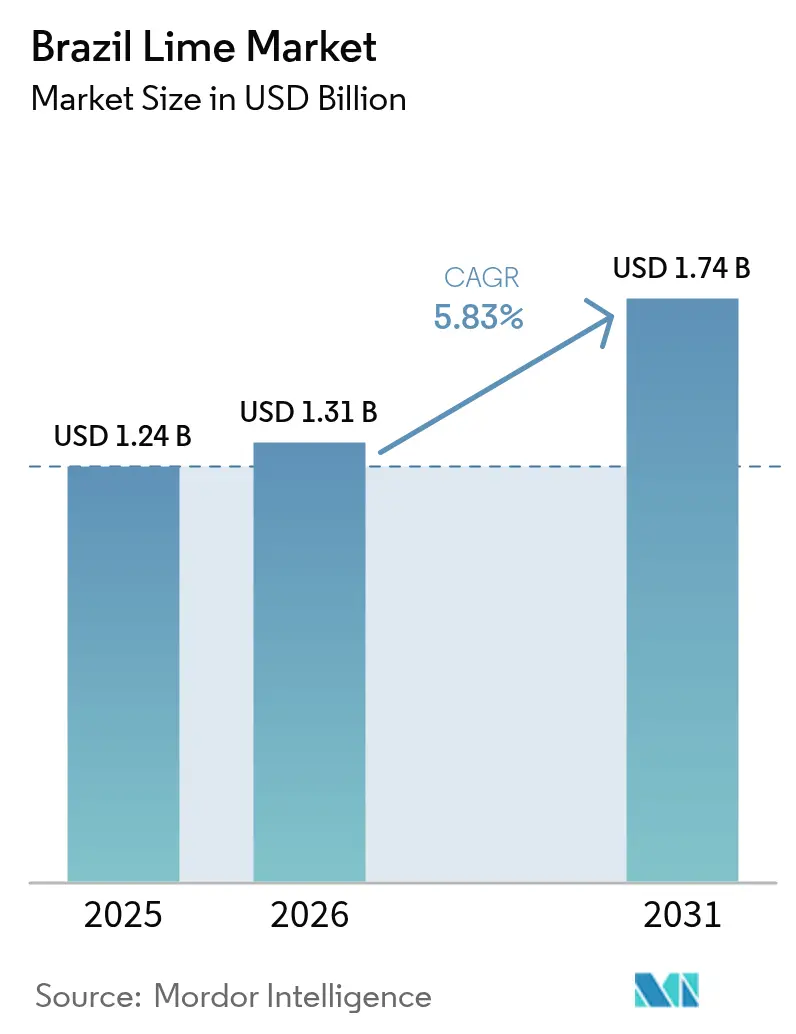
The Brazil lime market size is expected to grow from USD 1.24 billion in 2025 to USD 1.31 billion in 2026 and is forecast to reach USD 1.74 billion by 2031 at 5.83% CAGR over 2026-2031. This steady expansion reflects the country’s reinforced status as a global lime powerhouse, supported by a 70.3% leap in export value between 2020 and 2023 and underscored by its position as the world’s seventh-largest lime exporter in 2023. Export strength coincides with resilient domestic demand, where premium cocktail culture, clean-label food trends, and health-oriented diets sustain year-round consumption growth. Improving phytosanitary access, most recently, the April 2025 approved that opened India’s 1.4 billion-person market, offers new geographic outlets that are likely to temper Brazil’s long-standing reliance on the European Union for 85% of volumes. Meanwhile, water-efficient irrigation, no-till practices, and semi-dwarf rootstocks mitigate yield risk tied to rising disease pressure, keeping cost structures competitive even as energy, certification, and logistics costs rise.
Key Report Takeaways
- Brazil's lime market structure reveals production as the dominant value component, representing approximately 69.62% of total market value, with domestic consumption absorbing the majority of output while exports capture premium pricing for quality grades.
Note: Market size and forecast figures in this report are generated using Mordor Intelligence’s proprietary estimation framework, updated with the latest available data and insights as of 2026.
Brazil Lime Market Trends and Insights
Drivers Impact Analysis*
| Driver | (~) % Impact on CAGR Forecast | Geographic Relevance | Impact Timeline |
|---|---|---|---|
| Growing global demand for fresh lime | +1.8% | Global, led by European Union and expanding Asian markets | Long term (≥ 4 years) |
| Favorable climate and agricultural conditions | +1.2% | Southeast and Northeast production belts | Long term (≥ 4 years) |
| Expansion of food and beverage industry | +1.0% | Urban centers nationwide | Medium term (2–4 years) |
| Premium cocktail culture lifting domestic demand | +0.8% | Metropolitan areas, especially Southeast | Medium term (2–4 years) |
| New Asian market openings after phytosanitary deals | +0.7% | India, China, broader Asia-Pacific | Short term (≤ 2 years) |
| Climate-smart farming | +0.4% | Technology-enabled clusters in producing states | Long term (≥ 4 years) |
| Source: Mordor Intelligence | |||
Growing Global Demand for Fresh Lime
International appetite for Brazilian limes continues expanding, driven by health-conscious consumption patterns and culinary diversification across key export markets. Brazil's export performance demonstrates this trend, with lime exports achieving 14.35% year-over-year growth in 2023, significantly outpacing traditional citrus categories. In 2024, the European Union remains the dominant destination, absorbing approximately 85% of Brazilian lime exports, while South American markets capture the remaining 15%. This geographic concentration creates both opportunity and risk, as recent market access agreements with India represent critical diversification, potentially reducing dependence on European demand cycles. The processed lime segment benefits from industrial applications in beverage manufacturing, where Natural One's acquisition of lime farms from Vêneto Agrícola in 2024 exemplifies vertical integration strategies to secure raw material supply chains.
Favorable Climate and Agricultural Conditions
Brazil's tropical and subtropical climate zones provide optimal growing conditions for Tahiti lime cultivation, with year-round production capability distinguishing Brazilian supply from seasonal competitors. The Northeast region, particularly Bahia, emerges as a strategic expansion zone due to lower disease pressure compared to traditional São Paulo production areas. Climatic advantages extend beyond temperature and rainfall patterns to include reduced Huanglongbing incidence in newer production regions, creating natural barriers against the sector's most devastating disease. Water resource availability supports irrigation expansion, with precision agriculture adoption accelerating across major production states. Recent research demonstrates that no-tillage systems with cover crops significantly improve root development, water uptake, and photosynthetic efficiency in Tahiti lime cultivation, providing producers with sustainable intensification pathways.
Expansion of Food and Beverage Industry
Brazil's dynamic food and beverage sector drives sustained lime demand through both traditional applications and innovative product development. The domestic market benefits from robust foodservice recovery, with the sector reaching R$548 billion (USD 106 billion) in 2022, increasing out-of-home consumption that directly supports fresh lime demand[1]. Premium cocktail culture particularly influences lime consumption patterns, with citrus flavors representing 50% of Brazilian cocktail preferences according to Kerry's comprehensive field study across 40 top Brazilian bars. The mocktail trend further expands addressable markets, driven by Generation Z consumption patterns where only 45% consume alcoholic drinks, creating demand for sophisticated non-alcoholic beverages that maintain citrus flavor profiles. Industrial applications grow through vertical integration strategies, exemplified by Natural One's farm acquisitions to secure lime supply for juice production and shelf-life optimization.
Premium Cocktail Culture Lifting Domestic Demand
Brazilian cocktail culture undergoes sophisticated evolution, with lime emerging as an indispensable ingredient across traditional and contemporary beverage applications. Market research reveals citrus flavors dominate 50% of cocktail recipes in Brazil's top establishments, with lime specifically highlighted as a primary citrus component. This trend extends beyond alcoholic beverages to encompass the rapidly growing mocktail segment, driven by demographic shifts where Generation Z shows reduced alcohol consumption but maintains demand for sophisticated flavor profiles. The premium positioning of Brazilian bars increasingly emphasizes fresh, high-quality ingredients, creating opportunities for specialty lime varieties and organic production. Regional fruit diversification, including native ingredients like capim-limão, complements rather than displaces traditional lime usage, suggesting market expansion rather than substitution.
Restraints Impact Analysis*
| Restraint | (~) % Impact on CAGR Forecast | Geographic Relevance | Impact Timeline |
|---|---|---|---|
| High production and transportation costs | -1.5% | All producing regions, export corridors | Medium term (2–4 years) |
| Competition from Mexico, Peru and others | -1.2% | Europe and North American markets | Short term (≤ 2 years) |
| Rising citrus canker and HLB (Huanglongbing) incidence | -0.8% | São Paulo core belt, spreading zones | Long term (≥ 4 years) |
| Harvest-season labor shortages | -0.6% | Legacy orchards in Southeast | Short term (≤ 2 years) |
| Source: Mordor Intelligence | |||
High Production and Transportation Costs
Brazil's lime sector faces mounting cost pressures that threaten export competitiveness and domestic market accessibility. Transportation infrastructure limitations create significant logistical bottlenecks, particularly for fresh produce requiring cold chain management from interior production regions to major ports and urban consumption centers. The concentration of production in São Paulo state, while historically advantageous, now creates vulnerability as land costs escalate and labor availability tightens during peak harvest seasons. Energy costs for irrigation systems, essential for maintaining year-round production and fruit quality, add substantial operational expenses that smaller producers struggle to absorb. Currency fluctuations compound these challenges, as input costs often correlate with USD-denominated imports while domestic pricing remains in Brazilian reais, creating margin compression during periods of real weakness.
Competition from Mexico, Peru, and Others
International competition intensifies as established lime-producing countries expand capacity and new entrants emerge with competitive advantages. Mexico maintains a dominant global market position through proximity to the lucrative North American market, supplying over 90% of US lime imports and leveraging established distribution networks that Brazilian exporters struggle to penetrate [2]. Peru's aggressive expansion in citrus production, supported by favorable trade agreements and lower labor costs, creates direct competition in European markets where Brazilian exporters traditionally held strong positions. The competitive landscape shifts as climate change affects traditional producing regions differently, with some competitors benefiting from reduced disease pressure while Brazil faces increasing Huanglongbing incidence in core production areas.
*Our forecasts treat driver/restraint impacts as directional, not additive. The impact forecasts reflect baseline growth, mix effects, and variable interactions.
Geography Analysis
Brazil's lime production demonstrates pronounced regional concentration, with the Southeast region commanding the largest market share in 2025, anchored by São Paulo state's position as the undisputed production leader, generating over 1.2 million metric tons annually . São Paulo's dominance stems from established infrastructure, specialized expertise, and proximity to major ports that facilitate export operations to European markets, absorbing 85% of Brazilian lime exports. Minas Gerais and Rio de Janeiro contribute additional production capacity within the Southeast region, benefiting from similar climatic conditions and established supply chains. The region faces mounting challenges from Huanglongbing and citrus black spot diseases that threaten long-term sustainability, prompting producers to explore alternative locations with lower disease pressure.
The Northeast region emerges as the fastest-growing region, driven by Bahia's leadership in organic lime production and favorable disease profiles that support sustainable expansion. Itacitrus exemplifies this regional potential, operating 1,700 hectares in Inhambupe with plans to triple production within 5 years, achieving R$60 million (USD 11.1 million) revenue in 2023 through European export focus. Pernambuco and Ceará contribute additional Northeast production, though scale remains limited compared to traditional regions. The region's growth potential requires substantial irrigation investment due to semi-arid conditions, but offers advantages including year-round production capability and reduced transportation costs to European markets through northeastern ports. Climate-smart farming adoption accelerates in the Northeast, with biodynamic production systems demonstrating viability in Caatinga soils while meeting stringent European organic certification requirements. The South region maintains smaller-scale production primarily serving domestic markets, while the North region shows emerging potential through Pará state developments, though infrastructure limitations constrain expansion pace. Geographic diversification strategies respond to disease concentration risks while capturing regional competitive advantages in land costs, climate conditions, and government incentives. The region offers compelling advantages, including lower Huanglongbing pressure, favorable state financing through constitutional funds, and abundant land availability at competitive prices. Irrigation becomes essential due to high temperatures and sandy soils, but enables high productivity when properly managed.
Regulatory Landscape
Brazil's lime sector is overseen by the Ministry of Agriculture and Livestock (MAPA), including plant product sanitary control and export inspection functions (including DIPOV). Exporters are required to comply with official quality and identity, along with phytosanitary requirements set by destination markets. Establishments exporting plant products under official control must register in the CGC/MAPA, linking packhouses and exporters to MAPA inspection, traceability, and documentation routines for fresh citrus shipments.
Compliance conditions can shift across destinations and logistics flows, as reflected in Portaria MAPA No 757 (January 2025), which incorporates phytosanitary requirements for fresh citrus fruit within MERCOSUR origin and destination rules. The export chain also continues to rely on the existing framework for phytosanitary treatments for international transit of regulated plant products under Portaria MAPA No 385 (August 2021). On the trade-policy side, Medida Provisoria No 1309 (August 2025) created Plano Brasil Soberano, with credit lines aimed at exporters facing tariff impacts, while related legislative discussion on a Reintegra rate of 3% for export revenues runs through December 2026 and shapes the near-term fiscal environment for export-oriented lime chains.
Value Chain Analysis
Brazil's lime value chain starts with input supply (seedlings and rootstocks, fertilizers, crop protection, and irrigation equipment), then moves through orchard production, harvesting, sorting and packing, cold chain logistics, domestic wholesale and retail, and finally export marketing and distribution. Tahiti lime dominates the chain, accounting for about 97% of output, and production is concentrated in Sao Paulo and Minas Gerais, which together make up over 90% of national output. Small and medium-sized growers supply most of the base, representing around 80% of properties under 25 hectares. Packing houses and exporters are key value-adding nodes, particularly for fruit destined for the European Union and United Kingdom, where buyers and retailers often require consistent sizing, cosmetic standards, and documented compliance.
Export execution adds tariffs, documentation obligations, and transit risks, so the chain is sensitive to port delays and shipping disruptions that increase costs for perishable fruit. Brazil's year-round supply supports program-based exports, but it also increases exposure when domestic supply outpaces local absorption, which can feed back into prices and packing decisions. Investments that improve on-farm consistency, such as drip irrigation, monitoring, and improved agronomy, alongside packinghouse professionalization, support better yield-to-spec conversion and reduce losses across the cold chain, especially in long-haul export corridors.
Market Opportunities and Future Outlook
Export diversification and compliance-led upgrading stand out as opportunity areas for Brazil's lime chain, given the historically high share shipped to Europe and the effect of phytosanitary scrutiny on EU-bound volumes. The April 2025 market-access approval that opened India to Brazilian Tahiti lime adds another outlet beyond the European concentration. At the same time, the shift toward formalized certification and standardized documentation creates room for exporters and packinghouses to strengthen traceability, origin control, and consistent quality grading across lots.
On the supply side, the focus is on productivity and resilience investments to manage disease and climate volatility, including adoption of improved cultivars and production systems that help stabilize flowering cycles and post-harvest performance. Embrapa's work on improved Tahiti lime cultivars, including BRS Passos released in 2022, and organic production development in Bahia, including initiatives promoted with Embrapa support in Chapada Diamantina, provide practical pathways for differentiated supply into premium retail, foodservice, and ingredient channels. Record Tahiti lime exports of 175,821 metric tons in calendar year 2024 also indicates Brazil's ability to scale shipments when logistics and compliance execution align, while reinforcing the need for coordination across marketing, packing, and shipping capacity to protect margins during heavier supply periods.
Recent Industry Developments
- April 2026: MAPA published Portaria SDA/MAPA No 1.578/2026 establishing Sinfito, the National System of Phytosanitary Origin Certification, to standardize certification rules, traceability, and risk management for plant products. The measure upgrades the compliance backbone for fresh-produce export chains, supporting more consistent documentation and process control across growers, packers, and exporters.
- December 2025: PSP Investments agreed to take a minority stake in Citrosuco, adding institutional capital to one of Brazil's largest citrus processors and exporters. The transaction supports scale-up in orchards, industrial capacity, and supply-chain capabilities that can influence citrus sourcing dynamics and downstream ingredient availability.
- September 2025: MAPA issued the first official citrus quality certificate for a Tahiti lime export shipment to the European Union under OECD-aligned standards. The step strengthens the quality-assurance interface with EU import controls and helps exporters streamline clearance processes when shipments meet standardized grading and certification criteria.
Research Methodology Framework and Report Scope
Market Definition and Coverage
For this study, the market covers the value generated from limes sold within Brazil across fresh trade and organized distribution, measured at the producer and first-sale level, and then validated against domestic demand and trade flows.
Scope exclusions: We exclude other citrus fruits and products that are not lime, and we also exclude downstream retail markups and logistics add-ons that sit outside the first-sale value.
Segmentation Overview
- Production Analysis (Volume)
- Consumption Analysis (Volume and Value)
- Import Market Analysis (Volume and Value)
- Export Market Analysis (Volume and Value)
- Price Trend Analysis
Data Sources, Market Sizing, and Validation
Desk Research
Desk work starts by building a basic fact base for Brazil, so the model is anchored in volumes, trade, and pricing reality. We mainly refer to public agriculture and trade statistics such as IBGE crop outputs, CONAB bulletins, FAOSTAT series, UN Comtrade customs lines, and USDA FAS notes on citrus supply and export access.
After the core numbers are framed, supporting reads are pulled from company filings and investor presentations for growers, packers, and exporters, along with association websites and credible press to document seasonality, weather shocks, and freight constraints. Alongside this, a paid subscription for company financials and news is used to verify revenue-mix signals, and an import or export shipment-level database is used selectively to cross-check destination patterns and unit values. The sources named here are only illustrative, and other public references are also used as needed for data collection, clarification, and validation.
Primary Interviews and Surveys
Primary work focuses on growers, packhouses, exporters, wholesalers, and large buyers in foodservice and retail, so the assumed price bands and the sellable-grade split can be confirmed. We also use discussions with logistics and trade-facing participants to validate export season timing, rejection rates, and how domestic demand shifts when export pull strengthens. Assumptions are then rechecked across major producing and consuming pockets within Brazil.
Distribution of primary research fieldwork respondents
| Company type | Respondent position |
|---|---|
| Top tier: 39% | CXOs: 14% |
| Mid tier: 40% | Functional/Unit leaders: 28% |
| Smaller Players: 21% | Managers: 58% |
Market-Sizing & Forecasting
Sizing is built using a top-down reconstruction that starts from Brazil lime supply and availability, then adjusts using trade flows and loss factors to arrive at an implied domestic consumption pool. Once the demand pool is stable, value is calculated by applying observed farmgate and first-sale price bands that reflect grade mix, seasonal tightness, and channel spread.
To keep the number grounded, we corroborate it with selective bottom-up approximations such as sampled price per kilogram times marketed volume for key states, and a reasonableness roll-up using supplier and exporter revenue signals where public information is available. A few inputs that typically move the model are harvested area and yield trends, export volumes by destination, domestic wholesale price progression, share of fruit meeting export grade, and the seasonal gap between peak harvest and peak shipments.
Forecasts are developed using scenario analysis, because weather volatility and export demand can shift outcomes more than a single-line trend suggests. Assumptions for yield normalization, export pull, and price inflation are stress-tested with primary feedback, and then the central case is chosen when most signals point in the same direction. When bottom-up checks have missing pieces, gaps are handled with conservative ranges and tightened using trade unit values and distributor price checks.
Data Validation & Update Cycle
Model outputs are checked against independent signals such as production direction, customs exports, and wholesale price movements, and any mismatch is investigated before results are finalized. If an input change shifts totals beyond an expected band, the underlying assumption is reopened, and respondents are re-contacted to confirm whether the change is structural or short-term.
Before sign-off, a second analyst reviews the arithmetic, the unit conversions, and the logic chain so errors do not carry into the forecast. Reports are refreshed annually, and interim updates are triggered when material events occur, such as major crop disruptions, policy changes tied to exports, or sharp currency moves. Right before delivery, a final pass is completed so clients receive the latest consistent view.
Mordor Intelligence's Brazil Lime Market Size Compared Against Other Published Estimates
Published market values for Brazil limes can look different because each publisher draws the market coverage differently, and then uses different price points and timing for the same crop cycle. Differences also come from whether the number reflects producer-level value, wholesale turnover, or a wider chain that mixes in processed lime derivatives.
Export shipment trends and domestic wholesale price patterns are the evidence checks that keep Mordor Intelligence aligned to first-sale value for limes within Brazil, rather than counting retail margins or adjacent citrus categories under the same heading.
Benchmark comparison
| Source | Market Size | Gaps in Research Methodology |
|---|---|---|
| Mordor Intelligence | USD 1.24 B (2025) | |
| Global Consultancy A | USD 1.80 B (2023) | Uses an earlier base year and a broader scope that can blend fresh limes with processing-linked revenue pools, and it can also reflect later-stage pricing that sits closer to retail turnover than first-sale value. |
| Trade Publisher B | USD 1.40 B (2024) | Uses a regional definition (Latin America and the Caribbean) and a producer and importer revenue framing, so country attribution and margin treatment can differ from a Brazil-only first-sale model when trade re-exports and currency timing are handled differently. |
The spread across the three figures is mainly explained by scope choices and where pricing is captured in the chain. By tying volumes to Brazil supply and trade signals first, and then applying observable first-sale price bands that are repeatedly checked with market participants, the final number stays traceable to clear steps that can be reproduced and updated consistently.
Key Questions Answered in the Report
What is the 2026 value of the Brazil lime market?
The market is valued at USD 1.31 billion in 2026.
How fast is the market projected to grow through 2031?
It is projected to expand at a 5.83% CAGR, reaching USD 1.74 billion by 2031.
Which region is growing fastest for lime cultivation?
The Northeast is advancing at a significant share as producers seek lower disease pressure.
Why is India significant for Brazilian lime exporters?
India's 1.4 billion consumers became accessible in 2025 following a new phytosanitary agreement, offering diversification beyond Europe.