
Brazil Fourth-Party Logistics (4PL) Market Size and Share
Market Overview
| Study Period | 2021 - 2032 |
|---|---|
| Forecast Data Period | 2027 - 2032 |
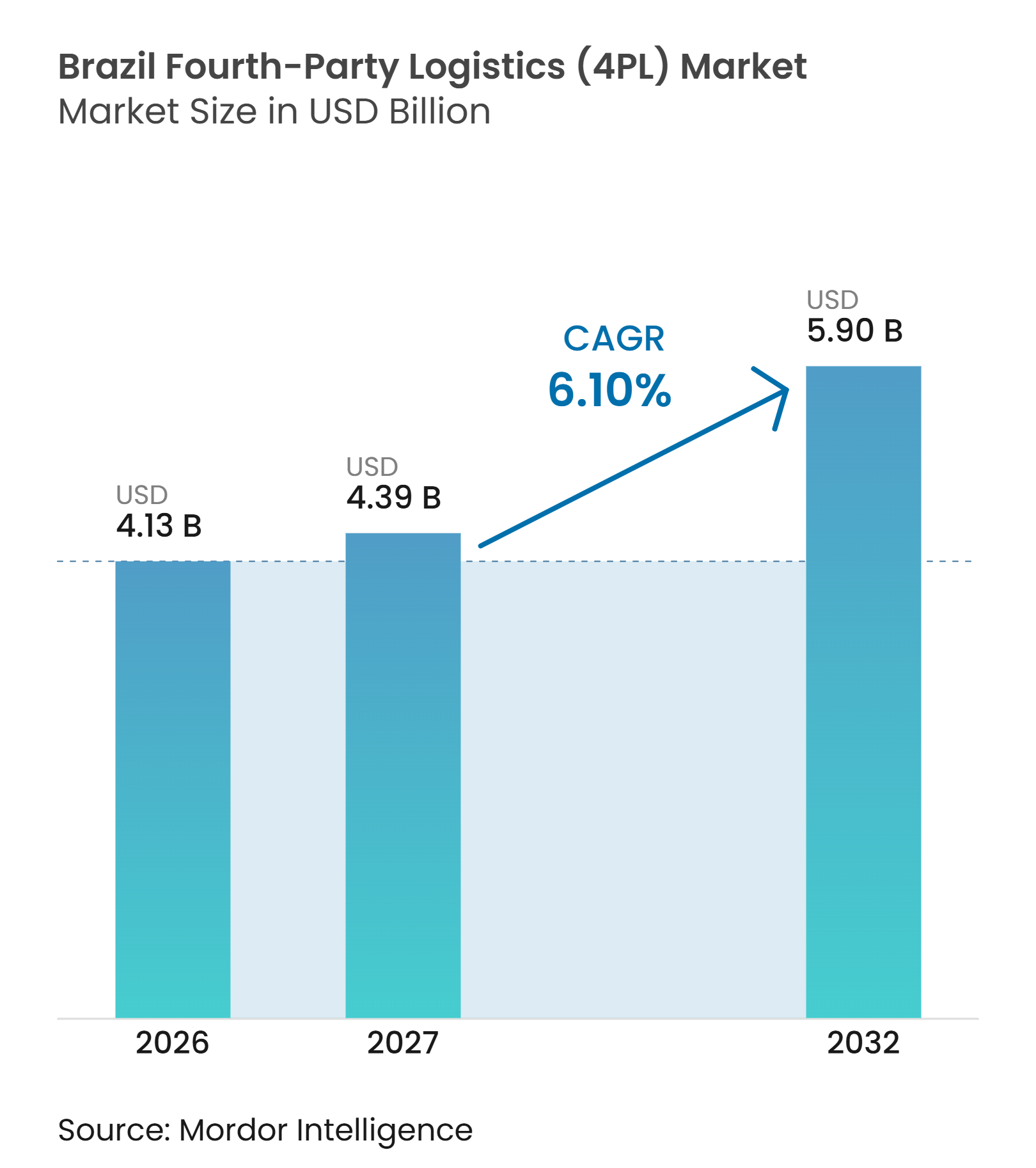
| Base Year Market Size (2026) | USD 4.13 Billion |
| Market Size (2027) | USD 4.39 Billion |
| Market Size (2032) | USD 5.90 Billion |
| Growth Rate (2027 - 2032) | 6.10 % |
| Market Concentration | Low |
Major Players *Disclaimer: Major Players sorted in no particular order Image © Mordor Intelligence. Reuse requires attribution under CC BY 4.0. | |
Brazil Fourth-Party Logistics (4PL) Market Analysis by Mordor Intelligence
The Brazil fourth-party logistics market size is valued at USD 4.13 billion in 2026. It is estimated to grow from USD 4.39 billion in 2027 to reach USD 5.90 billion by 2032, at a CAGR of 6.10% during the forecast period from 2027 to 2032.
The Brazil fourth-party logistics market is expanding as shippers consolidate fragmented carrier networks and seek a single party to coordinate transport, warehousing, and delivery performance. Public investment plans are improving the basis for multimodal coordination, including the National Logistics Plan 2050 and a 2026 auction program covering railways, roads, and ports. Large enterprises remain central to contract demand because their national networks need carrier-neutral oversight and measurable service standards. Providers are also moving beyond freight management by linking control towers, compliance processes, and specialized cold-chain operations into longer-term service contracts. This combination can make providers more central to customer planning because service quality depends on information shared across several operating partners, including carriers, warehouse operators, and technology vendors.
Key Report Takeaways
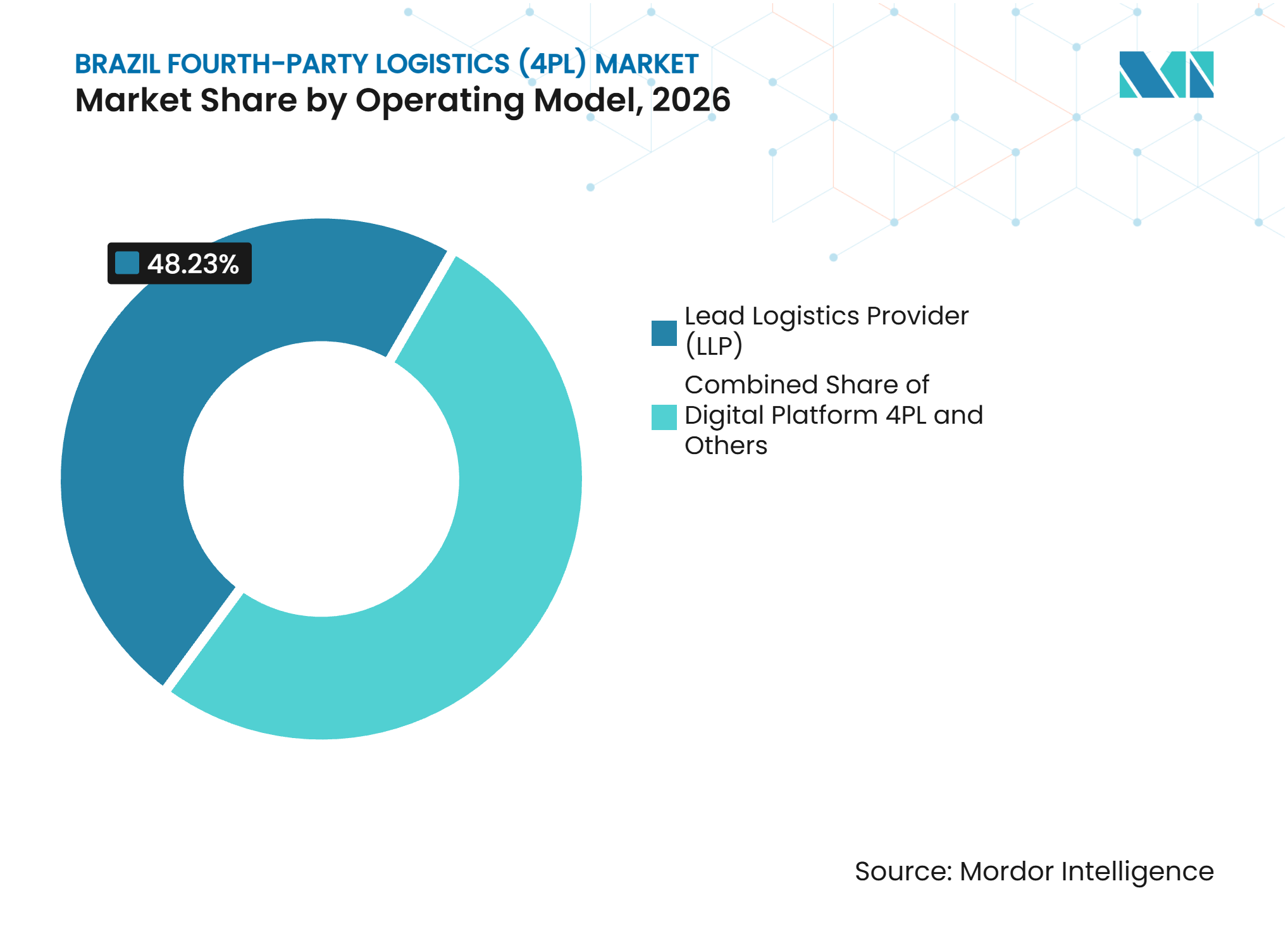
- By operating model, lead logistics providers account for 48.23% of the Brazil fourth-party logistics market share in 2026, while digital platform 4PL is forecast to register an 8.76% CAGR through 2032.
- By end-user industry, retail and e-commerce accounts for 33.65% of the Brazil fourth-party logistics market size in 2026, while refrigerated and pharma is forecast to advance at a 7.89% CAGR through 2032.
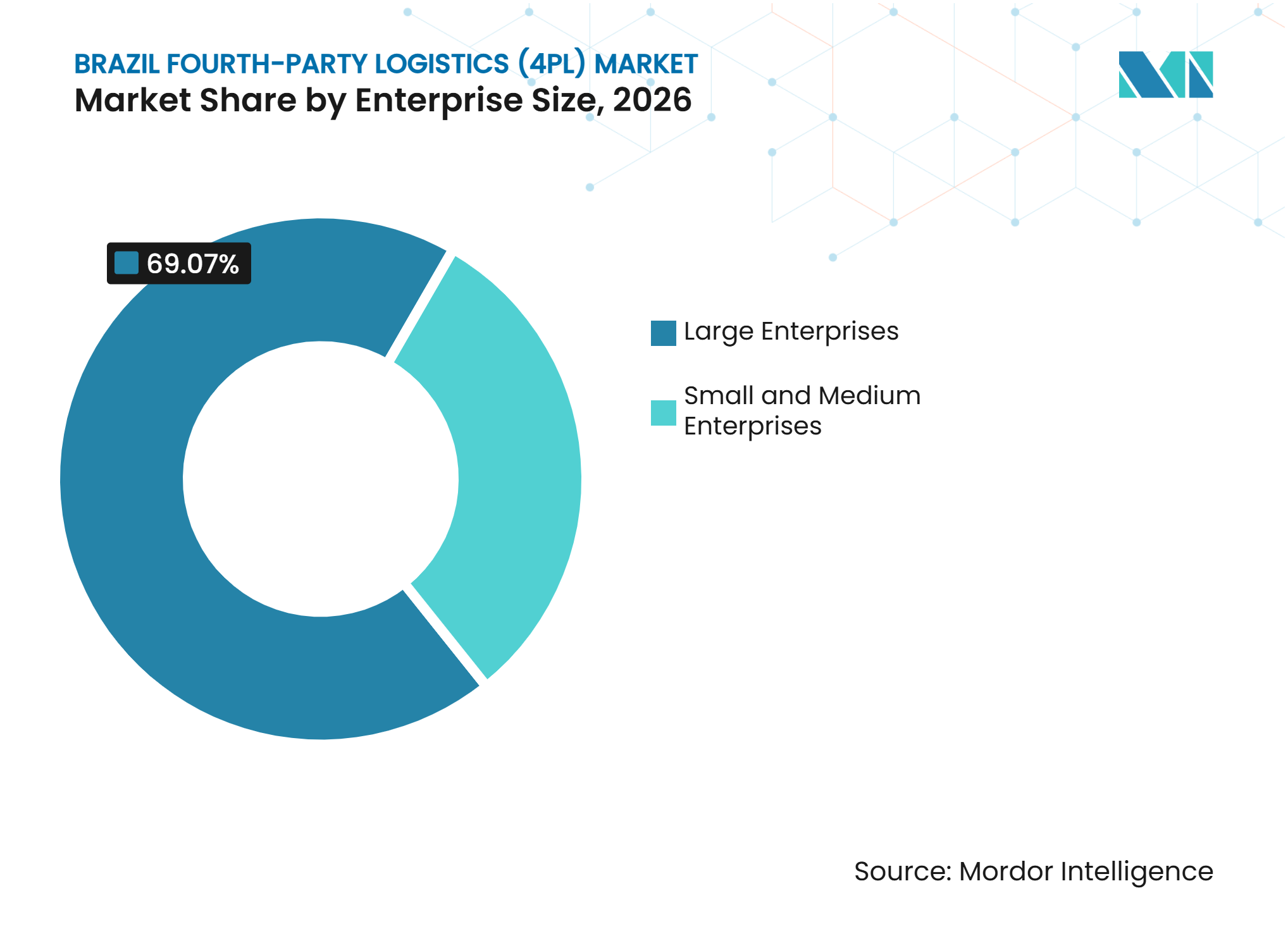
- By enterprise size, large enterprises account for 69.07% of the Brazil fourth-party logistics market share in 2026, while small and medium enterprises are forecast to register an 8.22% CAGR through 2032.
- By geography, the Southeast accounts for 43.48% of the Brazil fourth-party logistics market share in 2026, while the Northeast is forecast to expand at an 8.61% CAGR through 2032.
Note: Market numbers in this report are based on Mordor Intelligence's proprietary estimation framework, which combines nine months of actuals with Q4 projections for base year 2026.
Market Trends and Insights
Drivers Impact Analysis of Brazil Fourth-Party Logistics (4PL) Market*
| Driver | (~) % Impact on CAGR Forecast | Geographic Relevance | Impact Timeline |
|---|---|---|---|
| E-Commerce Complexity Increasing 4PL Orchestration Demand | +1.5% | Southeast and South; spill-over to Northeast | Short term (≤ 2 years) |
| Multimodal Investment Expanding Integrated Logistics Requirements | +1.2% | National, early gains in Mato Grosso, Pará, and Southeast ports | Medium term (2–4 years) |
| Control-Tower Adoption Strengthening End-to-End Supply Visibility | +0.9% | National; strongest in Southeast industrial clusters | Medium term (2–4 years) |
| Cold-Chain Growth Increasing Regulated Logistics Coordination | +0.8% | National; concentrated in Southeast, South, and Northeast | Medium term (2–4 years) |
| AI Planning Improving Exception Management and Optimization | +0.7% | National, led by São Paulo logistics corridor | Long term (≥ 4 years) |
| Vendor Consolidation Increasing Neutral Network Orchestration Demand | +0.6% | National; highest impact in automotive and consumer goods clusters | Medium term (2–4 years) |
| Source: Mordor Intelligence | |||
E-Commerce Complexity Increasing 4PL Orchestration Demand.
The Brazil fourth-party logistics market benefits from e-commerce networks that require coordination across fulfillment sites, carriers, and retail destinations. DHL Supply Chain began its Lead Logistics Partner arrangement with Alpargatas in April 2025 and took responsibility for the Campina Grande distribution operation[1]. The arrangement reduced the number of carriers from 15 to 6 and introduced a São Paulo control tower with robotic process automation. This model gives a shipper one operating view of retailer deliveries while leaving physical transport with specialized carriers. ID Logistics announced 3 structuring contracts with 2 major e-commerce platforms in April 2026, adding nearly 120,000 m² of warehouse space and more than 2,000 jobs.
Multimodal Investment Expanding Integrated Logistics Requirements
Brazil’s transport investment program is widening the range of modes that can be combined within a single supply chain. The Ministry of Transport states that the National Logistics Plan 2050 sets a long-term framework for infrastructure investment and that 2026 includes planned auctions for 8 railways, 13 roads, and 18 port projects. The new network capacity will require users to coordinate handoffs between road, rail, waterways, and port terminals. DP World and MRS Logística launched an agri-export corridor in July 2026 that connects Central-West production areas to the Port of Santos through road, rail, and port operations. The service can handle up to 84 TEUs per train, demonstrating the operating scale that integrated planning must manage. The Brazil fourth-party logistics market can benefit when shippers require independent performance oversight across these linked modes.
Cold-Chain Growth Increasing Regulated Logistics Coordination
Temperature-sensitive freight requires a stronger level of planning, documentation, and exception management than standard distribution. DHL Supply Chain invested more than BRL 100 million (USD 18.07 million) in 2025 to expand its refrigerated fleet by 60 trucks, with 50 further vehicles planned for 2026. The company also opened a DHL and SkyCell pharmaceutical service center near Guarulhos Airport, using containers designed to maintain 2 °C to 8 °C for up to 270 hours. Brazil’s ANVISA RDC 430/2020 framework makes temperature control and traceability essential across qualified pharmaceutical distribution. A 4PL provider can coordinate carriers and facilities while monitoring whether service partners meet the required procedures. This need supports the Brazil fourth-party logistics market because healthcare and food shippers must maintain a continuous record of execution across subcontracted networks.
AI Planning Improving Exception Management and Optimization
Control towers are becoming an operational requirement where national networks need quick responses to disruption. DHL Supply Chain assumed national logistics orchestration for GE HealthCare in Brazil in February 2026, covering the management of nearly 5,000 monthly invoices and roughly 1,500 operational incidents. The service includes same-day emergency dispatch within 45 minutes for Southeast and South locations. Such deployments make operational data, including carrier reliability and incident records, central to contract performance. GXO plans to deploy its GXO IQ warehouse operating system across more than 50 global sites in 2026, alongside nearly 20,000 robots. The Brazil fourth-party logistics market therefore has an opening for providers that convert operational data into practical service decisions without taking ownership of every asset.
Restraints Impact Analysis of Brazil Fourth-Party Logistics (4PL) Market*
| Restraint | (~) % Impact on CAGR Forecast | Geographic Relevance | Impact Timeline |
|---|---|---|---|
| Road Dependence Limiting Multimodal Network Efficiency | -0.6% | National; most acute in North and Northeast | Long term (≥ 4 years) |
| Compliance Complexity Increasing Cross-State Coordination Burden | -0.4% | National; disproportionate impact on cross-state 4PL operations | Medium term (2–4 years) |
| Tax Exposure Pressuring Asset-Light 4PL Economics | -0.2% | National, concentrated in Southeast hub operations | Medium term (2–4 years) |
| Cybersecurity Concerns Limiting Data Integration and Neutrality | -0.1% | National; highest exposure for digital platform 4PLs | Long term (≥ 4 years) |
| Source: Mordor Intelligence | |||
Road Dependence Limiting Multimodal Network Efficiency
Road transport remains essential to domestic freight movement, even as the public sector expands rail and port capacity. This creates reliability pressure for operators that make national service commitments across long road corridors. Delays at road-to-rail and road-to-port handoffs can weaken the delivery precision promised in performance-based contracts. The effect is more visible in the North and Northeast, where transport options can be less dense, and network recovery can take longer. The Brazil fourth-party logistics market must therefore price and manage transport volatility through diversified capacity, exception protocols, and realistic service levels. The government’s rail and road auction agenda is a relevant response, but network benefits will emerge over the medium and long term rather than immediately.
Tax Exposure Pressuring Asset-Light 4PL Economics
Brazil’s consumption tax reform changes the operating context for distribution and logistics contracts. The reform is moving from the existing taxes toward the destination-based IBS and CBS system through a transition that runs to 2033. Contract structures may need to change as shippers reassess facility locations, invoicing paths, and credit treatment. Providers with strong tax governance can provide greater certainty during these adjustments. Kuehne+Nagel Brazil joined the first group of 36 participants in the CONFIA cooperative fiscal compliance program in 2026, and it was the only logistics company in that group[2]. This environment can slow procurement decisions, but it also favors 4PL providers that can combine operational coordination with transparent compliance processes.
*Our forecasts treat driver/restraint impacts as directional, not additive. The impact forecasts reflect baseline growth, mix effects, and variable interactions.
Brazil Fourth-Party Logistics (4PL) Market Segment Analysis
By Operating Model:
LLP Holds the Largest Revenue Position While Digital Platforms AdvanceLead logistics provider accounts for 48.23% of the Brazil fourth-party logistics market share in 2026. The model gives a shipper a single accountable party to plan and supervise a multi-carrier network. It suits companies that want common service metrics across warehouse, transport, and delivery partners. DHL’s Alpargatas arrangement demonstrates this approach by combining carrier consolidation with a centralized control tower. Solution Integrators maintain a place in complex supply chains that require tailored coordination across engineering, production, and aftermarket activity. Automotive networks are especially relevant because parts availability and delivery timing need close alignment with production schedules.
Digital platform 4PL is forecast to register an 8.76% CAGR through 2032, the highest rate among operating models. Its appeal is that cloud-based tools can extend visibility and exception management to mid-sized shippers without requiring a full outsourcing arrangement. JSL reorganized its operations in 2025 and established JSL Digital as a 100% asset-light transport management platform. The platform links freight loads with an independent-driver network and reflects a move toward technology-led coordination. This part of the Brazil fourth-party logistics industry can complement LLP offerings rather than replace them in every account. Large, complex clients still often require formal governance, specialized capacity, and a broader operating model.



By End-User Industry:
Retail and E-Commerce Leads While Refrigerated and Pharma Grows FasterRetail and e-commerce accounts for 33.65% of the Brazil fourth-party logistics market size in 2026. The category requires coordination between distribution centers, cross-docking facilities, last-mile carriers, and customer returns. ID Logistics reported in April 2026 that its new contracts added nearly 120,000 m² of warehouse space and more than 2,000 jobs[3]. These investments support continuing demand for network design and operating oversight. FMCG, automotive and mobility, technology and electronics, and industrial manufacturing also sustain demand because each depends on reliable service across a large geography.
Refrigerated and pharma is forecast to register a 7.89% CAGR through 2032. The segment requires qualified multi-temperature distribution, traceability, and careful handling of biologics and other thermolabile medicines. DHL’s cold-chain fleet investment and pharmaceutical service center point to a growing need for specialized service coordination. ANVISA compliance raises the importance of keeping records across every subcontractor in the chain. The Brazil fourth-party logistics industry can support these users by making operational responsibility visible across transport, warehousing, and final delivery. Other end users, including agribusiness-linked consumer goods, add seasonal demand that requires flexible capacity planning.
By Enterprise Size:
Large Enterprises Lead Revenue While SMEs Gain Access Through PlatformsLarge enterprises account for 69.07% of the Brazil fourth-party logistics market size in 2026. Their multi-regional supply chains are more likely to need multi-carrier oversight, common key performance indicators, and structured outsourcing arrangements. Automotive, consumer goods, and pharmaceutical companies remain important buyers because their networks combine high shipment volumes with demanding service requirements. ABOL and ILOS reported that the largest 17% of Brazilian logistics operators captured 77% of sector revenue in 2026. The result shows the role of scale in procurement and in the ability to support large customer programs. Providers serving these accounts must demonstrate both network reach and a credible system for reporting performance.
Small and medium enterprises are forecast to register an 8.22% CAGR through 2032. Digital transport management platforms lower the entry barrier by connecting smaller shippers with carrier capacity and operational data. JSL Digital offers an asset-light model that can give smaller companies access to a network of independent drivers. This model can reduce the need for a company to develop a large internal logistics team before using advanced coordination services. It also makes the Brazil fourth-party logistics market less dependent on a small group of major contracts. However, platform adoption will depend on simple integration with a customer’s existing order, warehouse, and finance systems.

Geography Analysis
The Southeast accounts for 43.48% of the Brazil fourth-party logistics market size in 2026. São Paulo remains the main financial, industrial, and logistics center in the country, supporting dense flows between producers, distribution facilities, and consumers. CEVA Logistics expanded its warehousing footprint by more than 150,000 m² in 12 months and set a target of 620,000 m² by 2028. The company committed more than BRL 100 million (USD 18.07 million) to this expansion. The concentration of clients and facilities gives control-tower providers a practical base for coordinating diverse service partners. Tax reform is also likely to encourage a greater focus on proximity to end consumers when companies decide where to place distribution capacity. That shift strengthens the case for network design that looks beyond individual state tax incentives.
The Northeast is forecast to register an 8.61% CAGR through 2032, the fastest rate among Brazil’s regions. Maersk opened a distribution center in Suape, Pernambuco, in July 2026 with 11,920 m², 11,297 pallet positions, and 36 loading docks[4]. The facility integrates ocean, cabotage, inland transport, and warehousing for customers in the region. Its material-handling equipment is fully electric, indicating that operating standards are being considered alongside capacity growth. DHL’s LLP coverage for Alpargatas in Campina Grande also shows that consumer-goods supply chains in the Northeast can support structured orchestration.
The South, Central-West, and North create different opportunities for the Brazil fourth-party logistics market. Maersk expanded its Southern Brazil network in April 2026 with facilities in Rio Grande, Rio Grande do Sul, and Paranaguá, Paraná, to support agribusiness export flows. The Rio Grande depot covers nearly 70,000 m² for dry and refrigerated container handling, while the Paranaguá expansion brought the cargo services area to 6,000 m². In the Central-West, the DP World and MRS corridor creates a single road, rail, and port flow between production areas and Santos. Tegma is investing BRL 30 million (USD 5.42 million) in automotive yards near Camaçari, Bahia, and Horizonte, Ceará, linking regional manufacturing activity to broader logistics networks. The North remains less developed for structured services, but the National Logistics Plan 2050 places the Arco Norte corridor within its infrastructure priorities. Providers that understand commodity seasonality, port interfaces, and regional compliance requirements can build more durable positions across these mixed geographies.
Competitive Landscape
Market Concentration
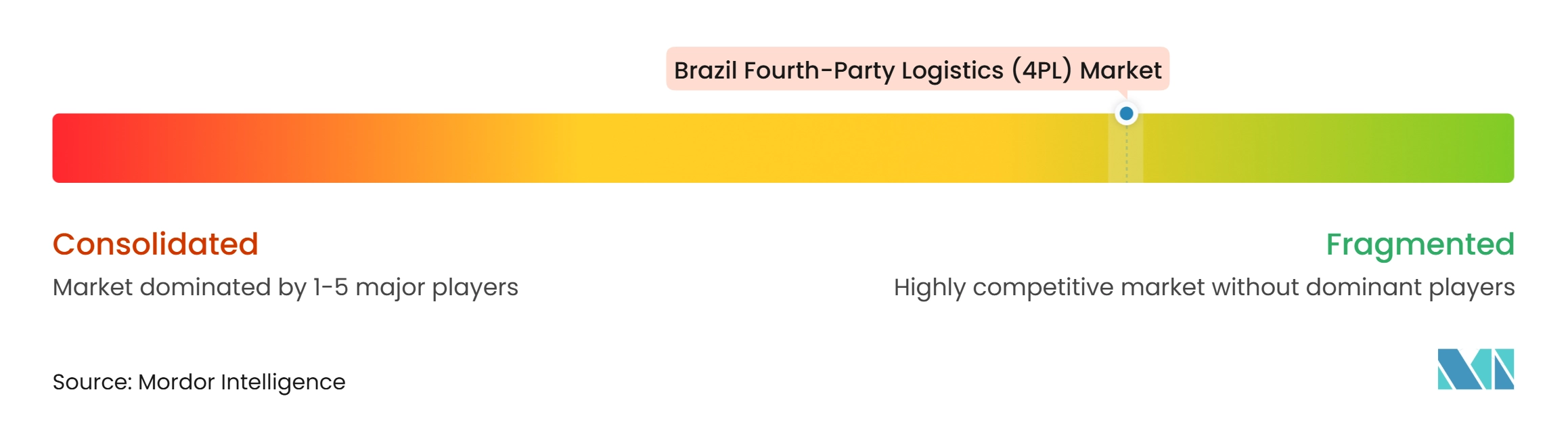
The Brazil fourth-party logistics market is a fragmented market. Global integrators, including DHL Group, A.P. Moller-Maersk, CEVA Logistics, Kuehne+Nagel, and DSV, compete using control-tower capabilities, multimodal networks, and relationships in healthcare, retail, and automotive. Domestic providers such as JSL and Tegma add local operating knowledge and established customer access. CEVA’s investment in new capacity illustrates how network scale can support bids for integrated logistics work. At the same time, asset-light offerings can compete on flexibility and data visibility rather than warehouse ownership. This creates room for specialized providers that can coordinate partners without replicating every physical asset.
DHL Supply Chain’s GE HealthCare contract is one example of a provider moving deeper into national orchestration. The arrangement covers incident monitoring, invoice processing, and urgent delivery requirements, which ties the provider’s role to daily service outcomes. DP World and MRS Logística provide another example through their Central-West to Santos export corridor, which joins road, rail, and port operations. Maersk’s Suape distribution center offers a third example by bringing ocean, cabotage, inland transport, and warehousing together for Northeast customers. These moves show that competitive strength increasingly depends on connecting operating capabilities into a clear customer proposition. Providers with effective compliance and quality processes will have an advantage in regulated sectors.
JSL’s 2025 reorganization created an asset-light digital unit alongside its logistics and dedicated-services businesses. DSV’s completed integration of Schenker strengthened its ability to offer a broader multimodal service base in Brazil. Kuehne+Nagel’s inclusion in the CONFIA program also distinguishes its approach to cooperative tax compliance. The competitive field therefore includes both asset-rich international providers and technology-led domestic models. Competition is likely to remain active because clients can select separate partners for specialized transport, warehouses, and digital coordination.
Brazil Fourth-Party Logistics (4PL) Industry Leaders
-
DHL Group
-
DSV A/S
-
JSL SA
-
BBM Logística SA
-
CMA CGM Group
- *Disclaimer: Major Players sorted in no particular order
Brazil Fourth-Party Logistics (4PL) Market Companies Covered in this Report
- DHL Group
- DSV A/S
- CMA CGM Group
- Kuehne+Nagel International AG
- A.P. Moller - Maersk
- 4flow
- Penske Logistics
- GEODIS
- C.H. Robinson Worldwide Inc.
- Rhenus Logistics
- UPS Supply Chain Solutions
- FedEx Logistics
- GXO Logistics Inc.
- Nippon Express Co. Ltd
- DP World
- JSL SA
- ID Logistics
- Yusen Logistics Co. Ltd
- FM Logistic
- BBM Logistica SA
- Tegma Gestão Logística SA
- Multilog SA
Recent Industry Developments in Brazil Fourth-Party Logistics (4PL) Market
- July 2026: A.P. Moller-Maersk inaugurated a distribution center in Suape, Pernambuco, with 11,920 m², 11,297 pallet positions, 36 loading docks, and 100% electric material-handling equipment, integrating ocean, cabotage, inland transport, and warehousing under one offering for the Northeast.
- July 2026: DP World and MRS Logística launched a multimodal agri-export corridor from Brazil’s Central-West to the Port of Santos, integrating road, rail, and port operations handling up to 84 TEUs per train and cutting GHG emissions by up to 80% versus road-only alternatives.
- April 2026: DHL Supply Chain announced its orchestration of GE HealthCare's national logistics operations in Brazil, managing approximately 5,000 invoices and 1,500 operational incidents monthly through an integrated control-tower model.
- April 2026: ID Logistics secured 3 structuring contracts with 2 major e-commerce platforms, adding nearly 120,000 m² of warehouse space and creating more than 2,000 jobs, bringing ID Logistics Brazil to 72 logistics sites and over 1 million m² of warehouse space.
Brazil Fourth-Party Logistics (4PL) Market Report Scope
Segmentation Overview
| Lead Logistics Provider (LLP) |
| Solution Integrator |
| Digital Platform 4PL |
| FMCG |
| Retail and E-commerce |
| Fashion and Lifestyle |
| Technology and Electronics |
| Refrigerated and Pharma |
| Automotive and Mobility |
| Industrial Manufacturing |
| Others |
| Small and Medium Enterprises |
| Large Enterprises |
| North |
| Northeast |
| Central-West |
| Southeast |
| South |
| By Operating Model | Lead Logistics Provider (LLP) |
| Solution Integrator | |
| Digital Platform 4PL | |
| By End-User Industry | FMCG |
| Retail and E-commerce | |
| Fashion and Lifestyle | |
| Technology and Electronics | |
| Refrigerated and Pharma | |
| Automotive and Mobility | |
| Industrial Manufacturing | |
| Others | |
| By Enterprise Size | Small and Medium Enterprises |
| Large Enterprises | |
| By Region | North |
| Northeast | |
| Central-West | |
| Southeast | |
| South |
Key Questions Answered in the Report
What is the projected value of Brazil’s fourth-party logistics sector by 2032?
The Brazil fourth-party logistics market size is forecast to reach USD 5.90 billion by 2032, growing at a 6.10% CAGR from 2027.
Which operating model leads Brazil’s 4PL sector?
Lead logistics provider leads with 48.23% of revenue in 2026, while digital platform 4PL has the highest forecast CAGR at 8.76% through 2032.
Which customer segment is growing fastest for 4PL providers in Brazil?
Small and medium enterprises are forecast to register an 8.22% CAGR through 2032 as digital platforms make coordinated logistics services more accessible.
Why is refrigerated and pharmaceutical logistics important in Brazil?
Refrigerated and pharma is forecast to register a 7.89% CAGR through 2032, supported by strict ANVISA requirements for traceability and temperature control.
Which region leads demand for fourth-party logistics services in Brazil?
The Southeast leads with 43.48% of revenue in 2026, supported by São Paulo’s industrial base, consumer concentration, and logistics infrastructure.
How is tax reform affecting logistics contracts in Brazil?
The shift to the IBS and CBS tax system through 2033 is prompting companies to review distribution locations, invoicing, and compliance processes.