
Brazil Cross-border Road Freight Transport Market Size and Share
Market Overview
| Study Period | 2021 - 2032 |
|---|---|
| Forecast Data Period | 2027 - 2032 |
| Base Year Market Size (2026) | USD 17.62 Billion |
| Market Size (2027) | USD 18.61 Billion |
| Market Size (2032) | USD 24.14 Billion |
| Growth Rate (2027 - 2032) | 5.34 % |
| Market Concentration | Low |
Major Players *Disclaimer: Major Players sorted in no particular order Image © Mordor Intelligence. Reuse requires attribution under CC BY 4.0. | |
Brazil Cross-border Road Freight Transport Market Analysis by Mordor Intelligence
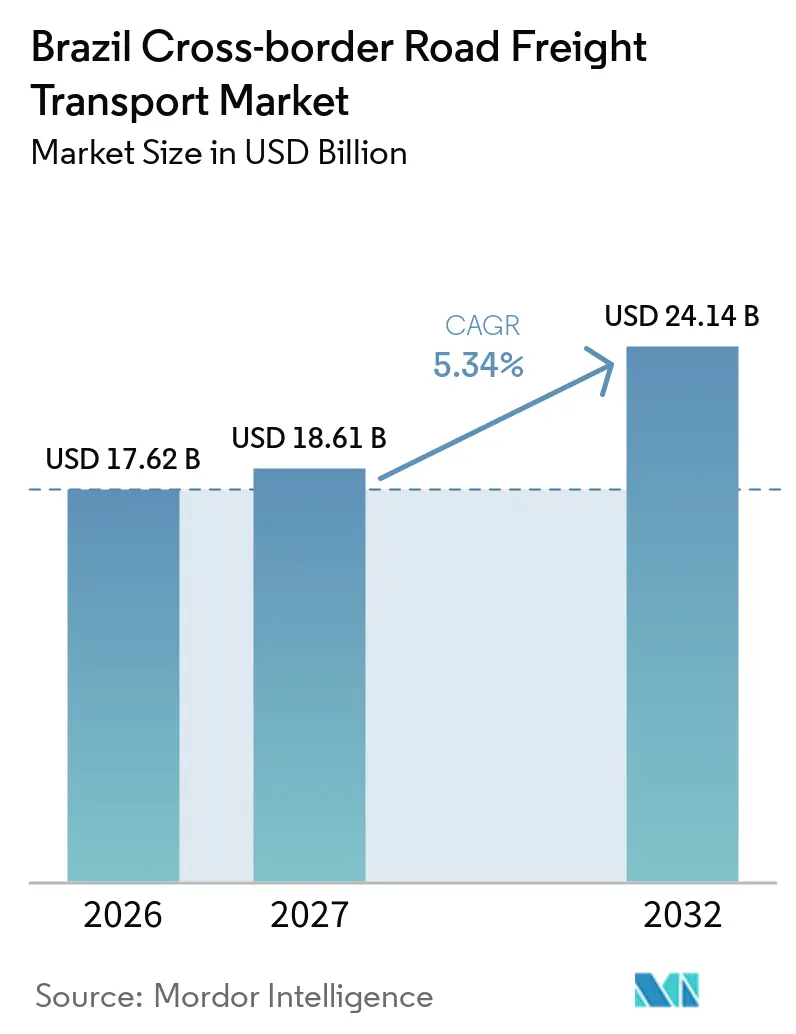
The Brazil cross-border road freight transport market size is valued at USD 17.62 billion in 2026 and is estimated to grow from USD 18.61 billion in 2027 to reach USD 24.14 billion by 2032, at a CAGR of 5.34% during the forecast period (2027-2032).
The Brazil cross-border road freight transport market is supported by regional trade in manufactured goods, where trucking can offer more flexible scheduling and shorter transit times than maritime services. Road exports from Brazil to South America reached USD 22.6 billion in 2025, their highest level in 10 years, with Argentina, Chile, Paraguay, and Uruguay accounting for much of this activity. Industrial integration across Mercosur is increasing the need for reliable scheduled transport, better documentation, and freight consolidation near border gateways. The Brazil cross-border road freight transport market also faces pressure from diesel costs, uneven road conditions, empty return trips, and border procedures. Digital customs systems and corridor upgrades can improve operating conditions, but their benefits will depend on practical implementation at major crossings.
Key Report Takeaways
- By end-user industry, manufacturing accounts for 41.37% of the Brazil cross-border road freight transport market share in 2026, while wholesale and retail trade is forecast to expand at a 7.46% CAGR through 2032.
- By truckload specification, full truckload accounts for 79.41% of the Brazil cross-border road freight transport market size in 2026, while less-than-truckload is forecast to expand at a 6.34% CAGR through 2032.
- By containerization, non-containerized freight accounts for 85.69% of the Brazil cross-border road freight transport market share in 2026, while containerized freight is forecast to expand at a 7.24% CAGR through 2032.
- By distance, long haul accounts for 72.17% of the Brazil cross-border road freight transport market size in 2026, while short haul is forecast to expand at a 7.29% CAGR through 2032.
- By goods configuration, solid goods accounts for 70.63% of the Brazil cross-border road freight transport market share in 2026, while fluid goods is forecast to expand at an 8.36% CAGR through 2032.
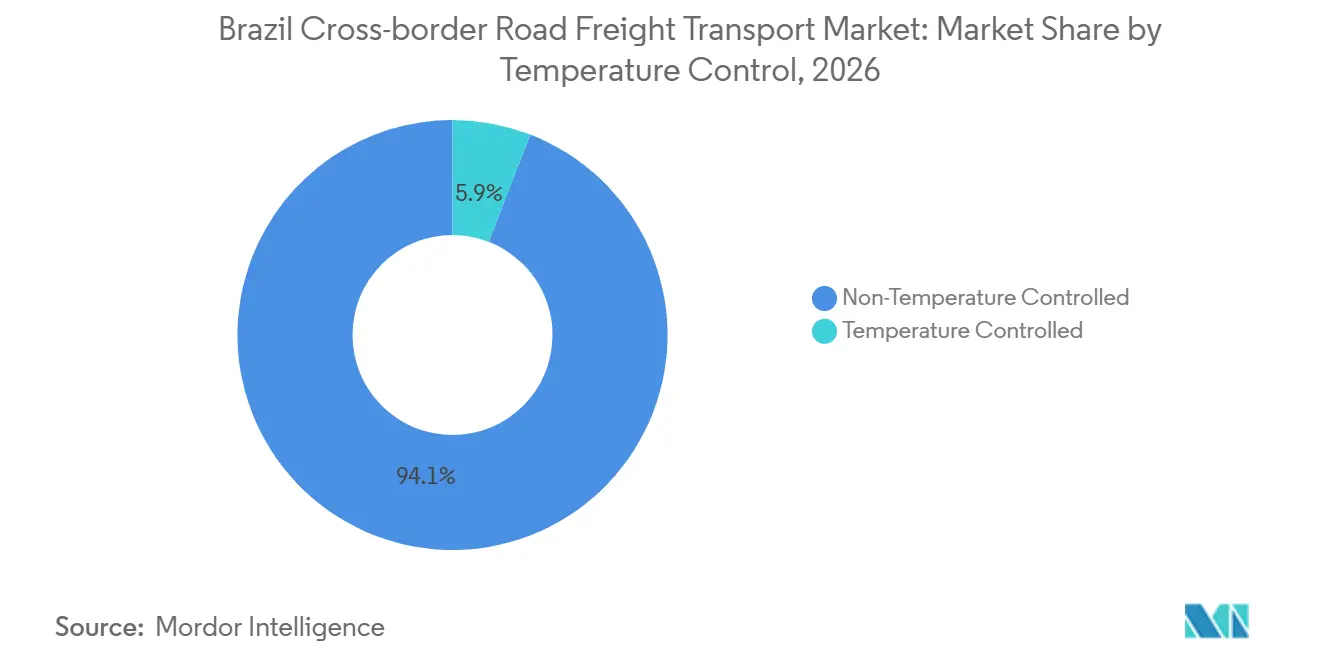
- By temperature control, non-temperature-controlled freight accounts for 94.11% of the Brazil cross-border road freight transport market size in 2026, while temperature-controlled freight is forecast to expand at a 7.39% CAGR through 2032.
- By cross-border lane, Brazil-Argentina accounts for 46.57% of the Brazil cross-border road freight transport market share in 2026, while Brazil-Paraguay is forecast to expand at a 7.36% CAGR through 2032.
Note: Market numbers in this report are based on Mordor Intelligence's proprietary estimation framework, which combines nine months of actuals with Q4 projections for base year 2026.
Market Trends and Insights
Drivers Impact Analysis of Brazil Cross-border Road Freight Transport Market*
| Driver | (~) % Impact on CAGR Forecast | Geographic Relevance | Impact Timeline |
|---|---|---|---|
| Intra-Mercosur Trade Expanding Cross-Border Freight Demand | +1.2% | All lanes, with core impact in Brazil-Argentina and Brazil-Paraguay corridors | Medium term (2-4 years) |
| Highway Modernization Improving International Road Corridor Efficiency | +1.0% | Brazil's domestic network and cross-border gateways, including the Brazil-Chile Bioceanic Corridor | Long term (≥ 4 years) |
| E-Commerce Growth Increasing Cross-Border LTL Shipment Volumes | +0.8% | Brazil-Argentina and Brazil-Paraguay, with spillover to Brazil-Uruguay | Medium term (2-4 years) |
| Manufacturing Integration Strengthening Regional Supply Chain Flows | +0.7% | Brazil-Argentina, Brazil-Paraguay maquila operations, and Brazil-Uruguay | Medium term (2-4 years) |
| Digital Customs Improving Border Clearance and Cargo Visibility | +0.5% | All lanes, with gains concentrated at Uruguaiana, Foz do Iguaçu, and Jaguarão. | Short term (≤ 2 years) |
| Border Consolidation Hubs Improving Backhaul Utilization Efficiency | +0.3% | Brazil-Argentina and Brazil-Paraguay border hubs | Medium term (2-4 years) |
| Source: Mordor Intelligence | |||
Intra-Mercosur Trade Expanding Cross-Border Freight Demand
Brazilian road exports to South America reached USD 22.6 billion in 2025, with Argentina receiving USD 10.6 billion, Chile USD 3.6 billion, Paraguay USD 3.8 billion, and Uruguay USD 2.3 billion[1]. The Brazil cross-border road freight transport market benefits when trade includes medium- and high-technology manufactured goods that need frequent delivery and flexible routing. Brazil-Argentina goods trade exceeded USD 31 billion in 2025, and this exchange supports recurring truck movements across automotive, chemical, and food supply chains. Higher production complexity can increase shipment frequency faster than freight weight, which favors carriers that can combine smaller consignments. ANTT pursued work on vehicle weights, technical inspection certificates, and digital freight data exchange through Mercosur transport discussions. More consistent operating rules can reduce administrative friction for operators serving multiple countries.
Highway Modernization Improving International Road Corridor Efficiency
Brazilian highway concession projects can improve access to international gateways and reduce delays on the domestic sections of long cross-border trips. The Capricorn Bioceanic Corridor is planned to link Mato Grosso do Sul through Paraguay and Argentina to Pacific ports in Chile, with projected freight cost reductions of 30% to 40% and shipping-time savings of up to 15 days once the route is operational. The Porto Murtinho-Carmelo Peralta bridge is the key Brazil-Paraguay connection in this corridor, and its completion is central to the route's commercial use. The Brazil cross-border road freight transport market can gain from more predictable long-haul routes to Chilean ports and inland markets.
E-Commerce Growth Increasing Cross-Border LTL Shipment Volumes
Brazil's expanding e-commerce sector is reshaping cross-border freight requirements by increasing demand for smaller, more frequent shipments alongside conventional full-truckload movements. This shift is increasing the importance of consolidation centers that can combine parcels and retail replenishment cargo before border clearance. Improvements to Brazil's Portal Único system, including integration APIs and support for land transport, facilitate advance document submission and coordination among logistics stakeholders. Efficient documentation is particularly important for frequent shipments, as border delays can disrupt inventory replenishment and delivery schedules. Carriers with extensive terminal networks, reliable tracking systems, and strong customs documentation capabilities are better positioned to serve these evolving cross-border logistics needs.
Manufacturing Integration Strengthening Regional Supply Chain Flows
Paraguay's maquila regime created a growing source of Brazil-bound cargo, particularly in auto parts, textiles, beverages, and aluminum products. Maquila manufacturing activity strengthens cross-border freight demand by linking production schedules with regional export markets, particularly Brazil. This trade pattern increases the importance of scheduled transport services, frequent cross-border collections, and dependable delivery coordination. Carriers that align pickup schedules with manufacturing output can help exporters maintain production flows and meet delivery commitments. The Brazil cross-border road freight transport market is increasingly shaped by the Brazil-Paraguay lane's transition from consumer-goods re-exports toward manufacturing-linked trade. Argentina also remains important because it receives 56% of Brazil's medium- and high-technology manufacturing exports, supporting regular bilateral truck traffic. Operators that can manage load visibility and documentation quality can benefit as delivery windows become more demanding.
Restraints Impact Analysis of Brazil Cross-border Road Freight Transport Market*
| Restraint | (~) % Impact on CAGR Forecast | Geographic Relevance | Impact Timeline |
|---|---|---|---|
| Fuel Volatility Increasing Cross-Border Transport Operating Costs | -1.1% | All lanes, with the strongest effect on Brazil-Chile and Brazil-Argentina long-haul routes | Short term (≤ 2 years) |
| Border Bureaucracy Increasing Documentation and Clearance Complexity | -0.9% | Brazil-Argentina, Brazil-Paraguay, and Brazil-Uruguay crossings | Medium term (2-4 years) |
| Uneven Road Quality Disrupting Cross-Border Transit Reliability | -0.6% | Northern and northeastern Brazil and parts of Paraguayan and Argentine corridors | Long term (≥ 4 years) |
| Trade Imbalances Increasing Empty-Return and Backhaul Risk | -0.4% | Brazil-Argentina, Brazil-Uruguay, and secondarily Brazil-Chile | Medium term (2-4 years) |
| Source: Mordor Intelligence | |||
Fuel Volatility Increasing Cross-Border Transport Operating Costs
Diesel S-10 prices in Brazil increased 15.26% through September 2026. Fuel represents a material operating cost for road freight and affects long cross-border movements[2]. ANTT adjusted its minimum-freight-rate coefficient to BRL 7.33 (USD 1.33) per liter in March 2026 after the diesel threshold was reached. Higher floor rates can reflect operating costs, but they do not remove pressure when contract prices lag fuel movements. The Brazil cross-border road freight transport market is particularly exposed on Brazil-Argentina routes when loaded southbound trips are followed by weaker northbound return demand. Mid-sized carriers have less capacity to manage this exposure through fuel hedging or long-term supply agreements.
Border Bureaucracy Increasing Documentation and Clearance Complexity
Digital customs advancements have yet to fully resolve the operational complexities associated with separate customs, sanitary, and transport procedures. Even green-channel cargo can experience waiting times of up to 72 hours at dry ports in Uruguaiana. In April 2025, work-to-rule actions by customs workers resulted in queues at the Uruguaiana dry port, highlighting the potential for border procedures to disrupt road freight schedules. The IRU identifies harmonized customs procedures and integrated inspections as critical to unlocking the commercial potential of overland Mercosur corridors. The Brazil cross-border road freight transport market depends on predictable release times, as trucks, drivers, and equipment may remain unavailable during the clearance process. Digital CRT and MIC/DTA processing through Portal Único can enhance visibility; consistent interagency coordination remains essential.
*Our forecasts treat driver/restraint impacts as directional, not additive. The impact forecasts reflect baseline growth, mix effects, and variable interactions.
Brazil Cross-border Road Freight Transport Market Segment Analysis
By End User Industry:
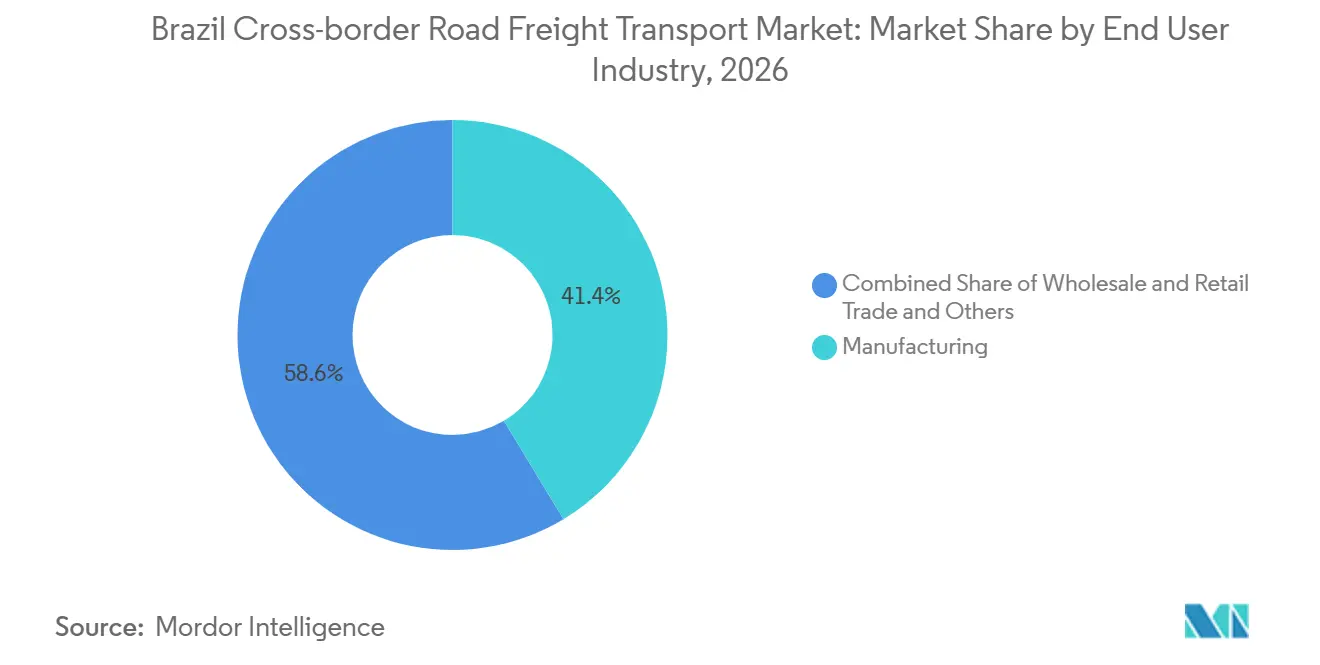
Manufacturing Commands the Largest Share, Wholesale and Retail Trade AcceleratesManufacturing accounts for 41.37% of the Brazil cross-border road freight transport market share in 2026. Automotive, chemical, and agro-industrial supply chains support manufacturing's leading position because they require recurring movement of parts, inputs, and finished goods. Brazil-Argentina vehicle and parts flows show the role of industrial linkages in generating frequent and relatively high-value truckloads. Agriculture, fishing, and forestry continue to create large freight volumes between Brazil, Argentina, and Paraguay. Their growth is more limited where bulk commodities can shift to rail or waterways. Construction cargo is linked to investment cycles in Paraguay and Uruguay, while oil, gas, mining, and quarrying require specialized vehicles on the Brazil-Chile-Argentina axis.
Wholesale and retail trade is forecast to register a 7.46% CAGR through 2032. This segment grows faster because retailers require more frequent replenishment of branded consumer goods from Brazilian suppliers. Cross-border e-commerce adds to this demand by creating smaller orders that need consolidation at gateways. The Brazil cross-border road freight transport industry is therefore rewarding operators that combine local collection networks with dependable border processing. Terminal density supports efficient load building and faster delivery of retail freight. Tracking capability also becomes more important when a single shipment contains multiple consignees. These conditions favor companies that can operate both line-haul capacity and smaller distribution movements without losing control of documents or delivery status.

By Truckload Specification:
Full Truckload Dominates, LTL Outpaces on GrowthFull truckload accounts for 79.41% of the Brazil cross-border road freight transport market share in 2026. Full truckload is suitable for agricultural machinery, automotive assemblies, chemicals, and other freight that can fill an entire trailer. The Brazil-Argentina and Brazil-Paraguay lanes contain vertically integrated trade flows that naturally support direct full loads. Full truckload also allows operators to limit intermediate handling and maintain more predictable transit schedules. Its scale gives it a stable role across the Brazil cross-border road freight transport market. Long-distance routes and higher-value industrial freight further reinforce its position.
Less-than-truckload is forecast to register a 6.34% CAGR through 2032. Less-than-truckload is expanding because retail orders and parcel movements are becoming more frequent and smaller. This category requires carriers to combine multiple loads, coordinate several delivery points, and complete documentation accurately for each shipment. Braspress Transportes Internacional is an example of a dedicated service for fragmented international loads in Mercosur. Interlink Cargo is an operator that uses OEA and SASSMAQ certifications alongside full truckload and less-than-truckload services. These capabilities are important because the cost of a border delay is higher when several customers' consignments are carried together. The Brazil cross-border road freight transport industry can therefore see more investment in terminals, line-haul planning, and compliance systems for less-than-truckload freight.
By Containerization:
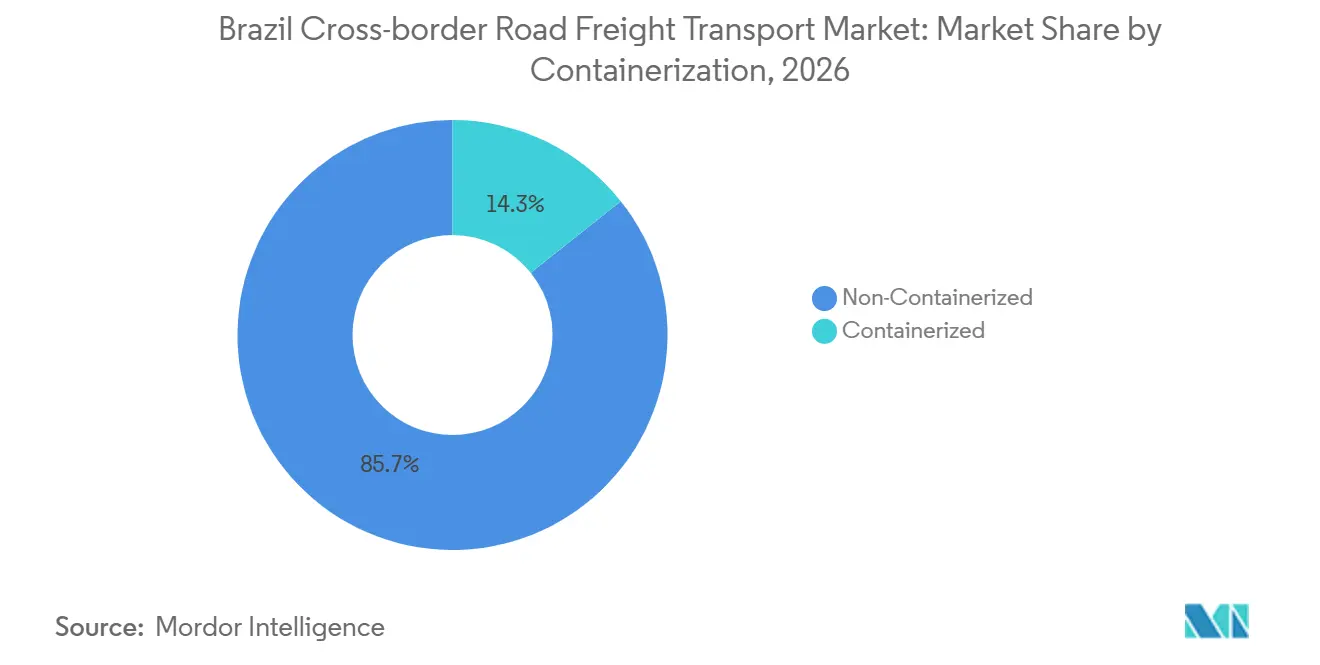
Non-Containerized Freight Remains Dominant, Containerized Grows FastestNon-containerized freight accounts for 85.69% of the Brazil cross-border road freight transport market share in 2026. Bulk agricultural products, liquid tanker shipments, machinery, and loose consumer goods are often more efficiently moved in open or covered trailers. These cargoes do not require ISO containers and fit established road-freight practices across Mercosur. The Brazil cross-border road freight transport market retains a broad base of non-containerized freight because the region's commodity and industrial flows have varied loading needs. Trailer-based freight also remains suitable for direct factory-to-customer or farm-to-border movements. This structure keeps non-containerized services central to corridor operations.
Containerized road freight is forecast to register at a 7.24% CAGR through 2032. Containerized road freight is growing from a smaller base as importers seek continuity between road, port, and intermodal operations. Automotive and consumer electronics shippers can use container-compatible loading to reduce handling between transport modes. Tegma Gestão Logística began a container logistics and yard-management partnership with BYD in August 2026 for movements between the Port of Salvador and the Camaçari facility[3]. ANTT's revised TRIC rules can reduce the compliance burden for operators on multi-country routes. The Brazil cross-border road freight transport market may therefore see a gradual rise in containerized traffic where port-connected supply chains need reliable inland movement. Growth will remain dependent on suitable equipment, secure yards, and clear cross-border licensing.
By Distance:
Long Haul Leads in Volume, Short Haul Registers Fastest GrowthLong haul accounts for 72.17% of the Brazil cross-border road freight transport market share in 2026. Major trade routes require multi-day trips because São Paulo to Buenos Aires is close to 2,500 km and São Paulo to Santiago exceeds 3,000 km. Long-haul services connect the largest manufacturing and agricultural centers in Brazil with major Mercosur demand centers. This geography explains why long-haul remains the core volume category in the Brazil cross-border road freight transport market. Long movements also carry the greatest exposure to fuel prices, driver availability, and road quality. Carriers serving these routes need robust fleet scheduling and reliable maintenance support.
Short haul is forecast to register at a 7.29% CAGR through 2032. Short-haul growth is linked to twin-border cities and maquila parks that lie within 300 km of national frontiers. These shorter movements can carry components and finished goods between factories, consolidation hubs, and customs facilities. Foz do Iguaçu and Uruguaiana are important because freight can be consolidated, cleared, and redistributed around the border. This model reduces the cost of serving smaller loads and supports frequent deliveries. ANTT's minimum-rate rules use distance coefficients that can favor longer trips with high vehicle utilization. The Brazil cross-border road freight transport market will need pricing structures that maintain viable short-haul returns if enforcement tightens without adjustments for border-zone routes.
By Goods Configuration:
Solid Goods Dominant, Fluid Goods Fastest GrowingSolid goods account for 70.63% of the Brazil cross-border road freight transport market share in 2026. Agricultural machinery, auto parts, processed foods, electronics, and packaged consumer goods create the structural volume base for solid-goods freight. These products move regularly on the Brazil-Argentina and Brazil-Paraguay corridors. Their variety requires different trailer configurations, but the underlying service model remains familiar to regional carriers. The Brazil cross-border road freight transport market continues to rely on this broad base of solid-goods movements. Manufacturers and retailers also benefit from established loading, warehousing, and distribution practices for these cargoes.
Fluid goods are forecast to register an 8.36% CAGR through 2032. Energy-sector trade and biodiesel swap agreements are another factor supporting specialized liquid freight. Tanker and flexi-bag equipment requires more operational attention than dry freight equipment. Hazardous-goods routing and inspection procedures add further complexity at border crossings. The Brazil cross-border road freight transport industry can offer higher margins to established liquid-freight operators because certification and equipment needs limit new entry. This specialization makes safety controls, driver training, and documentation essential to sustaining service quality.
By Temperature Control:
Ambient Loads Dominate, Cold Chain Records Fastest ExpansionNon-temperature-controlled freight accounts for 94.11% of the Brazil cross-border road freight transport market share in 2026. Manufactured goods, agricultural commodities, and construction materials usually do not need active thermal management. This broad range of ambient freight explains the category's dominant role in the Brazil cross-border road freight transport market. Standard dry trailers also have lower equipment and operating requirements than refrigerated units. Most cross-border industrial movements can therefore continue to use ambient services. The category remains important even as higher-value cold-chain services expand.
Temperature-controlled freight is forecast to register at a 7.39% CAGR through 2032. Temperature-controlled freight serves pharmaceuticals, frozen proteins, and fresh produce moving between Mercosur countries. These shipments require closer compliance with food, health, and sanitary standards across national borders. Abralog highlighted the need for precise regulatory alignment in Mercosur cold-chain operations. ANTT's minimum-rate table uses higher coefficients for refrigerated cargo than for dry general cargo. This can support investment in certified refrigeration capacity where shippers need dependable temperature control. The Brazil cross-border road freight transport market offers a clear opportunity for operators that can maintain equipment quality, traceability, and compliant handling throughout the trip.
Geography Analysis
Brazil-Argentina accounts for 46.57% of the Brazil cross-border road freight transport market share in 2026. Brazil-Argentina is the leading lane because decades of industrial integration link vehicle, chemical, and food-processing supply chains. Bilateral goods trade exceeded USD 31 billion in 2025, which provides a large base of recurring freight demand. The Brazil cross-border road freight transport market is most exposed to the conditions of this corridor because of its weight in regional volumes. Short-term trade changes can affect truck utilization, as Brazilian exports to Argentina declined 18.1% in June 2026 compared with June 2025. The established industrial relationship nevertheless continues to support the lane's central role.
Brazil-Paraguay is forecast to register a 7.36% CAGR through 2032. Brazil-Paraguay benefits from maquila production, Brazilian investment, and the planned Bioceanic Corridor connection. Brazil-Uruguay remains smaller, but road traffic at Chuy benefits from bilateral customs integration and a role in consumer-goods trade. Brazil-Chile produces high revenue per truck because of distance, fuel needs, and mountain crossings. Its freight volumes are limited by current infrastructure until the Bioceanic Corridor becomes operational. The Brazil cross-border road freight transport market also includes Brazil-Bolivia and other emerging routes that can gain relevance as corridor links improve. Each lane needs a different balance of equipment, border knowledge, cargo specialization, and backhaul planning.
Brazil-Uruguay records a smaller volume base, but the Chuy crossing handles close to 40,000 trucks annually[4]. The lane benefits from customs coordination and Uruguay's role in re-exporting Brazilian consumer goods. Brazil-Chile generates higher revenue per truck because of the longer route and Andean crossing requirements. The OECD estimates that the full Bioceanic Corridor could reduce freight costs by 30% to 40% and save up to 15 shipping days. These changes could strengthen Chile's place in the Brazil cross-border road freight transport market. Brazil-Bolivia and other routes remain smaller, though the wider Capricorn network creates future options for new regional road connections.
Competitive Landscape
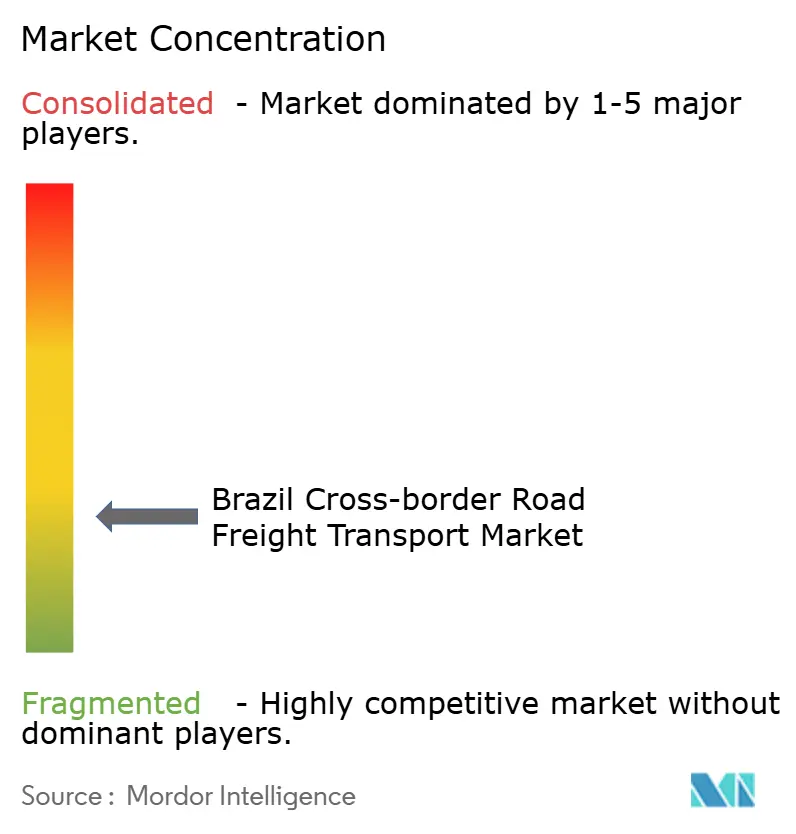
The Brazil cross-border road freight transport market is fragmented. Global integrators compete through broader networks, technology systems, and the ability to connect ground freight with international forwarding. Corridor specialists compete through local knowledge, bonded facilities, and compliance credentials at specific crossings. Their service reliability can be important where customs delays threaten delivery schedules. OEA-certified operators have an advantage when documentation quality and priority processing affect transit times. The Brazil cross-border road freight transport market therefore does not depend only on fleet scale, as corridor execution and border capability can be equally important.
DSV completed its acquisition of DB Schenker in April 2025, creating a larger logistics platform with broader international coverage. The combined operation runs more than 40 service centers across the Americas and operates close to 1,700 trucks daily in the region. This transaction expands DSV's ability to connect Brazilian full truckload and less-than-truckload operations with global sea and air freight networks. CEVA Logistics signed an agreement with Iveco Group for a 20,000 m² parts distribution center in Pouso Alegre, Minas Gerais, which supports its broader contract-logistics position in Brazil. Tegma also entered container logistics and yard management through its BYD partnership, adding a new service area to its automotive logistics base. These moves show how larger providers are adding warehousing, container handling, and international transport capabilities around road freight.
Cold-chain capacity remains limited in mid-corridor locations despite temperature-controlled freight's 7.39% projected CAGR. Digital platforms that can manage cross-border compliance documents are also less developed than standard domestic freight systems. Small-lot consolidation on the Paraguay axis is concentrated among a limited group of specialized operators. Companies that combine compliance certification with local terminals can reduce border uncertainty for retail and manufacturing shippers. The Brazil cross-border road freight transport market can remain competitive because local corridor knowledge remains valuable even as international providers expand.
Brazil Cross-border Road Freight Transport Industry Leaders
-
JSL SA (including Marvel)
-
Gafor SA
-
Veloce Logística
-
DSV A/S (including DB Schenker)
-
CEVA Logistics (CMA CGM Group)
- *Disclaimer: Major Players sorted in no particular order
Brazil Cross-border Road Freight Transport Market Companies Covered in this Report
- BBM Logística
- Braspress Transportes Urgentes (including Braspress Transportes Internacional)
- CEVA Logistics (CMA CGM Group)
- DHL Group
- DSV A/S (including DB Schenker)
- Gafor SA
- Interlink Cargo
- JSL SA (including Marvel)
- Logística Ruver
- Mercosullog
- Paranálog
- Polivias
- SIF Group
- Tegma Gestão Logística
- Tora Transportes
- TransBroker
- Transmaas
- Transpanorama Transportes
- Transportes Cordenonsi
- TW Transportes
- Veloce Logística
- VIP Logistics Brazil
Recent Industry Developments in Brazil Cross-border Road Freight Transport Market
- July 2026: CEVA Logistics received Brazilian regulatory authorization for its Argentine finished-vehicle logistics operation to provide international road freight services between Argentina and Brazil, supporting cross-border automotive transportation across authorized border crossings.
- March 2026: BBM Logística unveiled its 2026-2028 strategic growth plan, entering a structured expansion phase focused on scale, operational efficiency, and technology after closing 2025 with a record SLA of approximately 98%, above the 95% national sector average.
- February 2026: DHL Global Forwarding repositioned Brazil as the hub of its Latin American logistics network, centering operations on Guarulhos and Viracopos airports in Sao Paulo, targeting 30% growth in consolidated cross-border cargo volumes by the end of 2026.
- January 2026: Braspress Transportes Internacionais received authorization from Brazil's National Land Transport Agency (ANTT) to operate international road freight services between Brazil and Argentina and between Brazil and Paraguay, with a ten-year licensing period.
Brazil Cross-border Road Freight Transport Market Report Scope
Segmentation Overview
| Agriculture, Fishing, and Forestry |
| Construction |
| Manufacturing |
| Oil and Gas, Mining and Quarrying |
| Wholesale and Retail Trade |
| Others |
| Full-Truck-Load (FTL) |
| Less than-Truck-Load (LTL) |
| Containerized |
| Non-Containerized |
| Long Haul |
| Short Haul |
| Fluid Goods |
| Solid Goods |
| Non-Temperature Controlled |
| Temperature Controlled |
| Brazil-Argentina |
| Brazil-Paraguay |
| Brazil-Uruguay |
| Brazil-Chile |
| Other Cross-Border Road Freight Lanes |
| By End User Industry | Agriculture, Fishing, and Forestry |
| Construction | |
| Manufacturing | |
| Oil and Gas, Mining and Quarrying | |
| Wholesale and Retail Trade | |
| Others | |
| By Truckload Specification | Full-Truck-Load (FTL) |
| Less than-Truck-Load (LTL) | |
| By Containerization | Containerized |
| Non-Containerized | |
| By Distance | Long Haul |
| Short Haul | |
| By Goods Configuration | Fluid Goods |
| Solid Goods | |
| By Temperature Control | Non-Temperature Controlled |
| Temperature Controlled | |
| By Cross-Border Lane | Brazil-Argentina |
| Brazil-Paraguay | |
| Brazil-Uruguay | |
| Brazil-Chile | |
| Other Cross-Border Road Freight Lanes |
Key Questions Answered in the Report
What is the projected value of Brazil cross-border road freight transport by 2032?
The sector is forecast to reach USD 24.14 billion by 2032, rising from USD 18.61 billion in 2027 at a 5.34% CAGR.
Which end user generates the most cross-border road freight demand in Brazil?
Manufacturing accounts for a 41.37% share in 2026, supported by automotive, chemical, and agro-industrial supply chains.
Why is Brazil-Paraguay expanding faster than other freight corridors?
The lane is forecast to register a 7.36% CAGR through 2032, supported by maquila production and Bioceanic Corridor development.
What is driving less-than-truckload services across Mercosur borders?
Smaller retail orders and cross-border e-commerce shipments are increasing demand for consolidation, tracking, and frequent delivery services.
What are the main operating risks for cross-border trucking operators?
Diesel price increases, border documentation complexity, uneven road quality, and empty return trips can pressure carrier costs and schedules.
Which freight category is growing the fastest?
Fluid goods have the highest listed growth rate, with an 8.36% CAGR through 2032, supported by specialized liquid cargo movements.