
Brazil Contract Logistics Market Size and Share
Market Overview
| Study Period | 2021 - 2032 |
|---|---|
| Forecast Data Period | 2027 - 2032 |
| Base Year Market Size (2026) | USD 8.04 Billion |
| Market Size (2027) | USD 8.49 Billion |
| Market Size (2032) | USD 11.10 Billion |
| Growth Rate (2027 - 2032) | 5.50 % |
| Market Concentration | Low |
Major Players *Disclaimer: Major Players sorted in no particular order Image © Mordor Intelligence. Reuse requires attribution under CC BY 4.0. | |
Brazil Contract Logistics Market Analysis by Mordor Intelligence
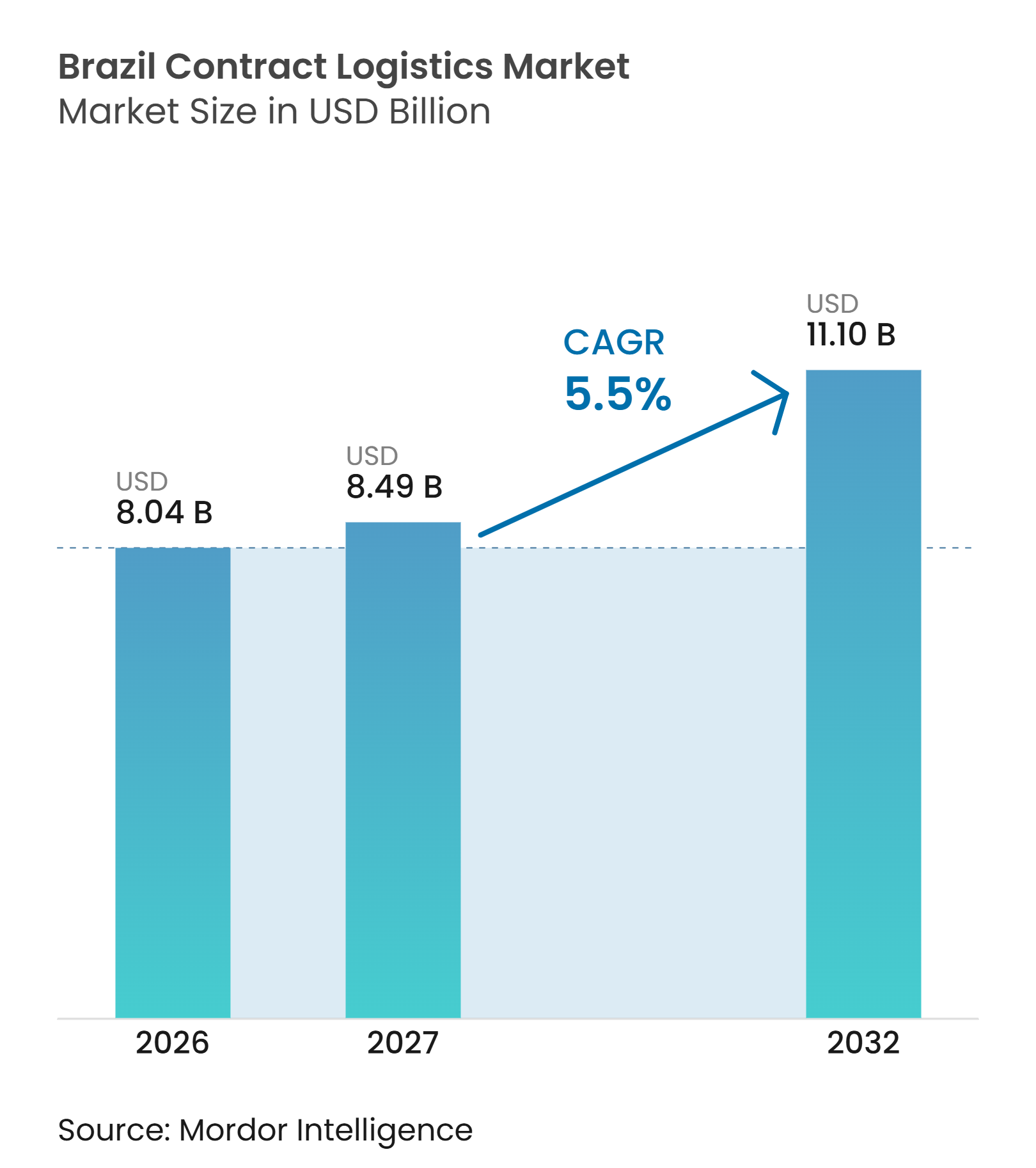
The Brazil contract logistics market size is valued at USD 8.04 billion in 2026. It is estimated to grow from USD 8.49 billion in 2027 to reach USD 11.10 billion by 2032, at a CAGR of 5.50% during the forecast period from 2027 to 2032.
Growth is supported by manufacturers and retailers moving asset-intensive transport, warehousing, and fulfillment work to specialist providers, allowing them to focus capital and management attention on production, merchandising, and customer service. Brazil’s tax reform is also changing distribution-network decisions because companies are reviewing facilities that were designed around state tax advantages under the earlier system. The Brazil contract logistics market therefore favors providers that can combine transport, warehousing, compliance, and inventory visibility in one operating model. Digital retail, automotive localization, rail and port investment, and temperature-controlled distribution are reinforcing demand for specialized services. At the same time, transport congestion, skilled-labor constraints, and the need to adapt systems during the tax transition can increase operating costs and make execution discipline important.
Key Report Takeaways
- By service type, transportation accounts for 58.56% of the Brazil contract logistics market share in 2026, while value-added services are forecast to register a 7.89% CAGR through 2032.
- By contract duration, above 3 years accounts for 58.92% of the Brazil contract logistics market size in 2026 and is forecast to register a 7.18% CAGR through 2032.
- By end-user industry, manufacturing and automotive accounts for 26.23% of the Brazil contract logistics market share in 2026, while healthcare and pharmaceuticals is forecast to register an 8.12% CAGR through 2032.
- By operating model, dedicated contract logistics accounts for 57.62% of the Brazil contract logistics market size in 2026, while shared or multi-client contract logistics is forecast to register a 6.39% CAGR through 2032.
- By geography, Southeast accounts for 42.14% of the Brazil contract logistics market share in 2026, while Northeast is forecast to register a 7.76% CAGR through 2032.
Note: Market numbers in this report are based on Mordor Intelligence's proprietary estimation framework, which combines nine months of actuals with Q4 projections for base year 2026.
Market Trends and Insights
Drivers Impact Analysis of Brazil Contract Logistics Market*
| Driver | (~) % Impact on CAGR Forecast | Geographic Relevance | Impact Timeline |
|---|---|---|---|
| E-Commerce Growth Expanding Contract Logistics Demand | +1.2% | National, highest intensity in Southeast and Northeast | Short term (≤ 2 years) |
| Automotive Localization Increasing Sequenced Logistics Requirements | +0.8% | Southeast (São Paulo, Minas Gerais); Northeast (Ceará) | Medium term (2–4 years) |
| Multimodal Investment Strengthening Integrated Distribution Networks | +0.9% | National; early gains in Center-West, North, and Northeast corridors | Long term (≥ 4 years) |
| Cold-Chain Demand Expanding Specialized Contract Logistics | +0.7% | Southeast (44.7% of pharmaceutical cold-chain volume) spill-over to South and Northeast | Medium term (2–4 years) |
| Secondary-City Fulfillment Increasing Distributed Warehousing Demand | +0.5% | Northeast and Central-West; secondary markets in South | Short term (≤ 2 years) |
| Control-Tower Adoption Strengthening Contractual Supply Visibility | +0.4% | National, led by São Paulo logistics hubs | Medium term (2–4 years) |
| Source: Mordor Intelligence | |||
E-Commerce Growth Expanding Contract Logistics Demand
Digital retail is raising demand for fulfillment space that can process varied order volumes and manage rapid dispatch. The Brazil contract logistics market benefits when online platforms need facilities that can operate across several customer accounts instead of relying only on dedicated sites. This model lets providers spread warehouse labor, systems, and transport capacity across a broader client base. CEVA Logistics opened a 67,000 m² Amazon fulfillment center in Santa Maria, Distrito Federal, during 2025, showing the scale of facilities being used to serve national e-commerce networks. DHL Supply Chain and Amazon also opened a 31,000 m² distribution center in Cariacica during 2026, with capacity to process more than 420,000 packages each week[1]. These investments extend fulfillment capacity beyond the São Paulo axis and increase the value of providers that can start operations quickly and maintain consistent service during demand peaks.
Automotive Localization Increasing Sequenced Logistics Requirements
Automotive manufacturing requires tightly controlled inbound flows, parts sequencing, storage, and traceability. The Brazil contract logistics market gains from this requirement because vehicle makers and component suppliers often need systems and labor that are difficult to reproduce internally. CEVA Logistics signed a contract with Iveco Group in November 2025 to operate a 20,000 m² parts distribution center in Pouso Alegre, Minas Gerais, while Iveco invested BRL 93 million (USD 16.79 million) in the facility. Such operations require a provider to coordinate inventory accuracy, warehouse movements, and aftermarket availability rather than simply transport freight. Automotive activity also supports demand for bonded processes, kitting, and packaging services in locations close to assembly plants and parts corridors. Compliance requirements for controlled products and transport documentation raise the value of operators with established procedures and trained workforces.
Multimodal Investment Strengthening Integrated Distribution Networks
Brazil’s logistics network remains road-led, but investments in rail, ports, terminals, and coastal shipping can create more choices for shippers. The Brazil contract logistics market can capture this change when providers connect inland storage and distribution with maritime or rail movements. DP World and Maersk entered an eight-year agreement in 2025 to expand maritime services at the Port of Santos, including 6 new services and 8 weekly calls in the first year. Maersk also expanded depot infrastructure at Rio Grande and Paranaguá in 2026 to support agribusiness exports and refrigerated cargo. The practical effect is a stronger case for bundled contracts that cover port handling, inventory staging, customs coordination, inland movement, and delivery. Network integration may reduce dependence on a single transport route, although the benefits depend on reliable connections beyond major gateways.
Cold-Chain Demand Expanding Specialized Contract Logistics
Temperature-controlled logistics requires validated facilities, appropriate packaging, trained handling teams, and continuous monitoring. These needs create a higher barrier to entry than conventional storage and transport, which supports specialized demand in the Brazil contract logistics market. Brazil’s logistics association reported that refrigerated logistics capacity was expected to increase by 4.5% in 2026 despite operating challenges[2]. DHL Supply Chain expanded its Bristol Myers Squibb operation in Extrema during 2026 with climate-controlled capabilities for life-sciences products. Providers with validated cold-chain operations can compete for pharmaceutical and healthcare contracts where service quality, temperature records, and regulatory conformity matter as much as price. These capabilities also help customers limit product-loss risk when storage conditions change unexpectedly during loading, delivery, or transfer between facilities.
Restraints Impact Analysis of Brazil Contract Logistics Market*
| Restraint | (~) % Impact on CAGR Forecast | Geographic Relevance | Impact Timeline |
|---|---|---|---|
| Road and Port Bottlenecks Reducing Service Reliability | -0.7% | National; most acute on BR-163 (Center-West to North), Port of Santos (Southeast), and Northeast port access roads | Short term (≤ 2 years) |
| Compliance Complexity Increasing Multi-State Operating Burden | -0.5% | National; transition period 2026–2033 under LC 214/2025 | Medium term (2–4 years) |
| Skilled Labor Shortages Constraining Warehouse Operations | -0.4% | National, highest in São Paulo and Southeast logistics hubs | Short term (≤ 2 years) |
| Currency Exposure Pressuring Contract Logistics Margins | -0.3% | National; most acute for multinational providers billing in USD | Medium term (2–4 years) |
| Source: Mordor Intelligence | |||
Road and Port Bottlenecks Reducing Service Reliability
Road congestion and port access constraints can interrupt schedules, increase safety-stock needs, and raise emergency transport costs. This is important for the Brazil contract logistics market because providers are often responsible for service levels that depend on infrastructure outside their direct control. Peak demand can make it harder to preserve delivery windows for importers, exporters, and manufacturers. Operators respond by using alternate facilities, planning additional lead time, and building more flexibility into contracts. These actions protect service continuity, but they can also limit margin expansion where customers resist higher logistics costs.
Skilled Labor Shortages Constraining Warehouse Operations
Warehouse and transport operations depend on supervisors, drivers, equipment operators, planners, and technical staff who can work with increasingly digital systems. The labor shortage is a restraint because service quality suffers when providers cannot staff new facilities at the same pace as demand. ABRALOG identified the shortage of qualified labor as a structural barrier for logistics in Brazil. The pressure is particularly relevant in large logistics hubs where several providers compete for the same experienced workforce. Companies can respond with training, automation, and more standardized warehouse processes, but these measures require investment and time. The result is a stronger preference for established providers that already have operating teams, process controls, and the capacity to move labor across sites.
*Our forecasts treat driver/restraint impacts as directional, not additive. The impact forecasts reflect baseline growth, mix effects, and variable interactions.
Brazil Contract Logistics Market Segment Analysis
By Service Type:
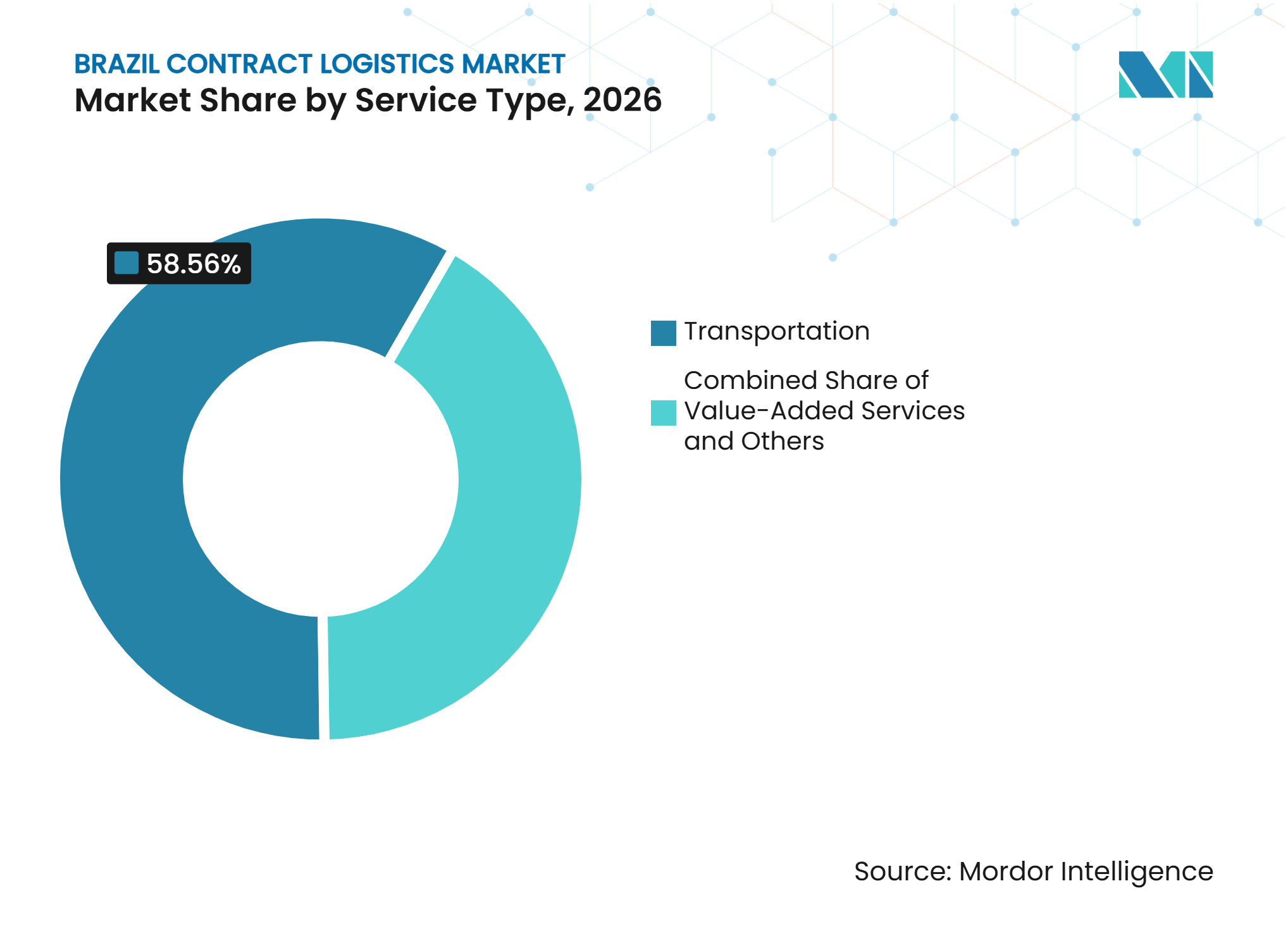
Value-Added Services Is Growing Faster Than TransportationTransportation accounts for 58.56% of the Brazil contract logistics market share in 2026, reflecting the central role of freight movement in a geographically large country. Road transport remains fundamental to the service mix because it connects industrial clusters, ports, retail locations, and inland customer bases. Warehousing and distribution form the next major layer of service demand because customers need inventory positioned near consumption and production centers. Providers are increasingly expected to coordinate transport with inventory management instead of treating the two activities as separate services. This integration supports contracts that connect receiving, storage, picking, dispatch, and returns management. It also gives customers a clearer view of costs and service performance across the supply chain.
Value-added services are forecast to expand at a 7.89% CAGR through 2032, the highest rate within the service-type segmentation. Assembly, labeling, kitting, repacking, and quality checks can place operations closer to the point of demand and reduce handling steps for customers. These services are relevant for e-commerce, automotive parts, consumer products, and healthcare goods, where order accuracy and product configuration matter. ID Logistics launched a control-tower solution in Brazil during 2025 that integrates ERP, TMS, WMS, and Power BI functions for transport management and operational visibility[3]. This type of capability helps a provider combine physical handling with data-based coordination. As customers seek fewer handoffs between vendors, service providers with both operational depth and technology capability may secure a larger portion of each contract.



By Contract Duration:
Longer Agreements Reflect Operational ComplexityAbove 3 years accounts for 58.92% of the Brazilian contract logistics sector share in 2026 and is forecast to register a 7.18% CAGR through 2032. Longer agreements are common when a provider must dedicate assets, systems, process design, or trained teams to a customer’s operation. These arrangements are particularly relevant for cold-chain, automotive, industrial, and large distribution-center work. Changing providers can disrupt inventory flow and require a customer to repeat system integrations and staff training. As a result, customers often value continuity when logistics execution directly affects production or regulated product handling. Longer terms also give operators more time to recover investments in equipment and site modifications.
Shorter agreements remain useful where customers need flexibility, particularly in fast-changing fulfillment networks. E-commerce clients may adjust their facility footprint as demand moves among cities, product ranges change, or delivery expectations rise. Providers therefore need a balanced contract portfolio that combines predictable multi-year work with flexible assignments. JSL and Vamos signed a 7-year forklift-fleet lease valued at BRL 74.67 million (USD 13.49 million) in 2025 for a new intralogistics contract. The agreement illustrates the equipment commitment behind long-duration operations. The tax transition can also encourage clearer commercial terms because both customer and provider need a workable approach to costs while systems and tax rules evolve.
By End-User Industry:
Automotive Holds Volume While Healthcare Leads GrowthManufacturing and automotive accounts for 26.23% of the Brazilian contract logistics sector share in 2026. The segment relies on regular inbound parts supply, production-line sequencing, storage of components, and distribution of spare parts. These needs are concentrated around industrial areas in São Paulo and Minas Gerais, while newer automotive investment also supports logistics activity in other regions. A provider serving this segment must protect part availability, track inventory carefully, and align deliveries to plant schedules. The contract often extends beyond conventional freight into site logistics, material handling, and aftermarket distribution. This makes industry knowledge and reliable operating routines important competitive factors.
Healthcare and pharmaceuticals are forecast to expand at an 8.12% CAGR through 2032, making it the fastest-growing end-user segment. Its growth reflects demand for validated temperature control and dependable distribution of products that cannot tolerate handling failures. The Brazil contract logistics market size for this segment is supported by strict storage and distribution processes rather than large freight volumes alone. DHL’s expanded Bristol Myers Squibb operation in Extrema shows continued investment in climate-controlled pharmaceutical handling. Kuehne+Nagel also began a healthcare contract logistics operation in Brazil with Opella during 2025, using a purpose-built temperature-controlled distribution center. Providers that cannot document temperature performance and meet health-sector requirements may be unable to compete for these contracts.
By Operating Model:
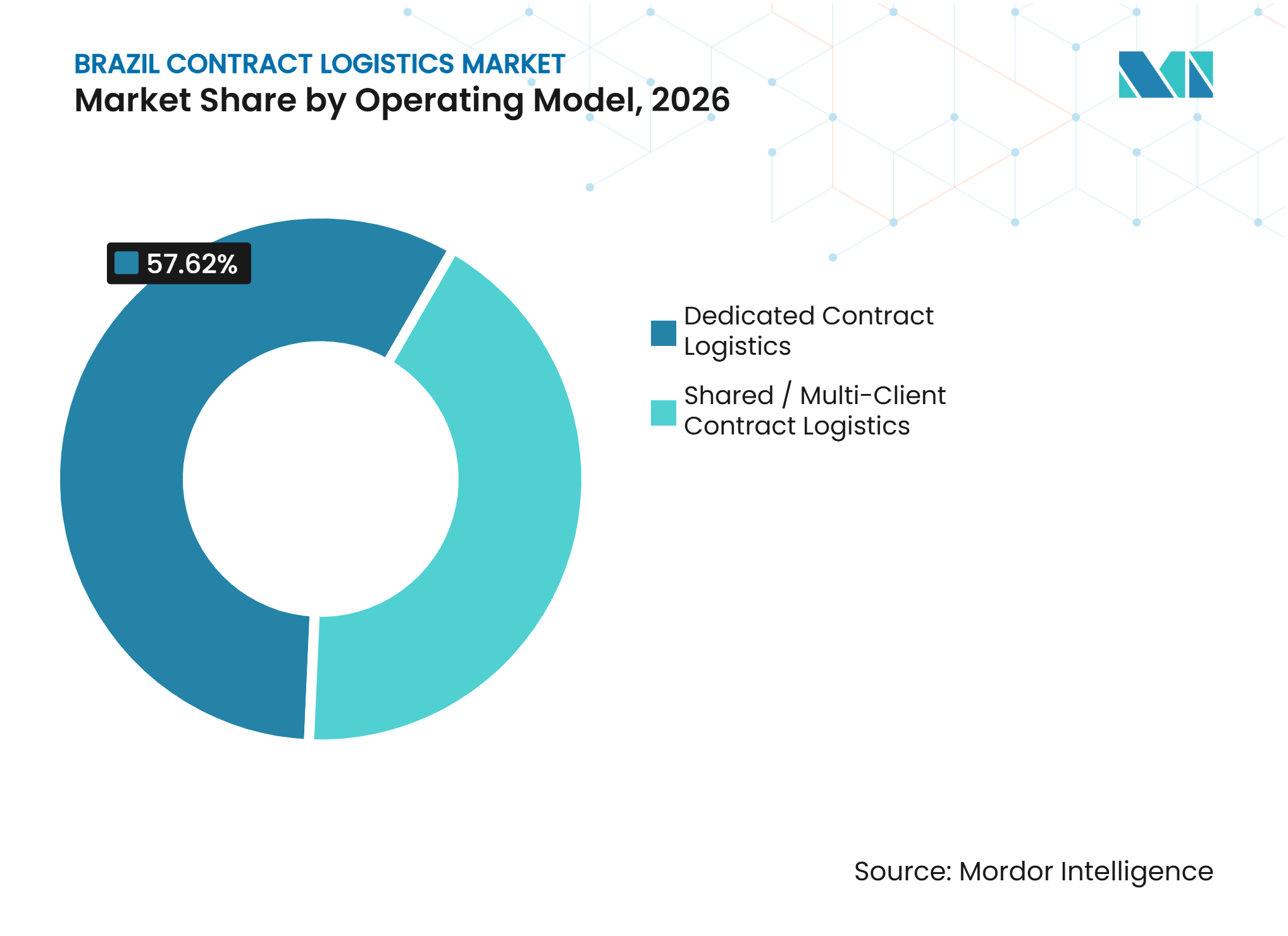
Dedicated Operations Lead While Shared Networks Gain DemandDedicated contract logistics accounts for 57.62% of the Brazilian contract logistics sector share in 2026. Large manufacturers favor dedicated assets when production requirements, product characteristics, or service commitments need close control. Automotive customers can require specific delivery sequences, while chemical and healthcare customers may need carefully managed storage and handling environments. A dedicated site gives the customer clear access to agreed labor, vehicles, systems, and warehouse capacity. It also helps the operator tailor procedures to a customer’s products and workflows. For these reasons, dedicated contracts remain important where a logistics disruption could stop production or compromise regulated goods.
Shared or multi-client contract logistics is forecast to register a 6.39% CAGR through 2032. The model enables customers to use common transport lanes, warehouse space, and labor pools instead of carrying the full cost of a dedicated operation. This can be valuable for retailers, smaller manufacturers, and e-commerce businesses with variable demand. Maersk opened an 11,920 m² distribution center near Suape in 2026 to combine warehousing, fulfillment, cross-docking, and customs services for several customer sectors. The facility demonstrates how shared infrastructure can support integrated services without requiring every customer to develop a separate site. The model will remain most compelling where providers can maintain service quality while balancing the requirements of multiple customers.

Geography Analysis
The Southeast accounts for 42.14% of the Brazil contract logistics market share in 2026. The concentration of manufacturing, consumer demand, distribution centers, and the Port of Santos supports its position. DHL’s 2026 expansion of its Bristol Myers Squibb operation in Extrema illustrates the region’s role in life-sciences distribution. The regional network benefits from established transport corridors and a broad supplier base, although congestion can create service risks. Compliance factors are important for pharmaceutical operations because validated storage and monitoring procedures are central to customer requirements.
The Northeast is forecast to register a 7.76% CAGR through 2032, the fastest rate among the geographic segments. Its growth is linked to e-commerce expansion, rising distribution activity, and new infrastructure near major ports. Maersk began commercial operations at APM Terminals Suape in 2026, describing the facility as Latin America’s first fully electrified container terminal, with an initial capacity of 400,000 TEUs annually. Maersk also opened a nearby distribution center in Cabo de Santo Agostinho that connects warehousing with fulfillment, cross-docking, customs, and inland transport. Electrification at Suape also gives shippers a practical option to consider environmental performance in logistics procurement.
The South supports agribusiness exports and refrigerated cargo, while the Center-West is shaped by agricultural production and the North depends more on river-linked transport. Maersk expanded depot capacity in Rio Grande and Paranaguá during 2026 to serve export and refrigerated cargo requirements. Tegma approved BRL 22 million (USD 3.97 million) in 2026 to expand its river-based vehicle transport fleet between Belém and Manaus[4]. Providers operating across these regions need varied network designs because a model that works near a southern port may not suit river logistics in the North or agricultural flows in the Center-West.
Competitive Landscape
Market Concentration
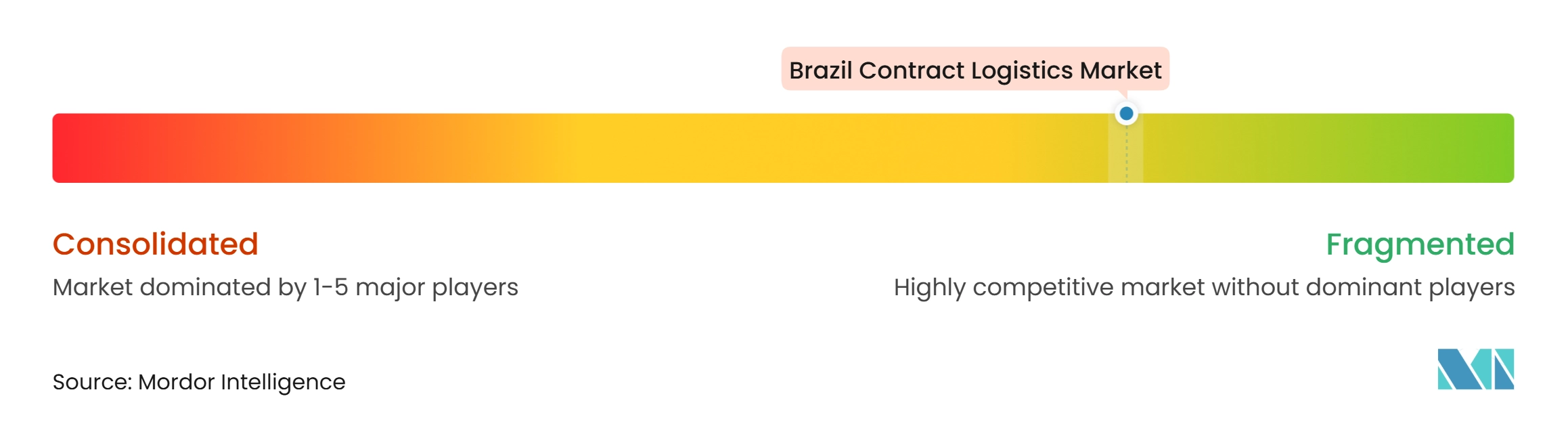
The Brazil contract logistics market is fragmented, with global integrators and domestic specialists serving different client needs. Global providers compete strongly in e-commerce, automotive, healthcare, and international supply chains because these activities benefit from standardized processes and broad networks. Domestic firms retain relevant positions in regional distribution, road transport, bonded facilities, and local operating knowledge. Competition increasingly centers on the ability to combine warehousing, transport, customs support, technology, and value-added work within a single contract. Service reliability and the capacity to manage complex operations influence customer selection.
Several company actions show how competitors are strengthening their positions. Maersk opened the Suape distribution center in 2026 to connect ocean services, warehousing, fulfillment, cross-docking, and customs activity in Northeast Brazil. CEVA’s contract to operate Iveco’s Pouso Alegre parts center adds a specialized automotive reference in Minas Gerais. JSL launched Intralog as an independent subsidiary in 2026, reporting annualized revenue of BRL 2.4 billion (USD 433.56 million), 65 distribution centers, and operations in 14 Brazilian states. Multilog announced a BRL 900 million (USD 162.59 million) investment program for 2026 through 2028, including a new Porto Seco facility in Foz do Iguaçu.
Technology and sustainability are becoming more visible in competitive offers. Kuehne+Nagel joined Brazil’s CONFIA fiscal compliance program in 2026, making it the only logistics company in the program’s first cohort. FM Logistic received SBTi validation in 2026 for a 42% absolute GHG reduction target by fiscal year 2032. Such actions may matter for customers with compliance and emissions requirements, especially in consumer goods and healthcare.
Brazil Contract Logistics Industry Leaders
-
DHL Group
-
JSL SA
-
ID Logistics
-
DSV A/S
-
CEVA Logistics (CMA CGM Group)
- *Disclaimer: Major Players sorted in no particular order
Brazil Contract Logistics Market Companies Covered in this Report
- DHL Group
- JSL SA
- ID Logistics
- CEVA Logistics
- DSV A/S
- Kuehne+Nagel International AG
- Penske Logistics
- GXO Logistics Inc.
- A.P. Moller - Maersk
- GEODIS
- BBM Logística SA
- Tegma Gestão Logística SA
- FM Logistic
- Luft Logistics
- TPC Logística Inteligente
- Multilog SA
- Rhenus Logistics
- Yusen Logistics Co. Ltd
- Nippon Express Co. Ltd
- UPS Supply Chain Solutions
- FedEx Logistics
- Expeditors International of Washington Inc.
Recent Industry Developments in Brazil Contract Logistics Market
- September 2026: Amazon and DHL Supply Chain inaugurated a 31,000 m² distribution center in Cariacica, Espírito Santo, capable of processing more than 420,000 packages per week.
- August 2026: Tegma Gestão Logística signed an agreement to acquire a 70% stake in TSS Holding, the parent company of Transcopa, for BRL 99.4 million (USD 17.95 million). The proposed transaction aims to strengthen its integrated logistics operations in chemicals and grain transportation.
- July 2026: Maersk opened an 11,920 m² distribution center in Cabo de Santo Agostinho, Pernambuco, with 11,297 pallet positions and 36 loading docks. The facility integrates warehousing, distribution, ocean freight, cabotage, and inland transport, strengthening Maersk's contract logistics capabilities in Northeast Brazil.
- April 2026: ID Logistics signed three new contracts with 2 major e-commerce platforms, covering 120,000 m² of new fulfillment space in Rio de Janeiro and Minas Gerais.
Brazil Contract Logistics Market Report Scope
Segmentation Overview
| Transportation | Road |
| Rail | |
| Air | |
| Sea | |
| Warehousing and Distribution | |
| Value-Added Services (Assembly, Labelling, Kitting) |
| 1-3 Years |
| Above 3 Years |
| Manufacturing and Automotive |
| Food and Beverage |
| Retail and E-commerce |
| Healthcare and Pharmaceuticals |
| Chemicals |
| Other Industries |
| Dedicated Contract Logistics |
| Shared / Multi-Client Contract Logistics |
| North |
| Northeast |
| Central-west |
| Southeast |
| South |
| By Service Type | Transportation | Road |
| Rail | ||
| Air | ||
| Sea | ||
| Warehousing and Distribution | ||
| Value-Added Services (Assembly, Labelling, Kitting) | ||
| By Contract Duration | 1-3 Years | |
| Above 3 Years | ||
| By End-User Industry | Manufacturing and Automotive | |
| Food and Beverage | ||
| Retail and E-commerce | ||
| Healthcare and Pharmaceuticals | ||
| Chemicals | ||
| Other Industries | ||
| By Operating Model | Dedicated Contract Logistics | |
| Shared / Multi-Client Contract Logistics | ||
| By Region | North | |
| Northeast | ||
| Central-west | ||
| Southeast | ||
| South |
Key Questions Answered in the Report
What is the projected value of Brazil contract logistics by 2032?
The Brazil contract logistics market is projected to reach USD 11.10 billion by 2032, rising from USD 8.49 billion in 2027 at a 5.50% CAGR.
Which service type has the largest role in Brazil contract logistics?
Transportation accounts for the largest share at 58.56% in 2026, while value-added services are forecast to register faster at a 7.89% CAGR through 2032.
Why are long-term logistics contracts important in Brazil?
Contracts of above 3 years account for 58.92% in 2026 and are forecast to expand at a 7.18% CAGR because complex operations require committed assets, systems, and trained teams.
Which customer sector is expanding fastest for outsourced logistics?
Healthcare and pharmaceuticals is forecast to register an 8.12% CAGR through 2032, supported by demand for validated temperature-controlled distribution.
What is driving growth in Northeast Brazil logistics?
The Northeast is forecast to expand at a 7.76% CAGR through 2032, supported by e-commerce, port-linked distribution, and new facilities near Suape.
What operating model is gaining new demand from shippers?
Shared or multi-client contract logistics is forecast to register a 6.39% CAGR through 2032 because it can offer flexible access to warehouse space, transport, and labor.