
Market Overview
| Study Period | 2021 - 2031 |
|---|---|
| Forecast Data Period | 2026 - 2031 |
| Base Year Market Size (2025) | USD 1.07 Billion |
| Market Size (2026) | USD 1.20 Billion |
| Market Size (2031) | USD 2.10 Billion |
| Growth Rate (2026 - 2031) | 11.84 % |
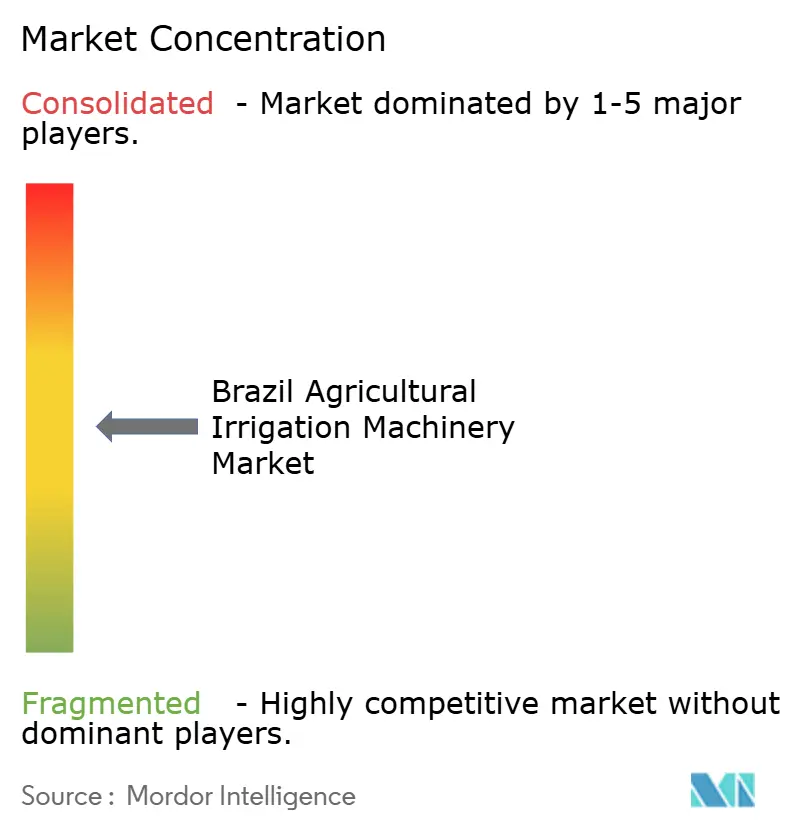
| Market Concentration | Medium |
Major Players *Disclaimer: Major Players sorted in no particular order Image © Mordor Intelligence. Reuse requires attribution under CC BY 4.0. | |
Brazil Agricultural Irrigation Machinery Market Analysis by Mordor Intelligence
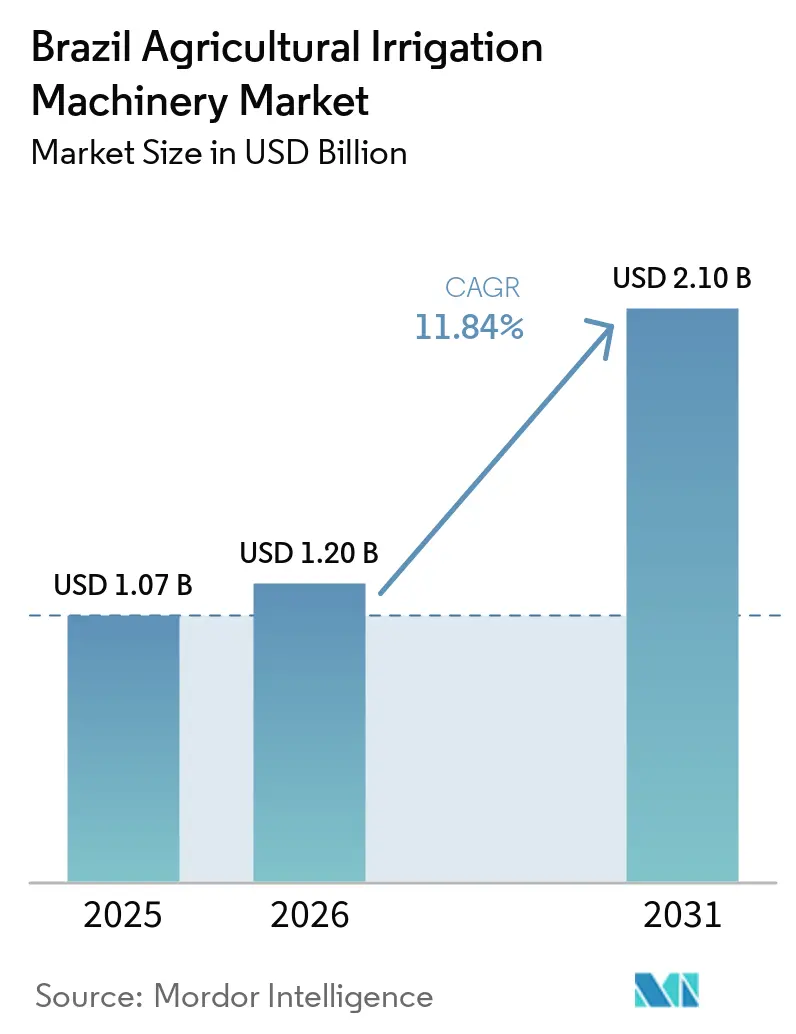
The Brazil agricultural irrigation machinery market size is projected to grow from USD 1.07 billion in 2025 to USD 1.20 billion in 2026 and is forecast to reach USD 2.1 billion by 2031 at 11.84% CAGR over 2026-2031. Demand is accelerating as growers replace flood and surface methods with pressurized systems that cut water use by 30% to 40% while safeguarding yields during recurring droughts. Federal credit lines under Plano Safra and Proirriga have injected USD 520 million (BRL 2.6 billion) into equipment purchases, thereby flattening upfront cost barriers for medium-sized operations. The rapid spread of center-pivot technology across the Cerrado, niche growth in drip solutions for fruit and vegetable belts, and surging adoption of solar-hybrid pumps together underpin the current expansion path. Competitive intensity remains moderate, with the top five companies accounting for just over half of revenue and differentiating themselves through localized factories, digital platforms, and the integration of renewable energy.
Key Report Takeaways
- By irrigation system, center-pivot and lateral-move systems held the largest share at 45% in 2025, while drip irrigation is projected to register a 15.0% CAGR through 2031.
- By crop type, cereals and grains held the largest share at 52% in 2025, while fruits and vegetables are projected to register a 13.0% CAGR through 2031.
- By farm size, large commercial operations held the largest share at 70% in 2025, while medium farms are projected to be the fastest-growing segment, registering a 12% CAGR through 2031.
- By component, pumps and motors held the largest share at 28% in 2025, while controllers and sensors are projected to be the fastest-growing segment, registering a 16% CAGR between 2026 and 2031.
- By energy source, grid-electric systems held the largest share at 60.0% in 2025, while solar and hybrid systems are projected to be the fastest-growing segment, registering an 18% CAGR through 2031.
- By distribution channel, dealers and distributors held the largest share at 65% in 2025, while online and e-commerce channels are projected to be the fastest-growing segment, registering a 19.0% CAGR through 2031.
Note: Market size and forecast figures in this report are generated using Mordor Intelligence’s proprietary estimation framework, updated with the latest available data and insights as of January 2026.
Market Trends and Insights
Drivers Impact Analysis of Brazil Agricultural Irrigation Machinery Market*
| Driver | (~) % Impact on CAGR Forecast | Geographic Relevance | Impact Timeline |
|---|---|---|---|
| Subsidized Credit Lines Under Moderinfra | +2.3% | National focus in Mato Grosso, Goiás, São Paulo | Medium term (2–4 years) |
| Expansion of Center-Pivot Irrigated Area in Cerrado | +2.8% | Mato Grosso, Goiás, Tocantins, western Bahia | Long term (≥ 4 years) |
| Precision Agriculture and Remote Monitoring Uptake | +1.9% | São Paulo, Paraná, Mato Grosso | Medium term (2–4 years) |
| Rising Drought Frequency and Climate Variability | +2.1% | São Francisco and Paraná basins, Northeast | Short term (≤ 2 years) |
| Solar-powered Pumping Systems Offsetting Diesel Costs | +1.5% | Grid-constrained rural zones nationwide | Medium term (2–4 years) |
| Sugarcane Rail-cleaner Retrofits for Pivots | +1.2% | São Paulo, Goiás, Minas Gerais | Long term (≥ 4 years) |
| Source: Mordor Intelligence | |||
Subsidized Credit Lines Under Moderinfra
Federal programs have transitioned irrigation from a cash-based purchase model to a financed asset approach. Plano Safra 2024/25 allocated BRL 475.5 billion (USD 95.1 billion) for rural lending, including BRL 2.6 billion (USD 520 million) designated for irrigation under Proirriga[1]. Low rates of 5% to 7% replace commercial rates above 12%, resulting in a 34% year-over-year gain in irrigation loans during the first half of 2025. Medium farms now secure credit in roughly 120 days, compared with more than 180 days in 2023, enabling system payback within five crop cycles.
Expansion of Center-Pivot Irrigated Area in Cerrado
The 2025 report by the Brazilian Agricultural Research Corporation (Embrapa) highlights that the area in Brazil irrigated with central pivots increased from 1.92 million hectares in 2022 to 2.2 million hectares, representing a growth of over 14% in two years. The typical Cerrado pivot spans 65 to 80 hectares, leveraging scale to dilute capital outlays across high-volume soybean and corn rotations. Strong demand drove Valmont’s Uberaba factory to ship 1,240 units in 2024, a 19% annual lift. Yet permit applications in the Araguaia-Tocantins basin climbed 27% in 2025, portending regulatory queues[2].
Precision Agriculture and Remote Monitoring Uptake
Digital overlays transform fixed-rate equipment into dynamic tools. Lindsay Corporation’s FieldNET manages 3,200 Brazilian pivots, trimming water use by up to 22% through zone-based dosing. A 2024 survey by the Brazilian Agricultural Research Corporation (Embrapa) found that 84% of large farms used at least one digital tool, and 29% had connected irrigation controllers. Rising labor costs, up 31% in Mato Grosso between 2020 and 2024, are further accelerating automation.
Rising Drought Frequency and Climate Variability
Brazil endured three severe droughts from 2020 to 2025, cutting rain-fed soybean yields by up to 25%. Reservoirs in the São Francisco basin fell below 40% in 2024, prompting temporary bans on new surface-water permits. The National Institute for Space Research (INPE) projects a 10% to 15% decline in rainfall across the Cerrado by 2040, thereby raising the long-term risk. These shocks are forcing a pivot from open-ditch irrigation, which currently accounts for 5% of equipped land, to pressurized systems that conserve scarce water supplies.
Restraints Impact Analysis of Brazil Agricultural Irrigation Machinery Market*
| Restraint | (~) % Impact on CAGR Forecast | Geographic Relevance | Impact Timeline |
|---|---|---|---|
| High Capital Cost and Limited Long-term Credit | -1.8% | Medium farms nationwide | Short term (≤ 2 years) |
| Commodity-Price Volatility Squeezing Farm Cash Flow | -1.5% | Export-dependent states | Short term (≤ 2 years) |
| Stricter Water License Enforcement in Stressed Sub-basins | -1.2% | São Francisco, Paraná, Araguaia-Tocantins | Medium term (2–4 years) |
| Limited Technical Assistance for O&M Among Mid-size Farms | -0.9% | Nationwide | Medium term (2–4 years) |
| Source: Mordor Intelligence | |||
High Capital Cost and Limited Long-term Credit
The installation of a 65-hectare pivot costs between USD 180,000 and USD 250,000, which is equivalent to three to four years of net income for an average medium-sized soybean farm[3]. This high upfront cost poses a financial challenge for many farmers. Although Proirriga provides loans at below-market rates, the loan maturities typically do not exceed seven years. As a result, farmers face annual payments exceeding USD 30,000, which can strain their financial resources. Smallholders encounter even greater difficulties, as a 10-hectare drip irrigation system costs between USD 25,000 and USD 35,000. However, financing options are limited, as most lenders do not support projects below USD 50,000, leaving smallholders with fewer viable solutions for irrigation investments.
Commodity-Price Volatility Squeezing Farm Cash Flow
Soybean contract prices declined from USD 16.50 to USD 14.50 per bushel in 2024, reducing gross margins for Cerrado growers by 12%. This price decline significantly affected soybean farmers' profitability, particularly in regions heavily reliant on soybean cultivation. Valmont attributed a 9% year-over-year decline in Brazilian pivot orders during Q3 2024 to "farmer caution," as growers hesitated to invest in new equipment amidst falling margins. Additionally, currency depreciation exacerbated challenges, as the Brazilian real weakened from 4.95 to 5.20 per USD during the same period. This depreciation increased the cost of imported components by 5%, further straining the financial stability of farmers and agricultural businesses reliant on imported machinery and inputs.
*Our forecasts treat driver/restraint impacts as directional, not additive. The impact forecasts reflect baseline growth, mix effects, and variable interactions.
Brazil Agricultural Irrigation Machinery Market Segment Analysis
By Irrigation System:
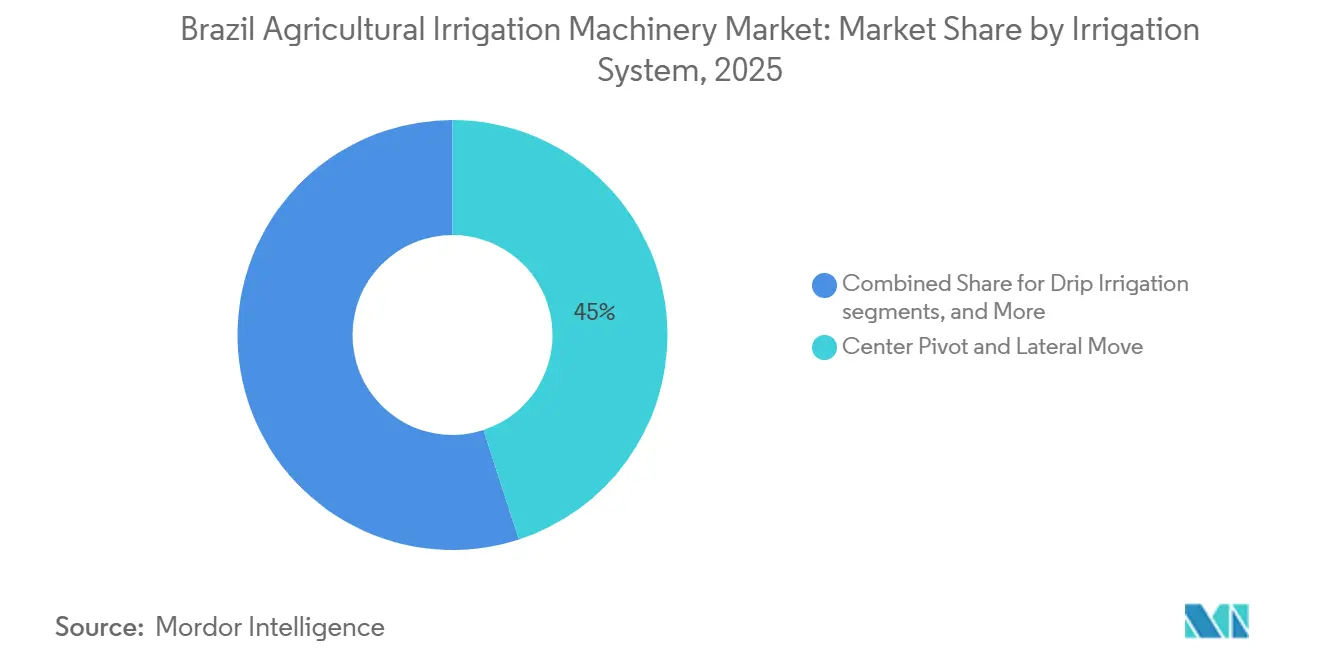
Pivots Dominate, Drip Gains in Specialty CropsCenter-pivot and lateral-move units accounted for 45% of the Brazil agricultural irrigation machinery market in 2025, bolstered by Cerrado farms measuring 200 to 500 hectares and seeking labor savings through automation. Variable-rate retrofits are poised to rise as FieldNET and Trimble integrations enable zone-specific dosing. Sprinkler systems, holding a significant share, concentrate in smaller perennial orchards such as coffee and citrus, where capital costs remain pivotal. Drip, with a 20% share, is accelerating at a 15% CAGR between 2026 and 2031 in fruit and vegetable acreage across the Northeast semi-arid region and the São Paulo citrus belt, where high crop value justifies USD 3,500-5,000 per hectare in outlays.
Micro-irrigation systems offer efficiency by addressing specific water demands. Rivulis installed subsurface lines across 8,400 hectares during 2024–25, while Stara’s mobile-drip pivot kit is priced 20% lower than global competitors. Surface irrigation methods now account for 5% of installations and are declining due to enforcement by the National Water Agency (ANA) and intensifying drought pressures. Furthermore, with the adoption of digital sensors, soil moisture probes are now pre-installed on 35% of new pivots, up from 12% in 2020.

By Crop Type:
Cereals Lead, Fruits and Vegetables AccelerateCereals and grains accounted for 52% of demand in 2025, buoyed by soybean and corn double-cropping, which relies on irrigation to stabilize output during the 5-month Cerrado dry season. The segment will grow near-parity with the overall Brazil agricultural irrigation machinery market through 2031, reflecting durable export pipelines to Asia. Commercial crops, primarily sugarcane and cotton, held a significant share after cereals and grains. Sugarcane irrigation alone is pacing at a higher growth rate as mills chase sucrose premiums. Fruits and vegetables are growing at a 13% CAGR between 2026 and 2031, because drip increases export-grade quality, lifting citrus Brix and grape counts.
Pulses and oilseeds, such as black beans, require precise water management during the pod-filling stage to enhance export potential. Effective irrigation during this critical growth phase ensures optimal yield and quality, which are essential for meeting international market standards. Other uses, including pasture and forestry, remain limited to niche markets, with potential for gradual expansion as demand evolves. According to the Brazilian Sugarcane Industry Association (UNICA), the irrigated sugarcane area increased from 7% in 2020 to 12% in 2025, indicating a growing market for irrigation equipment suppliers in the agricultural sector. This growth highlights the increasing adoption of irrigation technologies to improve productivity and sustainability in sugarcane farming.
By Farm Size:
Large Operators Dominate, Mid-Tier Gains MomentumLarge commercial operations over 100 hectares captured 70% of 2025 sales, revealing a clear scale bias within the Brazil agricultural irrigation machinery market. These enterprises deploy multiple pivots and integrate fleet-management software that cuts supervisory labor 25% to 30%. Medium farms are growing at a 12% CAGR through 2031, as flexible credit products and smaller 40- to 50-hectare pivots align with their capital ceilings. Smallholders with less than 20 hectares account for the remaining share, with drip irrigation centered on high-value horticulture.
Cooperative models lessen cost friction. A 2024 Paraná pilot had 12 farms jointly finance a lateral-move unit covering 480 hectares, paring individual exposure by 60%. Smallholders still battle thin margins, with loans under USD 50,000 rare, yet targeted subsidy pools could unlock micro-irrigation at a broader scale. Large enterprises continue to push the digital frontiers, bundling sensors, GPS steering, and variable-rate technology for whole-farm orchestration.
By Component:
Pumps Lead, Controllers SurgePumps and motors accounted for 28% of component turnover in 2025, driven by replacement cycles and the pivot to variable-frequency drives that slash energy use by up to 30%. Sprinklers and emitters benefit from rapid drip deployment. Netafim’s pressure-compensated emitter now features on 60% of new Brazilian drip lines. Controllers and sensors represent the fastest-growing segment at a 16% CAGR between 2026 and 2031, as Internet of Things (IoT) connectivity and falling hardware prices drive mainstream adoption.
Valves and filters hold a small share, supported by the National Water Agency (ANA)'s metering regulations, while pipes, hoses, and structural steel account for a significant share. Energy-efficiency labeling, introduced in 2024 for pumps above 10 horsepower, is spurring retrofit spending. Meanwhile, Trimble-enabled GPS receivers in pivot towers promote sub-meter accuracy, enhancing fertigation outcomes for specialty crops in São Paulo’s citrus groves.
By Energy Source:
Grid Dominates, Solar AscendsGrid-electric systems represented 60% of installations in 2025, particularly in São Paulo and Paraná, where power reliability remains high. Diesel pumps continue to be used in frontier regions but are experiencing slower growth due to the unpredictability caused by fuel price volatility. Solar-hybrid systems are growing at a compound annual growth rate (CAGR) of 18% and are projected to gain market share through 2031, driven by declining panel costs and supportive feed-in tariffs. Biogas and wind systems remain niche options, limited by high upfront costs and technical challenges.
The Brazilian Agricultural Research Corporation (Embrapa) estimates that a 65-hectare solar pivot system, costing USD 240,000, can save USD 18,000 annually in energy costs, resulting in a payback period of 4.3 years, which is more favorable than grid- or diesel-based systems. Additionally, FieldNET demand-management modules enable irrigation during off-peak hours, reducing electricity bills by 40% and increasing the attractiveness of grid connectivity in areas with mixed tariff structures.
By Distribution Channel:
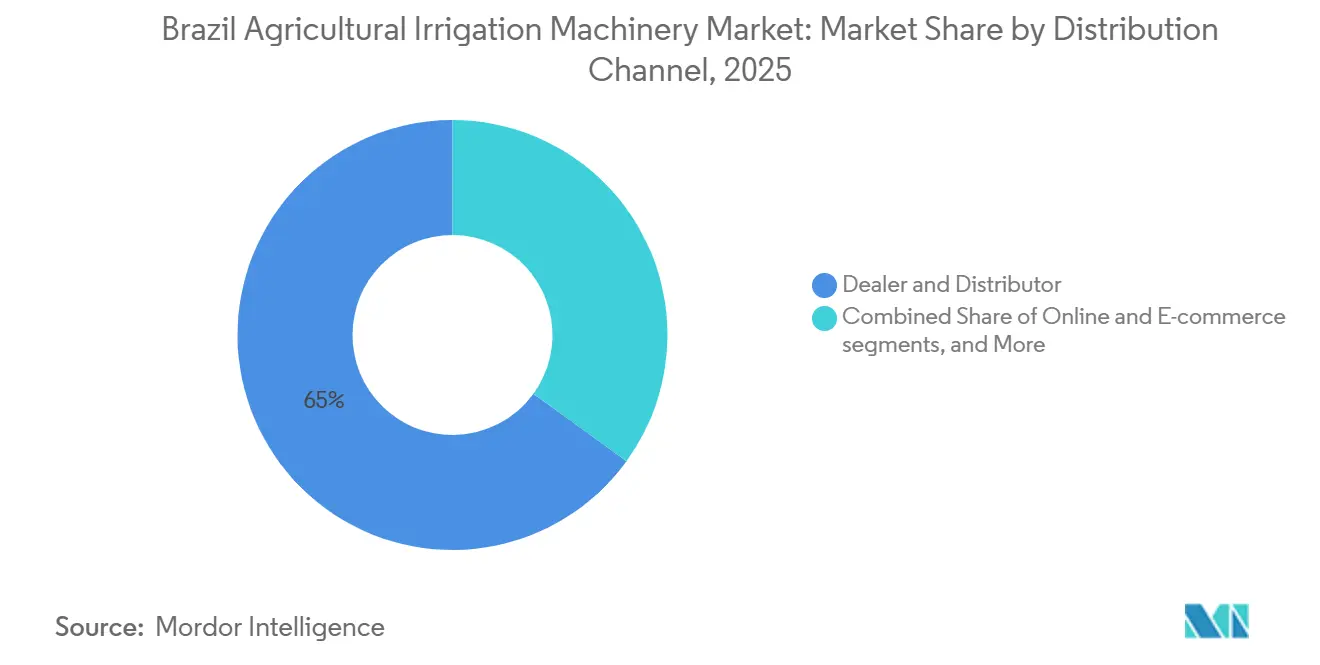
Dealers Prevail, E-Commerce EmergesDealers and distributors orchestrated 65% of 2025 revenue within the Brazil agricultural irrigation machinery market, harnessing localized service crews and bundled financing. Direct OEM contracts are skewed toward large farms negotiating multi-pivot orders. Online platforms are surging at a 19% CAGR between 2026 and 2031, as transparent pricing and remote diagnostics appeal to tech-savvy mid-size growers.
Rivulis’ Portuguese-language design portal generated 1,800 verified leads in its first year. Lindsay Corporation’s dealer portal accelerates troubleshooting by 30%, while Stara’s Agrishow-launched mobile-drip kit accepted 80 pre-orders at 20% below multinational quotes. Cooperatives and public purchasing schemes round out the remaining 5%, often tying equipment supply to regional development grants.
Geography Analysis
The Cerrado biome, spanning Mato Grosso, Goiás, Tocantins, and western Bahia, holds a significant share of center-pivot capacity as of 2025, driven by large-scale soybean and corn farms that integrate irrigation to sustain double-cropping under an increasingly erratic rainy season. Mato Grosso alone added 14,200 pivot hectares in 2024, reflecting a 9% annual climb. São Paulo followed with a 22% share, concentrating on sugarcane, citrus, and coffee, where drip and micro-sprinkler systems dominate due to higher returns per hectare.
Western Bahia’s MATOPIBA frontier is gaining traction, registering a 21% pivot installation spike in 2024, though licensing bottlenecks in the São Francisco watershed may temper momentum. The Northeast semi-arid zone, anchoring fruit export clusters along the São Francisco Valley, captured 8% of national sales in 2025 due to drip adoption covering 120,000 hectares. Southern states Paraná and Rio Grande do Sul held a combined 12% share, applying irrigation mostly to rice and vegetables, where frequent rainfall still demands supplemental coverage amid yield-critical growth stages[4].
Regional growth is determined by the relationship between water governance and aquifer depth. Guarani and Bambuí reserves underpin the scalability of the Cerrado. However, the National Institute for Space Research (INPE) projects a 10% to 15% decline in rainfall by 2040, which stresses recharge rates. São Paulo’s mature footprint is pivoting to retrofits. Nearly half of citrus growers now layer soil-moisture sensors on top of existing drip irrigation grids, pairing water consumption with an 18% reduction in water usage without sacrificing quality. Meanwhile, cost overruns at the São Francisco River Integration Project hinder the Northeast’s full potential, although the scheme already supplies 160,000 irrigated hectares. In the South, mixed rainfall patterns and smaller field sizes keep demand steady but capped.
Regulatory Landscape
Brazil irrigation equipment demand is shaped by water-use governance and national irrigation policy. The National Water Resources Policy (Lei 9.433/1997) requires an outorga (water-use grant) for withdrawals, and tighter enforcement in stressed sub-basins has increased the importance of metering and compliant system design. The National Irrigation Policy (Lei 12.787/2013), under the Ministry of Integration and Regional Development (MIDR), provides the core definitions and framework used to classify and prioritize irrigation projects, including those tied to public water-security and irrigation infrastructure initiatives.
On the equipment side, agricultural machinery must meet conformity and labeling requirements overseen by INMETRO, and registration requirements apply under RENAGRO (created under Decreto 11.014/2022) via the Ministry of Agriculture and Livestock (MAPA). MIDR Portaria 1.936/2023 also sets technical criteria for prioritized irrigation infrastructure projects, shaping specification choices for pumps, controls, and associated equipment. For imported machinery and sub-systems, baseline duties under NCM tariff schedules are a cost factor, with Ex-Tarifario exemptions used for qualifying capital goods without domestic equivalents, affecting sourcing strategies for advanced irrigation components.
Competitive Landscape
In 2025, the Brazil agricultural irrigation machinery market is moderately concentrated, with the top five companies, such as Valmont Industries, Inc., Lindsay Corporation, Bauer Group, Netafim Limited, and Rivulis Irrigation Ltd. (Temasek Holdings Limited), holding a significant market share. Valmont Industries, Inc. held a notable position, supported by its Uberaba plant, a planned 30% capacity expansion by 2025, and a service network spanning 22 states. Lindsay Corporation holds the second-largest share, driven by FieldNET’s 3,200 domestic subscriptions and a parts hub in Campinas that reduces client downtime. Bauer Group has capitalized on the retrofit opportunities in the sugarcane sector, achieving a 25% sales growth in 2024.
Competition in the market focuses on factory localization, precision integrations, and the incorporation of renewable energy solutions. Valmont’s Solbras unit combines photovoltaic technology with irrigation pivots, achieving a 70-80% reduction in operating costs over a ten-year period. Lindsay collaborates with FieldNET Advisor, offering services for an annual fee of USD 3,000 per pivot and generating revenue from agronomic data utilization. Bauer’s rail-cleaner upgrade addresses the issue of trash clogging in sugarcane rows, a persistent operational challenge.
Domestic manufacturers, such as Stara and Jacto, capitalize on local supply chains to price their products 15% to 20% lower than multinational competitors. However, they currently lack advanced digital control systems. Moving forward, opportunities for market growth lie in medium-farm financing, precision retrofitting, and innovations tailored to sugarcane farming, which represent untapped areas for potential market share expansion.
Brazil Agricultural Irrigation Machinery Industry Leaders
-
Valmont Industries, Inc.
-
Lindsay Corporation
-
Bauer Group (Bauer AG)
-
Netafim Limited (Orbia Advance Corporation)
-
Rivulis Irrigation Ltd. (Temasek Holdings Limited)
- *Disclaimer: Major Players sorted in no particular order
Brazil Agricultural Irrigation Machinery Market Companies Covered in this Report
- Valmont Industries Inc.
- Lindsay Corporation
- Bauer Group (Bauer AG)
- Netafim Limited (Orbia Advance Corporation)
- Rivulis Irrigation Ltd. (Temasek Holdings Limited)
- Reinke Manufacturing Co., Inc.
- Hunter Industries LLC
- Rain Bird Corporation
- The Toro Company
- T-L Irrigation Company
- Nelson Irrigation Corporation
- Stara S/A
- Jacto S/A (Grupo Jacto)
- Tatu Marchesan
- Fockink S.A.
Read Analysis of Brazil Agricultural Irrigation Machinery Companies
Market Opportunities and Future Outlook
Credit-linked modernization and irrigation efficiency programs continue to create supplier opportunities in bankable project bundles that combine equipment, controls, and advisory services. The federal rural credit framework remains a key enabler, with Proirriga operating as a named channel for irrigation equipment financing and the Plano Safra 2025/26 allocation for Proirriga rising to BRL 2.75 billion from BRL 2.6 billion in the prior season. That increase supports purchases of pivots, drip packages, pumps, and integrated controllers, while the demand backdrop includes ongoing replacement of surface methods with pressurized systems. It also supports higher attachment rates of controllers and sensors as growers manage water and energy under tighter licensing conditions.
Opportunity is concentrated in three demand pockets: (i) large-scale irrigation buildouts tied to named projects and irrigated poles, including the BRL 836 million irrigation initiative approved in Bahia (Xique-Xique) under the MIDR umbrella, which pulls through pivots, pumping sets, filtration, and automation; (ii) farm-level productivity and land-intensification strategies in Western Bahia, where BrasilAgro has been implementing center pivots across 4,200 hectares at Arrojadinho (with 2,900 hectares already operational), pointing to sustained appetite for multi-pivot projects and service capacity; and (iii) low-cost efficiency tools for small and mid-size producers, supported by the July 2026 SBMI-PMP initiative developed by UFS with MIDR support to improve irrigation management in smaller and medium properties. In parallel, product positioning that reduces initial investment while maintaining performance has support from new system introductions at Agrishow 2026, targeted at cost-sensitive growers.
Recent Industry Developments in Brazil Agricultural Irrigation Machinery Market
- June 2026: Netafim announced an investment cycle of around BRL 100-110 million (USD 19.2–21.1 million) linked to its Ribeirao Preto industrial operations, reinforcing localization of irrigation manufacturing for the Brazilian market. The expansion supports shorter lead times and a broader product mix for drip and micro-irrigation packages, while reducing exposure to imported components.
- December 2025: Netafim disclosed a plan to invest about BRL 100 million (USD 19.1 million) to double capacity at its Ribeirao Preto, Sao Paulo facility. The expansion strengthens domestic production capability, improving responsiveness to demand shifts across coffee, citrus, and row-crop irrigation projects.
- January 2025: Rivulis formed an exclusive partnership with Cocamar to expand advanced irrigation solutions for cooperative members. The collaboration broadened route-to-market coverage and service reach, supporting faster adoption of efficient irrigation systems among growers facing weather volatility.
Brazil Agricultural Irrigation Machinery Market Report Scope and Research Methodology
Market Definition and Coverage
This market covers revenues from agricultural irrigation machinery sold for in-field crop irrigation in Brazil, including center pivot and linear move systems, sprinkler setups, and drip systems, along with integrated pumps, drives, pipes, couplers, and control units sold as part of the equipment package.
Scope exclusions: Portable hoses, standalone sensors, and aftermarket spare parts sold outside original equipment packages are excluded.
Segments Covered in This Report
- By Irrigation System
- Drip Irrigation
- Sprinkler Irrigation
- Center Pivot and Lateral Move
- Micro-Irrigation
- Surface/Flood
- Others
- By Crop Type
- Cereals and Grains
- Commercial Crops
- Fruits and Vegetables
- Pulses and Oil Seeds
- Others
- By Farm Size
- Smallholders (Less than 20 ha)
- Medium Farms (20-100 ha)
- Large Commercial Farms (More than 100 ha)
- By Component
- Pumps and Motors
- Pipes and Hoses
- Sprinklers and Emitters
- Valves and Filters
- Controllers and Sensors
- Others
- By Energy Source
- Grid-Electric
- Diesel
- Solar and Hybrid
- Others
- By Distribution Channel
- Direct OEM Sales
- Dealer and Distributor
- Online and E-commerce
Data Sources, Market Sizing, and Validation
Desk Research
Desk research was used to build the starting structure for the Brazil demand pool and to set realistic boundaries for irrigation machinery revenue. We relied on public, non-paywalled sources such as IBGE agricultural statistics, CONAB crop supply and planted area updates, ANA water resources and irrigation references, FAOSTAT for cross-checking crop mix directionally, and SECEX/Comex Stat trade series for irrigation-related equipment flows.
Beyond official series, we also reviewed company filings and investor presentations where available, association and regional irrigation program pages, and trusted press coverage to understand adoption patterns (for example, center pivot expansion in the Cerrado and drip use in fruits and vegetables). In a few places, paid subscriptions that cover company financials and news, patent databases, and shipment-level import or export records helped confirm supplier presence and the pricing ranges used in assumptions. The sources listed above are illustrative only, and many other references were used for data collection, validation, and clarification during the work.
Primary Interviews and Surveys
Primary work focused on confirming what is actually being purchased and installed in Brazil, and how pricing shifts by farm profile, crop type, and power source. We spoke with a mix of irrigation equipment suppliers and distributors, agronomy and irrigation consultants, and large farm operators, so gaps from desk research could be closed and the final sizing assumptions stress-tested across the main producing corridors.
Distribution of primary research fieldwork respondents
| Company type | Respondent position |
|---|---|
| Top tier: 33% | CXOs: 14% |
| Mid tier: 50% | Functional/Unit leaders: 34% |
| Smaller Players: 17% | Managers: 52% |
Market-Sizing & Forecasting
Sizing was built using a top-down and bottom-up approach. The top-down view starts from the irrigated demand pool and the equipment intensity needed to serve it, then gets reconciled against what suppliers can realistically ship and install. On the demand side, we reconstructed annual equipment needs using indicators such as irrigated area movement by crop, the split between pressurized methods (center pivot, sprinkler, drip), typical replacement cycles for pivots and pumping sets, and average project size by farm scale.
To keep totals grounded, selective bottom-up checks were used, including a roll-up of supplier and channel signals, sampled average selling price ranges by equipment type, and installation activity checks through integrators. Where the bottom-up picture had gaps (for example, smaller regional installers without transparent financials), we used penetration assumptions tied to irrigated hectares, then revalidated the implied volumes with interview feedback.
For forecasting, scenario analysis was applied, guided by a short list of variables that stakeholders consistently connect to purchases. These included rural credit availability, energy costs affecting pump choices (including solar-hybrid interest), crop price sentiment for key commodities, and weather-driven water stress that accelerates conversion from surface irrigation. These drivers were translated into adoption and pricing trajectories, and the outcomes were reviewed again with field respondents before final sign-off.
Data Validation & Update Cycle
Validation was handled through multiple checks so the final number is not dependent on any single source. Model outputs were compared with independent signals like trade flows for relevant equipment categories, changes in irrigated area, and the pace of center pivot installations reported in interviews, then any outliers were investigated before acceptance.
A second analyst review was used to re-check unit logic, currency conversions, and the reasonableness of year-on-year shifts, followed by re-contact triggers when a key assumption moved meaningfully. Reports are refreshed annually, and interim updates are done when material events occur, such as major policy changes in rural credit or sharp input-cost movements. Right before delivery, an analyst performs a fresh pass so clients receive the latest updated view.
Mordor Intelligence's Brazil Agricultural Irrigation Machinery Market Size Versus Other Published Estimates
Published market sizes for irrigation machinery in Brazil can look far apart, even when the topic sounds identical. Each publisher draws the product boundary and sales capture point differently. Differences also show up when one estimate is built from installed base logic while another leans more on trade codes or narrower equipment definitions.
The gap drivers usually come down to what is counted as machinery revenue versus adjacent items, how pricing is treated across large pivots versus smaller drip packages, and how quickly assumptions are refreshed when credit conditions and farm spending sentiment change. Currency timing also matters in Brazil, since using different exchange-rate windows can shift a USD value even when local demand is unchanged.
Benchmark comparison
| Source | Market Size | Gaps in Research Methodology |
|---|---|---|
| Mordor Intelligence | USD 1.07 B (2025) | |
| Industry Publisher A | USD 0.10 B (2025) | This estimate appears to use a narrower equipment set, which can undercount integrated packages such as pumps, drives, and control units when they are sold with the irrigation system rather than separately. |
| Research Firm B | USD 0.81 B (2024) | The value is anchored to an earlier base year and may apply a different refresh cadence for price and mix, especially across center pivot versus drip systems, which can shift totals when farm capex changes quickly. |
The table shows a wide spread that mainly comes from scope and timing choices. In Mordor Intelligence's model, factory-built pivot, linear, sprinkler, and drip systems are counted together with the integrated components that are typically bought as part of the original equipment package, which shifts the total away from studies that separate those items or use older price and mix assumptions. With these boundaries stated clearly and checked against demand indicators and channel feedback, the result stays traceable and repeatable for planning.
Key Questions Answered in the Report
What is the projected value of the Brazil agricultural irrigation machinery market in 2031?
The market is projected to reach USD 2.10 billion by 2031.
Which irrigation system currently holds the largest share?
Center-pivot and lateral-move systems led with 45% share in 2025.
How fast are solar-powered irrigation systems growing?
Solar and hybrid solutions are expanding at an 18% CAGR through 2031.
Which component segment is expanding the quickest?
Controllers and sensors are advancing at a 16% CAGR between 2026 and 2031.
Why are medium-sized farms expected to grow their spending?
Easier access to subsidized credit and smaller pivot models align with their capital profiles, supporting a 12% CAGR.