
Boron Carbide Market Size and Share
Market Overview
| Study Period | 2022 - 2032 |
|---|---|
| Market Size (2027) | USD 284.09 Million |
| Market Size (2032) | USD 348.65 Million |
| Growth Rate (2027 - 2032) | 4.18 % |
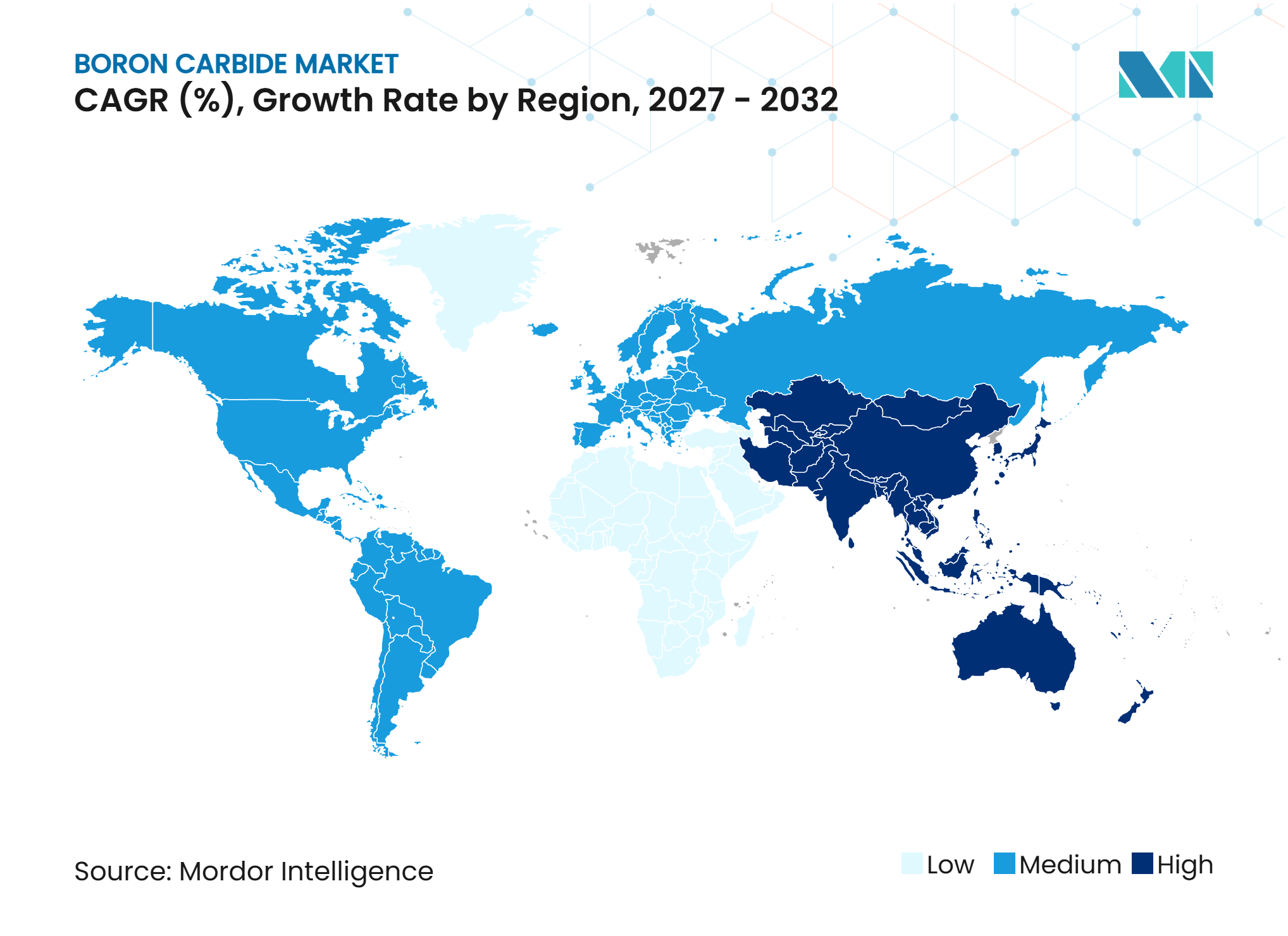
| Fastest Growing Market | Asia-Pacific |
| Largest Market | Asia-Pacific |
| Market Concentration | Medium |
Major Players *Disclaimer: Major Players sorted in no particular order Image © Mordor Intelligence. Reuse requires attribution under CC BY 4.0. | |
Boron Carbide Market Analysis by Mordor Intelligence
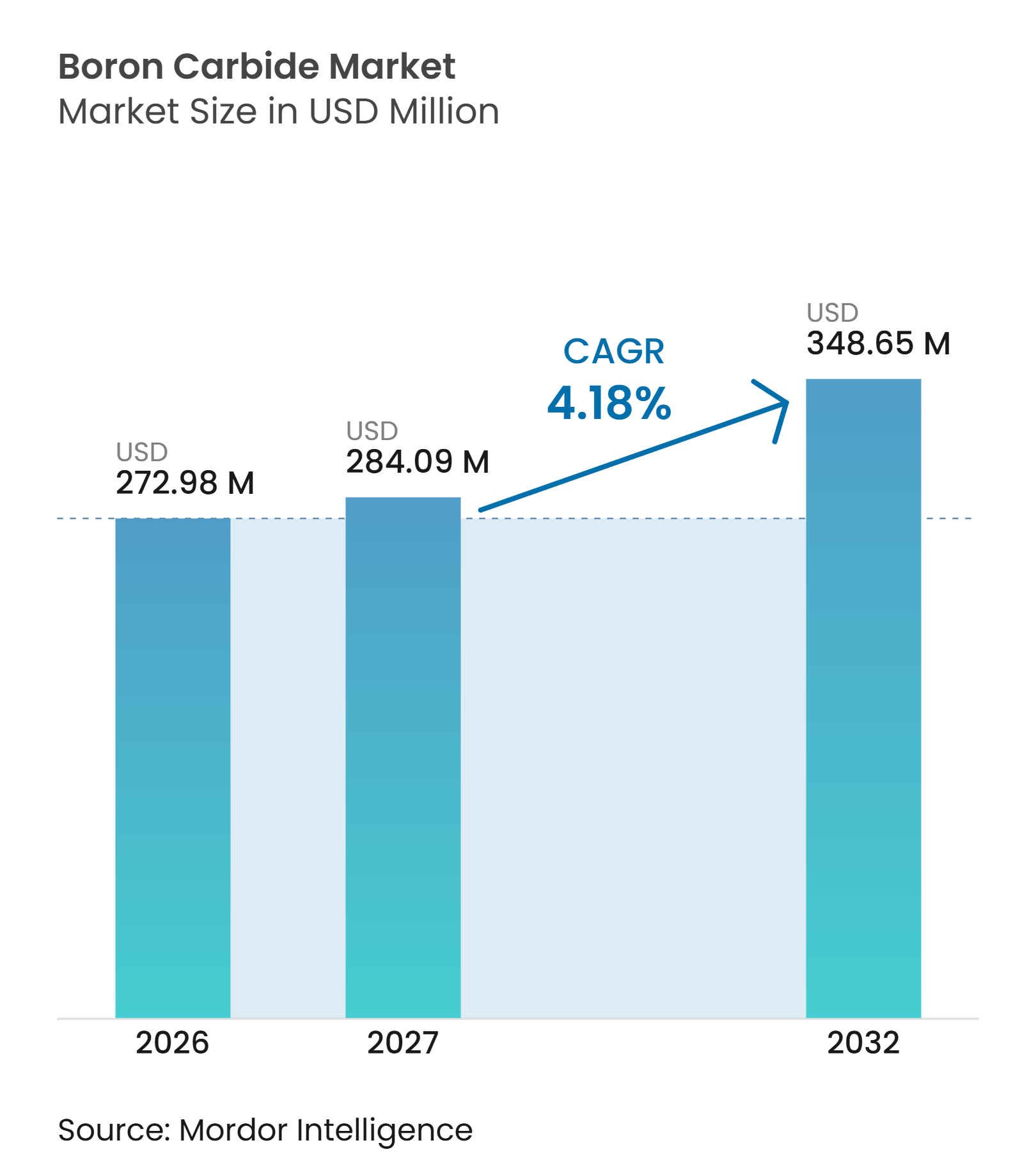
The Boron Carbide Market size was valued at USD 272.98 million in 2026 and is estimated to grow from USD 284.39 million in 2027 to USD 348.65 million by 2032, at a CAGR of 4.18% during the forecast period (2027-2032). The boron carbide market is supported by demand from ballistic protection, nuclear neutron absorption, and industrial abrasives. These demand areas have separate procurement cycles, which reduce dependence on a single end use. Nuclear programs support demand for boron carbide as the material is used as a neutron absorber in reactor control and shielding applications. ASTM C750 and ASTM C751 establish specifications for nuclear-grade powder and pellets, reinforcing the role of qualification in supply decisions. Competition is divided between high-volume abrasive supply and qualified defense and nuclear components, leaving opportunities for producers that meet material and certification requirements.
Key Report Takeaways
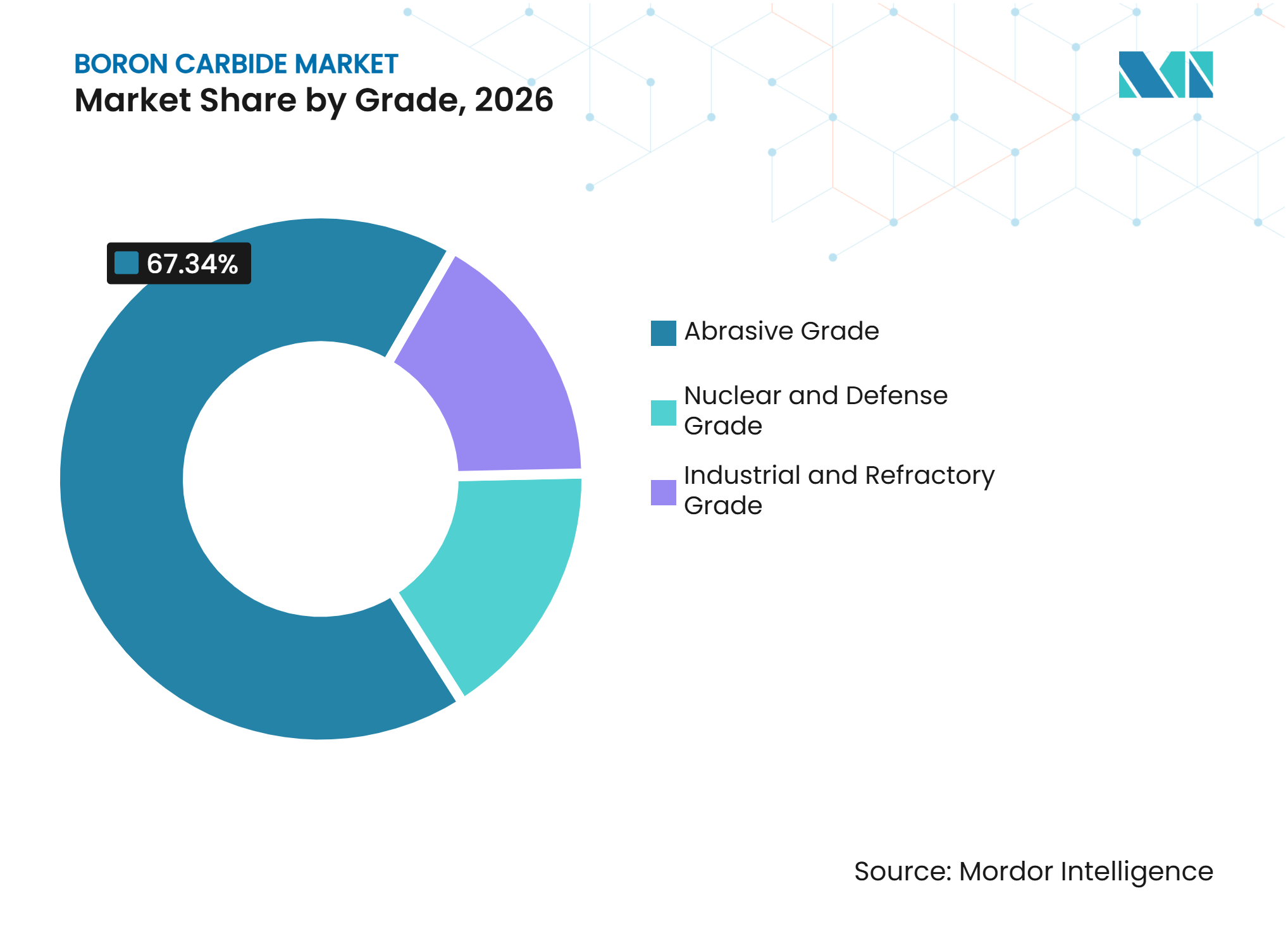
- By grade, Abrasive Grade held 67.34% of the boron carbide market share in 2026, while Nuclear and Defense Grade is projected to grow at a 5.19% CAGR through 2032.
- By product form, Powder accounted for 53.11% of the boron carbide market share in 2026 and is projected to grow at a 4.87% CAGR through 2032.
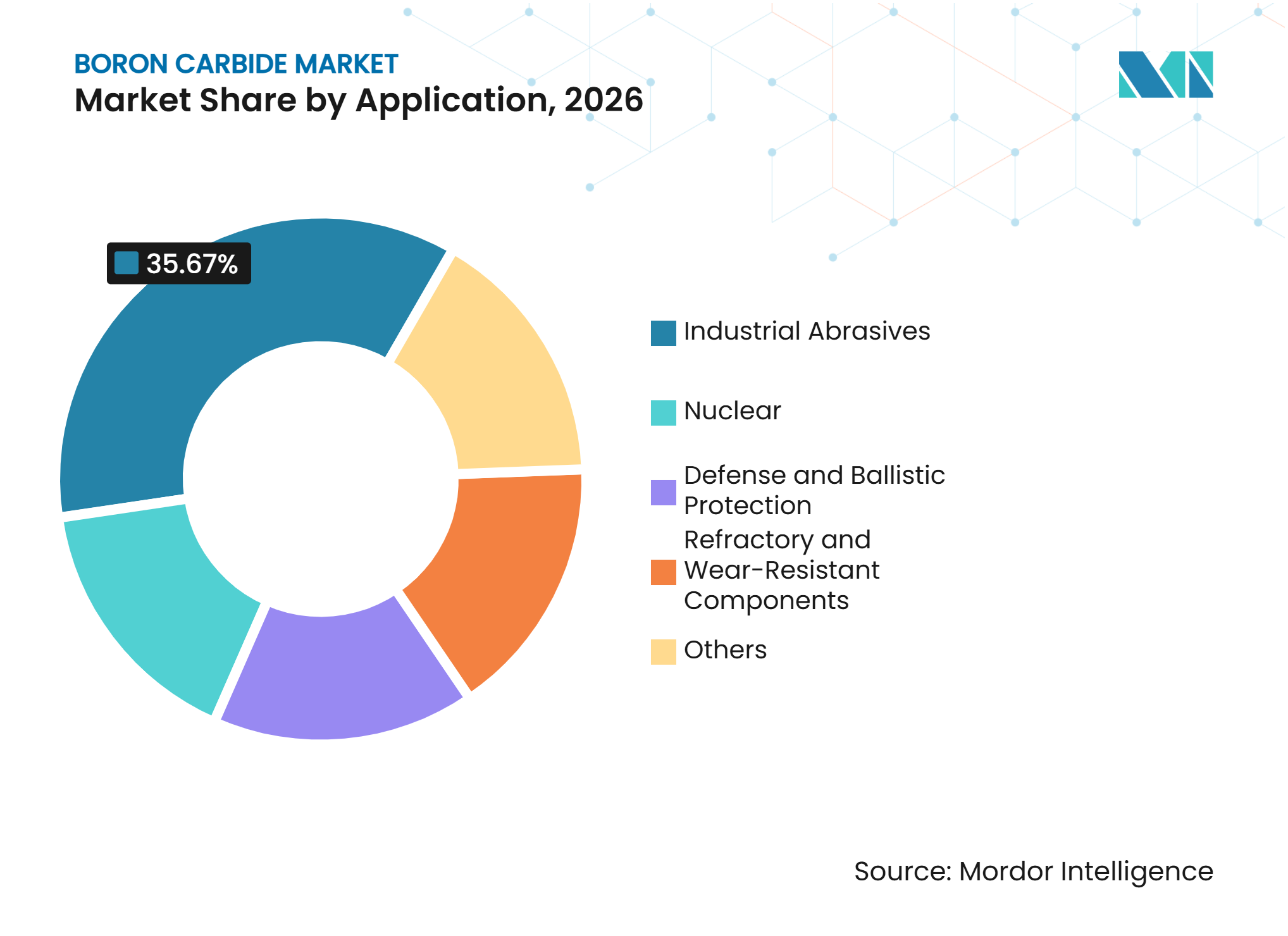
- By application, Industrial Abrasives accounted for 35.67% of the Boron Carbide Market size in 2026, while Nuclear is projected to expand at a 5.45% CAGR through 2032.
- By geography, Asia-Pacific captured 39.75% of the Boron Carbide Market size in 2026 and is forecast to grow at a 5.33% CAGR through 2032.
Note: Market numbers in this report are based on Mordor Intelligence's proprietary estimation framework, which combines nine months of actuals with Q4 projections for base year 2026.
Market Trends and Insights
Drivers Impact Analysis of Boron Carbide Market*
| Drivers | (~) % Impact on CAGR Forecast | Geographic Relevance | Impact Timeline |
|---|---|---|---|
| Lightweight Ballistic Protection Demand | +1.3% | Global, with concentrated spending in North America, Europe, and Asia-Pacific defense budgets | Short term (≤ 2 years) |
| Nuclear Reactor Control and Shielding Demand | +0.9% | Global, led by China, India, Europe, and U.S. small modular reactor programs | Medium term (2-4 years) |
| Precision Finishing of Hard Ceramics and Semiconductor Substrates | +0.6% | Asia-Pacific core, including South Korea, Japan, and Taiwan, with demand in North America and Europe | Medium term (2-4 years) |
| Expansion of High-Performance Abrasive and Waterjet Applications | +0.5% | Global, with early gains in North America, Germany, and industrial ASEAN countries | Short term (≤ 2 years) |
| Government-Supported Domestic Capacity and Qualification Programs | +0.4% | United States, India, France, Saudi Arabia, and South Korea | Long term (≥ 4 years) |
| Source: Mordor Intelligence | |||
Lightweight Ballistic Protection Demand
Defense acquisition programs continue to create a stable demand base for the boron carbide market. In September 2025, the U.S. Army issued USD 65.5 million in delivery orders to Hardwire LLC and Leading Technology Composites for Lightweight Small Arms Protective Inserts. The orders were issued under the USD 416 million Vital Torso Protection Program and were scheduled for delivery through March 2027[1]. In August 2025, Taiwan announced a plan to procure 48,000 bullet-resistant ceramic plates using boron carbide, with production scheduled for 2028 and 2029. The National Institute of Justice (NIJ) Standard 0101.07 updates ballistic test methods and threat-level requirements for U.S. law enforcement body armor. These specifications can increase boron carbide use per plate when manufacturers redesign plate structures for multi-hit performance.
Nuclear Reactor Control and Shielding Demand
The boron carbide market serves conventional pressurized-water and boiling-water reactor control systems, as well as fast-reactor and small modular reactor applications. These applications require different purity levels and isotope compositions, which separate procurement into distinct supply channels. India's 500 MWe Prototype Fast Breeder Reactor at Kalpakkam achieved first criticality in April 2026, and Bhukhanvala Industries stated that it supplied the reactor's natural boron carbide neutron-shielding components and powder. In April 2025, China's Nuclear Power Institute advanced a boron carbide ceramic production line in Sichuan to supply fast reactors. ASTM C751 and ANSI/ANS 6.4.2 are relevant to nuclear pellet and shielding requirements, making compliance central to supply contracts. Government support for domestic capacity and qualification programs bolsters longer-term demand in the boron carbide market.
Precision Finishing of Hard Ceramics and Semiconductor Substrates
The boron carbide market benefits from demand for abrasive materials used in finishing sapphire wafers, silicon carbide wafers, ceramics, and optical components. Boron carbide can remove hard materials while limiting subsurface damage in selected lapping applications. Research published in 2025 found that boron carbide additives improved densification in silicon carbide ceramic matrices, supporting the material's role in advanced ceramic processing. Photovoltaic silicon wafer cutting also uses boron carbide micro-powder in slurry-based wire-saw operations. Tighter particle-size requirements for thin-wafer geometries support demand for controlled powder grades. These applications provide industrial abrasive demand that is separate from defense procurement cycles.
Expansion of High-Performance Abrasive and Waterjet Applications
Waterjet nozzle suppliers use boron carbide in products designed to cut nonferrous metals and advanced composites. The material's chemical stability and erosion resistance can extend nozzle life under abrasive cutting conditions. Magnetic abrasive finishing is also a specialized application in the boron carbide market. A 2025 study on turbine compressor blades reported a 38.99% improvement in surface roughness under tested magnetic-finishing conditions using boron carbide abrasives. Washington Mills supplies custom particle-size distributions for applications that require tighter abrasive tolerances. Such requirements reduce the substitutability of standard commodity powders in semiconductor and turbine component finishing.
Restraints Impact Analysis of Boron Carbide Market*
| Restraints | (~) % Impact on CAGR Forecast | Geographic Relevance | Impact Timeline |
|---|---|---|---|
| High Energy and Capital Intensity of Carbothermal Reduction and Sintering | -0.8% | Global, most acute in Europe and North America where electricity costs are elevated | Long term (≥ 4 years) |
| Brittle Impact Failure and Fracture-Toughness Trade-Offs | -0.6% | Global, with the greatest commercial relevance for defense-grade plate producers in the United States, Europe, and Turkey | Medium term (2-4 years) |
| Qualification Bottlenecks for Armor and Nuclear Grades | -0.7% | National procurement agencies in the United States, India, France, and Germany, together with NATO qualification systems | Long term (≥ 4 years) |
| Source: Mordor Intelligence | |||
High Energy and Capital Intensity of Carbothermal Reduction and Sintering
Carbothermal reduction requires electric arc furnace temperatures above 2,400 degrees Celsius, making energy consumption a major production cost in the boron carbide market. The process requires 15-20 kWh per kilogram of boron carbide produced. Hot-press sintering for defense components requires dedicated equipment, with furnace line costs reaching USD 5-10 million. These costs limit entry by new producers and favor powder supply or publicly supported qualification projects. Chinese producers benefit from concentrated capacity in Inner Mongolia and Jiangxi, where their integrated supply structure supports abrasive-grade output. In Europe, Schunk Group's investment in a silicon carbide circular-economy model reflects the supply-resilience approach that advanced ceramics producers are pursuing[2].
Qualification Bottlenecks for Armor and Nuclear Grades
Defense and nuclear suppliers face multi-year testing and documentation requirements before admission to qualified programs. Relevant frameworks include NIJ Standard 0101.07 for ballistic protection, ASTM C751 for nuclear pellets, and NATO Standardization Agreement (STANAG) 4569 for vehicle armor. Brittle fracture behavior limits boron carbide performance against certain hypervelocity tungsten-core threats, increasing attention to material architecture and fracture-toughness trade-offs. Nurol Teknoloji has licensed its sintered boron carbide products to 12 U.S. firms following several years of testing. The long qualification process puts pressure on mid-tier producers that lack revenue from the intended defense or nuclear program. It also concentrates qualified supply among companies with established test histories and production documentation.
*Our forecasts treat driver/restraint impacts as directional, not additive. The impact forecasts reflect baseline growth, mix effects, and variable interactions.
Boron Carbide Market Segment Analysis
By Grade:
Abrasive Grade Leads by Output While Defense and Nuclear Drive Revenue GrowthAbrasive Grade held 67.34% of the boron carbide market share in 2026. It is widely used in lapping, polishing, waterjet nozzles, and hard-coating applications. Abrasive powder generates lower revenue per ton than hot-pressed defense tiles. Producers in this segment must balance output demand against commodity pricing pressure. Industrial and Refractory Grade occupies a middle position in the boron carbide market. It is used in wear-resistant pumps, nozzles, and furnace linings where chemical inertness and thermal stability are required.
Nuclear and Defense Grade is forecast to grow at a 5.19% CAGR through 2032. The segment benefits from the modernization of body armor and the expansion of nuclear programs. Qualified defense material cannot be readily substituted by standard abrasive powder, as performance specifications and testing requirements differ. A 2025 study found that boron carbide used in high-temperature gas-cooled reactor control rods requires controlled porous microstructures to permit helium release after neutron capture. This requirement illustrates the material distinction between nuclear-grade and abrasive-grade powders. Higher qualification requirements allow Nuclear and Defense Grade to grow revenue more quickly than its physical output.



By Product Form:
Powder Leads on Both Share and MomentumPowder accounted for 53.11% of the boron carbide market share in 2026. It is the starting form for hot pressing, pressureless sintering, reaction bonding, and abrasive-compound production. ASTM C750 covers nuclear-grade boron carbide powder requirements, including chemical composition, isotope ratio, particle size, and certification. These requirements create a specialized nuclear-supply category within the broader powder segment. Powder also supports China's export-oriented abrasive supply model, as it is the standard commercial format for international shipment. This sustains demand even when downstream forming occurs in other countries.
Powder is also projected to grow at a 4.87% CAGR through 2032. India, South Korea, and Southeast Asian countries are importing powder and expanding domestic sintering capacity to retain more manufacturing value. Grains are used mainly in waterjet and sandblasting applications that require coarser particle shapes. This form faces greater competition from silicon carbide in lower-threat abrasive uses. Other product forms include pastes, suspensions, and boron carbide composite feedstocks. These forms remain a smaller share but are relevant as additive manufacturing moves from laboratory work to limited production of defense components.
By Application:
Industrial Abrasives Defend Share as Nuclear Gains GroundIndustrial Abrasives accounted for 35.67% of the boron carbide market size in 2026. Demand is linked to lapping silicon wafers, sapphire substrates, and hard ceramic components used in semiconductor and optical applications. The material's hardness-to-density profile supports these uses where process reliability is important. Refractory and Wear-Resistant Components form another significant application group, including sandblast nozzles, pump seals, and furnace components used in abrasive and corrosive conditions. Defense and Ballistic Protection covers personal armor plates and vehicle ceramic tiles, supported by the U.S. Army's 2025 Vital Torso Protection Program.
Nuclear is forecast to expand at a 5.45% CAGR through 2032, outpacing Defense and Ballistic Protection, as nuclear demand encompasses both new construction and recurring maintenance. Control-rod maintenance, burnable-poison replacement, and shielding upgrades generate purchasing needs across existing pressurized-water and boiling-water reactor fleets. A 2025 study examined eutectic melt behavior in boron carbide and stainless-steel control rods under radiative heating, which is relevant to planning for the refurbishment of sodium-cooled fast reactors. Bhukhanvala Industries' participation in the Prototype Fast Breeder Reactor (PFBR) supply chain and engagement with the International Thermonuclear Experimental Reactor (ITER) fusion program demonstrate how qualified producers can address both fission and fusion requirements from the same production base. This application mix increases the importance of qualification, purity, and delivery reliability in the boron carbide market.

Geography Analysis
Asia-Pacific: Where Supply Chain Depth Meets Demand Acceleration
Asia-Pacific accounted for 39.75% of the Boron Carbide Market in 2026 and is projected to grow at a 5.33% CAGR through 2032. China remains a central manufacturing base due to its integrated boron carbide supply chain for abrasive-grade material. A 2025 project in Sichuan to establish a Nuclear Power Institute boron carbide ceramic production line reflects a focus on domestic fast-reactor supply. India's demand is linked to its fast-breeder reactor program and domestic manufacturing policy. Bhukhanvala Industries supplied natural boron carbide shielding components and powder to the PFBR at Kalpakkam, which reached first criticality in April 2026. Compliance with ASTM C750 and ASTM C751 requirements favors qualified suppliers serving nuclear programs.
North America: Domestic Supply Urgency Redefines Procurement Strategy
North America's Boron Carbide Market is shaped by defense procurement and efforts to reduce dependence on Chinese feedstock. The U.S. Army's Vital Torso Protection Program supports multi-year demand for hot-pressed boron carbide plates. Washington Mills is the only identified producer of crude boron carbide in North America. Recycling initiatives for expired Enhanced Small Arms Protective Insert (ESAPI) body armor aim to recover boron carbide and establish a secondary supply loop. Verco Materials received U.S. Patent 12,535,300 in January 2026 for a rollable rifle-protection ballistic shield that uses carbon-fiber-wrapped boron carbide tiles. NIJ Standard 0101.07 defines the product requirements that armor suppliers must meet.
Structural Divergence Shapes Europe, South America, and Middle East and Africa
Europe combines recovering defense demand with high energy costs for domestic ceramics production. Schunk Technical Ceramics invested EUR 100 million in a silicon carbide circular-economy model through its ESK-SIC acquisition, which is relevant to regional material security. Nurol Teknoloji supplies ceramic armor to European defense contractors and displayed an armored vehicle with sintered ceramic-tile technology at the International Defense Industry Fair (IDEF) 2025. The EU Common Military List imposes export-license controls on advanced ceramic technologies. South America is primarily a market driven by industrial demand, with Brazil using wear components in oil and gas operations and evaluating boron carbide for a planned microreactor program. Demand in the Middle East and Africa is supported by Saudi defense manufacturing plans and South Africa's abrasives base, although both regions remain import-dependent as they develop local finishing capability.
Competitive Landscape
Market Concentration
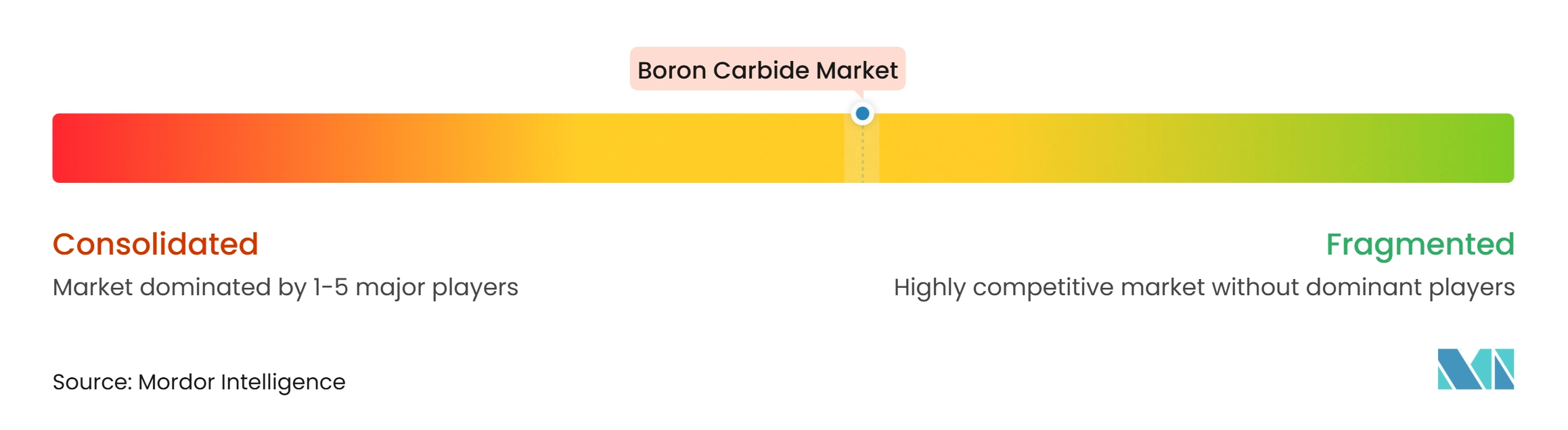
The boron carbide market is moderately fragmented. Chinese producers, including Dalian Jinma Boron Technology Group, hold a strong position in supplying abrasives and industrial refractories through integrated operations. Western suppliers focus more heavily on defense and nuclear materials that require validated processing and formal qualification. CoorsTek, 3M through Ceradyne, and Saint-Gobain are positioned in higher-value components, where platform qualification can enable long-term supply relationships. Saint-Gobain received U.S. Patent 12,435,006 in October 2025 for fine-grain boron carbide and silicon carbide armor plating.
The market also offers scope for products with complex geometries, including curved tiles for vehicle and aircraft protection. Hot pressing is costly for these shapes, which supports interest in pressureless and reaction-sintering alternatives. Verco Materials' January 2026 patent covers a flexible shield structure that uses overlapping boron carbide tiles, extending the material's use beyond conventional rigid plates. KYOCERA entered a 2025 co-development agreement with Kyoto Fusioneering for fusion-energy ceramics and neutron-shielding materials. These developments place product design, qualification, and advanced energy applications alongside cost as relevant competitive factors.
Distribution consolidation is also affecting specialty abrasives. GNPGraystar, a SurfacePrep subsidiary, acquired UK Abrasives in May 2025, reflecting the value of broader specialty-ceramics distribution networks for abrasive materials. NIJ Standard 0101.07 and NATO Standardization Agreement (STANAG) 4569 remain commercial barriers for armor suppliers, as compliance requires extensive testing. This structure allows established qualified suppliers to compete on approved designs and program history rather than commodity price alone.
Boron Carbide Industry Leaders
-
Saint-Gobain
-
CoorsTek Inc.
-
3M
-
WASHINGTON MILLS
-
Elmet Technologies
- *Disclaimer: Major Players sorted in no particular order
Boron Carbide Market Companies Covered in this Report
- 3M
- Adept Armor
- Bhukhanvala Industries Pvt. Ltd.
- CoorsTek Inc.
- Dalian Jinma Boron Technology Group Co., Ltd.
- Elmet Technologies
- KYOCERA Corporation
- Mudanjiang Qianjin Boron Carbide Co., Ltd.
- Nurol Holding A.Ş.
- Precision Ceramics Limited
- Saint-Gobain
- Schunk Technical
- UK Abrasives Inc.
- Verco Materials LLC
- WASHINGTON MILLS
Recent Industry Developments in Boron Carbide Market
- April 2026: India's 500 MWe Prototype Fast Breeder Reactor at Kalpakkam achieved first criticality. Bhukhanvala Industries Pvt. Ltd. supplied the complete natural boron carbide (B4C) neutron-shielding components and powder for the reactor, establishing its position as India's primary nuclear-grade B4C producer and creating opportunities for additional fast-reactor and Small Modular Reactor (SMR) contracts.
- January 2026: Verco Materials LLC received U.S. Patent 12,535,300 for a compact rollable rifle-protection ballistic shield using carbon-fiber-wrapped boron carbide (B4C) tiles in an imbricated pattern. The patent introduced a flexible armor architecture that extended the application of B4C to deployable shields and non-planar personal protection formats.
Global Boron Carbide Market Report Scope
Boron carbide is an extremely hard, black crystalline covalent ceramic material, ranking just behind diamond and cubic boron nitride among the hardest known man-made substances. It combines exceptional hardness and wear resistance with very low density, making it suitable for applications requiring materials that withstand significant mechanical stress while minimizing weight.
The boron carbide market is segmented by grade, product form, application, and geography. By grade, the market is segmented into abrasive grade, nuclear and defense grade, and industrial and refractory grade. By product form, the market is segmented into powder, grains, and others. By application, the market is segmented into industrial abrasives, nuclear, defense and ballistic protection, refractory and wear-resistant components, and others. The report also covers market sizes and forecasts for boron carbide across 15 countries in major regions. The market sizes and forecasts are provided in terms of value (USD).
Segmentation Overview
| Abrasive Grade |
| Nuclear and Defense Grade |
| Industrial and Refractory Grade |
| Powder |
| Grains |
| Others |
| Industrial Abrasives |
| Nuclear |
| Defense and Ballistic Protection |
| Refractory and Wear-Resistant Components |
| Others |
| Asia-Pacific | China |
| India | |
| Japan | |
| South Korea | |
| ASEAN Countries | |
| Rest of Asia-Pacific | |
| North America | United States |
| Canada | |
| Mexico | |
| Europe | Germany |
| United Kingdom | |
| France | |
| Italy | |
| NORDIC Countries | |
| Rest of Europe | |
| South America | Brazil |
| Argentina | |
| Rest of South America | |
| Middle East and Africa | Saudi Arabia |
| South Africa | |
| Rest of Middle East and Africa |
| By Grade | Abrasive Grade | |
| Nuclear and Defense Grade | ||
| Industrial and Refractory Grade | ||
| By Product Form | Powder | |
| Grains | ||
| Others | ||
| By Application | Industrial Abrasives | |
| Nuclear | ||
| Defense and Ballistic Protection | ||
| Refractory and Wear-Resistant Components | ||
| Others | ||
| By Geography | Asia-Pacific | China |
| India | ||
| Japan | ||
| South Korea | ||
| ASEAN Countries | ||
| Rest of Asia-Pacific | ||
| North America | United States | |
| Canada | ||
| Mexico | ||
| Europe | Germany | |
| United Kingdom | ||
| France | ||
| Italy | ||
| NORDIC Countries | ||
| Rest of Europe | ||
| South America | Brazil | |
| Argentina | ||
| Rest of South America | ||
| Middle East and Africa | Saudi Arabia | |
| South Africa | ||
| Rest of Middle East and Africa | ||
Key Questions Answered in the Report
What is current market size of Boron Carbide Market?
The Boron Carbide Market size was valued at USD 272.98 million in 2026 and is estimated to grow from USD 284.39 million in 2027 to USD 348.65 million by 2032, at a CAGR of 4.18% during the forecast period (2027-2032).
Which application is projected to grow fastest?
Nuclear applications are projected to grow at a 5.45% CAGR through 2032, supported by reactor construction, maintenance, and shielding needs.
Why is Asia-Pacific important for boron carbide suppliers?
Asia-Pacific held a 39.75% share in 2026 and is forecast to grow at a 5.33% CAGR, supported by China’s supply chain and India’s nuclear program.
What limits entry into defense-grade boron carbide production?
High-temperature processing, capital-intensive sintering equipment, and multi-year testing under National Institute of Justice (NIJ), ASTM International (ASTM), and NATO standards limit entry.