
Bookbinding Adhesives Market Size and Share
Market Overview
| Study Period | 2022 - 2032 |
|---|---|
| Market Size (2027) | USD 2.19 Billion |
| Market Size (2032) | USD 2.74 Billion |
| Growth Rate (2027 - 2032) | 4.53 % |
| Fastest Growing Market | Asia-Pacific |
| Largest Market | Asia-Pacific |
| Market Concentration | Medium |
Major Players *Disclaimer: Major Players sorted in no particular order Image © Mordor Intelligence. Reuse requires attribution under CC BY 4.0. | |
Bookbinding Adhesives Market Analysis by Mordor Intelligence
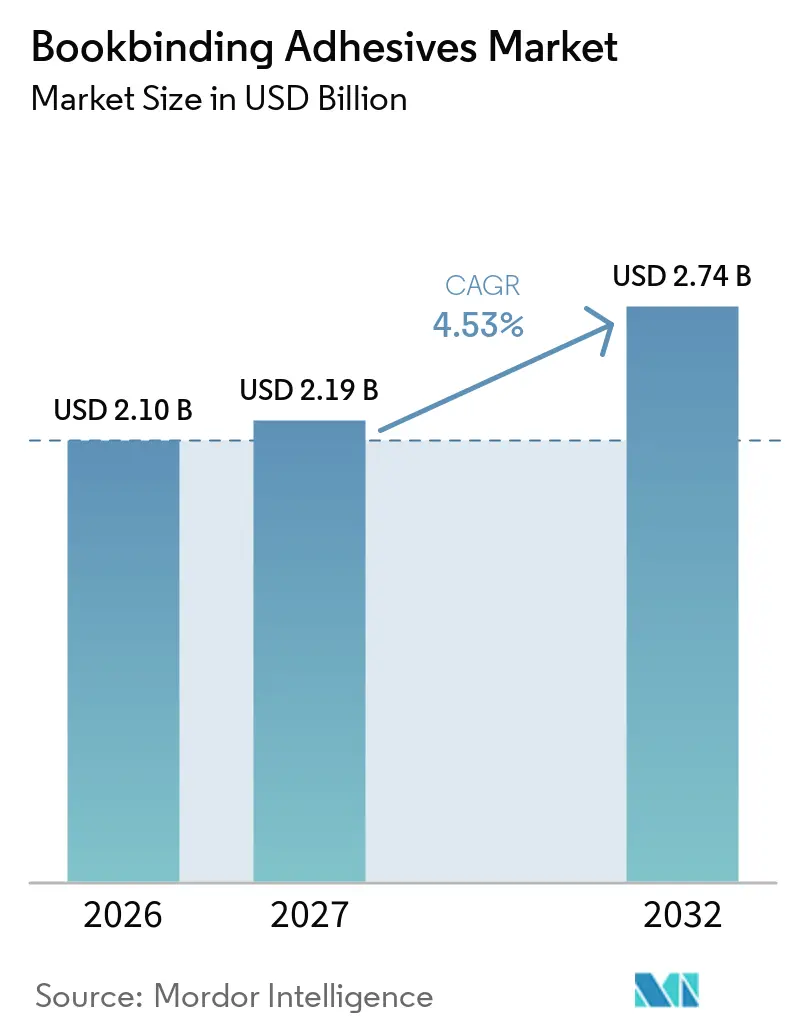
The Bookbinding Adhesives Market size was valued at USD 2.10 billion in 2026 and is estimated to grow from USD 2.19 billion in 2027 to USD 2.74 billion by 2032, at a CAGR of 4.53% during the forecast period (2027-2032). The bookbinding adhesives market is supported by commercial, educational, and professional publishing, where reliable bonds are required at high production speeds and across a range of paper stocks. Short-run printing increases the need for adhesives that bond toner-based, UV-coated, and recycled papers without compromising spine strength or page pull. Suppliers are moving toward Polyurethane Reactive (PUR), advanced polyolefin, low-temperature, and biobased products where standard Ethylene Vinyl Acetate (EVA) products do not meet substrate, durability, or processing requirements. Sustainability requirements in Europe are making recyclability, emissions, and renewable-content claims more important in product development and supplier qualification. Competition among global chemical groups and regional suppliers centers on price, local supply, technical service, and application support.
Key Report Takeaways
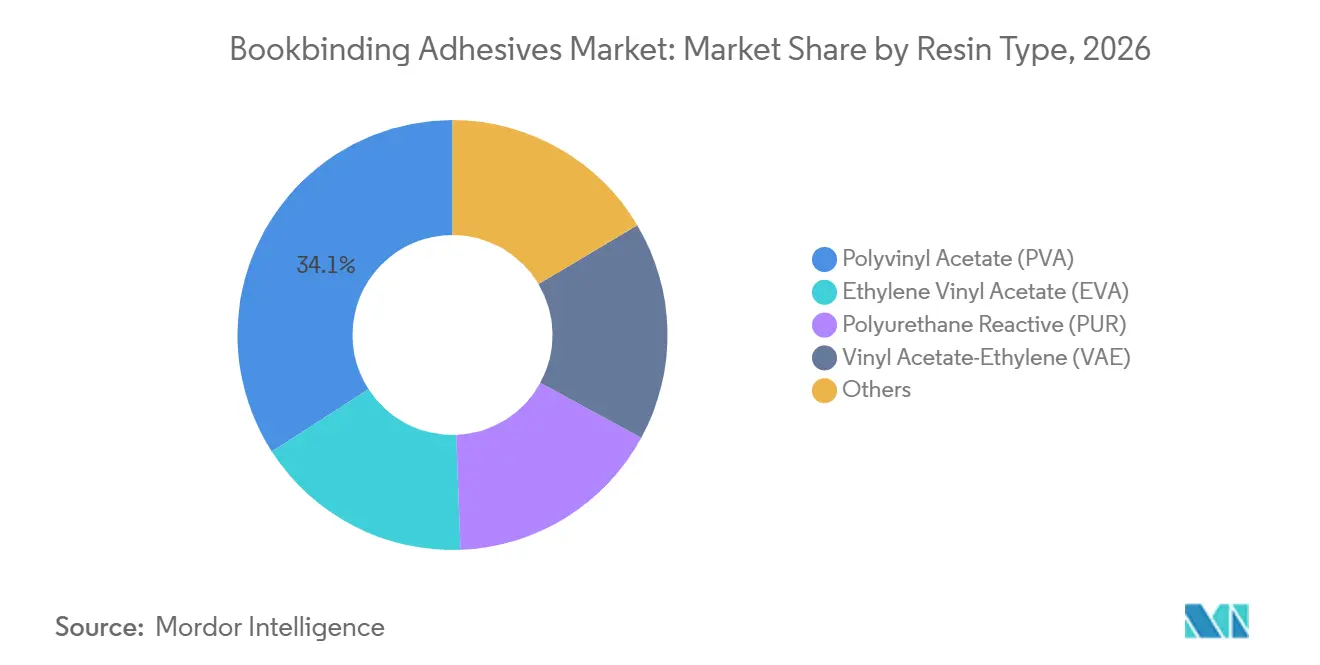
- By resin type, Polyvinyl Acetate (PVA) held 34.12% of the bookbinding adhesives market share in 2026, while PUR is forecast to grow at a 5.34% CAGR through 2032.
- By technology, hot melt adhesives accounted for 42.56% of the bookbinding adhesives market share in 2026 and are forecast to grow at a 5.78% CAGR through 2032.
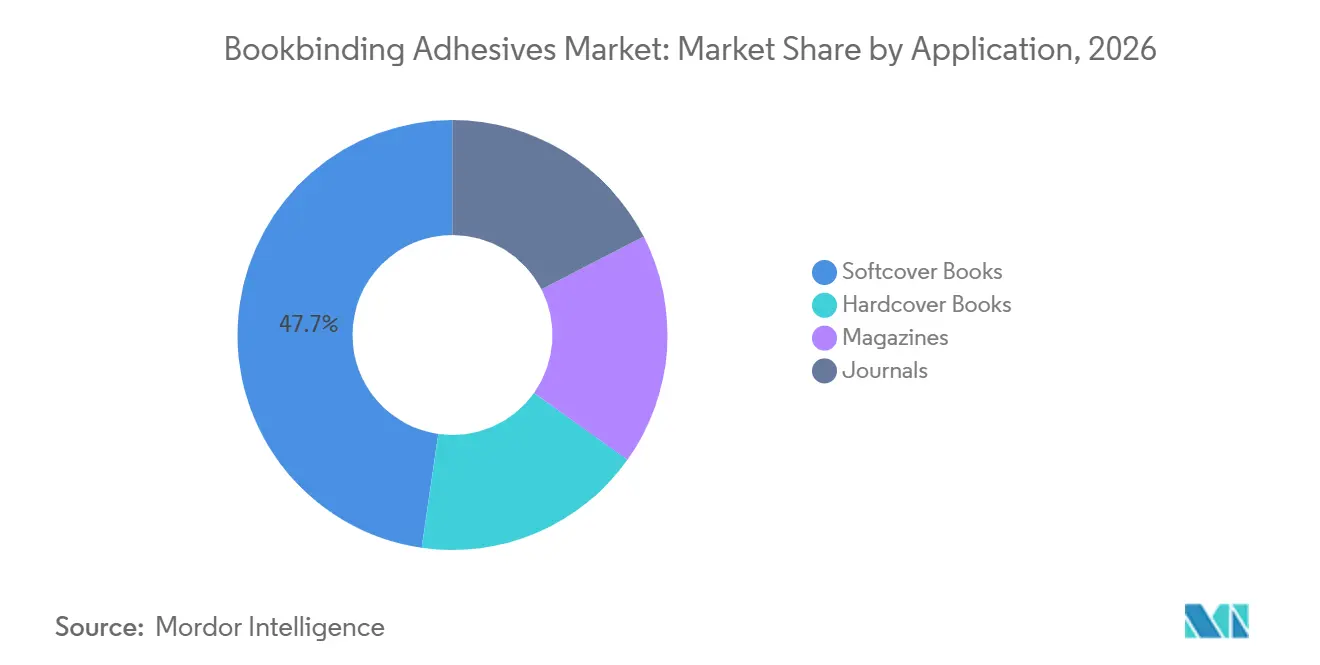
- By application, softcover books accounted for 47.71% of the bookbinding adhesives market share in 2026 and are forecast to expand at a 6.05% CAGR through 2032.
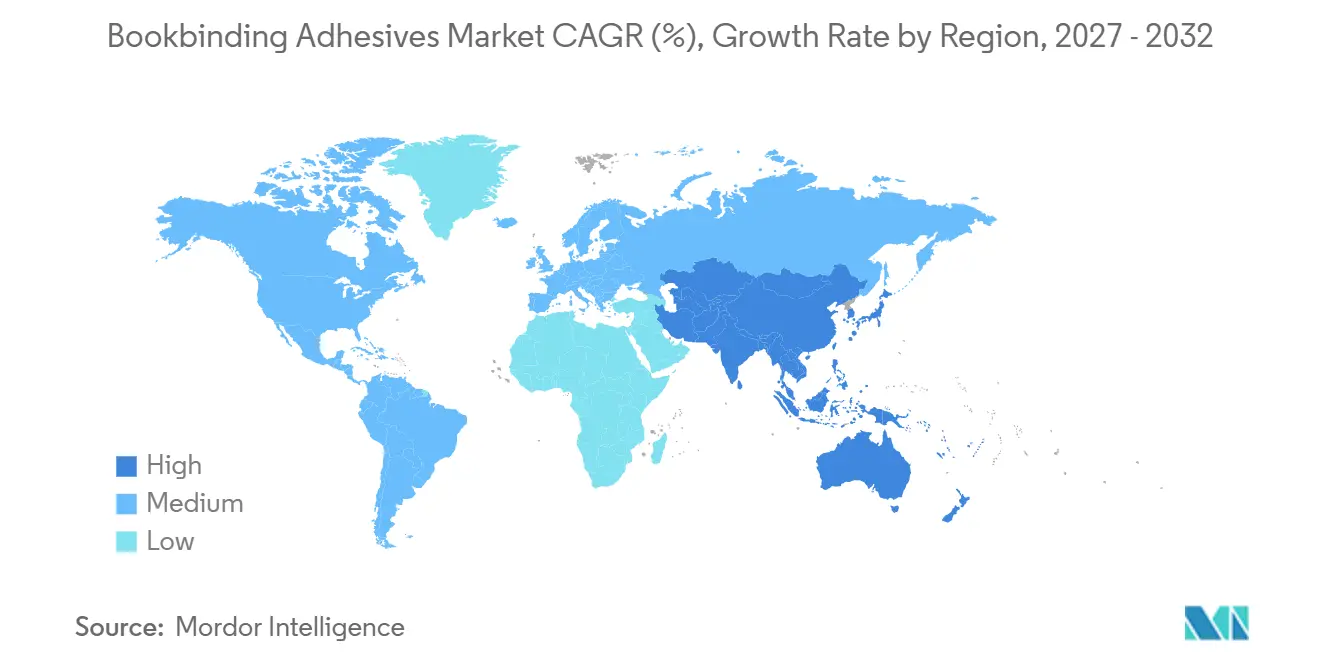
- By geography, Asia-Pacific held 38.67% of the bookbinding adhesives market share in 2026 and is forecast to grow at a 5.71% CAGR through 2032.
Note: Market numbers in this report are based on Mordor Intelligence's proprietary estimation framework, which combines nine months of actuals with Q4 projections for base year 2026.
Market Trends and Insights
Drivers Impact Analysis of Bookbinding Adhesives Market*
| Drivers | (~) % Impact on CAGR Forecast | Geographic Relevance | Impact Timeline |
|---|---|---|---|
| Print-on-Demand and Short-Run Publishing | +0.9% | Global, concentrated in North America, Europe, and India | Short term (≤ 2 years) |
| Growth in Educational and Professional Publishing | +1.0% | Asia-Pacific core, with spillover to the Middle East and Africa | Medium term (2-4 years) |
| Automation and High-Speed Binding Lines | +0.8% | Global, with early gains in Germany, Japan, and South Korea | Medium term (2-4 years) |
| Premium, Durable, and Lay-Flat Book Formats | +0.5% | North America and Europe | Short term (≤ 2 years) |
| Digital-Ink, Coated-Stock, and Recycled-Paper Compatibility | +0.3% | Global | Long term (≥ 4 years) |
| Source: Mordor Intelligence | |||
Print-on-Demand and Short-Run Publishing
Print-on-demand is changing the production conditions that adhesive suppliers must serve in the bookbinding adhesives market. Publishers use shorter runs to limit inventory exposure, preserve working capital, and address specialized titles without committing to large inventories. These runs increasingly use digitally printed papers with toner or UV-ink surfaces, rather than the offset stocks used in many established binding processes. Such surfaces can weaken bonds formed with conventional ethylene-vinyl acetate (EVA) hot melts and create greater variation in the conditions a binder experiences. Polyurethane reactive (PUR) and advanced EVA-PUR systems can meet the resulting page-pull and durability requirements, although their material costs and equipment requirements are higher. U.S. publishing sales reached USD 33.4 billion in 2025, maintaining a substantial base for commercial book production even as publishers adjust production models.
Growth in Educational and Professional Publishing
Educational publishing provides the bookbinding adhesives market with a more stable demand source than many consumer-led print categories. School and higher-education titles often depend on formal procurement cycles, curriculum updates, and institutional buying rather than short-term retail demand. In India, multilingual textbook programs under the National Education Policy have increased the need for coordinated print production across regional boards and language editions. This pattern can keep perfect-binding lines active around synchronized textbook launches, even when discretionary publishing conditions are less favorable. Italy's school publishing inquiry described the continuing importance of regulated textbook cycles for the publishing sector. These purchasing cycles give formulators a clearer basis for planning raw-material supply, production capacity, and service support for high-volume customers.
Automation and High-Speed Binding Lines
Automation is increasing the importance of adhesive behavior on high-speed binding lines. At elevated line speeds, open time, viscosity, set speed, and bond consistency can affect output as much as machine performance, because a small disruption can create waste throughout a continuous run. This supports demand for suppliers that can provide testing, process data, and application assistance alongside adhesive products. H.B. Fuller's FullVision service monitors adhesive application on softcover binding lines and identifies deviations in real time, helping users maintain repeatability from shift to shift. KLEIBERIT states that its E-Melt PUR systems operate at 80-100°C, which can reduce energy use and extend pot life compared with conventional PUR processing. These services and lower-temperature systems can make a binder less likely to change suppliers based solely on unit price, particularly where line reliability has direct cost implications.
Premium, Durable, and Lay-Flat Book Formats
Premium formats account for a higher-value share of demand in the bookbinding adhesives market. Photobooks, art editions, culinary books, technical manuals, and collector formats require flexible spines that can withstand repeated opening while maintaining an acceptable finished appearance. Conventional EVA systems are less suited to certain 180-degree opening requirements, especially when a book must lie flat without excessive spine stress. PUR and hybrid systems provide the bond strength and flexibility required for these applications, giving formulators opportunities beyond standard products. Planatol presents its Planamelt range for bookbinding applications requiring durable, flexible bonds. Gluecom also supplies protein jelly glues for art books and restoration, where reversibility remains important and hot melts cannot provide the same treatment option[1].
Restraints Impact Analysis of Bookbinding Adhesives Market*
| Restraints | (~) % Impact on CAGR Forecast | Geographic Relevance | Impact Timeline |
|---|---|---|---|
| Petrochemical Feedstock and Energy-Cost Volatility | -0.7% | Global, particularly Asia-Pacific and Europe | Medium term (2-4 years) |
| Recycling-Compatibility and Sticky Contamination Risk | -0.4% | Europe, with spillover to North America | Long term (≥ 4 years) |
| PUR Qualification, Storage, and Equipment Retrofit Costs | -0.5% | North America and Europe, with spillover to South America | Medium term (2-4 years) |
| Digital Substitution of Selected Print Volumes | -0.6% | North America and Western Europe | Medium term (2-4 years) |
| Source: Mordor Intelligence | |||
Petrochemical Feedstock and Energy-Cost Volatility
Feedstock and energy costs remain a constraint for the bookbinding adhesives market because key raw materials are linked to petrochemical supply chains. Vinyl acetate monomer is used in Polyvinyl Acetate (PVA) and Ethylene-Vinyl Acetate (EVA) products, while Methylene Diphenyl Diisocyanate (MDI) is a core reactive component in Polyurethane Reactive (PUR) systems, exposing suppliers to different cost patterns across their portfolios. These inputs can move independently, making it difficult for formulators to manage costs with a single purchasing approach or by substituting chemistry. Supply-chain uncertainty has kept procurement cautious among Asian petrochemical producers. Smaller binderies often have limited capacity to hedge against input price changes and may face immediate margin pressure when adhesive costs rise. Annual supply agreements in price-sensitive print markets can also limit the ability to pass on higher costs to customers, while technical requirements restrict the ability to switch materials quickly.
Digital Substitution of Selected Print Volumes
Digital substitution remains a demand constraint on the commodity portion of the bookbinding adhesives market. Magazine and directory applications are particularly exposed because they rely on high-output, price-sensitive print runs, where adhesive selection is often based on cost and established machine settings. U.S. print book sales fell 0.90% in the first nine months of 2025, while adult nonfiction declined 2.00% over the same period[2]. These declines affected water-based PVA and standard EVA products that served large-run applications more than the specialized products used in demanding binding work. Suppliers responded by prioritizing educational, durable, personalized, and premium formats where performance requirements support product differentiation. This shift directed product development toward applications where technical performance, compatibility, and service are more important than adhesive price.
*Our forecasts treat driver/restraint impacts as directional, not additive. The impact forecasts reflect baseline growth, mix effects, and variable interactions.
Bookbinding Adhesives Market Segment Analysis
By Resin Type:
PVA Leads by Share While PUR Gains Specification GroundPVA held 34.12% of the bookbinding adhesives market share in 2026, while PUR is forecast to grow at a 5.34% CAGR through 2032. PVA remains established in water-based dispersions used for casing-in, end-sheet gluing, and hardcover production, where reliable wet tack and substrate penetration are important. Its open time supports applications where operators need adhesive penetration into porous paper and board before the joint is closed. EVA serves high-speed perfect binding because it sets quickly, fits familiar production methods, and remains suitable for many standard paper stocks. VAE dispersions are relevant where lower-emission formulations are sought for printed products entering paper-recycling streams and where suppliers need to address environmental specifications without changing basic workflow requirements.
PUR is used where coated or digitally printed substrates require higher bond strength and flexibility over the life of the finished book. The bookbinding adhesives market for PUR benefits from applications where standard EVA products do not consistently handle toner or UV ink on the surface. Polyolefin and metallocene systems offer an alternative for users seeking reduced adhesive use, lower application weight, or alternatives to isocyanate-based chemistry. Tex Year states that its MPO bookbinding hot-melts use less adhesive by weight than EVA and PUR products while maintaining production efficiency. A European patent published in July 2025 describes a bookbinding hot melt formulation with more than 42% bio-based content, linking resin development to both material performance and renewable-content requirements.

By Technology:
Hot Melt Automation Advantage Sustains Dual LeadershipHot melt adhesives held 42.56% of the bookbinding adhesives market share in 2026 and are forecast to grow at a 5.78% CAGR through 2032. Their fast set supports automated lines that cannot accommodate delays due to water evaporation, especially on production lines that process a continuous series of book blocks. This supports stable cycle times and helps binders avoid delays that would reduce the value of automation investment. Hot-melt systems include conventional EVA, PUR, and lower-temperature variants, allowing users to match chemistry to paper type, speed, and final performance requirements. This range allows a single technology to address both standard production and more demanding book formats without requiring uniform process conditions across all applications.
Water-based adhesives remain important for manual and semi-automated work, particularly case binding and end-sheet gluing where drying time can be accommodated. Gluecom and Planatol offer water-based systems for graphic arts and bookbinding applications, reflecting the continuing role of dispersion chemistry in traditional workflows. Solvent-based products have a smaller role, as solvent-free alternatives avoid comparable ventilation demands and address restrictions associated with enclosed manufacturing spaces. REACH requirements also influence material selection in workplaces where chemical handling, worker exposure, and product compliance are assessed. KLEIBERIT's E-Melt range reflects the shift toward lower-temperature systems that can reduce processing energy while maintaining bond performance.
By Application:
Softcover Formats Drive Perfect-Binding Adhesive DemandSoftcover books accounted for 47.71% of the bookbinding adhesives market share in 2026 and are forecast to grow at a 6.05% CAGR through 2032. Perfect binding uses adhesive at the spine and in side-glue applications, placing adhesive performance at the center of both structural quality and production speed. This makes softcover production more adhesive-intensive than formats that use pre-coated boards or less adhesive during final assembly. Trade publishing and educational textbooks both rely extensively on softcover formats because they provide a practical balance between production economics and functional durability. Their scale supports demand for high-speed hot melt and water-based products, while the growing use of varied papers creates scope for higher-performing adhesive grades.
Hardcover books remain a stable secondary application for PVA dispersions and protein jelly glues, which support formats with different handling and preservation needs. These products serve premium, archival, gift, art, and children's formats, where appearance, durability, and the ability to handle repeated use can matter more than cycle speed. Magazines and journals continue to use high-speed hot melt systems, although digital channels put pressure on print volumes and reduce demand in some commodity applications. The bookbinding adhesives market for softcovers also benefits from shorter runs and personalized titles that fit perfect-binding workflows and require more frequent material adjustments. The European Federation of Corrugated Board Manufacturers (FEFCO)'s 2025 recyclability guidance identifies design considerations relevant to material recovery and circularity, reinforcing the need to consider end-of-life performance alongside bond strength.
Geography Analysis
Asia-Pacific: Scale and Demand Growth in One Region
Asia-Pacific held 38.67% of the bookbinding adhesives market share in 2026 and is forecast to expand at a 5.71% CAGR through 2032. Educational and commercial publishing underpin demand in China, India, Taiwan, and South Korea, where large print bases and expanding technical capacity support the region's position. Government textbook purchasing reduces dependence on discretionary consumer spending and limits exposure to changes in trade publishing demand. India continues to use physical books in school and higher-education settings, and multilingual materials add production complexity that requires dependable bindery workflows. NANPAO and Tex Year offer bookbinding hot melts and export-oriented supply networks across the region, giving local printers access to both standard and specialized formulations.
North America: Automation Premium and Adhesive Analytics Adoption
North America has high binding-line automation and demand for PUR and EVA-PUR products. Labor efficiency, process control, and waste reduction shape adhesive selection in the regional bookbinding adhesives market, where customers place high value on traceable production performance. U.S. publishing sales of USD 33.4 billion in 2025 supported demand across children's, academic, and specialty categories, each with different run sizes and format requirements. H.B. Fuller's FullVision platform adds production monitoring and traceability to binding operations, linking adhesive application with a plant's broader quality-control process. Capital Adhesives supplies PUR, EVA, and PVA products for major binding machinery platforms, and local application support remains central to supplier selection when operators must maintain output across varied jobs.
Europe and Emerging Markets: Regulatory Pull and Emerging Demand
Europe has specialist formulators located near bookbinding equipment producers, supporting joint product development and faster refinement of product specifications. Germany's Blauer Engel criteria and EU REACH influence demand for lower-emission and recycling-compatible products, making regulatory compliance a direct input to adhesive design. Jowat launched Jowacoll GROW 125.00 with 30% biobased content certified under ISO 16620-4, illustrating how suppliers incorporate verified renewable content into product development. South American demand centers on Brazil and Argentina, while demand in the Middle East and Africa is developing alongside investment in education and literacy. Sanyhot supplies hot melt products for spine and side-glue operations across relevant machinery platforms in these markets.
Competitive Landscape
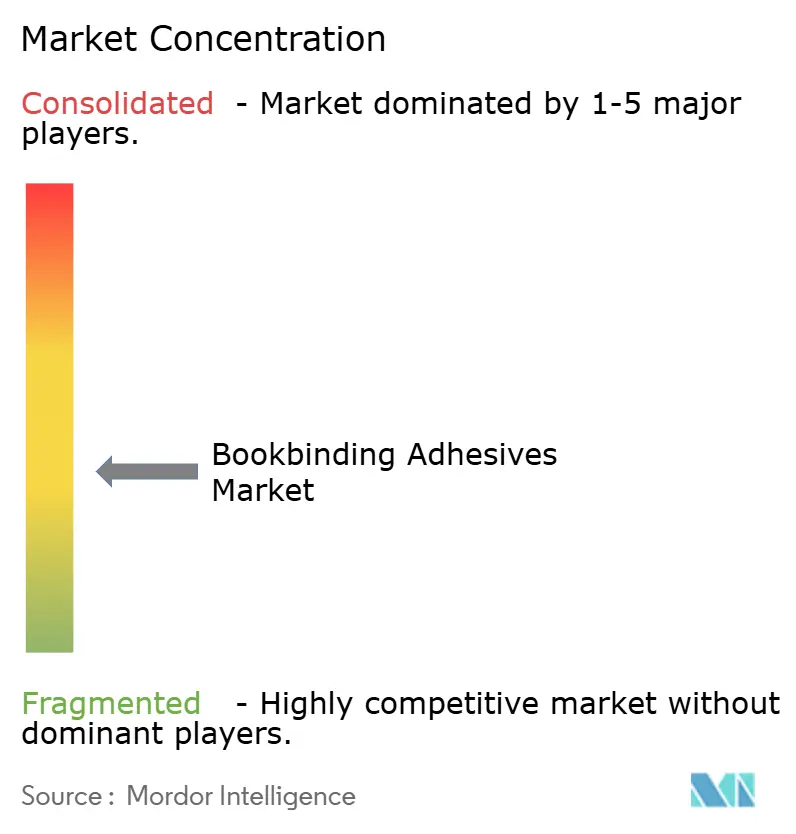
The bookbinding adhesives market is moderately fragmented. Henkel, Arkema through Bostik, and H.B. Fuller compete with Jowat, KLEIBERIT, Planatol, and regional suppliers. Global suppliers offer broad formulation portfolios, supply systems, and resources across multiple industrial adhesive categories. Specialists compete by offering faster application development, closer technical support, and greater familiarity with specific binding workflows.
Henkel's Technomelt portfolio supports its position in the hot melt adhesives market. Henkel reported EUR 10,667 million (~USD 11,921.7 million) in Adhesive Technologies sales in 2025 and agreed to acquire ATP Adhesive Systems AG to expand its water-based specialty capability. In 2025, Arkema acquired Dow's flexible packaging laminating adhesives business, extending Bostik's presence in adjacent converting applications and adding products that serve related packaging and paper-converting customers. H.B. Fuller connects adhesive supply with binding-line monitoring through FullVision, which converts process information into a technical-service component of the supplier relationship. These developments brought additional technology and service capabilities into adhesive supply relationships.
Biobased formulations, data-supported process optimization, and low-temperature polyurethane reactive (PUR) systems are active areas of development. A European Patent Office publication on a hot melt with more than 42% bio-based content supports continued work on renewable-content products that meet performance requirements. Registration, Evaluation, Authorization and Restriction of Chemicals (REACH) compliance requirements and paper recyclability expectations increase qualification work for new suppliers, particularly where adhesive residues can affect recycling outcomes. Tex Year and NANPAO combine export distribution with certified production for cost-sensitive markets, creating competitive pressure for established suppliers in standard applications.
Bookbinding Adhesives Industry Leaders
-
Henkel AG & Co. KGaA
-
H.B. Fuller Company
-
Arkema
-
Jowat SE
-
Pidilite Industries Ltd.
- *Disclaimer: Major Players sorted in no particular order
Bookbinding Adhesives Market Companies Covered in this Report
- Arkema
- Capital Adhesives, Inc.
- Cattie Adhesives
- Gluecom nv
- H.B. Fuller Company
- Henkel AG & Co. KGaA
- Jowat SE
- KLEIBERIT SE & Co. KG
- NANPAO RESINS CHEMICAL GROUP
- OM MIDWEST INDUSTRIES
- Pidilite Industries Ltd.
- Planatol GmbH
- Sanyhot Adhesivos, S.A.
- Sika AG
- Tex Year Industrial Adhesives Private Limited
- Yashbond Adhesive Co.
Recent Industry Developments in Bookbinding Adhesives Market
- January 2026: Henkel AG & Co. KGaA agreed to acquire ATP Adhesive Systems AG, a provider of water-based specialty adhesives and tapes, for EUR 270 million (~USD 301.75 million). The acquisition expanded Henkel's water-based adhesive portfolio across the automotive, electronics, medical, construction, and graphics segments in North America and Europe.
- May 2025: Tex Year Group reported growth in sales of MPO (metallocene polyolefin) hot melt bookbinding adhesives. Japanese publications on printing and binding featured these MPO bookbinding adhesive products in May 2025, reflecting adoption among printing and binding companies.
Global Bookbinding Adhesives Market Report Scope
Book binding adhesive is a glue, paste, or polymer compound used to hold the pages, spine, and cover of a book together. These adhesives are formulated to provide durable bonding across a range of book formats, including paperback, hardcover, and case-bound books. They are applied during the manufacturing process to ensure structural integrity and longevity of the finished product.
The bookbinding adhesives market is segmented by resin type, technology, application, and geography. By resin type, the market is segmented into polyvinyl acetate (PVA), ethylene vinyl acetate (EVA), polyurethane reactive (PUR), vinyl acetate-ethylene (VAE), and others. By technology, the market is segmented into water-based, hot melt, solvent-based, and others. By application, the market is segmented into hardcover books, softcover books, magazines, and journals. The report also covers market sizes and forecasts for bookbinding adhesives across 15 countries in major regions. The market sizes and forecasts are provided in terms of value (USD).
Segmentation Overview
| Polyvinyl Acetate (PVA) |
| Ethylene Vinyl Acetate (EVA) |
| Polyurethane Reactive (PUR) |
| Vinyl Acetate-Ethylene (VAE) |
| Others |
| Water-Based |
| Hot Melt |
| Solvent-Based |
| Others |
| Hardcover Books |
| Softcover Books |
| Magazines |
| Journals |
| Asia-Pacific | China |
| India | |
| Japan | |
| South Korea | |
| ASEAN Countries | |
| Rest of Asia-Pacific | |
| North America | United States |
| Canada | |
| Mexico | |
| Europe | Germany |
| United Kingdom | |
| France | |
| Italy | |
| NORDIC Countries | |
| Rest of Europe | |
| South America | Brazil |
| Argentina | |
| Rest of South America | |
| Middle East and Africa | Saudi Arabia |
| South Africa | |
| Rest of Middle East and Africa |
| By Resin Type | Polyvinyl Acetate (PVA) | |
| Ethylene Vinyl Acetate (EVA) | ||
| Polyurethane Reactive (PUR) | ||
| Vinyl Acetate-Ethylene (VAE) | ||
| Others | ||
| By Technology | Water-Based | |
| Hot Melt | ||
| Solvent-Based | ||
| Others | ||
| By Application | Hardcover Books | |
| Softcover Books | ||
| Magazines | ||
| Journals | ||
| By Geography | Asia-Pacific | China |
| India | ||
| Japan | ||
| South Korea | ||
| ASEAN Countries | ||
| Rest of Asia-Pacific | ||
| North America | United States | |
| Canada | ||
| Mexico | ||
| Europe | Germany | |
| United Kingdom | ||
| France | ||
| Italy | ||
| NORDIC Countries | ||
| Rest of Europe | ||
| South America | Brazil | |
| Argentina | ||
| Rest of South America | ||
| Middle East and Africa | Saudi Arabia | |
| South Africa | ||
| Rest of Middle East and Africa | ||
Key Questions Answered in the Report
What is current market size of Bookbinding Adhesives Market?
The Bookbinding Adhesives Market size was valued at USD 2.10 billion in 2026 and is estimated to grow from USD 2.19 billion in 2027 to USD 2.74 billion by 2032, at a CAGR of 4.53% during the forecast period (2027-2032).
Which adhesive technology is growing fastest for bookbinding?
Hot melt adhesives held a 42.56% share in 2026 and are projected to grow at a 5.78% CAGR through 2032.
Which book format creates the most demand for binding adhesives?
Softcover books held 47.71% of demand in 2026 and are forecast to grow at a 6.05% CAGR through 2032.
Which region leads in demand for bookbinding adhesives?
Asia-Pacific held 38.67% of demand in 2026 and is forecast to expand at a 5.71% CAGR through 2032.