
Bonding Sheet Market Size and Share
Market Overview
| Study Period | 2021 - 2031 |
|---|---|
| Market Size (2026) | USD 530.14 Million |
| Market Size (2031) | USD 755.44 Million |
| Growth Rate (2026 - 2031) | 7.34 % |
| Fastest Growing Market | Asia-Pacific |
| Largest Market | Asia-Pacific |
| Market Concentration | Medium |
Major Players *Disclaimer: Major Players sorted in no particular order Image © Mordor Intelligence. Reuse requires attribution under CC BY 4.0. | |
Bonding Sheet Market Analysis by Mordor Intelligence
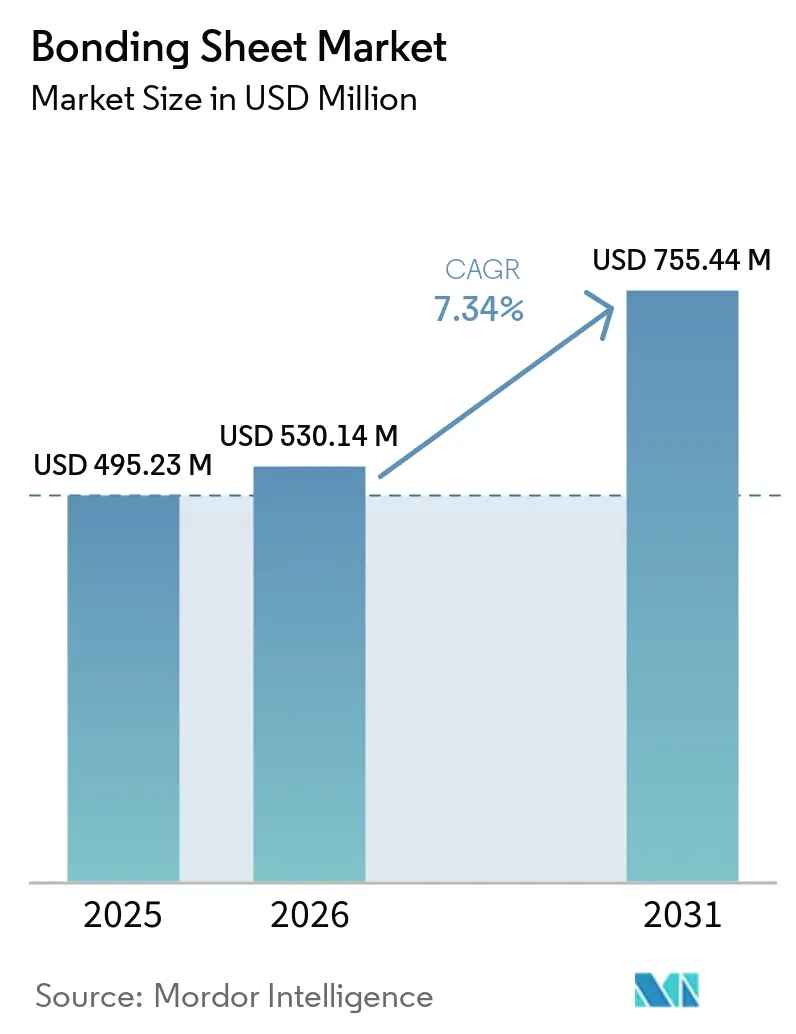
The Bonding Sheet Market size was valued at USD 495.23 million in 2025 and is estimated to grow from USD 530.14 million in 2026 to USD 755.44 million by 2031, at a CAGR of 7.34% during the forecast period (2026-2031). Growth in the bonding sheet market reflects rising technical requirements in semiconductor packaging, vehicle electronics, and radio-frequency equipment, where the bonding layer must meet electrical, thermal, and mechanical demands simultaneously in products that are becoming smaller and more complex. Chiplet integration is driving demand for thin films that enable precise patterning, controlled curing, reliable dielectric performance, and stable results in high-density package manufacturing, while remaining compatible with existing assembly processes, from film handling through final package assembly to subsequent thermal cycles. Manufacturers also need materials that support thinner smartphones, wearables, displays, and other compact electronic assemblies without adding thickness, causing damage during lamination, or restricting design flexibility in multilayer components. Suppliers are responding through application-specific film portfolios, lower-loss formulations, materials designed for more demanding thermal conditions, and products that can be qualified within customer production processes. The bonding sheet market also faces cost pressure from specialty chemical inputs and longer approval cycles in safety-critical applications, making established supplier relationships, upstream materials knowledge, dependable manufacturing support, and documentation capabilities important factors for market participants.
Key Report Takeaways
- By adhesive material, polyimides held 42.34% of the bonding sheet market share in 2025, while the polyimide segment is forecast to grow at a 7.76% CAGR through 2031.
- By application, electronics and optoelectronics accounted for 43.85% of the bonding sheet market in 2025, and this segment is forecast to grow at an 8.29% CAGR through 2031.
- By geography, Asia-Pacific accounted for 40.17% of revenue in 2025 and is forecast to grow at a 7.94% CAGR through 2031.
Note: Market size and forecast figures in this report are generated using Mordor Intelligence’s proprietary estimation framework, updated with the latest available data and insights as of January 2026.
Market Trends and Insights
Drivers Impact Analysis of Bonding Sheet Market*
| Drivers | (~) % Impact on CAGR Forecast | Geographic Relevance | Impact Timeline |
|---|---|---|---|
| Semiconductor Packaging Complexity and Advanced Package Integration | +2.2% | Global, concentrated in Japan, South Korea, Taiwan, and China | Medium term (2-4 years) |
| Miniaturization of Electronic and Optoelectronic Devices | +1.5% | Global, strongest in Asia-Pacific consumer electronics hubs | Short term (≤ 2 years) |
| Electrification and Lightweighting in Automotive Platforms | +1.2% | Global, strongest in Europe, China, and North America | Medium term (2-4 years) |
| High-Frequency Performance Requirements from 5G and Advanced Connectivity | +1.4% | Global, with Asia-Pacific and North America as core regions | Medium term (2-4 years) |
| Qualification of Application-Specific Bonding Sheets Through Digital Process Control | +0.8% | Global, with early adoption in Japan, South Korea, and the United States | Long term (≥ 4 years) |
| Source: Mordor Intelligence | |||
Semiconductor Packaging Complexity and Advanced Package Integration
Chiplet-based 2.5D and 3D integration is changing the performance requirements for films used in substrate and die-attach layers, particularly where several components are joined within a compact package. Conventional fan-out wafer-level packages accept broader dielectric tolerances than emerging glass-core substrate designs, which place tighter demands on every insulating and bonding layer. These newer designs require materials that support sub-10-micrometer via patterning, void-free through-glass-via filling, limited thermal shrinkage during curing, and stable adhesion through repeated thermal cycles. Photosensitive polyimide sheets meet these needs at scale and strengthen their role in the bonding sheet market when package makers need a material that meets both design rules and manufacturing process requirements. Toray developed a negative photo-definable polyimide sheet for next-generation semiconductor packaging that reduced the elastic modulus by one-third compared with its earlier product and was planned for mass production starting in April 2026[1]. This product addresses glass cracking caused by thermal stress differences, which is why material performance, documentation, and process reliability are central to supplier selection for advanced package programs.
Miniaturization of Electronic and Optoelectronic Devices
Demand for thinner smartphones, wearables, and augmented-reality hardware is reducing the available space for multilayer assemblies, leaving less room for films that add height or create uneven interfaces. This favors bonding sheets that maintain mechanical integrity at thicknesses below 25 micrometers while retaining the handling properties required in mass manufacturing. The bonding sheet market benefits from products that combine adhesion, low thermal expansion, fine patterning capability, and dependable performance after lamination. Research published in ACS Applied Polymer Materials reported that low-coefficient-of-thermal-expansion (CTE) photosensitive polyimide films achieved strong adhesion to copper and sub-10-micrometer lithographic resolution. The same research described expansion coefficients below 25 ppm/K, which supports their use in redistribution layers where dimensional stability affects the accuracy of fine interconnect structures. These characteristics also support demand for adhesiveless laminate formats when designers require reduced thickness, stable electrical performance, and materials suited to increasingly compact assemblies.
Electrification and Lightweighting in Automotive Platforms
Battery-electric vehicles use bonding materials across battery modules, silicon carbide power inverters, and advanced driver-assistance sensor arrays, increasing the number of demanding interfaces within each vehicle. These systems require structural load transfer, thermal management, and dielectric insulation across automotive operating conditions rather than a single adhesive function. Bonding sheets can distribute stress more evenly across aluminum, carbon-fiber-reinforced polymer, and polymer housings than mechanical fasteners, particularly where dissimilar substrates respond differently to heat and vibration. This supports vehicle designs seeking 20% weight reductions in bonded assemblies while maintaining durability and avoiding localized stress points associated with some mechanical joining methods. A 2025 review in Discover Mechanical Engineering identified epoxy, polyurethane, and silicone bonding materials in cell-to-cell bonding, busbar protection, cooling-plate thermal management, and sealing. Henkel's Teroson EP 52 illustrates demand for epoxy structural adhesives that combine high damping with body-in-white bonding requirements, reflecting the broader preference for materials that serve multiple functions within a single automotive assembly.
High-Frequency Performance Requirements from 5G and Advanced Connectivity
Millimeter-wave 5G base stations and antenna-in-package modules require materials with stable electrical properties at high frequencies, where small changes in dielectric behavior can affect signal quality. Target specifications include dielectric constant values below 3.0 and dissipation factors below 0.003 at 10 GHz, creating a clear distinction from applications with less demanding electrical requirements. Conventional epoxy prepregs can struggle to meet these requirements at 28 GHz and higher frequencies, particularly when performance must remain stable after processing and in service. Modified polyimide, liquid-crystal polymer, and PTFE-based bondplies are therefore more relevant in radio-access-network hardware, where the electrical contribution of the bonding layer becomes part of the overall design. The bonding sheet market is moving toward competition based on dielectric loss, dimensional stability, processing accuracy, and dependable supply rather than price per unit area alone. This shift also makes low-loss polyimide formulations relevant for antenna modules and other high-frequency assemblies that continue to require physical bonding films as connectivity specifications become more demanding.
Restraints Impact Analysis of Bonding Sheet Market*
| Restraints | (~) % Impact on CAGR Forecast | Geographic Relevance | Impact Timeline |
|---|---|---|---|
| Volatility in Polyimide, Epoxy, Specialty Polymer, and Chemical Input Costs | -1.8% | Global, with the largest margin exposure in Asia-Pacific and spillover to North America | Short term (≤ 2 years) |
| Qualification Lead Times and Switching Costs in Safety-Critical Applications | -1.2% | Global, most acute in North America and Europe | Medium term (2-4 years) |
| Increasing Requirements for Recyclability, Low Emissions, and End-of-Life Separation | -0.9% | Europe is primary, while North America and the Asia-Pacific are emerging | Long term (≥ 4 years) |
| Source: Mordor Intelligence | |||
Volatility in Polyimide, Epoxy, Specialty Polymer, and Chemical Input Costs
Polyimide-based bonding sheets have a cost structure that is sensitive to changes in specialty chemical inputs, so material margins can shift even when customer demand remains stable. Pyromellitic dianhydride (PMDA) accounts for 46-51% of total polyimide raw material costs. This exposure makes film pricing sensitive to broader petrochemical conditions and complicates pricing discussions for products with long development and approval cycles. Asia-Pacific producers face pressure when spot prices decline, while converters in North America face higher input costs during supply disruptions, resulting in different cost conditions across the same supply chain. Fixed-price customer agreements may limit suppliers' ability to quickly recover cost increases, particularly for suppliers that lack upstream integration for dianhydride or diamine inputs. Restrictions on certain diamine co-monomers in Europe, South Korea, and Japan can also extend formulation changes by 12-18 months, increasing the cost and timing risk of raw material substitution.
Qualification Lead Times and Switching Costs in Safety-Critical Applications
Bonding sheets used in aerospace harnesses, cardiac monitoring devices, and electric-vehicle power modules require lengthy product approval processes because the material becomes part of a safety-critical system. Qualification can involve Association Connecting Electronics Industries (IPC)-4101 laminate requirements, Automotive Electronics Council (AEC)-Q200 automotive stress testing, or equivalent standards that examine performance under defined mechanical, thermal, and electrical conditions. These processes can take 12-36 months from first-article submission to production approval, delaying the commercial use of a new material even after its technical development is complete. A chemistry revision can restart qualification activities after a material is already selected for a product, making customers cautious about changing a proven film. This limits the speed at which buyers and new suppliers can adopt improved materials or adjust their material choices in response to changing specifications. Medical devices can face additional change-control requirements under ISO 13485 and FDA 21 CFR Part 820, extending the approval process and increasing the documentation required for a material change.
*Our forecasts treat driver/restraint impacts as directional, not additive. The impact forecasts reflect baseline growth, mix effects, and variable interactions.
Bonding Sheet Market Segment Analysis
By Adhesive Material:
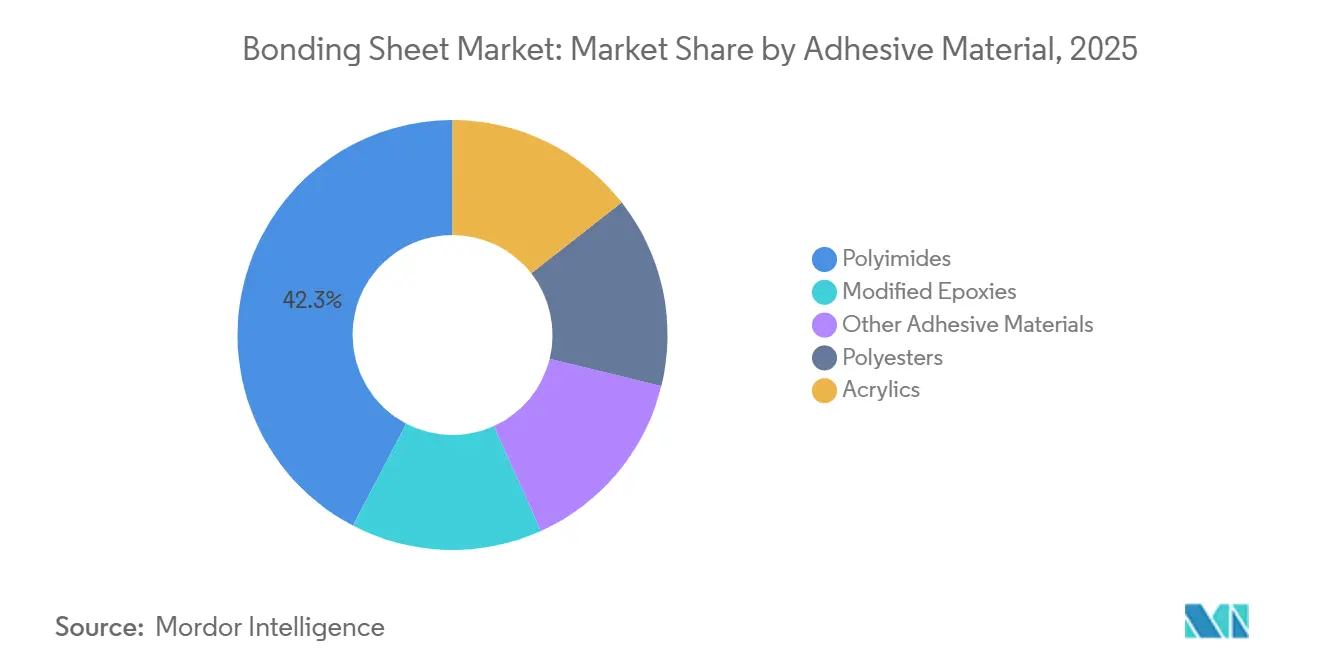
Polyimides Lead High-Performance ApplicationsPolyimide-based sheets held 42.34% revenue share in 2025, and the bonding sheet market size for polyimides is projected to expand at a 7.76% CAGR from 2026 to 2031. Their position reflects a combination of a dielectric constant below 3.5, thermal stability up to 260°C, and compatibility with photolithographic patterning, which together meet the requirements of demanding package structures. These properties suit advanced packages where insulating layers require reliable thermal performance, accurate registration, and tightly controlled processing conditions. As heterogeneous integration moves toward glass-core and panel-level designs, dielectric requirements become more demanding, and material choice becomes closely linked to process yield. This development favors materials already used in high-performance dielectric layers, particularly where suppliers understand both film chemistry and the customer's lamination sequence. In May 2026, Asahi Kasei announced a photosensitive polyimide film for advanced semiconductor packaging. Its Pimel resin platform and dry-film processing were designed to form uniform insulating layers across large panel areas, allowing a film format to address a production challenge in panel-level packaging. This addresses a yield constraint that liquid-resin processes may not handle well, while also reinforcing demand for materials tailored to advanced packaging methods.
Polyesters are used primarily in price-sensitive building and construction laminates and commodity electronics where thermal requirements remain below 100°C and material cost is a major selection factor. Acrylics serve as dicing-film bonding sheets and for temporary-hold applications in back-end semiconductor processing, where a secure yet controlled bond is required during specific manufacturing steps. Their pressure-sensitive adhesion and room-temperature processing are useful when UV debonding or cure-on-demand functionality is more important than high heat resistance. Modified epoxy products are gaining use in automotive die-attach applications, where the bond must support demanding thermal and mechanical operating conditions. These products address the need for low-temperature curing and post-cure glass transition temperatures above 150°C without compromising adhesion to copper. The bonding sheet industry contains distinct technical roles for these material classes rather than a single replacement path. This mix enables suppliers to address both performance-driven applications and large-scale, cost-sensitive uses, while customers can select materials based on the requirements of the final product.

By Application:
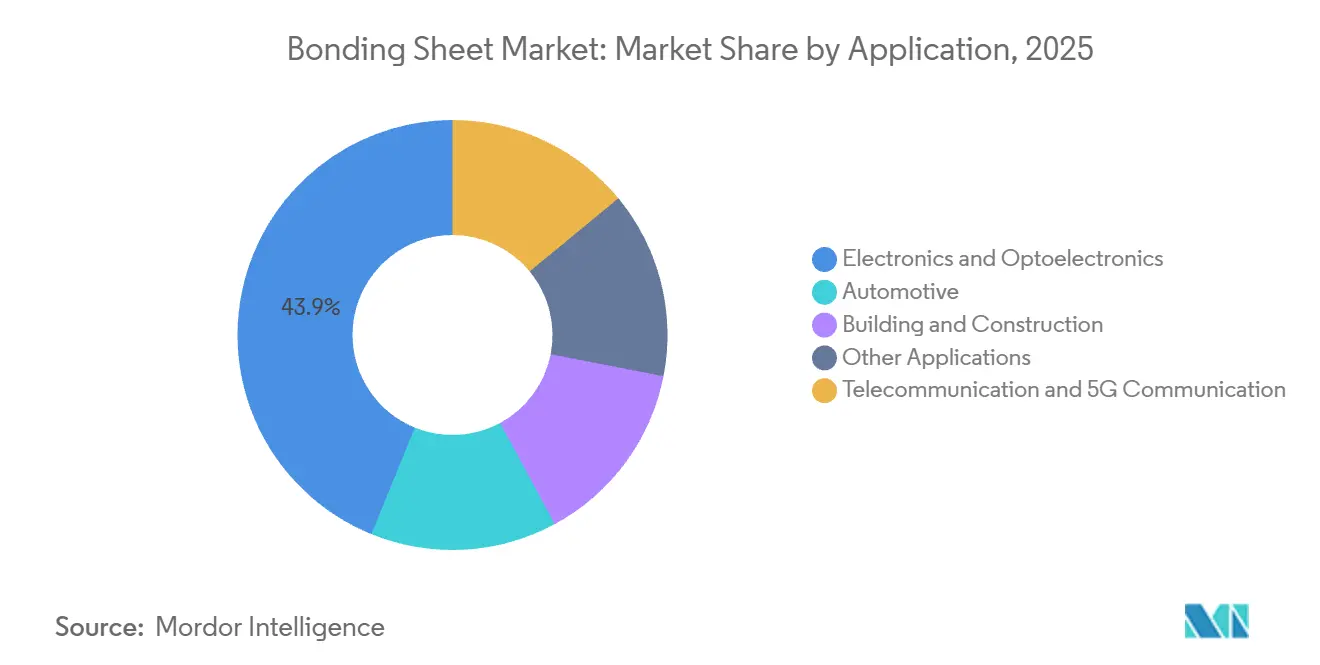
Electronics and Optoelectronics Retain the Leading PositionElectronics and optoelectronics held 43.85% of the bonding sheet market share in 2025, and the bonding sheet market size for this application is forecast to grow at an 8.29% CAGR through 2031. Demand extends from smartphones and tablets to artificial intelligence accelerator packaging, high-bandwidth memory stacks, and foldable OLED displays, broadening the end-use base for high-performance films. These products require thin, low-loss dielectric films with dependable adhesion, precise process behavior, and stable electrical properties during operation. Advanced packaging also brings tighter requirements for redistribution layers and multilayer interconnect structures, so material performance can affect both package design and manufacturing yield. IEEE research has examined polyimide-based hybrid bonding for lower-temperature processing, underscoring the technical relevance of these materials for advanced electronic packaging. Electronics applications therefore remain important for the bonding sheet market as packaging moves toward higher density and more complex structures. Suppliers with photo-definable films and established customer qualifications are positioned to meet these requirements, as they can support product design, process integration, and material consistency. Environmental documentation is also becoming more relevant as customers evaluate material choices within broader manufacturing controls.
Telecommunications and 5G communication applications are expanding as operators build millimeter-wave small-cell infrastructure and seek materials that preserve signal performance in compact antenna assemblies. These installations require films with closely controlled dielectric constant and dissipation factor values, making electrical performance as important as physical bond strength. Automotive applications are also becoming a more significant source of demand as vehicle systems add power electronics, sensor arrays, and battery components. Battery-electric vehicles use bonding sheets in power electronics, battery modules, and structural body-in-white joints, each with distinct mechanical and thermal requirements. Material use per vehicle in battery-electric vehicles can exceed that of comparable internal-combustion-engine vehicles because more electronic and battery-related assemblies must be joined and protected. Building and construction remains the most demand-sensitive application group and provides a stable base for polyester and acrylic grades. Other applications include medical devices, aerospace, and flexible solar cells, where smaller production quantities are balanced by detailed performance and approval requirements. These uses involve lower quantities but can offer higher margins due to qualification requirements and long product cycles. This application mix gives the bonding sheet industry exposure to both high-quantity electronics and specialized end uses, reducing reliance on any single downstream application.
Geography Analysis
APAC Bonding Sheet Market
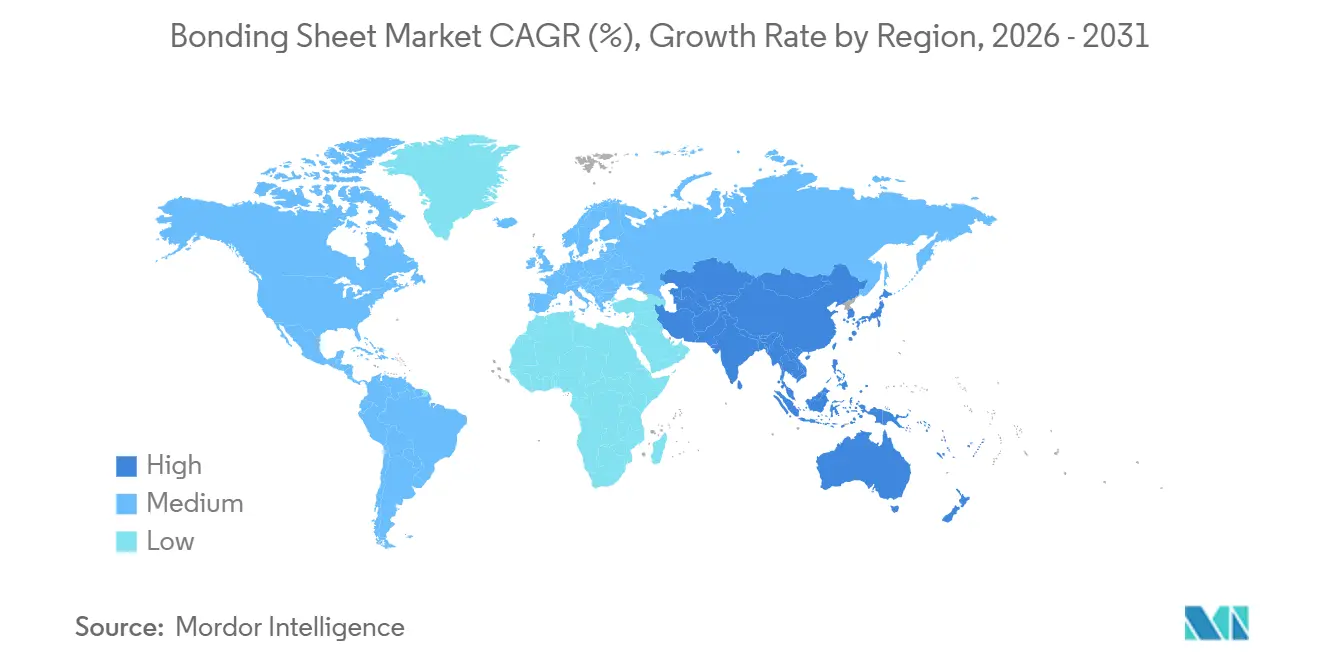
Asia-Pacific held 40.17% of the bonding sheet market share in 2025 and is forecast to grow at a 7.94% CAGR through 2031. Japan, South Korea, Taiwan, and China host major concentrations of flexible printed circuit manufacturers, advanced packaging providers, foundries, and consumer electronics producers, creating close links between material suppliers and large end users. These facilities are direct users of bonding sheet materials for products ranging from flexible circuits to complex semiconductor packages. Japan remains a center for high-specification films used in glass-core substrates, foldable OLED displays, and 5G antenna modules. Toray, Nitto Denko, Dexerials, and LINTEC have established advanced materials programs that address these applications and support ongoing product development. China's advanced packaging expansion has split demand between premium imported films for leading-edge chiplets and cost-optimized local products for mature-node applications, creating distinct competitive conditions across the regional market.
North America and Europe Bonding Sheet Market
North America represents a meaningful share of the bonding sheet market in 2026, supported by aerospace and defense requirements, semiconductor manufacturing investment, and electric vehicle supply chains. Regional customers prioritize high reliability and long-term supply relationships, as material changes can require detailed validation in regulated or safety-critical applications. DuPont developed a high-resolution, dry-film, photo-imageable dielectric for redistribution layers in advanced packaging applications[2]. Europe is supported by automotive Tier-1 suppliers in Germany and the Nordic countries. The shift toward battery-electric vehicles is increasing adhesive content per vehicle and driving material development toward recyclable, lower-emission systems.
MEA and South America Bonding Sheet Market
South America, the Middle East, and Africa remain smaller parts of the bonding sheet market. Brazil's Manaus electronics cluster and automotive assembly facilities consume materials for display modules and automotive electronics, providing a regional base for demand. Saudi Arabia's Vision 2030 program and semiconductor-adjacent investment support regional demand, while South Africa's automotive sector provides a base for structural film consumption. These regions primarily use cost-optimized polyester and acrylic grades, as many applications place greater emphasis on cost and standard processing conditions. Growth in these regions is projected to remain below the global average through 2031. Suppliers serving these regions require competitive cost structures, reliable local supply arrangements, and product offerings aligned with the requirements of electronics and vehicle assembly customers.
Competitive Landscape
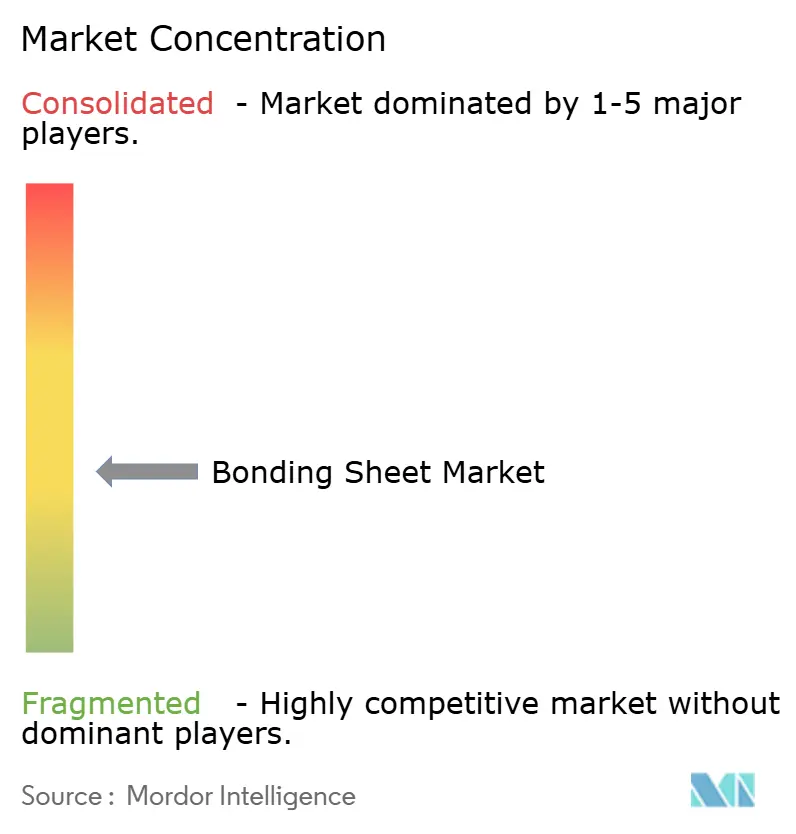
The bonding sheet market is moderately fragmented. Nitto Denko, Dexerials, LINTEC, Arisawa Manufacturing, NIKKAN INDUSTRIES, Nippon Mektron, and Mitsubishi Chemical Group form a major supplier group for high-specification polyimide and anisotropic conductive films. Their positions are supported by application development with electronics manufacturers, patent portfolios, upstream monomer capabilities, and established customer qualification processes. DuPont, Rogers Corporation, and Henkel are key Western participants with materials expertise and qualification histories in specialized electronics, aerospace, and automotive applications. Competition is strongest where suppliers must meet technical requirements for high-frequency equipment, aerospace systems, and automotive electronics. Suppliers that can combine qualified materials with consistent manufacturing support, technical service, and a stable response to customer-specific process needs hold a competitive advantage in this market.
Competitive strategies focus on low-loss dielectric performance for 5G and 6G substrates, thermal conductivity for artificial intelligence and power-electronics packaging, and debond-on-demand capability for applications with circularity requirements. Henkel launched the LOCTITE ABLESTIK CDF900 Series conductive die-attach film in August 2026. The product achieved a thermal conductivity above 8 W/(m·K) and addressed thermal management needs in advanced packages, where heat dissipation can limit performance and manufacturing options. Toray's photo-definable polyimide sheet for glass-core substrates is another example of a supplier targeting a specific packaging constraint. Asahi Kasei's development of dry-film polyimide aims to form uniform insulating layers for panel-level packaging. These developments indicate that technical specialization remains central to differentiation as suppliers respond to specific processing, electrical, and thermal requirements.
Smaller Korean and Taiwanese suppliers, including Hanwha Group's advanced materials subsidiary and NAMICS CORPORATION, are adding competitive pressure in mid-tier automotive and telecommunications applications. They use localized supply chains and shorter lead times to compete for programs that do not require the highest-end specifications. At the same time, larger competitors retain advantages in long-standing qualifications for advanced materials, broad product portfolios, and established customer relationships. We also have an opportunity for bio-based, fully recyclable bonding sheets that meet European end-of-life requirements without compromising electrical or adhesive performance.
Bonding Sheet Industry Leaders
-
Nitto Denko Corporation
-
DuPont
-
Arisawa Manufacturing Co., Ltd.
-
Dexerials Corporation
-
Mitsubishi Chemical Group Corporation
- *Disclaimer: Major Players sorted in no particular order
Bonding Sheet Market Companies Covered in this Report
- Arisawa Manufacturing Co., Ltd.
- Dexerials Corporation
- DuPont
- Fujikura Ltd.
- Hanwha Group
- Henkel AG & Co. KGaA
- LINTEC Corporation
- Microcosm Technology Co., Ltd.
- Mitsubishi Chemical Group Corporation
- NAMICS CORPORATION
- NIKKAN INDUSTRIES CO., LTD.
- Nippon Mektron, Ltd.
- Nitto Denko Corporation
- Panasonic Holdings Corporation
- Rogers Corporation
- Shin-Etsu Polymer Co., Ltd.
Recent Industry Developments in Bonding Sheet Market
- May 2026: Asahi Kasei announced the development of a photosensitive polyimide film for AI semiconductor advanced packaging. The product combines its Paimel photosensitive resin platform with dry-film lamination processing to enable uniform insulating layers across large panel areas for panel-level packaging applications.
- May 2026: South Korean firms Viacore and Aqlaser jointly disclosed a molecular bonding process that eliminates conventional adhesive interlayers and achieves more than 40% lower high-frequency signal loss compared to conventional substrate methods, as tracked in the Bonding Sheet. The process targets 6G antenna-in-package modules and satellite components.
Global Bonding Sheet Market Report Scope
A bonding sheet is a thin, standalone layer of pure adhesive film used in electronics manufacturing to join different materials together. It acts as an interface between substrates, providing structural adhesion without the need for liquid adhesives or mechanical fasteners.
The bonding sheet market is segmented by adhesive material, application, and geography. By adhesive material, the market is segmented into polyesters, polyimides, acrylics, modified epoxies, and other adhesive materials. By application, the market is segmented into electronics and optoelectronics, telecommunication and 5G communication, automotive, building and construction, and other applications. The report also covers market size and forecasts for bonding sheets across 15 countries in major regions. The market sizes and forecasts are provided in terms of value (USD).
Segmentation Overview
| Polyesters |
| Polyimides |
| Acrylics |
| Modified Epoxies |
| Other Adhesive Materials |
| Electronics and Optoelectronics |
| Telecommunication and 5G Communication |
| Automotive |
| Building and Construction |
| Other Applications |
| Asia-Pacific | China |
| India | |
| Japan | |
| South Korea | |
| ASEAN Countries | |
| Rest of Asia-Pacific | |
| North America | United States |
| Canada | |
| Mexico | |
| Europe | Germany |
| United Kingdom | |
| France | |
| Italy | |
| NORDIC Countries | |
| Rest of Europe | |
| South America | Brazil |
| Argentina | |
| Rest of South America | |
| Middle East and Africa | Saudi Arabia |
| South Africa | |
| Rest of Middle East and Africa |
| By Adhesive Material | Polyesters | |
| Polyimides | ||
| Acrylics | ||
| Modified Epoxies | ||
| Other Adhesive Materials | ||
| By Application | Electronics and Optoelectronics | |
| Telecommunication and 5G Communication | ||
| Automotive | ||
| Building and Construction | ||
| Other Applications | ||
| By Geography | Asia-Pacific | China |
| India | ||
| Japan | ||
| South Korea | ||
| ASEAN Countries | ||
| Rest of Asia-Pacific | ||
| North America | United States | |
| Canada | ||
| Mexico | ||
| Europe | Germany | |
| United Kingdom | ||
| France | ||
| Italy | ||
| NORDIC Countries | ||
| Rest of Europe | ||
| South America | Brazil | |
| Argentina | ||
| Rest of South America | ||
| Middle East and Africa | Saudi Arabia | |
| South Africa | ||
| Rest of Middle East and Africa | ||
Key Questions Answered in the Report
What is current market size of Bonding Sheet Market?
The Bonding Sheet Market size was valued at USD 495.23 million in 2025 and is estimated to grow from USD 530.14 million in 2026 to USD 755.44 million by 2031, at a CAGR of 7.34% during the forecast period (2026-2031).
Which adhesive material leads to demand for bonding sheets?
Polyimide held 42.34% revenue share in 2025 and is projected to grow at a 7.76% CAGR through 2031.
Which application accounts for the largest use of bonding sheets?
Electronics and optoelectronics held 43.85% revenue share in 2025 and are projected to grow at an 8.29% CAGR through 2031.
Which region leads to demand for bonding sheet materials?
Asia-Pacific held 40.17% revenue share in 2025 and is forecast to expand at a 7.94% CAGR through 2031.