
Boiler Insurance Market Size and Share
Market Overview
| Study Period | 2021 - 2032 |
|---|---|
| Market Size (2027) | USD 12.60 Billion |
| Market Size (2031) | USD 15.90 Billion |
| Growth Rate (2027 - 2032) | 4.80 % |
| Fastest Growing Market | Asia-Pacific |
| Largest Market | Europe |
| Market Concentration | Low |
Major Players *Disclaimer: Major Players sorted in no particular order Image © Mordor Intelligence. Reuse requires attribution under CC BY 4.0. | |
Boiler Insurance Market Analysis by Mordor Intelligence
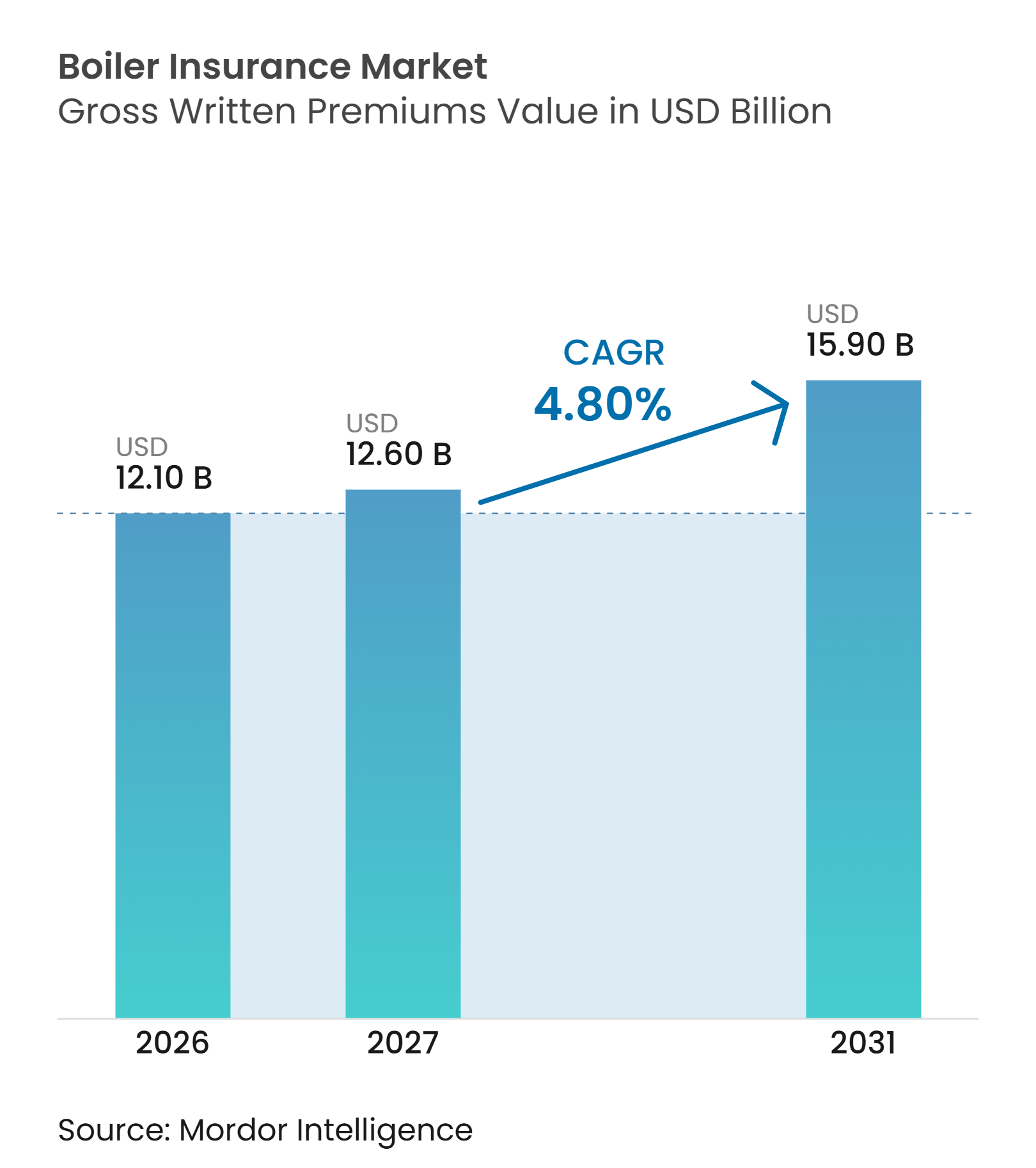
The Boiler Insurance Market size in terms of gross written premiums value is expected to grow from USD 12.10 billion in 2026 to USD 12.60 billion in 2027 and is forecast to reach USD 15.90 billion by 2031 at 4.80% CAGR over 2027-2031.
Growth rests on the need to protect industrial and commercial operators from equipment failure and prolonged shutdowns. Aging boiler fleets in North America and Western Europe maintain demand, while expanding boiler-intensive operations in Asia-Pacific and the Middle East add new insured assets. Insurers are pairing inspection services with connected monitoring and predictive maintenance, which places risk prevention alongside financial protection. This approach can improve loss prevention and supports policies that address operational continuity, not only repair costs. Competitive positioning increasingly depends on engineering expertise, inspection capability, and the ability to assess connected equipment risks.
Key Report Takeaways
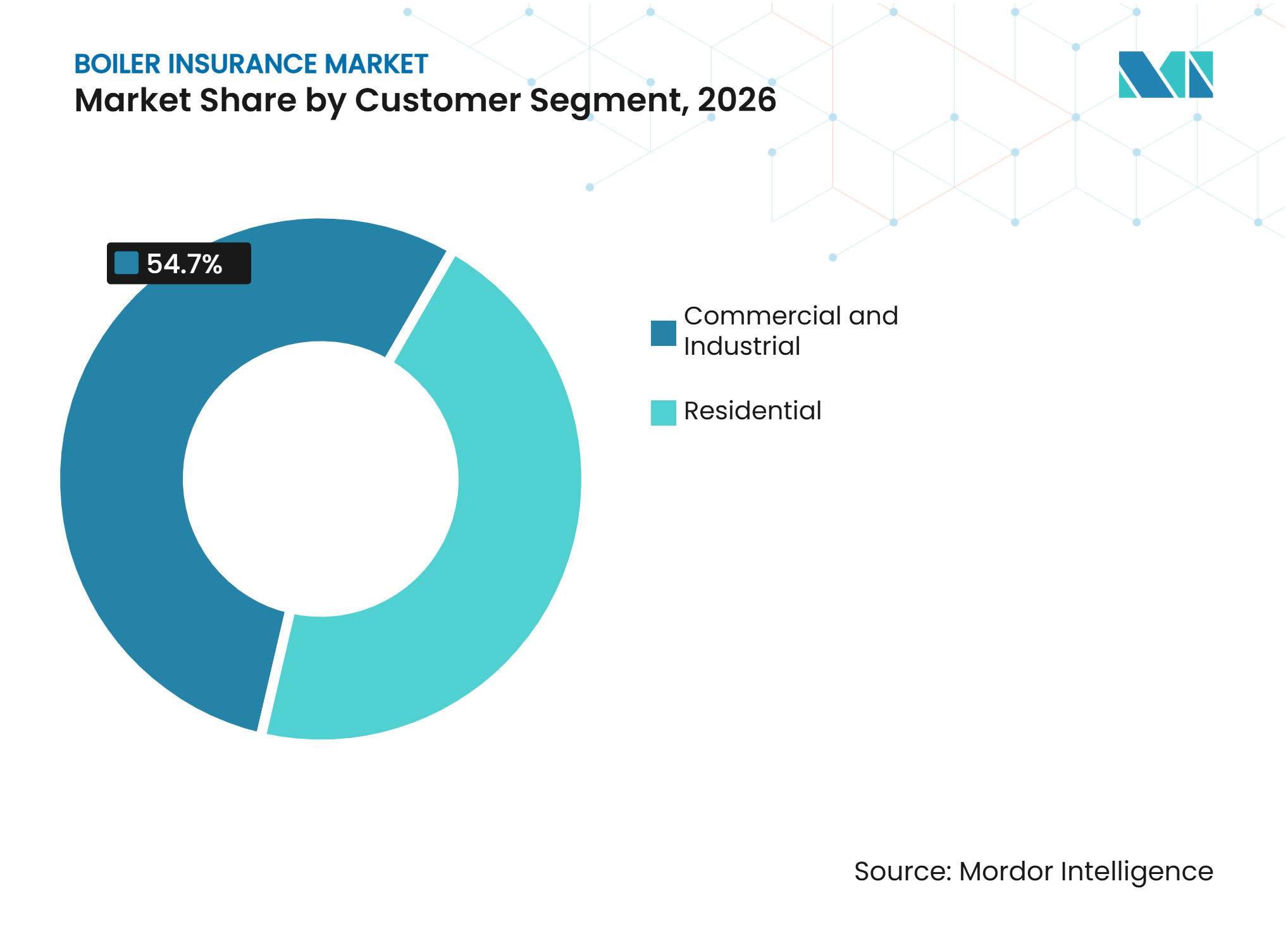
- By customer segment, commercial and industrial captured 54.7% of the boiler insurance market share in 2026, while residential is projected to grow at 5.5% CAGR through 2032.
- By policy structure, standalone boiler and equipment-breakdown policies held 60.3% of the boiler insurance market share in 2026, while embedded or endorsed boiler coverage is projected to grow at 6.6% CAGR through 2032.
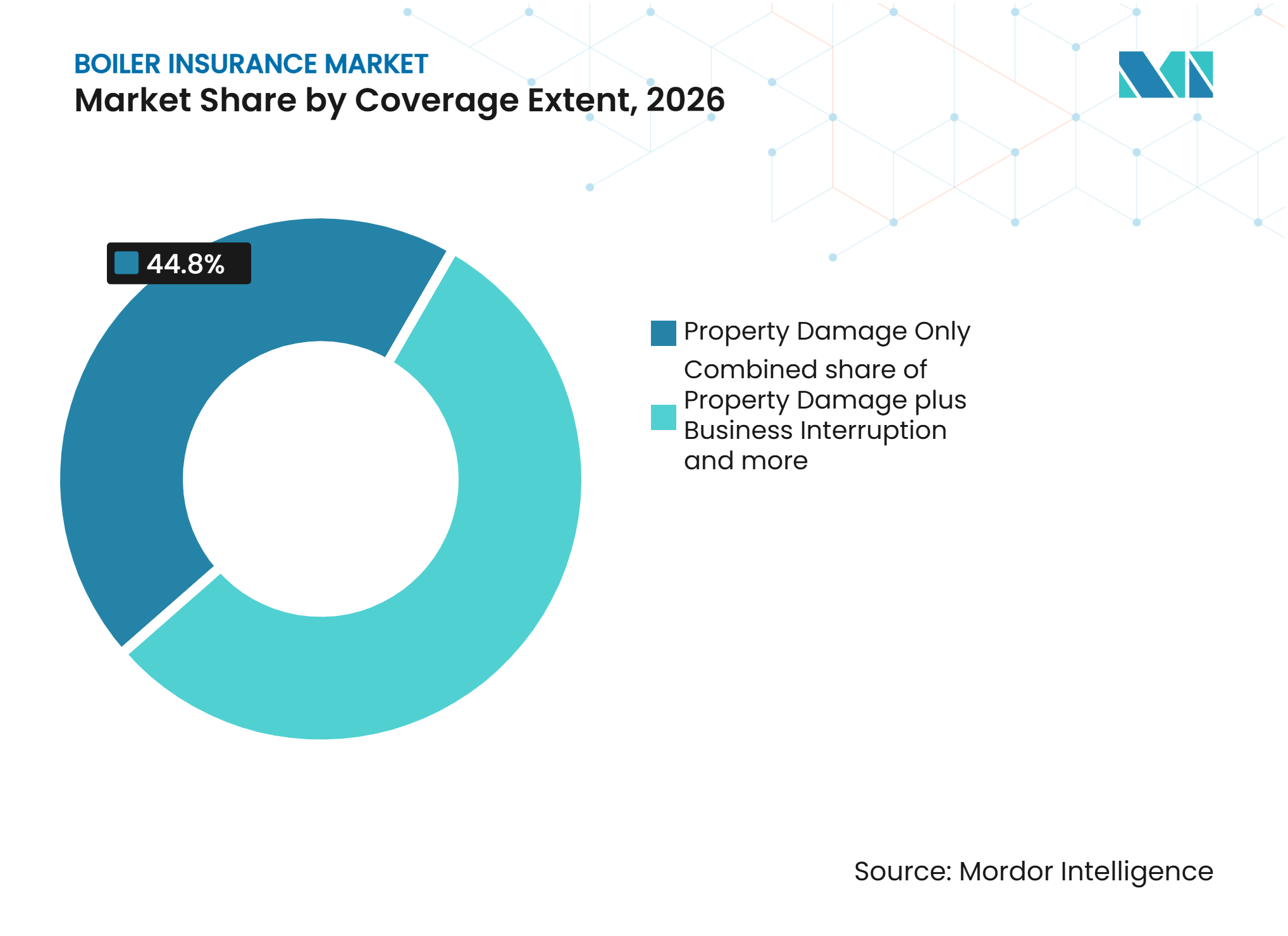
- By coverage extent, property damage only accounted for 44.8% of the boiler insurance market share in 2026, while property damage plus business interruption and extra expense is projected to grow at 6.2% CAGR through 2032.
- By distribution channel, insurance brokers and agents accounted for 45.1% of the boiler insurance market share in 2026, while boiler manufacturers, installers, and maintenance providers are projected to grow at 6.5% CAGR through 2032.
- By geography, Europe captured 32.3% of the boiler insurance market share in 2026, while Asia-Pacific is projected to grow at 6.8% CAGR through 2032.
Note: Market numbers in this report are based on Mordor Intelligence's proprietary estimation framework, which combines nine months of actuals with Q4 projections for base year 2026.
Market Trends and Insights
Drivers Impact Analysis of Boiler Insurance Market*
| Driver | (~) % Impact on CAGR Forecast | Geographic Relevance | Impact Timeline |
|---|---|---|---|
| Growing Awareness of Boiler Breakdown Insurance Among Industrial and Commercial Operators | +0.6% | Global | Medium term (2-4 years) |
| Rising Boiler Repair, Replacement, and Business Interruption Costs | +1.2% | Global, with immediate gains in North America and Europe | Short term (≤ 2 years) |
| Expansion of Boiler-Intensive Industries and Industrial Infrastructure | +0.9% | Asia-Pacific core, with spillover to Middle East and Africa | Long term (≥ 4 years) |
| Mandatory Boiler Inspections and Pressure-Vessel Safety Requirements | +1.0% | Global, with immediate gains in Europe, North America, and India | Medium term (2-4 years) |
| Increasing Demand for Comprehensive Equipment Breakdown Coverage | +0.8% | North America and Europe, with growth in Asia-Pacific | Medium term (2-4 years) |
| Expansion of Residential Boiler Servicing and Bundled Protection Plans | +0.7% | Europe and North America, with early gains in urban Asia-Pacific | Short term (≤ 2 years) |
| Source: Mordor Intelligence | |||
Rising Boiler Repair, Replacement, and Business Interruption Costs
Equipment failure costs are strengthening demand across the boiler insurance market because a loss can affect repair spending and revenue continuity at the same time. FM recorded 427 power-generation loss events between 2021 and 2025 that produced USD 3.7 billion in gross losses for its clients[1]. Mechanical and electrical breakdowns represented more than 70% of those events and more than 80% of their annual financial impact. Insured losses from United States natural catastrophes totaled USD 103.1 billion in 2025, and outages, voltage fluctuations, and backup equipment overloads created secondary equipment-breakdown claims. Supply constraints for boiler tubes, control systems, and steam turbines can lengthen repairs, which increases the importance of business-interruption protection. Replacement values that were not revised after earlier inflation can also leave policyholders underinsured when a loss occurs.
Mandatory Boiler Inspections and Pressure-Vessel Safety Requirements
Inspection requirements create recurring contact between operators, authorized inspectors, and insurers in the boiler insurance market. Several United States jurisdictions require annual internal and external inspections for high-pressure boilers, with certificate inspections performed by authorized insurance company inspectors. Rhode Island applies its Boiler and Pressure Vessel Inspection Rules using the 2025 ASME Code edition. India enacted the Boilers Act 2025 on April 4, 2025, and the legislation took effect on May 1, 2025, creating a modern framework for boiler registration, inspection, and certification[2]. India also published the Boiler Accident Inquiry Rules 2025 in September 2025, requiring accident reporting within 24 hours and a more structured record for claims review. These requirements make compliance documentation and insurance inspection services closely connected throughout the operating life of a boiler.
Expansion of Boiler-Intensive Industries and Industrial Infrastructure
The expansion of power generation, refining, chemical processing, and food and beverage manufacturing broadens the insured equipment base. Industrial activity in Indonesia, Vietnam, and Malaysia is adding process-boiler exposure through manufacturing relocation and logistics investment. The boiler insurance market can also address risks associated with battery energy storage systems and electrified heating equipment when those systems are integrated with conventional pressure equipment. Travelers notes that equipment breakdown risks are evolving as operations become more connected and equipment exposure becomes more complex[3]. This wider mix of assets requires underwriting that evaluates the interaction between electrical, mechanical, and conventional pressure systems. It also creates an opening for specialists that can provide risk engineering for mixed plant configurations.
Increasing Demand for Comprehensive Equipment Breakdown Coverage
Combined coverage is gaining attention because a boiler failure can interrupt production, refrigeration, utility services, and downstream processes at the same time. FM reports that replacement lead times for gas turbines can extend for years, which increases the financial consequence of an operational interruption. The ISO Equipment Breakdown Cause of Loss Endorsement, CP 10 46, can place breakdown protection within a property program, while dedicated products can offer broader policy structures. Connected and automated systems can spread a single equipment failure across several functions, increasing the value of protection for business income and extra expense. The boiler insurance market therefore benefits when policyholders assess the impact of a failure across the entire operation rather than the affected asset alone. Carriers with engineering support can use this broader assessment to explain the value of comprehensive coverage at renewal.
Restraints Impact Analysis of Boiler Insurance Market*
| Restraint | (~) % Impact on CAGR Forecast | Geographic Relevance | Impact Timeline |
|---|---|---|---|
| High Premiums and Deductibles for Aging or High-Risk Boilers | -0.9% | Global, particularly in the Middle East and Africa, South America, and small and medium-sized enterprises across all regions | Short term (≤ 2 years) |
| Limited Awareness and Insurance Penetration Among Small and Medium-Sized Enterprises | -0.7% | Asia-Pacific core, with secondary relevance in South America and the Middle East and Africa | Medium term (2-4 years) |
| Substitution by Manufacturer Warranties and Maintenance Contracts | -0.5% | Europe and North America | Medium term (2-4 years) |
| Coverage Exclusions, Equipment-Age Limits, and Claims Complexity | -0.4% | Global | Long term (≥ 4 years) |
| Source: Mordor Intelligence | |||
High Premiums and Deductibles for Aging or High-Risk Boilers
Premiums and deductibles can limit uptake among owners of old or poorly maintained boiler assets. HSB Canada has reported rising equipment-breakdown claims in office buildings, hotels, condominium towers, and retail food outlets that rely on aging equipment. Technician shortages can lead to incomplete repairs, which may increase damage and complicate the interpretation of policy terms. Higher deductibles can weaken the financial case for coverage when smaller operators compare annual premiums with expected loss costs. Conservative underwriting protects insurer profitability but can reduce access for mid-age industrial equipment and smaller accounts. The boiler insurance market must balance accurate pricing with terms that remain practical for the operators most exposed to equipment failure.
Limited Awareness and Insurance Penetration Among Small and Medium-Sized Enterprises
Small and medium-sized enterprises remain a major coverage gap, especially in emerging Asia-Pacific economies. Food processing, agro-industrial, and light manufacturing businesses may operate older boilers with incomplete maintenance records and limited access to specialist underwriting. A 2025 survey of 128 German broker association members found that respondents saw clear restrictions in industrial insurance capacity for small and medium-sized enterprise sectors. Many operators see boiler insurance only as a means to obtain an inspection certificate, rather than protection against business interruption and liability. Simplified underwriting, clearer product design, and operator education can improve awareness without reducing risk discipline. Until these measures become more common, the boiler insurance market will not fully reach its potential among smaller operators.
*Our forecasts treat driver/restraint impacts as directional, not additive. The impact forecasts reflect baseline growth, mix effects, and variable interactions.
Boiler Insurance Market Segment Analysis
By Customer Segment:
Industrial Risk Concentration Supports Premium DensityCommercial and industrial captured 54.7% of the boiler insurance market share in 2026, supported by the high value and critical nature of industrial boiler assets. Power generation utilities, oil and gas refineries, chemical manufacturers, and large commercial real estate portfolios require coverage because a boiler outage can interrupt essential operations. FM identifies gas turbines as the largest source of property damage in its power-generation client experience. The same FM review found that mechanical and electrical breakdowns caused more than 80% of the annual financial impact in that sector. Refineries, petrochemical sites, pharmaceutical plants, and mining operations also depend on continuous steam and heat production. Hospitals, schools, and public buildings provide a more stable demand base because reliable heating equipment supports essential services and compliance obligations. This concentration of essential infrastructure means that risk engineering and inspection quality remain central to the purchasing decision.
Residential represents the remaining share of the boiler insurance market in 2026 and is forecast to expand at 5.5% CAGR from 2027 to 2032. Its growth is linked to bundled protection plans sold through energy utilities and home-insurance partners, rather than an increase in domestic boiler installations alone. France requires tenants to arrange annual maintenance for boilers between 4 kW and 400 kW under national rules. The updated NF X50-010 standard, effective May 2025, added carbon monoxide monitoring and documentation requirements to relevant maintenance arrangements. These annual service requirements give insurers and service providers regular opportunities to validate risk conditions. Hospitality businesses and commercial real estate portfolios combine residential-style heating needs with larger operational exposures, making embedded protection relevant to both customer groups. The residential channel also depends on clear maintenance evidence because policy terms and claims handling are closely linked to service history. The boiler insurance market can benefit when routine servicing creates a reliable record of condition before a claim or policy renewal.


By Policy Structure:
Standalone Coverage Retains a Lead While Embedded Products ExpandStandalone boiler and equipment-breakdown policies accounted for 60.3% of the boiler insurance total in 2026. Large industrial operators favor these policies because they can set dedicated limits, obtain asset-specific terms, and access risk engineering services. Specialist brokers commonly place the coverage with technical underwriters that understand plant operations and inspection requirements. Inspection services attached to many standalone policies can also help operators meet statutory compliance requirements. HSB’s TechAdvantage equipment-breakdown form includes separate provisions for property damage, business income, extra expense, data restoration, and hazardous substance coverage. This depth helps explain why dedicated coverage remains important for high-value and technically complex assets. Dedicated placement also allows the insured and underwriter to address the equipment condition, location, and operating environment in greater detail.
Embedded or endorsed boiler coverage is forecast to grow at 6.6% CAGR from 2027 to 2032. Commercial property programs increasingly use ISO’s Equipment Breakdown Cause of Loss Endorsement, CP 10 46, to address mechanical and electrical breakdown gaps. Embedded coverage can bring previously uninsured operators into the boiler insurance market through a policy they already purchase. It can also encourage some policyholders to consolidate protection that was once bought through separate contracts. Specialists face lower-premium competition for simple exposures when property policies include basic breakdown protection. Their opportunity remains in complex loss scenarios where higher limits, inspection support, and tailored engineering coverage are required. This distinction lets embedded products address accessible risks while specialist policies retain a role in higher-severity installations. The boiler insurance market retains specialist value where the customer needs detailed terms for critical assets and interconnected operations.
By Coverage Extent:
Broader Protection Responds to Higher Downtime CostsProperty Damage Only retained 44.8% share of the boiler insurance total in 2026. Many standalone policy buyers still prioritize replacement or repair costs for the physical asset. Combined Property Damage plus Business Interruption and Extra Expense coverage is forecast to grow at 6.2% CAGR from 2027 to 2032. Long lead times for equipment and shortages of skilled technicians increase the cost of a production disruption. Travelers notes that higher material, technology, and labor costs can make replacement values difficult to estimate and can leave some equipment underinsured. Renewals therefore give operators an opportunity to revisit both policy limits and their approach to downtime protection. The coverage decision increasingly reflects the length of the restart period as well as the cost of repairing the damaged item. The boiler insurance market responds to this need by linking physical repair protection with the wider financial consequence of an interruption.
Other or Limited coverage retains a smaller portion of the boiler insurance market in 2026 because these policies restrict protection to certain components or perils. Smaller operators may choose these policies when they seek first-time coverage with a limited budget. The restricted approach can leave exclusions that become clear only when a claim occurs. Allianz United Kingdom offers machinery business-interruption coverage that can support wages and rent during repairs and may be extended to third-party utility supply failures. Such policy structures create a practical route from limited protection to more comprehensive cover at renewal. The segment can therefore provide insurers with an upgrade path for customers that initially prioritize affordability. Insurers can use the first renewal to show how deductibles, exclusions, and indemnity limits affect the practical value of limited protection.

By Distribution Channel:
Brokers Lead While Manufacturer Channels ExpandInsurance brokers and agents held 45.1% of the boiler insurance market share in 2026. Brokers remain important for steel mills, chemical plants, and large commercial real estate portfolios that require tailored policy terms and specialist underwriting. Their role includes matching the insured value, inspection needs, and business-interruption exposure with appropriate policy limits. W Denis Insurance Brokers described equipment-breakdown coverage as a response to specialized repair costs and extended downtime in its 2025 guidance. Direct insurer sales, energy utilities, suppliers, and home-insurance partnerships also reach residential and small commercial customers. These channels can reduce the complexity of purchase where a standard form of protection is sufficient. The channel mix reflects the difference between complex industrial placement, which needs advice, and simpler purchases that can be integrated into other services. The boiler insurance market continues to rely on brokers where operating complexity and the need for technical advice are highest.
Boiler manufacturers, installers, and maintenance providers are projected to grow at 6.5% CAGR from 2027 to 2032. An original equipment manufacturer can place coverage within a service agreement at installation, linking insurance renewal to the maintenance contract. This approach may reduce the role of the broker while providing insurers with maintenance information that supports underwriting. Proova has developed digital verification tools for confirming boiler maintenance status at policy inception. Maintenance records can reduce uncertainty around residential boiler condition and claims handling. For established insurers, manufacturer-linked distribution creates both a competitive risk and a source of more timely information on equipment condition. The relationship can align maintenance records, renewal timing, and risk selection within the same customer interaction. The boiler insurance market can use this channel to improve maintenance visibility while making coverage easier to obtain for residential customers.
Geography Analysis
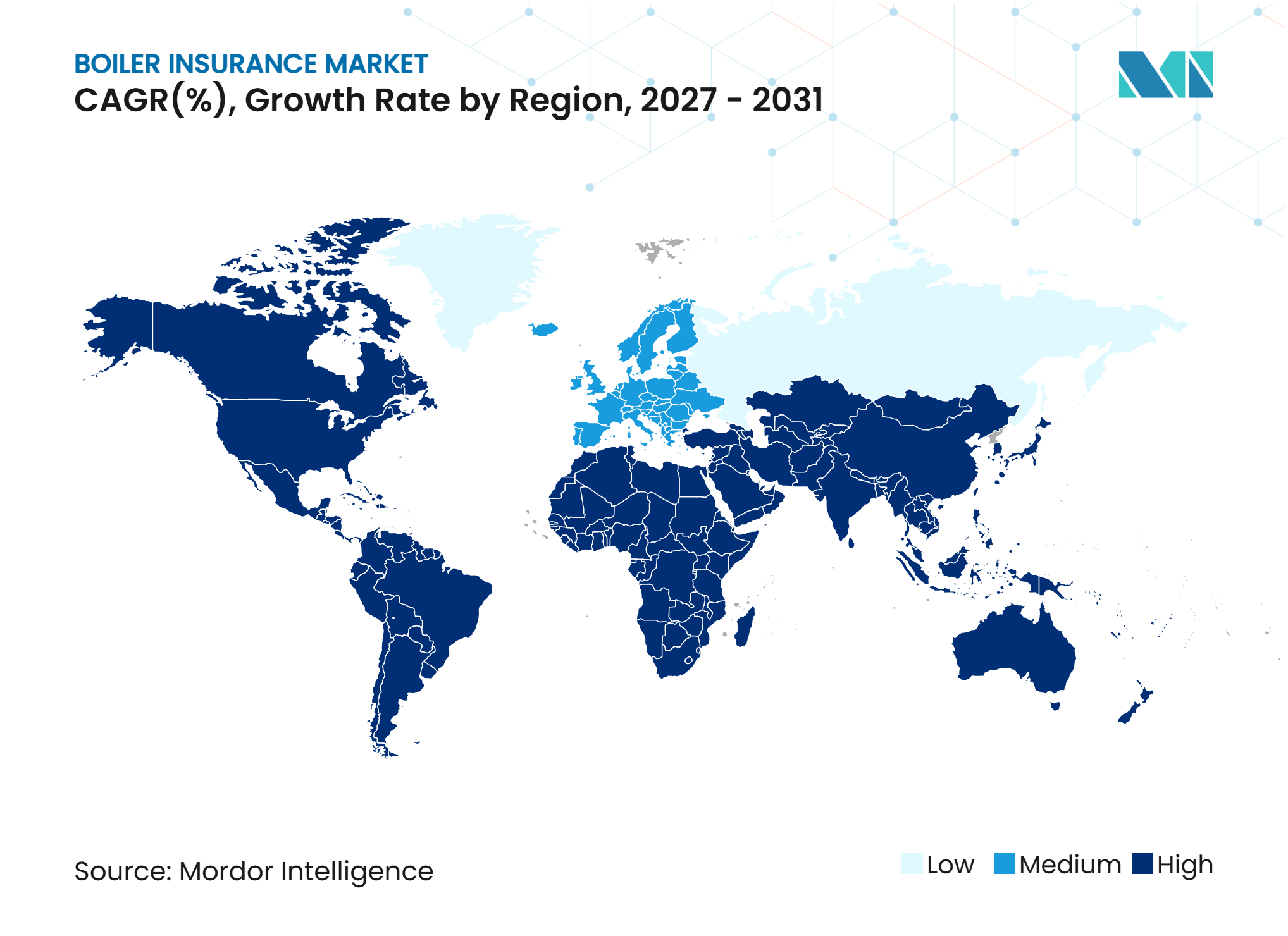
Europe held 32.3% of the boiler insurance total in 2026, supported by established industrial assets and structured inspection requirements. Germany’s technical insurance market includes boiler and machinery breakdown cover within a broad base of engineering risks. The United Kingdom is an important European market because HSB United Kingdom and Ireland provides equipment-breakdown protection with UKAS-accredited inspection body services. This model combines statutory inspection support with commercial protection for customers. France’s NF X50-010 standard became effective on May 1, 2025, and requires defined documentation and carbon monoxide monitoring for applicable gas-boiler maintenance contracts. These compliance obligations support regular equipment reviews and reinforce the role of insurance in risk management. The regular maintenance cycle also gives insurers a clearer basis for assessing equipment condition and adherence to service requirements.
Asia-Pacific is projected to grow at 6.8% CAGR from 2027 to 2032, the fastest regional rate in the boiler insurance market. India’s Boilers Act 2025 became effective on May 1, 2025, and standardized registration, inspection, and certification across boiler manufacture, erection, and use. The framework expands the compliance requirements that plant operators, contractors, and owners must meet. India’s Boiler Accident Inquiry Rules 2025 also require reporting within 24 hours after an accident, adding a clear record for investigations and claims assessment. Indonesia, Vietnam, Thailand, and Malaysia are adding industrial capacity through manufacturing relocation and related infrastructure investment. These markets have expanding process-boiler installations and remain less insured than mature regions. Specialist carriers can use maintenance partnerships and treaty support to reach these developing pools without relying only on traditional large-account distribution.
North America remains a mature but active region because state-level inspection requirements place authorized insurers within the annual operating cycle of commercial and industrial boilers. The United States reported USD 103.1 billion in insured natural catastrophe losses during 2025, with outages and emergency equipment loads contributing to equipment-breakdown claims. Canada has seen growing claims from steam turbines, generators, heating, ventilation, and air-conditioning systems, and production machinery. The Middle East and Africa draw demand from oil, gas, and refining assets that require large industrial all-risk and engineering programs. South America remains the smallest regional presence in 2026, with Brazil and Argentina providing the main industrial and energy-sector opportunities. Currency volatility and affordability constraints can make multiyear programs more difficult in those markets. The regional mix requires carriers to adapt policy terms and payment structures to local operating and affordability conditions.
Competitive Landscape
Market Concentration
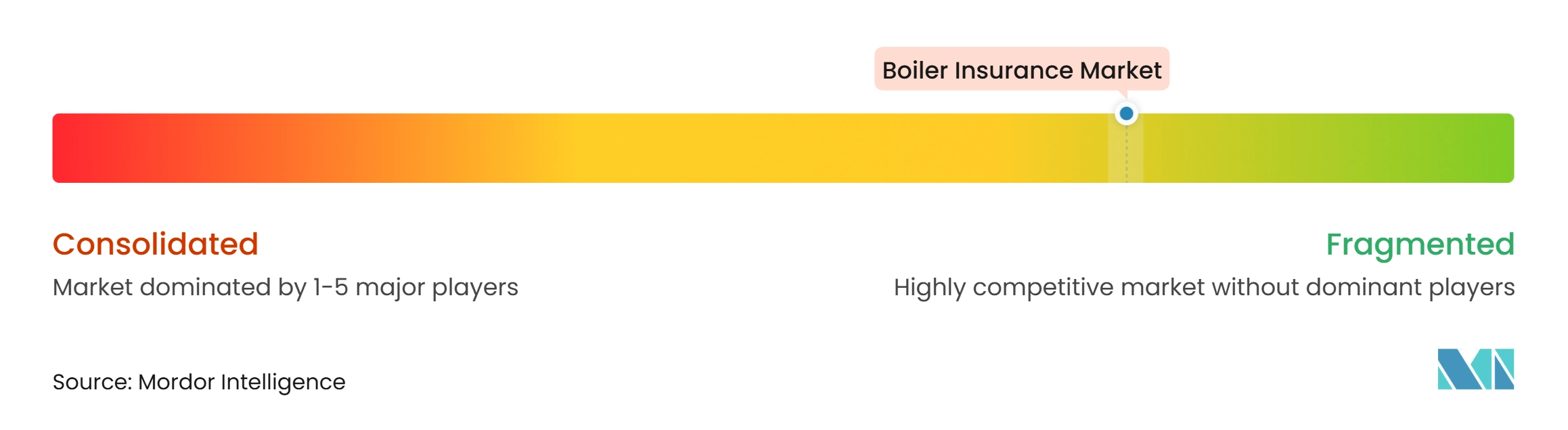
The boiler insurance market is fragmented, with specialist engineering insurers, regional carriers, and general commercial insurers competing across industrial, commercial, and small business segments. Providers such as HSB, FM Boiler Re, and Travelers BoilerRe have established expertise in equipment breakdown, machinery protection, inspection, and loss prevention, but their specialization does not indicate dominance across the broader market. FM reports that human error contributed to seven out of ten of its largest fire, boiler, and machinery losses at client locations globally, highlighting the importance of risk engineering and preventive maintenance. These capabilities help specialist providers differentiate themselves, while regional insurers compete by incorporating equipment-breakdown protection into broader commercial property policies.
Market fragmentation is reinforced by partnerships, geographic expansion, and technology-led risk management. In August 2026, FM Boiler Re announced plans to expand into the United Kingdom and European insurance markets through treaty reinsurance partnerships, extending its equipment-breakdown expertise to insurers, managing general agents, and reinsurance brokers. In March 2026, HSB, SECURA Insurance, and HelixIntel introduced HelixCMMS, a no-cost maintenance management tool for commercial and agricultural policyholders. Separately, QBE and Tokio Marine America joined Accelerant Risk Exchange as capital partners in April 2025, illustrating the continued development of alternative underwriting and distribution partnerships. These initiatives show how insurers and specialist providers are strengthening market access through technical expertise, digital tools, and reinsurance capacity rather than relying solely on pricing.
Opportunities remain for smaller insurers, regional carriers, and specialist providers to differentiate through connected equipment monitoring, preventive maintenance partnerships, and simplified coverage for small and medium-sized enterprises. Aging industrial equipment and increasingly complex heating, electrification, and battery energy storage systems create demand for coverage that reflects changing equipment configurations and associated risks. However, insurers must clearly define coverage boundaries between conventional boilers, electrical systems, and emerging technologies while maintaining effective underwriting standards. Overall, the fragmented market favors providers that combine engineering expertise, flexible distribution, and practical loss-prevention services to address the needs of diverse commercial policyholders.
Boiler Insurance Industry Leaders
-
Factory Mutual Insurance Company
-
The Hartford Steam Boiler Inspection and Insurance Company
-
The Travelers Companies, Inc.
-
Chubb Limited
-
American International Group, Inc.
- *Disclaimer: Major Players sorted in no particular order
Boiler Insurance Market Companies Covered in this Report
- Factory Mutual Insurance Company
- The Hartford Steam Boiler Inspection and Insurance Company
- Chubb Limited
- The Travelers Companies, Inc.
- HDFC ERGO General Insurance Company Limited
- QBE Insurance Group Limited
- Tokio Marine Holdings, Inc.
- Generali Central Insurance Company Limited
- Universal Sompo General Insurance Company Limited
- The Oriental Insurance Company Limited
- American International Group, Inc.
- Starr International Company, Inc.
- AXA XL
- Liberty Mutual Insurance Company
- ICICI Lombard General Insurance Company Limited
- IFFCO-TOKIO General Insurance Company Limited
- SBI General Insurance Company Limited
- The Cincinnati Insurance Companies
- Sompo International Insurance
Recent Industry Developments in Boiler Insurance Market
- August 2026: FM Boiler Re announced plans to expand into the United Kingdom and Europe through treaty reinsurance partnerships, extending its equipment-breakdown expertise to insurers, managing general agents, and reinsurance brokers
- July 2026: FM published Understanding Power Generation: Loss Trends and Predictive Analytics, reporting 427 losses and approximately USD 3.7 billion in gross losses among its power-generation clients from 2021 to 2025. Mechanical and electrical breakdowns accounted for more than 80% of the annual financial impact, highlighting the importance of predictive maintenance and equipment resilience.
- March 2026: HSB, SECURA Insurance, and HelixIntel collaborated to provide commercial and agricultural policyholders with HelixCMMS, a maintenance management platform designed to improve equipment reliability and support proactive loss prevention.
- May 2025: India’s Boilers Act, 2025 (Act No. 12 of 2025) came into force, replacing the Boilers Act, 1923. The legislation modernized the framework for boiler registration, inspection, and safety, affecting compliance requirements relevant to boiler insurance underwriting.
Global Boiler Insurance Market Report Scope
Segmentation Overview
| Residential | |
| Commercial & Industrial | Power Generation & Utilities |
| Oil, Gas, Refining & Petrochemicals | |
| Chemicals & Pharmaceutical Manufacturing | |
| Food, Beverage & Agro-processing | |
| Metals, Mining & Heavy Manufacturing | |
| Commercial Real Estate, Hospitality & Services | |
| Healthcare, Education & Public Sector | |
| Other Commercial Industries |
| Standalone Boiler / Equipment-Breakdown Policy |
| Embedded or Endorsed Boiler Coverage on a Broader Insurance Policy |
| Property Damage Only |
| Property Damage plus Business Interruption / Extra Expense |
| Other / Limited |
| Direct Insurer Sales |
| Insurance Brokers & Agents |
| Energy Utilities & Suppliers |
| Boiler Manufacturers, Installers & Maintenance Providers |
| Banks and Home-Insurance Partnership Channels |
| Other Affinity & Partnership Channels |
| North America | United States |
| Canada | |
| Mexico | |
| South America | Brazil |
| Argentina | |
| Rest of South America | |
| Europe | United Kingdom |
| Germany | |
| France | |
| Italy | |
| Spain | |
| Rest of Europe | |
| Asia-Pacific | China |
| Japan | |
| India | |
| South Korea | |
| Australia | |
| Indonesia | |
| Thailand | |
| Malaysia | |
| Singapore | |
| Vietnam | |
| Rest of Asia-Pacific | |
| Middle East and Africa | Saudi Arabia |
| United Arab Emirates | |
| Turkey | |
| South Africa | |
| Egypt | |
| Rest of Middle East and Africa |
| By Customer Segment | Residential | |
| Commercial & Industrial | Power Generation & Utilities | |
| Oil, Gas, Refining & Petrochemicals | ||
| Chemicals & Pharmaceutical Manufacturing | ||
| Food, Beverage & Agro-processing | ||
| Metals, Mining & Heavy Manufacturing | ||
| Commercial Real Estate, Hospitality & Services | ||
| Healthcare, Education & Public Sector | ||
| Other Commercial Industries | ||
| By Policy Structure | Standalone Boiler / Equipment-Breakdown Policy | |
| Embedded or Endorsed Boiler Coverage on a Broader Insurance Policy | ||
| By Coverage Extent | Property Damage Only | |
| Property Damage plus Business Interruption / Extra Expense | ||
| Other / Limited | ||
| By Distribution Channel | Direct Insurer Sales | |
| Insurance Brokers & Agents | ||
| Energy Utilities & Suppliers | ||
| Boiler Manufacturers, Installers & Maintenance Providers | ||
| Banks and Home-Insurance Partnership Channels | ||
| Other Affinity & Partnership Channels | ||
| By Geography | North America | United States |
| Canada | ||
| Mexico | ||
| South America | Brazil | |
| Argentina | ||
| Rest of South America | ||
| Europe | United Kingdom | |
| Germany | ||
| France | ||
| Italy | ||
| Spain | ||
| Rest of Europe | ||
| Asia-Pacific | China | |
| Japan | ||
| India | ||
| South Korea | ||
| Australia | ||
| Indonesia | ||
| Thailand | ||
| Malaysia | ||
| Singapore | ||
| Vietnam | ||
| Rest of Asia-Pacific | ||
| Middle East and Africa | Saudi Arabia | |
| United Arab Emirates | ||
| Turkey | ||
| South Africa | ||
| Egypt | ||
| Rest of Middle East and Africa | ||
Key Questions Answered in the Report
What is the projected value of the boiler insurance sector by 2032?
The global boiler insurance market is projected to reach USD 15.9 billion by 2032, growing at a 4.8% CAGR from 2027 to 2032.
Which customer group leads boiler insurance demand?
Commercial and Industrial customers held 54.7% share in 2026, reflecting the high loss exposure of utilities, refineries, manufacturers, and large property portfolios.
Why is business-interruption cover becoming more important for boiler operators?
Combined Property Damage plus Business Interruption and Extra Expense coverage is forecast to grow at 6.2% CAGR through 2032 because repair lead times and downtime costs are increasing.
Which region is expected to grow fastest through 2032?
Asia-Pacific is forecast to expand at 6.8% CAGR through 2032, supported by industrial expansion and updated boiler regulation in India.
How do boiler inspections affect insurance requirements?
Statutory inspection rules in several jurisdictions require authorized inspections and strengthen the link between policy coverage, certification, and operating compliance.
How are boiler manufacturers influencing insurance distribution?
Manufacturers, installers, and maintenance providers are forecast to grow at 6.5% CAGR through 2032 by bundling protection with installation and service agreements.