
Black Pellets Market Size and Share
Market Overview
| Study Period | 2022 - 2032 |
|---|---|
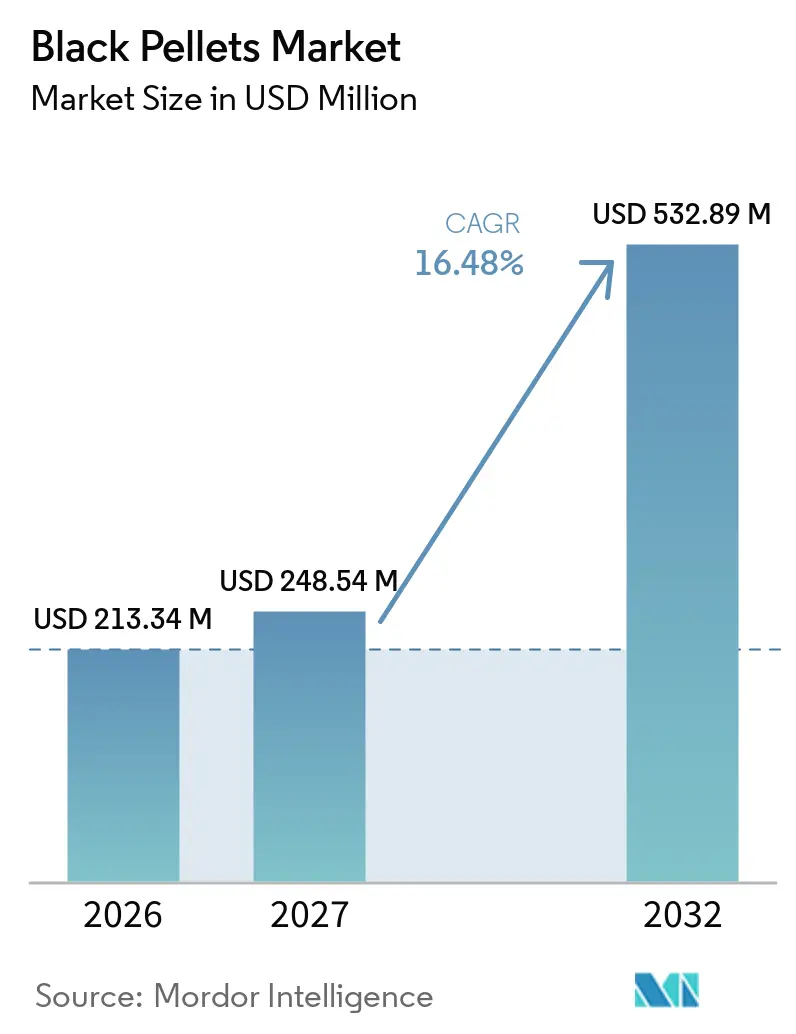
| Market Size (2027) | USD 248.54 Million |
| Market Size (2032) | USD 532.89 Million |
| Growth Rate (2027 - 2032) | 16.48 % |
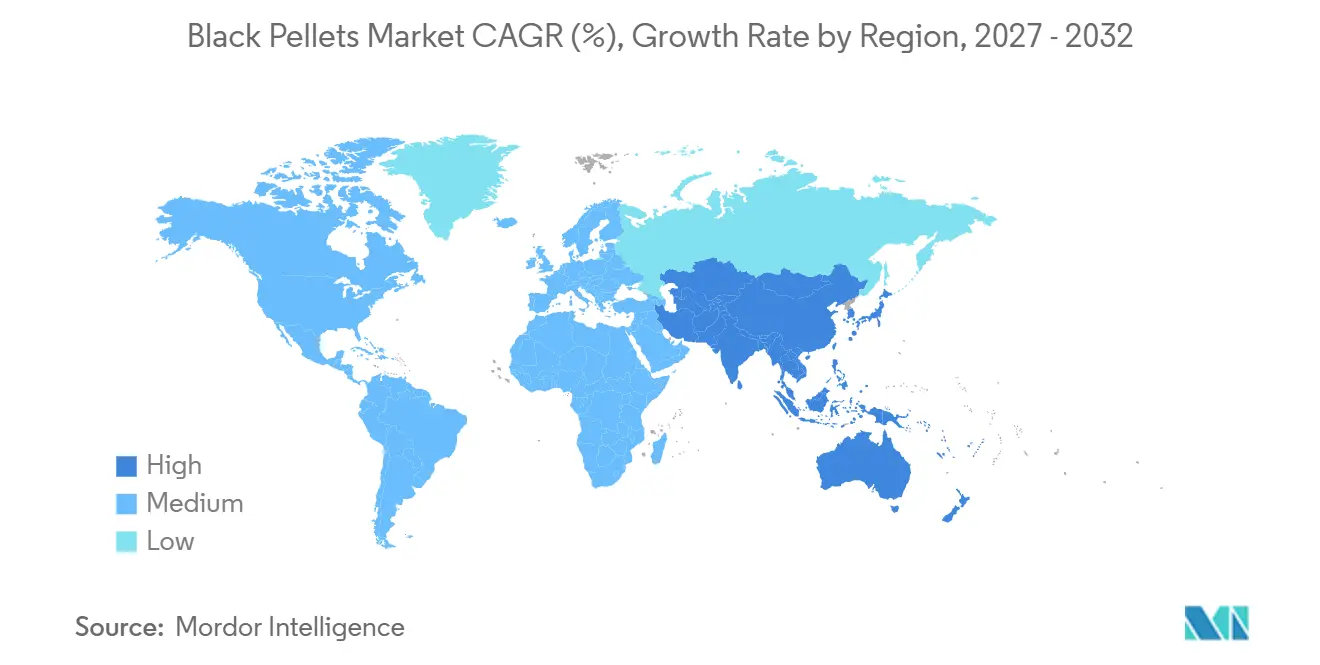
| Fastest Growing Market | Asia-Pacific |
| Largest Market | Europe |
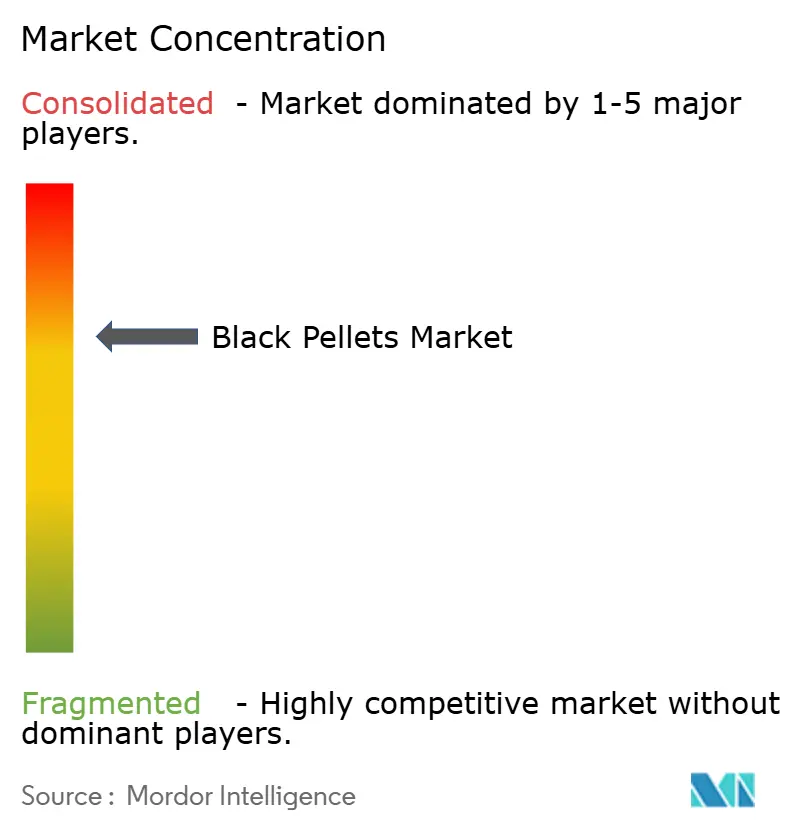
| Market Concentration | Medium |
Major Players *Disclaimer: Major Players sorted in no particular order Image © Mordor Intelligence. Reuse requires attribution under CC BY 4.0. | |
Black Pellets Market Analysis by Mordor Intelligence
The Black Pellets Market size is expected to increase from USD 213.34 million in 2026 to USD 248.54 million in 2027 and reach USD 532.89 million by 2032, growing at a CAGR of 16.48% over 2027-2032. The global black pellets market is gaining relevance as coal plant operators seek fuels that can be used in existing pulverized-coal systems with limited boiler changes. India’s 2025 co-firing policy and South Korea’s coal-retirement commitment strengthen the policy backdrop for long-term procurement.[1] The global black pellets market also benefits from its role in high-temperature industrial processes where a direct shift to electric heat remains difficult. Product qualification, traceable feedstock, and long-term supply agreements are becoming more important as buyers move from pilot projects to regular purchasing. In the global black pellets market, developers with proven production assets and documented supply chains are better placed to serve utilities and industrial users. Early supplier qualifications are becoming important for project planning and fuel procurement.
Key Report Takeaways
- By feedstock, Wood Biomass and Forest Residues held 60.3% of the global black pellets market share in 2026, while Agricultural Residues are projected to grow at an 17.1% CAGR through 2032.
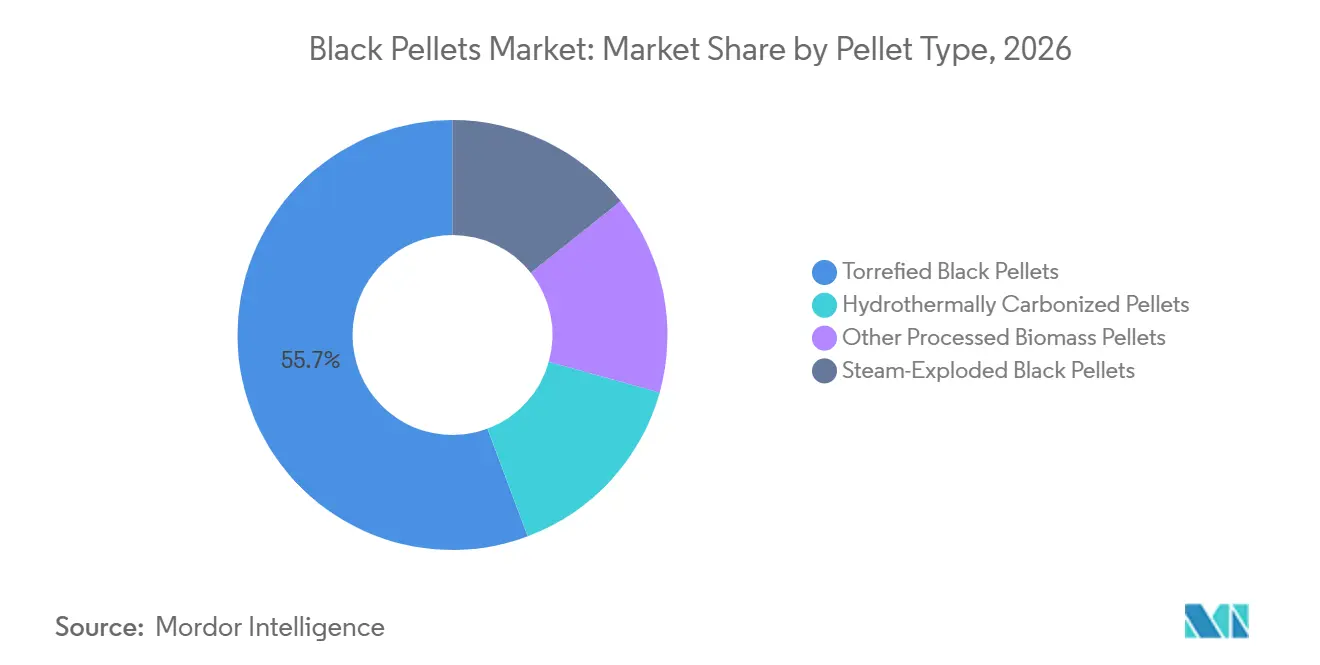
- By pellet type, Torrefied Black Pellets held 55.7% revenue share in 2026, while Steam-Exploded Black Pellets are expected to grow at a 16.8% CAGR through 2032.
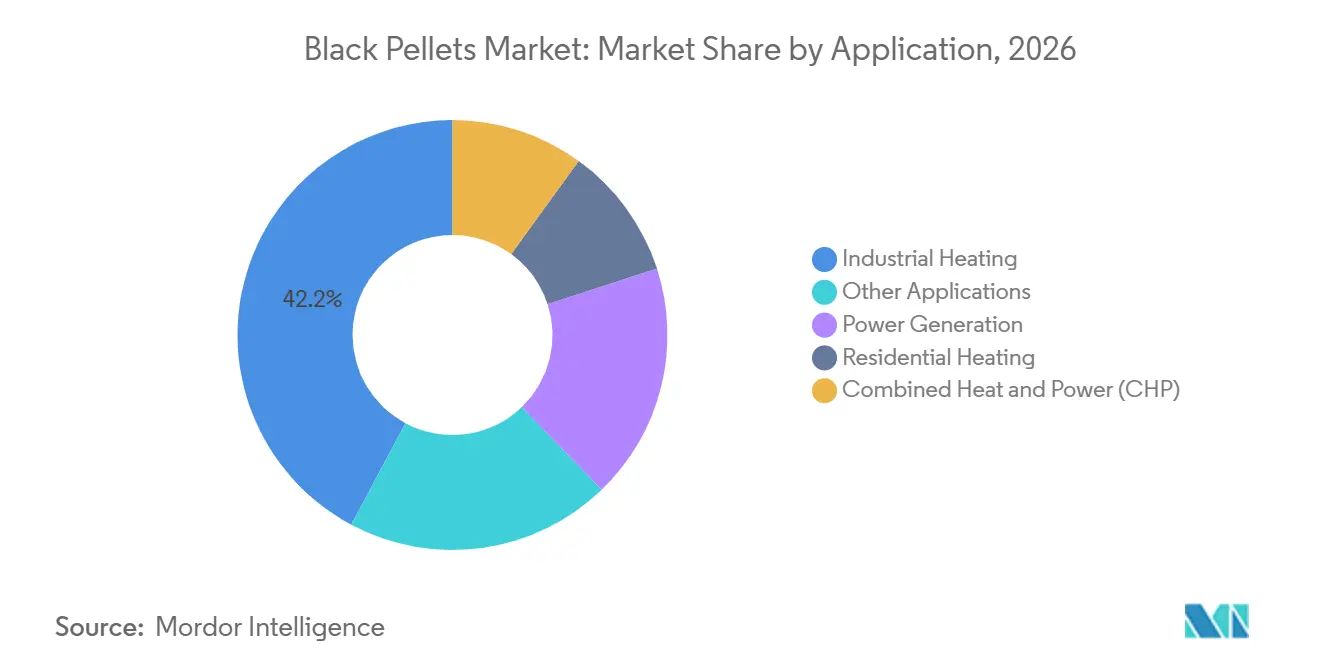
- By application, Industrial Heating accounted for 42.2% of the global black pellets market size in 2026 and is expected to grow at a 16.6% CAGR through 2032.
- By geography, Europe held 54.6% revenue share in 2026, while Asia-Pacific is projected to grow at a 17.5% CAGR through 2032.
Note: Market numbers in this report are based on Mordor Intelligence's proprietary estimation framework, which combines nine months of actuals with Q4 projections for base year 2026.
Market Trends and Insights
Drivers Impact Analysis of Black Pellets Market*
| Driver | (~) % Impact on CAGR Forecast | Geographic Relevance | Impact Timeline |
|---|---|---|---|
| Coal Phase-Out and Utility Co-Firing Mandates | +3.8% | Global, with relevance in the EU, South Asia, and Asia-Pacific | Short term (≤ 2 years) |
| Industrial Heat Decarbonization and Fuel Switching | +2.5% | Europe and North America, with spillover to Asia-Pacific | Medium term (2-4 years) |
| High Energy Density, Weather Resistance, and Coal-System Compatibility | +2.0% | Global | Short term (≤ 2 years) |
| Asian Coal-Fleet Retrofit Demand for Higher Co-Firing Ratios | +2.2% | Japan, South Korea, Vietnam, and Indonesia | Medium term (2-4 years) |
| Existing Coal-Handling Infrastructure Compatibility | +1.8% | Japan, South Korea, India, and South Asia | Short term (≤ 2 years) |
| Standardized Grades and Bankable Offtake Contracts | +1.5% | Global, with early gains in Japan and the EU | Medium term (2-4 years) |
| Source: Mordor Intelligence | |||
Coal Phase-Out and Utility Co-Firing Mandates
Government requirements are creating a clearer demand base for the global black pellets market. India issued its Comprehensive Policy for Biomass and Torrefied Charcoal Co-firing in Coal-Based Thermal Power Plants in November 2025. The policy requires coal-based thermal plants to blend at least 5% biomass or torrefied charcoal by weight from FY2025-26. Plants in the Delhi-NCR region are required to use a 7% blend. The policy draws on an estimated domestic crop-residue surplus of 228 million tons each year.[2] This requirement gives producers a defined route to utility demand, particularly where agricultural residues can meet technical specifications.
South Korea’s entry into the Powering Past Coal Alliance at COP30 in November 2025 signaled a plan to retire 40 of its 61 coal plants by 2040.[3] Its January 2025 Renewable Energy Certificate reforms also ended support for conventional imported wood-pellet co-firing at 6 state-owned plants. This changes shifts attention toward fuels that can support higher co-firing ratios and stronger emissions documentation. The global black pellets market can benefit where buyers treat certified fuel as a compliance input rather than a discretionary fuel choice. In the European Union, Renewable Energy Directive III (RED III) sustainability requirements add importance to traceability and chain-of-custody records. These rules favor suppliers able to document feedstock origin and product quality over spot suppliers without certification records.
Industrial Heat Decarbonization and Fuel Switching
Industrial heat demand supports a second route for the global black pellets market. Cement kilns, glass furnaces, paper mills, and primary steel operations require temperatures that are difficult to meet with direct electrification. A 2025 review identified hard-to-abate industrial sectors as responsible for 17% of global carbon dioxide emissions.[4] These facilities can use solid biomass fuels where coal is already part of the heat system. This supports demand for fuel that has greater energy density and better handling characteristics than untreated biomass. The opportunity is strongest where plants can shift fuels without replacing core process equipment.
A 2025 techno-economic assessment found that biomass boilers remained competitive for high-temperature industrial heat above 300 °C in regions with feedstock costs below USD 60 per ton. Cement producers can accommodate variable fuel chemistry because many kilns already use alternative fuels. Kobe Steel, Ltd. and Mitsubishi UBE Cement Corporation began a joint feasibility study in May 2025 under the New Energy and Industrial Technology Development Organization (NEDO)’s GREINS project. The project examines black-pellet manufacturing and sales, including use in steelmaking-related applications. This works matters for the global black pellets market because reducing-agent applications could create demand separate from power generation. Such applications require reliable calorific value, consistent quality, and assured supply.
High Energy Density, Weather Resistance, and Coal-System Compatibility
Black pellets are designed to address handling and milling limits associated with conventional white pellets. Torrefaction raises biomass energy content by 30% to 50% relative to untreated wood. A comparative life cycle assessment also found material differences in supply-chain emissions and energy balance across torrefaction, hydrothermal carbonization, and steam-explosion pathways. These characteristics can lower transport burdens when a fuel must move from a production site to an industrial user or port. Their resistance to moisture can also reduce concerns over open-air storage. The global black pellets market therefore has an advantage in projects that need bulk handling over long distances.
Research from Tampere University of Applied Sciences and Indian Institute of Technology (IIT) Kharagpur found that torrefied pellets may require up to 50% less pulverization energy than untreated biomass. This supports direct use in existing coal-mill systems and can reduce operating pressure on plant equipment. Idemitsu began commercial operations at its 120,000 ton-per-year facility in Vietnam in October 2025. Its product is intended for co-firing at higher ratios without boiler modification. The reported operating case indicates up to 35% co-firing with coal, compared with the lower practical ratio used for white pellets. This compatibility reduces the need for major retrofit spending and improves the value proposition for operators with operating coal assets.
Asian Coal-Fleet Retrofit Demand for Higher Co-Firing Ratios
Asia-Pacific is a major source of prospective demand for the global black pellets market. Japanese utility plans for 20% co-firing at a 600 MW coal unit and 10% co-firing at a 700 MW unit. These projects could require several hundred thousand tons of fuel each year. Such demand is significant compared with the output of one commercial black-pellet plant. Japan’s operational focus has moved beyond initial trials toward fuel qualification, handling safety, and reliable procurement. This raises the importance of durable pellets and suppliers that can meet contract requirements.
Indonesia has set co-firing targets of 10% for pulverized-coal boilers and up to 70% for stoker systems. Its state utility Perusahaan Listrik Negara (PLN) has identified biomass fuel demand of up to 10.2 million tons per year. Even a limited share for black pellets would represent material volume for producers. Japan is also upgrading safety systems at the 1,070 MW Taketoyo No. 5 facility following the January 2024 dust explosion. The planned renovation includes dust collection and fire monitoring equipment, with completion targeted for June 2028. Better handling systems can support higher co-firing rates, but they also increase the technical requirements for new fuel suppliers.
Restraints Impact Analysis of Black Pellets Market*
| Restraint | (~) % Impact on CAGR Forecast | Geographic Relevance | Impact Timeline |
|---|---|---|---|
| Feedstock Mass Loss and Conversion Yield Penalty | -2.1% | Global, with higher exposure in North America and Southeast Asia | Medium term (2-4 years) |
| High First-of-a-Kind Plant and Logistics Capital Requirements | -2.5% | Global, with early exposure in Southeast Asia and South America | Long term (≥ 4 years) |
| Fragmented Quality Standards and Limited Buyer Benchmarking | -1.5% | Global, most acute in India and Southeast Asia | Short term (≤ 2 years) |
| Moisture, Dust, and Self-Heating Risk Perception in New Supply Chains | -1.3% | Japan and Asia-Pacific, with relevance in North America and the EU | Short term (≤ 2 years) |
| Source: Mordor Intelligence | |||
Feedstock Mass Loss and Conversion Yield Penalty
Torrefaction has an inherent yield tradeoff that affects the global black pellets market. A 2025 study found that mass yields for woody biomass declined from 87% at 250°C to 53% at 290°C. Higher temperatures improve the fuel’s heating value, but they also reduce saleable output from the original feedstock. In the same analysis, the minimum selling price increased from USD 183 per ton to USD 277 per ton across those operating conditions. This makes process control a direct commercial issue for producers. It also leaves limited room for cost overruns when feedstock prices are high.
Agricultural residues add another technical challenge because their potassium and chlorine content can increase boiler corrosion risk. These feedstocks can also complicate compliance with black-pellet quality specifications at high co-firing ratios. Research on combined leaching and steam-explosion pretreatment indicates a possible route to improve low-grade residues. Commercial validation remains limited, so buyers may require more extensive qualification before accepting these fuels. The global black pellets market is likely to favor operating windows that balance energy density with acceptable yield. Heat integration and pretreatment improvements will determine whether lower-cost residues can compete more widely with wood-based feedstocks.
High Plant Costs, Fragmented Standards, and Safety Concerns
Specialized reactors, drying systems, thermal integration, and bulk-handling equipment make early black pellet projects capital intensive. Idemitsu's 120,000-ton-per-year plant in Vietnam illustrates the importance of structured project development and securing a reliable buyer base for commercial production. The global black pellets market also faces logistical challenges, as agricultural residues are seasonal and geographically dispersed. Field-edge collection costs range from USD 15 to USD 40 per dry ton, while feedstock availability is often limited to 4–8-week collection windows. These constraints complicate feedstock aggregation for inland projects and add pressure on the economics of facilities lacking adequate local storage and transportation infrastructure.
Product specifications and buyer benchmarks remain uneven across newer procurement markets. This can delay contracting because buyers may not have a common basis for comparing energy content, moisture behavior, durability, and emissions documentation. Dust, moisture, and self-heating concerns create further caution in new supply chains. The Taketoyo project shows that safety investments are essential where facilities intend to manage biomass at scale. PEARL Infrastructure Capital II acquired a 65% stake in Arbaflame in June 2025, providing a sign that specialized investors are developing a framework for this asset class. Wider investment will depend on repeatable plant performance, clear standards, and dependable logistics.
*Our forecasts treat driver/restraint impacts as directional, not additive. The impact forecasts reflect baseline growth, mix effects, and variable interactions.
Black Pellets Market Segment Analysis
By Feedstock:
Wood Biomass Leads While Agricultural Residues ExpandWood Biomass and Forest Residues held 60.3% of demand in 2026, while Agricultural Residues are projected to expand at a CAGR of 17.1% through 2032. Wood-based feedstock benefits from established collection, chipping, and pellet-production systems in North America, Scandinavia, and Southeast Asia. Its consistent lignin content supports pellet binding without added adhesives. These attributes reduce feedstock uncertainty for producers and their financing partners. The global black pellets market continues to rely on this established supply base where reliable quality and steady volume are the priorities.
Agricultural residues offer a broad potential feedstock base but require additional treatment to manage ash-forming minerals. A 2025 global study estimates that 1.44 billion tons of crop residues are technically available for pelletization. In India, Haryana Power Generation Corporation Limited (HPGCL) issued a tender in 2025 for 355,000 tons of torrefied agricultural-residue black pellets, specifying a minimum 50% rice-paddy straw content sourced from Haryana. This tender indicates growing procurement demand for specification-grade, residue-based fuels. Energy crops remain at an early demonstration stage, while forestry residues and wood-processing waste offer potentially lower-cost feedstocks for integrated operations in Europe.
By Pellet Type:
Torrefied Pellets Hold the Lead as Steam Explosion Gains AttentionTorrefied Black Pellets held 55.7% of the global black pellets market share in 2026, and Steam-Exploded Black Pellets are projected to grow at a CAGR of 16.8% through 2032. Torrefied products are the most established pathway and have the largest group of qualified commercial plants. Their compatibility with pulverized-coal mills supports their use in utility and industrial applications. The global black pellets market uses torrefied pellets as a reference product where buyers need a known fuel profile. This position is reinforced by operating experience at Japanese and European projects.
Steam-exploded black pellets are gaining attention because the process eliminates the need for inert-atmosphere engineering and enhances mechanical durability during maritime transport. In Norway, Arbaflame operates Arba One, the first industrial-scale facility to produce steam-treated black pellets. The company received additional financial backing through PEARL Infrastructure Capital's investment in 2025, supporting its planned expansion across Europe. Hydrothermally carbonized pellets remain at a relatively early stage of commercial deployment due to high water-processing requirements. However, their ability to convert wet agricultural residues into upgraded solid fuels presents opportunities in regions with abundant supplies of these feedstocks.
By Application:
Industrial Heating Provides the Largest Demand BaseIndustrial Heating accounted for 42.2% of demand in 2026 and was the largest application in the global black pellets market. Cement kilns, paper mills, and steel reheat furnaces need continuous high-temperature heat. These operations cannot easily replace solid fuels without substantial equipment changes. The segment therefore offers a direct route for fuel switching at plants that already have coal or solid-fuel systems. Industrial users also tend to value stable calorific quality and secure deliveries more than short-term spot pricing.
Kobe Steel, Ltd. and Mitsubishi UBE Cement Corporation are examining applications that could extend black pellet use beyond conventional co-firing. The project brings steelmaking and cement-sector requirements into a fuel category traditionally associated with power generation. Power Generation remains the second-largest application, supported by European biomass capacity and Asian retrofit activity. Combined Heat and Power are gaining attention as municipalities in Denmark, Germany, and Finland change coal-based heat networks to biomass systems. Residential Heating and other uses make up smaller parts of the demand base, but they broaden the customer base for producers that can supply smaller volumes.
Geography Analysis
Europe Black Pellets Market
Europe held 54.6% of global demand in 2026, supported by mature biomass heat and power infrastructure. The region’s position in the global black pellets market reflects demand in the UK, Germany, the Netherlands, and Nordic countries. Germany produced more than 4 million tons of pellets in 2025. LEAG reported domestic pellet capacity of 500,000 tons per year across plants in Schwedt, Wismar, Löbau, and Oranienbaum. European demand increasingly rewards traceability, product consistency, and recognized sustainability certification.
Northern and Central Europe Black Pellets Market
Finland strengthened its role in torrefaction manufacturing when Joensuu Biocoal began operating its 60,000 ton-per-year facility in April 2025, developed by NextFuel AB using C.F. Nielsen briquetting systems. Germany also formed the Climate Premium Pellets association in June 2025 to introduce a quality certification approach beyond Renewable Energy Directive III (RED III) thresholds. These developments show that the European black pellets market is differentiating products through compliance and documented quality. Poland’s extension of coal-plant operations through 2028 leaves a near-term opening for biomass co-firing in Central Europe.
APAC, the Americas and MEA Black Pellets Market
Asia-Pacific is projected to grow at a CAGR of 17.5% through 2032, making it the fastest-growing regional part of the global black pellets market. Idemitsu’s Vietnam facility started commercial operations in October 2025 and has supply commitments to around 20 Japanese industrial customers. KOBELCO is evaluating feedstock options in Malaysia and Vietnam under a Ministry of Economy, Trade and Industry (METI)-supported program. India’s mandatory co-firing policy and Indonesia’s biomass targets strengthen the regional demand base. North America remains mainly a supply region, while South America, the Middle East, and Africa remain earlier-stage markets with potential tied to residues, industrial heat, and coal-fleet conversion.
Competitive Landscape
The global black pellets market is moderately consolidated. Competition includes technology-focused producers with proprietary torrefaction, steam-explosion, or flash-carbonization processes, integrated energy-company affiliates building supply chains from feedstock through offtake, and regional biomass operators serving domestic mandates. This structure leaves room for specialized producers but makes scale, product qualification, and buyer relationships important.
Idemitsu Kosan represents the integrated model through its commercial facility in Vietnam and supply commitments to Japanese industrial customers. Kobe Steel, Ltd. and Mitsubishi UBE Cement Corporation began a joint feasibility study for black-pellet manufacturing and sales under the GREINS project, while Arbaflame gained expansion support after PEARL Infrastructure Capital II acquired a majority stake in June 2025. These moves show that companies are combining process know-how with capital, feedstock access, or customer relationships. Long-term offtake agreements are becoming a central way to reduce commercial risk for both plants and buyers.
Drax is reviewing its Canadian operations and has closed its Williams Lake plant in British Columbia amid tighter fiber markets. This highlights the importance of diversified feedstock supply in mature wood-fiber regions. Equipment providers also influence competition because their process designs shape plant cost, fuel quality, and operating reliability. Producers that can meet sustainability and chain-of-custody requirements have an advantage in institutional procurement. The global black pellets market is therefore likely to remain fragmented even as qualified suppliers gain stronger positions in specific regions and applications.
Black Pellets Industry Leaders
-
Blackwood Technology B.V.
-
Airex Energy Inc.
-
Arbaflame AS
-
Bioendev AB
-
Idemitsu Kosan Co., Ltd.
- *Disclaimer: Major Players sorted in no particular order
Black Pellets Market Companies Covered in this Report
- Airex Energy Inc.
- ANDRITZ AG
- Arbaflame AS
- Bioendev AB
- Bionet
- Blackwood Technology B.V.
- Drax Group plc
- Enviva Inc.
- Foresta Group Holdings Limited
- Futerra Fuels LLC
- Idemitsu Kosan Co., Ltd.
- Khodal Bio Fuel
- New Biomass Energy LLC
- NT Biomass Products Co., Ltd. (NTBC)
- PowerWood Canada Corp.
- SIMEC
- Talwandi Sabo Power Limited
- Thermya
- Torrgas B.V.
- Zilkha Biomass Energy LLC
Recent Industry Developments in Black Pellets Market
- November 2025: India’s Ministry of Power issued its Comprehensive Policy for Biomass and Torrefied Charcoal Co-firing in Coal-Based Thermal Power Plants, mandating 5% blending and 7% for Delhi-NCR plants from FY2025-26.
- November 2025: PowerWood Canada Corp. announced plans to develop 2 black-pellet plants, with earthworks completed at its Peace River biofuel plant near La Crete, Alberta.
- October 2025: Idemitsu Green Energy Vietnam Co., Ltd. commenced commercial operations at its 120,000 ton-per-year black-pellet plant in Gia Lai Province, Vietnam, with supply committed to around 20 Japanese industrial customers.
- September 2025: Kobe Steel, Ltd.’s black-pellet feedstock feasibility study in Malaysia and Vietnam was selected for Ministry of Economy, Trade and Industry (METI)’s Global South Co-Creation Project subsidy program.
Global Black Pellets Market Report Scope
The Black Pellets Market represents the global revenue generated from the production and commercial sale of thermally treated solid biomass biofuels. These pellets are engineered to serve as a low-carbon, drop-in replacement for coal in large-scale power generation and industrial heating applications.
The global black pellets market is segmented by feedstock, pellet type, application, and geography. By feedstock, the market is segmented into wood biomass and forest residues, agricultural residues, energy crops, forestry and wood-processing waste, and other biomass feedstocks. By pellet type, the market is segmented into torrefied black pellets, steam-exploded black pellets, hydrothermally carbonized pellets, and other processed biomass pellets. By application, the market is segmented into power generation, industrial heating, residential heating, combined heat and power (CHP), and other applications. The report also covers the market size and forecasts for the global black pellets market across 26 countries in key regions. For each segment, the market sizing and forecasts have been provided on the basis of value (USD).
Segmentation Overview
| Wood Biomass and Forest Residues |
| Agricultural Residues |
| Energy Crops |
| Forestry and Wood-Processing Waste |
| Other Biomass Feedstocks |
| Torrefied Black Pellets |
| Steam-Exploded Black Pellets |
| Hydrothermally Carbonized Pellets |
| Other Processed Biomass Pellets |
| Power Generation |
| Industrial Heating |
| Residential Heating |
| Combined Heat and Power (CHP) |
| Other Applications |
| North America | United States |
| Canada | |
| Mexico | |
| Europe | Germany |
| France | |
| Italy | |
| Spain | |
| United Kingdom | |
| Poland | |
| Russia | |
| Rest of Europe | |
| Asia-Pacific | China |
| India | |
| Japan | |
| South Korea | |
| Australia | |
| Indonesia | |
| Vietnam | |
| Thailand | |
| Rest of Asia-Pacific | |
| South America | Brazil |
| Argentina | |
| Chile | |
| Rest of South America | |
| Middle East and Africa | Saudi Arabia |
| United Arab Emirates | |
| Egypt | |
| South Africa | |
| Morocco | |
| Rest of Middle East and Africa |
| By Feedstock | Wood Biomass and Forest Residues | |
| Agricultural Residues | ||
| Energy Crops | ||
| Forestry and Wood-Processing Waste | ||
| Other Biomass Feedstocks | ||
| By Pellet Type | Torrefied Black Pellets | |
| Steam-Exploded Black Pellets | ||
| Hydrothermally Carbonized Pellets | ||
| Other Processed Biomass Pellets | ||
| By Application | Power Generation | |
| Industrial Heating | ||
| Residential Heating | ||
| Combined Heat and Power (CHP) | ||
| Other Applications | ||
| By Geography | North America | United States |
| Canada | ||
| Mexico | ||
| Europe | Germany | |
| France | ||
| Italy | ||
| Spain | ||
| United Kingdom | ||
| Poland | ||
| Russia | ||
| Rest of Europe | ||
| Asia-Pacific | China | |
| India | ||
| Japan | ||
| South Korea | ||
| Australia | ||
| Indonesia | ||
| Vietnam | ||
| Thailand | ||
| Rest of Asia-Pacific | ||
| South America | Brazil | |
| Argentina | ||
| Chile | ||
| Rest of South America | ||
| Middle East and Africa | Saudi Arabia | |
| United Arab Emirates | ||
| Egypt | ||
| South Africa | ||
| Morocco | ||
| Rest of Middle East and Africa | ||
Key Questions Answered in the Report
What is driving demand for black pellets?
Coal co-firing requirements, industrial heat fuel switching, and the ability to use existing coal-handling systems are the main demand drivers. Long-term contracts and traceable feedstock are also becoming more important.
How large is the global black pellets market?
The global black pellets market is valued at USD 213.34 million in 2026 and is projected to reach USD 532.89 million by 2032 at a 16.48% CAGR.
Which feedstock leads black-pellet production?
Wood Biomass and Forest Residues lead with a 60.3% share in 2026, while Agricultural Residues are projected to grow at 17.1% CAGR through 2032.
Which black-pellet technology is most widely used?
Torrefied Black Pellets lead with a 55.7% share in 2026 because they are compatible with established coal-milling systems and have the most established commercial base.
Which region is growing fastest for black pellets?
Asia-Pacific is projected to grow at a 17.5% CAGR through 2032, supported by activity in Japan, India, Indonesia, Vietnam, and South Korea.
What limits wider black-pellet adoption?
Feedstock yield losses, plant and logistics costs, uneven product standards, and handling-safety concerns remain important barriers, especially where supply chains are still being developed.