
Biometric Payments Market Size and Share
Market Overview
| Study Period | 2020 - 2031 |
|---|---|
| Market Size (2026) | USD 14.65 Billion |
| Market Size (2031) | USD 24.98 Billion |
| Growth Rate (2026 - 2031) | 11.26 % |
| Fastest Growing Market | Middle East and Africa |
| Largest Market | Asia-Pacific |
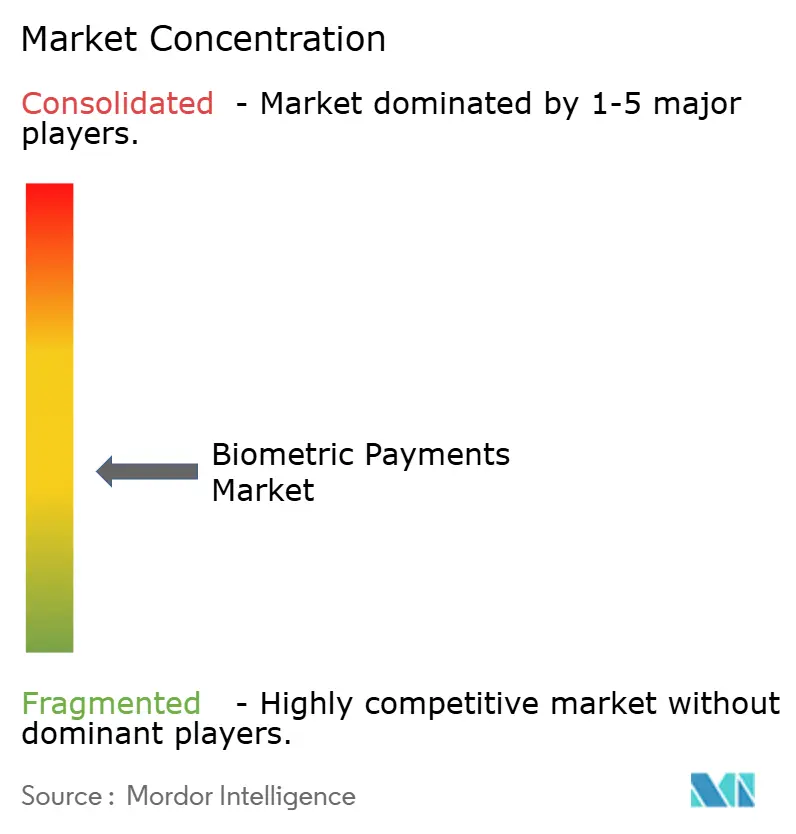
| Market Concentration | Medium |
Major Players *Disclaimer: Major Players sorted in no particular order Image © Mordor Intelligence. Reuse requires attribution under CC BY 4.0. | |
Biometric Payments Market Analysis by Mordor Intelligence
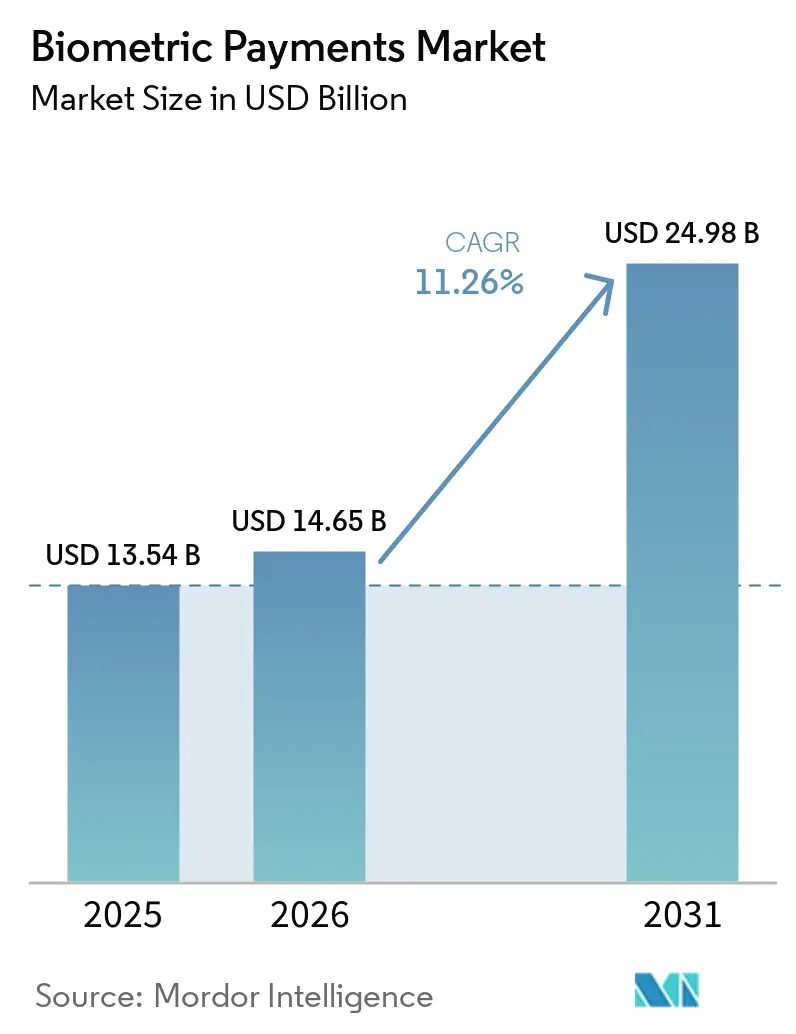
The Biometric Payments Market size is projected to expand from USD 13.54 billion in 2025 and USD 14.65 billion in 2026 to USD 24.98 billion by 2031, registering a CAGR of 11.26% between 2026 to 2031.
The market is moving forward because payment fraud remains elevated, especially in remote transactions, where authentication failures create direct financial and regulatory pressure on issuers, processors, and merchants. The European Central Bank and the European Banking Authority reported EUR 4.2 billion (USD 4.94 billion) in fraudulent payment transactions across the EEA in 2024, with card-not-present fraud running far above the overall card fraud rate, underscoring the importance of biometric authentication in investment decisions for payment security. Passkey adoption is also changing deployment economics because device-native biometrics now sit on top of existing card rails, which allows networks and merchants to improve checkout security without rebuilding settlement infrastructure from the ground up. The FIDO Alliance reported 5 billion passkeys in active use globally in 2026, which shows that consumer readiness for passwordless authentication is already established rather than emerging. Competitive pressure is rising as device platforms, card networks, and biometric specialists vie to control the authentication layer, while privacy regulations continue to shape the pace and cost of adoption across major markets.
Key Report Takeaways
- By biometric modality, facial recognition led with 36.12% of the biometric payments market share in 2025 and is also projected to grow at a 13.84% CAGR through 2031.
- By authentication form factor, mobile devices captured 71.26% of the biometric payments market share in 2025, while merchant-side biometric systems are projected to grow at 15.06% CAGR through 2031.
- By payment environment, in-app payments held 47.05% of the biometric payments market share in 2025, while remote and online payments are projected to grow at 12.96% CAGR through 2031.
- By industry vertical, retail and e-commerce accounted for 33.78% of the biometric payments market share in 2025, while travel, tourism, and hospitality are projected to grow at 13.37% CAGR through 2031.
- By geography, Asia-Pacific held 48.69% of the biometric payments market share in 2025, while the Middle East and Africa is projected to grow at 14.28% CAGR through 2031.
Note: Market size and forecast figures in this report are generated using Mordor Intelligence’s proprietary estimation framework, updated with the latest available data and insights as of January 2026.
Market Trends and Insights
Drivers Impact Analysis of Biometric Payments Market*
| Driver | (~) % Impact on CAGR Forecast | Geographic Relevance | Impact Timeline |
|---|---|---|---|
| Expanding Contactless Checkout Demand | +2.8% | Global, accelerated in Asia-Pacific, North America, and Europe | Short term (≤ 2 years) |
| Rising Fraud Pressure in Digital Payments | +2.1% | Global, highest impact in the EU/EEA, India, and the Asia-Pacific | Short term (≤ 2 years) |
| Growth of Passwordless Authentication | +1.9% | Global, led by Asia-Pacific and North America | Medium term (2-4 years) |
| Multimodal Biometrics in High-Risk Transactions | +1.5% | North America, EU, Singapore, Japan | Medium term (2-4 years) |
| Merchant Demand for Frictionless BFSI and Retail Onboarding | +1.3% | Global, with rapid uptake in Asia-Pacific and MEA | Medium term (2-4 years) |
| Biometric Smart Card Pilots in High-Income Markets | +0.8% | EU, Asia-Pacific, MEA | Long term (≥ 4 years) |
| Source: Mordor Intelligence | |||
Expanding Contactless Checkout Demand
Consumer preference for faster, lower-friction checkout is pushing biometric authentication from a premium feature to a more practical payment tool. South Korea’s Toss FacePay enrolled more than 1 million users across over 135,000 merchant locations after its 2024 launch, and that adoption pattern shows that once enrollment becomes familiar, repeat usage can rise quickly[1]. The same rollout also showed that terminal deployment can move faster than user enrollment, meaning future transaction growth can come from activation campaigns rather than new hardware spending. Google added another proof point in June 2026, saying that Secure Payment Authentication reduced desktop authentication time by 50% and improved purchase completion rates by 3% in testing. That matters because checkout friction affects both conversion and fraud control, so biometrics are now being measured against direct commerce outcomes rather than only against convenience. As more merchants see authentication speed as part of customer retention, the biometric payments market is becoming increasingly tied to transaction completion performance.
Rising Fraud Pressure in Digital Payments
Fraud intensity is accelerating biometric deployment on a timeline that convenience alone would not have created. The ECB and EBA reported EUR 4.2 billion in payment fraud across the EEA in 2024, a 17% increase from 2023, with remote card payments accounting for 83% of all card fraud by value. The same report showed that cross-border card payment fraud rates were more than 7 times higher than domestic rates, which puts international e-commerce at the center of biometric investment priorities for merchants and card issuers. Equifax also projected global card-not-present fraud losses of USD 28.1 billion by 2026, reinforcing the view that remote transaction security remains the main commercial case for stronger authentication[2]. In this setting, fraud reduction is no longer treated as a secondary efficiency gain because it now drives spending decisions on passkeys, biometric verification, and card-level authentication upgrades. That shift is one of the clearest reasons the biometric payments market continues to gain support across merchants, networks, and financial institutions.
Growth of Passwordless Authentication
Passwordless authentication is becoming a core enabler for biometric payments because passkeys are already familiar to consumers on the devices they use most often. The FIDO Alliance reported 5 billion passkeys in active use globally in 2026, with 90% of consumers aware of passkeys and 82% of organizations saying fully passwordless authentication is their workforce goal[3]. Mastercard launched its Payment Passkey Service in India in 2024 and expanded it into Europe and MENA in 2025, allowing biometric device verification to replace OTP-based card authentication on existing rails. Visa followed with a Payment Passkey Service rollout through Noon Payments in October 2025, making the provider the first payment service provider globally to offer FIDO-based biometric e-commerce authentication in the Middle East. Because passkeys stay on the user’s device and are not transmitted over the network, responsibility for authentication increasingly shifts to device ecosystems, which raises the strategic importance of Apple, Google, and Samsung within the payments stack. As a result, the biometric payments market is expanding not only through merchant adoption but also through broader control over digital identity and device-level trust.
Multimodal Biometrics in High-Risk Transactions
Higher-risk transactions are moving beyond single-modality systems because spoofing techniques have become more sophisticated and more scalable. Vendor telemetry cited in the report showed deepfake fraud attempts rising by more than 700% year on year, making liveness detection harder to treat as an optional feature. NIST’s SP 800-63-4 in 2025 stated that facial recognition cannot be used as a standalone authenticator for high-assurance logins and that presentation attack detection is required at higher identity assurance levels. Fiserv’s integration of Wink’s multimodal biometric platform into the Clover POS family shows that enterprise-grade combinations of face, palm, voice, and behavioral signals are moving into broader merchant environments during 2026. This raises the minimum capability threshold for vendors, as they now need strong liveness, low-latency matching, and alignment with standards simultaneously. The result is a biometric payments market where technical qualifications, rather than distribution reach alone, increasingly determine which providers can scale in sensitive payment workflows.
Restraints Impact Analysis of Biometric Payments Market*
| Restraint | (~) % Impact on CAGR Forecast | Geographic Relevance | Impact Timeline |
|---|---|---|---|
| Privacy and Consent Compliance Burden | -2.2% | EU (GDPR), United States (BIPA, Colorado Privacy Act), India | Short term (≤ 2 years) |
| Integration Complexity With Legacy POS and Issuer Stacks | -1.8% | Global, most acute in North America and Europe | Medium term (2-4 years) |
| Sensor and Card Cost Sensitivity in Mass Rollouts | -1.2% | Emerging markets, South Asia, Sub-Saharan Africa, Southeast Asia | Long term (≥ 4 years) |
| Template Spoofing, Liveness, and Trust Concerns | -0.8% | Asia-Pacific and globally, especially camera-based deployments | Medium term (2-4 years) |
| Source: Mordor Intelligence | |||
Privacy and Consent Compliance Burden
Privacy regulation remains the most significant non-technical limit on scale deployment in this market. Under GDPR Article 9, biometric data used for identification is treated as a special category of data, which requires explicit consent, a data protection impact assessment, and can lead to fines of up to 4% of global annual revenue for violations. Spain’s data protection authority ruled in June 2026 that biometric verification cannot be the only identity option under GDPR, which shows how even mature European identity programs can face structural design limits when consent and choice become central compliance tests[4]. In the United States, Reed Smith’s 2025 review highlighted that Colorado’s biometric-specific privacy rules broaden the compliance perimeter beyond Illinois, keeping legal exposure elevated across multiple state frameworks. Even where operators want rapid enrollment growth, tighter consent and data handling rules can directly limit participation rates and weaken the return on infrastructure investment. That legal tension continues to slow parts of the biometric payments market, especially in jurisdictions where user choice and data minimization receive strict regulatory attention.
Integration Complexity With Legacy POS and Issuer Stacks
Integration remains difficult because many existing payment environments were not built around device-native biometric credentials. Upgrades often require parallel work across terminal firmware, issuer access control servers, tokenization systems, and 3DS authentication rails, which extends project duration and raises coordination risk. Razorpay’s rollout of native ACS infrastructure to support Mastercard and Visa biometric passkey authentication in India, completed within 10 days of the RBI AFA deadline, shows both the technical precision and the operational pressure involved when regulatory timing is tight. For smaller merchants, hardware replacement remains a major limit because legacy terminal fleets are mixed, and camera-capable upgrades are not easy to standardize at scale. Verifone’s Qualcomm Dragonwing-based POS architecture in 2026 points toward a more firmware-led solution, but the transition of the installed base will still take years across global terminal networks. This keeps parts of the biometric payments market dependent on phased modernization rather than immediate mass rollout.
*Our forecasts treat driver/restraint impacts as directional, not additive. The impact forecasts reflect baseline growth, mix effects, and variable interactions.
Biometric Payments Market Segment Analysis
By Biometric Modality:
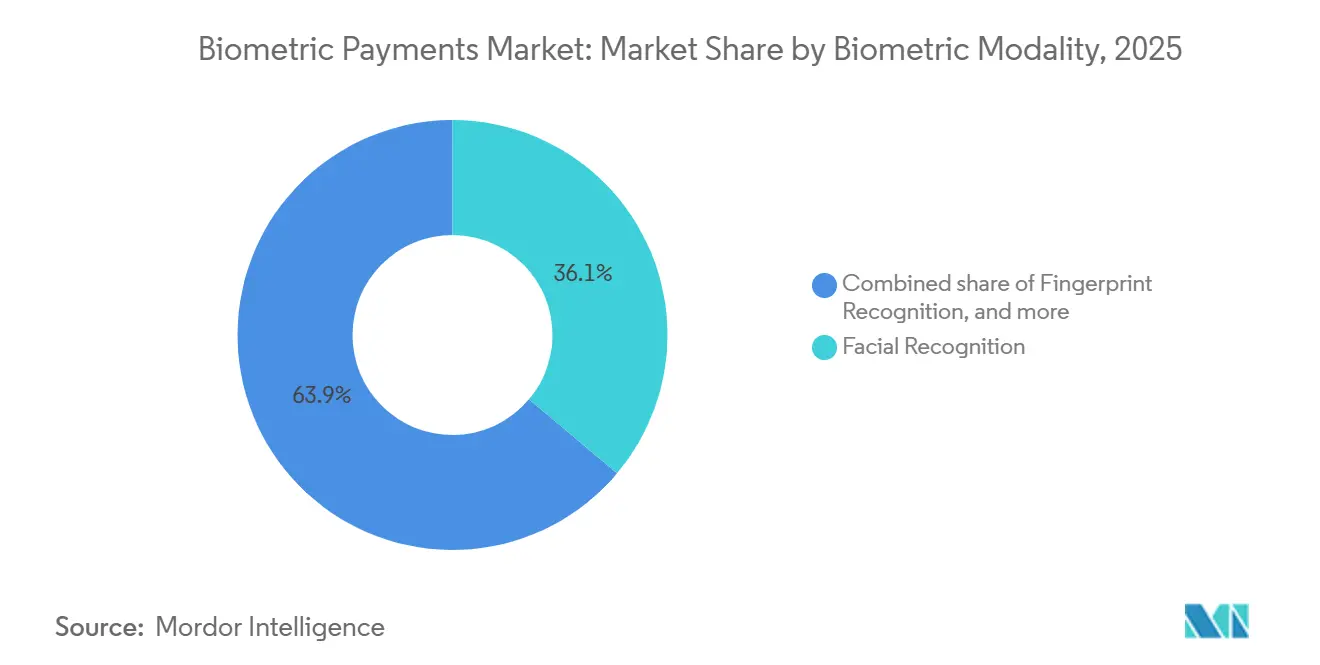
Facial Recognition Holds Volume and Growth LeadershipFacial recognition accounted for 36.12% of transaction value in 2025 and is also projected to grow at a 13.84% CAGR through 2031, making it the largest and fastest-growing modality in the biometric payments market. The segment benefits from a dual role, as the same facial credential supports both device unlock and merchant-side payment authentication, reducing the need for separate enrollment steps. South Korea provided one important validation point in 2025 when Lotte Card received regulatory sandbox approval for facial recognition payments in airport and duty-free settings. That approval matters because it shows deployment is moving through formal regulatory pathways rather than remaining limited to isolated operator pilots. It also indicates that facial recognition is gaining ground in environments where speed, security, and identity certainty need to work together.
Facial recognition also gains from the fact that existing user enrollment databases can be activated for payment use cases faster than new biometric programs can be built from scratch. Fingerprint recognition remains a substantial incumbent modality because it continues to support biometric card programs and mobile authentication patterns across several markets. Mastercard’s July 2025 launch of the biometric metal credit card in Bangladesh demonstrated that fingerprint-based authentication remains a clear fit for card-present use cases that do not depend on smartphones. Iris and voice recognition occupy smaller positions, while other biometrics, such as palm vein and behavioral methods, remain more selective and context-driven. NIST’s 2025 requirement for presentation attack detection adds a compliance filter that favors vendors with stronger liveness and active sensing capability, which should shape the future quality profile of this segment.
By Authentication Form Factor:
Mobile Leads, Merchant-side Systems Drive the Next PhaseMobile devices accounted for 71.26% of transaction value in 2025, capturing the dominant share of the biometric payments market at the form-factor level. Their lead comes from the installed base of biometric-capable smartphones that already function as default carriers for passkeys and device-native credentials. Google’s May 2026 I/O updates extended that role by enabling desktop checkout approval via the user’s Android phone, broadening mobile authentication to transactions that do not begin on a mobile screen. This matters because it protects the phone’s central role in payment authentication, even as commerce journeys span multiple screens and devices. It also helps explain why mobile remains the anchor form factor for the biometric payments market even as new hardware categories emerge.
Merchant-side biometric systems are projected to expand at a 15.06% CAGR through 2031, putting them at the forefront of the next growth cycle. Their momentum comes from better edge processors, broader camera integration, and the ability to embed biometric capabilities into terminal software and firmware rather than requiring a full hardware redesign. Sunmi’s 2026 collaboration with Wink and Qualcomm on Android POS devices highlighted that face and palm authentication are moving into mainstream terminal design rather than staying restricted to premium deployments. Biometric payment cards remain a growing niche, especially in higher-income segments where users want card-present verification without phone dependence, while wearables continue to develop more gradually in hands-free and transit-oriented contexts. The form-factor mix, therefore, shows a market that still depends on mobile scale, but increasingly adds merchant hardware and specialized card products to expand addressable transaction surfaces.
By Payment Environment:
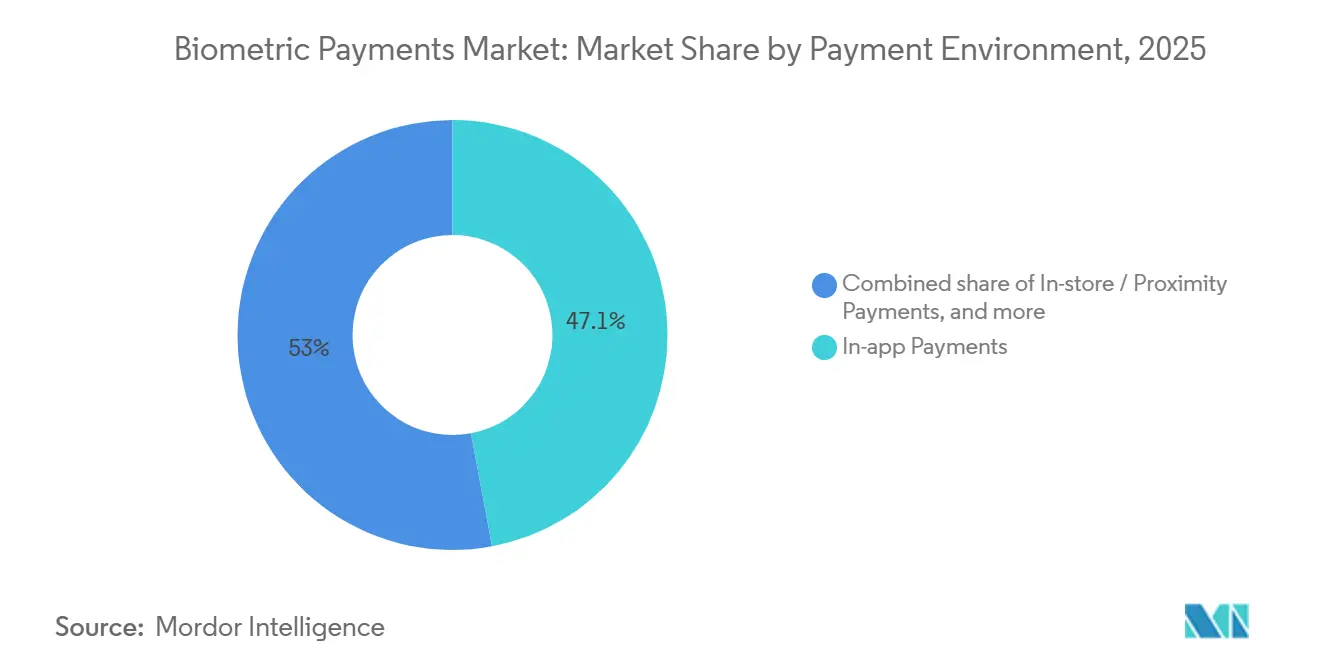
In-app Volumes Anchor the Market, Remote Payments Set the Growth PaceIn-app payments accounted for 47.05% of transaction value in 2025, making them the largest segment of the biometric payments market. Their lead reflects the fact that many payment ecosystems already had biometric login and identity verification in place before payment use cases were fully monetized. In practical terms, that means established enrollment pools can be used to accelerate payment adoption without requiring new user education at checkout. China’s super-app model illustrates this structure because biometrically authenticated payment activity is already deeply embedded in daily digital commerce flows. The segment also benefits from the fact that authentication often occurs at app launch, reducing interruptions during the purchase process.
Remote and online payments are projected to grow at a 12.96% CAGR through 2031, making them the fastest-expanding environment. That growth is tied directly to fraud pressure because remote card payments continue to account for the largest share of fraud value in Europe and remain the highest-risk payment surface. The ECB and EBA confirmed that card-not-present fraud accounted for 83% of total card fraud value in the EEA in 2024, keeping biometric authentication high on issuers' and merchants' investment agendas. Mastercard’s expansion of payment passkeys and Visa’s FIDO-based e-commerce authentication rollout show that card networks now treat biometric verification as a practical replacement for OTP-heavy flows in online commerce. In-store proximity payments continue to grow, but investment remains stronger in remote channels, where security, regulation, and conversion pressure converge.
By Industry Vertical:
Retail Commands the Market, Travel Accelerates on Identity ConvergenceRetail and e-commerce accounted for 33.78% of transaction value in 2025, giving the segment the leading share in the biometric payments market among industry verticals. That position reflects high transaction frequency, persistent chargeback exposure, and a strong merchant incentive to shorten checkout time without weakening authentication. Early retail adoption in South Korea, including usage across GS25 and 7-Eleven through Toss FacePay, showed that high-volume merchants see operational value in biometric checkout when repeat use becomes simple. BFSI also holds a substantial position because banks and payment providers increasingly connect biometric verification to onboarding, authorization, and remote service access. As fraud and compliance pressures rise together, the retail and BFSI segments continue to provide the most immediate commercial basis for rollout.
Travel, tourism, and hospitality are forecast to grow at a 13.37% CAGR through 2031, making it the fastest-growing vertical in the biometric payments market. The segment is expanding as identity and payments converge within a single travel workflow, especially at airports and connected hospitality checkpoints. IATA’s April 2026 proof-of-concept trials confirmed that fully biometric international boarding can work across multiple countries, wallet ecosystems, and authentication approaches, with 78% of surveyed passengers willing to use unified biometric credentials for travel and payment. That level of user acceptance matters because it supports a broader service model in which a single verified credential enables continuous movement, payments, and service access. Healthcare and government use cases are also advancing, especially where biometric identity infrastructure already exists, and payment functionality can be layered on as a secondary capability.
Geography Analysis
APAC Biometric Payments Market
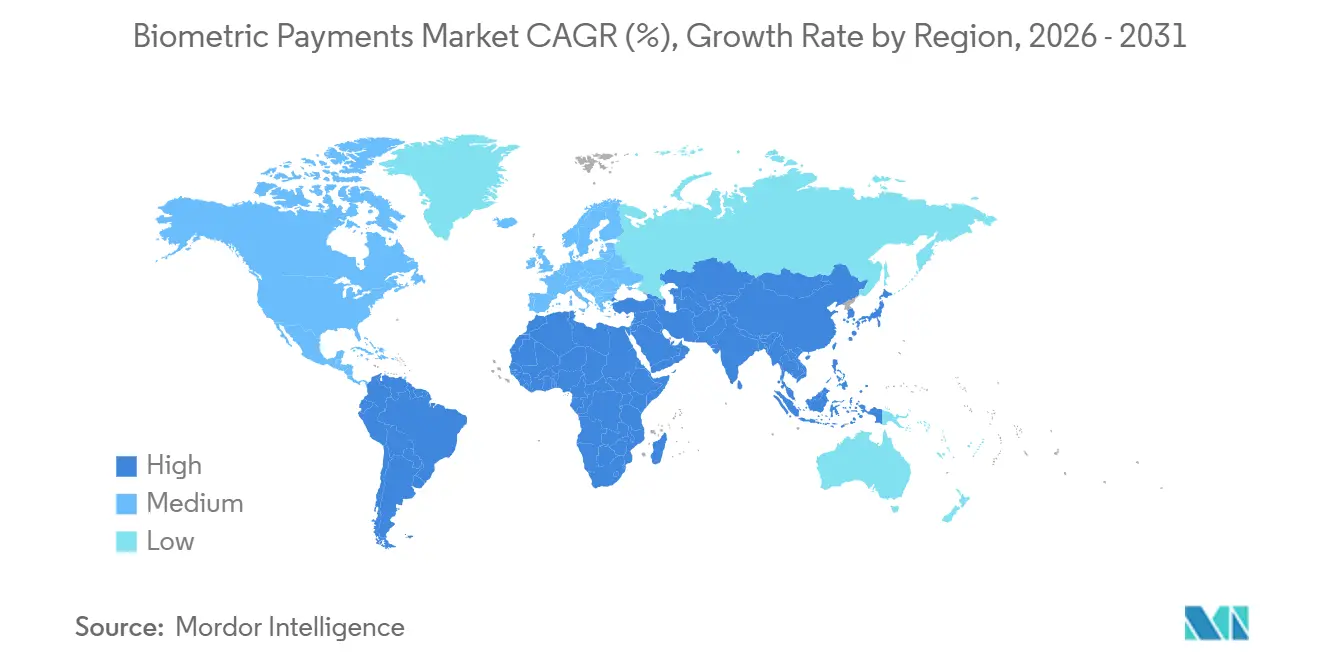
Asia-Pacific accounted for 48.69% of transaction value in 2025, making it the largest share of the biometric payments market. The region benefits from simultaneous deployment across several payment cultures, including super-app ecosystems, card-based authentication upgrades, and the rapid rollout of device-native biometric credentials. India remains a key part of that structure because Mastercard selected the country for the global launch of its Payment Passkey Service, which aligned biometric card authentication with large-scale digital payment behavior. South Korea also supports regional leadership through high-visibility face payment deployments, where Toss FacePay moved past 1 million users and 135,000 merchant locations by late 2025. The combination of scale, user familiarity, and policy-backed digital ecosystems keeps Asia-Pacific ahead of other regions on both deployment depth and use-case breadth.
North America and Europe Biometric Payments Market
North America and Europe are more mature regions, but different operating constraints shape their growth patterns. In North America, strategic control over the authentication layer is becoming increasingly important, with JPMorgan launching its own proprietary Paypad and Pinpad terminals rather than relying entirely on third-party terminal vendors. In Europe, fraud pressure and privacy regulation are both central, with the ECB’s 2025 fraud findings supporting stronger authentication while GDPR Article 9 raises compliance expectations for biometric data handling. Google’s June 2026 digital ID and secure payment authentication updates for select EU countries also show that Europe is becoming a live region for wallet-linked identity and commerce integration.
MEA Biometric Payments Market
The Middle East and Africa are projected to grow at a 14.28% CAGR through 2031, which makes it the fastest-growing regional market. Growth in this region is supported by policy-led cashless agendas and by the fact that some deployments face less legacy infrastructure drag than older payment environments. The UAE Central Bank’s biometric payment pilot and Network International’s related activity in the region show that merchant-side biometric payment models are moving from concept to testing in live markets. This makes the region important not only for future volume growth, but also for demonstrating that biometric payments can scale within modern cashless programs without the same installed-base burden found elsewhere.
Competitive Landscape
The biometric payments market remains moderately fragmented, as no single company controls the entire chain from biometric sensing to credential management to payment settlement. Competition is organized around 3 broad groups: device platform operators such as Apple, Alphabet, and Samsung; card networks such as Mastercard and Visa; and biometric hardware and software specialists, including IDEMIA, Thales Group, Fingerprint Cards AB, NXP Semiconductors, IDEX Biometrics, and Precise Biometrics AB. This structure creates strong competition at the integration layer because the most valuable control point increasingly sits where identity, device trust, and payment authentication meet. Mastercard and Visa are both pushing FIDO-based payment passkeys onto existing card infrastructure, enabling them to raise security without changing the settlement layer itself. At the same time, device ecosystems are deepening their role in payments because biometric authentication already sits at the operating system level for billions of users.
Platform-driven moves are raising the strategic value of hardware-linked identity inside payments. Google’s 2026 secure identity and payment updates reduced authentication time in testing and expanded digital ID support, strengthening the company’s position at the intersection of wallet, identity, and commerce. Visa’s May 2026 launch of Tap to Confirm and Tap to Activate with Keyno and Fidelity Bank showed another path, using the physical Visa card as a trusted identity credential inside a banking app. JPMorgan’s proprietary POS hardware launch adds a third example, suggesting that large financial institutions may want direct control over authentication hardware rather than relying on shared external terminal providers.
Biometric specialists still matter because sensor performance, liveness capability, and network certification remain difficult to replicate. IDEX Biometrics strengthened its position through multi-network progress, including Visa orders in MEA, Mastercard-related approvals, and RuPay-linked card activity, which shows that certification breadth is becoming a minimum commercial requirement rather than a differentiator. Fiserv’s integration of Wink into Clover and Verifone’s work on firmware-upgradeable biometric architecture both indicate that payment acceptance providers are trying to simplify rollout for merchants without forcing full hardware replacement. Compliance standards such as EMVCo biometric card specifications and FIDO2 certification continue to serve as barriers to entry, meaning competitive advantage increasingly depends on both technical certification and integration reach.
Biometric Payments Industry Leaders
-
Apple Inc.
-
Alphabet Inc.
-
Samsung Electronics Co Ltd.
-
Mastercard Incorporated
-
Visa Inc.
- *Disclaimer: Major Players sorted in no particular order
Biometric Payments Market Companies Covered in this Report
- Apple Inc.
- Alphabet Inc.
- Samsung Electronics Co Ltd.
- Mastercard Incorporated
- Visa Inc.
- PayPal Holdings, Inc.
- Alibaba Group Holding Limited
- Ant Group
- Tencent Holdings Limited
- IDEMIA
- Thales Group
- NEC Corporation
- Fujitsu Limited
- Fingerprint Cards AB
- Precise Biometrics AB
- Aware, Inc.
- NXP Semiconductors N.V.
- ASSA ABLOY AB
- Suprema Inc.
- Verifone Systems, Inc.
- Cielo S.A.
- StoneCo Ltd.
- Network International Holdings plc
- KONA I Co. Ltd.
Recent Industry Developments in Biometric Payments Market
- May 2026: Visa announced the first-ever global deployment of its Tap to Confirm and Tap to Activate identity verification technology, launched with fintech partner Keyno and Fidelity Bank (Bahamas), using the physical Visa card as a trusted identity credential within the bank's app. Broader global expansion is planned throughout 2026.
- April 2026: Amadeus announced its planned acquisition of IDEMIA Public Security for EUR 1.2 billion (USD 1.4 billion) to integrate biometric and digital identity capabilities into aviation, border control, and hospitality payment ecosystems. Deal signing was expected in Q2 2026, with close anticipated in mid-2027.
- April 2026: Kazakhstan's National Bank and ARDFM approved rules formalizing palm-vein and facial recognition authentication for remote onboarding, high-risk loan authorization, and electronic digital signatures across the national banking system. This made Kazakhstan the first Central Asian market to regulate multimodal biometrics at the national level.
- April 2026: IATA's contactless travel proof-of-concept trials, involving Japan Airlines, Haneda Airport, Hong Kong International Airport, Heathrow Airport, and British Airways, confirmed fully biometric international boarding across multiple wallet ecosystems and biometric authentication methods. 78% of passengers surveyed expressed willingness to use unified biometric travel and payment credentials.
Global Biometric Payments Market Report Scope
Segmentation Overview
| Fingerprint Recognition |
| Facial Recognition |
| Iris Recognition |
| Voice Recognition |
| Other Biometrics |
| Mobile Devices |
| Biometric Payment Cards |
| Merchant-side Biometric Systems |
| Wearables and Other Form Factors |
| In-store / Proximity Payments |
| Remote / Online Payments |
| In-app Payments |
| BFSI |
| Retail and E-commerce |
| Travel, Tourism and Hospitality |
| Transportation and Logistics |
| Healthcare |
| Government and Public Sector |
| Other Industries |
| North America | United States |
| Canada | |
| Mexico | |
| South America | Brazil |
| Argentina | |
| Rest of South America | |
| Europe | United Kingdom |
| Germany | |
| France | |
| Italy | |
| Spain | |
| Rest of Europe | |
| Asia-Pacific | India |
| China | |
| Japan | |
| South Korea | |
| Australia | |
| South East Asia (Singapore, Malaysia, Thailand, Indonesia, Vietnam, and Philippines) | |
| Rest of Asia-Pacific | |
| Middle East and Africa | United Arab Emirates |
| Saudi Arabia | |
| South Africa | |
| Nigeria | |
| Rest of Middle East and Africa |
| By Biometric Modality | Fingerprint Recognition | |
| Facial Recognition | ||
| Iris Recognition | ||
| Voice Recognition | ||
| Other Biometrics | ||
| By Authentication Form Factor | Mobile Devices | |
| Biometric Payment Cards | ||
| Merchant-side Biometric Systems | ||
| Wearables and Other Form Factors | ||
| By Payment Environment | In-store / Proximity Payments | |
| Remote / Online Payments | ||
| In-app Payments | ||
| By Industry Vertical | BFSI | |
| Retail and E-commerce | ||
| Travel, Tourism and Hospitality | ||
| Transportation and Logistics | ||
| Healthcare | ||
| Government and Public Sector | ||
| Other Industries | ||
| By Geography | North America | United States |
| Canada | ||
| Mexico | ||
| South America | Brazil | |
| Argentina | ||
| Rest of South America | ||
| Europe | United Kingdom | |
| Germany | ||
| France | ||
| Italy | ||
| Spain | ||
| Rest of Europe | ||
| Asia-Pacific | India | |
| China | ||
| Japan | ||
| South Korea | ||
| Australia | ||
| South East Asia (Singapore, Malaysia, Thailand, Indonesia, Vietnam, and Philippines) | ||
| Rest of Asia-Pacific | ||
| Middle East and Africa | United Arab Emirates | |
| Saudi Arabia | ||
| South Africa | ||
| Nigeria | ||
| Rest of Middle East and Africa | ||
Key Questions Answered in the Report
What is the 2031 outlook for biometric payments?
The biometric payments market is forecast to reach USD 24.98 trillion by 2031, up from USD 14.65 trillion in 2026, at an 11.26% CAGR over 2026-2031.
Which biometric modality results in the highest transaction value?
Facial recognition accounted for 36.12% of transaction value in 2025 and is also the fastest-growing modality, with a 13.84% CAGR through 2031.
Why are merchants investing more in biometric authentication?
Fraud pressure, lower checkout friction, and stronger conversion rates are key reasons. ECB and EBA fraud data and Google’s 2026 testing both support that shift.
Which form factor dominates usage today?
Mobile devices accounted for 71.26% of transaction value in 2025 because biometric-capable smartphones already serve as the default carriers for passkeys and device-level credentials.
Which region is growing the fastest through 2031?
The Middle East and Africa is projected to record the fastest growth at a 14.28% CAGR through 2031, supported by policy-led cashless programs and newer infrastructure rollouts.
Which end-user segment is expanding the quickest?
Travel, tourism and hospitality is the fastest-growing vertical at a 13.37% CAGR through 2031 because identity and payment are increasingly converging in airport and travel workflows.