
Biomass Gasification Market Size and Share
Market Overview
| Study Period | 2021 - 2031 |
|---|---|
| Market Size (2026) | USD 136.57 Billion |
| Market Size (2031) | USD 196.43 Billion |
| Growth Rate (2026 - 2031) | 7.54 % |
| Fastest Growing Market | South America |
| Largest Market | Asia-Pacific |
| Market Concentration | Low |
Major Players *Disclaimer: Major Players sorted in no particular order Image © Mordor Intelligence. Reuse requires attribution under CC BY 4.0. | |
Biomass Gasification Market Analysis by Mordor Intelligence
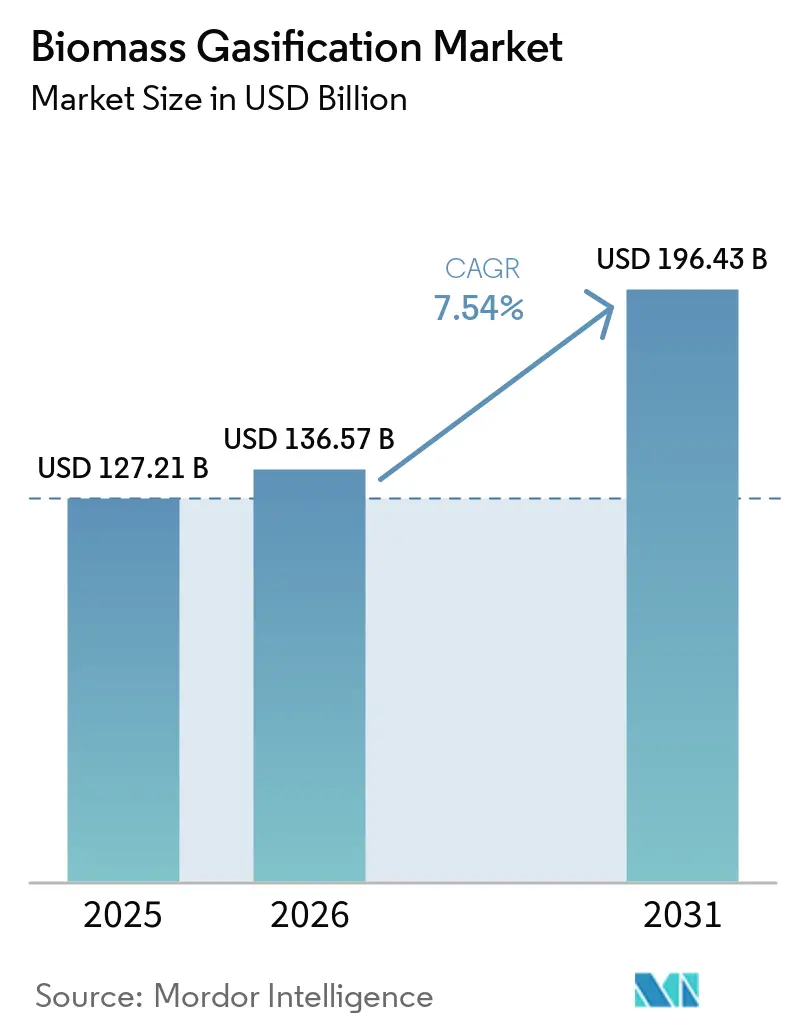
The biomass gasification market size is projected to be USD 127.21 billion in 2025, USD 136.57 billion in 2026, and reach USD 196.43 billion by 2031, at a CAGR of 7.54% from 2026 to 2031. Investment in liquid biofuels and biogases is projected to exceed USD 16 billion for the full year of 2026, which supports new low-emission energy infrastructure and related biomass conversion projects.[1] The biomass gasification market is moving beyond distributed electricity supply toward industrial heat, hydrogen, renewable fuels, and chemicals. This shift broadens the buyer base, although it also increases the need for reliable feedstock, gas cleaning, and long-term offtake arrangements. Established engineering firms retain an advantage because project financing depends on operating references, while modular systems make smaller commercial projects more accessible. The biomass gasification market therefore has opportunities where waste-management policy, industrial emissions targets, and local biomass supply can support the same project.
Key Report Takeaways
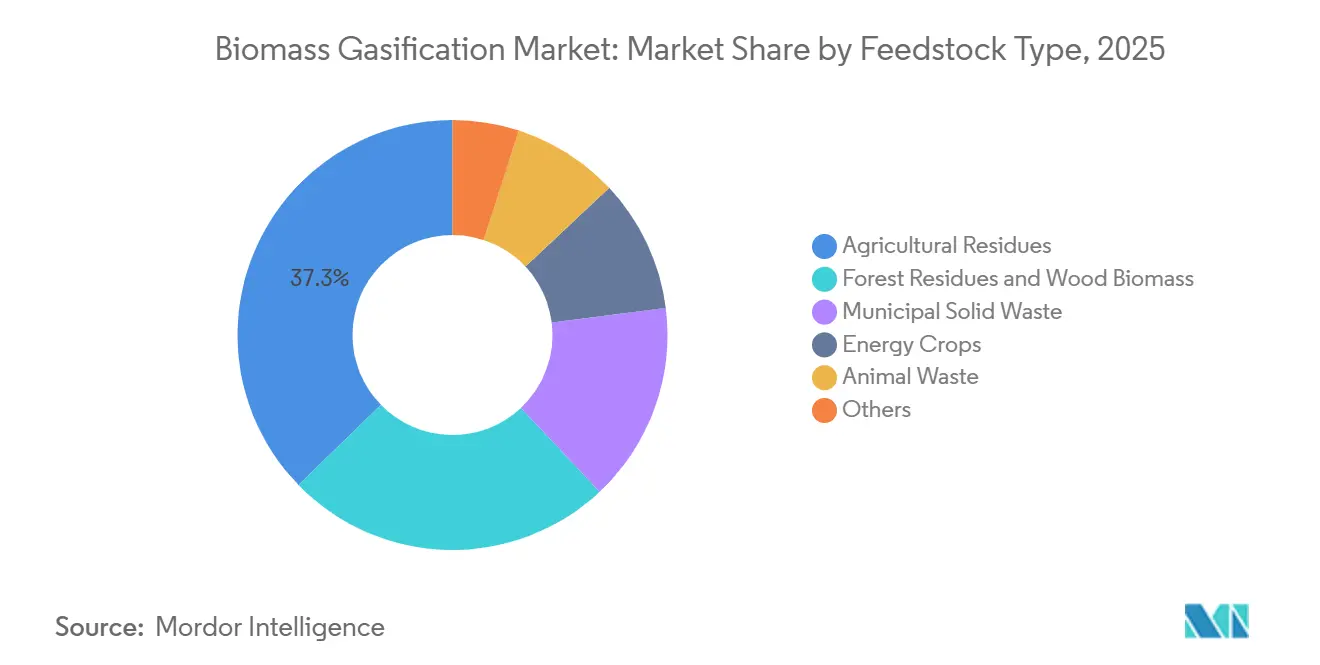
- By feedstock, agricultural residues held 37.3% of the Biomass Gasification Market share in 2025, while animal waste is projected to grow at a CAGR of 9.3% through 2031.
- By technology, fixed-bed gasification held 48.7% of the Biomass Gasification Market share in 2025, while fluidized-bed gasification is projected to record the highest CAGR at 9.8% through 2031.
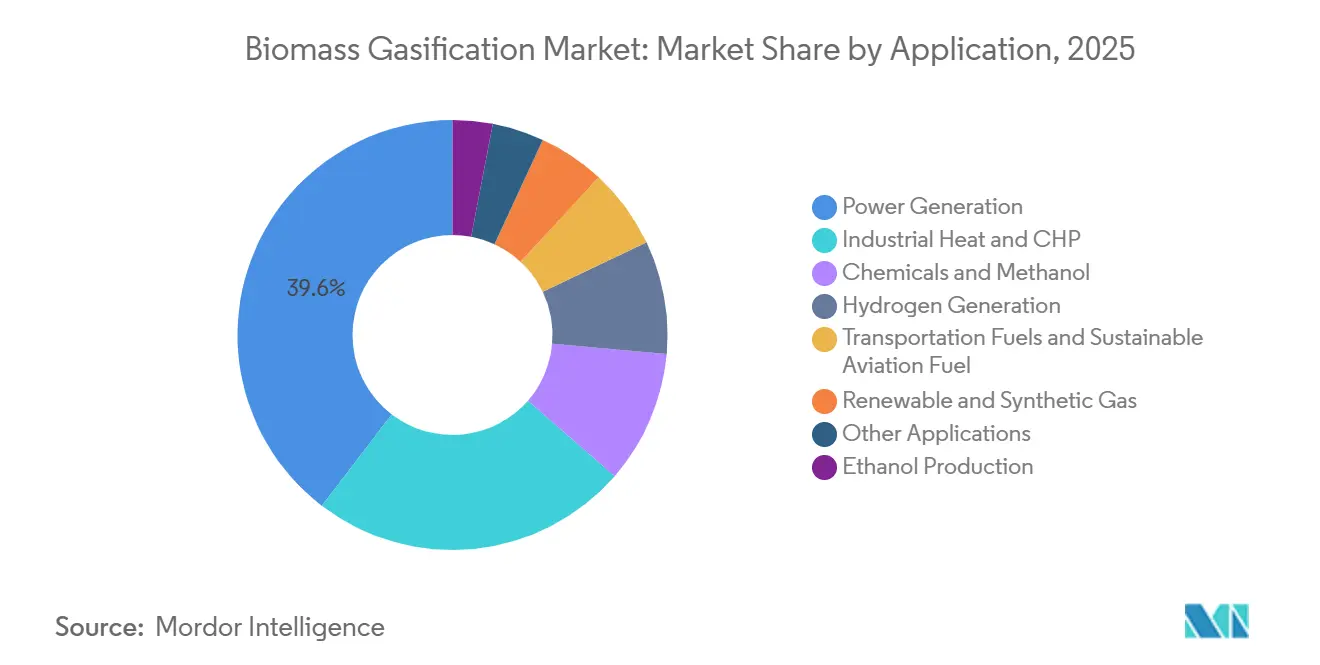
- By application, power generation held 39.6% of the Biomass Gasification Market share in 2025, while hydrogen generation is projected to record the highest CAGR at 17.9% through 2031.
- By geography, Asia-Pacific held 40.7% of the market share in 2025, while South America is projected to record the highest CAGR at 12.7% through 2031.
Note: Market size and forecast figures in this report are generated using Mordor Intelligence’s proprietary estimation framework, updated with the latest available data and insights as of January 2026.
Global Biomass Gasification Market Trends and Insights
Drivers Impact Analysis*
| Driver | (~) % Impact on CAGR Forecast | Geographic Relevance | Impact Timeline |
|---|---|---|---|
| Renewable and Low-Carbon Energy Demand | +2.1% | Global | Short term (≤ 2 years) |
| Industrial Decarbonization and Fossil-Fuel Substitution | +1.6% | APAC, Europe, North America | Medium term (2-4 years) |
| Waste-to-Energy and Circular-Economy Investment | +1.0% | Europe, APAC, South America | Medium term (2-4 years) |
| Green Hydrogen, Sustainable Fuels, and Chemicals Demand | +1.5% | Europe, APAC, North America | Long term (≥ 4 years) |
| Feedstock-Specific Gasifier Design and Digital Process Optimization | +0.8% | Global, with early gains in APAC and Europe | Medium term (2-4 years) |
| Digital Process Control and Predictive Maintenance | +0.4% | Europe, North America | Short term (≤ 2 years) |
| Source: Mordor Intelligence | |||
Renewable and Low-Carbon Energy Demand Reshapes the Market's Base Load
Governments and corporate buyers increasingly view biomass gasification as a controllable complement to variable wind and solar output. A gasifier can produce syngas when renewable electricity is not available, which can support power, heat, or fuel production. Indonesia raised its biodiesel blending mandate from B40 to B50 in July 2026, showing how policy can increase demand for agricultural biomass as an energy resource. The Biomass Gasification Market benefits when energy policy treats biomass as part of a broader domestic energy security strategy. Food processors, pulp producers, and refinery operators can use dedicated assets to reduce exposure to grid disruptions and fossil fuel costs. The value of these projects depends on lifecycle emissions compliance, feedstock contracts, and a dependable operating profile.
Industrial Decarbonization and Fossil-Fuel Substitution Consolidate Demand
Pulp and paper, metals, ceramics, and food processing need dependable high-temperature heat that direct electrification may not always provide. Biosyngas can replace conventional fuels in kilns, dryers, and steam systems where biomass residues are available nearby. The Biomass Gasification Market has a strong industrial case where producers can use their own residues and avoid transport costs. Suzano stated that its biomass-to-syngas installation at Ribas do Rio Pardo displaced petroleum-derived fuel oil in lime kilns and reduced associated energy costs.[2] This example supports the use of biomass gasification at large forest-product facilities with consistent residues and continuous heat demand. Operators still need project structures that account for capital costs, plant downtime, and the quality requirements of industrial gas users.
Waste-to-Energy and Circular-Economy Investment Accelerates Feedstock Diversification
Landfill diversion requirements are making end-of-life wood, municipal waste fractions, and agricultural processing residues more valuable. These feedstocks can create a local project base when disposal costs and emissions rules make conventional waste handling less attractive. EemsGas received a EUR 149.8 million operating subsidy in May 2026 to support a waste-wood-to-biomethane facility in the Netherlands.[3] The Biomass Gasification Market gains from such programs because public support can improve project revenue certainty during early commercial deployment. Clear rules for waste classification and renewable gas certificates can be as important as the delivered price of biomass. Developers also need pretreatment systems that manage moisture, contaminants, and changing material quality before conversion.
Green Hydrogen, Sustainable Fuels, and Chemicals Demand Repositions the Technology's Value Proposition
Hydrogen, sustainable aviation fuel, methanol, and renewable chemicals create higher-value routes for gasification output. Biomass-to-hydrogen pathways reported by IEA Bioenergy achieved 40% to 70% energy efficiency on a lower heating value basis. The same analysis found that carbon capture can produce an average lifecycle footprint of negative 15.8 kg CO₂eq per kg H₂. This makes the Biomass Gasification Market relevant to buyers seeking fuels with measurable emissions reductions. Aviation obligations can provide a durable demand signal because airlines have limited alternatives for decarbonizing long-distance flight. Feedstock-specific reactor design, digital controls, and predictive maintenance become more important when product specifications are tighter and plant utilization must remain high.
Restraints Impact Analysis*
| Restraint | (~) % Impact on CAGR Forecast | Geographic Relevance | Impact Timeline |
|---|---|---|---|
| High Capital Cost and Financing Risk | -1.8% | Global, more acute in MEA and South America | Short term (≤ 2 years) |
| Feedstock Variability, Seasonality, and Logistics | -1.3% | APAC, South America, MEA | Medium term (2-4 years) |
| Tar Formation, Syngas Cleaning, and Skilled-Operations Requirements | -1.0% | Global | Short term (≤ 2 years) |
| Carbon-Intensity Accounting and Permitting Uncertainty for Mixed Waste Feedstocks | -0.6% | Europe, North America | Medium term (2-4 years) |
| Source: Mordor Intelligence | |||
High Capital Cost and Financing Risk Constrain Project Pipelines
Capital requirements remain a major barrier for small and medium biomass gasification projects. A 2025 study of a 225-kW combined heat and power plant in Italy reported a levelized cost of energy of EUR 359 per MWh under the assessed subsidy conditions. Equipment cost increases have widened the gap between early feasibility estimates and engineering, procurement, and construction bids. Low-emissions projects also face delays when buyers do not offer firm, long-term contracts. Modular designs and structured power or gas purchase agreements can reduce these risks, but they do not remove commissioning and performance uncertainty. The Biomass Gasification Market needs financing models that reflect construction lead times, revenue stability, and the added cost of downstream gas treatment.
Feedstock Variability, Seasonality, and Logistics Undermine Plant Economics
Feedstock consistency is an operating challenge because moisture, ash, particle size, and chemical composition change by source and season. Centro Nacional de Energías Renovables (CENER) identifies moisture content, ash composition, nitrogen, chlorine, sulfur, and particle-size distribution as material variables in gasification performance.[4] A 2025 study reported tar content from 9 to 30 g/Nm³ across selected feedstocks under the same operating temperatures. Such variation raises gas-cleaning costs and can reduce plant availability when systems are not designed for the actual material mix. The European Bioenergy Association reported that large-scale biomass gasification remains at the demonstration stage, partly because heterogeneous supply chains are not standardized. Aggregation contracts, drying, densification, and local logistics planning are therefore essential parts of the Biomass Gasification Market project model.
*Our forecasts treat driver/restraint impacts as directional, not additive. The impact forecasts reflect baseline growth, mix effects, and variable interactions.
Segment Analysis
By Feedstock: Agricultural Residues Lead, While Regulatory Requirements Support Animal Waste
Agricultural Residues held 37.3% of the Biomass Gasification Market share in 2025, supported by large volumes of crop residues in Asia-Pacific and South America. Rice husk, sugarcane bagasse, wheat straw, and corn stover provide a broad feedstock base near agricultural processing sites. Their local availability can reduce haulage costs and connect gasification projects with existing residue collection systems. Forest Residues and Wood Biomass formed the second-largest category because their calorific value and moisture content are generally more consistent. More predictable biomass can simplify reactor configuration and lower the burden on syngas-cleaning equipment. Municipal Solid Waste and Energy Crops serve different use cases, with municipal projects concentrated in regulated urban waste systems. Energy crop projects have fewer installations but can provide more controlled feedstock quality. The Biomass Gasification Market uses these categories differently according to local land use, collection capability, and disposal regulation.
Animal Waste is forecast to grow at a 9.3% CAGR through 2031, making it the fastest-growing feedstock category. Its growth is tied to livestock methane requirements and manure management needs, not solely to the cost of the material. A 2025 study found that poultry litter gasification achieved a peak hydrogen concentration of 10.78% under optimized airflow conditions.[5] The same research associated thermochemical manure treatment with lifecycle greenhouse gas reductions above 90% versus conventional management options. Integrated livestock and crop operations can use this route to manage waste, produce energy, and support compliance objectives. This combination can help reduce dependence on energy-price movements for projects using animal waste. Feedstock handling, odor management, ash control, and nutrient recovery remain practical considerations for developers. The Biomass Gasification Market can expand this segment where farms have enough scale and a stable collection model.

By Technology: Fixed-Bed Holds Scale, While Fluidized-Bed Supports Higher-Value Applications
Fixed-Bed Gasification accounted for 48.7% of the Biomass Gasification Market share in 2025, reflecting its lower capital intensity and operational simplicity. Updraft and downdraft systems suit distributed energy projects and agricultural processing facilities that have limited engineering resources. Fixed-bed equipment can accept a range of particle sizes and operate across pressures from 0 to 70 bar.[6] These features support its use in rural electrification and small commercial installations. Entrained-Flow Gasification occupies specialized synthesis uses that need high-temperature conversion and cleaner syngas. Plasma Gasification can serve premium applications but carries significant capital and operating complexity. Hybrid and solar-integrated configurations remain in development and may address specific local energy needs. The Biomass Gasification Market will continue to use fixed-bed units where feedstock quality and project scale suit simple configurations.
Fluidized-Bed Gasification is forecast to grow at a 9.8% CAGR through 2031, driven by feedstock flexibility and hydrogen-oriented applications. Circulating fluidized-bed systems reported a 20% improvement in hydrogen yield over fixed-bed alternatives through stronger steam reforming reactions. These systems can manage mixed biomass with changing moisture and particle-size profiles more effectively. International Energy Agency (IEA) Bioenergy identifies fluidized-bed gasifiers as a preferred configuration for biomass-to-hydrogen pathways because stable syngas quality helps downstream purification. Their higher technical requirements can be justified where hydrogen, sustainable fuel, or chemical output carries higher value. The Biomass Gasification Market is likely to see a larger technology role for fluidized-bed systems as these project pipelines progress. Operators must still manage bed materials, gas cleaning, and maintenance to preserve the expected performance advantage. Technology selection will remain dependent on feedstock characteristics and the required end product.
By Application: Power Anchors Volume, While Hydrogen Changes Project Value
Power Generation held 39.6% of the Biomass Gasification Market share in 2025, supported by its installed base in distributed and off-grid electricity systems. Asia-Pacific and sub-Saharan Africa have a continued demand for local generation where grid access or grid reliability is limited. Industrial Heat and Combined Heat and Power also represent a major application because manufacturers need dependable heat and steam. Biosyngas can displace liquefied petroleum gas and natural gas in kilns, dryers, and steam generators. Chemicals and methanol provide another outlet where local biomass can support shipping and industrial fuel needs. Transportation fuels, sustainable aviation fuel, renewable gas, and ethanol remain smaller applications with strategic value. Their demand can benefit from blending rules and decarbonization obligations. The Biomass Gasification Market retains power as its volume base while adding applications that may improve project revenue.
Hydrogen Generation is forecast to grow at a 17.9% CAGR through 2031, the strongest rate among the applications. IEA Bioenergy estimates that a 200-MW biomass gasification plant can produce 100 kg of hydrogen per metric ton of dry biomass input. The report places production cost at EUR 4 per kg, with carbon capture reducing it below EUR 3 per kg in the assessed case. Carbon capture can also turn the facility into a carbon-negative hydrogen producer under the stated lifecycle methodology. Hydrogen projects must integrate gasification, reforming, purification, carbon management, and secure offtake contracts. This makes the application more complex than power generation but offers access to industrial and fuel markets. The Biomass Gasification Market has a credible route into hydrogen where sustainable biomass and carbon storage options are available. Commercial success will depend on sustained operating performance rather than technical potential alone.
Geography Analysis
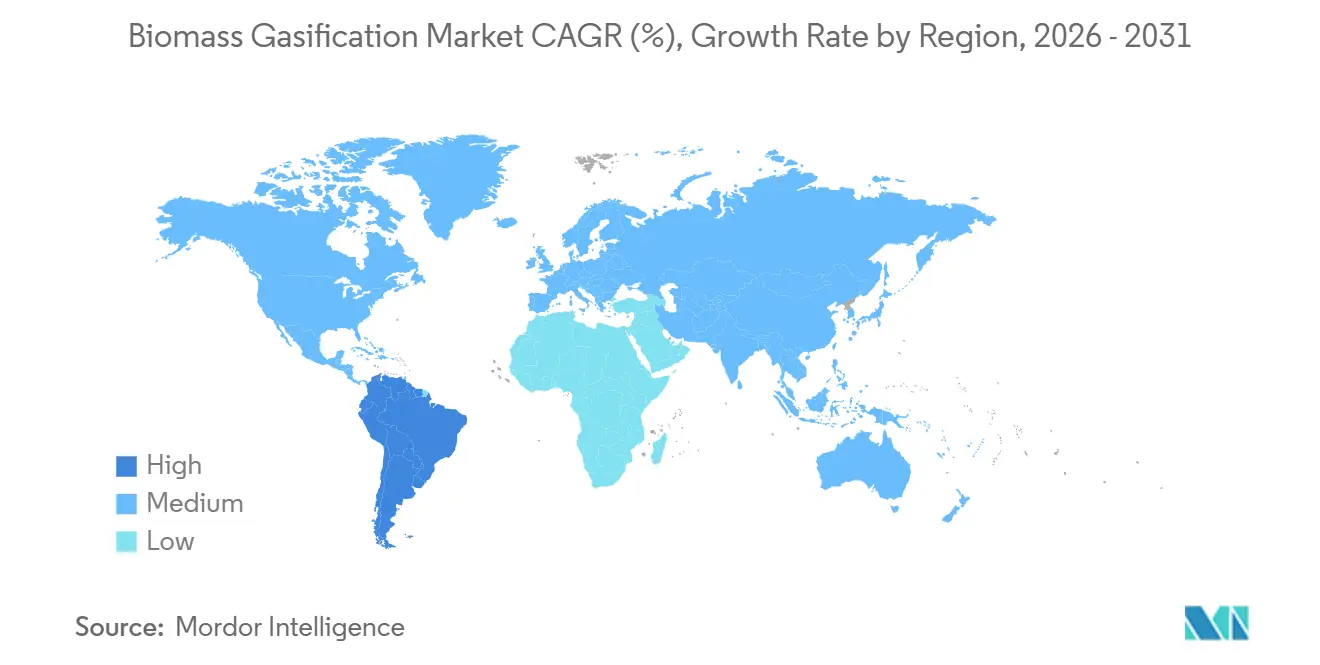
Asia-Pacific held 40.7% of the biomass gasification market share in 2025, making it the largest regional market. China has scale in distributed bioenergy systems, while India's compressed biogas requirements support renewable gas supply and feedstock aggregation across gas and transport applications. Vietnam, Thailand, and Indonesia have substantial agricultural residues and use small and medium fixed-bed systems in agri-food processing, linking residue management with local electricity, heat, and fuel demand. Regional deployment is largely based on fixed-bed technology, as it suits decentralized sites and established biomass types. The biomass gasification market in Asia-Pacific will remain tied to policy implementation, residue collection, and industrial users near farms.
Europe and North America support higher-value gasification projects for green hydrogen, sustainable aviation fuel, and green methanol. The European Union's Renewable Energy Directive III identifies agricultural residues, forestry residues, and biogenic municipal waste fractions for advanced fuel pathways. The Netherlands committed EUR 149.8 million in SDE++ support to the EemsGas project in May 2026, while the United States has provided a framework for low-emissions energy investment. These regions have strict sustainability rules, established engineering capacity, high construction costs, and careful permitting requirements for mixed waste feedstocks. The biomass gasification market in these regions is shaped more by policy quality and product standards than by low-cost biomass alone.
South America is forecast to grow at a 12.7% CAGR through 2031. Brazil has a large sugarcane processing base that provides bagasse, vinasse, and other organic residual streams, while its Future Fuel Law requires a 1% reduction in natural gas sector greenhouse gas emissions from 2026. Forest products provide an industrial setting for biomass-based heat substitution, as illustrated by Suzano Papel e Celulose's Ribas do Rio Pardo project. The Middle East and Africa represent a smaller but growing market, where South Africa and Morocco have prospects based on waste management obligations, energy security, and limited gas grid access.
Competitive Landscape
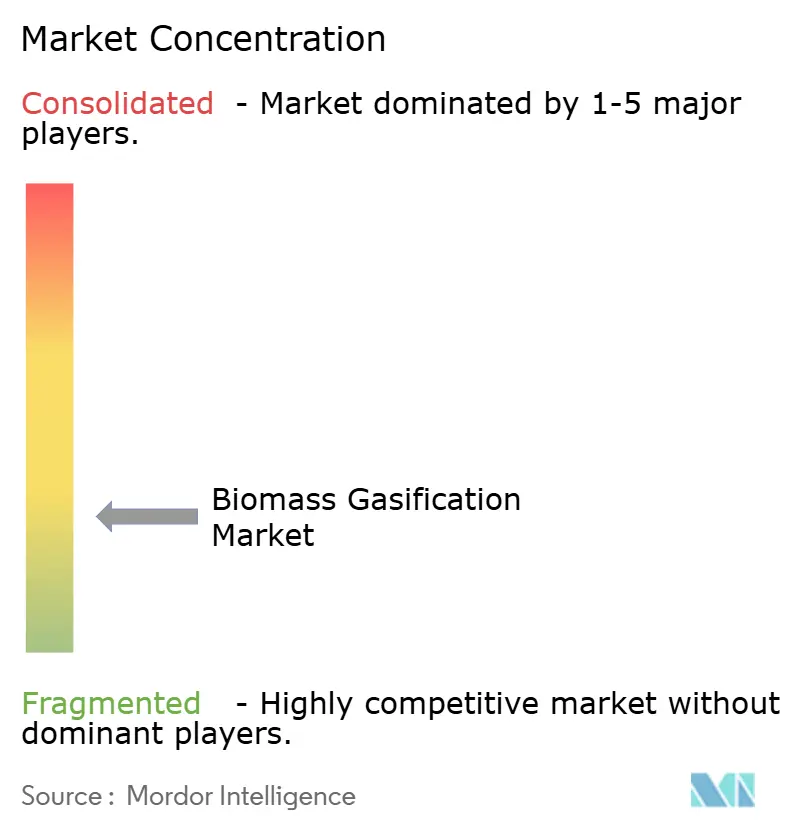
The Biomass Gasification Market is fragmented, with large engineering groups and specialist technology providers serving different project sizes. Industrial engineering firms compete for integrated projects that combine pretreatment, gasification, cleaning, and downstream fuel synthesis, while specialist suppliers compete through modular equipment and feedstock-specific designs. High capital costs and long commissioning periods favor firms with credible operating references, although containerized formats can lower the entry threshold for smaller engineering-led companies. This setting rewards firms that can help customers secure feedstock and offtake arrangements, not only supply equipment. The Biomass Gasification Market therefore retains space for focused suppliers alongside larger integrated providers.
Valmet launched BioTrac in 2026 as a lignocellulosic biomass pretreatment platform and reported 28 projects across bio-based chemicals, cellulosic ethanol, and biomethane applications. This upstream position can help developers manage biomass quality before it enters a gasification process. Wildfire Energy and Mitsui Mining & Smelting Co., Ltd. announced a September 2026 collaboration on a Queensland demonstration project for bio-methanol and sustainable aviation fuel, targeting more than 200,000 tonnes of waste processing annually. Valmet and Veolia also announced a heat-recovery system for a fluidized-bed biomass boiler in Poland, with startup targeted for Q3 2027. These moves show that competitive positions extend across feedstock preparation, energy recovery, and fuel production.
Companies seek greater control from biomass preparation through gas cleaning and conversion into hydrogen, fuels, or chemicals. Digital process control and predictive maintenance can improve availability, especially when feedstock quality varies. International Energy Agency (IEA) Bioenergy places integrated biomass-to-hydrogen operation at Technology Readiness Level 5, reflecting the need for further demonstration. Early operators that deliver reliable long-duration performance may gain an advantage in financing and customer confidence, while potential off-takers with purification and distribution capabilities can shape demand.
Biomass Gasification Industry Leaders
-
Valmet Corporation
-
Andritz AG
-
thyssenkrupp AG
-
Siemens Energy AG
-
Air Liquide S.A.
- *Disclaimer: Major Players sorted in no particular order
Recent Industry Developments
- September 2026: Wildfire Energy and Mitsui Kinzoku Company announced a collaboration to develop a demonstration project for producing low-cost bio-methanol from biomass and waste, with future plans to expand into Sustainable Aviation Fuel (SAF) production. The project secured AUD 3.15 million in funding from ARENA's Sustainable Aviation Fuel Funding Initiative, along with financial support from Mitsui Kinzoku Company. Running from 2026 to 2028, the project includes pilot-scale bio-methanol production trials at Wildfire Energy's Brisbane facility and a feasibility study for a Queensland waste-to-biofuel plant designed to process over 200,000 tonnes of waste annually.
- May 2026: EemsGas, a 50:50 joint venture between Perpetual Next and Gasunie, secured a EUR 149.8 million SDE++ operating subsidy from the Netherlands Enterprise Agency (RVO). This adds to a previously awarded EUR 30 million DEI+ investment subsidy, bringing total public support to nearly EUR 180 million. The EUR 100 million biomass gasification project will be built at Chemical Park Delfzijl in the Netherlands and is expected to become one of the country's largest biomethane production facilities. Construction is planned to begin in 2027, with commercial operations targeted for 2029, supporting Dutch energy security, renewable gas production, and decarbonization goals.
- May 2026: Valmet showcased its newly launched BioTrac pretreatment technology at the 11th Bio-based Industry Conference and Exhibition 2026 in Shanghai. The technology converts non-food biomass into fermentable sugars for biofuels, biochemicals, and bio-based materials. The continuous steam explosion-based BioTrac system processes feedstocks such as straw, wood chips, bamboo, bagasse, and energy grasses without chemical additives, while maximizing retention of C5 and C6 sugars.
- February 2026: Valmet partnered with Veolia Poland on the HeatUp! project at the EC4 combined heat and power plant in Łódź. Valmet delivered a flue gas condensing heat recovery system and automation solution to improve the efficiency of the biomass-fired facility. The system recovers more than 50 MW of heat from flue gases and feeds it into the district heating network, increasing renewable heat production without increasing biomass consumption. The project is expected to reduce CO₂ emissions by over 82,000 tonnes annually and supports Veolia Poland's strategy to phase out coal combustion in Łódź by 2031.
Global Biomass Gasification Market Report Scope
Biomass gasification is a thermochemical process that converts organic materials, such as agricultural residues, wood waste, and municipal solid waste, into a combustible fuel known as synthesis gas, or syngas. This conversion occurs at high temperatures (typically above 700°C) in a controlled environment with a limited supply of oxygen or steam. The resulting syngas, composed mainly of hydrogen (H2) and carbon monoxide (CO), can be burned directly to generate electricity and heat, or further processed into biofuels and chemicals.
The biomass gasification market is segmented by feedstock type, technology, application, and geography. By feedstock type, the market is segmented into agricultural residues, forest residues, municipal solid waste, animal waste, and energy crops. By technology, the market is segmented into fixed-bed gasification systems, fluidized-bed gasification systems, entrained-flow gasification systems, and plasma gasification systems. By application, the market is segmented into power generation, industrial heat and combined heat and power (CHP), hydrogen generation, chemicals production, transportation fuels, and sustainable aviation fuel (SAF). The report also covers the market size and forecasts for the global biomass gasification market across 26 countries in key regions. For each segment, the market sizing and forecasts have been provided on the basis of value (USD).
| Agricultural Residues |
| Forest Residues and Wood Biomass |
| Municipal Solid Waste |
| Animal Waste |
| Energy Crops |
| Others |
| Fixed-Bed Gasification |
| Fluidized-Bed Gasification |
| Entrained-Flow Gasification |
| Plasma Gasification |
| Other Technologies |
| Power Generation |
| Industrial Heat and CHP |
| Hydrogen Generation |
| Chemicals and Methanol |
| Transportation Fuels and Sustainable Aviation Fuel |
| Renewable and Synthetic Gas |
| Ethanol Production |
| Other Applications |
| North America | United States |
| Canada | |
| Mexico | |
| Europe | Germany |
| France | |
| Italy | |
| Spain | |
| United Kingdom | |
| Poland | |
| Russia | |
| Rest of Europe | |
| Asia-Pacific | China |
| India | |
| Japan | |
| South Korea | |
| Australia | |
| Indonesia | |
| Vietnam | |
| Thailand | |
| Rest of Asia-Pacific | |
| South America | Brazil |
| Argentina | |
| Chile | |
| Rest of South America | |
| Middle East and Africa | Saudi Arabia |
| United Arab Emirates | |
| Egypt | |
| South Africa | |
| Morocco | |
| Rest of Middle East and Africa |
| By Feedstock | Agricultural Residues | |
| Forest Residues and Wood Biomass | ||
| Municipal Solid Waste | ||
| Animal Waste | ||
| Energy Crops | ||
| Others | ||
| By Technology | Fixed-Bed Gasification | |
| Fluidized-Bed Gasification | ||
| Entrained-Flow Gasification | ||
| Plasma Gasification | ||
| Other Technologies | ||
| By Application | Power Generation | |
| Industrial Heat and CHP | ||
| Hydrogen Generation | ||
| Chemicals and Methanol | ||
| Transportation Fuels and Sustainable Aviation Fuel | ||
| Renewable and Synthetic Gas | ||
| Ethanol Production | ||
| Other Applications | ||
| By Geography | North America | United States |
| Canada | ||
| Mexico | ||
| Europe | Germany | |
| France | ||
| Italy | ||
| Spain | ||
| United Kingdom | ||
| Poland | ||
| Russia | ||
| Rest of Europe | ||
| Asia-Pacific | China | |
| India | ||
| Japan | ||
| South Korea | ||
| Australia | ||
| Indonesia | ||
| Vietnam | ||
| Thailand | ||
| Rest of Asia-Pacific | ||
| South America | Brazil | |
| Argentina | ||
| Chile | ||
| Rest of South America | ||
| Middle East and Africa | Saudi Arabia | |
| United Arab Emirates | ||
| Egypt | ||
| South Africa | ||
| Morocco | ||
| Rest of Middle East and Africa | ||
Key Questions Answered in the Report
What is the projected value of the Biomass Gasification Market by 2031?
The Biomass Gasification Market is forecast to reach USD 196.43 billion by 2031, rising from USD 136.57 billion in 2026 at a 7.54% CAGR.
Which feedstock held the largest share in 2025?
Agricultural Residues led with 37.3% share in 2025, supported by crop residues such as rice husk, bagasse, wheat straw, and corn stover.
Which technology is growing fastest in biomass gasification?
Fluidized-Bed Gasification is forecast to grow at a 9.8% CAGR through 2031, aided by feedstock flexibility and hydrogen applications.
Why is hydrogen generation important for biomass gasification?
Hydrogen Generation is the fastest-growing application at a 17.9% CAGR, with biomass-to-hydrogen also offering potential carbon-negative production when carbon capture is integrated.
Which region has the largest deployment base?
Asia-Pacific held 40.7% share in 2025, supported by distributed bioenergy systems, agricultural residues, and renewable gas policies.
What are the main barriers to new biomass gasification projects?
High capital costs, variable feedstock quality, tar removal, logistics, permitting, and long-term offtake agreements remain the main barriers.