
Biodegradable Plastics Market Size and Share
Market Overview
| Study Period | 2021 - 2031 |
|---|---|
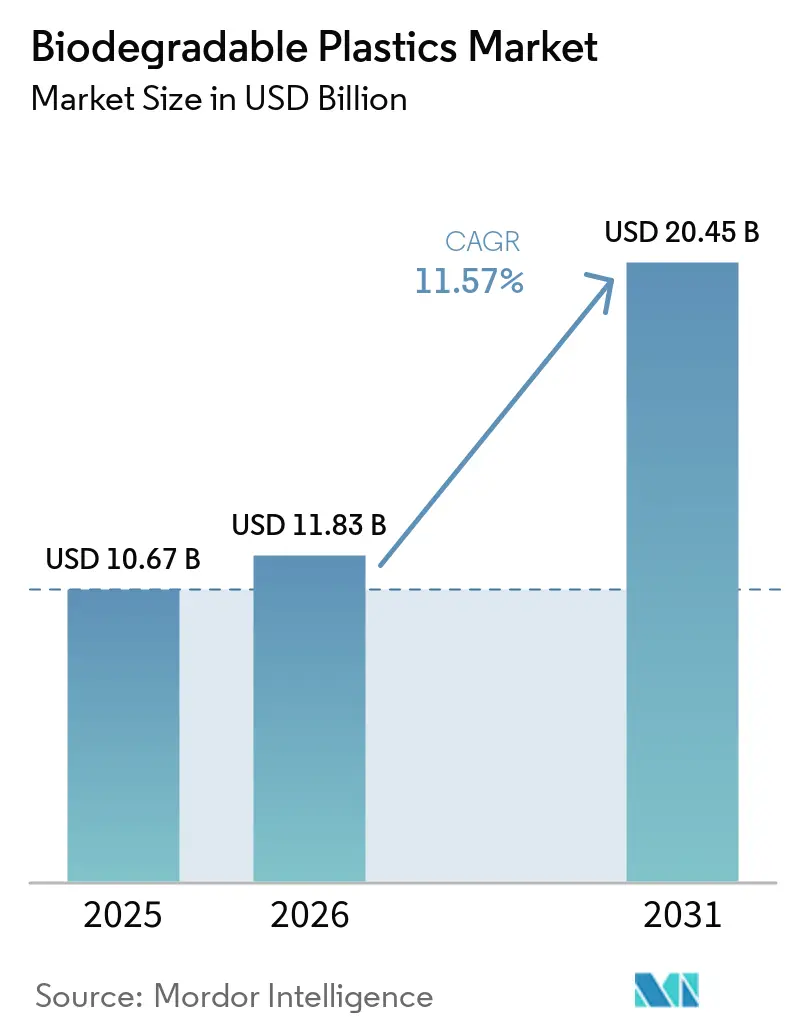
| Market Size (2026) | USD 11.83 Billion |
| Market Size (2031) | USD 20.45 Billion |
| Growth Rate (2026 - 2031) | 11.57 % |
| Fastest Growing Market | Asia-Pacific |
| Largest Market | Europe |
| Market Concentration | Medium |
Major Players *Disclaimer: Major Players sorted in no particular order Image © Mordor Intelligence. Reuse requires attribution under CC BY 4.0. | |
Biodegradable Plastics Market Analysis by Mordor Intelligence
The biodegradable plastics market size was valued at USD 10.67 billion in 2025 and is estimated to grow from USD 11.83 billion in 2026 to reach USD 20.45 billion by 2031, at a CAGR of 11.57% during the forecast period (2026-2031). Regulatory requirements are shifting compostable packaging from a voluntary sustainability option to a procurement requirement across many applications. The EU Packaging and Packaging Waste Regulation has been applied since August 12, 2026, linking producer responsibility costs to packaging design and end-of-life outcomes. This framework defines the commercial role of certified compostable materials, as buyers must comply with packaging regulations and manage associated compliance costs. Material suppliers are responding by securing certifications, developing products, and investing in local production capacity. However, feedstock availability and limited collection and composting infrastructure remain key barriers to the adoption of biodegradable plastics.
Key Report Takeaways
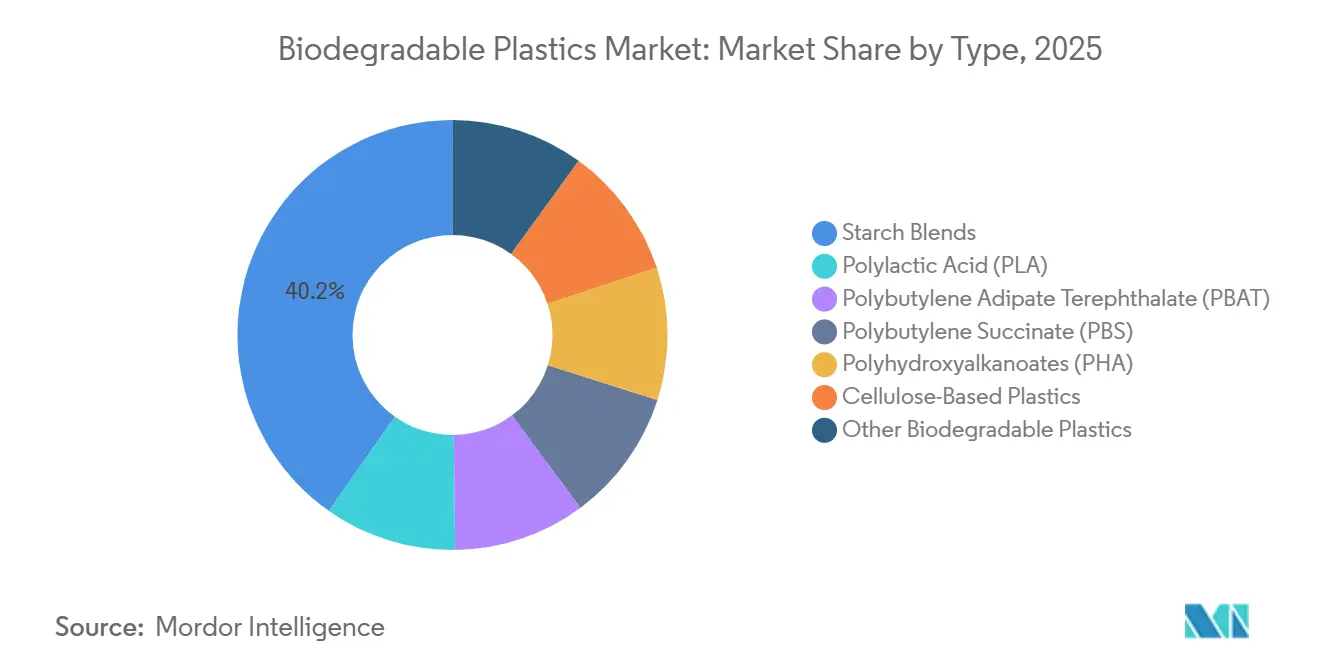
- By type, starch blends held 40.23% of the biodegradable plastics market share in 2025, while PHA is forecast to grow at a CAGR of 19.60% through 2031.
- By product form, films and sheets accounted for 34.12% of the biodegradable plastics market share in 2025 and are forecast to grow at a CAGR of 12.54% through 2031.
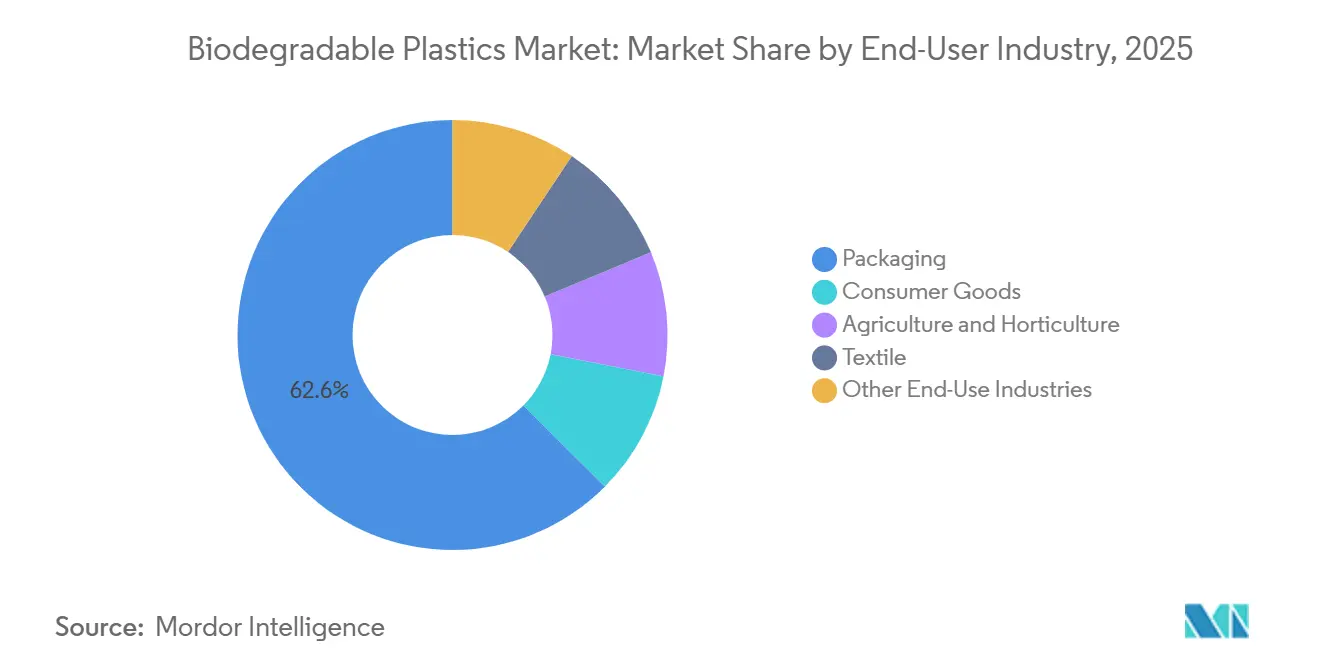
- By end-user industry, packaging held 62.56% of the biodegradable plastics market share in 2025, while agriculture and horticulture are forecast to grow at a CAGR of 13.37% through 2031.
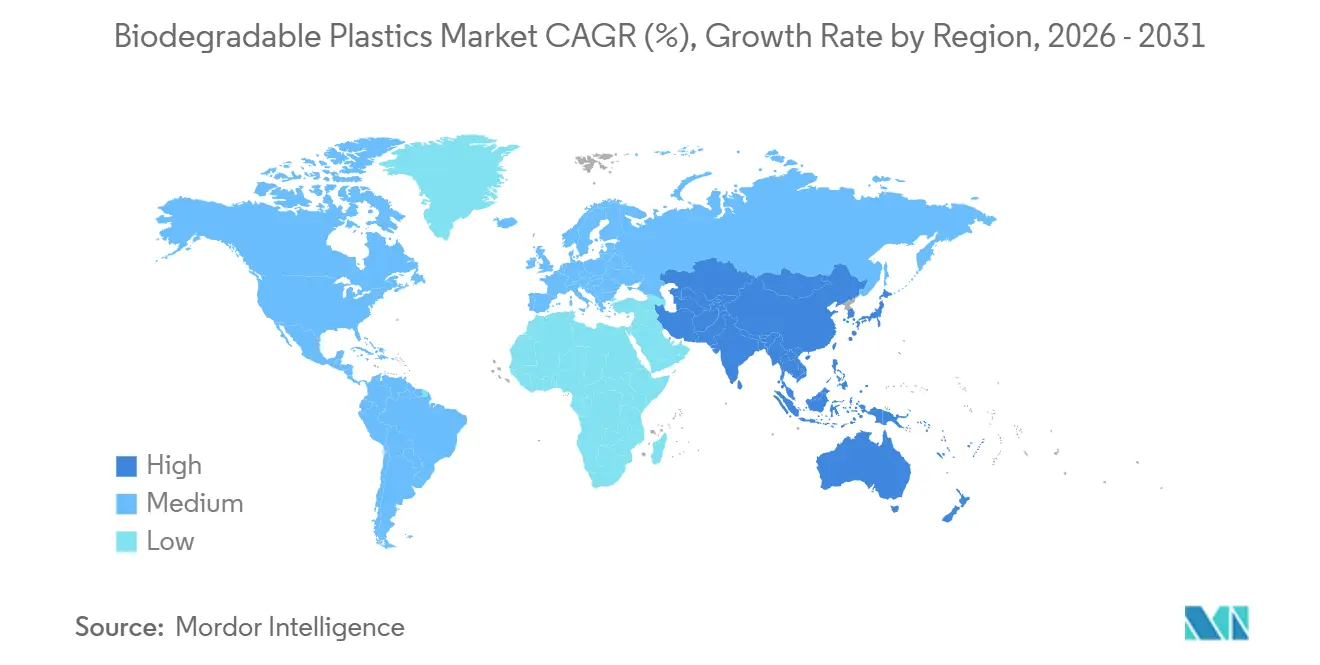
- By geography, Europe held 38.84% of the biodegradable plastics market share in 2025, while Asia-Pacific is forecast to grow at a CAGR of 12.84% through 2031.
Note: Market size and forecast figures in this report are generated using Mordor Intelligence’s proprietary estimation framework, updated with the latest available data and insights as of January 2026.
Market Trends and Insights
Drivers Impact Analysis of Biodegradable Plastics Market*
| Drivers | (~) % Impact on CAGR Forecast | Geographic Relevance | Impact Timeline |
|---|---|---|---|
| Single-Use Plastic Restrictions and Extended Producer Responsibility | +3.2% | Global, with concentrated near-term impact in the EU and key Asia-Pacific markets | Short term (≤ 2 years) |
| Sustainable Packaging Procurement by Retailers and Foodservice Brands | +2.4% | Global, with North America and the EU leading, while Asia-Pacific accelerates | Medium term (2-4 years) |
| Performance and Cost Improvements in PLA, PBAT, and PHA Formulations | +1.8% | Global, especially Asia-Pacific manufacturing hubs, and EU application markets | Medium term (2-4 years) |
| Biodegradable Agricultural Mulch Film Adoption | +1.4% | EU, Mediterranean basin, China, and Latin America | Medium term (2-4 years) |
| Corporate Carbon Disclosure and Internal Carbon Pricing | +0.8% | Global, especially EU and North American corporate procurement hubs | Long term (≥ 4 years) |
| Source: Mordor Intelligence | |||
Single-Use Plastic Restrictions and Extended Producer Responsibility
The EU Packaging and Packaging Waste Regulation has applied in full since August 12, 2026, establishing requirements for packaging waste, reuse, and producer responsibility. The regulation supports compostable formats where material selection affects producer responsibility costs. Fee modulation can make certified compostable packaging more attractive to buyers managing compliance costs. Packaging converters are incorporating EN 13432 compostability requirements into long-term supply agreements. Similar producer responsibility measures across Asia-Pacific and several U.S. states are expanding the addressable demand base for the biodegradable plastics market. These measures increase the importance of certification, supply reliability, and regulatory readiness in packaging procurement.
Sustainable Packaging Procurement by Retailers and Foodservice Brands
Major retailers and foodservice operators are using packaging targets to support demand for certified compostable materials. Grupo Bimbo worked toward making its packaging recyclable, biodegradable, or compostable by the end of 2025. These targets required packaging teams to evaluate material options across numerous products before broader regulations took effect. Amazon trialed Novamont Mater-Bi bio-based delivery bags in Spain through a project supported by the Circular Bio-based Europe program. Foodservice applications remain relevant because they combine high single-use with relatively straightforward material transitions. Corporate carbon disclosure and internal carbon pricing also influence material selection decisions, as Shiseido applied internal carbon pricing to its 2025 manufacturing investment decisions[1].
Performance and Cost Improvements in Polylactic Acid (PLA), Polybutylene Adipate Terephthalate (PBAT), and Polyhydroxyalkanoates (PHA) Formulations
Formulation improvements are making biodegradable resins more compatible with existing processing equipment and suitable for a broader range of applications. PHA production costs range from USD 4 to USD 6 per kilogram, compared with USD 1 to USD 2 per kilogram for petrochemical plastics. Research on continuous Halomonas fermentation indicates that eliminating sterility requirements can reduce PHA production costs to USD 1.98 per kilogram. In June 2024, BASF introduced biomass-balanced ecoflex PBAT with REDcert2 and International Sustainability and Carbon Certification (ISCC) PLUS certifications, reporting a 60% lower product carbon footprint. Film processors prioritize melt flow, clarity, and stable performance on blown-film lines. These factors reduce operational risks associated with material substitution and support demand in the biodegradable plastics market.
Biodegradable Agricultural Mulch Film Adoption
EU regulations have expanded the basis for the use of soil-biodegradable mulch films in agriculture. Delegated Act 2024/2787 made soil-biodegradable mulch films eligible for CE marking as fertilizing products from November 20, 2024. This pathway recognizes mulch films as certified agricultural inputs under defined conditions. Novamont stated that its Mater-Bi mulch film received certification as an inorganic soil improver in November 2025. The material can eliminate the need to retrieve conventional film after harvest, a process associated with soil loss when polyethylene mulch is mechanically removed. Agricultural plastic use exceeds 12.5 million tons annually, with mulch film accounting for 20% of this use. However, Europe recycles only 24% of agricultural plastic waste.
Restraints Impact Analysis of Biodegradable Plastics Market*
| Restraints | (~) % Impact on CAGR Forecast | Geographic Relevance | Impact Timeline |
|---|---|---|---|
| Feedstock and Energy Price Volatility | -1.5% | Global, most acute for PLA and starch-blend producers reliant on corn and sugarcane | Short term (≤ 2 years) |
| Cost Premium Versus Commodity Plastics | -1.3% | Global, most constraining in price-sensitive markets across Asia and South America | Medium term (2-4 years) |
| Industrial Composting and Separate-Collection Gaps | -0.9% | North America and emerging Asia, partly addressed in the northern EU | Long term (≥ 4 years) |
| Source: Mordor Intelligence | |||
Feedstock and Energy Price Volatility
Polylactic acid (PLA) and starch-blend manufacturers are exposed to agricultural commodity cycles. Their cost structures also include energy-intensive processing and logistics, creating concurrent cost pressures. Drought conditions in the U.S. Midwest and lower Brazilian sugarcane exports in early 2025 increased corn starch costs and reduced PLA margins. Petrochemical producers can leverage integrated feedstock systems and futures hedging strategies, which are less accessible to many biopolymer producers. Research has explored the production of polyhydroxyalkanoates (PHA) from lignocellulosic biomass using halophilic and thermophilic microbial platforms as an alternative to food-crop feedstocks. These approaches may reduce feedstock exposure over time; however, commercial-scale production remains limited in the biodegradable plastics market.
Cost Premium Versus Commodity Plastics and Composting Gaps
Biodegradable polymers typically have unit costs that are two to five times higher than conventional plastics. This cost differential affects adoption in price-sensitive packaging and agricultural film applications. Lower polyethylene or polypropylene prices can widen the cost gap, even when biopolymer costs remain stable. Lower production levels also increase fixed costs per ton. In addition, separate collection and composting infrastructure affects adoption, as end-of-life claims depend on access to waste-management systems. A United States Department of Agriculture (USDA) technical report found that 12% of U.S. households had access to residential food-waste collection services. In comparison, 29% of U.S. composting facilities did not accept compostable plastics[2].
*Our forecasts treat driver/restraint impacts as directional, not additive. The impact forecasts reflect baseline growth, mix effects, and variable interactions.
Biodegradable Plastics Market Segment Analysis
By Type:
PHA Growth Builds on Starch-Blend LeadershipStarch blends accounted for 40.23% of the biodegradable plastics market in 2025. Their position reflects extensive formulation development and use in carrier bags, food-contact films, and agricultural mulch films. These applications can use EN 13432 industrial composting certification to support end-of-life claims. However, starch blends do not provide the marine biodegradability, home compostability, or mechanical performance that PHA offers in demanding applications. This distinction defines the competitive positioning of each material. In November 2025, Novamont secured certification for its Mater-Bi mulch film as an inorganic soil improver, expanding its validation pathway beyond conventional industrial composting environments.
PHA is forecast to register a 19.60% CAGR through 2031, the highest among polymer types in the biodegradable plastics market. Its certifications support applications including marine-biodegradable fishing materials, home-compostable flexible films, and biocompatible medical packaging. In May 2026, CJ Biomaterials launched PHACT CB0504A, an all-PHA extrusion-coating resin for paper food service ware. The company stated that the resin received TÜV Austria OK compost HOME, INDUSTRIAL, and MARINE certifications. The launch indicates a focus on foodservice applications beyond specialty uses. PLA remains widely used in rigid packaging and thermoformed trays, while PBAT and PBS are used in flexible-film and specialty applications.

By Product Form:
Films and Sheets Combine Scale with GrowthFilms and sheets accounted for 34.12% of the biodegradable plastics market in 2025 and are forecast to grow at a 12.54% CAGR through 2031. Single-use plastic restrictions in the European Union, China, and South Korea are increasing demand for certified alternatives in flexible packaging. This trend supports converter investment in film-grade polylactic acid (PLA), polybutylene adipate terephthalate (PBAT), and polyhydroxyalkanoate (PHA) materials. Films require stable melt flow, optical clarity, and predictable drawdown behavior during blown-film processing. These technical requirements make film conversion a measure of material performance in the biodegradable plastics industry.
The Packaging and Packaging Waste Regulation (PPWR) requires all packaging to be recyclable or compostable by 2035. This requirement supports the development of film formulations compatible with existing processing equipment. Resins and compounds provide the upstream inputs for downstream converting operations. Molded products include cups, trays, and cutlery, where heat resistance is a competitive factor. KANEKA PHBH and high-heat Luminy PLA grades address hot-fill and microwave-safe applications that standard PLA cannot support. Paper coatings, fibers, and injection-molded closures also create opportunities for PHA-based materials in applications that require marine biodegradability.
By End-User Industry:
Agriculture and Horticulture Gain Regulatory SupportPackaging accounted for 62.56% of the biodegradable plastics market in 2025. Flexible packaging, food service ware, and carrier bags drive much of this concentration. Extended producer responsibility requirements are making packaging demand more predictable in regulated markets. Certification speed and supply reliability are becoming selection criteria for packaging buyers. Large-scale applications that require verified end-of-life claims support the biodegradable plastics market size for packaging. However, this position also requires suppliers to maintain a consistent supply of certified materials across product portfolios.
Agriculture and horticulture are forecast to grow at a CAGR of 13.37% through 2031. Soil-biodegradable mulch-film certification creates an application pathway that conventional polyethylene cannot address without changing the underlying material. This requirement supports a direct category transition rather than voluntary substitution, as seen in packaging applications. Consumer goods represent the second-largest end-user segment and include personal care, household, and hygiene products. In May 2026, CJ Biomaterials and Yuhan-Kimberly introduced a reusable nonwoven paper towel made with amorphous PHA. Medical devices and electronics packaging will remain smaller, high-value demand segments through 2031.
Geography Analysis
Europe and North America Biodegradable Plastics Market
Europe accounted for 38.84% of the biodegradable plastics market share in 2025, supported by regulatory requirements, industrial composting capacity, and an established production base. Novamont’s Italian sites have a combined annual capacity of 150,000 tons. Germany, Italy, and France account for most European consumption and generate demand for regulated packaging applications. Italy’s biopolymer cluster integrates raw material supply, polymer production, and downstream conversion. North America is the second-largest regional market, where state-level extended producer responsibility (EPR) measures in California, Oregon, and Colorado shape demand. U.S. brands serving European operations can standardize EN 13432-compliant specifications across broader procurement programs.
APAC Biodegradable Plastics Market
Asia-Pacific is projected to grow at a CAGR of 12.84% during 2026–2031, representing the highest regional growth rate in the biodegradable plastics market. China’s plastic restrictions, India’s EPR mandates, and the expansion of domestic polybutylene adipate terephthalate (PBAT) capacity support the regional outlook. Kingfa, Wanhua, Sinopec, and Huafon are expanding PBAT production at an industrial scale. This capacity expansion reduces unit prices for cost-sensitive packaging buyers and increases competitive pressure on producers outside China. NatureWorks opened its fully integrated Ingeo polylactic acid (PLA) facility in Nakhon Sawan, Thailand, in April 2026. The facility has an annual capacity of 75,000 tons, uses locally sourced sugarcane, and reduces Southeast Asian converters' dependence on imports. India requires 100% collection of Category IV compostable plastics; however, limited industrial composting capacity delays the full impact of this requirement on demand.
South America and MEA Biodegradable Plastics Market
South America has feedstock availability, driven by Brazil’s sugarcane production and bioethanol fermentation infrastructure. Sugarcane yields in key Brazilian regions range from 54 to 111 tons per hectare. As domestic regulations mature, Brazil could emerge as a production location for PLA and PHA. Argentina provides additional agricultural feedstock availability, although biopolymer manufacturing remains at the pilot stage. The Middle East and Africa represent the smallest regional markets; however, Saudi initiatives for bio-based materials and South African retailer requirements are generating demand. Stricter plastic waste regulations could support market development in the region through 2031.
Competitive Landscape
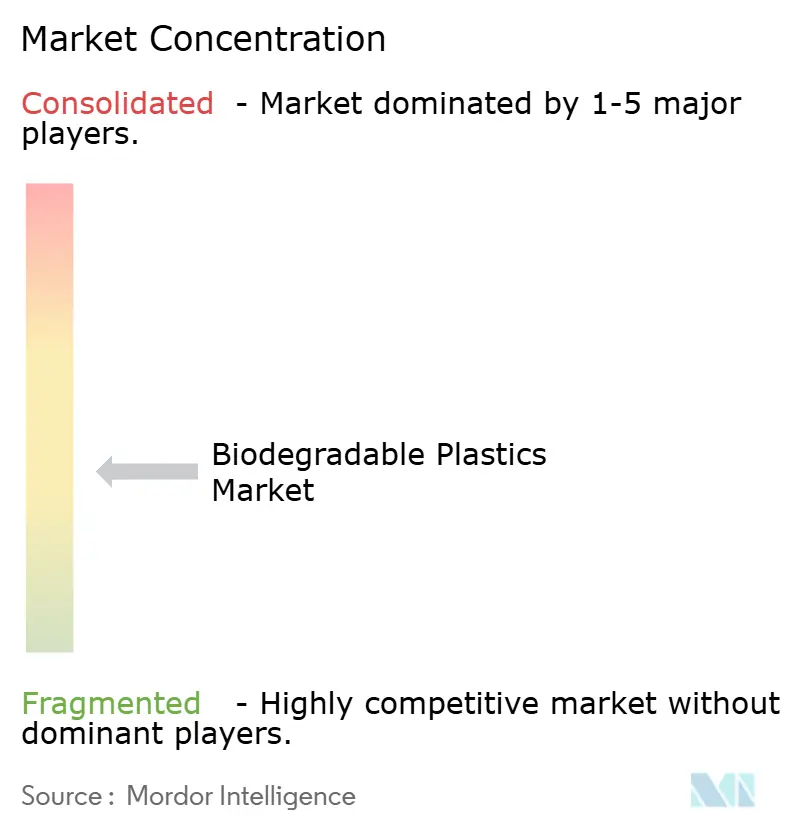
The biodegradable plastics market is moderately fragmented. Regional compounders, PHA specialists, and large-scale Chinese PBAT producers hold the remaining capacity. Chinese manufacturers have gained cost advantages through the large-scale expansion of PBAT capacity. This expansion has reshaped competition in flexible-film compounding and increased margin pressure on incumbents with smaller plants and higher cost structures. Feedstock security, certification breadth, and application-development capabilities determine how effectively suppliers compete for regulated applications.
Multi-standard certification improves access to procurement channels where brand owners seek to reduce the number of qualified suppliers. EN 13432, TÜV Austria OK compost, Biodegradable Products Institute (BPI), and marine biodegradation certifications are particularly relevant for products sold across multiple regulatory systems. PHA provides opportunities in marine-biodegradable fishing gear, aquaculture applications, and coatings for paper foodservice ware. High-heat biopolymer grades also support hot-fill formats, where standard PLA does not deliver the required performance. BASF introduced biomass-balanced ecoflex PBAT in 2024, linking certified mass-balance sourcing with a stated 60% lower product carbon footprint. NatureWorks’ Thailand plant provides the company with a second global PLA manufacturing site and improves its access to the Asia-Pacific supply.
CJ Biomaterials launched an all-PHA coating resin in May 2026, targeting certified paper foodservice applications. Companies that combine scale with application-specific performance can address price-sensitive and premium demand. The competitive structure differentiates PHA and high-heat PLA products from the more price-driven PBAT supply. Certification and performance can help you position your product as premium when end-use requirements are hard to meet with commodity alternatives. Smaller suppliers face challenges when their offerings rely on scale without a differentiated application position. The biodegradable plastics market favors suppliers that align capacity, compliance credentials, and end-use performance.
Biodegradable Plastics Industry Leaders
-
NatureWorks LLC
-
BASF
-
TotalEnergies Corbion
-
Novamont S.p.A.
-
Mitsubishi Chemical Group Corporation
- *Disclaimer: Major Players sorted in no particular order
Biodegradable Plastics Market Companies Covered in this Report
- BASF
- Biome Bioplastics
- BIOTEC Biologische Naturverpackungen GmbH & Co. KG
- Braskem
- CJ CheilJedang Corp.
- Danimer Scientific
- FKuR Kunststoff GmbH
- KANEKA CORPORATION
- KURARAY CO., LTD.
- Mitsubishi Chemical Group Corporation
- NatureWorks LLC
- Novamont S.p.A.
- PTT MCC Biochem Co., Ltd.
- RWDC Industries Limited
- TORAY INDUSTRIES, INC.
- TotalEnergies Corbion
Recent Industry Developments in Biodegradable Plastics Market
- April 2026: NatureWorks opened its integrated Ingeo biopolymer facility in Nakhon Sawan, Thailand, with an annual capacity of approximately 75,000 tons. The facility increased the company’s total capacity to approximately 225,000 tons per year. It uses locally sourced sugarcane to produce biopolymers for flexible packaging, compostable food serviceware, nonwoven fibers, and 3D printing applications in Asia-Pacific.
- June 2025: Teknor Apex acquired Danimer Scientific’s operating assets, including manufacturing facilities in Kentucky and Georgia and more than 480 granted and pending patents across 20 countries, for USD 19 million. The acquisition followed Danimer Scientific’s Chapter 11 bankruptcy filing in March 2025 and included the Nodax PHA technology platform and a commercial-scale PHA plant in North America.
Global Biodegradable Plastics Market Report Scope
Biodegradable plastic is a polymer-based material designed to undergo decomposition through the activity of microorganisms, including bacteria, fungi, and algae. Under suitable environmental conditions, these microorganisms can convert the material into natural byproducts such as water, carbon dioxide, and biomass.
The biodegradable plastics market is segmented by type, product form, end-user industry, and geography. By type, the market is segmented into polylactic acid (PLA), starch blends, polybutylene adipate terephthalate (PBAT), polybutylene succinate (PBS), polyhydroxyalkanoates (PHA), cellulose-based plastics, and other biodegradable plastics. By product form, the market is segmented into resins and compounds, films and sheets, molded products, and others. By end-user industry, the market is segmented into packaging, consumer goods, agriculture and horticulture, textile, and other end-use industries. The report also covers market size and forecasts for biodegradable plastics across 16 countries in major regions. The market sizes and forecasts are provided in terms of value (USD).
Segmentation Overview
| Polylactic Acid (PLA) |
| Starch Blends |
| Polybutylene Adipate Terephthalate (PBAT) |
| Polybutylene Succinate (PBS) |
| Polyhydroxyalkanoates (PHA) |
| Cellulose-Based Plastics |
| Other Biodegradable Plastics |
| Resins and Compounds |
| Films and Sheets |
| Molded Products |
| Others |
| Packaging |
| Consumer Goods |
| Agriculture and Horticulture |
| Textile |
| Other End-Use Industries |
| Asia-Pacific | China |
| India | |
| Japan | |
| South Korea | |
| ASEAN Countries | |
| Rest of Asia-Pacific | |
| North America | United States |
| Canada | |
| Mexico | |
| Europe | Germany |
| United Kingdom | |
| France | |
| Italy | |
| NORDIC Countries | |
| Russia | |
| Rest of Europe | |
| South America | Brazil |
| Argentina | |
| Rest of South America | |
| Middle East and Africa | Saudi Arabia |
| South Africa | |
| Rest of Middle East and Africa |
| By Type | Polylactic Acid (PLA) | |
| Starch Blends | ||
| Polybutylene Adipate Terephthalate (PBAT) | ||
| Polybutylene Succinate (PBS) | ||
| Polyhydroxyalkanoates (PHA) | ||
| Cellulose-Based Plastics | ||
| Other Biodegradable Plastics | ||
| By Product Form | Resins and Compounds | |
| Films and Sheets | ||
| Molded Products | ||
| Others | ||
| By End-User Industry | Packaging | |
| Consumer Goods | ||
| Agriculture and Horticulture | ||
| Textile | ||
| Other End-Use Industries | ||
| By Geography | Asia-Pacific | China |
| India | ||
| Japan | ||
| South Korea | ||
| ASEAN Countries | ||
| Rest of Asia-Pacific | ||
| North America | United States | |
| Canada | ||
| Mexico | ||
| Europe | Germany | |
| United Kingdom | ||
| France | ||
| Italy | ||
| NORDIC Countries | ||
| Russia | ||
| Rest of Europe | ||
| South America | Brazil | |
| Argentina | ||
| Rest of South America | ||
| Middle East and Africa | Saudi Arabia | |
| South Africa | ||
| Rest of Middle East and Africa | ||
Key Questions Answered in the Report
What is current market size of Biodegradable Plastics Market?
The biodegradable plastics market size was valued at USD 10.67 billion in 2025 and is estimated to grow from USD 11.83 billion in 2026 to reach USD 20.45 billion by 2031, at a CAGR of 11.57% during the forecast period (2026-2031).
Which polymer type is growing fastest through 2031?
Polyhydroxyalkanoate (PHA) is projected to record the fastest CAGR, at 19.60%, supported by applications in home composting and marine biodegradation.
Why do packaging applications lead demand?
Packaging held a 62.56% share in 2025 because flexible packaging, foodservice ware, and carrier bags consume large volumes of material.
Which region will grow fastest through 2031?
Asia-Pacific is projected to grow at a CAGR of 12.84%, supported by plastic restrictions, Extended Producer Responsibility (EPR) mandates, and new local capacity.