
Bio-Butadiene Market Size and Share
Market Overview
| Study Period | 2022 - 2032 |
|---|---|
| Market Size (2027) | USD 71.83 Million |
| Market Size (2032) | USD 118.17 Million |
| Growth Rate (2027 - 2032) | 10.47 % |
| Fastest Growing Market | Asia-Pacific |
| Largest Market | Europe |
| Market Concentration | Medium |
Major Players *Disclaimer: Major Players sorted in no particular order Image © Mordor Intelligence. Reuse requires attribution under CC BY 4.0. | |
Bio-Butadiene Market Analysis by Mordor Intelligence
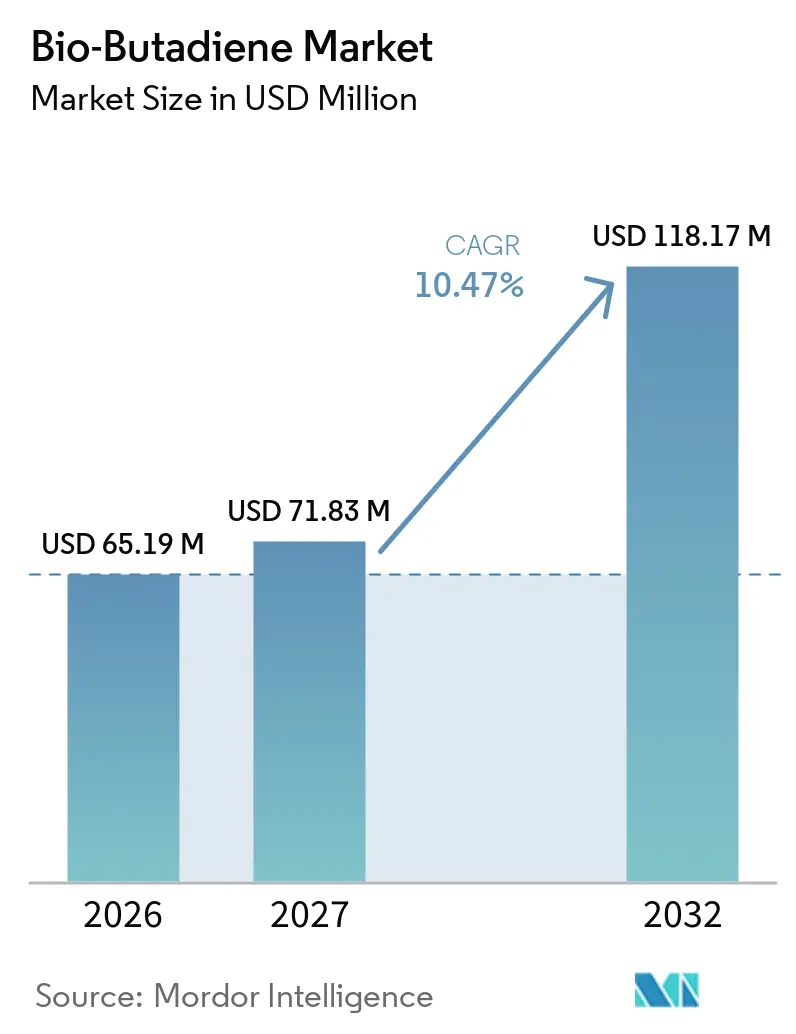
The Bio-Butadiene market size was valued at USD 65.19 million in 2026 and is estimated to grow from USD 71.83 million in 2027 to USD 118.17 million by 2032, at a CAGR of 10.47% during the forecast period (2027-2032). The bio-butadiene market is developing as conventional butadiene supply becomes less certain, driven by reduced C4 byproduct output from naphtha-based steam crackers. This shift strengthens the investment case for renewable production routes and increases the importance of secure feedstock access. Demand is concentrated in procurement programs that support corporate Scope 3 targets and vehicle manufacturers' renewable content commitments. Producers that combine ethanol-to-butadiene technology with recognized mass-balance certification are better positioned to secure long-term offtake agreements. The market remains constrained by a reported price premium of 100% to 150% over petrochemical material, which limits purchasing to programs with formal sustainability requirements rather than routine commodity buying. The bio-butadiene market is therefore tied to both the economics of renewable feedstocks and the purchasing policies of major tire and automotive customers.
Key Report Takeaways
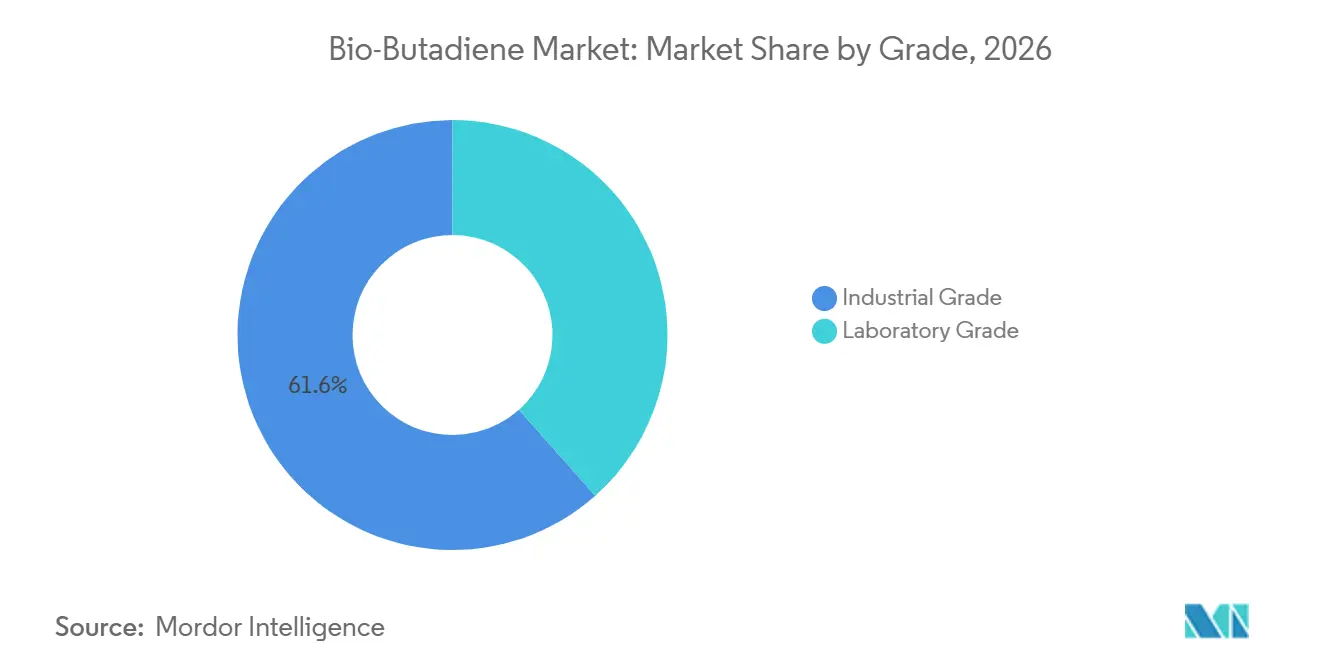
- By grade, Industrial Grade held 61.56% of the Bio-Butadiene market share in 2026, while Laboratory Grade is forecast to grow at an 11.42% CAGR through 2032.
- By type, Styrene-Butadiene Rubber accounted for 40.12% of the Bio-Butadiene market share in 2026 and is projected to expand at an 11.76% CAGR through 2032.
- By application, Synthetic Rubber captured 55.45% of market share in 2026, while Fine Chemicals is forecast to grow at 11.81% CAGR through 2032.
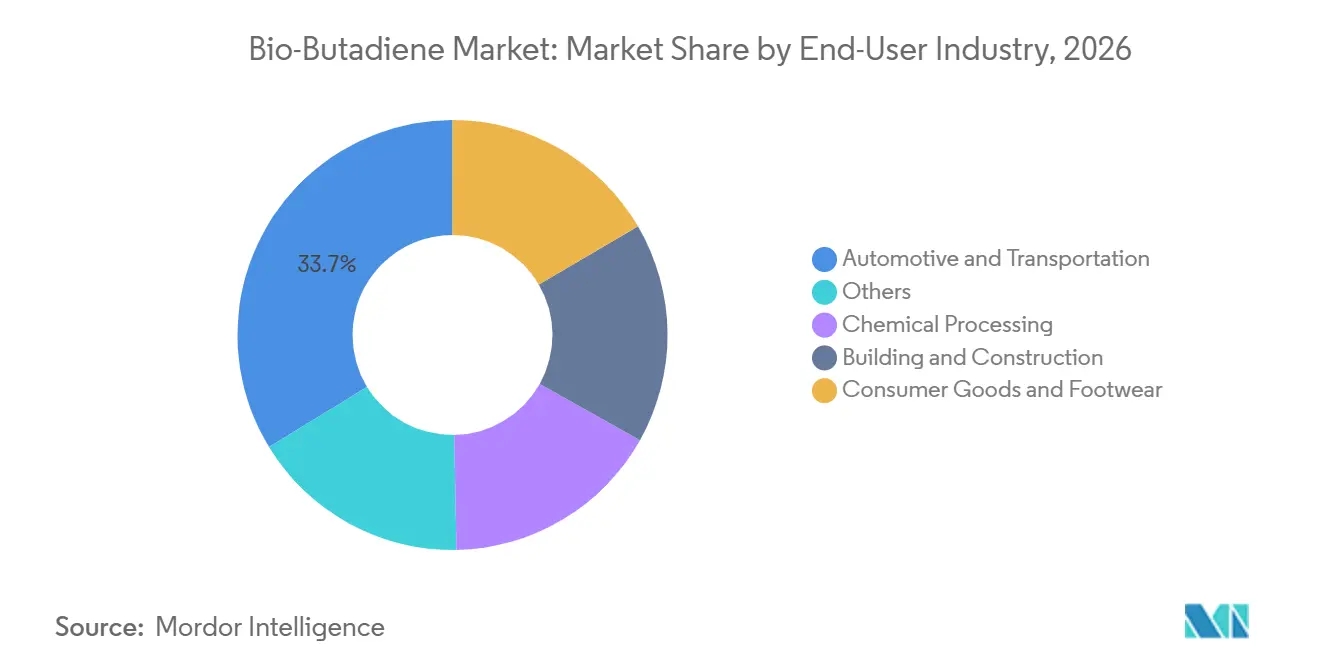
- By end-user industry, Automotive and Transportation held 33.71% of market share in 2026, while Building and Construction is projected to advance at a 12.07% CAGR through 2032.
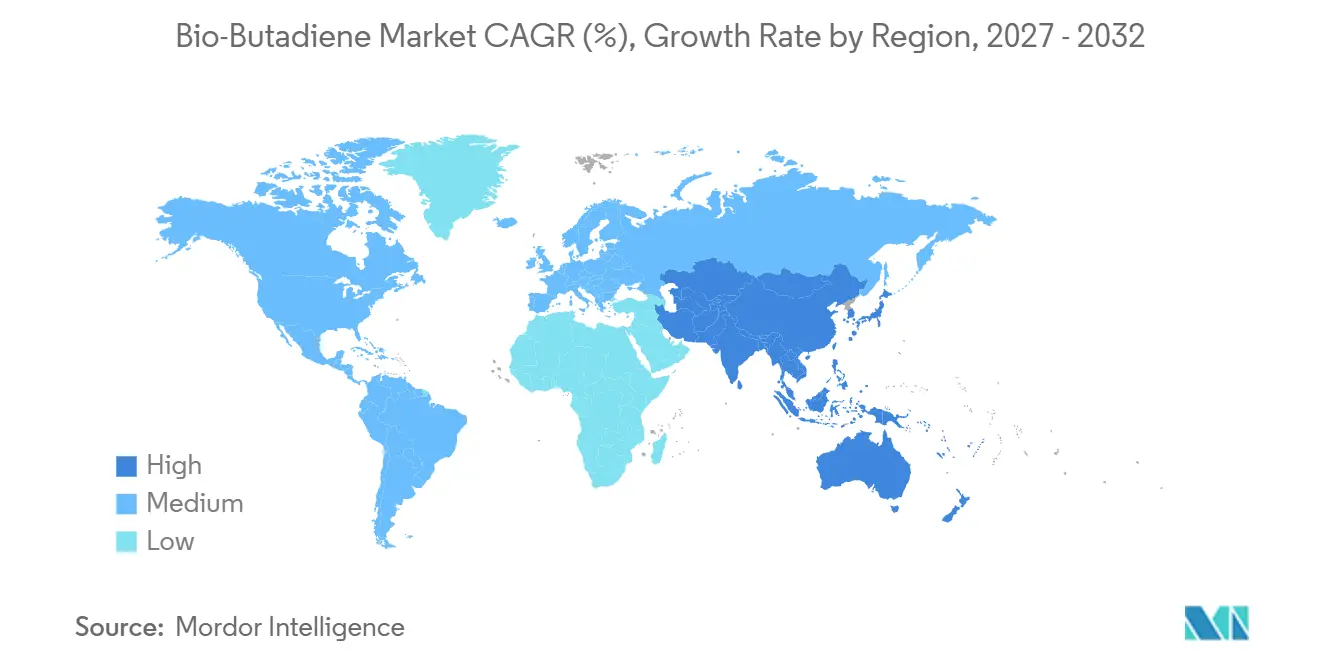
- By geography, Europe held 40.67% of the market share in 2026, while Asia-Pacific is forecast to grow at an 11.93% CAGR through 2032.
Note: Market numbers in this report are based on Mordor Intelligence's proprietary estimation framework, which combines nine months of actuals with Q4 projections for base year 2026.
Market Trends and Insights
Drivers Impact Analysis of Bio-Butadiene Market*
| Drivers | (~) % Impact on CAGR Forecast | Geographic Relevance | Impact Timeline |
|---|---|---|---|
| Renewable Content Targets in Tires and Elastomers | +2.0% | Europe, North America | Medium term (2-4 years) |
| Bioethanol-to-Butadiene Technology Maturation | +1.8% | Global, led by Europe and Japan | Medium term (2-4 years) |
| Sustainability-Linked Procurement by Automotive Original Equipment Manufacturers (OEMs) | +2.2% | North America and Europe, with spillover to the Asia-Pacific | Short term (≤ 2 years) |
| Carbon and Feedstock Traceability Requirements | +1.5% | Europe and North America | Medium term (2-4 years) |
| Demand for Lower-Carbon Synthetic Rubber in EV Tires | +1.8% | Asia-Pacific, with spillover to Europe and North America | Long term (≥ 4 years) |
| Source: Mordor Intelligence | |||
Demand for Lower-Carbon Synthetic Rubber in EV Tires
Electric vehicle tires require different materials than conventional tires. Low rolling-resistance tread compounds use higher proportions of solution styrene-butadiene rubber (SBR) and polybutadiene rubber, both of which depend on butadiene. This makes EV-specific tire lines more material-intensive than conventional passenger tire lines. Continental reported that renewable and recycled materials accounted for 26% of its material inputs in 2024 and expected this figure to rise by 2-3 percentage points in 2025. The bio-butadiene market benefits when sustainability assessments evaluate feedstock origin and carbon intensity alongside cost. These requirements reduce the influence of short-term fossil-feedstock price movements on purchasing decisions for EV tire programs.
Bioethanol-to-Butadiene Technology Maturation
Advances in ethanol-to-butadiene catalysis are moving renewable supply closer to industrial-scale use. Michelin, IFPEN, and Axens confirmed in December 2025 that the BioButterfly demonstrator in Bassens, France, produced butadiene rubber (BR) and SBR from first- and second-generation bioethanol that met polymer-grade tire specifications. The partners aimed to homologate the technology by mid-2026. Research published in ChemSusChem identified Zn-Zr mixed oxide and metal or metal-oxide-modified MgO-SiO₂ catalysts as viable options for industrial ethanol-to-butadiene production. Catalyst regeneration and inert-gas economics remain practical engineering constraints. The ability to use first- or second-generation bioethanol also allows producers to adjust feedstock sourcing as biomass availability varies across regions.
Sustainability-Linked Procurement by Automotive Original Equipment Manufacturers (OEMs)
Automotive Scope 3 targets are becoming a direct purchasing requirement for bio-based rubber inputs. Mercedes-Benz joined the Renewable Carbon Initiative in October 2025 as its first automotive company member[1]. The company stated that this commitment supports replacing fossil-carbon sources with renewable alternatives across vehicle components. Magna International has made carbon reporting mandatory across its supplier base and is implementing a material sustainability strategy that prioritizes bio-based materials. These actions demonstrate how vehicle manufacturer requirements can pass through the supply chain and into rubber formulation specifications. For the bio-butadiene market, this procurement structure supports demand where sustainability performance is considered alongside material performance.
Renewable Content Targets in Tires and Elastomers
Renewable-content requirements are increasing the relevance of bio-based inputs to tire and elastomer procurement. The European Tyre & Rubber Manufacturers' Association requested that the European Commission recognize tires as strategic users of bio-based raw materials in the revised EU Bioeconomy Strategy. The association also called for a European Rubber Strategy, end-of-waste criteria for rubber secondary materials, and stable biomass supply tools under the Ecodesign for Sustainable Products Regulation. Bridgestone introduced an International Sustainability and Carbon Certification (ISCC) PLUS-certified commercial tire with 70% recycled and renewable materials in April 2025. This demonstrates that high-renewable-content tire targets are technically achievable. Wider adoption would increase demand for certified butadiene supply and require stronger traceability across the value chain.
Restraints Impact Analysis of Bio-Butadiene Market*
| Restraints | (~) % Impact on CAGR Forecast | Geographic Relevance | Impact Timeline |
|---|---|---|---|
| Bio-Based Cost Premium Versus Petrochemical Butadiene | -2.0% | Global | Short term (≤ 2 years) |
| Limited Sustainable Feedstock Availability | -1.5% | Asia-Pacific, Europe | Medium term (2-4 years) |
| Certification and Chain-of-Custody Fragmentation | -1.0% | Global | Short term (≤ 2 years) |
| Source: Mordor Intelligence | |||
Bio-Based Cost Premium Versus Petrochemical Butadiene
The cost difference between bio-based and fossil butadiene remains the most direct barrier to near-term scale. European bio-butadiene spot prices stood at EUR 1,800-2,100 (~USD 2,020.1-2,020.1) per ton in mid-2025, compared with fossil butadiene at EUR 847.83 (~USD 951.50) per ton Free Delivered Northwest Europe (FD NWE) over the same period, representing a 110%-150% premium for bio-based material. A 2025 techno-economic study found that 1,3-butanediol dehydration could require a minimum selling price of EUR 3,500 (~USD 3,927.98) per ton when feedstock costs were EUR 1,120 (~USD 1,256.95) per ton, and capital expenditure was USD 280 million for a 200 kt/yr plant. Low fossil butadiene prices can widen this gap and delay capacity decisions. Carbon pricing has not offset the underlying production-cost difference.
Limited Sustainable Feedstock Availability
Reliable, sustainable feedstock supply limits the pace at which renewable production can expand. Ethanol-to-butadiene producers require access to bioethanol that meets quality, quantity, and certification requirements. First- and second-generation feedstocks offer flexibility, but each depends on local biomass availability and supply chain capabilities. Competition for certified renewable feedstocks can increase procurement costs. This constraint is particularly relevant in Europe and the Asia-Pacific region, where demand for certified material is rising across several chemical and fuel applications. Dedicated demonstration plants can reduce purity variation, but do not eliminate the need for dependable biomass sourcing.
*Our forecasts treat driver/restraint impacts as directional, not additive. The impact forecasts reflect baseline growth, mix effects, and variable interactions.
Bio-Butadiene Market Segment Analysis
By Grade:
Industrial Grade Anchors Current Demand, Laboratory Grade Signals Future ScaleIndustrial Grade held 61.56% of total revenue in 2026. It is used in the production of polymer-grade styrene-butadiene rubber (SBR), polybutadiene, and acrylonitrile butadiene styrene (ABS), where renewable butadiene can be used as a drop-in feedstock without reformulation. The BioButterfly demonstrator confirmed in December 2025 that renewable butadiene could meet polymer-grade tire specifications, supporting industrial-grade use in high-specification elastomer production. Industrial buyers also require reliable certification records, and ISCC PLUS chain-of-custody expectations are raising the documentation standard for industrial procurement.
Laboratory Grade is projected to grow at an 11.42% CAGR through 2032. Research institutions, specialty chemical producers, and process engineering firms use it to test renewable elastomers and fine chemical intermediates. Laboratory purchasing commonly precedes industrial offtake by 3-5 years, making laboratory demand an early indicator of later commercial use. Standardized ethanol-to-butadiene output from demonstration plants can reduce purity variation, and more consistent material can shorten testing protocols that previously slowed qualification.

By Type:
SBR Leads Current Demand and Projected GrowthStyrene-Butadiene Rubber accounted for 40.12% of total revenue in 2026 and is projected to grow at an 11.76% CAGR through 2032. This position reflects the importance of SBR in tire compounds and the December 2025 validation of polymer-grade renewable SBR at Bassens, which removes a central technical concern for tire applications and allows original equipment manufacturer qualification programs to work with commercially relevant material. Styrene-Butadiene Latex supports carpet-backing and paper-coating uses where eco-label frameworks increasingly request evidence of bio-origin.
Nitrile-Butadiene Rubber is used for oil-resistant seals, gaskets, and hoses in automotive and industrial equipment, with both supply-chain resilience and sustainability supporting interest in renewable NBR. ABS is relevant to consumer electronics and automotive interiors as brands commit to circular plastics. UBE launched ISCC PLUS-certified UBEPOL BR in Rayong, Thailand, in December 2025, extending certified polybutadiene supply for automotive tires and industrial rubber applications. The Others category includes specialty block copolymers such as Styrene Block Copolymer (SBC). Kraton received ISCC PLUS certification for its Mailiao, Taiwan, plant in February 2025, extending certified renewable polymer supply across three continents.
By Application:
Synthetic Rubber Provides Base Demand, Fine Chemicals Add Specialized DemandSynthetic Rubber captured 55.45% of total revenue in 2026. Tire production provides the largest use base for this application, and renewable butadiene can be integrated into established SBR and polybutadiene polymerization lines without changes to handling properties, making synthetic rubber the most direct high-output application for the material. Plastics, chiefly ABS and Styrene-Butadiene-Styrene (SBS) block copolymers, form the next large application cluster. Kraton's February 2025 certification in Taiwan added certified bio-based SBC capacity across three continents.
Fine Chemicals is projected to grow at an 11.81% CAGR through 2032. Specialty chemical and pharmaceutical buyers can accept a bio-origin cost premium when supply security and documented origin are priorities. Renewable adiponitrile precursors for nylon 6,6 link the bio-butadiene and bio-nylon value chains, allowing this application to serve more than a single product category. Buyers in this area increasingly request International Sustainability and Carbon Certification (ISCC) PLUS or Roundtable on Sustainable Biomaterials (RSB) certification for Scope 3 procurement processes, and suppliers with established chain-of-custody records can more readily meet these requirements. The Others application group includes adhesives, sealants, and specialty coatings, where bio-content certification is becoming a procurement criterion in construction and consumer-goods programs.
By End-User Industry:
Automotive Sets Requirements, Building and Construction Grows FastestAutomotive and Transportation held 33.71% of total revenue in 2026. Tire manufacturers use multi-year supplier agreements that include renewable-content thresholds, setting expectations for rubber formulations throughout the supply chain. Vehicle manufacturer Scope 3 frameworks reinforce this direction by making carbon reporting and the use of renewable materials part of supplier engagement. The bio-butadiene market, therefore, depends on automotive qualification processes and long-term offtake relationships. Consumer Goods and Footwear remain smaller users but can accept a larger premium for bio-origin credentials than many automotive buyers.
Building and Construction is projected to expand at a 12.07% CAGR through 2032. Bio-sourced elastomers are used in roofing membranes, expansion-joint sealants, and waterproofing membranes. Leadership in Energy and Environmental Design (LEED) v5 was finalized in May 2025 and introduced embodied-carbon assessment as a certification prerequisite, making the carbon profile of construction inputs a documented evaluation factor. Chemical Processing is another important demand cluster, requiring consistent purity and chain-of-custody documentation. The Others category includes industrial rubber uses in which verified bio-based content supports Environmental, Social, and Governance (ESG) reporting.
Geography Analysis
Europe and North America Bio-Butadiene Market
Europe accounted for 40.67% of total revenue in 2026. The region combines policy activity, tire manufacturing, chemical production, and technology development. France hosts the BioButterfly demonstrator at Bassens, where first- and second-generation bioethanol were validated as feedstocks, with technology homologation targeted for mid-2026. Germany contributes through Continental's material-sourcing work and existing mass-balance certification infrastructure. BASF stated that its sites across North America have earned REDcert2 and International Sustainability and Carbon Certification (ISCC) PLUS certifications, illustrating the broader certification capability available to global chemical suppliers[2].
Poland and Nordics Bio-Butadiene Market
Poland is emerging as a market through ORLEN's acquisition of S54, a butadiene extraction unit under construction in Płock, valued at PLN 692 million (~USD 164 million). Nordic markets also offer favorable conditions, as corporate sustainability reporting is widely used in procurement decisions, which can support willingness to pay for certified renewable inputs. Europe's tire manufacturing base remains important because it connects technology providers with large demand anchors. The region also has established certification processes that make verified procurement more practical for large buyers.
Japan and China Bio-Butadiene Market
Asia-Pacific is projected to grow at an 11.93% CAGR through 2032. Japan is the principal technology development hub, while China provides the largest processing base. Japan's New Energy and Industrial Technology Development Organization (NEDO) Green Innovation Fund supports parallel commercialization work. Zeon completed a bench-scale demonstration facility at Tokuyama in August 2026, with full operation beginning in January 2027. Bridgestone, Eneos Materials, and JGC Holdings target pilot-scale bio-tire production by 2028 and commercialization in the first half of the 2030s. Japan's programs are framed as industrial policy, which can support continuity when fossil-feedstock prices weaken.
The Americas, APAC and MEA Bio-Butadiene Market
China's large SBR manufacturing base and sustainability requirements could create a substantial pool of demand when domestic supply or accepted import certifications become available. South Korea and ASEAN countries are medium-term growth markets as synthetic rubber capacity expands and ISCC PLUS recognition becomes more common. North America holds a mid-sized position, with the United States supporting catalyst work through national laboratory and industry partnerships. Pacific Northwest National Laboratory (PNNL) reported 68% butadiene selectivity at 64% ethanol conversion in January 2025 and delivered material to Bridgestone for test-piece production. Brazil could become a low-cost exporter because the economics of sugarcane bioethanol can support ethanol-to-butadiene production. The Middle East and Africa remain early-stage markets, although Saudi Arabia has C4 processing infrastructure, and South Africa has diverse agricultural biomass feedstocks.
Competitive Landscape
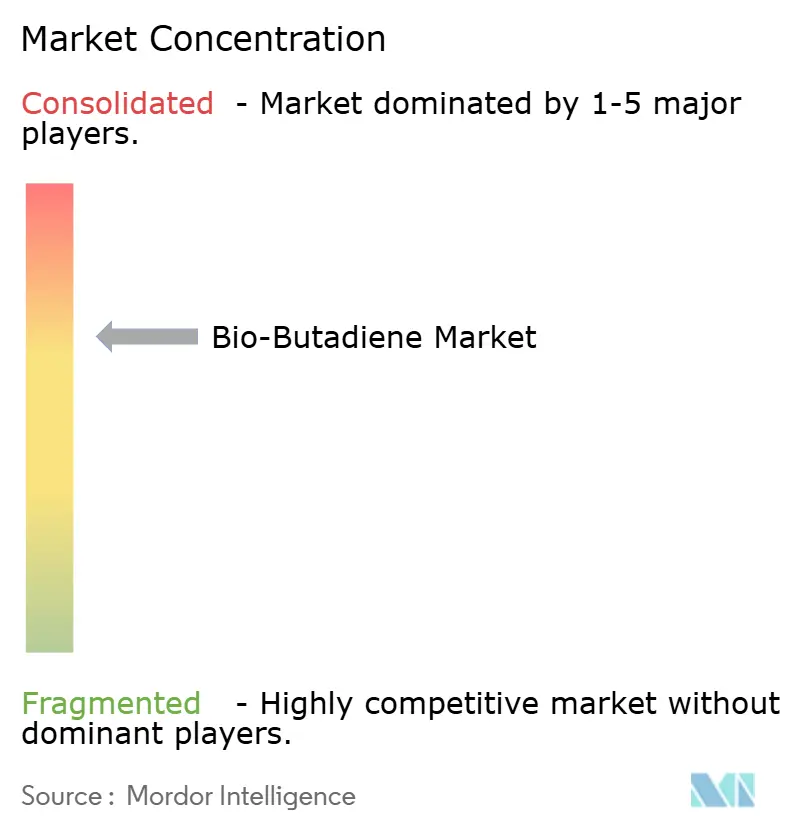
The bio-butadiene market is moderately consolidated. Axens, ETB Catalytic Technologies, IFPEN, and Global Bioenergies are active technology licensors. Genomatica and Versalis, Braskem, Synthos, Trinseo, LanzaTech, INVISTA, Zeon, and Biokemik are vertically integrated producers. Michelin and Yokohama Rubber serve as demand anchors within the tire sector. Competitive strength depends on catalyst expertise, customer offtake relationships, and ISCC PLUS audit capability rather than on current production output alone. The BioButterfly intellectual property portfolio creates a licensing barrier to the ethanol-to-butadiene route.
Michelin, IFPEN, and Axens validated their BioButterfly technology at Bassens in December 2025, demonstrating that material derived from 1st- and 2nd-generation bioethanol could produce BR and SBR meeting polymer-grade tire specifications. Zeon commissioned a dedicated biofermentation research and development facility in Yonezawa in June 2025, signaling a strategy to develop a direct fermentation route rather than relying on ethanol-to-butadiene licensing. UBE launched a certified UBEPOL BR in Thailand in December 2025. Kraton's February 2025 certification at Mailiao represents another example of companies strengthening certified renewable polymer supply.
In the Asia-Pacific region, supply opportunities exist as interest in certified feedstocks grows faster than local supply infrastructure. Producers in Thailand and India can draw on agricultural residues and established bioethanol industries. Their cost position may improve if they secure offtake contracts with regional tire manufacturers and maintain ISCC PLUS certification. Genomatica's patent portfolio and its partnership with Versalis combine biotechnology with industrial chemical infrastructure, providing a fermentation-to-butadiene pathway that differs from the ethanol-to-butadiene model. Increasing patent activity around Zn-Zr mixed oxides and silver-modified catalysts makes an intellectual property review important before new entrants commit capital to dedicated facilities.
Bio-Butadiene Industry Leaders
-
Braskem
-
Biokemik
-
Genomatica
-
Versalis S.p.A.
-
LanzaTech
- *Disclaimer: Major Players sorted in no particular order
Bio-Butadiene Market Companies Covered in this Report
- Axens
- Biokemik
- Braskem
- ETB Catalytic Technologies
- Genomatica
- Global Bioenergies
- IFPEN
- INVISTA
- LanzaTech
- Michelin
- SABIC
- Synthos
- THE YOKOHAMA RUBBER CO., LTD.
- Trinseo
- Versalis S.p.A.
- Zeon Corporation
Recent Industry Developments in Bio-Butadiene Market
- December 2025: Michelin, IFPEN, and Axens validated BioButterfly technology, confirming that bio-based butadiene produced from first- and second-generation bioethanol synthesized both BR and SBR meeting polymer-grade tire specifications at the Bassens, France, industrial demonstrator. Technology homologation was targeted for mid-2026, paving the way for global licensing and commercialization.
- December 2025: ORLEN acquired 100% of Synthos S54's shares for approximately PLN 692 million (approximately USD 164 million), thereby taking full ownership of the entity and constructing a new bio-butadiene extraction unit in Płock, Poland. The deal established a framework for continued cooperation between ORLEN and Synthos in developing the C4 value chain in Central Europe.
Global Bio-Butadiene Market Report Scope
Bio-butadiene is a renewable, plant-derived alternative to petroleum-based 1,3-butadiene. It serves as a direct drop-in replacement for fossil-fuel butadiene, meaning it can substitute conventional feedstocks in existing manufacturing processes without affecting final product quality.
The bio-butadiene market is segmented by grade, type, application, end-user industry, and geography. By grade, the market is segmented into industrial grade and laboratory grade. By type, the market is segmented into styrene-butadiene rubber (SBR), styrene-butadiene latex (SBL), nitrile-butadiene rubber (NBR), acrylonitrile-butadiene-styrene (ABS), polybutadiene (PB), and others. By application, the market is segmented into synthetic rubber, fine chemicals, plastics, and others. By end-user industry, the market is segmented into automotive and transportation, chemical processing, building and construction, consumer goods and footwear, and others. The report also covers market sizes and forecasts for the global bio-butadiene across 15 countries in major regions. The market sizes and forecasts are provided in terms of value (USD).
Segmentation Overview
| Industrial Grade |
| Laboratory Grade |
| Styrene-Butadiene Rubber (SBR) |
| Styrene-Butadiene Latex (SBL) |
| Nitrile-Butadiene Rubber (NBR) |
| Acrylonitrile-Butadiene-Styrene (ABS) |
| Polybutadiene (PB) |
| Others |
| Synthetic Rubber |
| Fine Chemicals |
| Plastics |
| Others |
| Automotive and Transportation |
| Chemical Processing |
| Building and Construction |
| Consumer Goods and Footwear |
| Others |
| Asia-Pacific | China |
| India | |
| Japan | |
| South Korea | |
| ASEAN Countries | |
| Rest of Asia-Pacific | |
| North America | United States |
| Canada | |
| Mexico | |
| Europe | Germany |
| United Kingdom | |
| France | |
| Italy | |
| NORDIC Countries | |
| Rest of Europe | |
| South America | Brazil |
| Argentina | |
| Rest of South America | |
| Middle East and Africa | Saudi Arabia |
| South Africa | |
| Rest of Middle East and Africa |
| By Grade | Industrial Grade | |
| Laboratory Grade | ||
| By Type | Styrene-Butadiene Rubber (SBR) | |
| Styrene-Butadiene Latex (SBL) | ||
| Nitrile-Butadiene Rubber (NBR) | ||
| Acrylonitrile-Butadiene-Styrene (ABS) | ||
| Polybutadiene (PB) | ||
| Others | ||
| By Application | Synthetic Rubber | |
| Fine Chemicals | ||
| Plastics | ||
| Others | ||
| By End-User Industry | Automotive and Transportation | |
| Chemical Processing | ||
| Building and Construction | ||
| Consumer Goods and Footwear | ||
| Others | ||
| By Geography | Asia-Pacific | China |
| India | ||
| Japan | ||
| South Korea | ||
| ASEAN Countries | ||
| Rest of Asia-Pacific | ||
| North America | United States | |
| Canada | ||
| Mexico | ||
| Europe | Germany | |
| United Kingdom | ||
| France | ||
| Italy | ||
| NORDIC Countries | ||
| Rest of Europe | ||
| South America | Brazil | |
| Argentina | ||
| Rest of South America | ||
| Middle East and Africa | Saudi Arabia | |
| South Africa | ||
| Rest of Middle East and Africa | ||
Key Questions Answered in the Report
What is current market size of Bio-Butadiene Market?
The Bio-Butadiene market size was valued at USD 65.19 million in 2026 and is estimated to grow from USD 71.83 million in 2027 to USD 118.17 million by 2032, at a CAGR of 10.47% during the forecast period (2027-2032).
Which application uses the most bio-butadiene?
Synthetic Rubber leads with 55.45% share in 2026 because tire applications can use renewable butadiene in established polymerization lines. Within the Bio-Butadiene market, this application has the clearest path to volume because SBR and polybutadiene production already require butadiene feedstock, while producers can use material that retains the handling characteristics of conventional feedstock.
Which end-user is expected to grow fastest?
Building and Construction is forecast to grow at a 12.07% CAGR through 2032, supported by its use in membranes, sealants, and waterproofing products. The Bio-Butadiene market can address this demand when customers specify certified materials to support embodied-carbon evaluation and green-building requirements, although material consistency and documentation remain important for adoption in construction product formulations.
Which region is growing fastest for bio-butadiene?
Asia-Pacific is projected to grow at an 11.93% CAGR through 2032, supported by Japanese technology programs and regional rubber-processing capacity. The Bio-Butadiene market in the region also has access to large downstream SBR processing capacity, especially as accepted certification pathways become more established and suppliers build the local renewable-feedstock and processing links needed for commercial supply.