
Bio-Based Foam Market Size and Share
Market Overview
| Study Period | 2022 - 2032 |
|---|---|
| Market Size (2027) | USD 3.57 Billion |
| Market Size (2032) | USD 5.41 Billion |
| Growth Rate (2027 - 2032) | 8.67 % |
| Fastest Growing Market | Asia-Pacific |
| Largest Market | Europe |
| Market Concentration | Low |
Major Players *Disclaimer: Major Players sorted in no particular order Image © Mordor Intelligence. Reuse requires attribution under CC BY 4.0. | |
Bio-Based Foam Market Analysis by Mordor Intelligence
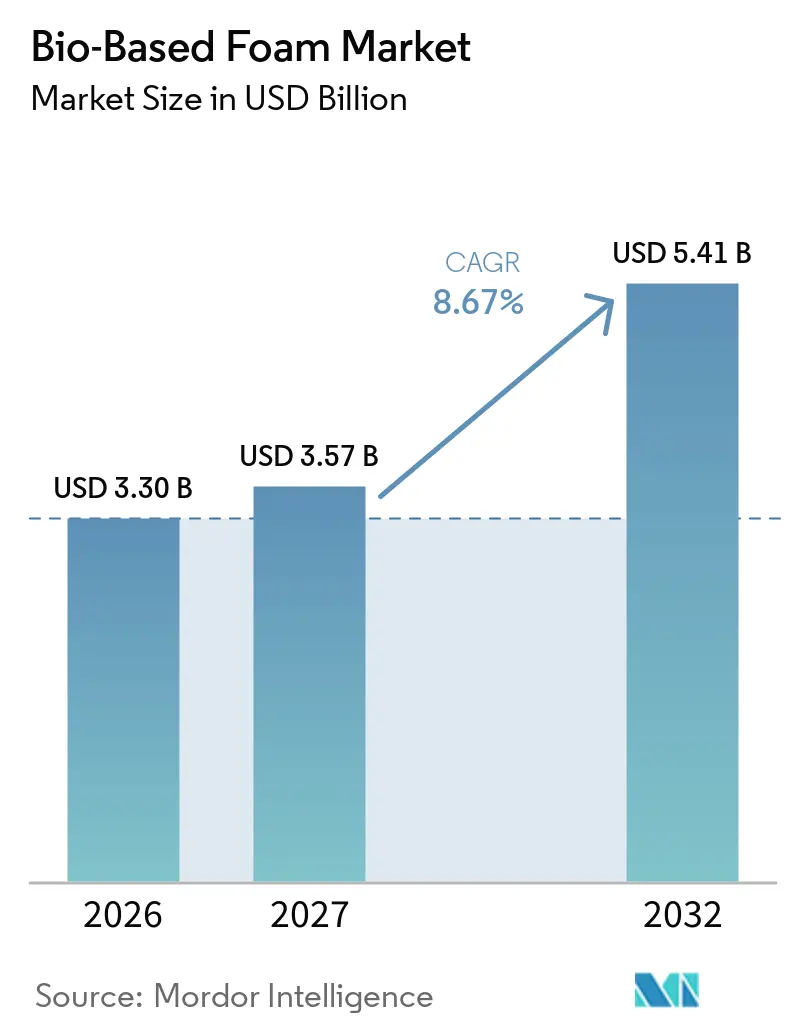
The bio-based foam market size was valued at USD 3.30 billion in 2026 and is estimated to grow from USD 3.57 billion in 2027 to USD 5.41 billion by 2032, at a CAGR of 8.67% during the forecast period (2027-2032). The bio-based foam market is shifting away from petrochemical polyols and fossil-derived polymer precursors as regulations, sustainability requirements, and feedstock economics influence purchasing decisions across packaging, construction, and mobility. European energy-efficiency rules and the USDA BioPreferred Program support demand by providing clearer procurement pathways for certified bio-based products across public and private supply chains. The Packaging and Packaging Waste Regulation (EU) 2025/40 places packaging materials under a more demanding sustainability framework and assigns the European Chemicals Agency (ECHA) a role in identifying chemicals of concern. Producers that can combine verified feedstock attribution, consistent product performance, and credible documentation are favored in the bio-based foam market. In contrast, cost premiums and agricultural feedstock variability continue to limit faster adoption.
Key Report Takeaways
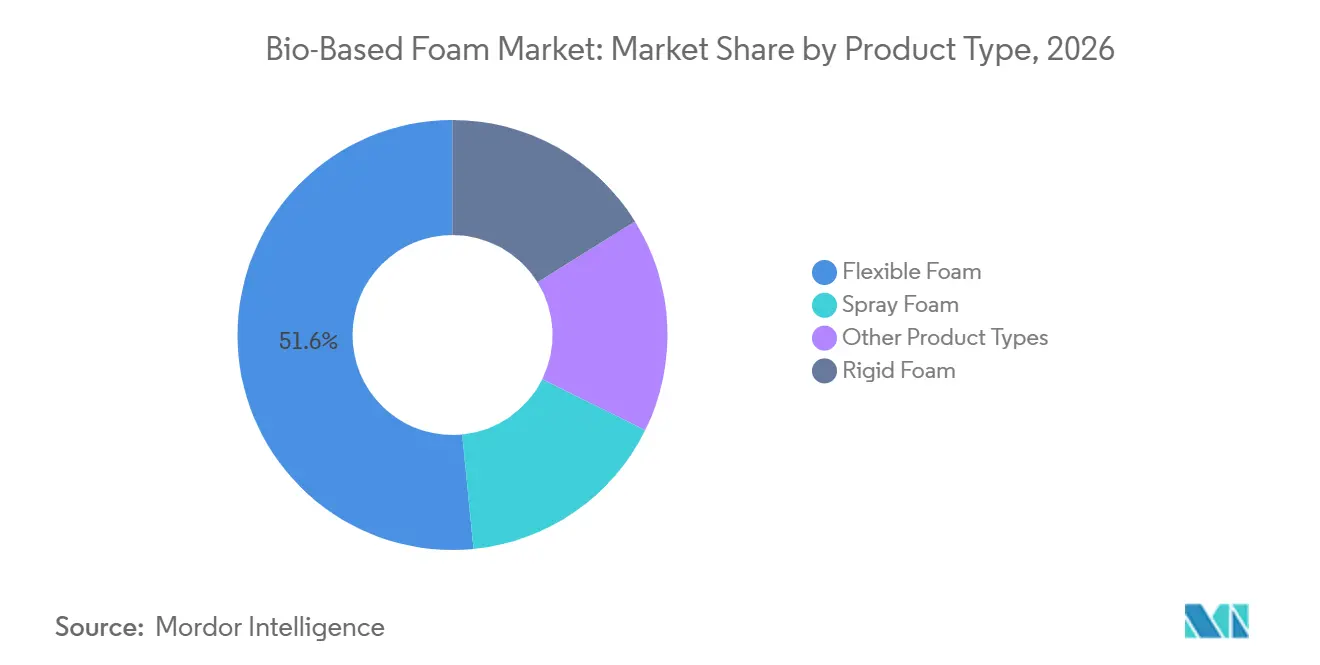
- By product type, flexible foam held 51.56% of the bio-based foam market share in 2026, while rigid foam is forecast to grow at a 9.34% CAGR through 2032.
- By raw material, sugarcane-based feedstocks held 40.13% of total bio-based foam market share in 2026, while castor-based feedstocks are projected to grow at a 9.56% CAGR through 2032.
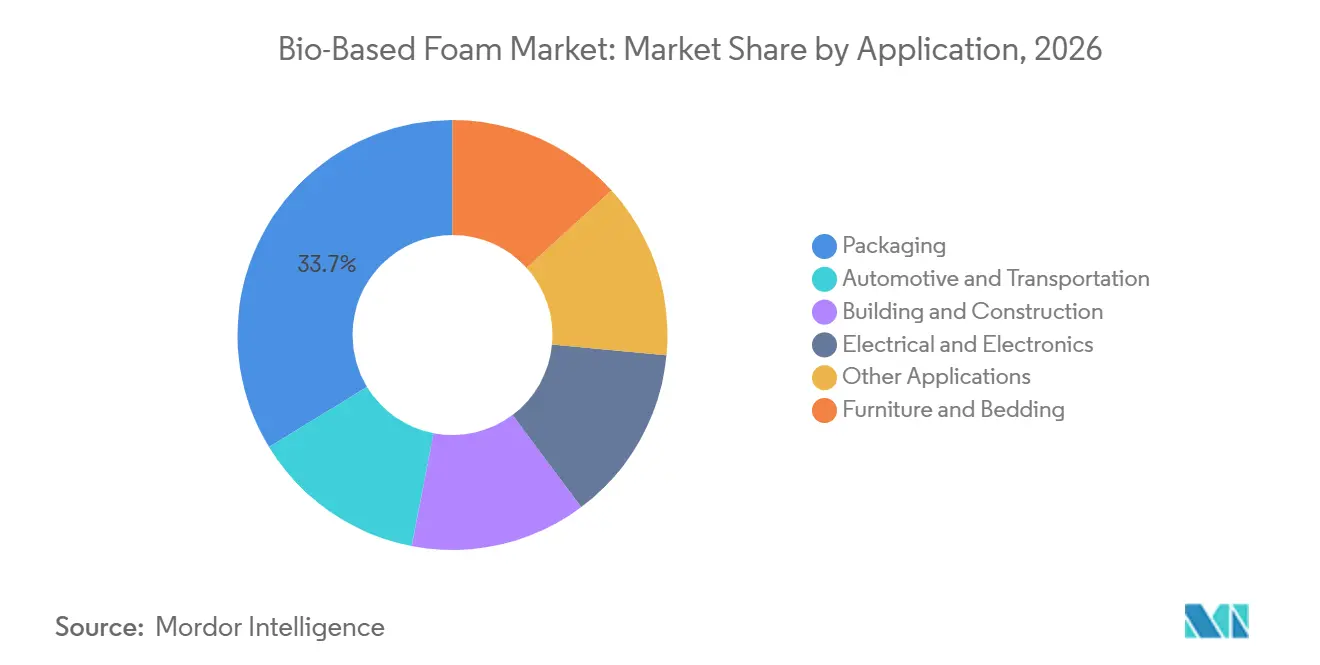
- By application, packaging accounted for 33.71% of total bio-based foam market share in 2026, while automotive and transportation are forecast to advance at a 10.08% CAGR through 2032.
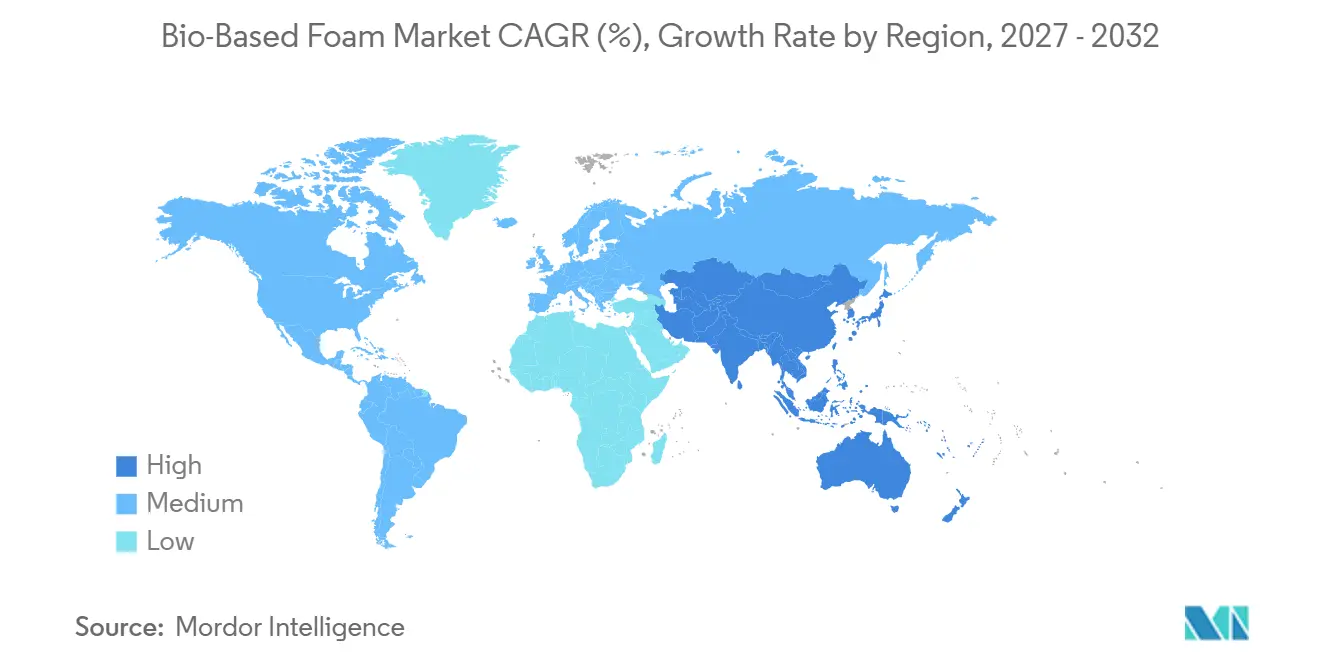
- By geography, Europe held 42.82% of total bio-based foam market share in 2026, while Asia-Pacific is projected to grow at a 9.83% CAGR through 2032.
Note: Market numbers in this report are based on Mordor Intelligence's proprietary estimation framework, which combines nine months of actuals with Q4 projections for base year 2026.
Market Trends and Insights
Drivers Impact Analysis of Bio-Based Foam Market*
| Drivers | (~) % Impact on CAGR Forecast | Geographic Relevance | Impact Timeline |
|---|---|---|---|
| Sustainability-Led Substitution of Fossil-Derived Foam | +3.0% | Global | Medium term (2-4 years) |
| Energy-Efficiency Codes and Low-Carbon Building Demand | +1.8% | Europe and North America core, spillover to Asia-Pacific (APAC) | Medium term (2-4 years) |
| Lightweighting and Lower-Emission Automotive Interiors | +1.4% | Global, led by Europe, U.S., and China | Short term (≤ 2 years) |
| Bio-Circular Feedstock Attribution in Original Equipment Manufacturer (OEM) Supply Chains | +0.8% | North America and Europe | Medium term (2-4 years) |
| Renewable Feedstock Diversification and Agricultural Residue Valorization | +0.7% | Asia-Pacific and South America | Long term (≥ 4 years) |
| Source: Mordor Intelligence | |||
Sustainability-Led Substitution of Fossil-Derived Foam
Bio-based foam market demand in packaging and consumer goods is developing first in upstream chemical supply chains, where material producers can adjust formulations before brand requirements become widespread. Commercial flexible foam grades can use bio-based polyols to replace 10-20% of petrochemical polyol content, while suppliers continue to raise the feasible bio-content in newer formulations. In March 2025, BASF introduced its REDcert²-certified Elastoflex biomass-balance polyurethane systems for North American furniture, reporting a reduction in product carbon footprint of up to 75% compared with conventional systems, without changing processing parameters. Fraunhofer CCPE presented its CircularInFoam work at BAU 2025, combining biopolymers with halogen-free flame retardants for thermoplastic construction foams. This shift gives integrated producers a commercial advantage because improved access to feedstocks can reduce the premium attached to verified bio-based materials. The bio-based foam market benefits when suppliers can provide a credible environmental record without requiring converters to replace established manufacturing equipment.
Energy-Efficiency Codes and Low-Carbon Building Demand
Rigid insulation is becoming increasingly relevant to the bio-based foam market as construction buyers face stricter carbon and energy performance requirements. Germany's recycling hierarchy and European packaging rules have increased attention to the environmental profile of construction products and packaging materials. In 2026, Fraunhofer IAP reported that its xPBS extrusion foam could replace conventional polyethylene (PE) foam on existing production lines, eliminating the need for dedicated equipment investment. Recticel's Eurothane Silver Impact and Eurowall Impact boards use 25% bio-circular methylene diphenyl diisocyanate (MDI), sourced from Covestro's Desmodur CQ MS, and are reported to have 43% lower embodied carbon than standard polyisocyanurate (PIR) insulation. These products indicate that construction procurement is placing greater weight on documentation, supply security, thermal performance, and environmental product records. The bio-based foam market has a clear route into retrofit activity when products meet performance and compliance requirements without adding installation complexity.
Lightweighting and Lower-Emission Automotive Interiors
Automotive electrification supports the bio-based foam market because electric vehicles require more acoustic management for road and wind noise. Bio-based polyurethane foam can be formulated across a range of densities, enabling its use in noise, vibration, and harshness applications. In October 2025, Dow received International Sustainability and Carbon Certification (ISCC) PLUS certification for its Freeport, Texas, methylene diphenyl diisocyanate (MDI) facility, supporting the supply of bio-circular materials such as SPECFLEX NES 1540 REN for automotive applications. INOAC reported a urethane foam that uses more than 50% plant-derived raw materials, including inedible plant sources, thereby reducing direct competition with food uses. The pending EU End-of-Life Vehicle Regulation is also expected to increase attention to recycled content in seating components. This demand profile offers certified producers an opportunity to link lower-emission feedstocks to the technical requirements of automotive interiors.
Bio-Circular Feedstock Attribution in Original Equipment Manufacturer (OEM) Supply Chains
ISCC PLUS and REDcert2 are becoming increasingly important in the bio-based foam market as original equipment manufacturers (OEMs) require reliable evidence to support bio-circular claims. These chain-of-custody systems help customers distinguish attributed material from products supported only by voluntary environmental statements. In May 2025, Covestro received ISCC PLUS certification at its South Charleston, West Virginia, polyether polyol site, enabling the supply of Hyperlite CQ products with at least 25% alternative-raw-material attribution. JLR, Adient, and Dow announced a collaboration in 2025 to bring circular seat foam made with RENUVA recycled polyol into production-scale vehicles in 2026. Such programs can make certification a condition for participation in higher-value supplier contracts. They also create a two-tier supply structure in which verified producers have better access to formal OEM bids than suppliers without comparable documentation.
Restraints Impact Analysis of Bio-Based Foam Market*
| Restraints | (~) % Impact on CAGR Forecast | Geographic Relevance | Impact Timeline |
|---|---|---|---|
| Bio-Based Cost Premium and Scale-Up Economics | -1.6% | Global | Medium term (2-4 years) |
| Feedstock Seasonality, Land-Use Competition, and Price Volatility | -1.1% | Asia-Pacific, South America, Middle East and Africa | Long term (≥ 4 years) |
| Flame, Smoke, Moisture, and Durability Qualification Gaps | -0.7% | Global | Medium term (2-4 years) |
| Source: Mordor Intelligence | |||
Bio-Based Cost Premium and Scale-Up Economics
The cost difference between bio-based and petroleum-derived foam remains a central constraint for the bio-based foam market, and the gap varies widely by feedstock and formulation. A 2025 life-cycle assessment found that bio-based flexible polyurethane foam reduced global warming impact by 6% and fossil resource scarcity by 9% compared with a fossil baseline. The same study found higher freshwater eutrophication (91%) and marine eutrophication (19%), mainly linked to fertilizer use in soybean cultivation. These trade-offs can complicate procurement when buyers require detailed environmental product declarations rather than broad sustainability claims. Mass-balance production can avoid the cost of separate bio-based production lines, but these products still carry a 5-15% premium in most end uses. Larger feedstock quantities and consistent specifications are necessary before the price gap can narrow on a sustained basis.
Feedstock Seasonality, Land-Use Competition, and Price Volatility
Agricultural feedstocks introduce risks that are not present in petroleum-derived foam supply chains. Soybean and sugarcane yields are affected by weather conditions, while their food and feed uses can link prices to global agricultural commodity markets. A 2025 study of soy polyol-based flexible polyurethane foam identified fertilizer-driven nutrient runoff as the most significant environmental hotspot in the bio-based pathway[2]. Japan's Ministry of the Environment has promoted the use of non-food biomass, including wood debris, agricultural residues, and marine biomass, to reduce pressure on food-related resources. The European Packaging and Packaging Waste Regulation (PPWR) review criteria, due in February 2028, will require sustainable sourcing and may limit the use of high-risk feedstocks associated with deforestation. The bio-based foam market will need broader raw-material portfolios, improved agricultural traceability, and stronger local sourcing to reduce these risks.
*Our forecasts treat driver/restraint impacts as directional, not additive. The impact forecasts reflect baseline growth, mix effects, and variable interactions.
Bio-Based Foam Market Segment Analysis
By Product Type:
Rigid Foam Growth Builds on Flexible Foam’s Established ScaleFlexible foam held 51.56% of total bio-based foam sales in 2026, reflecting its established use in furniture, bedding, and automotive seating. Its position is supported by a large installed base of slabstock and molded-foam equipment and by established soy-based and sugarcane-based polyol supply chains. Flexible foam producers can incorporate bio-based content while maintaining familiar processing conditions, reducing practical barriers for converters. BASF's March 2025 Elastoflex biomass-balance systems illustrate this approach, offering furniture-grade polyurethane systems that retain conventional processing parameters. Specialty acoustic and vibration-damping foams also give flexible products a role in battery-electric vehicle platforms, where interior noise control remains important.
Rigid foam is projected to grow at a 9.34% CAGR through 2032, driven by European retrofit programs and thermal-performance standards that are increasing demand for insulation materials. Its growth is tied to the performance requirements of closed-cell polyurethane and polyisocyanurate (PIR) foam, where thermal resistance per unit thickness is a primary selection factor. BASF introduced WALLTITE RSB in December 2025 as a closed-cell spray polyurethane foam incorporating recycled and bio-based raw materials for North American construction applications. Rigid formulations using castor oil and lignin-derived polyols have shown promising laboratory performance, but moisture resistance, dimensional stability, and long-term thermal cycling still require careful validation. Research published in 2025 identified castor oil's high hydroxyl functionality, low toxicity, and availability as useful attributes for rigid polyurethane foam polyols. The bio-based foam market size for rigid materials will depend on whether suppliers can convert this technical promise into consistent commercial grades.

By Raw Material:
Sugarcane Scale Supports Current Demand While Castor Oil Gains GroundSugarcane-based feedstocks accounted for 40.13% of total bio-based foam sales in 2026, as their supply chain scale exceeds that of other bio-based feedstocks. Braskem's sugarcane ethanol-based green ethylene platform provides an important regional base for bio-based polyethylene in Brazil. The company reported a nominal production capacity of 275,000 tons per year in 2025 during industrial validation testing. Braskem also reported in 2025 that its updated life-cycle assessments identified a net carbon benefit of 5 kg CO2e per kg of bio-based high-density polyethylene (HDPE) compared with fossil alternatives. Trocellen's TR-EECell, a cross-linked polyethylene foam made largely from sugarcane biomass, demonstrates the downstream application of this feedstock in automotive, packaging, and construction products.
Castor-based feedstocks are forecast to expand at a 9.56% CAGR through 2032, supported by the chemical characteristics of ricinoleic acid. The natural hydroxyl groups in castor oil enable direct polyol substitution in polyurethane synthesis and eliminate the epoxidation steps required for soy or corn oil. Research published through the Office of Scientific and Technical Information (OSTI) in 2025 found that lignin and castor oil co-polyol systems can improve crosslink density in rigid polyurethane foam matrices. Soy-based materials remain relevant through established commercial polyol ranges for furniture, bedding, and automotive foam, with 2025 research also demonstrating reprocessability through vitrimer chemistry. Corn, lignin, cellulose, and agricultural-residue precursors provide additional routes for the bio-based foam industry, particularly for producers seeking to diversify their supply and reduce dependence on food-linked feedstocks.
By Application:
Automotive Requirements Support the Fastest ExpansionPackaging accounted for 33.71% of total bio-based foam sales in 2026, supported by high replacement rates and evolving packaging requirements. The EU Packaging and Packaging Waste Regulation (PPWR), which entered into force in February 2025, provides packaging producers with a more clearly defined framework for sustainability and chemical safety. Sealed Air's Cellu-Pro foam profiles carry EN 15343 certification, contain up to 95% recycled content, and are compatible with Low-Density Polyethylene (LDPE) mechanical-recycling streams. The segment therefore uses both bio-based and recycled-content routes, which can share collection, documentation, and customer procurement systems. Furniture and bedding remain substantial demand centers, while building and construction specifications increasingly link insulation choices to green-building credentials such as Leadership in Energy and Environmental Design (LEED) and EU energy-performance certificates.
Automotive and transportation are expected to grow at a 10.08% CAGR through 2032, the highest rate among the listed applications. Foam suppliers are being asked to deliver materials that meet vehicle comfort, acoustic, safety, and documentation requirements simultaneously. Woodbridge opened a joint-venture plant in Pune, India, in February 2025 and two facilities in Guangdong and Jiangsu, China, in June 2025, expanding its capacity near regional automotive customers. A 2025 study reported that lignin-soy composite polyols can raise bio-content in automotive flexible polyurethane foam above 20% without reducing thermomechanical performance. These developments indicate that vehicle programs may create repeatable demand once certified formulations meet Original Equipment Manufacturer (OEM) qualification requirements.
Geography Analysis
Europe
Europe held 42.82% of the bio-based foam market share in 2026, supported by an established polyurethane supply base and stringent sustainability regulations. Germany, France, the United Kingdom, and the Nordic countries are key demand centers for construction and consumer goods applications. The Packaging and Packaging Waste Regulation (PPWR) entered into force in February 2025, and the European Chemicals Agency (ECHA) is tasked with identifying chemicals of concern in packaging materials by September 2026[2]. Germany introduced a measure in May 2025 that limits plastic content in organic waste streams to 0.5%, increasing pressure on packaging materials to demonstrate credible end-of-life outcomes. Covestro and Recticel used bio-circular Methylene Diphenyl Diisocyanate (MDI)-based insulation boards with 43% lower embodied carbon in the Brightlands Circular House project, illustrating how construction specifications are beginning to incorporate verified material attribution. The European Commission is also preparing bio-based content criteria for plastic packaging, to be reviewed by February 2028, adding regulatory support for documented supply chains.
Asia-Pacific
Asia-Pacific is projected to grow at a 9.83% CAGR through 2032, making it the fastest-growing regional market for bio-based foam. Manufacturing growth in China and India is expanding regional capacity for sustainable materials used in automotive and electronics supply chains. India's castor oil processing base and China's packaging production network can reduce regional foam converters' dependence on imports. Japan's Ministry of Economy, Trade and Industry published design-certification standards for plastic containers in July 2025 under the Plastic Resources Circulation Act, with bio-based plastics serving as a route to compliance. INOAC's development of urethane foam with more than 50% plant-derived raw materials reflects a growing focus on verified content in Japan. These regulatory and manufacturing conditions position the region as significant for both production capacity and application-driven product development.
North America, South America, Middle East and Africa
North America is supported by the USDA BioPreferred Program, whose January 2025 consolidation under 7 Code of Federal Regulations (CFR) Part 4270 clarified voluntary labeling and federal procurement preferences for eligible products. This framework can help eligible foam products compete in federally procured construction and packaging applications, provided they meet the applicable product and documentation requirements. Brazil's sugarcane-based polyethylene value chain anchors South America, and Brazil's October 2025 Decree No. 12.688 established progressive reverse-logistics requirements for plastic packaging. The Middle East and Africa remain at an earlier stage of market development due to high feedstock costs and limited enforcement of green-building codes. Saudi Arabia's diversification into petrochemicals could create a longer-term route to bio-derived polymer intermediates, though local demand and certification systems require further development. Across these regions, the bio-based foam market size will be shaped by procurement preferences, feedstock access, and the ability to establish reliable local conversion capacity.
Competitive Landscape
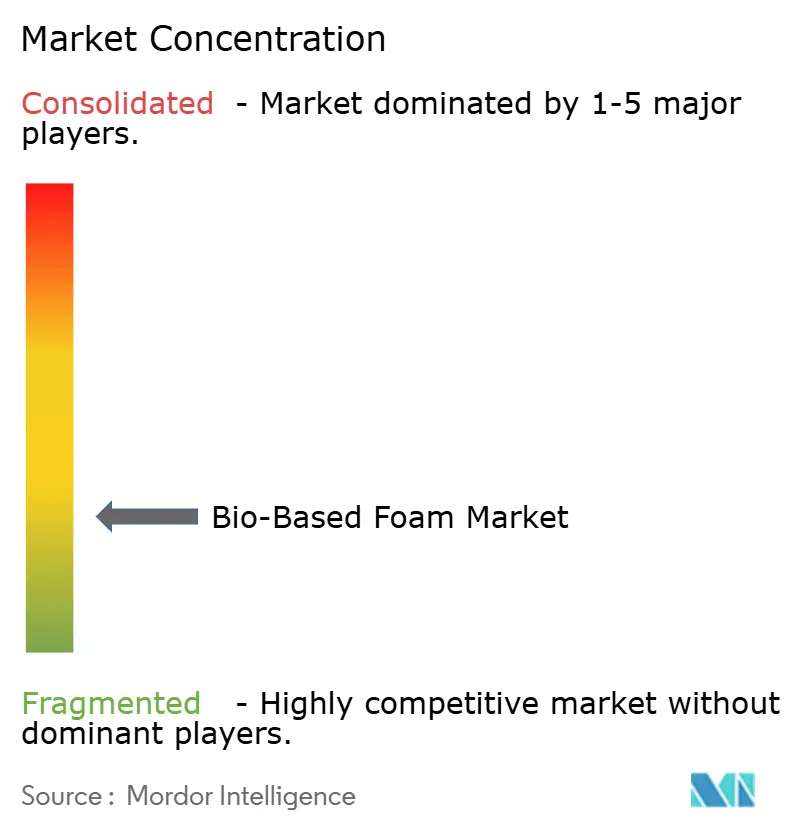
The bio-based foam market remains fragmented, although BASF, Covestro AG, Dow, and Huntsman influence the availability of upstream polyols and isocyanates. These companies have expanded International Sustainability and Carbon Certification (ISCC) PLUS-certified production capabilities across global sites, allowing them to supply materials through mass-balance chain-of-custody systems. Covestro's Circular Intelligence product line has been used with Recticel's Impact insulation boards and The Vita Group's Vita Advanced mattress concept through formulation partnerships and joint engineering work. Their position is reinforced by the ability to link feedstock attribution, technical service, and product documentation for multinational customers.
Competitive differentiation in the bio-based foam market relies heavily on life-cycle assessment evidence, environmental product declarations, and measurements aligned with ISO 16620-2 or ASTM D6866. These documents are important in premium supply programs because customers need to compare carbon and bio-based content claims consistently. Producers are also seeking scale in the European construction and packaging supply base, where low-carbon product portfolios must be supported by consistent raw-material availability. This gives larger suppliers an advantage by enabling them to support customers across multiple geographies and applications, while also leaving room for regional converters that can qualify specialized products and respond quickly to local requirements.
The castor-oil rigid-foam segment remains open because no individual producer has secured a clear commercial lead in high-bio-content formulations. The Fraunhofer Institute for Applied Polymer Research (IAP)'s xPBS project provides another potential path by demonstrating a bio-based foam that can be processed on established extrusion equipment. In September 2025, Dow and Gruppo Fiori announced a process to recover polyurethane foam from end-of-life vehicles without disassembly, supporting chemical-recycling routes for automotive waste. BASF's December 2025 WALLTITE RSB launch extended recycled and bio-based content into North American spray-foam insulation. The bio-based foam market is likely to reward companies that can meet technical qualification requirements while supporting customer documentation and circular-material commitments.
Bio-Based Foam Industry Leaders
-
BASF
-
Huntsman International LLC
-
Cargill, Incorporated
-
Dow
-
Covestro AG
- *Disclaimer: Major Players sorted in no particular order
Bio-Based Foam Market Companies Covered in this Report
- BASF
- BEWI
- Braskem
- Cargill, Incorporated
- Covestro AG
- Dow
- Huntsman International LLC
- INOAC CORPORATION
- Mitsui Chemicals, Inc.
- RAMPF Holding GmbH & Co. KG
- Recticel NV
- Sealed Air Corporation
- Sinomax USA Inc.
- The Vita Group
- Trocellen Group
- Woodbridge
Recent Industry Developments in Bio-Based Foam Market
- December 2025: BASF launched WALLTITE RSB, a closed-cell spray polyurethane bio-based foam for the North American construction market. The foam incorporates recycled and bio-based raw materials and has a lower carbon footprint than conventional formulations. It carries pending USDA BioPreferred certification under ASTM D6866 and a manufacturer-specific Environmental Product Declaration confirming measurable embodied carbon reductions, making it compatible with LEED certification and EPA Preferred Purchasing programs.
- September 2025: Dow and Gruppo Fiori announced a jointly developed process to recover polyurethane foam from end-of-life vehicles without disassembly. The process enables depolymerization-grade polyurethane (PU) waste streams suitable for chemical recycling and supports OEM compliance with upcoming EU End-of-Life Vehicle Regulation recycled content requirements.
Global Bio-Based Foam Market Report Scope
A bio-based foam is a lightweight, porous, cellular material made wholly or partly from renewable biological resources, such as plant oils (soybean, castor, palm), sugarcane, corn starch, or waste wood, rather than crude oil or petroleum. These materials are derived from agricultural and forestry sources, offering an alternative raw material base for foam production.
The bio-based foam market is segmented by product type, raw material, application, and geography. By product type, the market is segmented into flexible foam, rigid foam, spray foam, and other product types. By raw material, the market is segmented into soy-based, castor-based, corn-based, sugarcane-based, and other raw materials. By application, the market is segmented into furniture and bedding, automotive and transportation, packaging, building and construction, electrical and electronics, and other applications. The report also covers market sizes and forecasts for the bio-based foam across 15 countries in major regions. The market sizes and forecasts are provided in terms of value (USD).
Segmentation Overview
| Flexible Foam |
| Rigid Foam |
| Spray Foam |
| Other Product Types |
| Soy-Based |
| Castor-Based |
| Corn-Based |
| Sugarcane-Based |
| Other Raw Materials |
| Furniture and Bedding |
| Automotive and Transportation |
| Packaging |
| Building and Construction |
| Electrical and Electronics |
| Other Applications |
| Asia-Pacific | China |
| India | |
| Japan | |
| South Korea | |
| ASEAN Countries | |
| Rest of Asia-Pacific | |
| North America | United States |
| Canada | |
| Mexico | |
| Europe | Germany |
| United Kingdom | |
| France | |
| Italy | |
| NORDIC Countries | |
| Rest of Europe | |
| South America | Brazil |
| Argentina | |
| Rest of South America | |
| Middle East and Africa | Saudi Arabia |
| South Africa | |
| Rest of Middle East and Africa |
| By Product Type | Flexible Foam | |
| Rigid Foam | ||
| Spray Foam | ||
| Other Product Types | ||
| By Raw Material | Soy-Based | |
| Castor-Based | ||
| Corn-Based | ||
| Sugarcane-Based | ||
| Other Raw Materials | ||
| By Application | Furniture and Bedding | |
| Automotive and Transportation | ||
| Packaging | ||
| Building and Construction | ||
| Electrical and Electronics | ||
| Other Applications | ||
| By Geography | Asia-Pacific | China |
| India | ||
| Japan | ||
| South Korea | ||
| ASEAN Countries | ||
| Rest of Asia-Pacific | ||
| North America | United States | |
| Canada | ||
| Mexico | ||
| Europe | Germany | |
| United Kingdom | ||
| France | ||
| Italy | ||
| NORDIC Countries | ||
| Rest of Europe | ||
| South America | Brazil | |
| Argentina | ||
| Rest of South America | ||
| Middle East and Africa | Saudi Arabia | |
| South Africa | ||
| Rest of Middle East and Africa | ||
Key Questions Answered in the Report
What is current market size of Bio-Based Foam Market?
The bio-based foam market size was valued at USD 3.30 billion in 2026 and is estimated to grow from USD 3.57 billion in 2027 to USD 5.41 billion by 2032, at a CAGR of 8.67% during the forecast period (2027-2032).
Which raw material is growing fastest for bio-based foam production?
Castor-based feedstocks are forecast to grow at a 9.56% CAGR through 2032 because their natural hydroxyl groups support direct polyol substitution.
Why is automotive demand growing for bio-based foam?
Automotive and transportation are forecast to expand at 10.08% CAGR through 2032 as vehicle makers seek certified materials for interiors, acoustic performance, and circularity targets.
Which region leads demand for bio-based foam?
Europe leads with a 42.82% share in 2026, supported by polyurethane manufacturing capacity and environmental requirements.