
Bio-Acrylic Acid Market Size and Share
Market Overview
| Study Period | 2022 - 2032 |
|---|---|
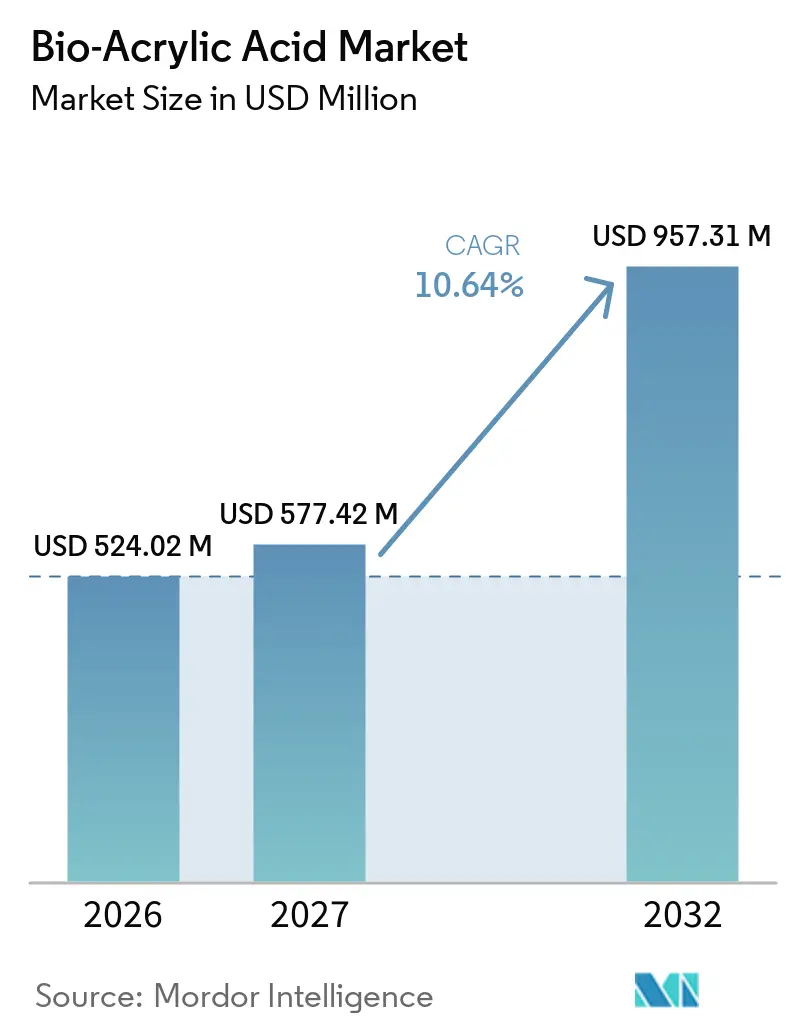
| Market Size (2027) | USD 577.42 Million |
| Market Size (2032) | USD 957.31 Million |
| Growth Rate (2027 - 2032) | 10.64 % |
| Fastest Growing Market | Asia-Pacific |
| Largest Market | Asia-Pacific |
| Market Concentration | Low |
Major Players *Disclaimer: Major Players sorted in no particular order Image © Mordor Intelligence. Reuse requires attribution under CC BY 4.0. | |
Bio-Acrylic Acid Market Analysis by Mordor Intelligence
The Bio-Acrylic Acid Market size was valued at USD 524.02 million in 2026 and is estimated to grow from USD 577.42 million in 2027 to reach USD 957.31 million by 2032, at a CAGR of 10.64% during the forecast period (2027-2032). The bio-acrylic acid market is moving from pilot activity toward early industrial deployment rather than expanding from a mature supply base. Production ramp-up, yield improvement, and downstream qualification will, therefore, influence growth alongside end-use demand. Bio-attributed materials can help customers meet procurement and emissions goals while full bio-based capacity remains limited. Companies are using certification and mass-balance systems to offer lower-carbon acrylic materials before dedicated bio-acrylic capacity reaches a broader scale. This creates opportunities for producers that can supply verified material consistently and manage feedstock, purification, and cost risks.
Key Report Takeaways
- By derivative products, butyl acrylate held 30.12% of the bio-acrylic acid market share in 2026 and is forecast to advance at an 11.15% CAGR through 2032.
- By application, sanitary products held 35.67% of the bio-acrylic acid market share in 2026, while adhesives and sealants are forecast to advance at an 11.59% CAGR through 2032.
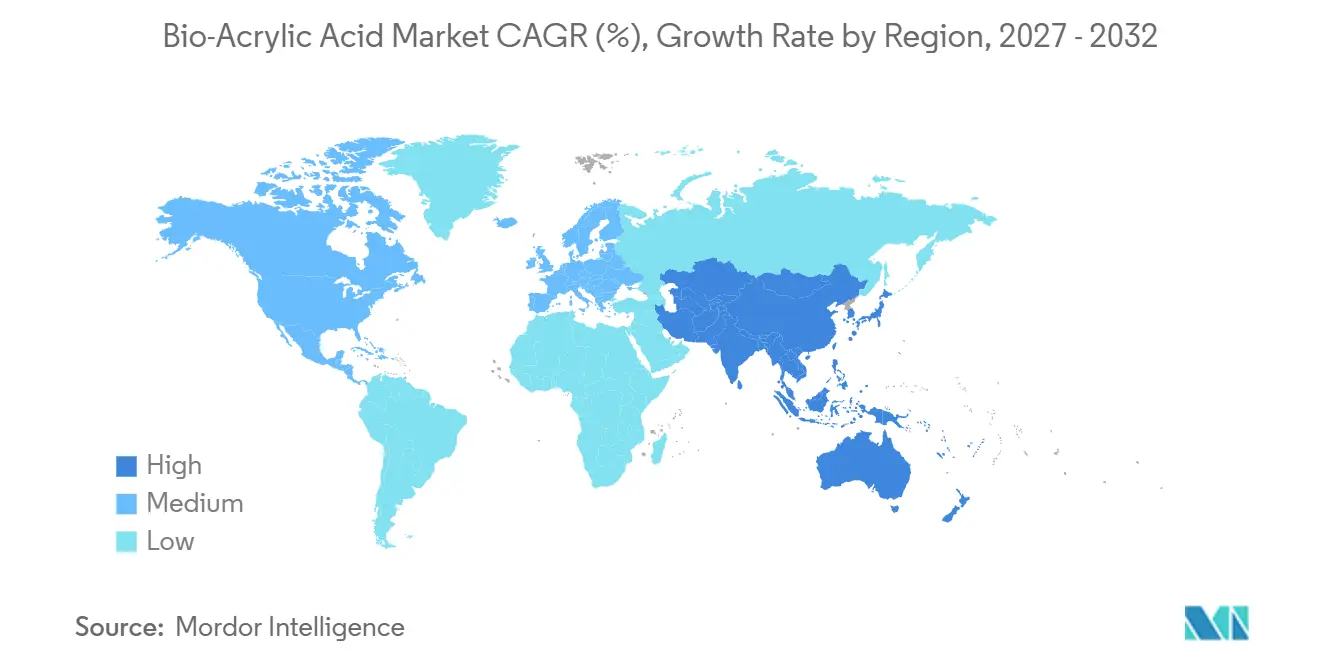
- By geography, Asia-Pacific held 38.24% of the bio-acrylic acid market share in 2026 and is forecast to advance at an 11.33% CAGR through 2032.
Note: Market numbers in this report are based on Mordor Intelligence's proprietary estimation framework, which combines nine months of actuals with Q4 projections for base year 2026.
Market Trends and Insights
Drivers Impact Analysis of Bio-Acrylic Acid Market*
| Driver | (~) % Impact on CAGR Forecast | Geographic Relevance | Impact Timeline |
|---|---|---|---|
| Corporate Demand for Lower-Carbon and Bio-Based Chemical Inputs | +3.2% | Global, with early concentration in North America and Europe | Short term (≤ 2 years) |
| Superabsorbent Polymer Demand from Hygiene Products | +2.8% | Global; APAC core (China, India, South Korea), spillover to MEA | Medium term (2-4 years) |
| Low-VOC and Water-Based Coating Adoption | +1.9% | North America and EU; growing in ASEAN and China | Short term (≤ 2 years) |
| Government Support for Renewable Chemicals and Decarbonization | +1.5% | EU, South Korea, United States, China | Long term (≥ 4 years) |
| Bio-Based Content Procurement and Product Certification | +1.1% | North America, Europe, Japan, South Korea | Medium term (2-4 years) |
| Source: Mordor Intelligence | |||
Corporate Demand for Lower-Carbon and Bio-Based Chemical Inputs
Demand in the bio-acrylic acid market increasingly starts with procurement teams rather than consumer preference. Companies with Science Based Targets initiative Scope 3 goals are reviewing the carbon intensity and certified bio-based content of purchased chemicals. Ontex introduced bio-based superabsorbent polymers in selected diaper brands in July 2025 and linked the move to its goal of reducing Scope 3 emissions by 25% by 2030. Such commitments can create demand signals for upstream acrylic inputs that are less dependent on spot-market pricing. Buyers are also treating verified bio-based content as part of supplier qualification, which raises the importance of traceability and consistent certification. The European Commission’s 2025 bioeconomy plan supports wider use of renewable biological resources and provides a policy setting that favors this procurement direction.
Superabsorbent Polymer Demand from Hygiene Products
Superabsorbent polymers are a major outlet for acrylic acid, making hygiene products important to the bio-acrylic acid market. Ontex placed bio-based superabsorbent polymers in its Moltex Pure & Nature diaper lines in 2025 and reported a targeted 15% - 25% carbon-footprint reduction against conventional superabsorbent polymers. The change shows how sustainability requirements can move through the hygiene supply chain to acrylic acid and its derivatives. Research published in 2025 reviewed the use of bio-based superabsorbent polymers in sanitary products and addressed their functional role in absorbent hygiene applications. Producers that meet absorption, safety, and supply requirements can participate in higher-value customer programs. The commercial path still depends on producers building sufficient bio-acrylic volumes at costs that hygiene brands can absorb.
Low-VOC and Water-Based Coating Adoption
Coatings formulators are moving toward water-based and lower-emission systems, which support demand for bio-attributed acrylic binders and additives. Dow presented bio-based acrylic emulsions for construction applications in 2025, showing how plant-based content can be incorporated into familiar resin platforms. Arkema introduced bio-based acrylic binders for performance textiles in January 2025, extending this approach beyond architectural coatings. A 2025 journal article examined waterborne acrylic dispersions combined with biopolymers, supporting the technical basis for further formulation work. The bio-acrylic acid market benefits when both binders and formulation additives adopt renewable feedstocks. This wider conversion can increase bio-attributed content across a finished coating without forcing customers to change every component at once.
Government Support for Renewable Chemicals and Decarbonization
Public programs can reduce technical and funding barriers for renewable chemical projects in the bio-acrylic acid market. The U.S. Department of Energy announced up to USD 23 million in 2025 through its Sustainable Propane and Renewable Chemicals (SPARC) program for renewable chemicals and fuels from biomass and waste resources[1]. China’s Ministry of Industry and Information Technology issued a 2025 notice supporting pilot-scale biomanufacturing capability platforms. The Circular Bio-based Europe Joint Undertaking opened a project call in 2025 for competitive circular bio-based industries, including work relevant to platform chemicals. These programs do not remove scale-up risk, but they can support pilots, demonstration plants, and process development. They also strengthen the local research networks and supply chains needed for commercialization.
Restraints Impact Analysis of Bio-Acrylic Acid Market*
| Restraint | (~) % Impact on CAGR Forecast | Geographic Relevance | Impact Timeline |
|---|---|---|---|
| High Production Cost Versus Petrochemical Acrylic Acid | -2.6% | Global, most acute in price-sensitive APAC and South America markets | Medium term (2-4 years) |
| Scale-Up, Yield and Purification Complexity | -1.8% | Global; most severe for startups and first movers in North America and Europe | Short term (≤ 2 years) |
| Feedstock Availability and Price Volatility | -1.2% | APAC (palm oil, sugarcane), North America (corn), EU (beet, wheat) | Long term (≥ 4 years) |
| Source: Mordor Intelligence | |||
High Production Cost Versus Petrochemical Acrylic Acid
Bio-acrylic acid has not yet shown sustained cost parity with propylene-based acrylic acid at large commercial volumes. A 2025 techno-economic assessment found that a glycerol-based route using an acrolein intermediate required USD 173.6 million in capital investment for a 79,200 metric ton per year plant and had an 11.6-year payback period. Early facilities operate on a smaller scale, so fixed costs and process losses remain important constraints. Industrial Microbes, Inc. reported a 60% cost reduction in its fermentation route from early 2024 to mid-2025, indicating that process learning can narrow the gap. Even so, customers in cost-sensitive applications will need reliable evidence of performance, certification value, and supply continuity before accepting a premium. The bio-acrylic acid market will remain exposed to the relative economics of renewable feedstocks and conventional propylene, which will shape bio-acrylic acid market cost competitiveness.
Scale-Up, Yield and Feedstock Complexity
Commercialization requires producers to improve yield, purification, and feedstock reliability at the same time. Research published in 2025 discussed metabolic engineering and fermentation challenges associated with 3-hydroxypropionic acid, an important intermediate in several bio-acrylic routes. NIPPON SHOKUBAI CO., LTD. stated that it was aiming for early commercialization around 2030 for biomass-derived bio-acrylic acid, reflecting the remaining distance from bench validation to commercial deployment. Corn sugar, sugarcane-derived materials, glycerol, and palm-based residues have different availability, logistics, land-use, and certification issues. GS Caltex Corporation’s work on palm oil mill effluent processing in Indonesia illustrates the search for alternative feedstocks, while also showing why feedstock qualifications matter. Producers must, therefore, secure feedstocks that meet traceability standards without creating a new cost or compliance burden.
*Our forecasts treat driver/restraint impacts as directional, not additive. The impact forecasts reflect baseline growth, mix effects, and variable interactions.
Bio-Acrylic Acid Market Segment Analysis
By Derivative Products:
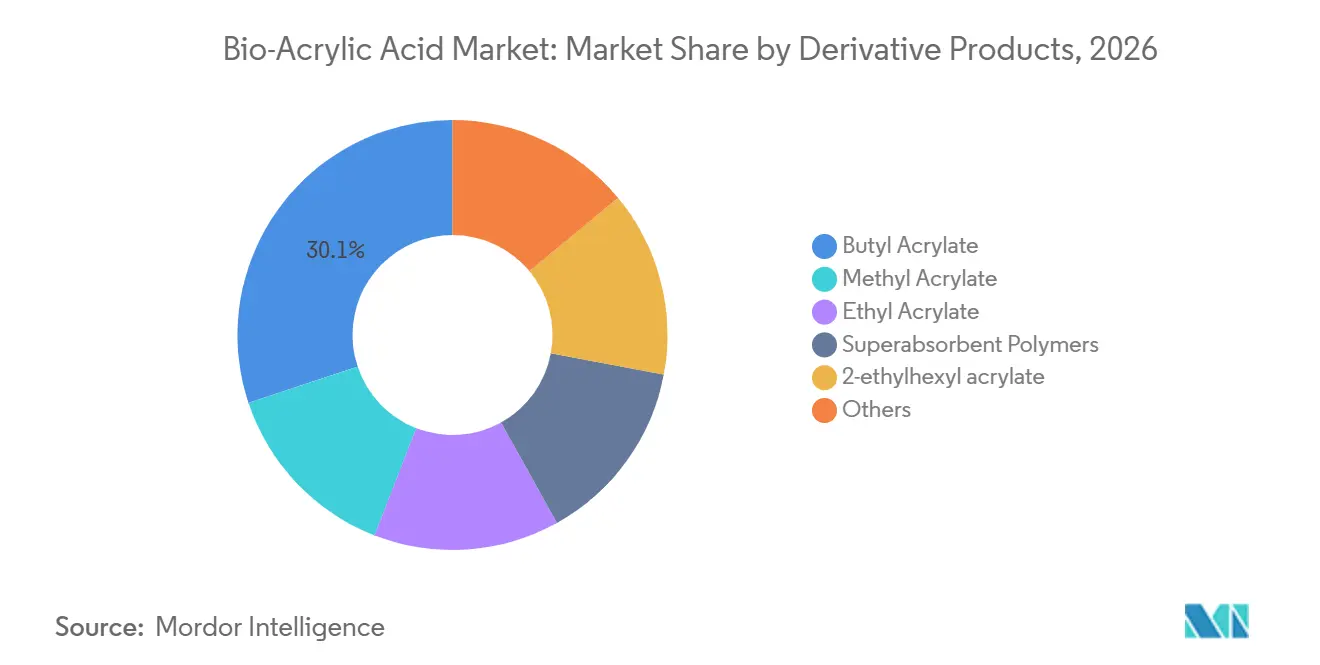
Butyl Acrylate Leads Both Scale and GrowthButyl acrylate held 30.12% of the bio-acrylic acid market share in 2026 and is projected to advance at an 11.15% CAGR through 2032. It serves adhesive and construction uses where customers are introducing bio-attributed versions to meet sustainability specifications. Its position reflects the practical advantage of converting established formulations when a certified acrylic input can meet technical requirements. Superabsorbent polymers offer substantial future demand potential because hygiene products consume large quantities of acrylic-based materials. Methyl acrylate and ethyl acrylate also have a route to adoption through existing specialty chemical product lines.
BASF completed the transition of its Rheovis range to bio-based ethyl acrylate in June 2025, with products containing up to 35% biogenic carbon content under ASTM D6866 testing. This change showed that bio-attributed material can enter established formulations without changing stated technical specifications. The others category includes glacial acrylic acid for water treatment and specialty acrylics for paper processing. These applications may adopt more slowly, where purchasing decisions focus on technical performance and cost instead of certification. ISCC PLUS and USDA BioPreferred frameworks can reduce uncertainty around content claims as suppliers expand product offerings. The bio-acrylic acid market size for derivatives will depend on whether certification systems remain credible and accessible across the value chain.



By Application:
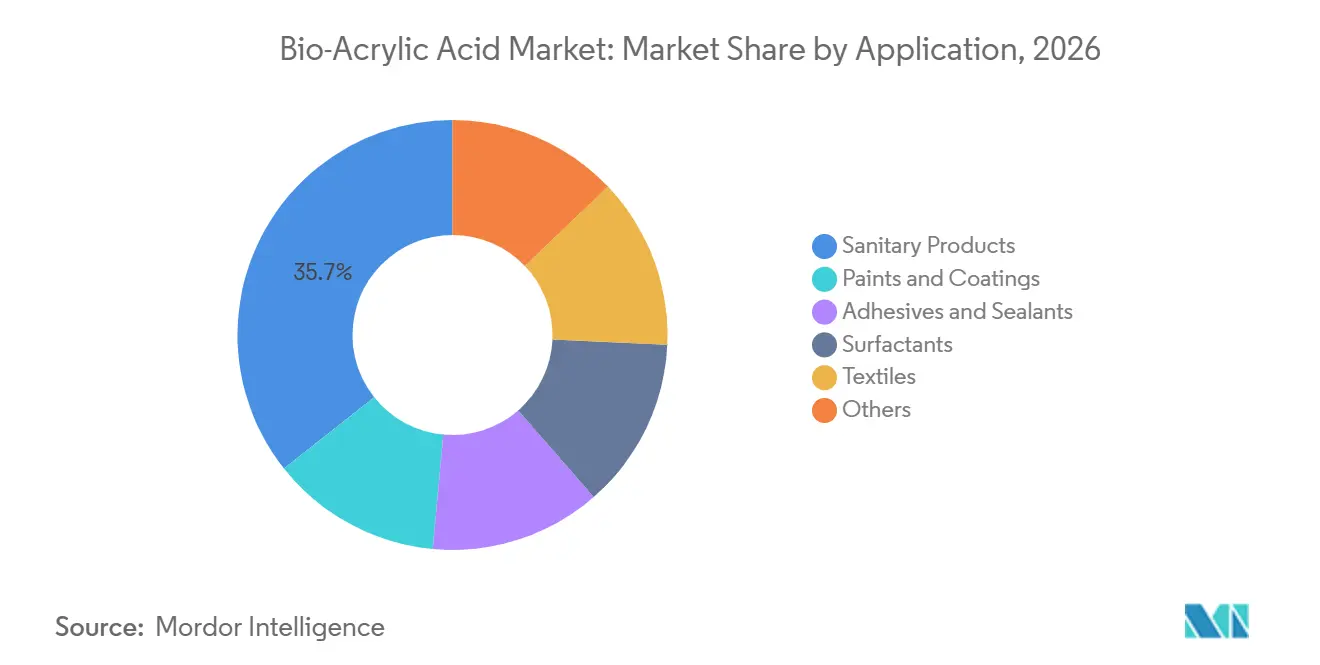
Sanitary Products Provide Demand While Adhesives and Sealants ExpandSanitary products held 35.67% of the bio-acrylic acid market share in 2026, supported by their use of superabsorbent polymer inputs. Adhesives and Sealants are projected to advance at an 11.59% CAGR through 2032 as construction, automotive, and electronics buyers seek lower-carbon materials. Hygiene applications reward dependable absorption performance and verifiable carbon claims. Adhesive customers also need materials that fit existing production systems and meet durability requirements. These needs place a premium on early supply contracts and technical qualification.
Arkema launched ENCOR bio-based waterborne dispersions for textile printing and finishing in February 2025, with up to 30% bio-based content and up to 40% lower carbon footprint than traditional textile resins. Paints and Coatings are shifting from mass-balance acrylic monomers to bio-attributed binders and thickeners. Dow’s bio-based acrylic emulsions support caulk, sealant, and related construction uses. Surfactants are an emerging outlet because they can be combined with other bio-derived formulation components. Water treatment and paper additives remain relevant applications, although their lower margins can limit willingness to pay for bio-based content. The bio-acrylic acid market share in these applications will depend on regulations, customer specifications, and the premium available for certified materials.

Geography Analysis
Asia-Pacific
Asia-Pacific held 38.24% of the bio-acrylic acid market share in 2026 and is projected to advance at an 11.33% CAGR through 2032. The region combines biomass access, established acrylic derivative manufacturing, and public support for biomanufacturing. LG Chem announced prototype production of 100% bio-acrylic acid at 100 metric tons per year using plant-based raw materials and 3-hydroxypropionic acid from microbial fermentation. The product received a USDA Certified Biobased Product label, which supports access to sustainability-focused customers. GS Caltex Corporation is developing 3-hydroxypropionic acid purification and separation technology with LG Chem for a pilot project aimed at mass production by 2028. China’s 2025 pilot-platform program strengthens the regional infrastructure for commercial biomanufacturing[2]. These developments position the region to link fermentation, purification, and downstream acrylate production.
North America
North America has a concentrated group of technology developers and a well-established certification environment. Industrial Microbes, Inc. announced a 750-fold scale-up in September 2025 from 2-liter to 1,500-liter reactors, producing 20-kilogram batches of high-purity, 100% bio-based acrylic acid. This development showed progress toward larger fermentation volumes, while commercial delivery remains a separate step. Låkril Technologies raised USD 3.1 million in 2025 to scale a corn-based acrylic acid route using lactic acid dehydration technology. The U.S. Department of Energy’s renewable-chemicals funding program adds support for biomass and waste-based technologies. The USDA BioPreferred program provides a recognized framework for product claims and public procurement. These conditions can help suppliers connect technical progress with early customer demand.
Europe, South America, and Middle East and Africa
Europe has an advanced policy environment for renewable chemicals, while South America and the Middle East and Africa have feedstock and import-substitution opportunities. Arkema completed ISCC PLUS certification for all of its acrylic monomer facilities worldwide in July 2025, covering sites in France, the United States, and China. It later added its Boretto, Italy, waterborne resin site to the certified network. The Circular Bio-based Europe Joint Undertaking offers project support that can improve Europe’s scale-up conditions. Brazil and Argentina could provide sugarcane and agricultural-residue feedstocks. Indonesia’s 500,000 metric tons per year bio-feedstock refinery, developed by GS Caltex and POSCO International, supports a regional materials base. The bio-acrylic acid market size across these mixed regions will depend on investment in conversion capacity, recognized certification, and local downstream demand.
Competitive Landscape
Market Concentration
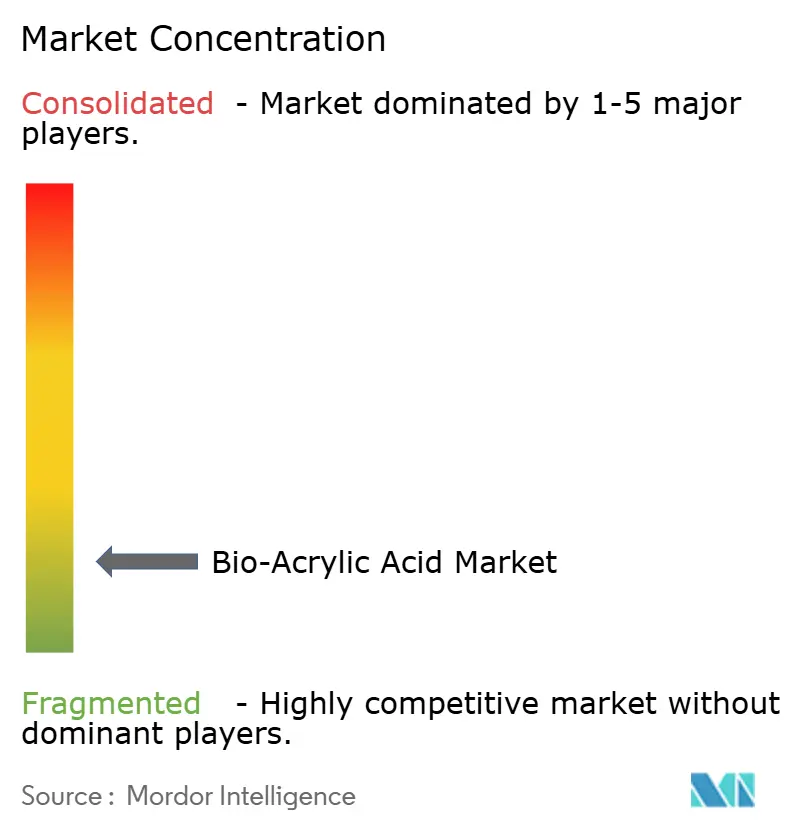
The bio-acrylic acid market is highly fragmented, with the top five players including LG Chem, BASF, Arkema, Industrial Microbes, Inc., and Låkril Technologies. Arkema, BASF, Dow, LG Chem, and NIPPON SHOKUBAI CO., LTD. are using existing acrylic capabilities to introduce certified or bio-attributed materials. Industrial Microbes, Inc. and Låkril Technologies are developing production routes based on fermentation and catalytic conversion. This combination makes process performance and customer qualification central competitive factors.
Arkema completed global ISCC PLUS certification for its acrylic monomer facilities in July 2025 and partnered with Catalyxx in September 2025 to develop lower-carbon acrylic resins. BASF moved its Rheovis range to bio-based ethyl acrylate, reporting up to 35% biogenic carbon content and up to 30% lower product carbon footprint. NIPPON SHOKUBAI CO., LTD. obtained ISCC PLUS certification for acrylic acid and superabsorbent polymers at its U.S. operations in 2025. These moves give customers a certified transition option before large volumes of fully bio-based acrylic acid are widely available. They also make chain-of-custody controls and mass-balance accounting important parts of supplier competition.
Technology developers are focused on cost, yield, purity, and feedstock flexibility. Industrial Microbes uses an intracellular poly-3-hydroxypropionate route intended to reduce solvent-intensive purification steps. Låkril Technologies is pursuing a lactic-acid-to-acrylic-acid pathway designed for deployment through existing biorefinery infrastructure. ISCC PLUS and ISO 22095:2020 mass-balance principles provide a transitional structure for attributing renewable inputs through complex chemical supply chains. The competitive field is, therefore, collaborative in part, since technology suppliers, feedstock providers, and downstream resin producers need each other to build a qualified supply. Commercial advantage will favor companies that combine credible claims with stable material quality and a realistic scale-up plan.
Bio-Acrylic Acid Industry Leaders
-
LG Chem
-
BASF
-
Arkema
-
Industrial Microbes, Inc.
-
Låkril Technologies
- *Disclaimer: Major Players sorted in no particular order
Bio-Acrylic Acid Market Companies Covered in this Report
- ADM
- Arkema
- BASF
- Cargill, Incorporated
- China Petroleum and Chemical Corporation
- Dow
- Evonik Industries AG
- Formosa Plastics Corp
- GS Caltex Corporation
- Industrial Microbes, Inc.
- Låkril Technologies
- LG Chem
- Mitsubishi Chemical Group Corporation
- NIPPON SHOKUBAI CO., LTD.
- PJSC SIBUR Holding
Recent Industry Developments in Bio-Acrylic Acid Market
- December 2025: Låkril Technologies commissioned its first fully continuous pilot plant for bio-based acrylic acid production, marking its fourth production facility. The plant converts lactic acid derived from renewable sugars into acrylic acid with over 90% selectivity, supporting the bio-acrylic acid market by advancing continuous production, customer sampling, and commercial-scale development.
- September 2025: Industrial Microbes, Inc. successfully scaled its production of 100% bio-based, high-purity acrylic acid using proprietary fermentation technology, increasing reactor volume from 2 liters to 1,500 liters and achieving production batches of 20 kg. The development supports the bio-acrylic acid market by demonstrating the scalability of renewable-feedstock production and advancing commercial supply opportunities for bio-based acrylic acid.
Global Bio-Acrylic Acid Market Report Scope
Bio-acrylic acid is acrylic acid produced using renewable or bio-based feedstocks instead of conventional fossil-based raw materials. It serves as a building block for acrylic derivatives and polymers used in industrial and consumer product formulations.
The Bio-Acrylic Acid Market is segmented by derivative products, application, and geography. By derivative products, the market is segmented into butyl acrylate, methyl acrylate, ethyl acrylate, 2-ethylhexyl acrylate, superabsorbent polymers, and others. By application, the market is segmented into sanitary products, paints and coatings, adhesives and sealants, textiles, surfactants, and others. The report also covers the market size and forecasts for bio-acrylic acid across 15 countries. For each segment, the market sizing and forecasts have been done on the basis of value (USD).
Segmentation Overview
| Butyl Acrylate |
| Methyl Acrylate |
| Ethyl Acrylate |
| 2-ethylhexyl acrylate |
| Superabsorbent Polymers |
| Others |
| Sanitary Products |
| Paints and Coatings |
| Adhesives and Sealants |
| Textiles |
| Surfactants |
| Others |
| Asia-Pacific | China |
| India | |
| Japan | |
| South Korea | |
| ASEAN Countries | |
| Rest of Asia-Pacific | |
| North America | United States |
| Canada | |
| Mexico | |
| Europe | Germany |
| United Kingdom | |
| France | |
| Italy | |
| NORDIC Countries | |
| Rest of Europe | |
| South America | Brazil |
| Argentina | |
| Rest of South America | |
| Middle East and Africa | Saudi Arabia |
| South Africa | |
| Rest of Middle East and Africa |
| By Derivative Products | Butyl Acrylate | |
| Methyl Acrylate | ||
| Ethyl Acrylate | ||
| 2-ethylhexyl acrylate | ||
| Superabsorbent Polymers | ||
| Others | ||
| By Application | Sanitary Products | |
| Paints and Coatings | ||
| Adhesives and Sealants | ||
| Textiles | ||
| Surfactants | ||
| Others | ||
| By Geography | Asia-Pacific | China |
| India | ||
| Japan | ||
| South Korea | ||
| ASEAN Countries | ||
| Rest of Asia-Pacific | ||
| North America | United States | |
| Canada | ||
| Mexico | ||
| Europe | Germany | |
| United Kingdom | ||
| France | ||
| Italy | ||
| NORDIC Countries | ||
| Rest of Europe | ||
| South America | Brazil | |
| Argentina | ||
| Rest of South America | ||
| Middle East and Africa | Saudi Arabia | |
| South Africa | ||
| Rest of Middle East and Africa | ||
Key Questions Answered in the Report
What is the size of the bio-acrylic acid market?
The bio-acrylic acid market size was valued at USD 524.02 million in 2026 and is estimated to grow from USD 577.42 million in 2027 to reach USD 957.31 million by 2032, at a CAGR of 10.64% during the forecast period (2027-2032).
What is driving demand for bio-acrylic acid?
Corporate Scope 3 goals, certified bio-based procurement, hygiene applications, and lower-emission coating systems are supporting adoption.
Which derivative product held the largest share in 2026?
Butyl acrylate held 30.12% of the bio-acrylic acid market share in 2026.
Which application is projected to advance fastest through 2032?
Adhesives and sealants are projected to advance at an 11.59% CAGR through 2032, supported by construction, automotive, and electronics applications.