
Binders Excipients Market Size and Share
Market Overview
| Study Period | 2020 - 2031 |
|---|---|
| Market Size (2026) | USD 1.55 Billion |
| Market Size (2031) | USD 1.94 Billion |
| Growth Rate (2026 - 2031) | 4.58 % |
| Fastest Growing Market | Asia-Pacific |
| Largest Market | North America |
| Market Concentration | Medium |
Major Players *Disclaimer: Major Players sorted in no particular order Image © Mordor Intelligence. Reuse requires attribution under CC BY 4.0. | |
Binders Excipients Market Analysis by Mordor Intelligence
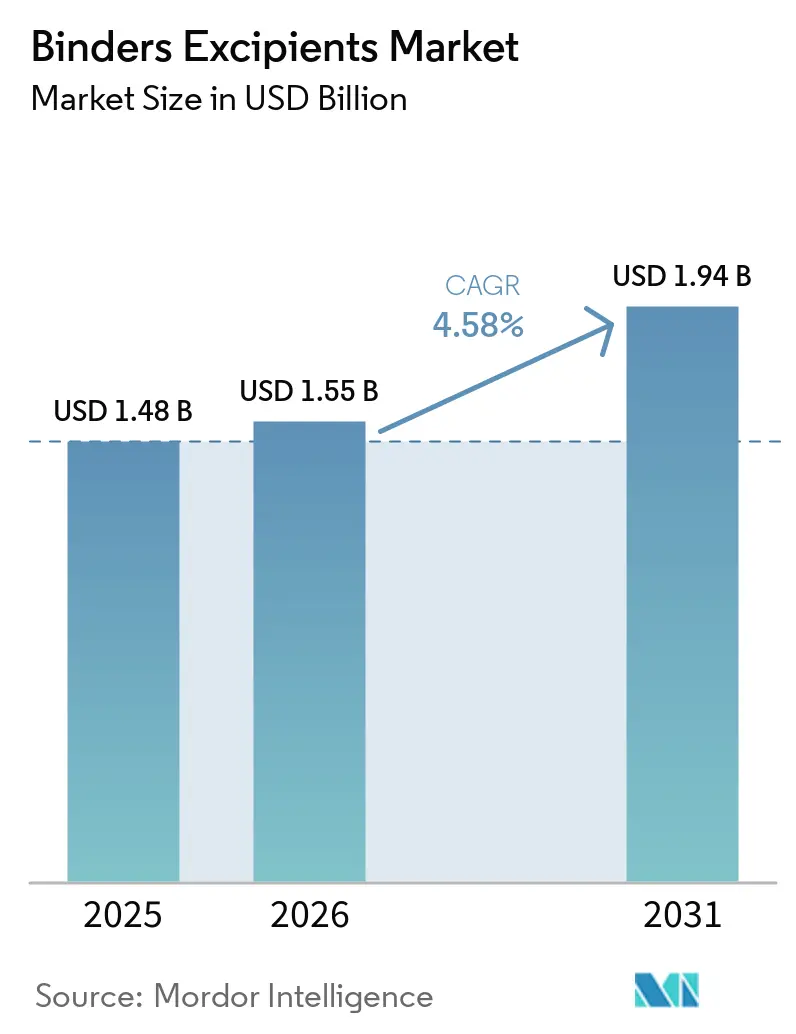
The Binders Excipients Market size is expected to increase from USD 1.48 billion in 2025 to USD 1.55 billion in 2026 and reach USD 1.94 billion by 2031, growing at a CAGR of 4.58% over 2026-2031.
This growth is primarily supported by sustained pharmaceutical solid-dosage production volumes rather than short-term shifts in formulation demand. The expansion of generic and biosimilar oral solid-dose programs is increasing the need for efficient tablet manufacturing, positioning binder performance as a key factor in production cost control. The adoption of continuous and semi-continuous manufacturing is also raising qualification requirements for binder grades used in direct compression and twin-screw granulation. As a result, the binders excipients market increasingly favors suppliers that offer consistent technical performance and regulatory documentation to support product filings. India’s March 2026 notification requires QR codes on finished Schedule H2 formulations to include qualitative excipient details, making binder identification a pack-level compliance requirement.
Key Report Takeaways
- By source, natural binders held 57.65% of the binders excipients market share in 2025, while synthetic binders are forecast to grow at a 6.5% CAGR through 2031.
- By application, tablets accounted for 37.86% revenue share in 2025, while solution-based formulations are projected to expand at a 6.8% CAGR through 2031.
- By end user, pharmaceutical companies held 46.87% revenue share in 2025, while CDMOs are forecast to advance at a 7.9% CAGR through 2031.
- By geography, North America accounted for 43.65% revenue share in 2025, while Asia-Pacific is projected to grow at a 5.7% CAGR through 2031.
Note: Market size and forecast figures in this report are generated using Mordor Intelligence’s proprietary estimation framework, updated with the latest available data and insights as of January 2026.
Market Trends and Insights
Drivers Impact Analysis of Binders Excipients Market*
| Driver | (~) % Impact on CAGR Forecast | Geographic Relevance | Impact Timeline |
|---|---|---|---|
| Growth Of Generic And Biosimilar Oral Solid Dose Manufacturing | +1.80% | Global, with concentrated gains in North America, India, and China | Short term (≤ 2 years) |
| Demand For Multifunctional And Co-processed Excipients | +1.20% | Global, strongest in North America and EU | Medium term (2-4 years) |
| Expansion Of Pharmaceutical And Nutraceutical Production In Asia-Pacific | +0.80% | Asia-Pacific core, with spillover to Middle East and Africa | Medium term (2-4 years) |
| Continuous Manufacturing And High-Shear Granulation Adoption | +0.60% | North America and EU, with early gains in India | Long term (≥ 4 years) |
| Excipient Traceability As A Procurement Differentiator | +0.40% | Global, with early enforcement in India, US, and EU | Short term (≤ 2 years) |
| Source: Mordor Intelligence | |||
Growth of Generic and Biosimilar Oral Solid Dose Manufacturing
Generic oral solid dosage forms remain the primary volume driver for binders, with the patent expiry cycle continuing to support demand. The FDA’s generic drug program is expected to process more than 35,000 cumulative ANDA approvals through 2025. The growing number of biosimilar approvals also supports future formulation activity, although binder requirements vary by dosage form. Large-scale manufacturing programs favor grades that deliver stable granules and consistent compression performance. The binders excipients market benefits as generic manufacturers expand tablet and capsule production across multiple therapeutic areas. Binder qualification is increasingly shifting to CDMOs, which manage development and manufacturing for multiple customers, rather than remaining solely at originator sites. Suppliers that pre-qualify grades for standard generic platforms and maintain current regulatory files across multiple jurisdictions are better positioned to secure repeat orders.
Demand for Multifunctional and Co-processed Excipients
Co-processed excipients provide binding, filling, and disintegration functions within direct-compression workflows. A 2025 study found that co-processed excipients improved flowability, compressibility, and disintegration performance compared with physical blends of their individual components. These attributes are increasingly important for tablet manufacturers operating high-speed presses and seeking to streamline formulation processes. The existing pharmacopoeial status of the underlying materials can also simplify the development pathway compared with introducing a new chemical entity. Evonik is expected to receive a Market Impact Award at CPHI China 2026 for its EUDRAGIT polymer platform, underscoring the commercial value of functional polymer systems. The binders excipients market is moving toward suppliers that combine co-processing capabilities with formulation support. Commodity suppliers offering only starch or PVP grades face increasing challenges as customers seek integrated performance solutions.
Expansion of Pharmaceutical and Nutraceutical Production in the Asia-Pacific
Pharmaceutical production across Asia-Pacific is driving demand for binders with consistent specifications and pharmaceutical-grade manufacturing controls. India’s production-linked incentive program for APIs and bulk drugs supports broader pharmaceutical capacity expansion. New granulation and tablet manufacturing facilities require GMP-grade inputs that comply with Central Drugs Standard Control Organisation requirements. Sigachi reported a 29.57% increase in microcrystalline cellulose production in FY2025 and plans to commission a croscarmellose sodium facility in Dahej by late 2026. The company targets total microcrystalline cellulose capacity of 25,000 MTPA. Nutraceutical tablets and softgels further increase demand for materials that provide binding and processing support. Ashland plans to begin construction of its first South Asian tablet-coatings facility in Ambernath in June 2026, citing India’s base of more than 3,000 pharmaceutical manufacturers and access to the Pune and Hyderabad formulation clusters.
Continuous Manufacturing and High-Shear Granulation Adoption
Continuous manufacturing is changing the binder attributes that pharmaceutical teams evaluate during process development. The FDA is expected to approve 22 drug products manufactured through continuous manufacturing processes by mid-2026, compared with 6 products in 2022. The agency’s GDUFA IV framework introduces meeting types for complex generic submissions that may involve new process parameters. Continuous wet granulation research published in 2025 demonstrated a process that uses crystallization-water-releasing excipients instead of external granulation liquid. The research reported granule tensile strength above 1.5 MPa and scale-up from 0.5 kg/h to 10 kg/h without formulation changes. DFE Pharma plans to launch a continuous manufacturing platform with Gericke in Hyderabad in February 2026, enabling customers to evaluate continuous-manufacturing-ready excipients before process lock. The binders excipients market favors suppliers with dedicated testing capabilities, as binder selection can occur during process design rather than after development.
Restraints Impact Analysis of Binders Excipients Market*
| Restraint | (~) % Impact on CAGR Forecast | Geographic Relevance | Impact Timeline |
|---|---|---|---|
| Complex And Regionally Variable Excipient Regulation | -0.50% | Global, with the greatest divergence across US, EU, China, and India | Long term (≥ 4 years) |
| High Qualification And Change-Control Costs | -0.40% | Global, concentrated among mid-sized generic manufacturers | Long term (≥ 4 years) |
| Potential Risks of Contamination or Adverse Reactions | -0.30% | Europe and Southeast Asia most exposed | Short term (≤ 2 years) |
| Source: Mordor Intelligence | |||
Complex and Regionally Variable Excipient Regulation
The absence of a harmonized global regulatory framework for excipients creates ongoing compliance challenges for suppliers and formulators. In the United States, excipients are reviewed as part of the finished drug application, with Type IV Drug Master Files serving as a standard documentation pathway. In the European Union, the European Medicines Agency’s (EMA) draft guideline defines excipient requirements for marketing authorization dossiers. China follows a national standards system that does not fully align with the United States Pharmacopeia–National Formulary (USP–NF) and European Pharmacopeia monographs. The EMA is expected to update its excipient labeling annex guidance in 2025, while the World Health Organization (WHO) issued good manufacturing practice (GMP) guidance for excipient manufacturers in 2024[1]World Health Organization, “Good Manufacturing Practices for Excipients Used in Pharmaceutical Products,” World Health Organization, who.int. These differing regulatory requirements increase compliance costs for participants in the binders and excipients market, particularly due to the need for multi-compendial compliance and variation filings. The burden is more pronounced for smaller regional suppliers, while established suppliers benefit from their ability to support global customers and retain key accounts.
High Qualification and Change-Control Costs
Once a binder is included in regulatory submissions and used in approved medicines, any change requires a formal change-control process. Changes to manufacturing sites, synthesis routes, raw material sources, or grade specifications can trigger a Prior Approval Supplement or a Type II variation. The IPEC Federation’s Version 3 guide, expected in 2026, is anticipated to state that significant Level 2 changes require notification to users and, in some cases, regulatory authorities. These processes require coordination among pharmaceutical manufacturers, excipient suppliers, quality teams, and regulatory authorities. When products are registered across multiple regions, resolution can take 6 to 18 months. Consequently, manufacturers often continue working with qualified suppliers, even when alternative materials offer lower prices or different performance characteristics. This dynamic strengthens the position of incumbent suppliers but can delay the adoption of alternative binder technologies among mid-sized generic drug manufacturers.
*Our forecasts treat driver/restraint impacts as directional, not additive. The impact forecasts reflect baseline growth, mix effects, and variable interactions.
Binders Excipients Market Segment Analysis
By Source:
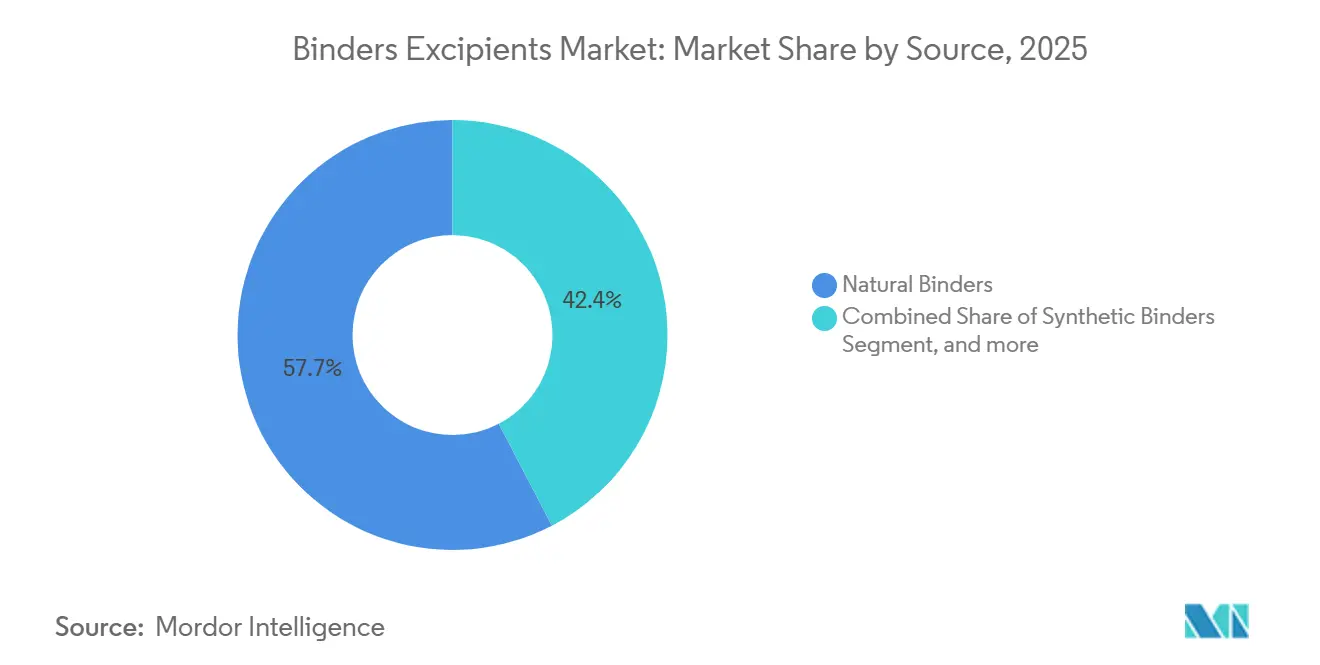
Natural Binders Dominate, Synthetic Grades Drive Value GrowthNatural binders are expected to account for 57.65% of the binders excipients market share in 2025. Their leading position is supported by established pharmacopoeial status, broad regulatory acceptance, and lower qualification requirements than many synthetic alternatives. Microcrystalline cellulose, hydroxypropyl methylcellulose, starch, and guar gum are expected to account for a significant share of natural binder use in tablet manufacturing. Gelatin will remain relevant for selected tablet formats and modified-release capsule fills. Semi-synthetic materials offer a balance between familiar source materials and more controlled functional performance.
Synthetic binders are projected to be the fastest-growing source category, with a forecast CAGR of 6.5% from 2026 to 2031. PVP and copovidone offer tighter viscosity control, greater batch consistency, and compatibility with twin-screw granulation. A 2025 study is expected to demonstrate that viscosity and surface tension influence granule growth and tablet tensile strength during high-shear wet granulation. The EU restriction on synthetic polymeric microplastics will introduce reporting obligations for materials within its scope from May 2027. As a result, the source mix within the binders excipients market will be influenced by both processing performance and evolving compliance requirements.



By Application:
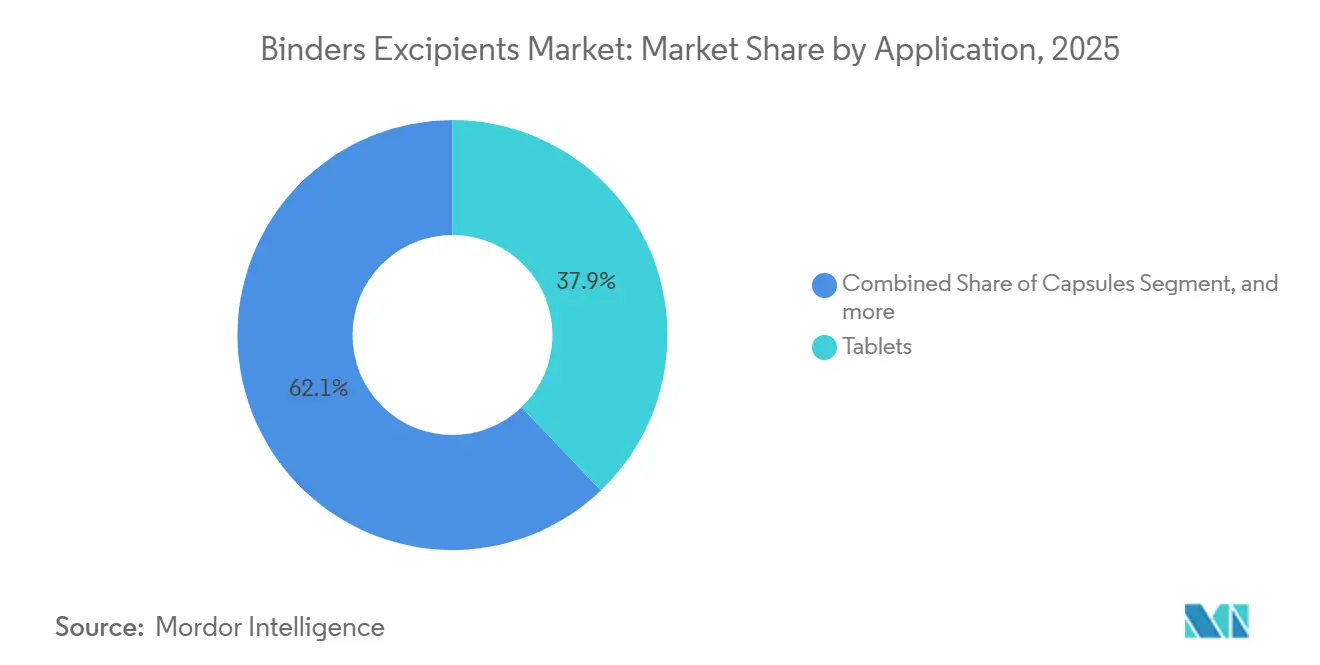
Tablets, Anchor Volume, Solution-Based Formulations AccelerateTablets are expected to account for 37.86% of the binders excipients market size in 2025. Oral solid dosage forms remain widely used because they support patient adherence, scalable manufacturing, and lower production costs than many injectable and liquid formats. Binders facilitate granule formation and maintain tablet integrity during compression. Capsules use binders in wet-filled and granule-filled formats, while modified-release matrices require controlled hydrophilic swelling behavior. Colorcon’s 2025 partnership with ASHA Cellulose will cover ethyl cellulose polymers for binding, film forming, taste masking, and sustained release across several regions.
Solution-based formulations are forecast to grow at a CAGR of 6.8% from 2026 to 2031. Pediatric and geriatric programs are driving demand for liquid and semi-solid oral products, as these populations may have difficulty swallowing tablets. In these formulations, binders provide viscosity and stabilize suspended ingredients. FDA and EMA pediatric frameworks support the development of age-appropriate formulations. ICH Q8 documentation can encourage solution manufacturers to retain previously qualified suppliers, even when they face pricing pressure.
By End User:
Pharmaceutical Companies Lead, CDMOs Emerge As Fastest-Growing BuyersPharmaceutical companies are expected to account for 46.87% of the binders excipients market size in 2025. Their in-house tablet and capsule operations generate consistent demand across innovator and generic drug portfolios. Nutraceutical companies use binders in vitamin, mineral, tablet, and softgel products. Biotechnology companies and research laboratories represent smaller, project-based buyers, including those involved in oral peptide and biologic delivery programs. Ashland will launch Permexa sodium caprate in August 2026 for oral peptide and biologic drug delivery, including GLP-1 agonist formulations.
CDMOs are projected to record the highest end-user CAGR, at 7.9% through 2031. They manage development and manufacturing activities for generic, biosimilar, and specialty drug programs, shifting binder qualification closer to multi-client production sites. Long-term supply agreements may include quality audits and detailed documentation requirements. Evonik will announce a USD 100 million investment in July 2026 to modernize its Lafayette, Indiana, drug-substance CDMO facility over five years. Suppliers that demonstrate validated performance in CDMO development programs are more likely to secure specifications before formulations are finalized.
Geography Analysis
North America Binders Excipients Market
North America is expected to account for 43.65% of the binders excipients market size in 2025. Large generic drug operations, FDA-centered regulation, and GMP manufacturing facilities underpin the region’s position in the binders and excipients market. GDUFA IV will take effect in 2028 and introduce pre-submission meeting types for complex generic drug applicants. The National Supply Chain Resilience Act will require domestic or allied-nation sourcing for 50% of APIs used in Medicare and Medicaid drugs by 2030. BASF will open a GMP Solution Center in Wyandotte, Michigan, in June 2025, while Canada and Mexico will contribute additional demand[2]BASF SE, “BASF Strengthens Its Commitment to the Biopharma and Pharmaceutical Ingredients Industries,” BASF Media, basf.com.
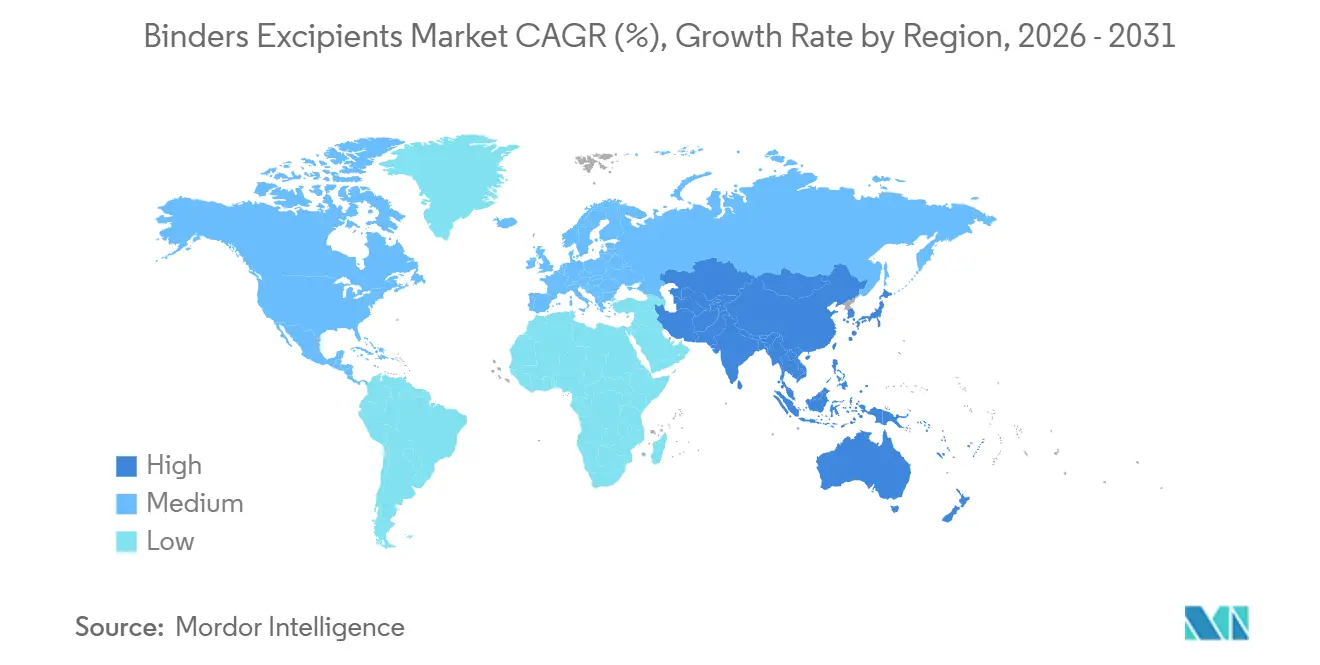
Europe, South America and APAC Binders Excipients Market
Europe will maintain a significant position in the binders excipients market, led by Germany, France, and the United Kingdom. These countries have established pharmaceutical manufacturers and generic drug producers that use cellulose, starch, and polymer binders. Germany benefits from local supply networks that include Evonik, BASF, and MEGGLE. Evonik and Higuchi will open the Open Pharma Lab in Yokohama in April 2026, extending European technical support into Asia. European suppliers will manage compliance costs associated with REACH and EMA labeling guidance, while Brazil will lead demand in South America.
APAC and MEA Binders Excipients Market
Asia-Pacific is forecast to grow at a CAGR of 5.7% from 2026 to 2031, representing the fastest growth rate in the binders excipients market. India supplies more than 20% of global generic drug volumes and requires reliable GMP-grade binders. India’s QR code requirement, scheduled for March 2026, will formalize excipient identity documentation, while Chinese producers are increasing the supply of locally certified binders. The Middle East and Africa will remain smaller but active markets as Saudi Arabia, the UAE, and South Africa expand pharmaceutical manufacturing capacity.

Competitive Landscape
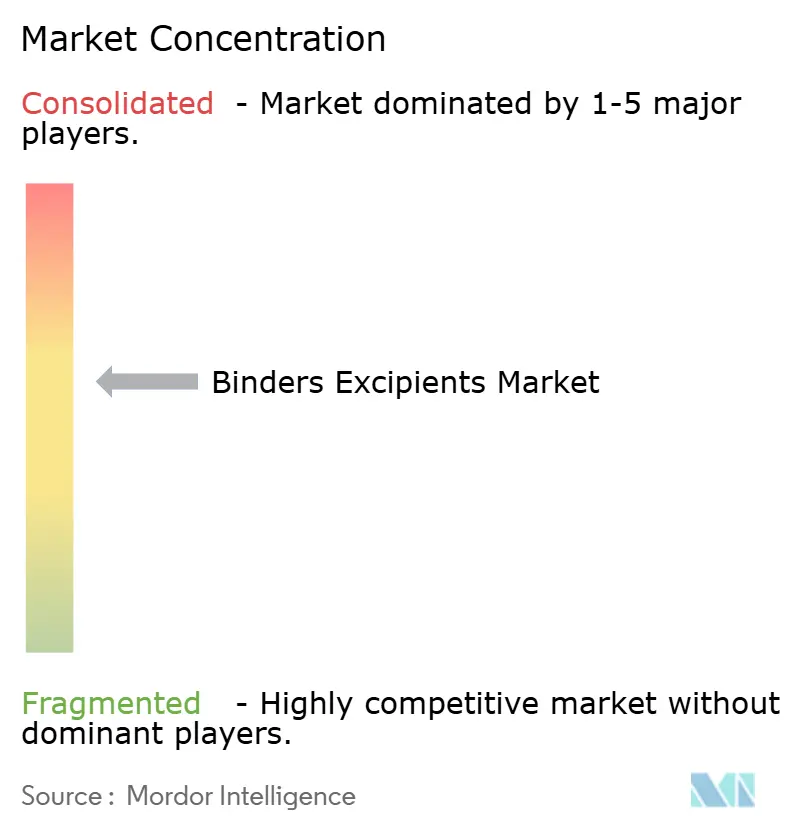
The binders excipients market is moderately concentrated, with 8 to 10 global suppliers accounting for a disproportionate share of volume. Ashland, BASF, Roquette, JRS Pharma, Evonik, and Shin-Etsu Chemical are among the companies active in pharmaceutical-grade cellulosics, starch derivatives, and synthetic polymers. Competition centers on technical performance, regulatory documentation, manufacturing reliability, and formulation development support. Roquette is expected to complete its acquisition of IFF Pharma Solutions in May 2025. The transaction will expand Roquette’s binders excipients market portfolio with HPMC, microcrystalline cellulose, croscarmellose sodium, and alginate under a broader plant-based platform.
The binders excipients market also faces competition from Indian and Chinese producers expanding commodity-grade capacity. Ingredion will form a joint venture with Sanstar in May 2026, including a 9% equity stake and a greenfield specialty pharmaceutical ingredient project in India. Ashland will begin construction of its Ambernath facility in June 2026 to serve pharmaceutical and nutraceutical customers in Asia-Pacific. DFE Pharma’s EcoLact 2030 program will report carbon dioxide traceability data and a 30% carbon footprint reduction across its lactose portfolio without offsets. Evonik will release TÜV-certified life cycle assessment data for selected EUDRAGIT polymers in August 2026.
Continuous-manufacturing-ready binders remain a key area for differentiated technical support. IPEC’s 2026 qualification guide will raise expectations for supplier qualification records, batch traceability, and change notifications. Safic-Alcan will expand its Ingredion Pharma Solutions partnership across European markets in April 2026. Univar Solutions will become the exclusive distributor for Ingredion Pharma Solutions’ pharmaceutical starch portfolio in the United States and Canada in February 2026.
Binders Excipients Industry Leaders
Ashland Inc.
Roquette Frères
BASF SE
DFE Pharma GmbH & Co. KG
JRS Pharma GmbH & Co. KG
- *Disclaimer: Major Players sorted in no particular order
Binders Excipients Market Companies Covered in this Report
- Ashland
- Archer Daniels Midland Company
- BENEO GmbH
- Croda International Plc
- Colorcon, Inc.
- DFE Pharma GmbH & Co. KG
- Evonik Industries
- Fuji Chemical Industries Co., Ltd.
- Ingredion Incorporated
- JRS Pharma GmbH & Co. KG
- Kerry Group plc
- Merck
- Roquette Frères
- Scope Ingredients Pvt. Ltd.
- Shin-Etsu Chemical Co., Ltd.
- Lubrizol

Recent Industry Developments in Binders Excipients Market
- August 2026: Ashland Inc. launches permexa sodium caprate, an intestinal permeation enhancer designed for oral peptide and biologic drug delivery, including GLP-1 agonist formulations. The product combines sodium caprate functionality with an IP-protected manufacturing process that improves tablet compressibility and formulation robustness, and is backed by pre-launch sampling engagements with pharmaceutical, biotech, and CDMO organizations globally.
- July 2026: Evonik Industries announces a USD 100 million investment over 5 years to modernize its drug substance contract manufacturing facility in Lafayette, Indiana, including upgrading 100 m³ reactors, enhancing automation, and expanding ergonomics and efficiency at one of the world’s largest API and high-potency API facilities. The investment positions Evonik for growing US-based CDMO demand driven by supply chain localization.
- June 2026: Ashland Life Sciences breaks ground on its fourth aquarius™ film-coatings manufacturing facility in Ambernath, Maharashtra, India. The company describes it as its first South Asian tablet coatings site and its largest India investment to date. The facility will serve pharmaceutical and nutraceutical customers across India and Asia-Pacific with immediate-release, enteric, sustained-release, barrier, and TiO₂-free coating systems.
- May 2026: Ingredion Incorporated announces a joint venture with Sanstar Limited, including a 9% equity stake, to commission a greenfield specialty pharmaceutical and food ingredient manufacturing plant in India. The plant is intended to serve high-growth pharmaceutical and nutrition applications.


Global Binders Excipients Market Report Scope
According to the report’s scope, binder excipients are substances used in pharmaceutical formulations to hold ingredients together and ensure tablet integrity. They improve the cohesion and compressibility of powders during tablet manufacturing.
The binder excipients market is segmented into source, application, end user, and geography. By source, the market is segmented into natural binders, synthetic binders, and semi-synthetic binders. The natural binders segment is further bifurcated into plant-derived binders and animal-derived binders. By application, the market is segmented into tablets, capsules, solution-based formulations, and modified-release and taste-masked formulations. By end user, the market is segmented into pharmaceutical companies, nutraceutical companies, contract manufacturing and development organizations, biotechnology companies, and research and development laboratories. By geography, the market is segmented into North America, Europe, Asia-Pacific, the Middle East and Africa, and South America. The report also covers the estimated market sizes and trends for 17 countries across major regions globally. The report offers values (USD) for all the above segments.
| Natural Binders | Plant-derived Binders |
| Animal-derived Binders | |
| Synthetic Binders | |
| Semi-synthetic Binders |
| Tablets |
| Capsules |
| Solution-based Formulations |
| Modified-release and Taste-masked Formulations |
| Pharmaceutical Companies |
| Nutraceutical Companies |
| Contract Manufacturing and Development Organizations |
| Biotechnology Companies |
| Research and Development Laboratories |
| North America | United States |
| Canada | |
| Mexico | |
| Europe | Germany |
| United Kingdom | |
| France | |
| Italy | |
| Spain | |
| Rest of Europe | |
| Asia-Pacific | China |
| Japan | |
| India | |
| Australia | |
| South Korea | |
| Rest of Asia-Pacific | |
| Middle East and Africa | GCC |
| South Africa | |
| Rest of Middle East and Africa | |
| South America | Brazil |
| Argentina | |
| Rest of South America |
| By Source | Natural Binders | Plant-derived Binders |
| Animal-derived Binders | ||
| Synthetic Binders | ||
| Semi-synthetic Binders | ||
| By Application | Tablets | |
| Capsules | ||
| Solution-based Formulations | ||
| Modified-release and Taste-masked Formulations | ||
| By End User | Pharmaceutical Companies | |
| Nutraceutical Companies | ||
| Contract Manufacturing and Development Organizations | ||
| Biotechnology Companies | ||
| Research and Development Laboratories | ||
| Geography | North America | United States |
| Canada | ||
| Mexico | ||
| Europe | Germany | |
| United Kingdom | ||
| France | ||
| Italy | ||
| Spain | ||
| Rest of Europe | ||
| Asia-Pacific | China | |
| Japan | ||
| India | ||
| Australia | ||
| South Korea | ||
| Rest of Asia-Pacific | ||
| Middle East and Africa | GCC | |
| South Africa | ||
| Rest of Middle East and Africa | ||
| South America | Brazil | |
| Argentina | ||
| Rest of South America | ||


Key Questions Answered in the Report
What is the projected value of the binders excipients market by 2031?
It is projected to reach USD 1.94 billion by 2031, growing at a 4.6% CAGR from 2026.
Which source category leads binder excipient demand?
Natural binders led with 57.65% share in 2025 due to established pharmacopoeial status and broad regulatory acceptance.
Why are synthetic binders growing faster?
Synthetic binders are forecast to grow at 6.5% CAGR through 2031 because PVP and copovidone support consistent high-speed and continuous processing.
Which application uses the most binder excipients?
Tablets led applications with 37.86% share in 2025, supported by their scale, cost profile, and widespread use in oral drug delivery.
Why are CDMOs important buyers of binder excipients?
CDMOs are the fastest-growing end-user group at a 7.9% CAGR through 2031 because they manage development and production for multiple drug programs.
Which region will grow fastest through 2031?
Asia-Pacific is forecast to grow at 5.7% CAGR, supported by pharmaceutical production growth in India and China.
Page last updated on:





