
Bifurcation Lesions Treatment Market Size and Share
Market Overview
| Study Period | 2021 - 2032 |
|---|---|
| Market Size (2027) | USD 2.82 Billion |
| Market Size (2032) | USD 3.70 Billion |
| Growth Rate (2027 - 2032) | 5.58 % |
| Fastest Growing Market | Asia-Pacific |
| Largest Market | North America |
| Market Concentration | Medium |
Major Players *Disclaimer: Major Players sorted in no particular order Image © Mordor Intelligence. Reuse requires attribution under CC BY 4.0. | |
Bifurcation Lesions Treatment Market Analysis by Mordor Intelligence
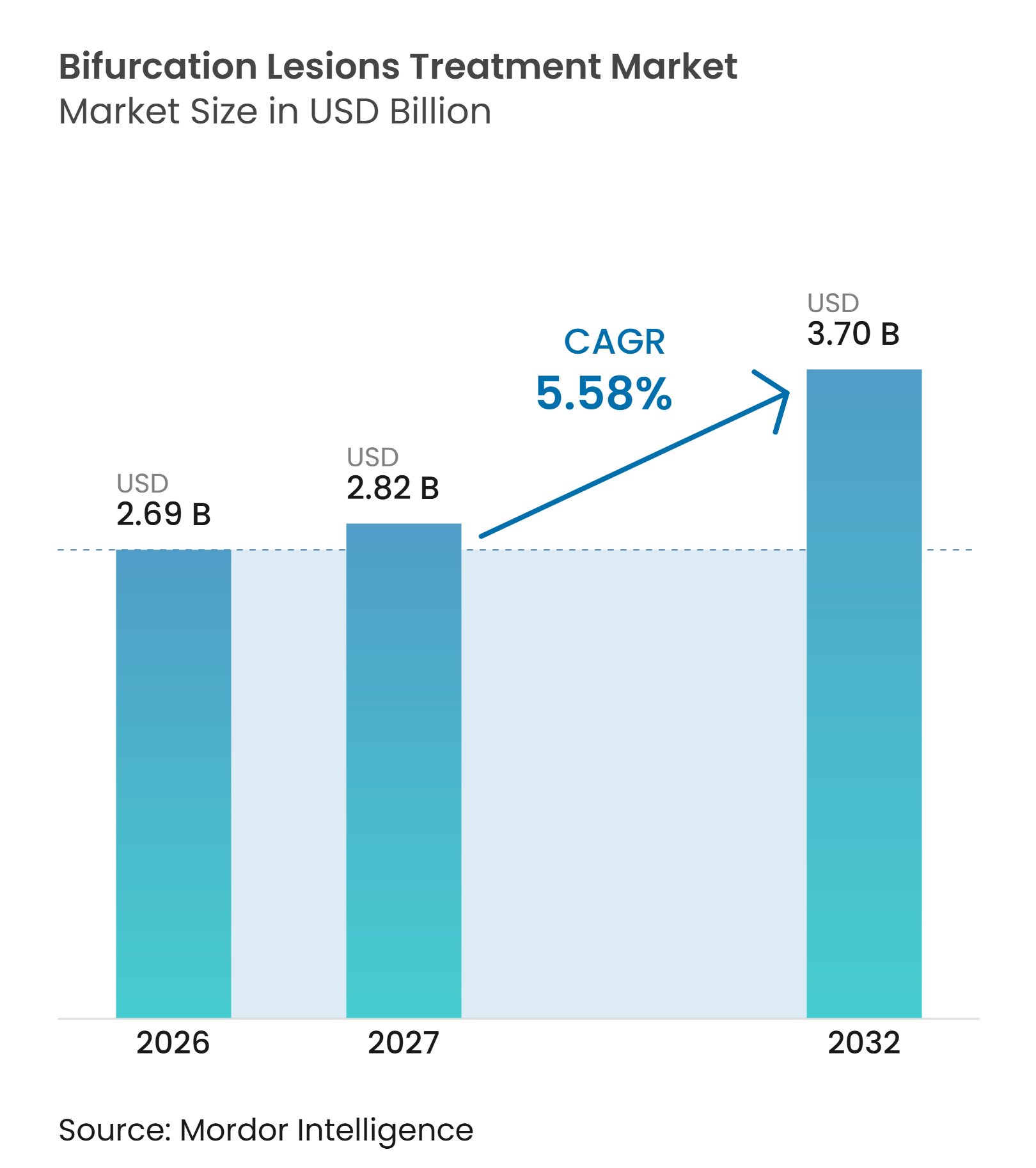
The Bifurcation Lesions Treatment Market size is expected to increase from USD 2.69 billion in 2026 to USD 2.82 billion in 2027 and reach USD 3.70 billion by 2032, growing at a CAGR of 5.58% over 2027-2032.
Growth reflects a rising burden of ischemic heart disease and more frequent use of complex coronary interventions. Imaging, physiology assessment, and adjunct balloons increase the number of devices used in a single procedure. In the United States, intravascular imaging use in PCI rose from 15% in 2016 to nearly 30% in 2023, while combined imaging and physiology use was linked with lower 2-year major adverse cardiovascular event rates and lower long-term costs than angiography alone. The bifurcation lesions treatment market is also being shaped by guideline-supported imaging, outpatient treatment for selected cases, and products that support side-branch treatment. Competition increasingly centers on complete procedure platforms rather than stents alone.
Key Report Takeaways
- By treatment strategy, the one-stent strategy held 52.15% of the bifurcation lesions treatment market share in 2026, while the two-stent strategy is forecast to grow at a 6.14% CAGR through 2032.
- By product type, drug-eluting stents (DES) held 38.71% of the bifurcation lesions treatment market share in 2026, while bare-metal stents are expected to grow at a 6.73% CAGR through 2032.
- By lesion location, left main coronary bifurcation lesions held 39.27% revenue share in 2026, while peripheral bifurcation lesions are forecast to grow at a 7.82% CAGR through 2032.
- By application, percutaneous coronary intervention (PCI) held a 53.04% revenue share in 2026 and is expected to be the fastest-growing application, growing at an 8.23% CAGR through 2032.
- By end-user, hospitals held a 43.63% revenue share in 2026, while cardiac specialty centers are forecast to grow at a 7.22% CAGR through 2032.
- By geography, North America held a 46.24% revenue share in 2026, while Asia-Pacific is projected to grow at a 9.24% CAGR through 2032.
Note: Market numbers in this report are based on Mordor Intelligence's proprietary estimation framework, which combines nine months of actuals with Q4 projections for base year 2026.
Market Trends and Insights
Drivers Impact Analysis of Bifurcation Lesions Treatment Market*
| Driver | (~) % Impact on CAGR Forecast | Geographic Relevance | Impact Timeline |
|---|---|---|---|
| Growth in Complex Percutaneous Coronary Intervention | +0.8% | Global, particularly North America and East Asia | Medium term (2-4 years) |
| Expansion of Intravascular Imaging-Guided Procedures | +0.7% | Global, led by North America, Europe, and Japan | Short term (≤ 2 years) |
| Shift Toward Drug-Eluting and Lower-Profile Stent Platforms | +0.6% | Global | Long term (≥ 4 years) |
| Rising Cardiovascular Disease and High-Risk Patient Burden | +0.9% | Global, most pronounced in Asia-Pacific and Middle East and Africa | Long term (≥ 4 years) |
| Increasing Use of Dedicated Side-Branch Access Technologies | +0.5% | North America and Europe | Medium term (2-4 years) |
| Greater Use of Physiology and Imaging to Select Side-Branch Treatment | +0.4% | North America, Europe, and Japan | Short term (≤ 2 years) |
| Source: Mordor Intelligence | |||
Rising Cardiovascular Disease and High-Risk Patient Burden
Cardiovascular disease creates a larger pool of patients who may require treatment for complex coronary anatomy. A Global Burden of Disease modeling study projected global cardiovascular prevalence to rise 90% from 2025 to 2050. The same study projected cardiovascular deaths to increase from 20.5 million in 2025 to 35.6 million by 2050, with ischemic heart disease remaining the leading cause.[1] Bifurcation lesions accounted for an estimated 15% to 20% of coronary PCI procedures. Patients with diabetes, chronic kidney disease, and hypertension often require more detailed procedural assessment. This supports demand in the bifurcation lesions treatment market because these cases can use imaging, physiology tools, and side-branch protection devices in addition to a stent.
Growth in Complex Percutaneous Coronary Intervention
Complex PCI protocols are increasing the resources used during many bifurcation procedures. A nationwide study of 6,796 patients found that complex PCI was associated with a 26% lower adjusted hazard of major adverse cardiovascular events at 1 year than simple PCI. Event rates were 6.2% for complex PCI and 7.9% for simple PCI, and the adjusted hazard ratio was 0.74.[2]The reported advantage continued through 5 years of follow-up. More complex cases can require additional guidewires, microcatheters, imaging catheters, and contrast use. This expands the bifurcation lesions treatment market beyond demand for the implantable stent.
Expansion of Intravascular Imaging-Guided Procedures
Intravascular imaging has a Class I recommendation in the 2025 ACC/AHA/SCAI and 2024 ESC guidance for complex PCI that includes bifurcation lesions.[3] The DK-CRUSH VIII trial reported that IVUS-guided DK-crush treatment reduced target vessel failure by 60% at 1 year compared with angiography-guided treatment. The reported hazard ratio was 0.40, with a 95% confidence interval of 0.23 to 0.71. The result makes procedural optimization targets more important, not only for real-time imaging use. Abbott received FDA clearance and CE Mark for its Ultreon 3.0 AI-powered OCT platform in April 2026, adding automated plaque characterization and stent-sizing guidance. Such systems can increase imaging catheter use in the bifurcation lesions treatment market while making workflow support a clearer point of product differentiation.
Shift Toward Drug-Eluting and Lower-Profile Stent Platforms
Drug-eluting stents remain the main treatment platform for the main branch in coronary bifurcation procedures. Drug-coated balloons are gaining use as a side-branch option within hybrid procedures. A 2025 meta-analysis of 13 studies and 2,393 patients reported a 5.6% combined cardiac event rate for a hybrid drug-coated balloon approach. The reported rate was 15.4% for a two-stent strategy and 10.0% for plain balloon angioplasty of the side branch. MicroPort received NMPA approval for its Firelimus rapamycin drug-coated balloon for primary coronary bifurcation lesions in February 2025. Medtronic also received expanded CE Mark indications for the Prevail paclitaxel-coated balloon, including complex bifurcation lesions.
Restraints Impact Analysis of Bifurcation Lesions Treatment Market*
| Restraint | (~) % Impact on CAGR Forecast | Geographic Relevance | Impact Timeline |
|---|---|---|---|
| Procedural Complexity and Operator Training Requirements | -0.7% | Global, most acute in emerging and middle-income markets | Long term (≥ 4 years) |
| High Device, Imaging, and Procedure Costs | -0.6% | Middle East and Africa, South America, and developing Asia-Pacific | Long term (≥ 4 years) |
| Reimbursement Variation for Complex Bifurcation PCI | -0.5% | Asia-Pacific, South America, and Middle East and Africa | Medium term (2-4 years) |
| Limited Standardization of Dedicated Device Workflows Across Cath Labs | -0.4% | Global | Short term (≤ 2 years) |
| Source: Mordor Intelligence | |||
Procedural Complexity and Operator Training Requirements
Bifurcation PCI remains technically demanding, and outcomes vary more widely between centers than in standard coronary PCI. The KISS randomized trial included 616 patients and found side-branch dissection in 2.9% of patients receiving additional side-branch treatment. No side-branch dissections occurred in patients managed without additional intervention. The study showed that procedural risk persists even in a controlled trial setting. A survey of Korean and Japanese bifurcation experts found different preferences for left-main techniques, imaging, physiology, and proximal optimization. Limited operator access to advanced training can restrain the adoption of premium protocols in the bifurcation lesions treatment market.
High Device, Imaging, and Procedure Costs
A fully optimized bifurcation PCI can combine a drug-eluting stent, an imaging catheter, a physiology wire, and a drug-coated balloon. This raises initial procedure spending compared with standard coronary intervention. An analysis of 1.6 million Medicare PCI episodes from 2016 to 2023 found higher upfront costs for adjunctive imaging and physiology use. It also found lower long-term total cost when these tools reduced repeat revascularization. In systems without complete procedural reimbursement, this cost can limit access to full device protocols. Providers may instead use angiography-guided single-stent treatment, which constrains higher-value device use in the bifurcation lesions treatment market.
*Our forecasts treat driver/restraint impacts as directional, not additive. The impact forecasts reflect baseline growth, mix effects, and variable interactions.
Bifurcation Lesions Treatment Market Segment Analysis
By Treatment Strategy:
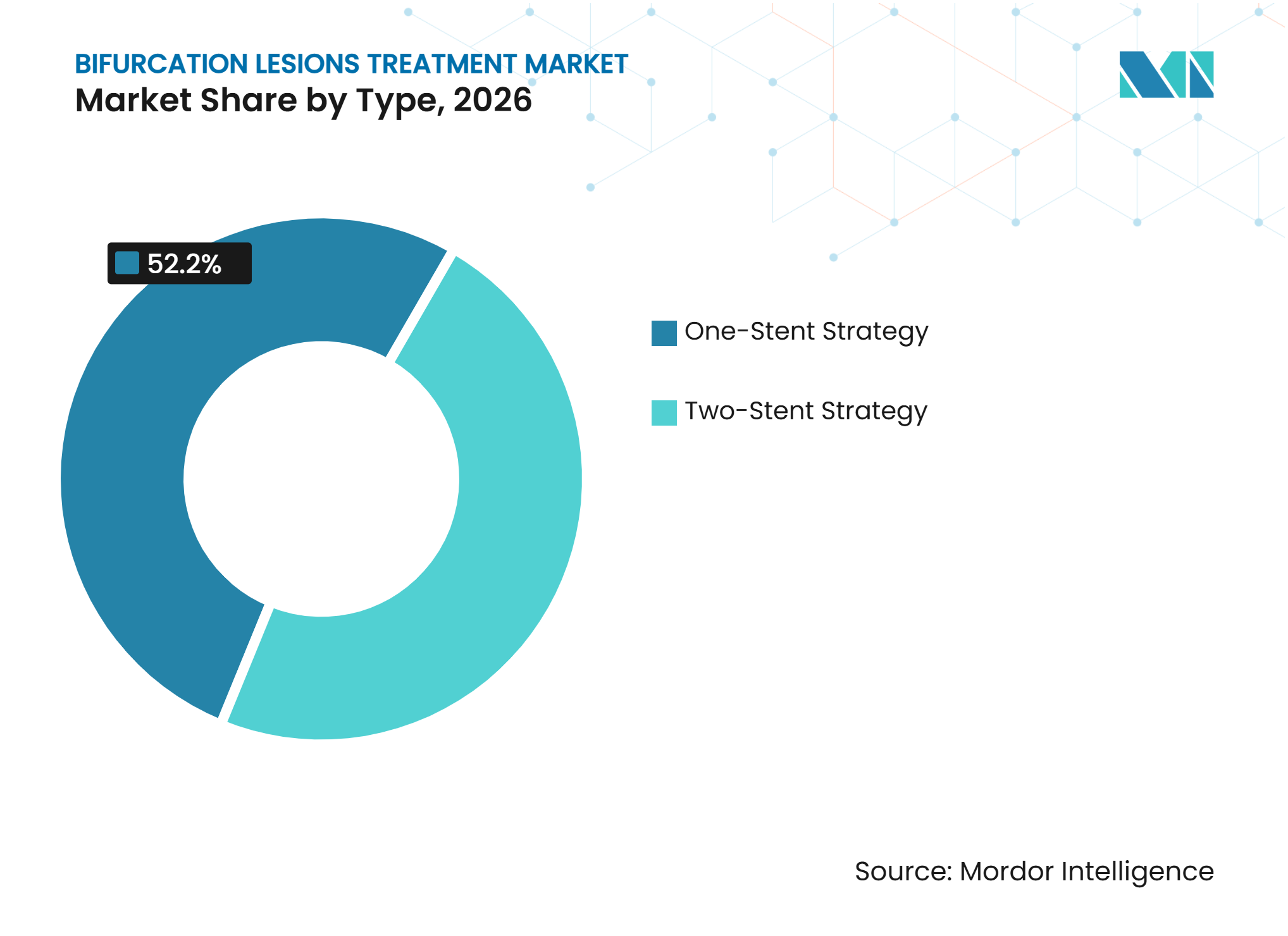
One-Stent Strategies Lead While Two-Stent Use Expands in Selected CasesOne-stent strategy accounted for 52.15% of revenue in 2026. Their leading position reflects evidence that provisional stenting reduces procedural complexity and can lower periprocedural myocardial infarction risk in many non-true bifurcations. The approach is supported by device ecosystems designed around single-stent workflows.
The two-stent strategy is projected to grow at a 6.14% CAGR from 2027 to 2032. Growth is concentrated in true bifurcation anatomy with long side-branch involvement. Imaging-guided assessment helps operators identify the cases where an upfront two-stent strategy is clinically appropriate. A 2026 meta-analysis of 10 randomized trials involving 2,500 patients found dedicated bifurcation stents clinically comparable to conventional drug-eluting stents at 1-year and 4-year endpoints. The evidence supports their use in selected cases, although it does not show clinical superiority over conventional DES.


By Product Type:
Drug-Eluting Stents Anchor Revenue While Drug-Coated Balloons Change Side-Branch TreatmentDrug-eluting stents accounted for 38.71% of the bifurcation lesions treatment market by product type in 2026. They remain the reference treatment for the main branch in both one-stent and two-stent procedures. Guidewires, balloons, and microcatheters are essential complements to stent placement. Their use rises as procedural complexity increases. Atherectomy devices also have a role in calcified lesions that require preparation before stent delivery.
Bare-metal stents are forecasted to grow at 6.73% CAGR through 2032. This pattern is used as a main-branch scaffold in hybrid drug-coated balloon procedures. The hybrid approach can avoid placing a second permanent implant in the side branch. A 2026 stentless PCI study reported 87.3% freedom from target vessel failure and 92.6% target vessel revascularization at 1 year, without side-branch flow disturbance. These findings suggest that selected anatomies may use fewer DES per procedure over time.
By Lesion Location:
Left Main Coronary Procedures Lead While Peripheral Cases Gain AttentionLeft main coronary bifurcation lesions accounted for 39.27% of revenue in 2026. Coronary cases generally use a wider set of devices than peripheral procedures. A typical coronary procedure may include a DES, guidewire, imaging catheter, and a drug-coated balloon or physiology wire. Left-main lesions have particularly high device use because they often require imaging, extended procedure time, and a two-stent approach.
Peripheral bifurcation lesions are forecasted to grow at a 7.82% CAGR from 2027 to 2032. Greater awareness of peripheral artery disease and expanded ankle-brachial index screening support this growth. Aortoiliac procedures using a kissing-stent technique can require bilateral iliac stents. Manufacturers are investing in peripheral balloon and stent profiles to diversify beyond the more competitive coronary bifurcation lesions treatment market.
By Application:
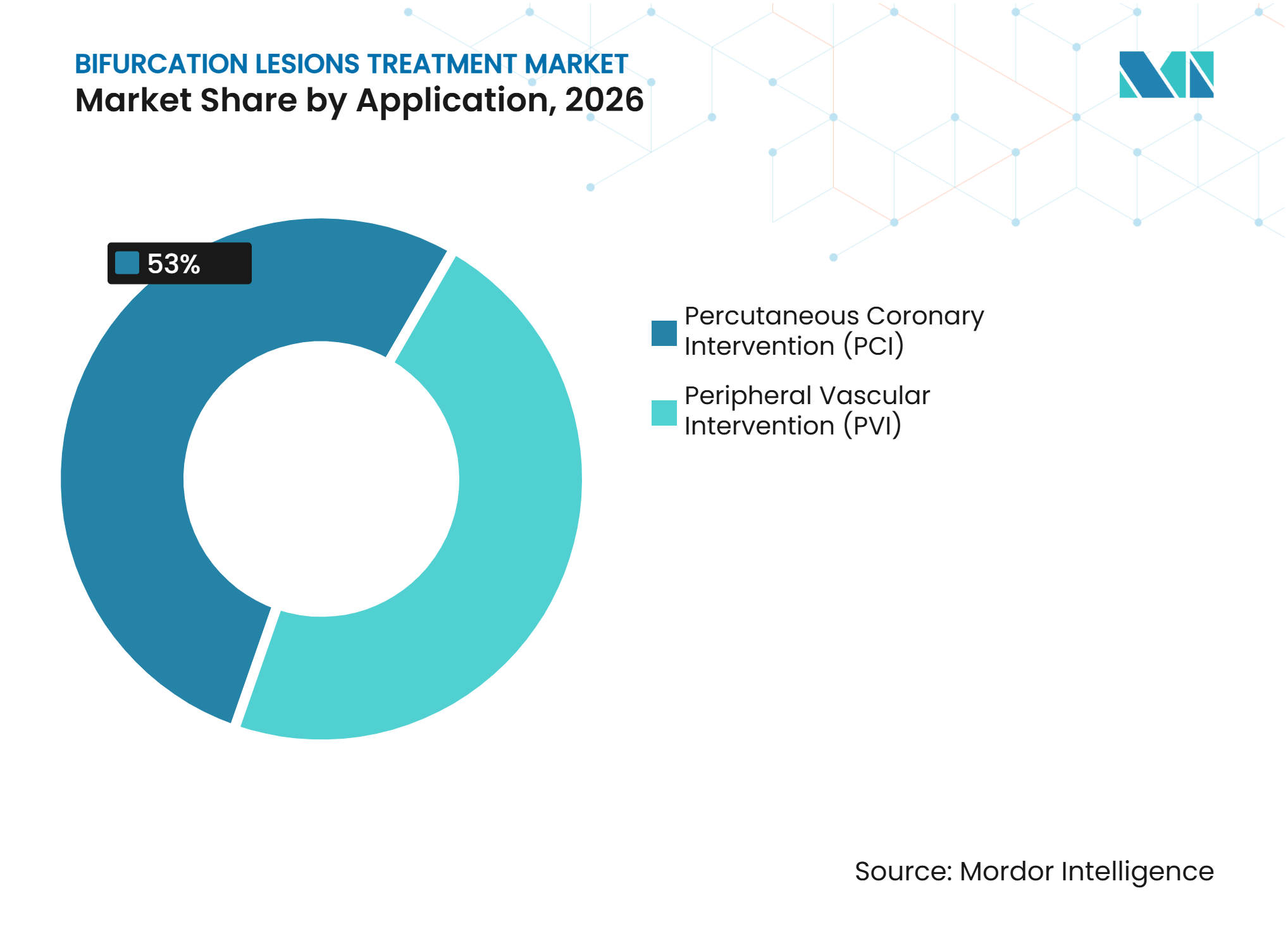
PCI Remains the Primary Source of DemandPercutaneous coronary intervention (PCI) accounted for 53.04% of the bifurcation lesions treatment market by application in 2026. Coronary bifurcation anatomy represents a large share of clinical caseloads. PCI also benefits from the broadest device ecosystem for procedure planning and optimization. Peripheral vascular intervention serves a smaller but expanding population of patients with peripheral artery disease.
PCI is also expected to be the fastest-growing application, growing at an 8.23% CAGR through 2032. Rising coronary disease volumes support procedure demand. Imaging, physiology assessment, and adjunct balloon use can also increase device consumption per PCI case. Current recommendations for intravascular imaging in complex PCI strengthen the clinical basis for these tools. The resulting demand extends to diagnostic and therapeutic products, rather than only stents.

By End-User:
Hospitals Lead While Cardiac Specialty Centers Grow FasterHospitals accounted for 43.63% of revenue in 2026. They remain the principal setting for high-acuity coronary cases that need surgical backup, intensive care, and full catheterization laboratory resources. Academic and research institutes play a smaller role in purchasing volume. However, they are often early adopters of imaging systems and specialized bifurcation devices. Their clinical research can shape later purchasing decisions at community hospitals.
Cardiac specialty centers are forecasted to grow at a 7.22% CAGR from 2027 to 2032. Lower-complexity bifurcation PCI cases are moving toward outpatient cardiac facilities. Stable and predictable cases are more suitable for these settings than high-risk lesions. Greater operator experience and AI-assisted OCT guidance may help reduce variation in technique selection. This increases the relevance of specialty centers to the bifurcation lesions industry.
Geography Analysis
North America
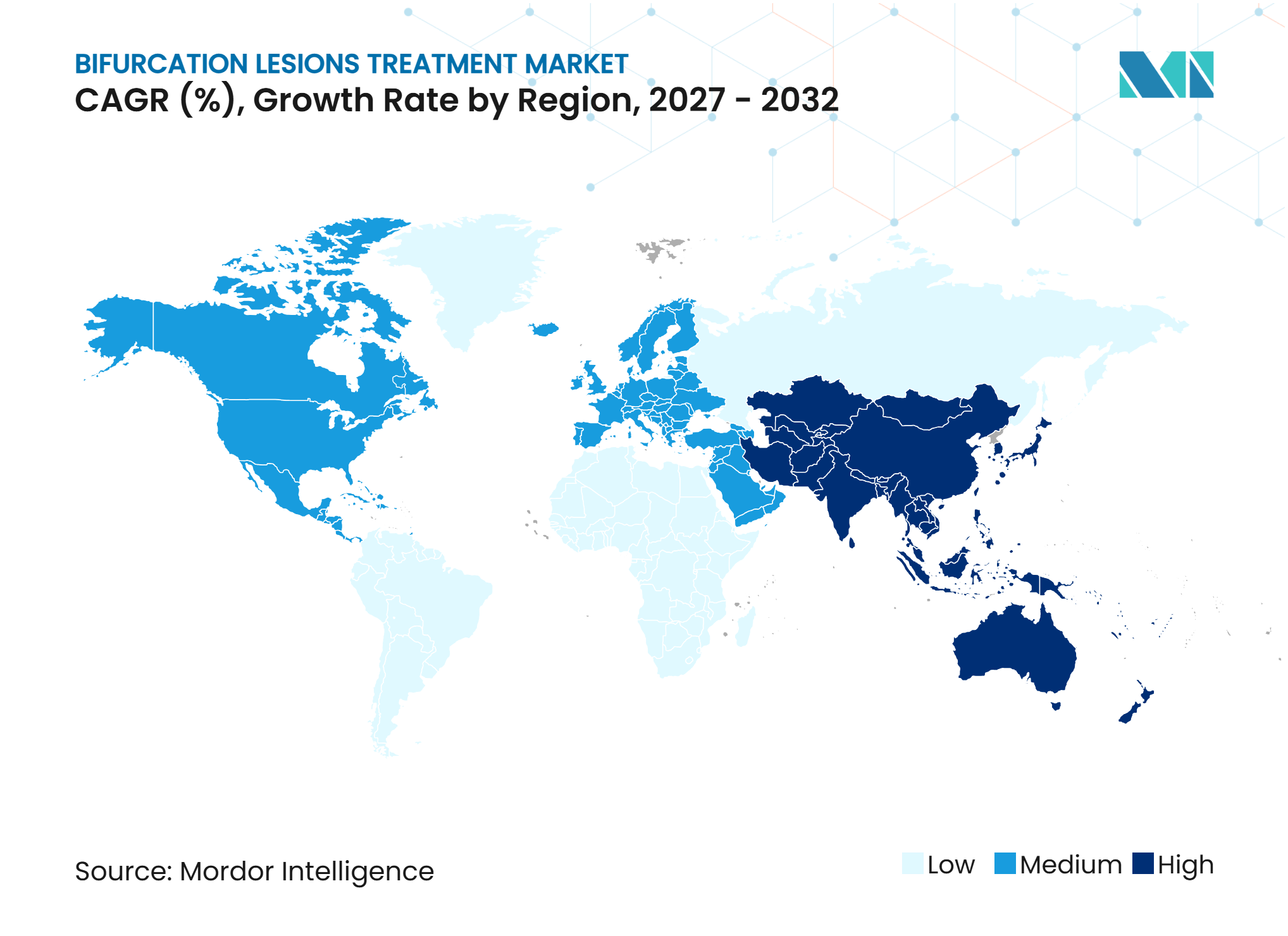
North America accounted for 46.24% of revenue in 2026. High PCI procedure density, hospital reimbursement, and rapid uptake of imaging technologies support its leading position. The United States is the largest national contributor in the region. Guideline support for intravascular imaging in complex PCI has reinforced investment in catheterization laboratory equipment. Medtronic completed its acquisition of CathWorks for USD 585 million in April 2026, adding FFRangio physiology assessment from routine angiograms to its cardiovascular portfolio. Canada and Mexico have growing PCI infrastructure, though reimbursement alignment is less consistent.
Asia-Pacific
Asia-Pacific is projected to grow at a 9.24% CAGR from 2027 to 2032. The region benefits from rising cardiovascular disease, broader access to care, and investment in tertiary cardiac facilities. Japan and South Korea are technical leaders but use different approaches to imaging and physiology assessment. China is expanding procedure access through national procurement, even as stent prices face pressure. MicroPort reported that its coronary stent systems surpassed 10 million cumulative global shipments in October 2025. India is expanding PCI access through Ayushman Bharat and private hospital growth in tier-2 and tier-3 cities.
Europe, Middle East and Africa, and South America
Europe is the second-largest region. Post-market follow-up obligations under EU MDR influence implantable cardiac device registration timelines. The European Bifurcation Club’s MADS-2 classification supports greater consistency in procedure selection across major markets. The bifurcation lesions treatment market in the Middle East and Africa remains smaller but is expanding with healthcare infrastructure investment in Saudi Arabia and the UAE. South America has an early-stage but relevant opportunity, particularly in Brazil and Argentina. Public reimbursement in Brazil supports standard coronary stenting but does not consistently cover premium imaging or dedicated bifurcation devices, creating different access levels across care settings.
Competitive Landscape
Market Concentration
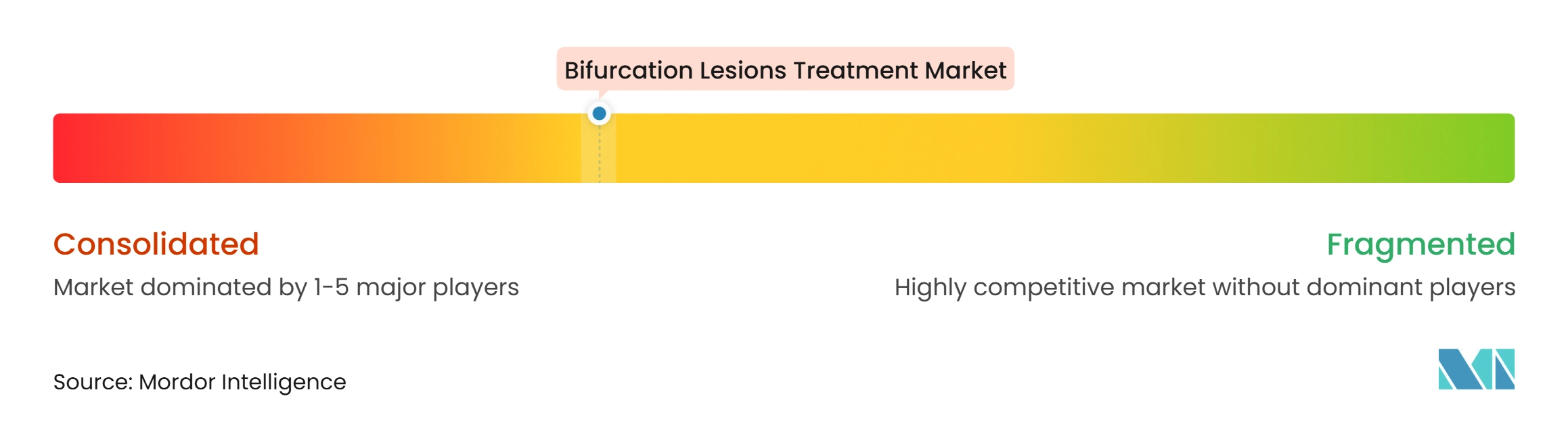
The bifurcation lesions treatment market is moderately consolidated among global device companies. Abbott, Boston Scientific, and Medtronic lead through their DES portfolios and broader procedure platforms. MicroPort, OrbusNeich, Biotronik, B. Braun, and Meril Life Sciences compete through price-performance positions in Asia-Pacific, the Middle East, and emerging hospital markets. Major companies increasingly combine imaging, physiology, and therapy products within catheterization laboratory partnerships. This strategy reduces reliance on stent specifications as the only source of differentiation.
Medtronic added CathWorks in April 2026 for USD 585 million. The acquisition brings angiogram-based physiology assessment into Medtronic’s interventional cardiology portfolio. Advanced Bifurcation Systems acquired Svelte Medical Systems’ FDA-approved DES assets in April 2026, supporting its path toward a dedicated bifurcation DES platform. These moves show that the bifurcation lesions treatment market is moving toward integrated procedure support.
Product opportunities remain in dedicated peripheral configurations for aortoiliac and femoro-profunda anatomy. MicroPort’s Firelimus and Medtronic’s Prevail support greater use of drug-coated balloons in bifurcation treatment. Smaller suppliers need compatible imaging and physiology pathways to compete in high-volume accounts. Regulatory acceleration pathways in China and the United States can help incumbents and specialists bring new platforms forward. The Bifurcation lesions industry, therefore, remains shaped by both device technology and procedural workflow integration.
Bifurcation Lesions Treatment Industry Leaders
-
Abbott Laboratories
-
Boston Scientific Corporation
-
Medtronic plc
-
Terumo Corporation
-
B. Braun Melsungen AG
- *Disclaimer: Major Players sorted in no particular order
Bifurcation Lesions Treatment Market Companies Covered in this Report
- Abbott Laboratories
- Advanced Bifurcation Systems
- B. Braun
- Biosensors International Group, Ltd.
- BIOTRONIK
- Boston Scientific
- Cook Group
- Cordis
- Elixir Medical
- InspireMD, Inc.
- Johnson & Johnson MedTech
- Medinol Ltd.
- Medtronic
- Meril Life Science
- MicroPort
- OrbusNeich Medical Company Limited
- Sahajanand Medical Technologies (SMT) Pvt. Ltd.
- Svelte Medical Systems, Inc.
- Terumo
- Tryton Medical, Inc.
Recent Industry Developments in Bifurcation Lesions Treatment Market
- October 2026: W. L. Gore & Associates' medical business announced that the U.S. Food and Drug Administration approved an expanded indication for the GORE VIABAHN VBX Balloon Expandable Endoprosthesis (VBX Stent Graft) for use in fenestrated and branched endovascular aortic repair (FEVAR and BEVAR).
- April 2026: Advanced Bifurcation Systems Inc., a provider of innovative solutions for treating bifurcation lesions in coronary angioplasty, acquired all assets of Svelte Medical Systems, Inc.
Global Bifurcation Lesions Treatment Market Report Scope
According to the report’s scope, the bifurcation lesions treatment market refers to the global market for interventional cardiology devices and techniques designed to treat coronary artery bifurcation lesions, where a blockage occurs at or near the branching of a main vessel and a side branch. This market encompasses specialized stents, balloons, and procedural strategies (e.g., provisional stenting, double‑stent techniques) that improve patient outcomes in complex percutaneous coronary interventions (PCI).
The bifurcation lesions treatment market is segmented into treatment strategy, product type, lesion location, application, end-user, and geography. By treatment strategy, the market is segmented into one-stent strategy and two-stent strategy. By product type, the market is segmented into drug-eluting stents (DES), bare-metal stents (BMS), balloon catheters, guidewires, microcatheters, atherectomy devices, and other product types. By lesion location, the market is segmented into left main coronary bifurcation lesions, non-left main coronary bifurcation lesions, and peripheral bifurcation lesions. By application, the market is segmented into percutaneous coronary intervention (PCI) and peripheral vascular intervention (PVI). By end-user, the market is segmented into hospitals, cardiac specialty centers, ambulatory surgical centers (ASCs), and academic & research institutes. By geography, the market is segmented into North America, Europe, Asia-Pacific, the Middle East and Africa, and South America. The report also covers the estimated market sizes and trends for 17 countries across major regions globally. The report offers values (USD) for all the above segments.
Segmentation Overview
| One-Stent Strategy |
| Two-Stent Strategy |
| Drug-Eluting Stents (DES) |
| Bare-Metal Stents (BMS) |
| Balloon Catheters |
| Guidewires |
| Microcatheters |
| Atherectomy Devices |
| Other Product Types |
| Left Main Coronary Bifurcation Lesions |
| Non-Left Main Coronary Bifurcation Lesions |
| Peripheral Bifurcation Lesions |
| Percutaneous Coronary Intervention (PCI) |
| Peripheral Vascular Intervention (PVI) |
| Hospitals |
| Cardiac Specialty Centers |
| Ambulatory Surgical Centers (ASCs) |
| Academic & Research Institutes |
| North America | United States |
| Canada | |
| Mexico | |
| Europe | Germany |
| United Kingdom | |
| France | |
| Italy | |
| Spain | |
| Rest of Europe | |
| Asia-Pacific | China |
| Japan | |
| India | |
| Australia | |
| South Korea | |
| Rest of Asia-Pacific | |
| Middle East and Africa | GCC |
| South Africa | |
| Rest of Middle East and Africa | |
| South America | Brazil |
| Argentina | |
| Rest of South America |
| By Treatment Strategy | One-Stent Strategy | |
| Two-Stent Strategy | ||
| By Product Type | Drug-Eluting Stents (DES) | |
| Bare-Metal Stents (BMS) | ||
| Balloon Catheters | ||
| Guidewires | ||
| Microcatheters | ||
| Atherectomy Devices | ||
| Other Product Types | ||
| By Lesion Location | Left Main Coronary Bifurcation Lesions | |
| Non-Left Main Coronary Bifurcation Lesions | ||
| Peripheral Bifurcation Lesions | ||
| By Application | Percutaneous Coronary Intervention (PCI) | |
| Peripheral Vascular Intervention (PVI) | ||
| By End-User | Hospitals | |
| Cardiac Specialty Centers | ||
| Ambulatory Surgical Centers (ASCs) | ||
| Academic & Research Institutes | ||
| By Geography | North America | United States |
| Canada | ||
| Mexico | ||
| Europe | Germany | |
| United Kingdom | ||
| France | ||
| Italy | ||
| Spain | ||
| Rest of Europe | ||
| Asia-Pacific | China | |
| Japan | ||
| India | ||
| Australia | ||
| South Korea | ||
| Rest of Asia-Pacific | ||
| Middle East and Africa | GCC | |
| South Africa | ||
| Rest of Middle East and Africa | ||
| South America | Brazil | |
| Argentina | ||
| Rest of South America | ||
Key Questions Answered in the Report
What is driving demand for the bifurcation lesion treatment market?
Rising cardiovascular disease and wider use of intravascular imaging are supporting demand for stents, imaging catheters, and adjunct tools. The market value is expected to grow from USD 2.69 billion in 2026 to USD 2.82 billion in 2027 to reach USD 3.70 billion by 2032, from 2027 to 2032.
Which treatment strategy is most common for bifurcation lesions?
One-stent strategy led with 52.15% revenue share in 2026 because provisional stenting remains suitable for many non-true bifurcations.
Where are bifurcation procedures increasingly being performed?
Hospitals remain the largest end-user setting, while cardiac specialty centers are projected to grow at a 7.22% CAGR as selected lower-complexity cases move to outpatient.
Which region is expanding fastest for bifurcation treatment?
Asia-Pacific is projected to expand at a 9.24% CAGR from 2027 to 2032, supported by growing cardiac care access and infrastructure.