
Battery Transportation Market Size and Share
Market Overview
| Study Period | 2022 - 2032 |
|---|---|
| Market Size (2027) | USD 24.56 Billion |
| Market Size (2032) | USD 42.32 Billion |
| Growth Rate (2027 - 2032) | 11.72 % |
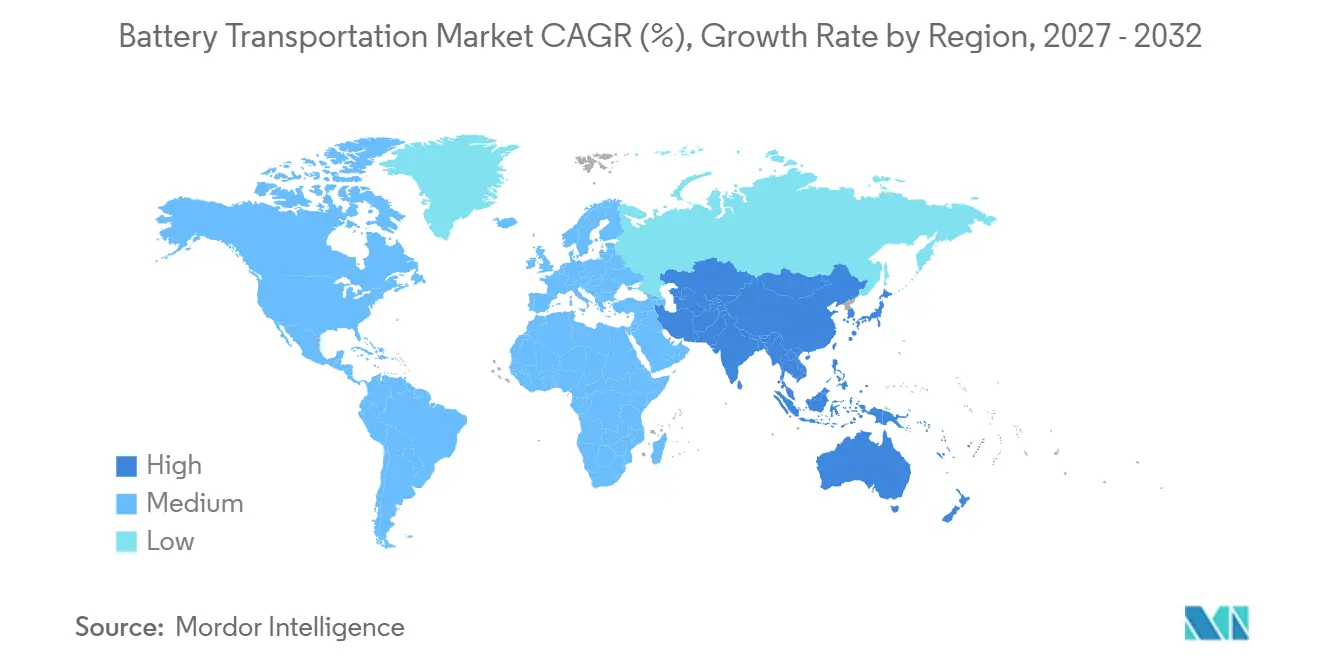
| Fastest Growing Market | Asia-Pacific |
| Largest Market | Asia-Pacific |
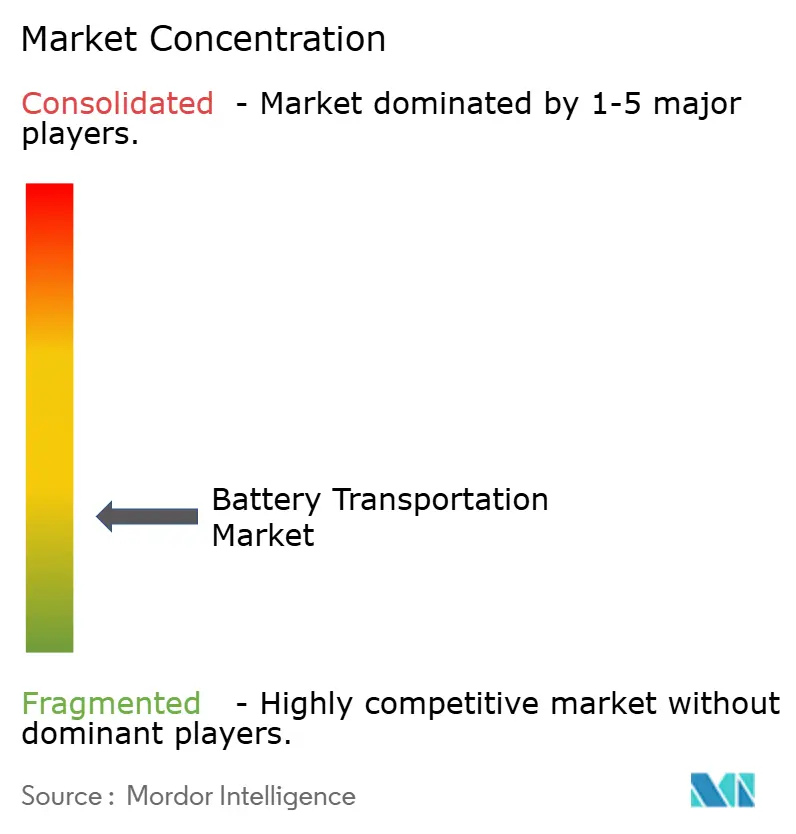
| Market Concentration | Low |
Major Players *Disclaimer: Major Players sorted in no particular order Image © Mordor Intelligence. Reuse requires attribution under CC BY 4.0. | |
Battery Transportation Market Analysis by Mordor Intelligence
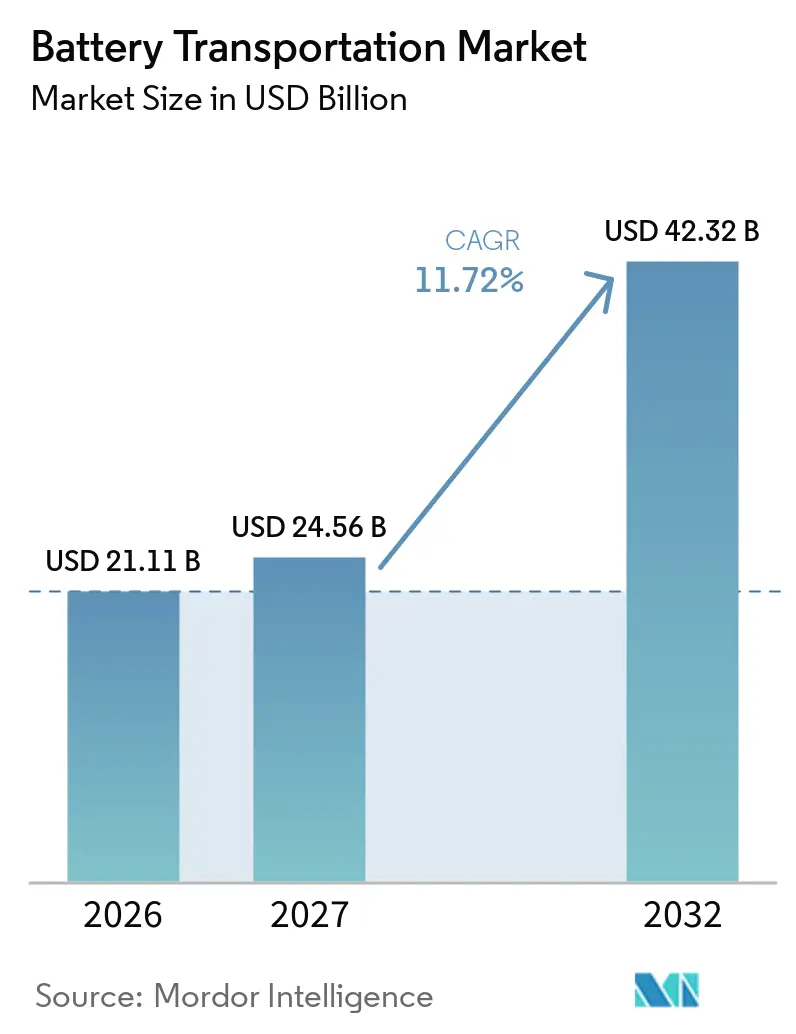
The Battery Transportation Market size is expected to increase from USD 21.11 billion in 2026 to USD 24.56 billion in 2027 and reach USD 42.32 billion by 2032, growing at a CAGR of 11.72% over 2027-2032. Growth in the battery transportation market follows the rise in electric vehicle and stationary-storage deployments, which require freight providers to handle Class 9 dangerous goods with specialized documentation and controls.[1] The battery transportation market is also shaped by concentrated cell production in China and the resulting movement of cells, packs, and materials across long international routes.[2] Safety risk raises the value of established dangerous-goods expertise, because thermal runaway cannot be fully stopped by current suppression methods once it begins.[3] This setting favors carriers that can combine compliant warehousing, qualified personnel, condition monitoring, and cross-border operating capability. It also creates an opening for firms that can integrate traceability requirements into regular freight operations before European rules take effect.[4]
Key Report Takeaways
- By battery type, lithium-ion batteries held 63.5% of the battery transportation market share in 2026, while solid-state batteries are projected to grow at an 18.3% CAGR through 2032.
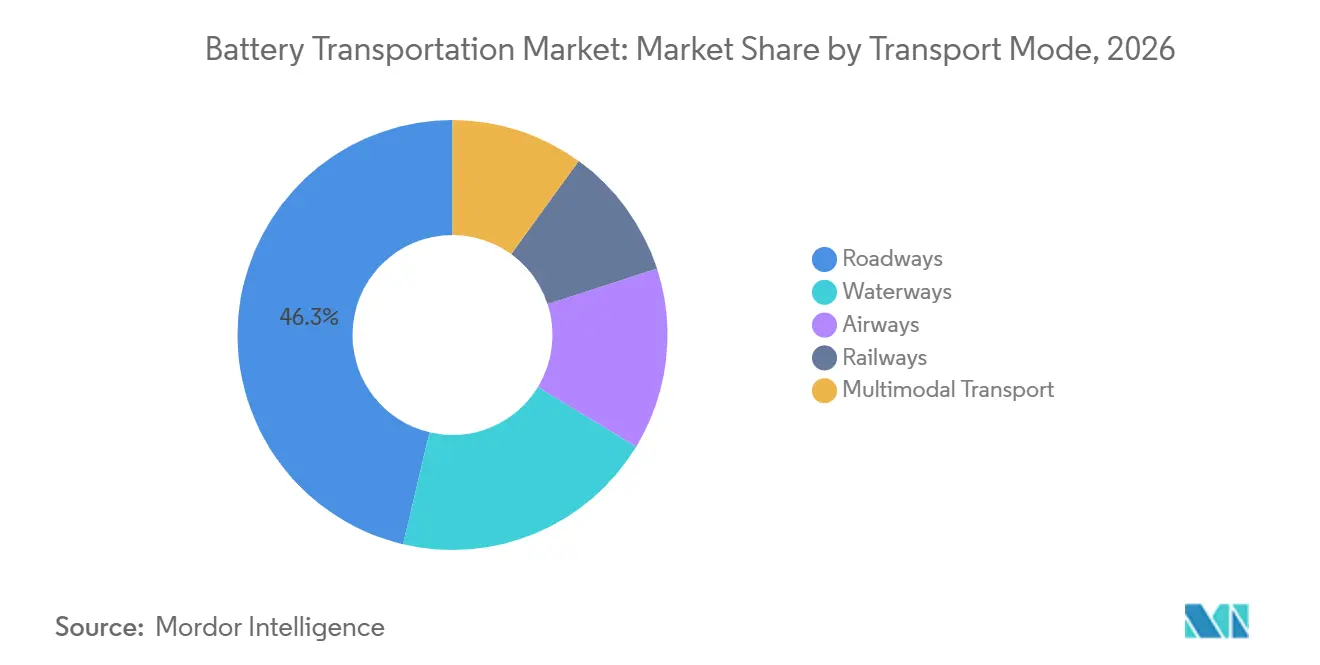
- By transport mode, roadways held 46.3% of the battery transportation market share in 2026, while multimodal transport is projected to grow at a 12.4% CAGR through 2032.
- By battery status, new cells and packs held 65.7% of the battery transportation market share in 2026, while end-of-life batteries are projected to grow at a 13.4% CAGR through 2032.
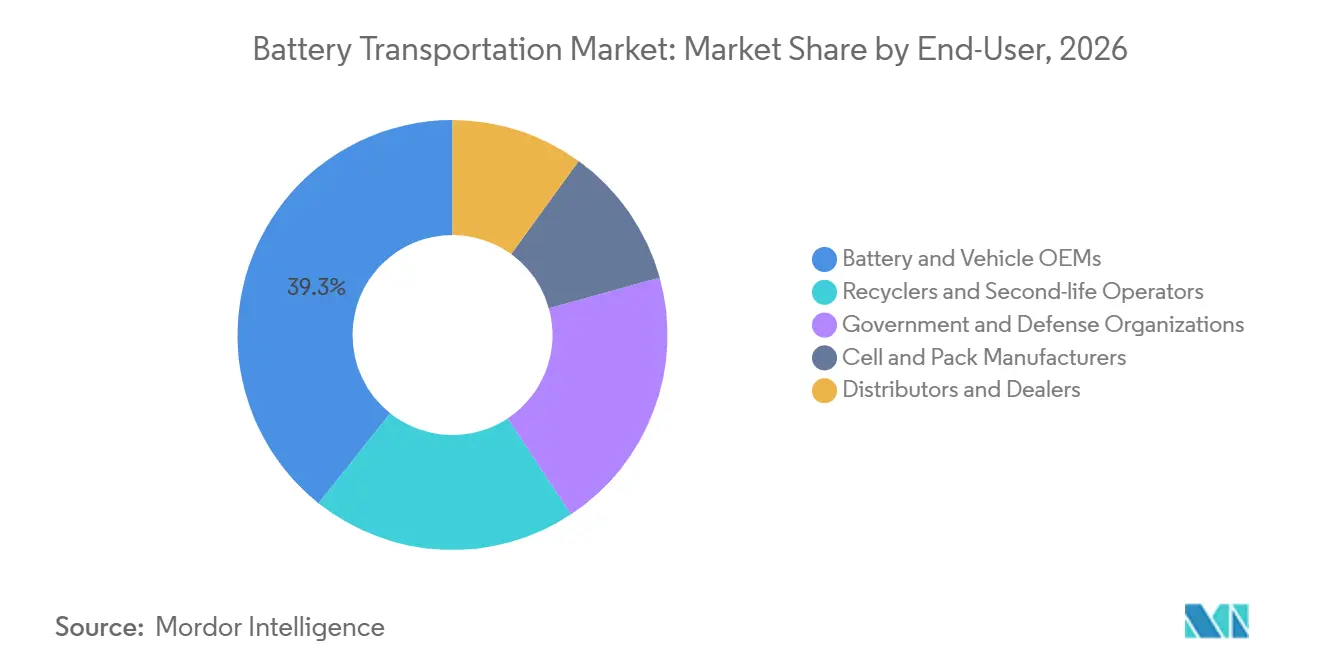
- By end user, battery and vehicle Original Equipment Manufacturers (OEMs) held 39.3% of the battery transportation market share in 2026, while recyclers and second-life operators are projected to grow at a 14.2% CAGR through 2032.
- By geography, Asia-Pacific held 47.3% of the battery transportation market share in 2026 and is projected to grow at a 13.1% CAGR through 2032.
Note: Market numbers in this report are based on Mordor Intelligence's proprietary estimation framework, which combines nine months of actuals with Q4 projections for base year 2026.
Market Trends and Insights
Drivers Impact Analysis of Battery Transportation Market*
| Driver | (~) % Impact on CAGR Forecast | Geographic Relevance | Impact Timeline |
|---|---|---|---|
| Electrification and EV Battery Production Growth | +3.0% | Global, concentrated in APAC, North America, and Europe | Short term (≤ 2 years) |
| Renewable Energy Storage and BESS Deployment | +2.2% | Global, with core activity in APAC and North America | Medium term (2-4 years) |
| Battery-Passport Traceability and Compliance Outsourcing | +1.4% | Europe, with spillover to North America | Medium term (2-4 years) |
| Cross-Border Gigafactory Corridor Formation | +1.6% | Europe, North America, and APAC | Medium term (2-4 years) |
| Closed-Loop Logistics for Retired and Damaged Batteries | +1.2% | Europe, APAC, and North America | Long term (≥ 4 years) |
| E-commerce and Time-Critical Replacement Battery Shipments | +0.8% | Global, with core activity in APAC and North America | Short term (≤ 2 years) |
| Source: Mordor Intelligence | |||
Electrification And Electric Vehicle (EV) Battery Production Growth
Global electric vehicle sales exceeded 20 million units in 2025, and electric cars represented more than one in four cars sold worldwide. Each finished vehicle battery requires compliant shipment, while material, module, and cell movements add further transport activity before final assembly. This pattern gives the battery transportation market exposure to both finished-pack distribution and the upstream manufacturing chain. China remains central to these flows because it manufactured more than 80% of lithium-ion cells in 2025. Production expansion in North America and Europe adds regional transport lanes rather than removing the need for intercontinental movement. Carriers with dangerous-goods capability can therefore participate in recurring movements between material suppliers, cell plants, vehicle plants, and distribution locations.
Renewable Energy Storage and Battery Energy Storage System (BESS) Deployment
Utility-scale battery energy storage systems create a distinct requirement within the battery transportation market because units can exceed standard container weights. Containerized BESS units in the 40 to 48 ton range require Class 9 treatment under UN3536 and may need multipurpose or heavy-lift vessels. COSCO SHIPPING Special Transport delivered 2,386 containerized units totaling 12.5 GWh to a Saudi Arabian project across 13 voyages in August 2025. Such projects require transport planning across vessel selection, port handling, inland movement, and site delivery. Lower storage-system prices have broadened deployment pipelines across several regions, increasing the need for qualified project cargo capacity. The battery transportation market benefits when providers can plan these movements as a single controlled operation rather than as separate freight legs.
Battery Passport Traceability and Compliance Outsourcing
The European Union requires a digital Battery Passport for qualifying EV and industrial batteries placed on its market from February 2027. Supply-chain due diligence requirements for cobalt, nickel, lithium, and natural graphite take effect from August 2027 under the amended schedule. These rules make verified records relevant at each point where batteries move, are stored, repaired, repurposed, or collected. The battery transportation market can gain additional service revenue where logistics providers support traceability and data capture alongside physical handling. Manufacturers without established digital systems may depend more heavily on qualified third-party logistics providers for EU-bound movements. This requirement favors operators that connect shipment records with battery identification, condition data, and regulatory documentation.
Cross-Border Gigafactory Corridor Formation
Battery plants create repeated freight movements that support dedicated routes and specialized logistics assets. Volkswagen Group’s PowerCo SE commenced production at its Salzgitter plant in December 2025, with a capacity of up to 20 GWh and rail-prioritized links to facilities in Martorell and Valencia. In China, CATL and Yunnan Communications Investment launched a 900 km battery-swapping corridor in June 2025 for new-energy trucks operating on Southeast Asian trade routes. These established lanes give the battery transportation market more predictable volumes than one-time project shipments. Predictable movement supports investment in trained drivers, approved equipment, and specialized hubs. It also strengthens the position of providers that can commit capacity before a new plant reaches full output.
Restraints Impact Analysis of Battery Transportation Market*
| Restraint | (~) % Impact on CAGR Forecast | Geographic Relevance | Impact Timeline |
|---|---|---|---|
| Thermal Runaway, Fire Risk and Insurance Costs | -1.8% | Global, with particular exposure in maritime and air modes | Medium term (2-4 years) |
| Evolving Dangerous-Goods Rules and Airline Acceptance Limits | -1.4% | Global, with particular exposure in air and cross-border road and rail transport | Short term (≤ 2 years) |
| Shortage of DG-Certified Capacity and Emergency-Response Infrastructure | -0.9% | APAC, with spillover to the Middle East, Africa, and South America | Medium term (2-4 years) |
| High Capital Costs for Compliant Warehouses and Specialized Fleets | -1.1% | North America, Europe, and emerging APAC markets | Long term (≥ 4 years) |
| Source: Mordor Intelligence | |||
Thermal Runaway, Fire Risk and Insurance Costs
Thermal runaway remains a major safety constraint for the battery transportation market because it produces heat and flammable gases that existing suppression methods cannot fully interrupt. A single event can affect cargo, a vessel or facility, onward operations, and carrier acceptance. Maritime movements are especially exposed when large battery systems travel in enclosed shipboard environments. The resulting risk leads carriers and insurers to place greater value on proven containment, separation, detection, and emergency-response procedures. Smaller providers may find it difficult to absorb the cost of compliant storage and response equipment. The battery transportation market therefore has higher barriers for operators that do not already have specialized dangerous-goods infrastructure.
Evolving Dangerous-Goods Rules and Airline Acceptance Limits
The UN Model Regulations Rev. 24 introduced new entries for hybrid batteries combining lithium-ion and sodium-ion cells in 2025. Agreement concerning the International Carriage of Dangerous Goods by Road (ADR) 2025 also added requirements affecting battery-powered vehicles and sodium-ion batteries, requiring updated transport documentation and procedures. IATA guidance for 2025 to 2026 sets requirements for lithium batteries offered for air transport, including state-of-charge controls in applicable cases. These updates can limit available capacity for urgent air shipments and raise training requirements for carriers. The battery transportation market must adjust quickly because incorrect documentation or packaging can prevent shipment acceptance. Compliance resources are therefore becoming a practical differentiator in addition to physical freight capacity.
*Our forecasts treat driver/restraint impacts as directional, not additive. The impact forecasts reflect baseline growth, mix effects, and variable interactions.
Battery Transportation Market Segment Analysis
By Battery Type:
Lithium-Ion Leads Volumes While Solid-State Raises Handling RequirementsLithium-ion batteries held 63.5% of the battery transportation market share in 2026. Their position reflects standardized UN38.3 testing, established containment practices, and carrier familiarity across road, air, sea, and rail movements. The battery transportation market size for lithium-ion movements benefits from the chemistry’s broad use in electric vehicles, energy storage, consumer electronics, and industrial equipment. China’s manufacturing base gives lithium-ion logistics a large export component, while regional vehicle and cell plants generate domestic flows. Lead-acid batteries remain relevant in industrial and starter-battery replacement routes, particularly where cost sensitivity supports continued use. Nickel-metal hydride and nickel-cadmium batteries have less automotive relevance, while sodium-ion batteries are entering commercial transport lanes under newer regulatory treatment.
Solid-state batteries are projected to advance at an 18.3% CAGR through 2032, the fastest rate among battery types. This category needs closer attention to temperature, humidity, and packaging conditions than conventional liquid-electrolyte batteries. ION Storage Systems shipped commercial Cornerstone cells to electric vehicle and consumer electronics customers in August 2025. Early sample and commercial shipments give specialist freight providers an opportunity to develop controlled service processes before larger volumes emerge. The segment may command higher fees because logistics providers need to protect sensitive products while retaining dangerous-goods compliance. The battery transportation industry will need tailored procedures as more solid-state cells move between manufacturers, testing sites, customers, and vehicle programs.
By Transport Mode:
Roadways Anchor Distribution While Multimodal Services ExpandRoadways held 46.3% of the battery transportation market share in 2026. Road freight provides direct links between distribution centers, ports, gigafactories, dealers, recycling sites, and final project locations. The mode is particularly important for last-mile and regional deliveries where alternative modes do not provide the same flexibility. European Agreement Concerning the International Carriage of Dangerous Goods by Road (ADR) requirements increase the administrative burden for European road carriers, but do not change the need for controlled truck movements. Air freight remains relevant for urgent shipments, prototypes, and certain replacement batteries, although state-of-charge controls can constrain operations. Waterways handle large BESS and project cargo, where vessel and port suitability can determine whether a shipment proceeds.
Multimodal transport is forecast to grow at a 12.4% CAGR through 2032. The battery transportation market size for this model rises where heavy Battery Energy Storage System (BESS) cargo exceeds road axle-load limits or must travel over long international routes. EUROGATE Wilhelmshaven completed a sea-rail transfer of 12 BESS units weighing 48 tons each from Ningbo to Budapest in December 2025. Nippon Express, Honda, and JR Freight also began commercial rail transport for EV battery packs in Japan during September 2025. These examples show that coordinated transfers can meet weight, compliance, and timing needs that a single mode cannot meet. Multimodal providers must manage handovers carefully because each transfer introduces documentation, safety, and condition-control requirements.
By Battery Status:
New Cells and Packs Lead While End-of-life Movements FormalizeNew cells and packs held 65.7% of the battery transportation market share in 2026. Most of this volume travels from cell plants and pack assembly sites to vehicle manufacturers, energy-storage projects, distribution networks, and export markets. The battery transportation market gains steady new-product volumes as Asian production feeds manufacturing and consumption centers worldwide. Damaged and defective batteries form a separate service area because they need stricter packaging and additional handling controls. Prototype batteries also require careful planning as manufacturers move samples between laboratories, automotive partners, and validation facilities. These flows reward logistics companies that can separate, identify, and document different conditions without disrupting regular operations.
End-of-life batteries are forecast to grow at a 13.4% CAGR through 2032. Their movement is linked to collection, discharge, diagnostics, dismantling, repurposing, and recycling rather than a direct shipment to a final customer. CEVA Logistics announced a European reverse-logistics network in September 2025 that includes Accord Dangereux Routier (ADR) transport, deep discharge, dismantling, and real-time diagnostics. The EU Battery Regulation connects product records and recycling responsibilities, raising the importance of traceable reverse movements. Second-life candidates need assessment before they are assigned to reuse or material recovery. This status category creates demand for providers that can combine transportation with controlled storage, diagnostics, and approved downstream routing.
By End User:
Original Equipment Manufacturers (OEMs) Provide Stable Lanes While Recyclers Scale Reverse NetworksBattery and vehicle Original Equipment Manufacturers (OEMs) held 39.3% of the battery transportation market share in 2026. Their contracts tend to support predictable routes because shipments follow planned production schedules and long-term supply arrangements. The battery transportation market size tied to OEMs includes materials, cells, modules, packs, finished vehicles, service replacements, and returns. Cell and pack manufacturers also generate repeat movements between facilities, though their freight patterns can be more concentrated around production locations. Distributors and dealers support more fragmented aftermarket demand. Government and defense buyers require security and operational controls that can limit the number of suitable general freight providers.
Recyclers and second-life operators are projected to grow at a 14.2% CAGR through 2032. Their requirements differ from OEM freight because the battery condition and final destination may not be known until inspection occurs. The battery transportation industry must support secure collection, isolation of damaged units, transport to qualified facilities, and records that follow each battery through the process. CEVA Logistics’ network plan shows that logistics companies are adding technical activities beside transport in response to this need. Providers that can perform diagnostics at a logistics node can direct usable batteries to stationary-storage applications and unsuitable units to recycling. This ability creates differentiation that cannot be delivered by scale alone.
Geography Analysis
APAC Battery Transportation Market
Asia-Pacific held 47.3% of the battery transportation market share in 2026 and is projected to grow at a 13.1% CAGR through 2032. China is central to regional activity because it produced more than 80% of global lithium-ion cells in 2025 and has a major electric-vehicle base. This combination supports large domestic movements and export flows to Europe and North America. The battery transportation market in the region must accommodate cells, vehicle packs, materials, BESS units, and reverse logistics. South Korea and Japan add established technology and automotive supply chains. Nippon Express, Honda, and JR Freight’s 500 km rail service in Japan illustrates a controlled alternative to road transport for battery packs. Vietnam, Thailand, and Indonesia are also expanding their roles as manufacturing and consumption locations.
Europe Battery Transportation Market
Europe has a substantial position in the battery transportation market because regulatory requirements and new gigafactory capacity are reshaping freight decisions. PowerCo’s Salzgitter plant began production in December 2025, creating rail-prioritized logistics links to other European battery sites. The Battery Passport requirement from February 2027 will increase the importance of documented and traceable EU-bound supply chains. European logistics providers are responding with dedicated battery facilities and reverse-logistics capacity. CEVA’s planned network covers 10 European countries by 2027. The region therefore combines high compliance needs with both forward and return movements.
The Americas and Middle East Battery Transportation Market
North America is developing more systematic battery logistics infrastructure as manufacturing and energy-transition programs broaden. Maersk launched a dedicated Class 9 battery ground-freight service in the United States, Canada, and Mexico in June 2026 through 65 stations and 7 regional hubs. South America is connected to battery supply chains through lithium resources and BESS imports for renewable-energy projects. The Middle East has gained project-logistics relevance through large energy-storage deployments. Cosco Shipping’s 125 GWh delivery to Saudi Arabia shows the scale of BESS cargo now moving into the region. These areas require providers that can manage port, inland, and site-delivery activities under a consistent compliance process.
Competitive Landscape
The global battery transportation market is fragmented. Large third-party logistics providers compete with focused battery logistics specialists that possess deep dangerous goods knowledge and established handling procedures. DHL Supply Chain, Maersk, Kuehne+Nagel, DSV, and DB Schenker have broad networks that can support international movements. Specialized firms can retain an advantage where a shipment requires unusual containment, technical assessment, or emergency-response planning. This competitive setting means physical scale alone is not enough. Qualified personnel, compliant facilities, equipment, and documentation systems remain essential competitive assets.
DHL delivered more than 1,100 BESS units globally in the first half of 2026 and expanded its new-energy logistics network beyond 20 global sites. Maersk’s June 2026 launch of a 65-station North American battery freight service expanded competition in a service category previously served largely by specialist providers. Kuehne+Nagel has also documented specialized international BESS shipments to the United States, United Kingdom, and Germany. These moves show an emphasis on dedicated hubs, qualified handling teams, and cross-modal project capability. The battery transportation market rewards firms that can control risk at every handoff, rather than simply booking transport capacity. Providers are also competing to make compliance activity easier for customers through centralized records and visibility tools.
Real-time monitoring of state of charge, temperature, and voltage across multimodal journeys remains an important opportunity for differentiation. The Battery Passport deadline adds urgency because logistics records may become more valuable within a wider product-traceability system. Providers lacking integrated traceability systems may be less attractive for EU-bound work even when their physical network is strong. Competitive strategies are therefore likely to center on controlled handling, digital records, condition visibility, and dedicated facilities.
Battery Transportation Industry Leaders
-
DHL Supply Chain
-
Kuehne + Nagel International AG
-
DB Schenker
-
DSV A/S
-
CEVA Logistics
- *Disclaimer: Major Players sorted in no particular order
Battery Transportation Market Companies Covered in this Report
- Alfred Schuon GmbH
- C.H. Robinson Worldwide, Inc.
- CEVA Logistics
- CJ Logistics Corporation
- DB Schenker
- DHL Supply Chain
- DSV A/S
- Expeditors International of Washington, Inc.
- FedEx Corporation
- GEODIS
- Hellmann Worldwide Logistics
- J.B. Hunt Transport Services, Inc.
- Kuehne + Nagel International AG
- Maersk
- Nippon Express Holdings, Inc.
- NOWOS
- PSA BDP
- Rhenus Group
- SF Express Co., Ltd.
- Sinotrans Limited
- United Parcel Service, Inc.
- XPO, Inc.
Recent Industry Developments in Battery Transportation Market
- September 2026: DHL delivers more than 1,100 BESS units globally and breaks ground on Netherlands battery hub. DHL Supply Chain expanded its New Energy Logistics network to over 20 global sites and began construction of a new 17,000 m² European Battery Logistics Hub in Holtum, Netherlands, targeting EUR 3 billion in new-energy logistics revenue by 2030 and scheduled for Q1 2027 commissioning.
- June 2026: Maersk launches dedicated lithium-ion battery ground freight service in North America. A.P. Moller – Maersk entered the U.S., Canada, and Mexico battery transport market with a specialized Class 9 dangerous-goods service via 65 stations and 7 regional hubs, targeting a USD 2.4–3.0 billion North American battery logistics opportunity with hazmat-trained drivers and strict state-of-charge compliance.
- December 2025: VW’s PowerCo SE commences production at Salzgitter gigafactory, Europe’s first battery cell plant. PowerCo SE brought Europe’s first domestically designed and manufactured battery cell plant online at Salzgitter, Germany, with initial capacity up to 20 GWh expandable to 40 GWh, establishing rail-prioritized logistics corridors to Valencia and St. Thomas gigafactory sites.
- September 2025: CEVA Logistics launches EV battery reverse logistics network across Europe. CEVA announced a multi-million-euro investment to establish Battery Logistics Centers in 10 European countries by 2027, targeting 80% of European end-of-life EV battery volumes by 2030, with Accord Dangereux Routier (ADR)-certified collection, deep discharge, dismantling, and real-time traceability.
Global Battery Transportation Market Report Scope
The Battery Transportation Market is defined through two distinct industry lenses: the transport of batteries as cargo (logistics) and batteries used for vehicular propulsion (product market).
The global battery transportation market is segmented by battery type, transport mode, battery status, end user, and geography. By battery type, the market is segmented into lithium-ion, lead-acid, nickel-metal hydride (NiMH), nickel-cadmium (NiCd), sodium-ion, solid-state, and other battery types. By transport mode, the market is segmented into roadways, airways, waterways, railways, and multimodal transport. By battery status, the market is segmented into new cells and packs, used and returned batteries, damaged and defective batteries, prototype batteries, and end-of-life batteries. By end user, the market is segmented into battery and vehicle original equipment manufacturers (OEMs), cell and pack manufacturers, distributors and dealers, recyclers and second-life operators, and government and defense organizations. The report also covers the market size and forecasts for the global battery transportation market across 26 countries in key regions. For each segment, the market sizing and forecasts have been provided on the basis of value (USD).
Segmentation Overview
| Lithium-ion Batteries |
| Lead-acid Batteries |
| Nickel-metal Hydride Batteries |
| Nickel-cadmium Batteries |
| Sodium-ion Batteries |
| Solid-state Batteries |
| Other Battery Types |
| Roadways |
| Airways |
| Waterways |
| Railways |
| Multimodal Transport |
| New Cells and Packs |
| Used and Returned Batteries |
| Damaged and Defective Batteries |
| Prototype Batteries |
| End-of-life Batteries |
| Battery and Vehicle OEMs |
| Cell and Pack Manufacturers |
| Distributors and Dealers |
| Recyclers and Second-life Operators |
| Government and Defense Organizations |
| North America | United States |
| Canada | |
| Mexico | |
| Europe | Germany |
| France | |
| Italy | |
| Spain | |
| United Kingdom | |
| Poland | |
| Russia | |
| Rest of Europe | |
| Asia-Pacific | China |
| India | |
| Japan | |
| South Korea | |
| Australia | |
| Indonesia | |
| Vietnam | |
| Thailand | |
| Rest of Asia-Pacific | |
| South America | Brazil |
| Argentina | |
| Chile | |
| Rest of South America | |
| Middle East and Africa | Saudi Arabia |
| United Arab Emirates | |
| Egypt | |
| South Africa | |
| Morocco | |
| Rest of Middle East and Africa |
| By Battery Type | Lithium-ion Batteries | |
| Lead-acid Batteries | ||
| Nickel-metal Hydride Batteries | ||
| Nickel-cadmium Batteries | ||
| Sodium-ion Batteries | ||
| Solid-state Batteries | ||
| Other Battery Types | ||
| By Transport Mode | Roadways | |
| Airways | ||
| Waterways | ||
| Railways | ||
| Multimodal Transport | ||
| By Battery Status | New Cells and Packs | |
| Used and Returned Batteries | ||
| Damaged and Defective Batteries | ||
| Prototype Batteries | ||
| End-of-life Batteries | ||
| By End User | Battery and Vehicle OEMs | |
| Cell and Pack Manufacturers | ||
| Distributors and Dealers | ||
| Recyclers and Second-life Operators | ||
| Government and Defense Organizations | ||
| By Geography | North America | United States |
| Canada | ||
| Mexico | ||
| Europe | Germany | |
| France | ||
| Italy | ||
| Spain | ||
| United Kingdom | ||
| Poland | ||
| Russia | ||
| Rest of Europe | ||
| Asia-Pacific | China | |
| India | ||
| Japan | ||
| South Korea | ||
| Australia | ||
| Indonesia | ||
| Vietnam | ||
| Thailand | ||
| Rest of Asia-Pacific | ||
| South America | Brazil | |
| Argentina | ||
| Chile | ||
| Rest of South America | ||
| Middle East and Africa | Saudi Arabia | |
| United Arab Emirates | ||
| Egypt | ||
| South Africa | ||
| Morocco | ||
| Rest of Middle East and Africa | ||
Key Questions Answered in the Report
What is the projected value of global battery transportation in 2032?
The global battery transportation market is projected to reach USD 42.32 billion by 2032, rising from USD 21.11 billion in 2026 at an 11.72% CAGR over 2027 to 2032.
Which battery type leads transportation demand?
Lithium-ion batteries lead, with 63.5% share in 2026. Their extensive use in electric vehicles, storage systems, and electronics supports broad freight demand.
Which transport mode is growing fastest for battery shipments?
Multimodal transport is forecast to grow at a 12.4% CAGR through 2032 as heavy BESS systems often need coordinated sea, rail, and road movements.
Why are battery passports important for logistics providers?
The EU Battery Passport requirement begins in February 2027 for qualifying batteries, increasing the need for traceable shipment and handling records.
Which region has the largest share of battery transportation activity?
Asia-Pacific leads with 47.3% share in 2026 and is projected to grow at a 13.1% CAGR through 2032, supported by Chinas large battery manufacturing base.
What creates the main safety challenge in battery freight?
Thermal runaway is the key risk because current suppression methods cannot fully stop the reaction after it has begun, requiring specialist containment and emergency procedures.