
Battery Separator Market Size and Share
Market Overview
| Study Period | 2022 - 2032 |
|---|---|
| Market Size (2027) | USD 18.16 Billion |
| Market Size (2032) | USD 37.60 Billion |
| Growth Rate (2027 - 2032) | 15.66 % |
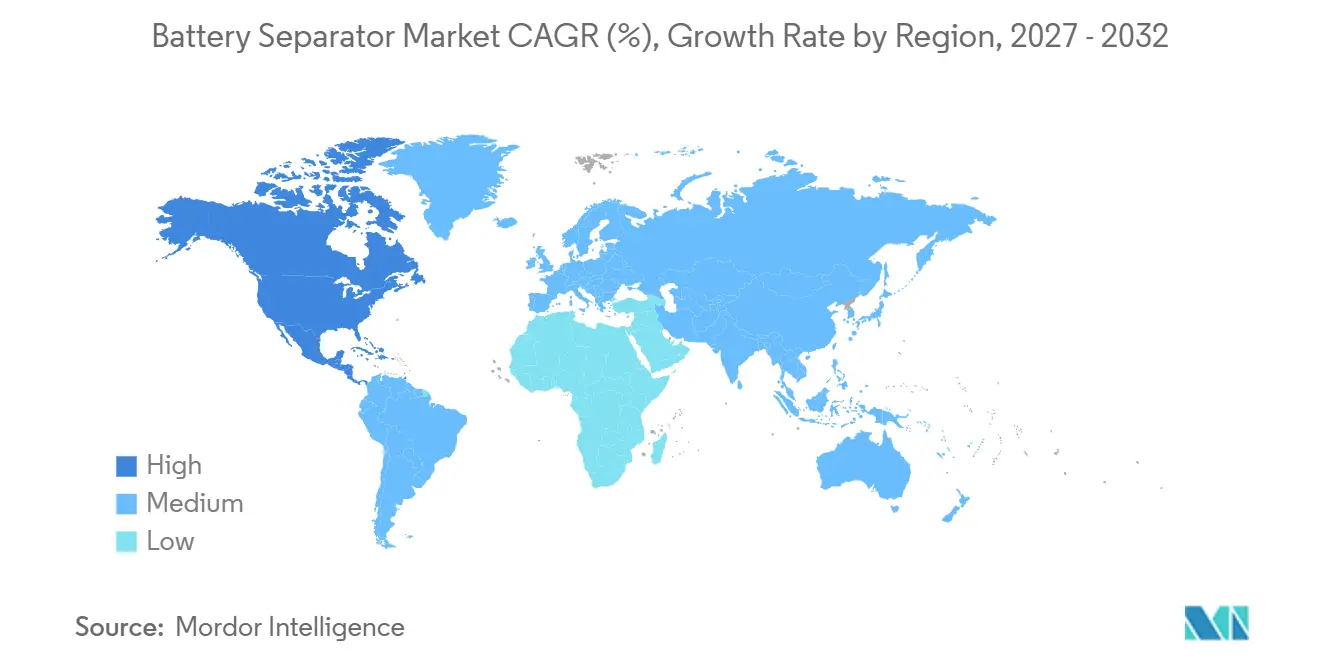
| Fastest Growing Market | North America |
| Largest Market | Asia-Pacific |
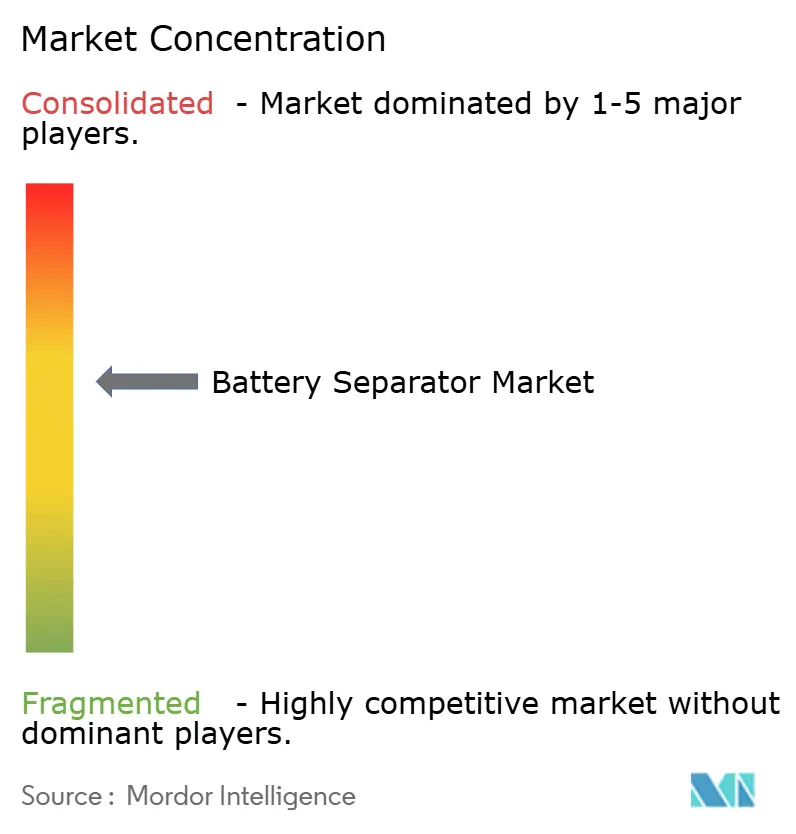
| Market Concentration | Medium |
Major Players *Disclaimer: Major Players sorted in no particular order Image © Mordor Intelligence. Reuse requires attribution under CC BY 4.0. | |
Battery Separator Market Analysis by Mordor Intelligence
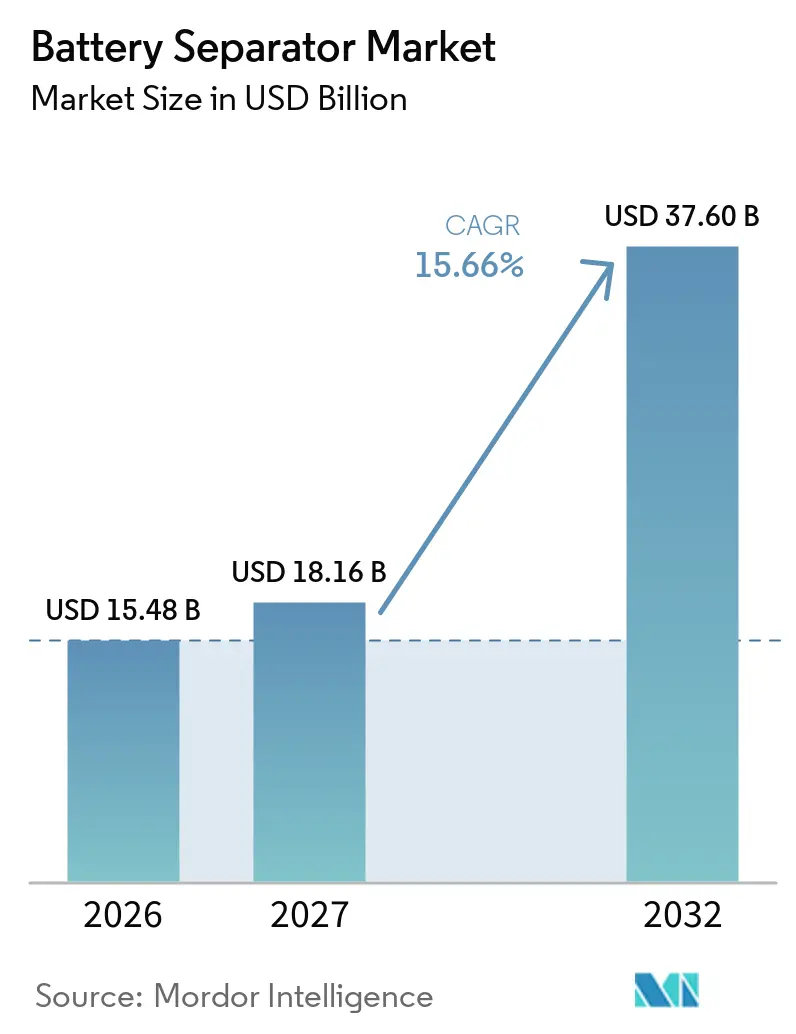
The global battery separator market size is projected to be USD 15.48 billion in 2026, USD 18.16 billion in 2027, and reach USD 37.60 billion by 2032, at a CAGR of 15.66% from 2027 to 2032. The battery separator market grows because each lithium-ion cell needs a film that allows ion movement and prevents contact between electrodes. Demand is supported by electric vehicles, grid storage systems, and backup batteries used in data centers. Higher-voltage battery designs are increasing the need for coated films that can manage heat more effectively. Suppliers are separating into high-volume producers of standard films and companies that can deliver thinner or ceramic-coated products. This leaves opportunities for firms with established cell-maker qualifications and local production near new battery plants.
Key Report Takeaways
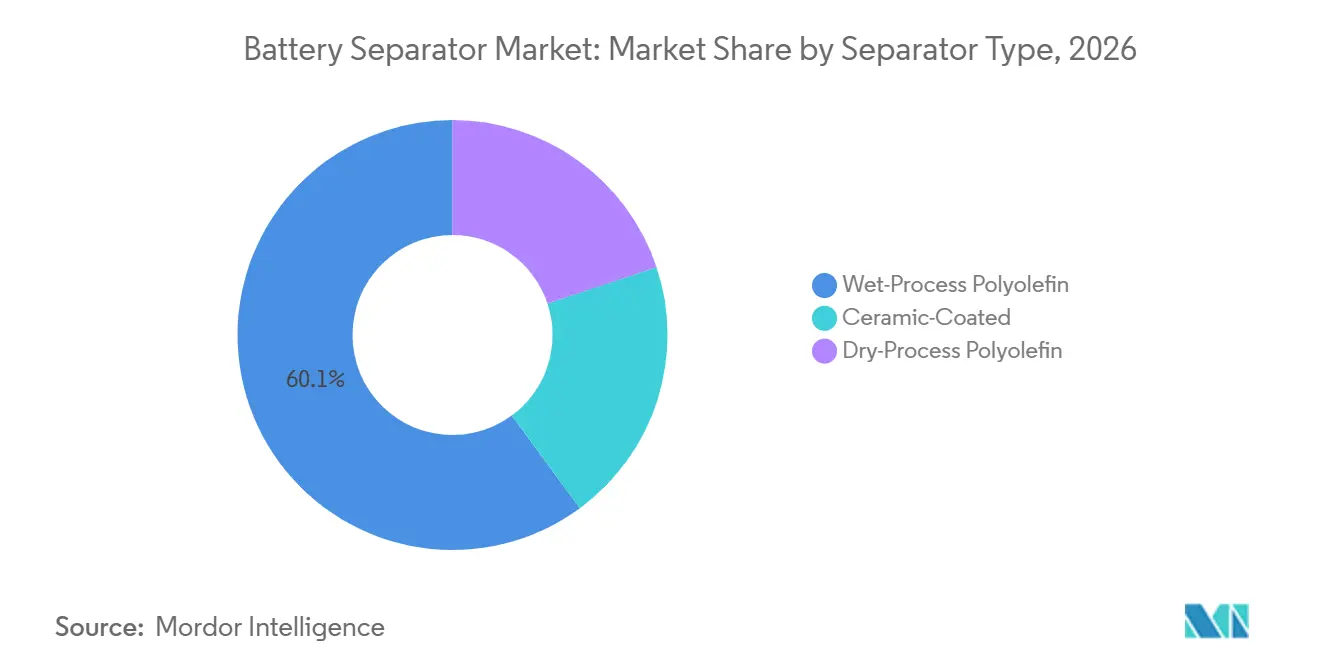
- By separator type, wet-process polyolefin held a 60.1% revenue share in 2026, while ceramic-coated separators are projected to grow at a 22.3% CAGR through 2032.
- By material, polypropylene held a 48.3% revenue share in 2026, while non-woven and specialty materials are forecast to expand at an 18.1% CAGR through 2032.
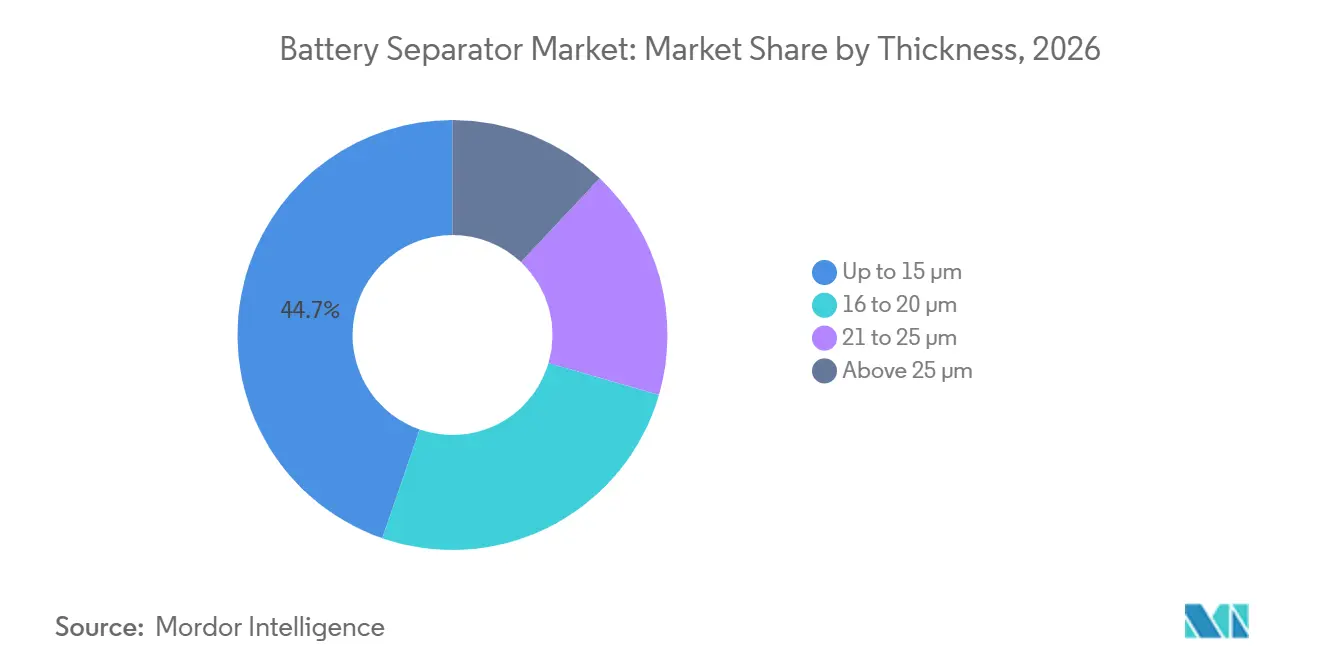
- By thickness, the 16 to 20 µm band held a 44.7% value share in 2026, while the up-to-15 µm category is forecast to grow at an 18.4% CAGR through 2032.
- By coating technology, uncoated polyolefin held a 59.6% revenue share in 2026, while in-line ceramic coating is forecast to grow at a 20.6% CAGR through 2032.
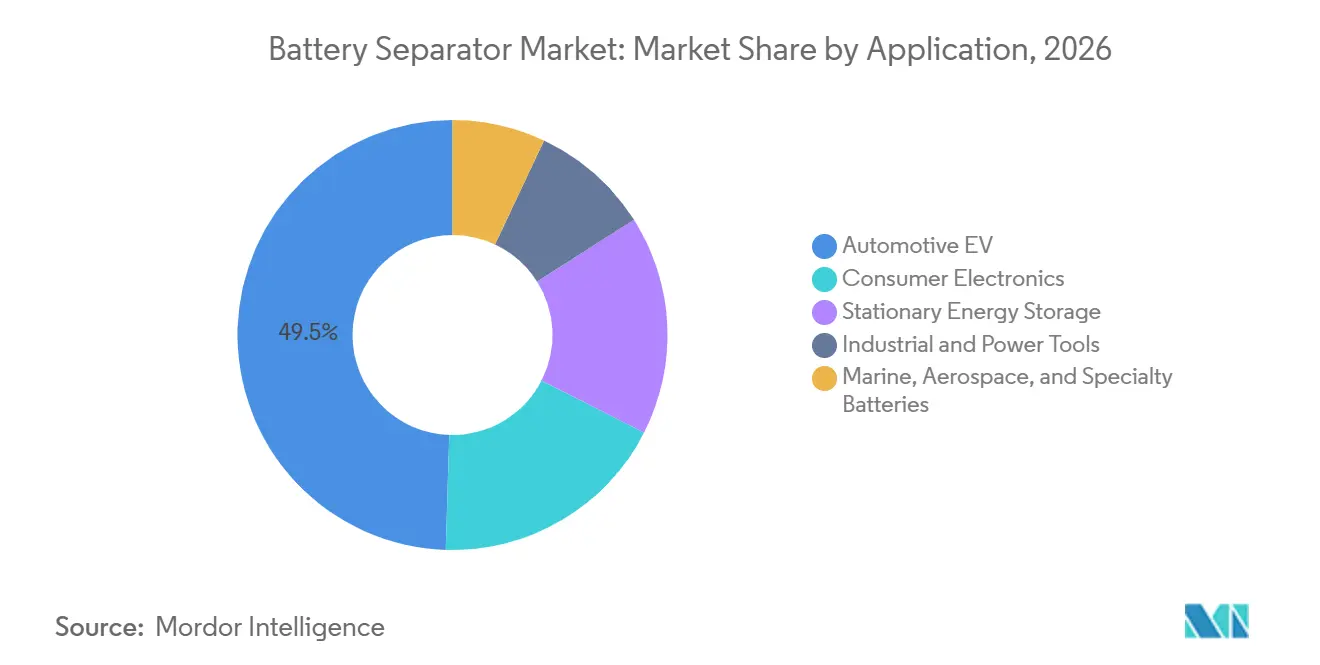
- By application, the automotive electric vehicle (EV) segment accounted for 49.5% of the battery separator market in 2026, while stationary energy storage is forecast to expand at a 20.1% CAGR through 2032.
- By battery chemistry, lithium-ion held a 74.4% revenue share in 2025, while sodium-ion separators are forecast to grow at a 27.3% CAGR through 2031.
- By geography, Asia-Pacific accounted for a 54.5% revenue share in 2025, while North America is forecast to grow at a 17.6% CAGR through 2031.
Note: Market numbers in this report are based on Mordor Intelligence's proprietary estimation framework, which combines nine months of actuals with Q4 projections for base year 2026.
Market Trends and Insights
Drivers Impact Analysis of Battery Separator Market*
| Driver | (~) % Impact on CAGR Forecast | Geographic Relevance | Impact Timeline |
|---|---|---|---|
| Electric Vehicle Battery Capacity Expansion | +4.8% | Global, with an APAC core and rapid expansion in North America and Europe | Medium term (2-4 years) |
| Grid-Scale and Commercial Energy Storage Deployment | +2.8% | Global, with APAC leading and North American and European pipelines expanding | Medium term (2-4 years) |
| Localized Battery Supply Chains and Gigafactories | +2% | North America and Europe, with continuing expansion in APAC | Long term (≥ 4 years) |
| Ceramic Coating Adoption for High-Voltage and Fast-Charging Cells | +1.3% | Global, beginning in APAC and gaining traction in North America and Europe | Medium term (2-4 years) |
| Rising Separator Consumption per Kilowatt-Hour | +1.5% | Global | Short term (≤ 2 years) |
| Growth of Data Center and Telecom Backup Batteries | +1% | North America and APAC | Short term (≤ 2 years) |
| Source: Mordor Intelligence | |||
Electric Vehicle Battery Capacity Expansion
Global battery-electric vehicle sales exceeded 14 million units in 2024, and automakers announced 312 GWh of additional cell capacity for 2025 through 2027. Each GWh requires 2.5 million square meters of separator film, linking announced cell capacity to multi-year purchasing needs. The battery separator market benefits when manufacturers build larger cell plants because every cell format requires a separator, and the effect continues as plants move from early commissioning to stable production. Separator installations outside China grew faster than the global rate in Q1 2026, which supports suppliers already qualified by Korean and Japanese cell makers and highlights the importance of early supply relationships in new regions. High-nickel cathodes and 800-volt systems also require stronger thermal performance, making ceramic coating a more common procurement requirement.
Grid-Scale and Commercial Energy Storage Deployment
Grid storage and commercial energy storage are widening the customer base for the battery separator market. Larger storage cells and targets of more than 8,000 cycles are leading battery producers to place greater weight on consistent safety performance. Utility-scale renewable integration requires batteries that can discharge over repeated cycles, which favors separators designed for long operating life and consistent performance across large numbers of cells. Commercial behind-the-meter installations add another source of demand that does not follow vehicle sales cycles, helping suppliers serve customers with a different timing of investment and replacement needs. Data center backup systems also use lithium-ion batteries, creating demand for high-specification separator films. The International Energy Agency stated that data center electricity use was 415 TWh in 2024 and could nearly double by 2030, increasing the need for dependable backup power systems.[1]
Localized Battery Supply Chains and Gigafactories
Battery manufacturers in North America and Europe are building more local supply chains to reduce import exposure and meet policy requirements. The U.S. Inflation Reduction Act sets domestic-content conditions for certain vehicle incentives and supports local manufacturing through Section 45X production credits. These rules make separator capacity close to cell plants more valuable for producers seeking eligible supply, while also reducing the operational difficulty of coordinating deliveries across distant supply chains. Qualification cycles can last 18 to 24 months, which gives early local suppliers a practical advantage once they secure an approved position and makes late entry more difficult even when capacity is available. ENTEK received USD 800 million in equity alongside a USD 1.3 billion Department of Energy loan for its Indiana project, which is planned for 1.4 billion square meters of annual capacity. The battery separator market therefore requires substantial capital and long customer engagement before new facilities can reach meaningful utilization.[2]
Ceramic Coating Adoption for High-Voltage and Fast-Charging Cells
Ceramic coatings are becoming more important as battery makers seek better thermal stability during fast charging. A September 2026 study found that an AlOOH and Al₂O₃ coated polypropylene separator had 10% thermal shrinkage at 150 °C, compared with 41% for standard commercial polypropylene. The same study reported ionic conductivity of 0.361 mS/cm for the coated separator, compared with 0.149 mS/cm for the baseline material. It also reported 92.1% capacity retention after 2,000 cycles at 1,000 mA/g, compared with 24.6% for uncoated polypropylene. These results support the use of coatings where safety, ion transport, and cycle life need to improve together, rather than forcing cell designers to accept a trade-off between thermal stability and electrochemical performance. In-line processes can apply ceramic material during base-film production, reducing separate handling steps and improving thickness control, which is valuable when films must be produced consistently at thinner dimensions.
Restraints Impact Analysis of Battery Separator Market*
| Restraint | (~) % Impact on CAGR Forecast | Geographic Relevance | Impact Timeline |
|---|---|---|---|
| Separator Capacity Overhang and Commodity Price Compression | -2.2% | Global, centered in APAC with effects on Western entrants | Short term (≤ 2 years) |
| High Qualification, Certification, and Ramp-Up Requirements | -1.5% | North America and Europe, where qualification backlogs are most acute | Medium term (2-4 years) |
| Resin Supply Concentration and Feedstock Volatility | -1.2% | Global | Medium term (2-4 years) |
| Long-Term Substitution Risk from Solid-State Batteries | -0.8% | Global, concentrated in premium EV segments | Long term (≥ 4 years) |
| Source: Mordor Intelligence | |||
Separator Capacity Overhang and Commodity Price Compression
Large additions of standard separator capacity continue to pressure pricing in the battery separator market. High output from Chinese wet-process lines gives cell makers more options for conventional films. This pressure is strongest in standard coated and uncoated grades that have limited technical differentiation, where customers can compare available products primarily on price, supply terms, and basic performance. It does not apply equally to ultra-thin, automotive-certified, and high-performance coated products, where yield development and customer approval still restrict supply and create a meaningful barrier for producers without proven processes. Producers with commodity-only portfolios can face lower margins even when unit shipments rise. The difference between available nameplate capacity and usable qualified capacity remains important when assessing supply conditions.
Long-Term Substitution Risk from Solid-State Batteries
Solid-state batteries replace the porous separator used in liquid-electrolyte cells with a solid electrolyte. This technology could reduce demand for conventional separator films in selected premium vehicle applications over the longer term, but the effect depends on whether pilot-scale results can be converted into economical mass production. Toyota and Samsung SDI have targeted pilot vehicle introductions around 2027 and 2028, but the transition is expected to remain gradual. Liquid-electrolyte designs remain relevant for Lithium Iron Phosphate (LFP) vehicles, stationary storage, and consumer electronics where cost and manufacturing scale are important, preserving a substantial addressable base for established separator products. The battery separator market retains a broad base of applications while solid-state producers continue to address manufacturing yield and commercial scale.
*Our forecasts treat driver/restraint impacts as directional, not additive. The impact forecasts reflect baseline growth, mix effects, and variable interactions.
Battery Separator Market Segment Analysis
By Separator Type:
Wet-Process Commands Scale, Ceramic Coatings Define the Value TierWet-process polyolefin separators held 60.1% of the battery separator market share by separator type in 2026. Their pore structure suits high-energy-density lithium-ion cells used in electric vehicles and energy storage systems. Wet-process production supports the tight thickness and uniformity requirements of many automotive designs. Dry-process polyolefin remains relevant for lower-cost LFP cells and lead-acid replacement applications. Its solvent-free manufacturing route can support high throughput, though it offers less uniformity at thicknesses below 15 µm. The battery separator industry continues to use dry-process products where cost and production efficiency matter more than the highest energy-density targets.
Ceramic-coated separators are projected to record a 22.3% CAGR from 2027 to 2032, the fastest rate within this segmentation. High-nickel cell platforms use these products to strengthen resistance to thermal propagation. A 2024 Journal of Power Sources study reported that a pilot roll-to-roll sputtering process achieved ionic conductance above that of slurry-based ceramic-coated separators while avoiding binders. The result supported in-line ceramic deposition as a route for ultra-thin films. Commodity wet-process products face price pressure as Chinese capacity expands. Suppliers with coating expertise can retain value through longer qualification cycles and more demanding cell specifications.

By Material:
Polypropylene Anchors Volume, Non-Woven Captures New Chemistry DemandPolypropylene separators held 48.3% of material revenue in 2026. The material is used in dry-process designs and ceramic-coated products because established production routes can process it consistently, while manufacturers can adapt it for different cell requirements. It also has a cost advantage in lead-acid AGM batteries and selected LFP vehicle platforms. Polyethylene held the second-largest position because its lower melting point can support thermal shutdown before cathode decomposition. temperatures. Automotive manufacturers value this safety characteristic in high-nickel cells. Multilayer polypropylene and polyethylene membranes combine polyethylene shutdown behavior with the strength retained by outer polypropylene layers.
Non-woven and specialty materials are forecast to grow at an 18.1% CAGR through 2032. Sodium-ion cells and large-format LFP storage batteries require porosity profiles that conventional polyolefin films may not provide as efficiently. These applications create a need for tailored wettability and ion transport properties. Multilayer films can meet demanding automotive specifications by combining shutdown behavior with structural integrity, but their added manufacturing cost can limit their use in cost-sensitive storage systems. Feedstock costs also influence the choice between polypropylene-heavy and polyethylene-heavy structures. The battery separator market will continue to balance material cost, shutdown behavior, mechanical strength, and the required operating life of the battery.
By Thickness:
Mid-Range Holds Volume, Sub-15 µm Drives Energy DensityThe 16-to-20 µm band held 44.7% of the battery separator market size by value in 2026. This range serves common lithium-ion cells used in electric vehicle pouch and prismatic designs. It is also used in cylindrical consumer electronics cells that require a practical balance between reliability and energy density. The band remains established because it works with many current cell manufacturing lines. Thickness selection affects internal resistance, safety margins, usable cell volume, and the amount of active material that can fit into a cell, so it remains a central design decision. Manufacturers therefore choose it according to cell format and the intended duty cycle.
The up-to-15 µm category is expected to grow at an 18.4% CAGR from 2027 to 2032. Thinner films allow higher active-material loading within a fixed cell footprint, which can improve energy density. A March 2026 study in Chemical Engineering Journal reported an ultra-thin ceramic-coated dry-biaxially stretched polypropylene separator with balanced ionic transport and short-circuit resistance in lithium metal batteries. This work supports the technical potential of sub-15 µm designs in high-energy-density applications. Films between 21 and 25 µm, and those above 25 µm, remain suited to lead-acid, nickel-based, and industrial batteries where strength is the main requirement. Longer yield ramps for ultra-thin extrusion equipment can keep supply tight for sub-9 µm products, since small variations can affect performance, and support a premium for qualified output.[3]
By Coating Technology:
Uncoated Base Dominates by Volume, In-Line Ceramic AcceleratesUncoated polyolefin separators held 59.6% of coating-technology revenue in 2026. Standard lithium-ion cells in consumer electronics, entry-level electric vehicles, and stationary applications account for much of this installed base. These applications may not require coated membranes when thermal specifications are less stringent and established cell designs can meet their operating requirements with standard base films. Uncoated products also offer a lower-cost option for cell makers with established safety margins. Their continued scale maintains demand for basic base-film production capacity. The battery separator market still depends on uncoated films for high-volume applications where performance needs remain conventional.
In-line ceramic coating is projected to grow at a 20.6% CAGR through 2032. This approach applies alumina or boehmite as part of the base-film process, which can reduce staging time and improve thickness tolerances. It is particularly relevant for fast-charging and high-voltage cells that need stronger thermal behavior. Offline coating retains a large installed base in China and remains suitable for mid-tier manufacturers seeking cost-competitive supply. Specialized coating products also need enough committed customer demand to justify qualification expenses, dedicated production capacity, and the operating discipline needed to maintain uniform performance. The segment increasingly differentiates suppliers by their control of coating uniformity, process integration, and safety performance.
By Application:
Automotive EV Leads by Value, Stationary Storage Widens Its Growth LeadAutomotive EV applications accounted for 49.5% of total value in 2026. Electric vehicle cells require substantial separator content and must meet thermal, mechanical, and ionic-conductivity requirements. Battery packs in this application use films that can perform reliably across charging conditions and operating temperatures, since a separator failure can affect safety and battery availability. Consumer electronics formed a meaningful secondary application because laptops and mobile devices need compact, high-energy-density cells. Regular device replacement also supports recurring demand for smaller battery cells. Industrial and power-tool batteries add demand from forklifts, automated guided vehicles, and cordless equipment.
Stationary energy storage is projected to expand at a 20.1% CAGR from 2027 to 2032. Renewable energy integration, commercial storage installations, and lithium-ion Uninterruptible Power Supply (UPS) systems for data centers support this rate. This application places greater importance on repeated-cycle performance and consistent safety across large-format cells. Marine, aerospace, and specialty batteries remain smaller applications but can command higher prices because they need vibration tolerance, temperature resistance, and long shelf life. These applications do not follow the same volume pattern as passenger electric vehicles, which gives suppliers a more balanced demand base across uses with different procurement cycles. Their requirements give qualified suppliers a route to diversify sales within the battery separator market.
By Battery Chemistry:
Lithium-Ion Commands Volume, Sodium-Ion Signals the Next Scale PointLithium-ion separators commanded 74.4% of chemistry revenue in 2026. They are used across smartphones, electric vehicle packs, and utility-scale storage systems. The chemistry has the broadest range of cell formats and the most developed global manufacturing base, which supports continued use from small consumer cells to large stationary battery systems. Lead-acid separators retain an installed position in starter batteries, industrial forklifts, and UPS systems. Existing recycling systems and cost economics support continued use in 12-volt applications. Nickel-based battery separators remain concentrated in industrial and aerospace uses, although lithium-ion improvements are reducing their role in adjacent applications.
Sodium-ion separators are forecast to record a 27.3% CAGR through 2032, the fastest rate among battery chemistries. Chinese manufacturers are scaling sodium-ion cells for two-wheeled electric vehicles, stationary storage, and shorter-range vehicles. Sodium-ion systems use different electrochemical potentials and electrolyte systems from lithium-ion batteries. As a result, separator porosity, wettability, and ionic transport requirements cannot always be transferred directly from existing lithium-ion lines. Producers must adapt product lines deliberately rather than treating sodium-ion as a simple extension of lithium-ion production, because a separator designed for one chemistry may not meet the needs of another. This shift can create a differentiated demand stream for the battery separator market.
Geography Analysis
APAC Battery Separator Market
Asia-Pacific held 54.5% revenue share in 2026. China has an integrated supply base spanning polyolefin resin, separator film, cell manufacturing, and battery-pack assembly. This structure supports large-scale production, proximity to major cell makers, and shorter coordination between resin suppliers, film producers, and battery manufacturers. Japan retains a quality-focused position through suppliers such as Asahi Kasei, Toray, and Teijin in premium segments. South Korean and Japanese producers remain important where cell makers prioritize established qualification records and high specifications. India, Vietnam, Indonesia, and Thailand are emerging manufacturing locations as battery producers seek supply-chain resilience beyond China, although local separator production has not yet matched the expected growth in battery-cell demand.
North America and Europe Battery Separator Market
North America is expected to grow at a 17.6% CAGR from 2027 to 2032. Domestic-content rules and new gigafactory construction are driving interest in local separator supply for automakers including GM, Stellantis, Ford, and Honda. ENTEK is developing an Indiana facility with planned annual capacity of 1.4 billion square meters. Asahi Kasei opened a wet-process separator coating line in Charlotte, North Carolina, during August 2026, with commercial production planned for the second half of fiscal 2026. Microporous secured offtake agreements exceeding 500 million square meters annually, supporting its planned Danville, Virginia expansion. Europe is also expanding battery capacity in Germany, Poland, Hungary, and France, where carbon-footprint disclosure requirements encourage production using renewable power and add a compliance consideration to supplier selection.[4]
MEA and South America Battery Separator Market
South America and the Middle East and Africa are building electric vehicle infrastructure and utility-scale storage programs, creating demand that is linked to transport electrification and renewable-energy deployment. Chile has lithium reserves that could support future links between mineral processing and battery supply chains, although a direct local separator manufacturing base remains a future possibility rather than an established supply center. The Middle East is adding battery storage alongside solar generation, particularly in Saudi Arabia and the UAE. These projects favor large-format Lithium Iron Phosphate (LFP) cells and designs suited to high ambient temperatures. The battery separator market can gain from regional demand growth even where local film manufacturing remains at an early stage.
Competitive Landscape
The battery separator market is concentrated among leading Chinese producers, including SEMCORP, Sinoma Science & Technology, Shenzhen Senior Technology Material, and Gellec. These firms benefit from integrated feedstock access, production located near major cell factories, and the ability to serve large-volume orders through connected domestic supply chains. Their scale is strongest in high-volume wet-process and coated separator production, where large domestic cell manufacturing capacity can support utilization and provide frequent opportunities for product development with customers. Asahi Kasei, Toray, Teijin, SK IE Technology, and W-SCOPE compete through specification quality and relationships with premium cell manufacturers. Their established approval records can matter where customers need automotive-grade products and need confidence that a supplier can maintain specifications through a long production run. The competitive position of each supplier depends on product performance, local capacity, and the time needed to complete customer qualification.
SK Innovation announced a merger with SK IE Technology in September 2026 to reduce annual costs by KRW 60 billion, or USD 43 million, concentrate separator production in Poland, sell the SKIET China factory, and develop energy-storage separators. Asahi Kasei opened its Charlotte coating line in August 2026 and has scheduled commercial production for the second half of fiscal 2026. Microporous secured annual offtake agreements exceeding 500 million square meters in May 2026 across lithium-ion, sodium-ion, and lithium-sulfur customers. These steps show that suppliers are focusing on production location, committed customer volumes, and products that support storage applications. Investments must be paired with customer approvals because capacity alone does not ensure sales, particularly where battery makers require performance testing before they add a new separator source. Companies that can meet local-content requirements and offer tested performance have a stronger position in new battery supply chains.
The battery separator market also presents opportunities in high-safety Lithium Iron Phosphate (LFP) and large-format energy-storage products. These applications can have lower automotive qualification burdens, while cycle life and safety remain important to procurement decisions. U.S. and European cell makers are seeking supply diversification beyond Chinese, Japanese, and Korean suppliers, creating room for qualified local producers that can show reliable quality and delivery performance. Premium ceramic coatings and ultra-thin extrusion give suppliers a clearer path to product differentiation than standard films. Firms limited to commodity grades remain more exposed to price pressure from high-capacity producers. Competition is therefore shaped by the ability to combine cost control with technical qualification, reliable local delivery, and products that match the safety and cycle-life needs of each application.
Battery Separator Industry Leaders
-
SEMCORP
-
Asahi Kasei Corporation
-
SK IE Technology Co., Ltd.
-
Toray Industries, Inc.
-
W-SCOPE Corporation
- *Disclaimer: Major Players sorted in no particular order
Battery Separator Market Companies Covered in this Report
- Ahlstrom Oyj
- Asahi Kasei Corporation
- Cangzhou Mingzhu Plastic Co., Ltd.
- Celgard LLC
- ENTEK International LLC
- Freudenberg Performance Materials
- Gellec Co., Ltd.
- Hollingsworth & Vose Company
- Mitsubishi Chemical Group Corporation
- Mitsubishi Paper Mills Limited
- Polypore International, LP
- SEMCORP
- Shenzhen Senior Technology Material Co., Ltd.
- Sinoma Science & Technology Co., Ltd.
- SK IE Technology Co., Ltd.
- Solvay SA
- Sumitomo Chemical Co., Ltd.
- Suzhou GreenPower New Energy Technology Co., Ltd.
- Teijin Limited
- Toray Industries, Inc.
- UBE Corporation
- W-SCOPE Corporation
Recent Industry Developments in Battery Separator Market
- August 2026: SK Innovation announced plans to absorb its battery separator subsidiary SK IE Technology as part of a broader business restructuring strategy, targeting a turnaround of the separator business within two years. The merger is expected to generate approximately KRW 60 billion in annual cost savings through the consolidation of overlapping functions, reduced marketing expenses, and integrated research and development capabilities focused on key customers.
- August 2026: Asahi Kasei Corporation inaugurated a new Hipore™ wet-process lithium-ion battery separator coating line at its Charlotte, North Carolina facility, strengthening its North American battery separator manufacturing strategy. The investment expands production capabilities at the existing Celgard® plant and establishes localized coating and supply of wet-process separators, with commercial production scheduled to begin in the second half of fiscal 2026.
- May 2026: Microporous announced that it had secured multiple long-term offtake agreements totaling more than 500 million square meters per year of its ionForce® battery separator products, enough to support over 50 GWh of annual battery production capacity. The agreements were signed with several domestic battery manufacturers producing advanced battery chemistries, including lithium-ion, sodium-ion, and lithium-sulfur batteries, and cover the majority of Microporous' current and planned separator production capacity over the next five years.
- September 2025: I Squared Capital signed a definitive agreement to acquire a majority stake in ENTEK Technology Holdings LLC, a battery separator manufacturer, to accelerate the reshoring of critical United States battery supply chain manufacturing. The investment includes USD 800 million from I Squared Capital and complements a United States Department of Energy ATVM loan of up to USD 1.3 billion, supporting the construction of a wet-process lithium-ion battery separator gigafactory in Terre Haute, Indiana.
Global Battery Separator Market Report Scope
A battery separator is a microporous membrane placed between the positive (cathode) and negative (anode) electrodes of a battery to prevent electrical short circuits. While keeping the electrodes physically isolated, its porous structure allows the continuous flow of ionic charge carriers necessary to complete the electrical circuit. Modern separators are typically made from polyolefin polymers or ceramics to withstand extreme chemical environments and provide thermal shutdown protection to prevent thermal runaway.
The battery separator market is segmented by separator type into wet-process polyolefin, dry-process polyolefin, and ceramic-coated separators. By material, the market is segmented into polypropylene (PP), polyethylene (PE), multilayer PP/PE/PP, non-woven materials, and others. By thickness, the market is segmented into up to 15 µm, 16 to 20 µm, 21 to 25 µm, and above 25 µm. By coating technology, the market is segmented into in-line ceramic coating, offline ceramic coating, functional polymer coatings, and uncoated polyolefins. By application, the market is segmented into automotive EV, consumer electronics, stationary energy storage, industrial and power tools, and marine, aerospace, and specialty batteries. By battery chemistry, the market is segmented into lithium-ion, lead-acid, nickel-based, sodium-ion, and others. The report also covers the market size and forecasts for the global battery separator market across 26 countries in key regions. For each segment, the market sizing and forecasts are provided in value terms (USD).
Segmentation Overview
| Wet-Process Polyolefin |
| Dry-Process Polyolefin |
| Ceramic-Coated |
| Polypropylene (PP) |
| Polyethylene (PE) |
| Multilayer PP/PE/PP |
| Non-woven and Others |
| Up to 15 µm |
| 16 to 20 µm |
| 21 to 25 µm |
| Above 25 µm |
| In-line Ceramic Coating |
| Offline Ceramic Coating |
| Functional Polymer Coatings |
| Uncoated Polyolefin |
| Automotive EV |
| Consumer Electronics |
| Stationary Energy Storage |
| Industrial and Power Tools |
| Marine, Aerospace, and Specialty Batteries |
| Lithium-Ion |
| Lead-Acid |
| Nickel-Based |
| Sodium-Ion |
| Others |
| North America | United States |
| Canada | |
| Mexico | |
| Europe | Germany |
| France | |
| Italy | |
| Spain | |
| United Kingdom | |
| Poland | |
| Hungary | |
| Rest of Europe | |
| Asia-Pacific | China |
| India | |
| Japan | |
| South Korea | |
| Australia | |
| Indonesia | |
| Vietnam | |
| Thailand | |
| Rest of Asia-Pacific | |
| South America | Brazil |
| Argentina | |
| Chile | |
| Rest of South America | |
| Middle East and Africa | Saudi Arabia |
| United Arab Emirates | |
| Egypt | |
| South Africa | |
| Israel | |
| Rest of Middle East and Africa |
| By Separator Type | Wet-Process Polyolefin | |
| Dry-Process Polyolefin | ||
| Ceramic-Coated | ||
| By Material | Polypropylene (PP) | |
| Polyethylene (PE) | ||
| Multilayer PP/PE/PP | ||
| Non-woven and Others | ||
| By Thickness | Up to 15 µm | |
| 16 to 20 µm | ||
| 21 to 25 µm | ||
| Above 25 µm | ||
| By Coating Technology | In-line Ceramic Coating | |
| Offline Ceramic Coating | ||
| Functional Polymer Coatings | ||
| Uncoated Polyolefin | ||
| By Application | Automotive EV | |
| Consumer Electronics | ||
| Stationary Energy Storage | ||
| Industrial and Power Tools | ||
| Marine, Aerospace, and Specialty Batteries | ||
| By Battery Chemistry | Lithium-Ion | |
| Lead-Acid | ||
| Nickel-Based | ||
| Sodium-Ion | ||
| Others | ||
| By Geography | North America | United States |
| Canada | ||
| Mexico | ||
| Europe | Germany | |
| France | ||
| Italy | ||
| Spain | ||
| United Kingdom | ||
| Poland | ||
| Hungary | ||
| Rest of Europe | ||
| Asia-Pacific | China | |
| India | ||
| Japan | ||
| South Korea | ||
| Australia | ||
| Indonesia | ||
| Vietnam | ||
| Thailand | ||
| Rest of Asia-Pacific | ||
| South America | Brazil | |
| Argentina | ||
| Chile | ||
| Rest of South America | ||
| Middle East and Africa | Saudi Arabia | |
| United Arab Emirates | ||
| Egypt | ||
| South Africa | ||
| Israel | ||
| Rest of Middle East and Africa | ||
Key Questions Answered in the Report
What is the projected value of the battery separator market by 2032?
The battery separator market is projected to reach USD 37.60 billion by 2032, growing at a 15.66% CAGR from 2027. Electric vehicles, stationary storage, and backup batteries for data centers are the demand areas identified.
Which separator type is growing fastest?
Ceramic-coated separators are forecast to grow at a 22.3% CAGR through 2032, supported by high-voltage and fast-charging cell requirements
Why do ceramic-coated battery separators matter?
Ceramic coatings can improve thermal stability, ionic transport, and cycle durability in demanding lithium-ion battery applications. A September 2026 study compared coated polypropylene with standard polypropylene and reported improved shrinkage, conductivity, and capacity retention results.
Which application is the largest user of battery separators?
Automotive EV applications accounted for 49.5% of total value in 2026 because vehicle cells require high separator content and strict performance standards.
Which region is expanding fastest for separator demand?
North America is projected to grow at a 17.6% CAGR through 2032 as gigafactory construction and domestic-content requirements support local supply.
How could sodium-ion batteries affect separator demand?
Sodium-ion separators are projected to grow at a 27.3% CAGR through 2032 and require tailored porosity, wettability, and ionic transport characteristics.