
Battery Leaching Reagents Market Size and Share
Market Overview
| Study Period | 2021 - 2031 |
|---|---|
| Market Size (2026) | USD 1.82 Billion |
| Market Size (2031) | USD 3.23 Billion |
| Growth Rate (2026 - 2031) | 12.18 % |
| Fastest Growing Market | Asia-Pacific |
| Largest Market | Asia-Pacific |
| Market Concentration | Low |
Major Players *Disclaimer: Major Players sorted in no particular order Image © Mordor Intelligence. Reuse requires attribution under CC BY 4.0. | |
Battery Leaching Reagents Market Analysis by Mordor Intelligence
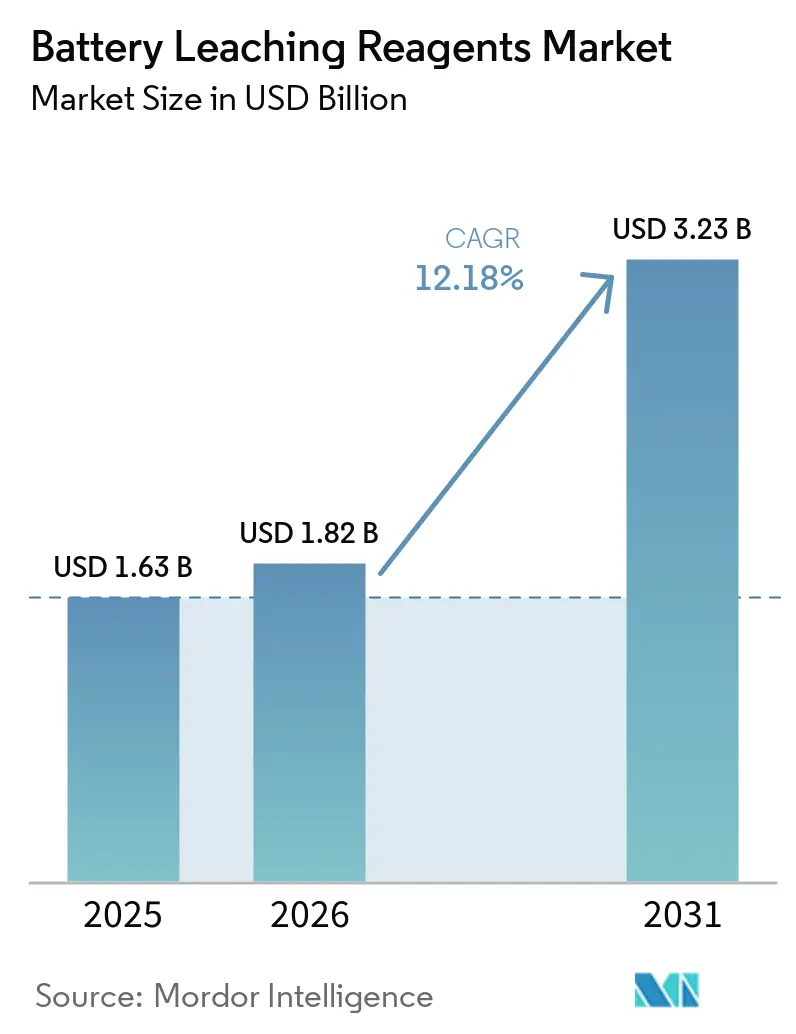
The battery leaching reagents market size was valued at USD 1.63 billion in 2025 and is estimated to grow from USD 1.82 billion in 2026 to USD 3.23 billion by 2031, at a CAGR of 12.18% during the forecast period (2026-2031). The battery leaching reagents market is expanding as hydrometallurgical recycling capacity grows in major battery-producing regions, while domestic-content regulations make recovered minerals more relevant to supply planning. Mixed black mass is also changing purchasing requirements, as streams combining Nickel Manganese Cobalt (NMC), Lithium Iron Phosphate (LFP), and Lithium Manganese Iron Phosphate (LMFP) cells require more precisely controlled leaching chemistry than single-chemistry feedstock. This increases reagent use per metric ton of material processed and can raise costs even when recycling capacity growth is measured only in output terms. The market is also moving toward longer-term supply arrangements as more automotive companies develop captive recycling operations, giving chemical suppliers an opportunity to offer application-specific grades rather than compete solely on commodity quantities. These arrangements can align chemical demand more closely with a recycler's material mix, recovery targets, planned production schedule, and required output quality for downstream customers. This improves planning for both parties, but also places greater importance on consistent purity, delivery reliability, and process-specific technical support.
Key Report Takeaways
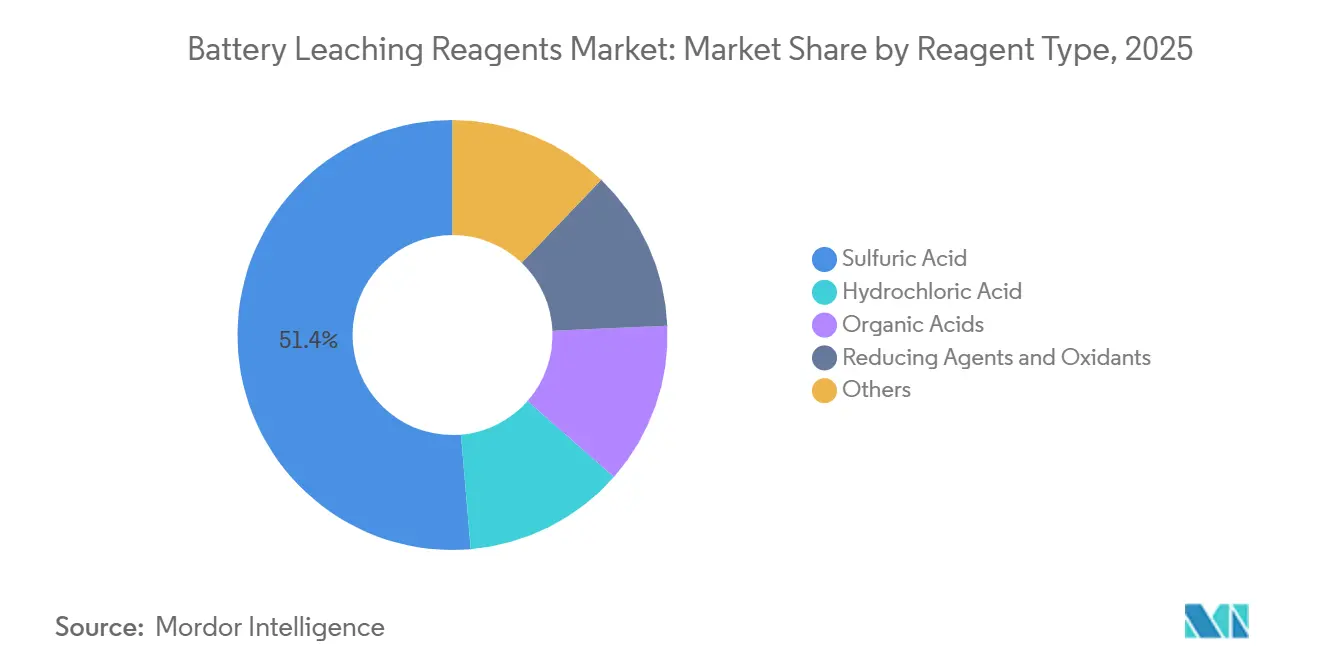
- By reagent type, sulfuric acid held 51.35% of the battery leaching reagents market share in 2025, while organic acids are forecast to grow at a 13.27% CAGR through 2031.
- By battery chemistry, Nickel Manganese Cobalt (NMC) and Nickel Cobalt Aluminum (NCA) accounted for 43.67% of demand in 2025, while LFP is projected to record a 13.63% CAGR through 2031.
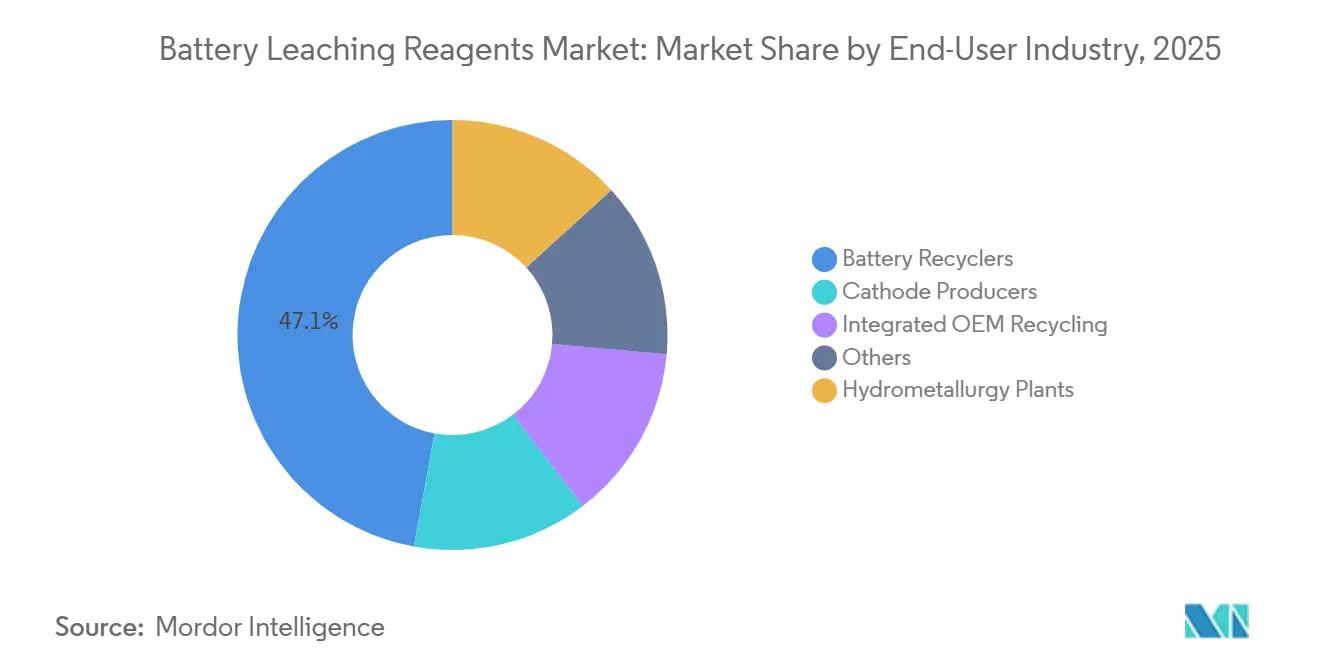
- By end-user industry, battery recyclers held 47.13% of demand in 2025, while integrated Original Equipment Manufacturer (OEM) recycling is projected to expand at a 14.06% CAGR through 2031.
- By geography, Asia-Pacific captured 45.71% of the battery leaching reagents market share in 2025 and is forecast to grow at a 13.78% CAGR through 2031.
Note: Market size and forecast figures in this report are generated using Mordor Intelligence’s proprietary estimation framework, updated with the latest available data and insights as of January 2026.
Market Trends and Insights
Drivers Impact Analysis of Battery Leaching Reagents Market*
| Drivers | (~) % Impact on CAGR Forecast | Geographic Relevance | Impact Timeline |
|---|---|---|---|
| Growth In Hydrometallurgical Battery Recycling Capacity | +4.5% | Global, APAC core, spillover to EU and North America | Short term (≤ 2 years) |
| Mandatory Recycled-Content and Recovery Targets | +2.8% | EU and North America | Medium term (2-4 years) |
| Demand for Domestic Critical-Material Supply | +2.0% | North America, EU, India | Medium term (2-4 years) |
| Higher Selectivity Requirements for LFP and Mixed Black Mass | +1.5% | Global | Short term (≤ 2 years) |
| Production-Scrap Recycling as a Consistent Reagent Demand Pool | +1.2% | Global, APAC core | Short term (≤ 2 years) |
| Source: Mordor Intelligence | |||
Growth In Hydrometallurgical Battery Recycling Capacity
Hydrometallurgical capacity additions are a major driver of reagent demand in the battery leaching reagents market. In March 2026, Fortum Battery Recycling received a EUR 40 million grant from the EU Innovation Fund for its NEXT HYDROMET plant in Finland. The project is designed to process 3,000 tons of black mass per year, targeting metal recovery rates above 95%. In August 2026, the U.S. Department of Energy announced USD 500 million in funding for seven selected projects to support critical mineral processing and battery recycling. These investments add processing capacity that requires acid leaching, purification, and recovery steps. A larger and more reliable hydrometallurgical feedstock base enables the battery leaching reagents market to shift from irregular purchases toward scheduled procurement tied to processing plans.
Mandatory Recycled-Content and Recovery Targets
Regulation (EU) 2023/1542, which has applied since February 2024, sets minimum recycled-content requirements for Electric Vehicle (EV) batteries from August 18, 2031. The required levels are 16% cobalt, 6% lithium, and 6% nickel by weight, while battery passport and labeling requirements apply from 2026[1]. These obligations create a defined future demand for recovered battery materials that is not solely dependent on metal-price conditions. Traceability requirements also place greater importance on routes that recover material from waste and document its origin. Leaching and purification routes may therefore become more relevant than lower-purity alternatives for operators seeking compliant output. This supports the battery leaching reagents market, as European Original Equipment Manufacturers (OEMs) and recyclers need to prepare their material supply chains before the 2031 requirements take effect.
Demand for Domestic Critical-Material Supply
Domestic supply objectives are drawing attention to battery recycling in North America and other import-dependent regions. In 2026, the U.S. Government Accountability Office stated that recycling is a near-term route to reducing reliance on imported cobalt, nickel, and lithium, even though domestic recycling capacity remains insufficient. This makes local processing capacity relevant to both industrial policy and battery waste management. Recycling can provide manufacturers with an additional source of critical materials when upstream supply faces disruption. The battery leaching reagents market benefits when government-backed operators adopt chemical extraction rather than limiting activity to collection and mechanical processing. This also supports longer-term supply discussions between reagent producers and recycling facilities that are developing domestic material positions.
Higher Selectivity Requirements for LFP and Mixed Black Mass
Rising LFP adoption is creating specific technical requirements for the battery leaching reagents market. Since LFP does not contain cobalt or nickel, recyclers must manage iron-phosphate dissolution while selectively recovering lithium. A 2025 study reported a closed-loop H₂SO₄-H₂O₂ process that achieved 98.72% lithium leaching efficiency from LFP within 10 minutes, using an acid-to-lithium molar ratio of 0.57. A 2024 Journal of Power Sources study reported 99.96% lithium leaching selectivity with formic acid, while iron remained in the solid residue. Mixed black mass containing both LFP and NMC requires protocols that can manage mineral-acid dissolution alongside selective organic-acid or reducing-agent additions. This operational requirement increases formulation complexity and can raise reagent spending per metric ton processed.
Restraints Impact Analysis of Battery Leaching Reagents Market*
| Restraints | (~) % Impact on CAGR Forecast | Geographic Relevance | Impact Timeline |
|---|---|---|---|
| Low-Value Economics of Cobalt-Free Chemistries | -1.8% | Global | Long term (≥ 4 years) |
| Wastewater, Salt-By-Product, And Discharge Compliance Costs | -1.2% | EU, North America | Medium term (2-4 years) |
| Feedstock Variability and Impurity Carryover | -0.9% | Global | Short term (≤ 2 years) |
| Source: Mordor Intelligence | |||
Low-Value Economics of Cobalt-Free Chemistries
Cobalt-free chemistries can limit recycling activity due to the lower value of their recovered materials. LFP recycling costs range from USD 900 to 1,200 per ton, while the value of recovered lithium, iron, and phosphate is USD 300 to 600 per ton. In comparison, NMC recycling costs range from USD 1,200 to 1,600 per ton, with cobalt and nickel recovery revenue at USD 1,100 to 2,200 per ton, depending on grade and purity. A 2025 cost-modeling study identified economic factors as central to lithium-ion battery recycling outcomes[2]. Without regulatory support, gate fees, or carbon credits, recyclers may be less willing to process low-value LFP feedstock. This could restrain the battery leaching reagents market even as LFP material accounts for a growing share of end-of-life battery flows, since quantity alone does not ensure that recyclers will process each available stream.
Wastewater, Salt-By-Product, And Discharge Compliance Costs
Hydrometallurgical leaching can produce wastewater containing fluoride, phosphate, heavy metals, and high chemical oxygen demand. German municipal discharge limits are set at 200 mg/L for chemical oxygen demand and 30 mg/L for fluoride. Estimated hazardous-waste disposal costs stand at EUR 661 per cubic meter, with electrochemical-oxidation costs at EUR 6.63 per cubic meter, before additional fluoride and phosphorus treatment. A 2025 assessment reviewed environmental and safety tradeoffs in lithium-ion battery recycling wastewater treatment. High-performance treatment systems add capital and energy costs, which particularly affect smaller recyclers. As a result, the battery leaching reagents market may face a more concentrated buyer base, where independent operators cannot absorb the same compliance costs as larger facilities.
*Our forecasts treat driver/restraint impacts as directional, not additive. The impact forecasts reflect baseline growth, mix effects, and variable interactions.
Battery Leaching Reagents Market Segment Analysis
By Reagent Type:
Sulfuric Acid Dominates While Organic Acids Record Fastest GrowthSulfuric acid held 51.35% of the battery leaching reagents market share in 2025, supported by its dissolution performance for NMC, NCA, and cobalt-bearing LCO materials. Its position also reflects the established industrial supply chain serving battery-material processing in East Asia. Sulfuric acid demand in battery processing is expected to increase from 9 million tons globally in 2025 to 26-68 million tons by 2040, with battery recycling contributing an increasing share of that demand alongside cathode manufacturing. Hydrochloric acid remains a significant secondary reagent where chloride-based selective leaching can reduce iron and phosphate co-dissolution. This is useful for recyclers handling LCO and earlier-generation NMC packs, where avoiding unnecessary dissolution can simplify downstream separation, reduce chemical consumption, and limit sensitivity to impurity carryover.
Organic acids are the fastest-growing reagent type, with the battery leaching reagents market size for this segment projected to grow at a 13.27% CAGR during 2026-2031. Formic, citric, and malic acids can operate at lower temperatures and have chelating properties that support selective metal recovery. They also produce lower SO₂ and Cl₂ by-products than mineral-acid routes, which is relevant for facilities subject to discharge controls. A 2025 study found that citric acid leaching could exceed HCl and H₂SO₄ in metal-extraction efficiency for NMC-type black mass under ultrasonic-assisted conditions. Proprietary mixed-acid formulations and ammonia-based systems remain small in share but are attracting research and development from chemical suppliers seeking differentiation through process chemistry rather than price, particularly where customers require formulations suited to specific feedstock profiles.

By Battery Chemistry, NMC and NCA Command Share While LFP Changes Formulation Needs
NMC and NCA accounted for 43.67% of the battery leaching reagents market share in 2025. Their position reflects higher reagent use per ton of cobalt-bearing black mass and stronger recycling economics compared to cobalt-free streams. Early-generation EV packs from the 2019-2022 production cohort are entering retirement in China, South Korea, and Europe, supporting near-term availability of NMC and NCA feedstock for recycling plants. Recovery economics for these plants are strengthened by the presence of cobalt and nickel in incoming black mass. LCO, once central to consumer-electronics recycling, is declining as automotive and stationary-storage battery shares grow. The battery leaching reagents industry is adjusting its operating practices toward larger automotive battery streams and their different composition profiles.
LFP is projected to record a 13.63% CAGR from 2026 to 2031, making it the fastest-growing battery chemistry segment in the battery leaching reagents market. LFP accounted for more than 50% of global EV battery deployments by capacity in recent years. Its expansion is driving demand for methods that recover lithium without incurring high iron-removal costs. Huayou Recycling presented its Dual-Process and Dual-Chemistry matrix in 2025 as an industrial approach designed to manage both NMC and LFP chemistries within a single facility. LMFP introduces an additional processing consideration, as manganese dissolution requires controlled oxidation, which can increase the use of reducing agents and pH buffers compared with standard LFP processing. This reinforces the need to match reagent selection to the metal profile of incoming material.
By End-User Industry:
Battery Recyclers Account for the Largest Share While OEM Integration Reshapes ProcurementBattery recyclers held 47.13% of the battery leaching reagents market share in 2025, making independent operators the largest direct buyers of leaching chemicals. This reflects a structure in which third-party recyclers process much of the collected black mass under contracts with battery manufacturers and automotive companies. These facilities often operate alongside smelting sites and convert black mass or intermediate materials into battery-grade metal salts through acid leaching and solvent extraction. Cathode producers are also integrating some upstream leaching steps to secure critical-material supply, increasingly blurring the line between reagent users and downstream manufacturers, as the same organization may now determine both chemical specifications and recovered-material sales strategy.
Integrated OEM recycling is the fastest-growing end-user category, with the battery leaching reagents market size for this segment forecast to grow at a 14.06% CAGR from 2026 to 2031. Automotive companies are bringing hydrometallurgical operations in-house to reduce reliance on third-party processing and improve supply security. CATL's battery materials and recycling segment generated CNY 18.811 billion (~USD 2.80 billion) in revenue in H1 2026, a 67.23% year-over-year increase, with a 27.04% gross margin. Tesla's Texas Gigafactory recycling line is expected to process 3,000 tons of manufacturing scrap annually by the end of 2026. Captive recycling can replace spot chemical purchases with negotiated supply agreements, offering suppliers more predictable demand while putting pressure on margins in the spot portion of the battery leaching reagents market.
Geography Analysis
APAC Battery Leaching Reagents Market
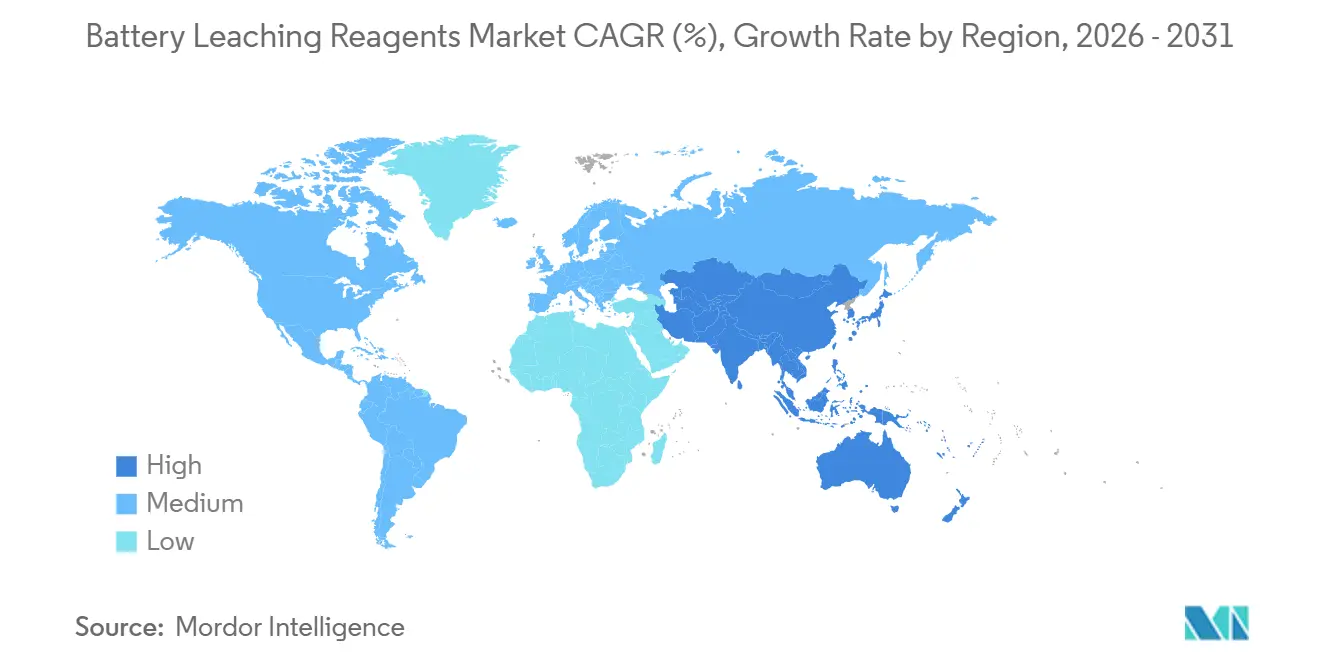
Asia-Pacific held 45.71% of the battery leaching reagents market share in 2025 and is forecast to record the fastest regional growth at a 13.78% CAGR through 2031. The region combines a large reagent supply base with a high concentration of battery recycling activity. China's established chemical clusters in Jiangsu, Zhejiang, Hubei, and Sichuan concentrate demand close to processing capacity. India is also developing capacity under its National Critical Minerals Mission, which supports chemical extraction activity and encourages investment in hydrometallurgical plants.
North America Battery Leaching Reagents Market
N.A.N. Silox GreenMet's facility in Andhra Pradesh, with a capacity of 40,000 tons per annum (TPA), demonstrates the transition from policy commitments to construction. South Korea and Japan retain advanced processing capabilities but remain exposed to the cost and availability of bulk acid supply. North American demand is increasing as policy moves from incentives toward funded project delivery. The U.S. Department of Energy's August 2026 funding package covers 7 selected projects and aims to increase domestic critical-mineral production by up to 15% by 2030. Redwood Materials is developing its South Carolina campus with 20,000 metric tons of initial annual materials production, in addition to its 60,000-metric-ton Nevada operation. These commitments anchor demand for battery leaching reagents around long-term processing investments.
EMEA and South America Battery Leaching Reagents Market
Europe's battery leaching reagents market is shaped by Regulation (EU) 2023/1542 and its recycled-content requirements. Fortum's Kirchardt facility in Germany expanded from 10 to 25 tons per day under an environmental permit issued in February 2026, serving as a pre-treatment location for black mass supplied to its Harjavalta refinery in Finland. Tozero launched an industrial demonstration plant in Bavaria in March 2026 with the capacity to process 1,500 tons of battery waste per year through an acid-free hydrometallurgical process. Such approaches aim to reduce reagent demand and wastewater-treatment exposure at the process level. South America remains constrained by early-stage battery collection infrastructure, while Argentina's lithium-brine activity creates adjacent acid demand. The Middle East and Africa remain early-stage regions, although battery waste in South Africa and industrial diversification activity in Saudi Arabia are creating a foundation for future hydrometallurgical infrastructure.
Competitive Landscape
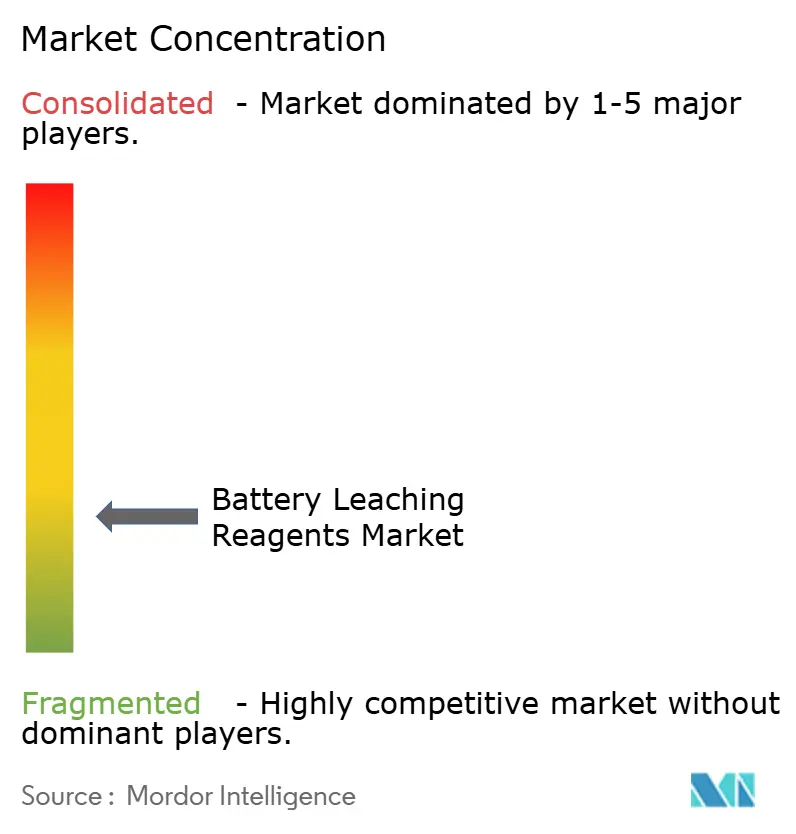
The battery leaching reagents market is fragmented, with commodity acid producers competing alongside specialty chemical companies that offer formulated leaching systems. BASF operates in both reagent supply and cathode precursor manufacturing, illustrating how chemical companies can participate in battery circularity through leaching chemistry. Many participants are both chemical consumers through recycling operations and competitors in recovered-material markets. They must manage the tradeoff between lowering reagent cost per ton and maximizing metal recovery yield. This dual role makes technical process knowledge important in the battery leaching reagents market. Suppliers with formulation expertise can work more closely with recyclers as feedstock chemistry becomes less uniform.
Umicore's pyro-hydro process achieves recovery rates above 95% for cobalt, copper, and nickel, and above 90% for lithium. The company uses process efficiency and protected separation sequences to differentiate its recycling position. In its 2025 full-year results, Umicore stated that it planned an H2 2026 investment decision related to its proprietary hydrometallurgical flowsheet, with the potential to add cobalt capacity and improve platinum group metal throughput times. These strategies demonstrate why process design and chemical control can matter as much as reagent price, and they make it more difficult for smaller recyclers to replicate established recovery performance. The battery leaching reagents market therefore depends on both chemical supply and the operating capability of the facilities that use those materials. Operators must maintain recovery yield while controlling wastewater, managing variable feedstock, and producing material quality that meets the specifications of downstream cathode and battery manufacturers.
The competitive space is particularly open in LFP-selective chemistry and closed-loop wastewater systems. Recyclers that can process LFP with positive margins without relying on cobalt value could hold an important long-term position as cobalt-free feedstock expands. Partnerships between chemical companies and recycling operators can lower the cost of proprietary process development while providing more reliable reagent offtake. Huayou's dual-chemistry approach is an example of a strategy that seeks to address multiple battery chemistries within one operating system. Some smaller participants are pursuing integrated electrochemical leaching to reduce external acid use and wastewater generation. The U.S. Government Accountability Office's 2026 assessment indicates that feedstock availability and recycler capacity, rather than reagent supply, remain the binding constraints for U.S. recycling infrastructure. This positions reagent suppliers as demand-responsive participants in the near-term battery leaching reagents market, with their prospects closely tied to whether facilities secure feedstock and convert planned capacity into stable operations.
Battery Leaching Reagents Industry Leaders
-
BASF
-
Umicore
-
Glencore
-
Redwood Materials, Inc.
-
Ascend Elements Inc.
- *Disclaimer: Major Players sorted in no particular order
Battery Leaching Reagents Market Companies Covered in this Report
- American Battery Technology Company
- Ascend Elements Inc.
- BASF
- BatteReverse
- Contemporary Amperex Technology Co., Limited.
- Ganfeng Lithium Group Co., Ltd.
- GEM Co., Ltd.
- Glencore
- Huayou Cobalt Co., Ltd.
- Lithion Technologies
- Neometals Ltd
- Redwood Materials, Inc.
- SungEel HiTech Co., Ltd.
- Umicore
- Veolia
Recent Industry Developments in Battery Leaching Reagents Market
- September 2026: General Motors and Cirba Solutions completed a closed-loop EV battery recycling pilot, producing the first GM EV batteries containing cathode active material with 100% recycled nickel, cobalt, and manganese. This milestone validates commercial hydrometallurgical recovery at automotive scale and establishes a replicable template for OEM closed-loop sourcing.
- September 2026: Blue Whale Materials completed a DOE-supported full processing line expansion at its Bartlesville, Oklahoma, facility, raising annual capacity from 14,000 to 20,000 metric tons of battery feedstock. The expansion adds integrated cell, module, and pack processing capability through the company's proprietary Blacksand thermally treated black mass technology.
Global Battery Leaching Reagents Market Report Scope
Battery leaching reagents are chemical solutions used to dissolve and extract valuable metals such as lithium, cobalt, nickel, and manganese from shredded spent batteries during the recycling process. These reagents play a functional role in hydrometallurgical recycling operations, where they break down the cathode materials of spent lithium-ion and other battery types to recover metals for reuse in new battery production or other industrial applications.
The battery leaching reagents market is segmented by reagent type, battery chemistry, end-user industry, and geography. By reagent type, the market is segmented into sulfuric acid, hydrochloric acid, organic acids, reducing agents and oxidants, and others. By battery chemistry, the market is segmented into nickel manganese cobalt (NMC), nickel cobalt aluminum (NCA), lithium iron phosphate (LFP), lithium cobalt oxide (LCO), lithium manganese iron phosphate (LMFP), and others. By end-user industry, the market is segmented into battery recyclers, hydrometallurgy plants, cathode producers, integrated OEM recycling, and others. The report also covers the market size and forecasts for battery leaching reagents in 15 countries across major regions. The market sizes and forecasts are provided in terms of value (USD).
Segmentation Overview
| Sulfuric Acid |
| Hydrochloric Acid |
| Organic Acids |
| Reducing Agents and Oxidants |
| Others |
| Nickel Manganese Cobalt (NMC) and Nickel Cobalt Aluminum (NCA) |
| Lithium Iron Phosphate (LFP) |
| Lithium Cobalt Oxide (LCO) |
| Lithium Manganese Iron Phosphate (LMFP) |
| Others |
| Battery Recyclers |
| Hydrometallurgy Plants |
| Cathode Producers |
| Integrated OEM Recycling |
| Others |
| Asia-Pacific | China |
| India | |
| Japan | |
| South Korea | |
| ASEAN Countries | |
| Rest of Asia-Pacific | |
| North America | United States |
| Canada | |
| Mexico | |
| Europe | Germany |
| United Kingdom | |
| France | |
| Italy | |
| NORDIC Countries | |
| Rest of Europe | |
| South America | Brazil |
| Argentina | |
| Rest of South America | |
| Middle East and Africa | Saudi Arabia |
| South Africa | |
| Rest of Middle East and Africa |
| By Reagent Type | Sulfuric Acid | |
| Hydrochloric Acid | ||
| Organic Acids | ||
| Reducing Agents and Oxidants | ||
| Others | ||
| By Battery Chemistry | Nickel Manganese Cobalt (NMC) and Nickel Cobalt Aluminum (NCA) | |
| Lithium Iron Phosphate (LFP) | ||
| Lithium Cobalt Oxide (LCO) | ||
| Lithium Manganese Iron Phosphate (LMFP) | ||
| Others | ||
| By End-User Industry | Battery Recyclers | |
| Hydrometallurgy Plants | ||
| Cathode Producers | ||
| Integrated OEM Recycling | ||
| Others | ||
| By Geography | Asia-Pacific | China |
| India | ||
| Japan | ||
| South Korea | ||
| ASEAN Countries | ||
| Rest of Asia-Pacific | ||
| North America | United States | |
| Canada | ||
| Mexico | ||
| Europe | Germany | |
| United Kingdom | ||
| France | ||
| Italy | ||
| NORDIC Countries | ||
| Rest of Europe | ||
| South America | Brazil | |
| Argentina | ||
| Rest of South America | ||
| Middle East and Africa | Saudi Arabia | |
| South Africa | ||
| Rest of Middle East and Africa | ||
Key Questions Answered in the Report
What is current market size of Battery Leaching Reagents Market?
The battery leaching reagents market size was valued at USD 1.63 billion in 2025 and is estimated to grow from USD 1.82 billion in 2026 to USD 3.23 billion by 2031, at a CAGR of 12.18% during the forecast period (2026-2031).
Why are organic acids gaining use in battery recycling?
Organic acids are projected to grow at 13.27% CAGR because their selectivity can support LFP processing and reduce some mineral-acid process burdens. Formic and citric acids are relevant where lithium recovery is needed to limit iron co-dissolution.
Which battery chemistry will grow fastest in reagent demand?
LFP is forecast to expand at 13.63% CAGR through 2031 as its battery deployment increases and recycling processes require selective lithium recovery. Its low cobalt and nickel content also makes process efficiency especially important.
Which buyers use the most battery leaching reagents?
Battery recyclers held 47.13% of demand in 2025, while integrated OEM recycling was the fastest-growing end-user category at 14.06% CAGR. OEM integration is increasing the use of negotiated supply arrangements.