
Battery Handling Market Size and Share
Market Overview
| Study Period | 2022 - 2032 |
|---|---|
| Market Size (2027) | USD 2.56 Billion |
| Market Size (2032) | USD 4.03 Billion |
| Growth Rate (2027 - 2032) | 9.48 % |
| Fastest Growing Market | Asia-Pacific |
| Largest Market | Asia-Pacific |
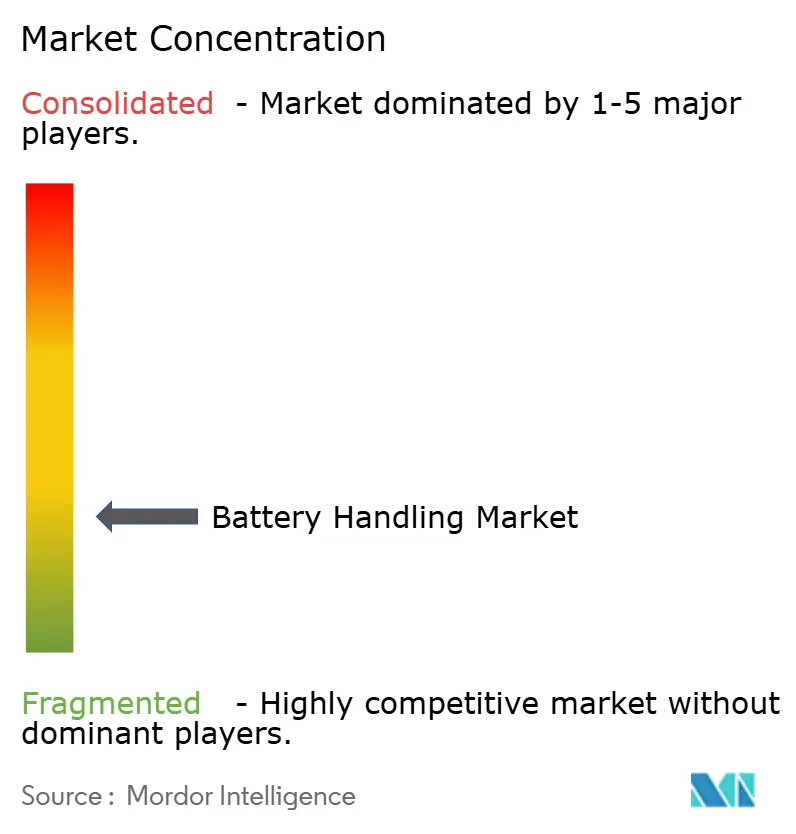
| Market Concentration | Low |
Major Players *Disclaimer: Major Players sorted in no particular order Image © Mordor Intelligence. Reuse requires attribution under CC BY 4.0. | |
Battery Handling Market Analysis by Mordor Intelligence
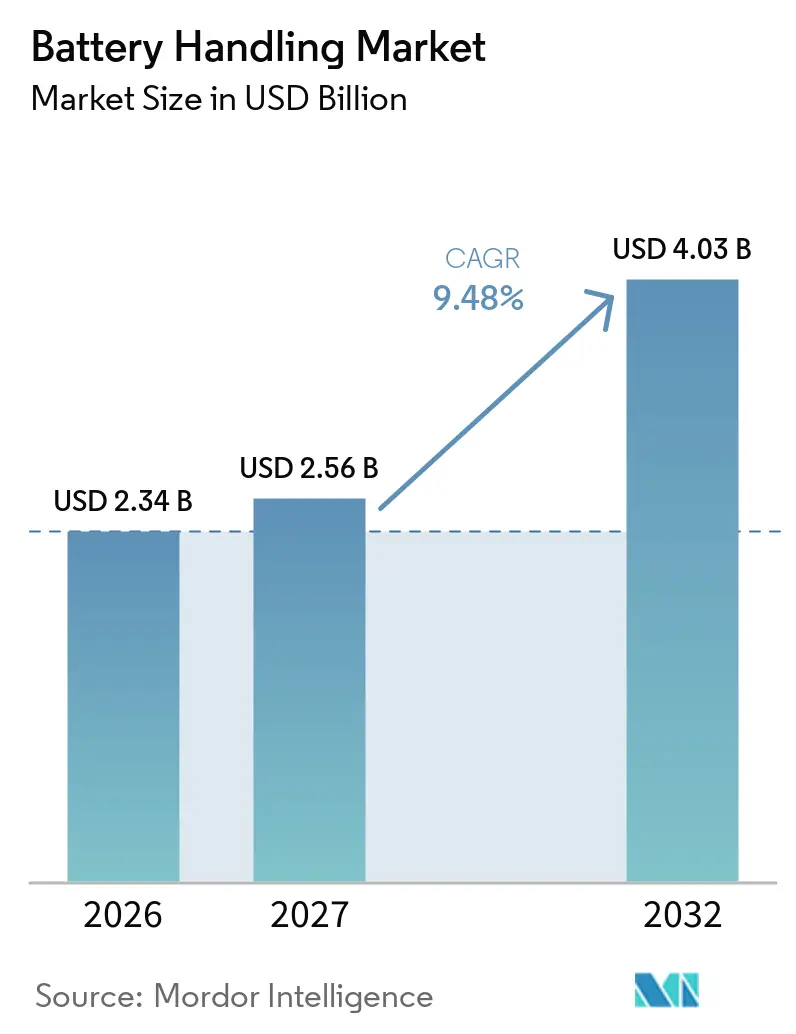
The Battery Handling Market size is projected to expand from USD 2.34 billion in 2026 and USD 2.56 billion in 2027 to USD 4.03 billion by 2032, registering a CAGR of 9.48% between 2027 and 2032. The battery handling market is supported by investment in battery-cell plants and by new recycling facilities, which both require systems that move, position, store, inspect, and process cells, modules, and packs. Global lithium-ion nameplate manufacturing capacity exceeded 4 TWh at the end of 2025, while battery deployment reached 1.2 TWh that year, supporting demand for precision material movement across production stages.[1] Higher use of robotic lines, traceable material flows, and dry-room equipment is raising the importance of suppliers that can combine equipment with software integration. The battery handling market also faces uneven order timing because project delays or cancellations can remove large equipment packages from procurement plans. Suppliers with established battery-manufacturer relationships are better placed to serve committed projects and retrofits.
Key Report Takeaways
- By battery type, lithium-ion batteries held 67.3% of the battery handling market share in 2026, while sodium-ion batteries are forecast to grow at a 15.7% CAGR through 2032.
- By handling equipment, forklifts and electric pallet trucks held 24.1% share in 2026, while robotic handling systems are forecast to grow at an 11.3% CAGR through 2032.
- By handling service, transportation within facilities held 21.5% share in 2026, while recycling and end-of-life handling are forecast to grow at an 11.1% CAGR through 2032.
- By automation level, manual battery handling held 44.7% share in 2026, while fully automated battery handling is forecast to grow at a 10.3% CAGR through 2032.
- By end user, battery manufacturers held 28.6% share in 2026, while battery recycling companies are forecast to grow at a 12.3% CAGR through 2032.
- By geography, Asia-Pacific held 52.9% share in 2026 and is forecast to grow at a 9.9% CAGR through 2032.
Note: Market numbers in this report are based on Mordor Intelligence's proprietary estimation framework, which combines nine months of actuals with Q4 projections for base year 2026.
Market Trends and Insights
Drivers Impact Analysis of Battery Handling Market*
| Driver | (~) % Impact on CAGR Forecast | Geographic Relevance | Impact Timeline |
|---|---|---|---|
| Expansion of Battery Gigafactory Capacity | +2.6% | Global, concentrated in China, Europe, and North America | Medium term (2-4 years) |
| Growth of Automated Material Movement in High-Throughput Plants | +1.4% | Global, with early adoption in China, South Korea, and Germany | Medium term (2-4 years) |
| Rising Demand for Electric Vehicles and Stationary Energy Storage | +1.8% | Global, centered in Asia-Pacific and extending to North America and Europe | Short term (≤ 2 years) |
| Increasing Adoption of AGVs and Autonomous Mobile Robots | +1.2% | Asia-Pacific, expanding to Europe and North America | Short term (≤ 2 years) |
| Dry-Room and Cleanroom Handling Requirements | +0.6% | Global, particularly China and Europe for advanced cell chemistries | Long term (≥ 4 years) |
| Battery Traceability and Digital Production Control Requirements | +0.4% | Global, with regulation-led demand in Europe and the United States | Medium term (2-4 years) |
| Source: Mordor Intelligence | |||
Expansion of Battery Gigafactory Capacity Drives Core Industrial Battery Handling Demand
Gigafactory construction remains the strongest source of equipment demand for the battery handling market because each plant requires material movement from raw materials through finished packs. Global lithium-ion nameplate capacity exceeded 4 TWh at the end of 2025, and the European Union and United States each recorded capacity growth near 50% during the year.[2] New plants need AGV and AMR fleets for movement between process areas, gantry robots for electrode reels, dry-room conveyors, and robotic cell-stacking stations. The demand extends beyond new sites because facilities opened during 2019-2022 are expanding in capacity and replacing early layouts with higher-throughput systems. Companies and startups have announced up to 965 GWh of production capacity in Europe by 2030, including investment in cell manufacturing equipment. The battery handling market therefore gains a second procurement cycle from retrofits, even where approvals for completely new sites are slower.
Rising Demand for Electric Vehicles and Stationary Energy Storage Expands the Addressable Base
Electric vehicles accounted for more than 70% of global battery deployment in 2025, and electric truck battery demand more than doubled during the year.[3] Larger packs need different lifting methods because passenger-vehicle packs weigh 200-800 kg and commercial-truck packs can weigh more than 800 kg. This increases demand for precision lifting equipment, safe fixtures, and stronger electrostatic-discharge controls across the battery handling market. Stationary storage also creates demand for fire-rated cabinets, battery replacement equipment, and outdoor-rate lifting systems for large-format racks. Global battery deployment is projected to approach 3 TWh annually by 2030 under the IEA Current Policies and Stated Policies scenarios. This volume expands equipment requirements in automotive, commercial transport, and energy storage sites, even though their handling processes differ.
Increasing Adoption of Automated Guided Vehicles (AGVs) and Autonomous Mobile Robots Rewires Plant Intralogistics
Flexible AMR fleets are replacing some fixed conveyors in battery plants because routes can change without major civil work or long production interruptions. A 2025 simulation study found that hybrid AMR and AGV concepts can allocate fleet capacity between material supply and product transport in battery-pack production.[4] This flexibility is important for high-mix, low-volume operations where equipment and product sequences change often. The battery handling market is moving toward fleet-management software, dispatch systems, and mobile equipment rather than equipment-only transactions. KUKA has demonstrated modular battery-cell production with the Karlsruhe Institute of Technology, using robot-based mini-environments to increase flexibility within tightly controlled areas. Suppliers of fixed-path systems must adapt to this shift by providing interoperable control layers and upgrade paths.
Battery Traceability and Digital Production Control Requirements Create a New Layer of Handling Intelligence
Battery passport requirements under the European Union Battery Regulation increase the need for handling systems that can record material identity and movement through production. Equipment increasingly needs to connect with manufacturing execution systems, warehouse systems, and vehicle dispatch software. The battery handling market benefits conveyors, lifting stations, and mobile robots provide timestamped events and process data rather than only physical movement. Research from Fraunhofer FFB and Accenture reported that predictive quality and traceability applications can reduce material scrap by up to 10.3% in a 40 GWh gigafactory. These savings can support investment in integrated controls, even though the equipment is more expensive than mechanical alternatives. The distinction between digitally capable integrators and commodity equipment suppliers is therefore becoming more important in procurement.
Restraints Impact Analysis of Battery Handling Market*
| Restraint | (~) % Impact on CAGR Forecast | Geographic Relevance | Impact Timeline |
|---|---|---|---|
| High Capital Cost and Extended Payback Periods | -2.0% | Global, most acute in North American and European greenfield sites | Medium term (2-4 years) |
| Shortage of Battery-Automation Engineering Talent | -1.2% | Global, particularly the United States, Europe, and emerging Asia-Pacific manufacturing hubs | Long term (≥ 4 years) |
| Fire, Thermal-Runaway, and High-Voltage Safety Risks | -0.8% | Global, with region-specific compliance under NFPA 855, IEC 62281, and UL 9540 | Medium term (2-4 years) |
| Limited Interoperability Across MES, WMS, AGV, and Production Equipment | -0.6% | Global, concentrated at multi-vendor greenfield sites | Long term (≥ 4 years) |
| Source: Mordor Intelligence | |||
High Capital Cost and Extended Payback Periods Constrain Mid-Market Automation Penetration
High upfront costs can limit automation adoption at mid-scale battery plants, especially where operators lack long-term purchase commitments or public capital support. World-scale facilities require significant integrated equipment investment, while smaller pack lines may not obtain the same cost-per-unit benefit from automation. The battery handling market is exposed when greenfield projects are delayed because handling systems are often bought as part of larger factory equipment packages. Fire-rated storage, thermal-runaway containment, and high-voltage safety equipment also raise the cost of compliant systems. Operators may choose manual or semi-automated arrangements while chemistry, product design, and production volumes remain uncertain. This makes modular equipment and staged automation options important for suppliers serving smaller projects.
Shortage of Battery-Automation Engineering Talent Slows Deployment and Raises Project Risk
The shortage of specialists in automation, robotics, manufacturing systems, and electrochemical process control can delay equipment commissioning. The Center for Automotive Research found that 82% of respondents reported shortages of locally available skilled applicants in battery-related roles. The United States is projected to require more than 120,000 skilled battery workers by 2030, while workforce supply does not always match the location of new battery plants. The battery handling market is affected because delayed AGV commissioning and software integration can hold up production ramps and customer deliveries. Training programs supported by universities, community colleges, and the Department of Energy address the gap, but their benefits will take time to reach all plant locations. Talent scarcity also makes repeatable platforms and simpler integration interfaces more valuable.
*Our forecasts treat driver/restraint impacts as directional, not additive. The impact forecasts reflect baseline growth, mix effects, and variable interactions.
Battery Handling Market Segment Analysis
By Battery Type:
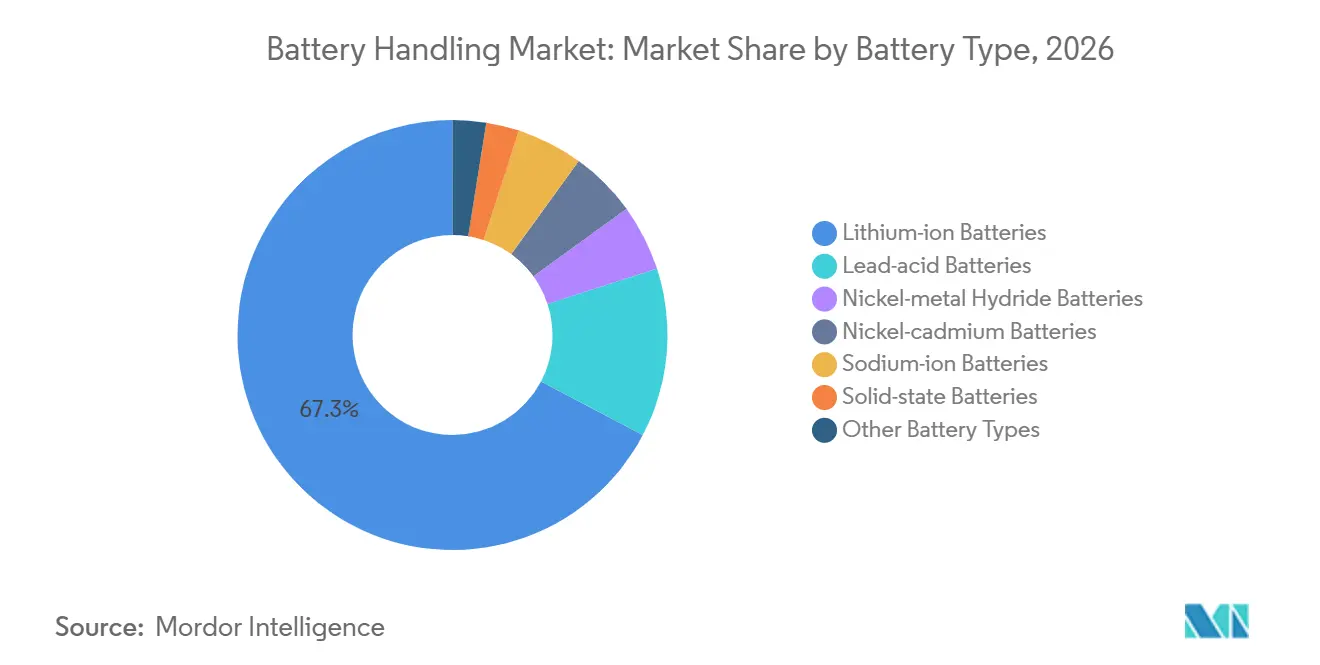
Lithium-Ion Leads Volume While Sodium-Ion Changes Equipment SpecificationsLithium-ion batteries held 67.3% of revenue in 2026, reflecting their central role in automotive and stationary storage applications. Their scale keeps the battery handling market focused on safe movement of cells, modules, and packs through high-volume production lines. Lithium-ion production requires controlled material flows from electrode preparation through formation, inspection, and final assembly. Equipment providers must meet cleanroom and dry-room requirements while protecting products from damage, contamination, and electrostatic discharge. The battery handling industry also serves lithium-ion pack assembly, warehousing, transport, repair, and collection activities. These varied settings support demand for conveyors, mobile robots, lifting systems, racks, and storage fixtures. The established installed base makes lithium-ion processes the most immediate source of replacement and upgrade work. It also gives suppliers experience that can be adapted when customers add new cell formats.
Sodium-ion batteries are forecast to grow at a 15.7% CAGR through 2032, the highest rate among battery types. CATL launched its Naxtra sodium-ion brand in 2025, and the International Energy Agency (IEA) reported that sodium-ion capacity remains small compared with lithium-ion capacity despite planned expansion. Sodium-ion cells use different materials and may require tailored electrostatic-discharge controls, conveyor designs, robotic grippers, and storage fixtures. Lead-acid batteries remain relevant for forklift replacement cycles and industrial uninterruptible power supply applications. Nickel-metal hydride, nickel-cadmium, and solid-state batteries are smaller segments with more specialized handling requirements. Solid-state cells need stringent dry-room and atmospheric controls, which makes early equipment design more important. The battery handling industry can gain from these chemistry shifts where suppliers establish specifications before volumes rise.

By Handling Equipment:
Forklifts Retain a Large Installed Base While Robotics Gains ShareForklifts and electric pallet trucks held 24.1% of market revenue in 2026. Their position reflects the volume of pack movement in warehouses, inbound logistics, production sites, and end-of-life collection networks. Heavy forklift batteries can require certified lifting beams and crane-assisted changing systems rather than manual replacement. Conveyors, racks, storage cabinets, and handling fixtures support the fixed sections of material flow within plants. Dry rooms can account for 26-53% of energy use in battery manufacturing, which encourages layouts that reduce exposure time outside controlled conditions. These operating conditions keep energy use, reliability, and safety central to equipment selection. The battery handling market continues to depend on conventional equipment where sites need simple and durable movement systems.
Robotic handling systems are forecast to grow at an 11.3% CAGR through 2032. Collaborative robots, gantry robots, and six-axis arms are increasingly used for cell stacking, module assembly, inspection, and end-of-line testing. The AgiloBat work by KUKA, and the Karlsruhe Institute of Technology shows how robot-based mini-environments can bring flexible automation into lithium-ion production. Battery lifting and extraction equipment also becomes more important as commercial vehicle packs become heavier and need controlled handling. Equipment must align with workplace safety and material-handling requirements, especially around high-voltage products. Robotics is not simply replacing forklifts, because both serve different steps and operating environments. The battery handling market is instead adding robotic capacity where precision, speed, cleanliness, and repeatability justify higher capital spending.
By Handling Service:
In-Facility Transport Provides Continuous Demand While Recycling ExpandsTransportation within facilities held 21.5% share in 2026, making it the largest handling-service activity. It supports recurring movement from electrode production through cell formation, module assembly, and pack shipment. An operating gigafactory can require millions of handling events each day, creating demand for equipment servicing, vehicle software, consumables, and predictive maintenance. This gives the battery handling market an operating revenue stream that does not depend only on purchases of new equipment. Loading and unloading, sorting and inspection, and packaging and palletization manage key transitions at plant gates and warehouse interfaces. These activities are increasingly automated as battery supply chains adopt more consistent product identification and handling procedures. The service requirement is broad because it combines movement, storage, packaging, inspection, and control of materials. Suppliers that support several of these functions can offer more integrated systems to plant operators.
Recycling and end-of-life handling are forecast to expand at an 11.1% CAGR through 2032. European Union rules set methods for calculating recycling efficiency and material recovery rates under the Battery Regulation. Recycling facilities need systems for pack disassembly, module sorting, hazardous-material containment, and black-mass processing. These inputs arrive in different conditions and states of charge, so equipment must handle greater uncertainty than new-cell production lines. United States consultations on extended battery producer responsibility also signal a growing focus on recycling goals and reporting. The battery handling market can benefit where regulations convert recycling from a voluntary activity into a formal operating requirement. Specialized recycling equipment remains distinct from manufacturing equipment because it emphasizes isolation, containment, and safe material classification.
By Automation Level:
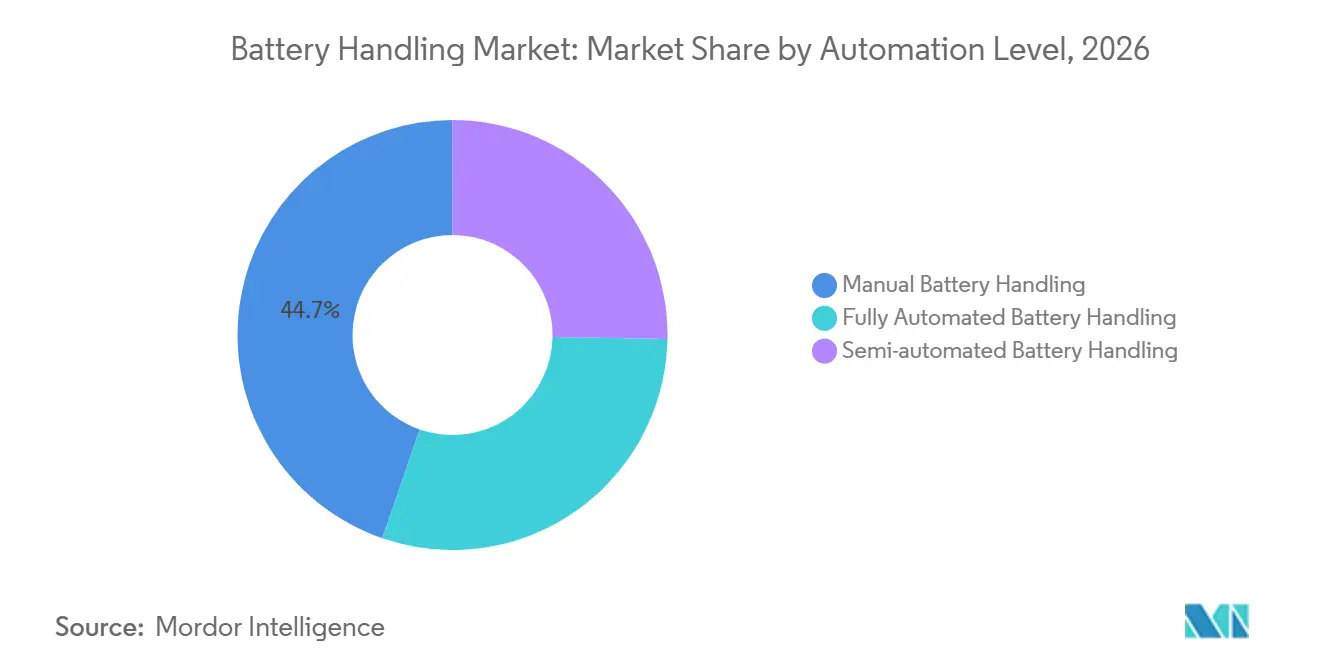
Manual Operations Remain Important While Fully Automated Lines Grow FastestManual battery handling held 44.7% share in 2026, showing that many operations still need human flexibility. Low-volume production, service work, and early runs of sodium-ion, lithium-sulfur, and solid-state products may not support dedicated automation. Manual methods can also be practical in geographically dispersed operations with changing product formats. However, operators must manage worker training, incident prevention, and handling controls for batteries. Semi-automated equipment provides a middle path for mid-scale pack assembly, maintenance workshops, and operators moving toward higher throughput. It can reduce some repetitive tasks while preserving the adaptability of manual processes. The battery handling market retains a broad customer base because not every facility can justify a fully automated line.
Fully automated battery handling is forecast to grow at a 10.3% CAGR by 2032. Integrated Autonomous Mobile Robot (AMR) and Automated Guided Vehicle (AGV) systems can improve material flow across facilities with different fleet sizes and product types. South Korea selected the Korea Institute of Machinery and Materials for its 2025 AI Factory Leading Project for secondary-battery assembly. This work supports development of autonomous manufacturing systems for battery assembly. Fully automated lines are most attractive where output volume, safety needs, and production consistency are high. They can reduce direct handling exposure and improve traceability when linked to manufacturing and warehouse software. The battery handling market will continue to use manual and semi-automated systems, but integrated automation is becoming the preferred design for new high-volume facilities.
By End User:
Battery Manufacturers Generate the Largest Demand While Recyclers Grow FastestBattery manufacturers held 28.6% share in 2026, the largest end-user position in the battery handling market. Cell production involves many handling events during electrode preparation, assembly, formation, inspection, and shipment. Manufacturers therefore require reliable conveyors, lifting stations, mobile robots, and traceability control across the plant. Their specifications can include zero-defect equipment, explosion-protected lifting stations, and integrated data capture in sensitive areas. Automotive manufacturers and battery-pack producers are another major customer group because they need direct-docking Automated Guided Vehicles (AGVs) and lifting equipment for 300-800 kg pack assemblies. Their procurement priorities include cycle time, safety, and precise positioning for assembly. Battery manufacturers are also the customer group most likely to invest in linked handling systems across several process steps.
Battery recycling companies are forecast to grow at a 12.3% CAGR through 2032. Their systems must accept end-of-life packs with different states of charge, designs, and physical conditions. This requires high-voltage isolation, thermal-runaway detection, containment, and downstream black-mass logistics. Third-party logistics providers and warehouse operators also need battery-compliant storage and movement infrastructure as supply chains scale. Energy storage operators and industrial sites generate steadier demand for replacement and maintenance handling. The battery handling market serves a wider customer base as transportation, storage, production, and recycling become more closely connected. This supports opportunities for suppliers that can adapt equipment across different risk profiles and operating volumes. It also increases the value of standardized controls and training across the battery lifecycle.
Geography Analysis
APAC, North America and Europe Battery Handling Market
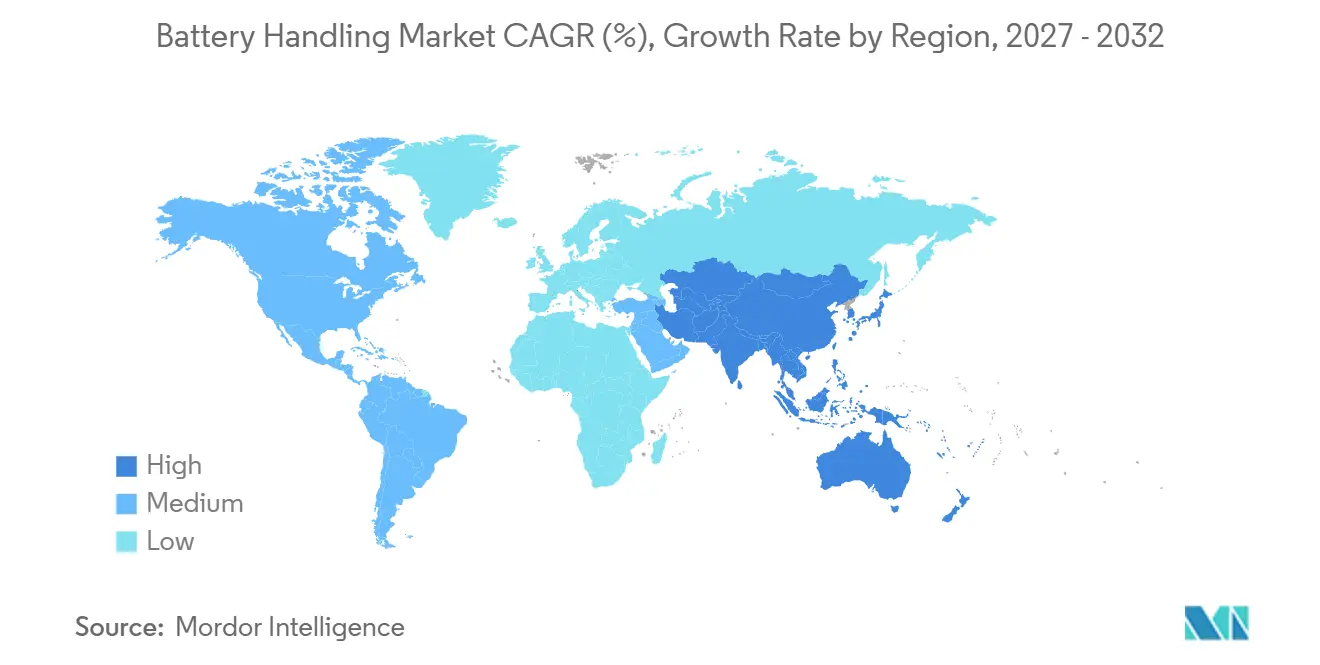
Asia-Pacific held 52.9% of the battery handling market share in 2026 and is forecast to expand at a 9.9% CAGR through 2032. China produces more than 80% of global lithium-ion battery output, linking cell manufacturing with a large domestic base of handling-equipment providers. This concentration supports demand for automated movement, dry-room systems, and high-volume intra-facility transport. South Korea contributes advanced battery manufacturing and automation development, including state-supported work on AI-based secondary-battery assembly, while Japan remains an important equipment-export base through Murata Machinery, Daifuku, and Toyota Industries. These suppliers serve projects in Asia-Pacific, North America, and Europe, and the battery handling market benefits from regional production scale, supplier density, and ongoing investment in advanced cells.
Europe Battery Handling Market
Europe has the second-largest geographic concentration because its regulatory framework combines battery production, traceability, and recycling requirements. The European Union Battery Regulation applies a lifecycle approach that affects production, logistics, collection, and waste-battery treatment. Germany has a large equipment base including Bosch Rexroth, Dürr, KUKA, Lenze, and Beckhoff, while Poland hosts significant battery manufacturing capacity. New rules on recycling efficiency and battery-waste classification require auditable practices for lithium-based batteries and black mass. These rules help sustain handling investment even when some new gigafactory announcements slow, supporting both manufacturing automation and specialized end-of-life systems.
The Americas and MEA Battery Handling Market
North America is supported by battery-manufacturing capacity growth and public interest in domestic supply chains. The United States recorded battery manufacturing capacity growth near 50% in 2025, according to the IEA. South America remains an earlier-stage opportunity, with Chile’s lithium resources and Brazil’s vehicle-assembly base supporting imported equipment demand. The Middle East and Africa focus more on energy-storage installation and maintenance, including projects connected with Saudi Arabia’s energy diversification and United Arab Emirates storage deployment, so demand is more infrastructure-led than cell-production-led.
Competitive Landscape
The battery handling market is fragmented among system integrators and fragmented among equipment-component suppliers. ABB, Siemens, KUKA, Bosch Rexroth, Daifuku, and KION Group compete for high-value intralogistics contracts at major battery plants. Their strengths include existing customer relationships, certified dry-room products, cleanroom capabilities, and integration of manufacturing, warehouse, and mobile-robot controls. This competitive structure favors companies that can take responsibility for several connected production steps, while component suppliers compete on specialized equipment, software, reliability, and compatibility with larger control architectures. Battery producers often require qualified suppliers because handling errors can affect safety, yield, and traceability, making system-integration capability more important than unit price.
Dürr expanded its collaboration with GROB for lithium-ion battery production systems, covering much of the manufacturing value chain and integrating dry-coating processes. Cimcorp entered the electric-vehicle battery-manufacturing field in 2025 with automated warehouses, AGV fleets, conveyor systems, and gantry robots for dry-room and cleanroom uses. Lenze and Bosch Rexroth demonstrated conveyor, AMR, and cell-handling systems for battery production at Hannover Messe 2025. KUKA’s work with the Karlsruhe Institute of Technology highlights contained robotic environments for battery-cell production. These moves show that the battery handling market rewards suppliers that can address changing cell chemistries and production configurations without a complete redesign.
Opportunities remain in sodium-ion and solid-state-compatible fixtures, end-of-life disassembly automation, and digitally connected forklift-battery handling. JOT Automation, Manz, and Cimcorp are examples of specialized companies pursuing configurable platforms for battery-production steps. Virtual commissioning, material-flow modeling, predictive maintenance, and digital twins are becoming part of the service offer from automation providers. These tools can reduce bottlenecks and support earlier system validation before a plant begins production.
Battery Handling Industry Leaders
-
Daifuku Co., Ltd.
-
KION Group AG
-
Toyota Industries Corporation
-
Jungheinrich AG
-
SSI SCHAEFER Group
- *Disclaimer: Major Players sorted in no particular order
Battery Handling Market Companies Covered in this Report
- ABB Ltd.
- Beckhoff Automation GmbH and Co. KG
- Bosch Rexroth AG
- Cimcorp Oy
- Daifuku Co., Ltd.
- Dematic GmbH
- Dürr AG
- Festo SE and Co. KG
- Hyster-Yale Materials Handling, Inc.
- Intralox, L.L.C.
- JOT Automation Oy
- Jungheinrich AG
- KION Group AG
- KUKA AG
- Manz AG
- Mecalux, S.A.
- Murata Machinery, Ltd.
- Siemens AG
- SSI SCHAEFER Group
- Toyota Industries Corporation
Recent Industry Developments in Battery Handling Market
- November 2025: HiNa Battery Technology officially launched four sodium-ion battery product lines in mass production and commercial sale at a themed event in China, marking the formal transition of sodium-ion batteries from pilot to commercial deployment. This directly expands the addressable market for sodium-ion-compatible battery handling fixtures and electrostatic-discharge-controlled conveyor infrastructure.
- July 2025: The European Parliament adopted Regulation (EU) 2025/1561 on 18 July 2025, amending the EU Battery Regulation to introduce mandatory battery due diligence obligations for economic operators. The regulation creates traceability and supply-chain documentation requirements that extend battery handling systems' compliance scope from production into logistics and import operations.
- April 2025: Cimcorp Oy officially entered the EV battery manufacturing market, targeting European gigafactories with automated buffer warehouses, AGV fleets, conveyor systems, and gantry robots suited for both ambient and elevated-temperature process zones, including clean and dry room areas. The market entry was made in partnership with Murata Machinery Ltd. and sister company AGVE, leveraging gantry technology proven in tire manufacturing since 1991.
- March 2025: The European Commission published Delegated Regulation (EU) 2025/606 on 21 March 2025, which entered effective application on 24 July 2025, establishing the binding methodology for calculating and verifying recycling efficiency and material recovery rates under the EU Battery Regulation 2023/1542. The rule mandates 65% recycling efficiency for lithium-based batteries by the end of 2025, directly requiring compliant handling infrastructure at recycling facilities.
Global Battery Handling Market Report Scope
Battery handling is the specialized process of safely moving, storing, installing, extracting, and preparing batteries across their entire lifecycle, from manufacturing to recycling. Because batteries store electrical energy and contain chemical compounds, handling them requires specific procedures, safety equipment, and environmental controls to mitigate the risks of electrical shocks, short circuits, chemical leaks, and thermal runaway.
The global battery handling market is segmented by battery type, handling equipment, handling service, automation level, end user, and geography. By battery type, the market is segmented into lithium-ion batteries, lead-acid batteries, nickel-metal hydride batteries, nickel-cadmium batteries, sodium-ion batteries, solid-state batteries, and other battery types. By handling equipment, the market is segmented into forklifts and electric pallet trucks, cranes and hoists, conveyors and automated conveyor systems, robotic handling systems, automated guided vehicles (AGVs), autonomous mobile robots (AMRs), battery lifting and extraction equipment, battery racks, storage cabinets and handling fixtures, and other handling equipment. By handling service, the market is segmented into loading and unloading, transportation within facilities, lifting and positioning, installation and removal, sorting and inspection, storage and inventory management, packaging and palletization, and recycling and end-of-life handling. By automation level, the market is segmented into manual, semi-automated, and fully automated battery handling. By end user, the market is segmented into battery manufacturers, automotive original equipment manufacturers (OEMs) and battery pack manufacturers, third-party logistics providers, industrial and manufacturing facilities, warehousing and distribution centers, energy storage system operators, battery recycling companies, and other end users. The report also covers the market size and forecasts for the global battery handling market across 26 countries in key regions. For each segment, the market sizing and forecasts have been provided on the basis of value (USD).
Segmentation Overview
| Lithium-ion Batteries |
| Lead-acid Batteries |
| Nickel-metal Hydride Batteries |
| Nickel-cadmium Batteries |
| Sodium-ion Batteries |
| Solid-state Batteries |
| Other Battery Types |
| Forklifts and Electric Pallet Trucks |
| Cranes and Hoists |
| Conveyors and Automated Conveyor Systems |
| Robotic Handling Systems |
| Automated Guided Vehicles (AGVs) |
| Autonomous Mobile Robots (AMRs) |
| Battery Lifting and Extraction Equipment |
| Battery Racks, Storage Cabinets, and Handling Fixtures |
| Other Handling Equipment |
| Loading and Unloading |
| Transportation Within Facilities |
| Lifting and Positioning |
| Installation and Removal |
| Sorting and Inspection |
| Storage and Inventory Management |
| Packaging and Palletization |
| Recycling and End-of-Life Handling |
| Manual Battery Handling |
| Semi-automated Battery Handling |
| Fully Automated Battery Handling |
| Battery Manufacturers |
| Automotive OEMs and Battery Pack Manufacturers |
| Third-party Logistics Providers |
| Industrial and Manufacturing Facilities |
| Warehousing and Distribution Centers |
| Energy Storage System Operators |
| Battery Recycling Companies |
| Other End Users |
| North America | United States |
| Canada | |
| Mexico | |
| Europe | Germany |
| France | |
| Italy | |
| Spain | |
| United Kingdom | |
| Poland | |
| Russia | |
| Rest of Europe | |
| Asia-Pacific | China |
| India | |
| Japan | |
| South Korea | |
| Australia | |
| Indonesia | |
| Vietnam | |
| Thailand | |
| Rest of Asia-Pacific | |
| South America | Brazil |
| Argentina | |
| Chile | |
| Rest of South America | |
| Middle East and Africa | Saudi Arabia |
| United Arab Emirates | |
| Egypt | |
| South Africa | |
| Morocco | |
| Rest of Middle East and Africa |
| By Battery Type | Lithium-ion Batteries | |
| Lead-acid Batteries | ||
| Nickel-metal Hydride Batteries | ||
| Nickel-cadmium Batteries | ||
| Sodium-ion Batteries | ||
| Solid-state Batteries | ||
| Other Battery Types | ||
| By Handling Equipment | Forklifts and Electric Pallet Trucks | |
| Cranes and Hoists | ||
| Conveyors and Automated Conveyor Systems | ||
| Robotic Handling Systems | ||
| Automated Guided Vehicles (AGVs) | ||
| Autonomous Mobile Robots (AMRs) | ||
| Battery Lifting and Extraction Equipment | ||
| Battery Racks, Storage Cabinets, and Handling Fixtures | ||
| Other Handling Equipment | ||
| By Handling Service | Loading and Unloading | |
| Transportation Within Facilities | ||
| Lifting and Positioning | ||
| Installation and Removal | ||
| Sorting and Inspection | ||
| Storage and Inventory Management | ||
| Packaging and Palletization | ||
| Recycling and End-of-Life Handling | ||
| By Automation Level | Manual Battery Handling | |
| Semi-automated Battery Handling | ||
| Fully Automated Battery Handling | ||
| By End User | Battery Manufacturers | |
| Automotive OEMs and Battery Pack Manufacturers | ||
| Third-party Logistics Providers | ||
| Industrial and Manufacturing Facilities | ||
| Warehousing and Distribution Centers | ||
| Energy Storage System Operators | ||
| Battery Recycling Companies | ||
| Other End Users | ||
| By Geography | North America | United States |
| Canada | ||
| Mexico | ||
| Europe | Germany | |
| France | ||
| Italy | ||
| Spain | ||
| United Kingdom | ||
| Poland | ||
| Russia | ||
| Rest of Europe | ||
| Asia-Pacific | China | |
| India | ||
| Japan | ||
| South Korea | ||
| Australia | ||
| Indonesia | ||
| Vietnam | ||
| Thailand | ||
| Rest of Asia-Pacific | ||
| South America | Brazil | |
| Argentina | ||
| Chile | ||
| Rest of South America | ||
| Middle East and Africa | Saudi Arabia | |
| United Arab Emirates | ||
| Egypt | ||
| South Africa | ||
| Morocco | ||
| Rest of Middle East and Africa | ||
Key Questions Answered in the Report
What is the projected value of the Battery Handling Market by 2032?
The Battery Handling Market is forecast to reach USD 4.03 billion by 2032, growing at a 9.48% CAGR from 2027. The projection reflects demand across cell manufacturing, recycling, and battery-storage applications.
Which battery chemistry leads demand for handling equipment?
Lithium-ion batteries led with 67.3% share in 2026 because they are widely used in electric vehicles and stationary energy storage. Sodium-ion batteries are expected to create additional requirements for tailored equipment specifications.
Why are robotic battery-handling systems growing quickly?
Robotic systems are forecast to grow at an 11.3% CAGR through 2032 because cell production needs precise, clean, and repeatable operations. Manufacturers also use robots to improve material traceability and reduce handling exposure.
Which end users are expanding their equipment purchases fastest?
Battery recycling companies are forecast to grow at a 12.3% CAGR through 2032 as recycling and traceability requirements become more formal. Their sites need dedicated equipment for disassembly, sorting, isolation, and containment.
Which region has the largest demand for battery-handling systems?
Asia-Pacific held 52.9% share in 2026 and is forecast to grow at a 9.9% CAGR through 2032, supported by regional battery production capacity. China, South Korea, and Japan each support different parts of the equipment supply chain.
What factors can limit the adoption of automated systems?
Capital costs, long payback periods, safety requirements, interoperability issues, and shortages of automation specialists can delay deployment. These constraints are particularly important for smaller plants and projects still undergoing design changes.