
Bariatric Beds Market Size and Share
Market Overview
| Study Period | 2021 - 2032 |
|---|---|
| Market Size (2027) | USD 419.5 Million |
| Market Size (2032) | USD 548.79 Million |
| Growth Rate (2027 - 2032) | 5.52 % |
| Fastest Growing Market | Asia-Pacific |
| Largest Market | North America |
| Market Concentration | Medium |
Major Players *Disclaimer: Major Players sorted in no particular order Image © Mordor Intelligence. Reuse requires attribution under CC BY 4.0. | |
Bariatric Beds Market Analysis by Mordor Intelligence
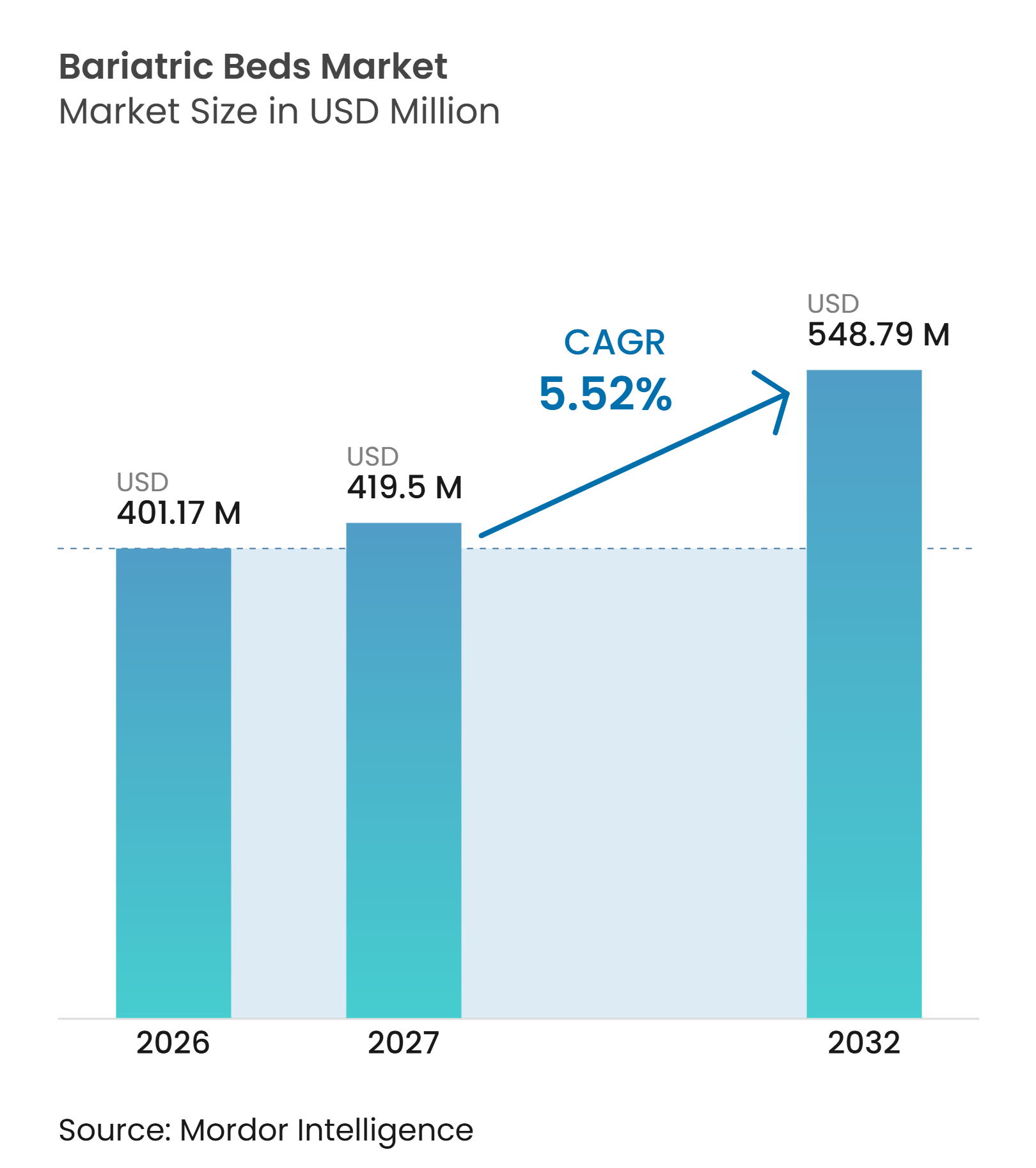
The Bariatric Beds Market size is expected to grow from USD 401.17 million in 2026 to USD 419.5 million in 2027 and is forecast to reach USD 548.79 million by 2032 at 5.52% CAGR over 2027-2032.
Demand follows the increasing number of adults living with obesity, which reached 890 million in 2022 and is projected to reach 1.13 billion by 2030, increasing the volume of patients whose weight and mobility needs cannot be met reliably by standard equipment. Patients with obesity can have diabetes, cardiovascular disease, sleep apnea, and mobility limitations, which can increase care needs across hospitals, rehabilitation, and residential care, particularly when transfers, skin protection, and routine repositioning require more staff time. Healthcare providers are also raising their equipment specifications as heavier patients require safe handling, wider decks, reliable pressure management, and frames that can be moved through the facility without compromising daily nursing workflows. Product development is moving toward connected functions that support bed-exit detection, repositioning, weighing, and nursing alerts, giving staff more timely information while reducing reliance on separate monitoring steps. Procurement is constrained by equipment cost, coverage differences, and the physical limits of older care facilities, including doorway width, lift capacity, and floor loading, so providers often need to coordinate capital plans with building and clinical teams.
Key Report Takeaways
- By product type, manual bariatric beds held 41.51% of revenue in 2026, while fully electric bariatric beds are forecast to grow at a 7.12% CAGR through 2032.
- By weight capacity, the 500-700 pounds tier held 43.17% of revenue in 2026, while the 701-1,000 pounds tier is expected to grow at a 6.23% CAGR through 2032.
- By clinical function, acute and critical care held 40.72% of revenue in 2026, while postoperative and rehabilitation care is anticipated to grow at a 7.72% CAGR through 2032.
- By end-user, hospitals and clinics held 43.36% of revenue in 2026, while long-term care facilities are forecast to grow at a 6.83% CAGR through 2032.
- By geography, North America held 47.42% of revenue in 2026, while Asia-Pacific is projected to grow at a 7.24% CAGR through 2032.
Note: Market numbers in this report are based on Mordor Intelligence's proprietary estimation framework, which combines nine months of actuals with Q4 projections for base year 2026.
Market Trends and Insights
Drivers Impact Analysis of Bariatric Beds Market*
| Driver | (~) % Impact on CAGR Forecast | Geographic Relevance | Impact Timeline |
|---|---|---|---|
| Rising Global Obesity and Higher-Acuity Patient Mix | +1.8% | Global, highest concentration in North America, MENA, and parts of Asia-Pacific | Long term (≥ 4 years) |
| Growth in Bariatric Surgery and Postoperative Care | +1.0% | North America, Europe, and emerging Asia-Pacific | Medium term (2-4 years) |
| Safe Patient Handling and Caregiver Injury Reduction | +0.9% | North America and Europe | Medium term (2-4 years) |
| Expansion of Home Healthcare and Aging-in-Place | +0.8% | North America, core APAC, and spillover to MEA | Long term (≥ 4 years) |
| Digital and Automated Bed-Function Adoption | +0.7% | Asia-Pacific, North America, and Europe | Medium term (2-4 years) |
| Under-Recognized Need for Bariatric-Ready Capacity Planning | +0.6% | Global, with early uptake in North America and Western Europe | Short term (≤ 2 years) |
| Source: Mordor Intelligence | |||
Rising Global Obesity and Higher-Acuity Patient Mix
Global obesity has more than doubled, increasing the number of patients who need care that accounts for greater weight and restricted mobility. The World Obesity Federation projected 1.13 billion adults with obesity by 2030. In the United States, adult obesity was 40.3% and severe obesity was 9.4%, which keeps demand for bariatric-ready infrastructure high across acute and post-acute settings.[1] Patients with severe obesity may need longer and more complex episodes of care because of related clinical conditions. The bariatric beds market responds to this need through higher-capacity frames, integrated scales, CPR controls, and compatible pressure-redistribution surfaces. Growing admissions among patients weighing 500 pounds or more are also encouraging providers to consider equipment capacity before an urgent case occurs.
Safe Patient Handling and Caregiver Injury Reduction
Moving bariatric patients can expose healthcare staff to musculoskeletal injury risks, especially when a task depends on manual lifting. The American Society for Healthcare Professionals stated in 2026 that structured safe handling and mobility programs support safety, dignity, and outcomes in bariatric care.[2]A 2025 study reported high musculoskeletal disorder prevalence among hospital and nursing home workers, alongside inconsistent adherence to patient-handling guidance.[3] Adjustable deck heights, maneuverable frames, and patient-assistance features can reduce the need for unsafe transfers. This makes staff safety and compliance a continuing purchasing consideration in the bariatric beds market, especially where leaders are expected to document safer processes for transfers, repositioning, and everyday mobility support.
Expansion of Home Healthcare and Aging-in-Place
The bariatric beds market is expanding beyond acute hospitals as older adults with obesity-related conditions need more support at home and in residential facilities. Aging and mobility limitations can coincide with obesity-related conditions in North America and Europe, as well as in China, Japan, and South Korea. Rental arrangements and durable medical equipment coverage can lower the entry cost for some home settings. The home channel requires lighter and semi-electric products that can fit through residential doorways and still support safe care. This creates a different product requirement from hospital systems that prioritize intensive monitoring and acute functions. The need for bariatric-ready capacity planning is therefore extending into long-term care and homecare operations, where a lack of suitable equipment can make routine care harder for both the patient and the caregiver.
Digital and Automated Bed-Function Adoption
Hospitals are replacing some manual configurations with electric and connected models as they address falls, caregiver strain, and care complexity. Joerns Healthcare states that the Bari10A includes a battery-backup scale system and multifunction controls, and it complies with IEC/EN 60601-2-52. These features support patient observation and routine nursing workflows in high-acuity settings. Digital functions can also shorten the useful life of manual and semi-electric inventories when hospitals set new baseline specifications. This replacement activity adds to new installation demand in the bariatric beds market, because a hospital may upgrade existing rooms even when its number of available beds is unchanged.
Restraints Impact Analysis of Bariatric Beds Market*
| Restraint | (~) % Impact on CAGR Forecast | Geographic Relevance | Impact Timeline |
|---|---|---|---|
| High Acquisition and Lifecycle Cost Versus Standard Beds | -0.8% | Global, most acute in emerging markets and rural healthcare networks | Long term (≥ 4 years) |
| Facility Space, Doorway, Lift, and Flooring Constraints | -0.5% | Europe, Asia-Pacific, and South America with older infrastructure | Medium term (2-4 years) |
| Fragmented Reimbursement and Procurement Economics | -0.6% | North America and Europe | Medium term (2-4 years) |
| Under-Utilization Risk and Rental Substitution | -0.4% | North America and Western Europe | Short term (≤ 2 years) |
| Source: Mordor Intelligence | |||
High Acquisition and Lifecycle Cost Versus Standard Beds
High acquisition cost remains a barrier for rural, community, and developing-market facilities with limited capital budgets. Full-electric beds with monitoring functions and capacities above 700 pounds cost more than standard hospital beds. Maintenance, mattress replacement, and compliance upgrades raise the cost over the equipment life. This gap can be most difficult for providers in sub-Saharan Africa, South Asia, rural Latin America, and other resource-constrained settings. Rental can reduce the need for ownership, but it can also delay an equipment purchase. The bariatric beds market, therefore,1 faces slower adoption where a provider cannot connect the higher initial cost to operational and clinical value, even if a larger or more automated bed would be helpful during complex patient episodes.
Fragmented Reimbursement and Procurement Economics
Coverage for bariatric beds differs across payers and care settings, which can make purchasing decisions difficult for providers and patients. Coverage rules can separate hospital bed eligibility by patient need and clinical documentation, rather than patient weight alone. In home settings, rental structures can limit the path to long-term deployment when an individual needs ongoing mobility support. In inpatient care, specialty bed costs are commonly absorbed within broader hospital payment arrangements. These conditions leave providers responsible for aligning clinical requirements with local reimbursement rules. Facility constraints can compound the decision because doorways, lifts, and flooring may need upgrades before a larger bed can be installed, linking the purchasing decision to maintenance planning and possible disruption within an operating care unit.
*Our forecasts treat driver/restraint impacts as directional, not additive. The impact forecasts reflect baseline growth, mix effects, and variable interactions.
Bariatric Beds Market Segment Analysis
By Product Type:
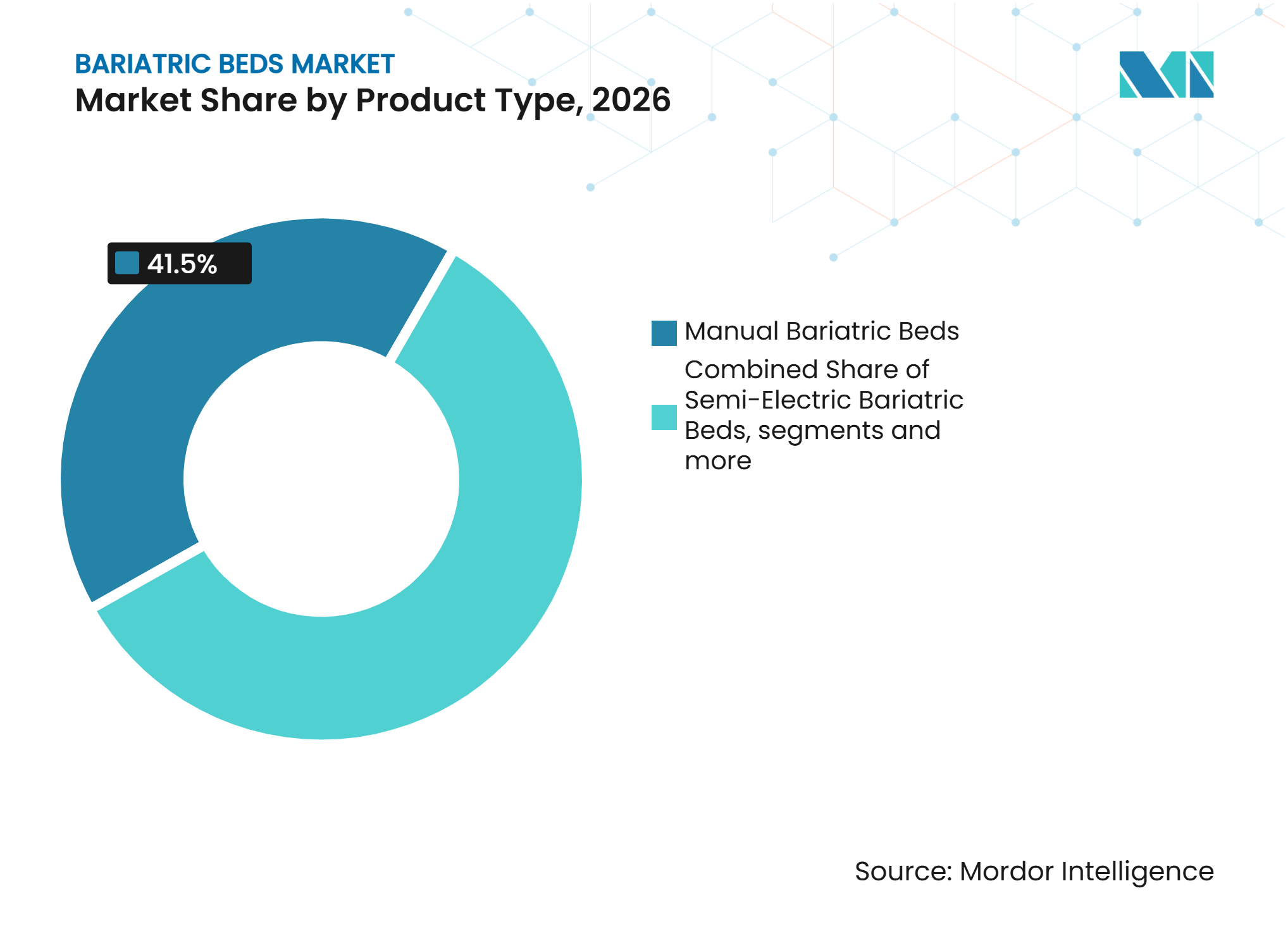
Manual Models Hold Ground While Electrification Reshapes ProcurementManual bariatric beds held 41.51% of the bariatric beds market share in 2026 because their lower initial cost suited cost-sensitive purchasing environments. Long-term care providers in emerging markets and community hospitals continued to use manual models where budget limits shaped equipment selection. Semi-electric beds offered powered head and foot adjustment without full-frame electric control. This middle tier remained relevant for skilled nursing facilities seeking some automation at a manageable cost within the bariatric beds market.
Fully electric bariatric beds are projected to record a 7.12% CAGR through 2032. Their growth reflects hospital interest in reducing staff strain, supporting safe handling programs, and adding patient-monitoring functions. Stryker's MV3 illustrates the high-acuity direction of the product category through its 1,102-pound safe working load, adjustable deck widths, and exit detection. At the same time, lower-cost models can widen access in Asia-Pacific hospitals. The bariatric beds industry, therefore, has different product paths in developed and emerging care systems, with product specifications shaped as much by capital budgets, local service availability, and facility design as by clinical preference.



By Weight Capacity:
Mid-Range Builds the Broadest Clinical Base, Heavier Tier AcceleratesThe 500- 700-pound tier held 43.17% of the bariatric beds market share in 2026, making it the broadest clinical capacity range. It matched common needs in hospitals, rehabilitation units, and long-term care facilities across the bariatric beds market. The 701-1,000-pounds tier is projected to grow at a 6.23% CAGR through 2032.
Rising severe obesity and more super-bariatric admissions are leading facilities to specify greater capacity earlier in the buying process. The change reduces reliance on emergency rentals for individual patient episodes. Higher-capacity products are being developed for active clinical support rather than simple accommodation, including full-electric articulation, therapeutic surface integration, and positioning functions. The above-1,000-pound tier remains specialized but matters to facilities that want heavy-duty equipment on site. These providers may prefer ownership to the operational uncertainty of a per-episode rental. Facilities that once bought 500- 700-pound models are increasingly considering the 701-1,000-pound range.
By Clinical Function:
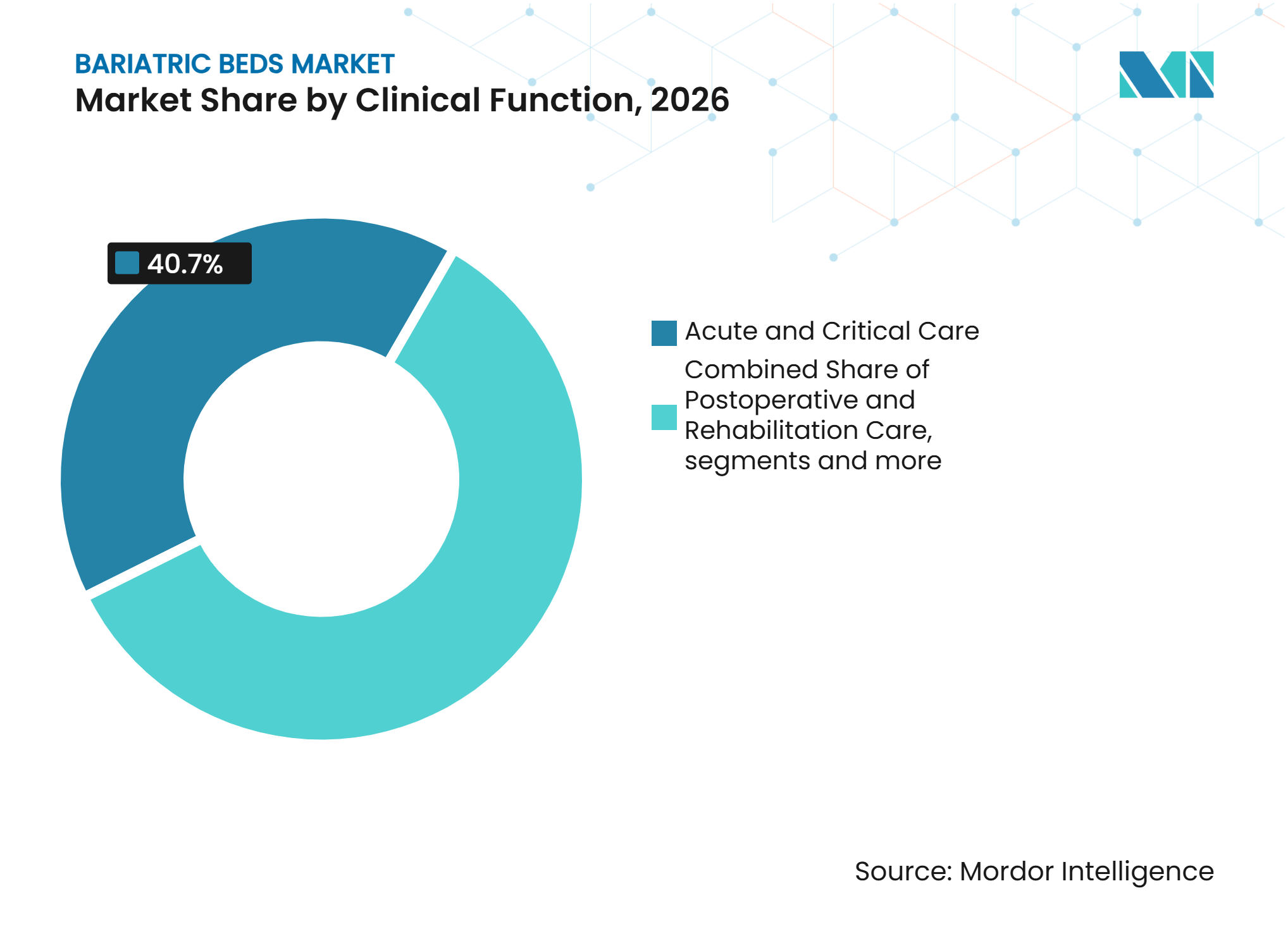
Acute Care Anchors Volumes, Postoperative and Rehabilitation Leads GrowthAcute and critical care held 40.72% of revenue in 2026, supported by the need for high-specification equipment in intensive care and medical-surgical units. These settings use functions such as pressure redistribution, integrated weighing, CPR-ready positioning, and support for other clinical equipment in the bariatric beds market. Severe obesity-related admissions for cardiovascular events, respiratory issues, and procedures sustain baseline equipment demand. Postoperative and rehabilitation care is projected to grow at a 7.72% CAGR through 2032. The care pathway now includes patients using GLP-1 medicines who require monitored mobility support alongside traditional surgery recovery cases.
Long-term and residential care focuses on repositioning, pressure-injury prevention, and caregiver ergonomics rather than intensive clinical monitoring. The overlap of aging and obesity supports this function in several major care systems. Homecare and community care remain the smallest clinical functions, but they offer an important route outside institutions. Rental programs and remote care management can make bariatric bed use more practical in community settings.

By End-User:
Hospitals Lead the Market as Long-Term Care Facilities Scale the FastestHospitals and clinics held 43.36% of revenue in 2026, supported by fleet purchasing, safe handling requirements, and the concentration of acute admissions in tertiary facilities. These purchasers need equipment that can serve a wide range of inpatient cases. Their buying decisions also reflect requirements for staff safety and clinical workflow across the bariatric beds market. Long-term care facilities are projected to grow at a 6.83% CAGR through 2032. Providers that build bariatric-ready capacity at the start can avoid later retrofits of standard-weight infrastructure.
Rehabilitation and specialty centers form a growing middle tier as surgery aftercare connects with multidisciplinary weight-management services. Some centers are becoming medical weight-management hubs, so they need mobility equipment beyond surgical recovery use. Homecare providers and patients are the fastest-growing alternate-care channel in the end-user dimension. The bariatric beds market is therefore becoming less dependent on hospital-only procurement, as care delivery models require suitable equipment in residential and community settings as well as inpatient rooms.
Geography Analysis
North America
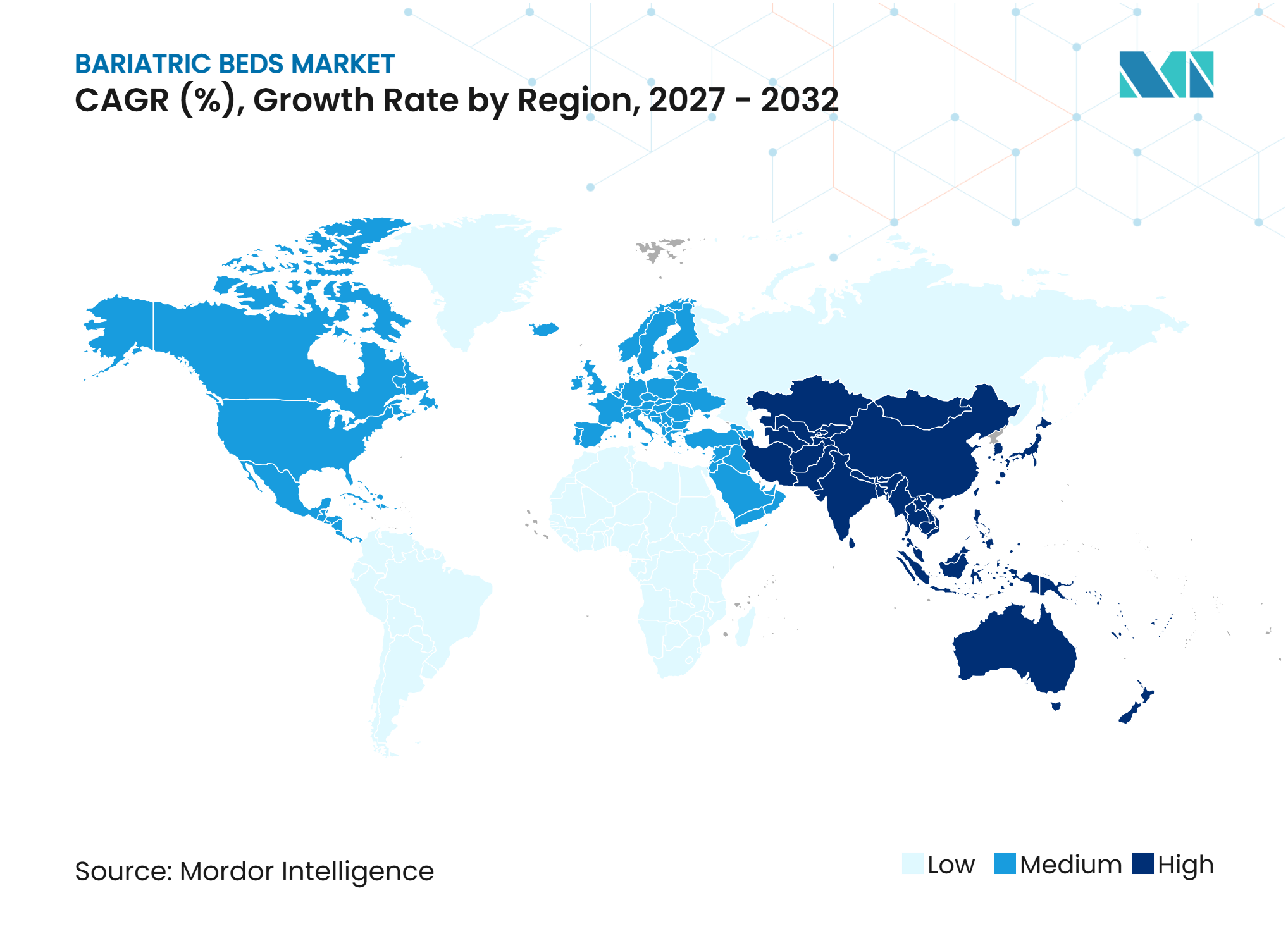
North America held 47.42% of revenue in 2026, supported by the United States and its high prevalence of adult and severe obesity. Safe patient handling guidance and state legislation connect bariatric equipment to employee safety and accreditation expectations. This turns some purchases into an institutional requirement rather than a discretionary capital decision in the bariatric beds market. Canada also supports mechanical-assist care through restrictions on manual patient handling. Mexico is growing through private hospital investment linked to weight-loss procedure medical tourism.
Europe
Europe is the second-largest regional presence in the bariatric beds market, led by Germany, the United Kingdom, France, Italy, and Spain, where established hospitals and long-term care providers make equipment standards an important part of purchasing decisions. Germany benefits from broad care infrastructure and the regional operations of Arjo and LINET. The United Kingdom has safe patient handling guidance that supports the use of mechanical transfer equipment for bariatric patients. The EU Medical Device Regulation requires clinical evidence and post-market surveillance for CE-marked hospital beds. These requirements raise compliance costs, but they also maintain a quality threshold for electric hospital bed suppliers in the bariatric beds market.
Asia-Pacific, Middle East and Africa
Asia-Pacific is forecasted to grow at a 7.24% CAGR through 2032, the fastest regional rate in the bariatric beds market, as providers add care capacity and seek products that fit both hospital modernization and long-term care requirements in routine and complex treatment settings. Healthcare infrastructure expansion, urban obesity, and hospital modernization are supporting demand. Japan and South Korea have a long-term care-focused pattern because of aging populations and investment in care facilities. PARAMOUNT BED, Merits Health Products, and other regional suppliers compete through cost-focused configurations in the bariatric beds market. The Middle East and Africa are emerging through GCC healthcare investment and South African private hospital networks.
Competitive Landscape
Market Concentration
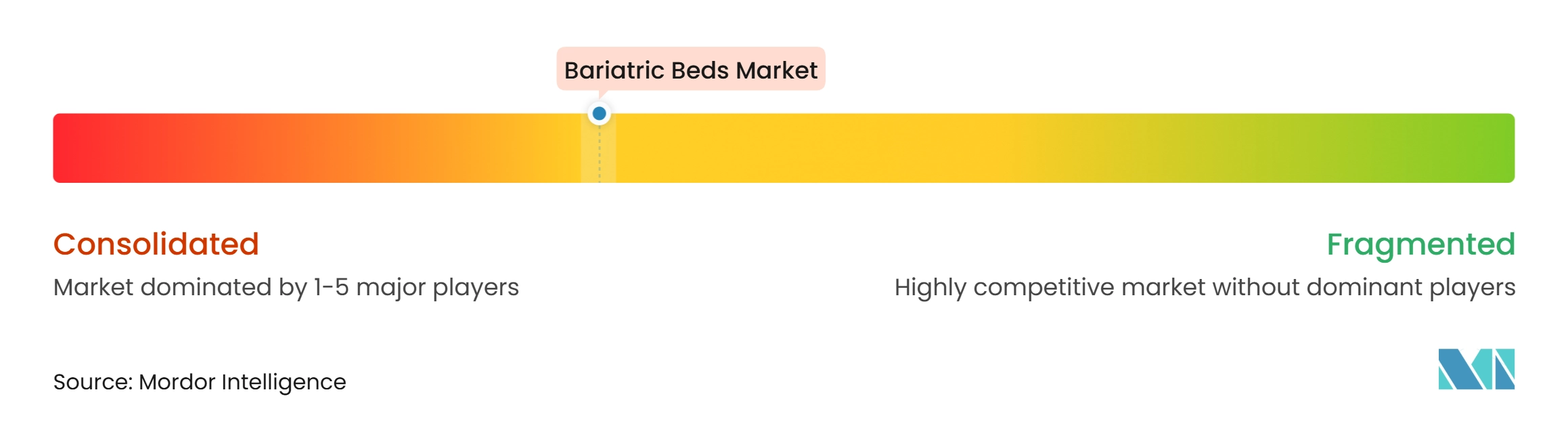
The bariatric beds market has moderate concentration at the premium institutional end, where Stryker, Arjo, LINET, and Joerns hold established positions in acute and high-acuity channels, while regional producers provide lower-cost options in selected markets. Their positions reflect product breadth, safety and compliance portfolios, and service networks in the bariatric beds market. Stryker combines bed technology with clinical workflow features in its MV3 portfolio. Arjo connects beds with slings, transfer devices, and hygiene solutions to support patient flow across a provider account.
DHCare was formed in February 2026 by combining Invacare Europe and Asia-Pacific with Direct Healthcare Group. DHCare also signed an agreement in 2026 to acquire Ottobock's Human Mobility division, subject to an expected second-half 2026 close. This expands its post-acute and complex rehabilitation coverage across Europe and changes the competitive options available in the bariatric beds market. Asian producers, including PARAMOUNT BED, Merits Health Products, and Zhangjiagang Medi Medical Equipment, are adding capacity and competing aggressively on price in Asia-Pacific. Their distributor reach is also extending into European mid-tier channels. This creates a more difficult pricing environment for suppliers of manual and basic electric models.
Opportunities remain in cost-effective electric beds for mid-tier hospitals in the Asia-Pacific and Latin America. Home rental programs outside North America remain another area for expansion. Suppliers could also link remote monitoring with outcome data as providers seek new purchasing models in the bariatric beds market. Premarket notification requirements and ISO 13485 expectations raise the entry threshold in North American procurement. IEC/EN 60601-2-52 similarly acts as a practical global safety benchmark for electric beds. The bariatric beds market remains open to regional competitors, but certification, support, and clinical credibility shape success in premium accounts, where hospitals need confidence in equipment availability, training, and service response.
Bariatric Beds Industry Leaders
-
Baxter International Inc.
-
Stryker Corporation
-
Arjo AB
-
Invacare Corporation
-
Drive DeVilbiss Healthcare
- *Disclaimer: Major Players sorted in no particular order
Bariatric Beds Market Companies Covered in this Report
- Alerta Medical
- Arjo AB
- Baxter
- Benmor Medical Limited
- Cobi Rehab
- Drive DeVilbiss Healthcare
- Gendron, Inc.
- GF Health Products, Inc.
- Haelvoet NV
- Invacare
- Joerns Healthcare
- LINET Group
- Medline Industries
- Merits Health Products
- Paramount Bed
- Rotec International
- Savaria Corporation
- Sizewise Rentals LLC
- Stryker
- Zhangjiagang Medi Medical Equipment Co., Ltd.
Recent Industry Developments in Bariatric Beds Market
- February 2026: Rhône, a global private equity firm, completed the acquisitions of Invacare Europe and Asia-Pacific alongside Direct Healthcare Group (DHG), merging both into the newly formed DHCare entity. DHCare is headquartered in London, present in 16 countries, and exporting to over 50 worldwide, positioning itself as one of the international leaders in mobility and post-acute care medical devices.
- February 2025: Stryker launched the ProCeed hospital bed globally, featuring a low bed height design, a fifth-wheel steering mechanism to reduce caregiver back injury risk, and two configurable headboard options. The product targets both standard and bariatric care workflows across multiple regions, with a design emphasis on caregiver ergonomics and patient fall prevention.
- January 2025: Arjo announced expanded distribution partnerships in North America for bariatric patient handling and medical bed systems, targeting rehabilitation and long-term care providers. The move aligns with Arjo's 2026 organic growth target of 3-5% and deepens the company's reach in the North American post-acute channel.
Global Bariatric Beds Market Report Scope
According to the report’s scope, the bariatric beds market encompasses medical beds engineered to support patients with higher body weight, integrating features such as extra‑wide frames, motorized positioning, reinforced side rails, and pressure‑relief surfaces. These beds are used in hospitals, long‑term care facilities, and homecare settings to improve patient mobility, reduce caregiver strain, and enhance clinical outcomes.
The bariatric beds market is segmented into product type, weight capacity, clinical function, end-user, and geography. By product type, the market is segmented into manual bariatric beds, semi-electric bariatric beds, and fully-electric bariatric beds. By weight capacity, the market is segmented into 500-700 pounds, 701-1,000 pounds, and above 1,000 pounds. By clinical function, the market is segmented into acute and critical care, postoperative and rehabilitation care, long-term care and residential care, and homecare and community care. By end-user, the market is segmented into hospitals and clinics, long-term care facilities, rehabilitation and specialty centers, and homecare providers and patients. By geography, the market is segmented into North America, Europe, Asia-Pacific, the Middle East and Africa, and South America. The report also covers the estimated market sizes and trends for 17 countries across major regions globally. The report offers values (USD) for all the above segments.
Segmentation Overview
| Manual Bariatric Beds |
| Semi-Electric Bariatric Beds |
| Fully-Electric Bariatric Beds |
| 500-700 Pounds |
| 701-1,000 Pounds |
| Above 1,000 Pounds |
| Acute and Critical Care |
| Postoperative and Rehabilitation Care |
| Long-Term Care and Residential Care |
| Homecare and Community Care |
| Hospitals and Clinics |
| Long-Term Care Facilities |
| Rehabilitation and Specialty Centers |
| Other End Users (Homecare Providers and Patients, among others) |
| North America | United States |
| Canada | |
| Mexico | |
| Europe | Germany |
| United Kingdom | |
| France | |
| Italy | |
| Spain | |
| Rest of Europe | |
| Asia-Pacific | China |
| Japan | |
| India | |
| Australia | |
| South Korea | |
| Rest of Asia-Pacific | |
| Middle East and Africa | GCC |
| South Africa | |
| Rest of Middle East and Africa | |
| South America | Brazil |
| Argentina | |
| Rest of South America |
| By Product Type | Manual Bariatric Beds | |
| Semi-Electric Bariatric Beds | ||
| Fully-Electric Bariatric Beds | ||
| By Weight Capacity | 500-700 Pounds | |
| 701-1,000 Pounds | ||
| Above 1,000 Pounds | ||
| By Clinical Function | Acute and Critical Care | |
| Postoperative and Rehabilitation Care | ||
| Long-Term Care and Residential Care | ||
| Homecare and Community Care | ||
| By End-User | Hospitals and Clinics | |
| Long-Term Care Facilities | ||
| Rehabilitation and Specialty Centers | ||
| Other End Users (Homecare Providers and Patients, among others) | ||
| By Geography | North America | United States |
| Canada | ||
| Mexico | ||
| Europe | Germany | |
| United Kingdom | ||
| France | ||
| Italy | ||
| Spain | ||
| Rest of Europe | ||
| Asia-Pacific | China | |
| Japan | ||
| India | ||
| Australia | ||
| South Korea | ||
| Rest of Asia-Pacific | ||
| Middle East and Africa | GCC | |
| South Africa | ||
| Rest of Middle East and Africa | ||
| South America | Brazil | |
| Argentina | ||
| Rest of South America | ||
Key Questions Answered in the Report
What is the projected size of the bariatric beds market by 2032?
The bariatric beds market is projected to grow from USD 419.50 million in 2027 to USD 548.79 million by 2032, at a CAGR of 5.52% during the 2027–2032 forecast period.
Which product category leads bariatric bed demand?
Manual bariatric beds led product demand with 41.51% of revenue in 2026, while fully electric models are projected to grow the fastest at 7.12% CAGR through 2032.
Which end-user is growing fastest for bariatric beds?
Long-term care facilities are projected to grow at a 6.83% CAGR through 2032 as aging and obesity increase residential care needs, with repositioning and caregiver ergonomics becoming more important in daily care for residents who need frequent support with movement.
Which region has the strongest growth outlook?
Asia-Pacific is projected to grow at a 7.24% CAGR through 2032, supported by care-facility investment and a wider range of price-focused product configurations that are intended for both expanding hospitals and long-term care facilities.