
Market Overview
| Study Period | 2021 - 2031 |
|---|---|
| Forecast Data Period | 2026 - 2031 |
| Base Year Market Size (2025) | USD 0.84 Billion |
| Market Size (2026) | USD 0.87 Billion |
| Market Size (2031) | USD 1.10 Billion |
| Growth Rate (2026 - 2031) | 4.69 % |
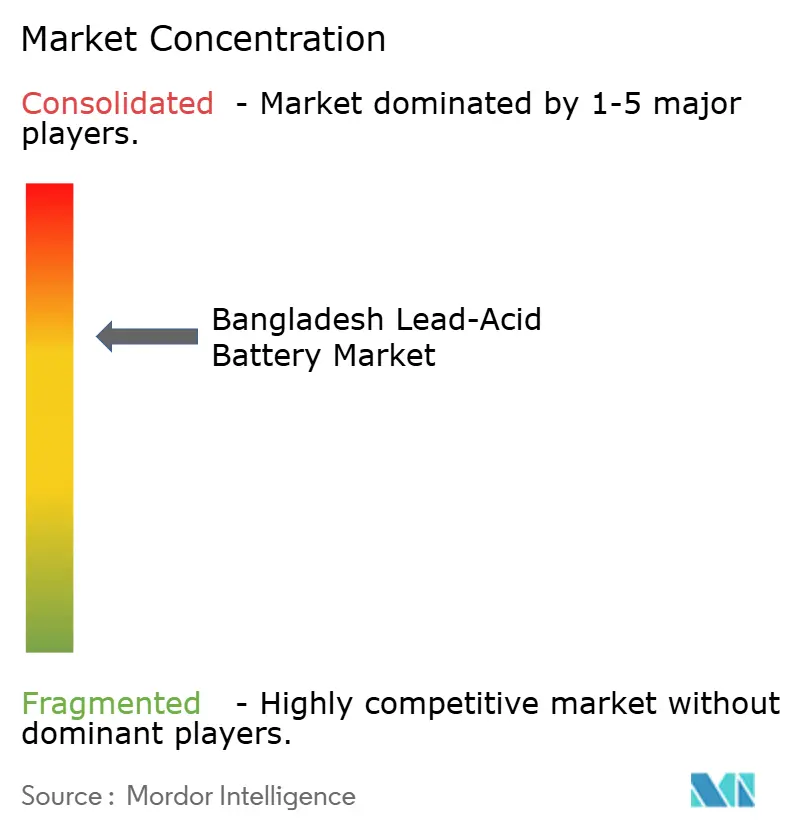
| Market Concentration | Medium |
Major Players *Disclaimer: Major Players sorted in no particular order Image © Mordor Intelligence. Reuse requires attribution under CC BY 4.0. | |
Bangladesh Lead-Acid Battery Market Analysis by Mordor Intelligence
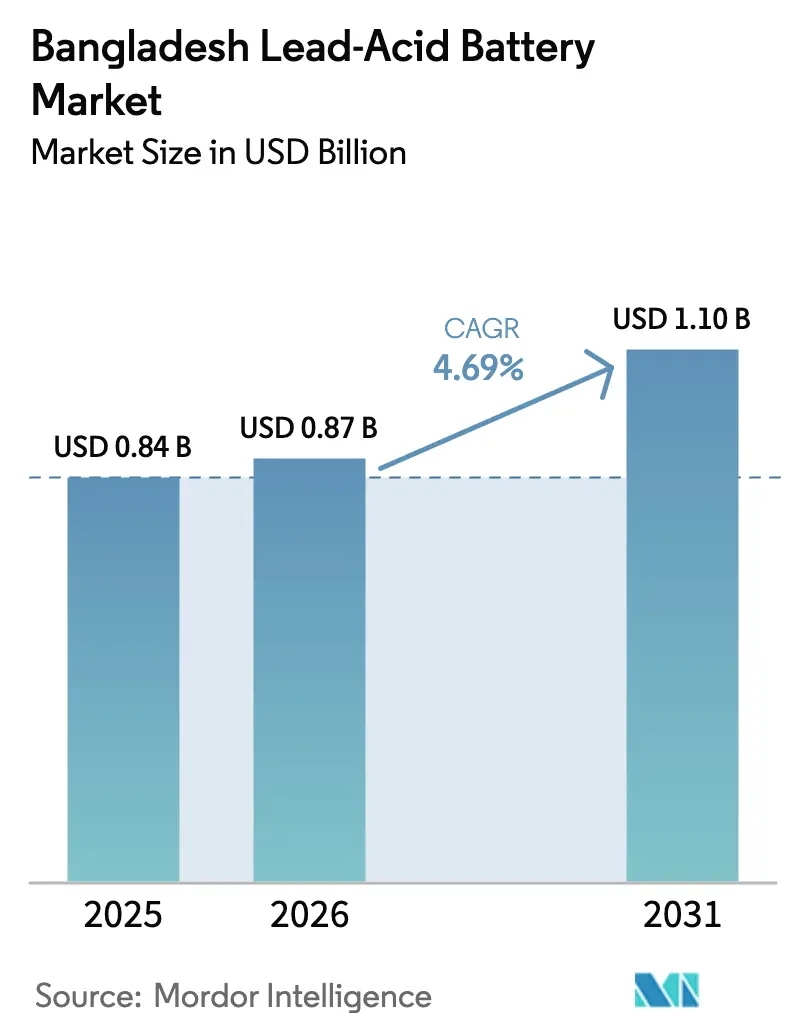
The Bangladesh Lead-Acid Battery Market size is projected to be USD 0.84 billion in 2025, USD 0.87 billion in 2026, and reach USD 1.10 billion by 2031, growing at a CAGR of 4.69% from 2026 to 2031.
This expansion reflects enduring replacement cycles in automotive Starting-Lighting-Ignition (SLI) units, rising stationary demand across solar home systems and data-center UPS rooms, and fiscal incentives that lower manufacturing costs.[1]IDLC Finance PLC, “Bangladesh Battery Industry,” idlc.com Motive-traction batteries for forklifts and warehouse equipment add a fast-growing volume layer as e-commerce logistics enlarge modern distribution centers. Conversely, lithium-ion penetration in telecom towers and premium automotive trims tempers long-term growth, while volatile prices for lead and antimony inflate working-capital requirements. High import reliance for raw materials, combined with dollar-liquidity constraints at banks, compresses supplier margins and underscores the appeal of vertical integration into formal recycling.
Key Report Takeaways
- By construction method, flooded batteries held 62.5% of Bangladesh's lead-acid battery market share in 2025, whereas valve-regulated lead-acid (VRLA) units are forecast to expand at a 5.7% CAGR to 2031.
- By application, the motive-traction segment accounted for 6.2% CAGR—the fastest pace within the Bangladesh lead acid battery market size through 2031.
- Rahimafrooz, Walton, and Confidence Batteries together controlled about 48% of domestic shipments in 2025 within the Bangladesh lead acid battery market share.
Note: Market size and forecast figures in this report are generated using Mordor Intelligence’s proprietary estimation framework, updated with the latest available data and insights as of January 2026.
Bangladesh Lead-Acid Battery Market Trends and Insights
Drivers Impact Analysis*
| Driver | (~) % Impact on CAGR Forecast | Geographic Relevance | Impact Timeline |
|---|---|---|---|
| Growing aftermarket demand for SLI batteries | 1.8% | National, concentrated in Dhaka, Chattogram, Sylhet urban corridors | Medium term (2-4 years) |
| Solar Home System roll-out in rural areas | 0.9% | Rural Bangladesh, particularly northern and coastal off-grid zones | Long term (≥4 years) |
| Fiscal incentives for local manufacturing & recycling | 0.7% | National, with export-zone benefits in Chattogram, Ishwardi, Mirsarai | Long term (≥4 years) |
| Inland-waterway e-ferry pilot projects | 0.3% | Mongla, Barishal, Sundarbans routes | Long term (≥4 years) |
| 5G-driven telecom-tower backup upgrades | 0.6% | Urban centers (Dhaka, Chattogram) expanding to secondary cities | Medium term (2-4 years) |
| Data-center boom boosting UPS demand | 0.5% | Dhaka, Gazipur industrial clusters | Short term (≤2 years) |
| Source: Mordor Intelligence | |||
Growing Aftermarket Demand for SLI Batteries
Bangladesh’s registered fleet exceeded 4 million battery-powered three-wheelers in 2025, and each unit requires a full set of five flooded batteries every 10-12 months because deep discharge cycles and ambient heat accelerate sulfation. Domestic assemblers such as Saif Powertec doubled automotive battery capacity to 60,000 units per month before 2025 liquidity strains, underscoring volume potential even as Chinese imports undercut prices by 30-40%. Passenger cars and light-duty trucks add another 20% to replacement volumes as ride-hailing and garment-industry logistics maintain high annual mileage. The entrenched public-transport gap in major cities locks consumers into recurring battery purchases, cushioning revenue against cyclical shocks. Yet widening parity of lithium-ion prices for upper-segment passenger vehicles will gradually chip away at premium SLI demand through 2031.
Solar Home-System Roll-Out in Rural Areas
The Infrastructure Development Company Limited financed 4.1 million solar home systems across off-grid districts, each using 100-130 Ah deep-cycle flooded batteries that retail at BDT 8,000-12,000 (USD 70-104). Field audits in 2025 showed lifespans of only 2-3 years versus the rated 5 years because of low-grade plates and sub-optimal charge controllers. The government’s Export Policy 2024-27 earmarks grants for local R&D and establishes a national testing laboratory to certify cell quality.[2]Export Promotion Bureau, “Export Policy 2024-2027,” epb.gov.bd These interventions aim to extend cycle life, reduce warranty claims, and enlarge the captive replacement pool that underpins long-run demand for the Bangladesh lead acid battery market. Lithium alternatives remain priced at 2-3 times comparable capacity, keeping lead acid as the default chemistry for low-income households through the forecast window.
Fiscal Incentives for Local Manufacturing & Recycling
Reclassification of batteries as “Highest Priority” light-engineering goods unlocks low-interest working-capital loans, 50% income-tax rebates on export earnings, and duty drawbacks on imported raw materials.[3]Bangladesh Investment Development Authority, “Investment Incentives,” bida.gov.bd Investors in export-processing zones also enjoy up to 10-year tax holidays and duty-free machinery imports. A Chinese-backed plant signed a USD 12.24 million agreement in 2024 to produce 208 million battery plates annually, reinforcing domestic component depth. Formal recyclers may export re-melted lead under VAT registration, creating a price hedge against London Metal Exchange volatility. Effective enforcement against 1,100 informal smelters remains critical; closing this gap would boost feedstock quality and curb environmental liabilities that threaten export certifications.
5G-Driven Telecom-Tower Backup Upgrades
Roughly 45,000 active towers will migrate to 5G by 2028, increasing power draw 2-3 fold and compressing acceptable downtime to minutes. Edotco converted its 18,000 sites to lithium-ion by late 2024, but small towercos and rural operators still specify VRLA due to half the upfront cost and local servicing familiarity. Teletalk reported 21.5% of its 5,661 base stations were incapable of a one-minute backup in 2025, triggering phased replacements that sustain near-term VRLA volumes. Battery-as-a-Service contracts launched in July 2025 reduce capex hurdles and can extend the residual life of lead-acid chemistry where climatic stress is moderate.
Restraints Impact Analysis*
| Restraint | (~) % Impact on CAGR Forecast | Geographic Relevance | Impact Timeline |
|---|---|---|---|
| Rapid shift toward lithium-ion batteries | -1.2% | Urban centers (Dhaka, Chattogram) and telecom/data-center segments | Short term (≤2 years) |
| Lead price volatility | -0.6% | Global, with acute impact on import-dependent manufacturers | Short term (≤2 years) |
| Crack-down on informal battery-recycling clusters | -0.4% | National, concentrated in Dhaka, Chattogram peri-urban zones | Medium term (2-4 years) |
| Supply-chain risk for antimony & separator materials | -0.5% | Global, affecting all manufacturers reliant on Chinese antimony | Medium term (2-4 years) |
| Source: Mordor Intelligence | |||
Rapid Shift Toward Lithium-Ion Batteries
Edotco’s full lithium conversion and Huawei-Walton’s 80,000-unit cell plant scheduled for 2026 highlight accelerating capital reallocation away from legacy chemistries. Government VAT exemptions and customs rebates of up to 60% on lithium cells amplify the cost gap. While easy-bike fleets and rural households remain sensitive to purchase price, total-cost-of-ownership calculations increasingly favor lithium in high-cycle telecom and data-center applications. Lead-acid suppliers must innovate around service agreements, hybrid configurations, and recycling loops to defend volume.
Lead & Antimony Price Volatility
China’s August 2024 export curbs sent antimony above USD 60,000 per tonne, a five-fold jump that raised plate alloy costs for every manufacturer. Letter-of-credit margins escalated above 100% during the 2025 dollar crunch, eroding liquidity. Although half of domestic lead comes from recycling, erratic purity from informal smelters forces blending with costly virgin metal. Price pass-through is difficult in the price-elastic easy-bike segment, compressing gross margins and accelerating plant-shutdown risk for under-capitalized assemblers.
*Our forecasts treat driver/restraint impacts as directional, not additive. The impact forecasts reflect baseline growth, mix effects, and variable interactions.
Segment Analysis
By Construction Method: VRLA Gains Ground Despite Flooded Dominance
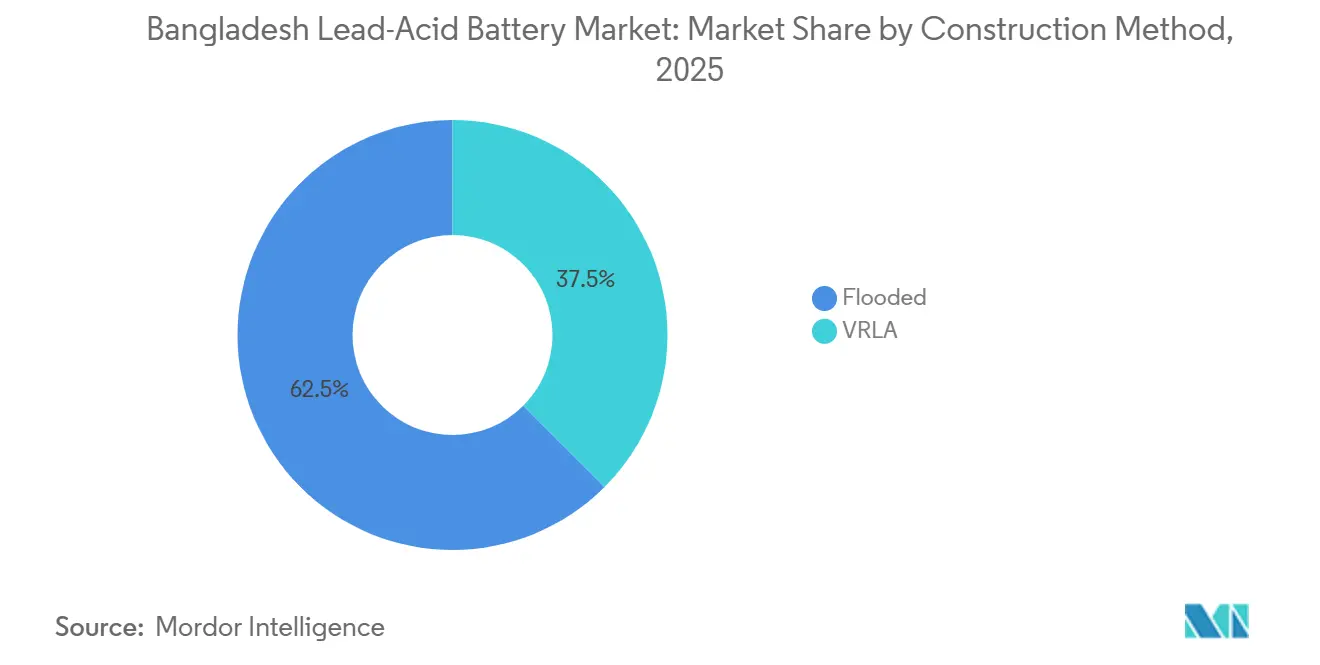
Flooded units generated USD 528.7 million in 2025, equal to 62.5% of the Bangladesh lead acid battery market. Tech-savvy fleet owners value their serviceability, and grassroots mechanics in Dhaka wholesale hubs rebuild plates at low cost. VRLA units captured USD 317.2 million, and are forecast to outpace the overall Bangladesh lead acid battery market at 5.7% CAGR to 2031 as sealed designs meet telecom, UPS, and rooftop-solar safety codes. Yet ambient temperatures averaging 30-35 °C cut VRLA life expectancy to 3-4 years, compelling operators to budget for mid-cycle replacements.[4]Battery University, “VRLA Temperature Effects,” batteryuniversity.com Flooded batteries keep their stronghold in the easy-bike ecosystem, which absorbed 60% of national output in 2025, but VRLA’s foothold in stationary sites ensures a broader customer mix and smoother revenue profile.
The Bangladesh lead-acid battery market size for VRLA could climb near USD 443 million by 2031 if telecom tower companies in secondary cities maintain lead-acid preference. Meanwhile, governmental testing facilities promised under Export Policy 2024-27 will raise product standards, allowing domestic VRLA brands to target export niches such as Nepal and the UAE.



By Application: Motive-Traction Batteries Accelerate on Logistics Expansion
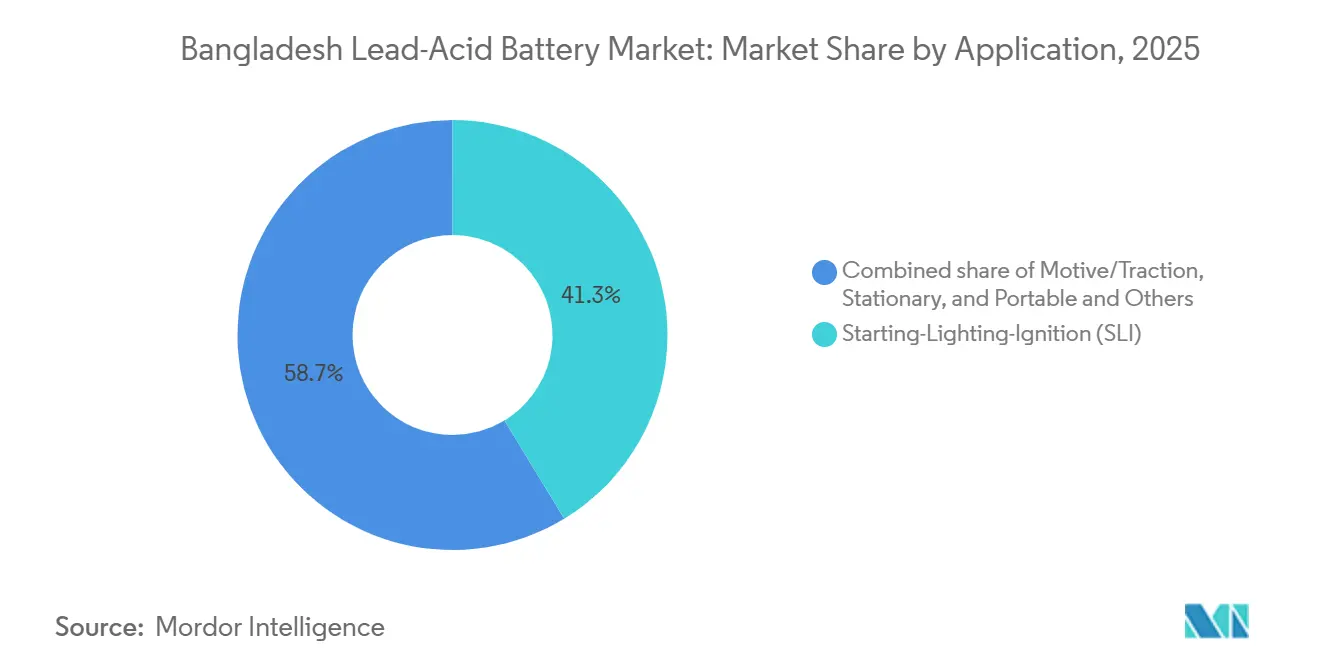
SLI batteries delivered USD 349.4 million or 41.3% in 2025, locked in by dense ride-share fleets and sustained growth in private-vehicle registrations. However, motive-traction batteries posted the fastest 6.2% CAGR and are projected to seize an additional 2 percentage points of the Bangladesh lead acid battery market share by 2031. Warehouses in Gazipur, Chattogram, and Mirsarai EPZs have embraced electric forklifts to comply with safety mandates and noise restrictions, each machine integrating 36-48 V flooded or VRLA packs. Stationary batteries comprised 15-18% of demand, chiefly at telecom base stations and data centers that still weigh capex more heavily than lifecycle economics.
Replacement cycles in motive-traction units average 4-5 years, longer than SLI, but unit value is 4-6 times higher, bolstering revenue. Battery suppliers increasingly bundle chargers and maintenance contracts, mirroring practices in neighboring India. Although lithium-iron-phosphate packs will capture premium forklifts after 2027, total addressable volume for lead acid remains large because medium-duty warehouses prioritize proven service networks over energy density.
Geography Analysis
Dhaka Division anchored roughly 45% of the Bangladesh lead-acid battery market in 2025, fueled by 3 million three-wheelers, omnipresent ride-hailing cars, and the majority of telecom MSC switches. Gazipur and Narayanganj industrial belts add high stationary consumption in garment ERP data centers. Chattogram Division followed with about 25% share thanks to port-centered logistics fleets, eight EPZs, and dense tower grids connecting international subsea cables.
Rural northern and coastal districts contributed 20-25% the value, overwhelmingly via solar home systems financed under IDCOL schemes. Here, distributors handle 100-130 Ah deep-cycle units, and warranty costs run high because informal retailers often mix counterfeit plates into refurbished casings. Sylhet and Mymensingh accounted for the residual 5-10%; their smaller urban footprints limit fleet growth, yet earmarked economic zones could tilt more demand by 2031.
Export flows, totaling USD 29 million in 2025, move mainly through Chattogram Port to the Middle East and Southeast Asia, where Bangladeshi brands compete on price and deliver short lead times on SLI. Rahimafrooz claimed 95% of these exports, buoyed by ISO 14001-certified recycling loops that satisfy EU audit checks. Future export upside depends on closing informal recycling sites whose emissions jeopardize certificates of conformity.
Regulatory Landscape
Lead-acid batteries in Bangladesh sit within a product-standard and import-control framework led by the Bangladesh Standards and Testing Institution (BSTI). Battery imports require BSTI-linked technical certification under the Import Policy Order, and lead-acid starter batteries fall under Bangladesh Standard BDS 206 (Part 1-3), which specifies requirements such as dimensions and terminal markings for vehicle applications. For Solar Home System (SHS) programs, BSTI certification is also required for batteries supplied into the scheme, tightening compliance expectations for deep-cycle flooded products sold through rural channels.
Policy signals in 2025-2026 point to stronger state support for alternative chemistries in mobility and storage, which affects the demand mix and investment decisions for lead-acid players. In June 2026, the National Board of Revenue (NBR) issued SRO-166 to reduce duties on imported raw materials for lithium-ion and sodium-ion battery manufacturing, building on earlier duty reductions on raw materials for e-bikes and advanced lithium batteries in June 2025. Alongside enforcement aimed at informal recycling and lead pollution in three-wheeler ecosystems, this combination of standards compliance and fiscal policy raises the value of certified manufacturing, traceable recycling, and more formalized supply chains for lead-acid producers.
Competitive Landscape
Competition is moderate, with the top three brands controlling 48% of domestic shipments in 2025. Rahimafrooz runs vertically integrated plate casting, oxide production, and recycling, insulating margins from raw-material swings and enabling 60-plus export destinations. Walton is pivoting toward lithium, yet its lead-acid portfolio benefited from fiscal rebates and brand pull in consumer electronics channels. Confidence Batteries’ 275,000 sq ft plant offers 32 SKUs and captured data-center UPS contracts by coupling batteries with its “Dimitris” inverter.
Indian entrants Exide and Okaya broadened their reach through 480 retail dealers, targeting corporate fleets that demand extended warranties. Chinese imports, though fragmented, undercut domestic brands in the easy-bike channel and commanded about two-thirds of that sub-market by 2025. Strategic moves in 2025-2026 focused on technology partnerships, Huawei supplying process know-how to Walton, Tiger New Energy piloting Battery-as-a-Service with Edotco, and on component localization, exemplified by the USD 12.24 million plate factory in Bepza Economic.
Going forward, white-space opportunities reside in compliant recycling, where only eight formal smelters serve an annual 180,000-tonne scrap flow, and in motive-traction packs for automated warehouses. Suppliers able to integrate IoT health-monitoring and offer financing bundles stand to secure above-market growth.
Bangladesh Lead-Acid Battery Industry Leaders
Saif Powertec Limited
Rahimafrooz Ltd
Panna Group
HAMKO Battery
Exide Industries Ltd (incl. Amaron)
- *Disclaimer: Major Players sorted in no particular order

Market Opportunities and Future Outlook
A near-term whitespace for lead-acid suppliers is compliance-led quality upgrades and deeper integration with formal recycling, where policy enforcement and market structure reward scale players that can demonstrate traceability. Export-oriented manufacturers such as Rahimafrooz, which already operates vertically integrated recycling, can leverage stricter BSTI certification requirements (including SHS batteries) to differentiate higher-quality deep-cycle products and reduce the warranty-driven replacement behavior seen in rural solar deployments. With only a limited number of formal smelters serving the national scrap flow, investment and partnerships that expand compliant collection, segregation, and secondary lead quality also provide a hedge against imported lead and alloy volatility.
Opportunity is also shifting toward hybrid and service-led stationary power architectures that help protect lead-acid share where upfront cost and local service networks matter. Battery-as-a-Service models for telecom tower sites, including Edotco partnering with Tiger New Energy in July 2025, move purchasing toward subscription-style operating expenditure and raise monitoring and maintenance needs for battery systems. Hybrid backup solutions, such as Rahimafrooz launching a hybrid solar IPS in July 2026 that can run with lead-acid or lithium-ion, create room for lead-acid vendors to stay involved through bundled maintenance, controlled charging, and standardized replacement programs. Separately, national energy-storage direction under the Renewable Energy Policy 2025, including an outlined 500 MW battery storage target by 2027, is shaping procurement and technical evaluation pathways for stationary storage, which supports lead-acid suppliers focusing on safety, certification, and lifecycle-service offerings in segments where lithium-centric duty incentives also accelerate local manufacturing investment.
Recent Industry Developments
- July 2026: Rahimafrooz launched a full hybrid solar IPS in Dhaka that can operate with or without lead-acid or lithium-ion batteries. The product combines solar input, inverter capability, and battery flexibility, widening stationary backup use cases beyond traditional lead-acid-only setups. This expands the role of domestic lead-acid suppliers in system integration and service offerings.
- July 2025: Edotco partnered with Tiger New Energy to roll out Battery-as-a-Service across tower sites, shifting procurement toward subscription-style operating expenditure models. The approach reduces upfront replacement barriers and increases monitoring and maintenance requirements for battery systems in telecom deployments.
- September 2024: Huawei and Walton began installing an 80,000-unit lithium-ion line for telecom BTS batteries, with commercialization targeted within several months of the installation start. The rollout expands local lithium-based capability and increases substitution pressure on lead-acid for high-cycle, uptime-critical applications.


Research Methodology Framework and Report Scope
Market Definition and Coverage
For this methodology, the market covers lead-acid batteries sold and used in Bangladesh across major end uses, measured in revenue (USD) at the point of sale within the country. It includes both replacement demand and new demand that comes through OEM and aftermarket channels.
Scope exclusions: We exclude lithium-ion and other non lead-acid chemistries, and we do not count stand-alone recycling activity or pure lead trading unless it is embedded in battery sales value.
Segmentation Overview
- By Construction Method
- Flooded
- VRLA
- By Application
- Starting-Lighting-Ignition (SLI)
- Stationary
- Motive/Traction (Forklifts, Golf-carts)
- Portable and Others
Data Sources, Market Sizing, and Validation
Desk Research
Desk research was used to establish the demand and supply context that a country model needs, and to limit assumptions when Bangladesh-specific data is not directly available. We referred to public trade and tariff data for batteries and related inputs, and then cross-checked it with local energy and mobility signals.
Typical public sources used include Bangladesh Bureau of Statistics releases, Bangladesh Bank macro series, National Board of Revenue customs and tariff schedules, UN Comtrade and ITC Trade Map import export tables, and technical standards and notes from bodies such as IEC publications and open-access journals on lead-acid performance and life cycles. We also used company annual reports, investor decks, distributor price lists where available, and reputed local press to validate timing of expansions and demand shifts. In a few places, paid subscriptions were used for company financials and intelligence, shipment-level trade checks, patent lookups, and news and financials, but only to confirm direction and scale. These examples are not exhaustive, and other sources were also referenced for data collection, validation, and clarification.
Primary Interviews and Surveys
Our primary interviews and surveys cover manufacturers, importers, distributors, dealers, recyclers, fleet operators, backup-power users, and regulators within Bangladesh. Responses help clarify unregistered sales, ASPs, replacement cycles, and application demand alongside trade and vehicle evidence. We re-contact respondents when material conflicts arise before assumptions and final results are triangulated.
Distribution of primary research fieldwork respondents
| Company type | Respondent position |
|---|---|
| Top tier: 29% | CXOs: 17% |
| Mid tier: 46% | Functional/Unit leaders: 33% |
| Smaller Players: 25% | Managers: 50% |
Market-Sizing & Forecasting
The market was first rebuilt using a top-down approach where production and trade flows, together with local consumption proxies, were converted into an addressable revenue pool for Bangladesh, which was then reconciled to application-level demand. To keep the totals realistic, we corroborated them with selective bottom-up approximations such as sampled price points by battery rating, channel checks on replacement cycles, and a light supplier and distributor roll-up.
Inputs that mattered most included the vehicle parc and replacement frequency for SLI batteries, the installed base of telecom and data backup systems for stationary demand, solar home and rooftop activity that uses battery backup, import mix between flooded and VRLA products, and observed price movement tied to lead costs and currency shifts. Forecasts were built using scenario analysis supported by simple regression-style relationships, where drivers like vehicle growth, power outage sensitivity, telecom capex direction, and import pricing trends were adjusted based on what interviewees expected over the next few years. When bottom-up data was missing for smaller channels, gaps were handled through share-based allocation from validated totals rather than forcing a full roll-up.
Data Validation & Update Cycle
We checked the model outputs against independent signals such as import trends, lead price direction, and application demand markers, and then looked for outliers that did not fit Bangladesh-specific reality. Large variances triggered a deeper review of unit assumptions, conversion factors, and pricing, followed by re-contacting a few respondents when needed.
Before sign-off, the work goes through multiple analyst review steps, where calculations are re-run and key assumptions are challenged for consistency across years. The report is refreshed annually, and interim updates are made when material events occur, such as policy changes, sharp currency moves, or major capacity additions. Right before delivery, an analyst does a final pass so clients receive the latest updated view.
Mordor Intelligence's Bangladesh Lead Acid Battery Market Size Measured Against Other Published Estimates
It is normal to see different market sizes for the same country, because studies do not always count the same products, channels, and pricing points. Differences also come from how older base years are carried forward, how currency conversion is timed, and whether assumptions were validated with local market checks.
The benchmark table shows a clear spread that usually comes from what is counted as a battery sale versus adjacent value in the lead ecosystem, and from whether informal distribution is treated as visible demand or ignored. In Mordor Intelligence's model, the value reflects lead-acid battery revenues within Bangladesh across key applications, while excluding stand-alone recycling and raw lead trading, which can inflate totals when folded into the same bucket.
Benchmark comparison
| Source | Market Size | Gaps in Research Methodology |
|---|---|---|
| Mordor Intelligence | USD 0.84 B (2025) | |
| Trade Journal A | USD 0.87 B (2022) | Uses a narrow proxy tied to batteries for electric three-wheelers, and it is anchored to a single year value that is not normalized to the full country demand pool or to a consistent price basis. |
| Regional Consultancy B | USD 0.48 B (2026) | Appears to apply a tighter scope and conservative pricing, likely underweighting replacement-led demand and the mix shift toward higher value VRLA products across stationary uses. |
Taken together, the comparison suggests that scope and price logic are the biggest drivers of the differences, not a disagreement on direction of growth. By tying the number to visible demand signals like replacement cycles, application installed base, and import mix, the estimate stays traceable to repeatable steps and can be updated cleanly when conditions change.


Key Questions Answered in the Report
How big is the Bangladesh lead acid battery market in 2026?
The Bangladesh lead acid battery market size is estimated at USD 876.69 million in 2026, up from USD 845.98 million in 2025.
Which battery type is growing fastest in Bangladesh?
Valve-regulated lead-acid units are projected to expand at 5.7% CAGR through 2031, the quickest among lead-acid construction types.
What is driving forklift battery demand in Bangladesh?
Rapid e-commerce logistics and new export-processing zones are boosting warehouse automation, lifting motive-traction battery volumes at a 6.2% CAGR.
How are government policies supporting battery manufacturers?
Export Policy 2024-27 grants low-interest loans, duty drawbacks and tax rebates, while allowing 100% foreign equity in battery ventures.
Why is lithium-ion adoption accelerating in telecom towers?
Higher energy density, faster recharge and VAT exemptions have led major towercos such as Edotco to fully convert their 18,000 sites to lithium-ion backup systems.
What environmental issue challenges the sector?
Informal recycling by up to 1,100 smelters emits lead dust, prompting tighter enforcement that could disrupt secondary lead supply until formal capacity scales
Page last updated on:


 Your data is secure and never sold or shared.


