
Bangladesh ICT Market Analysis by Mordor Intelligence
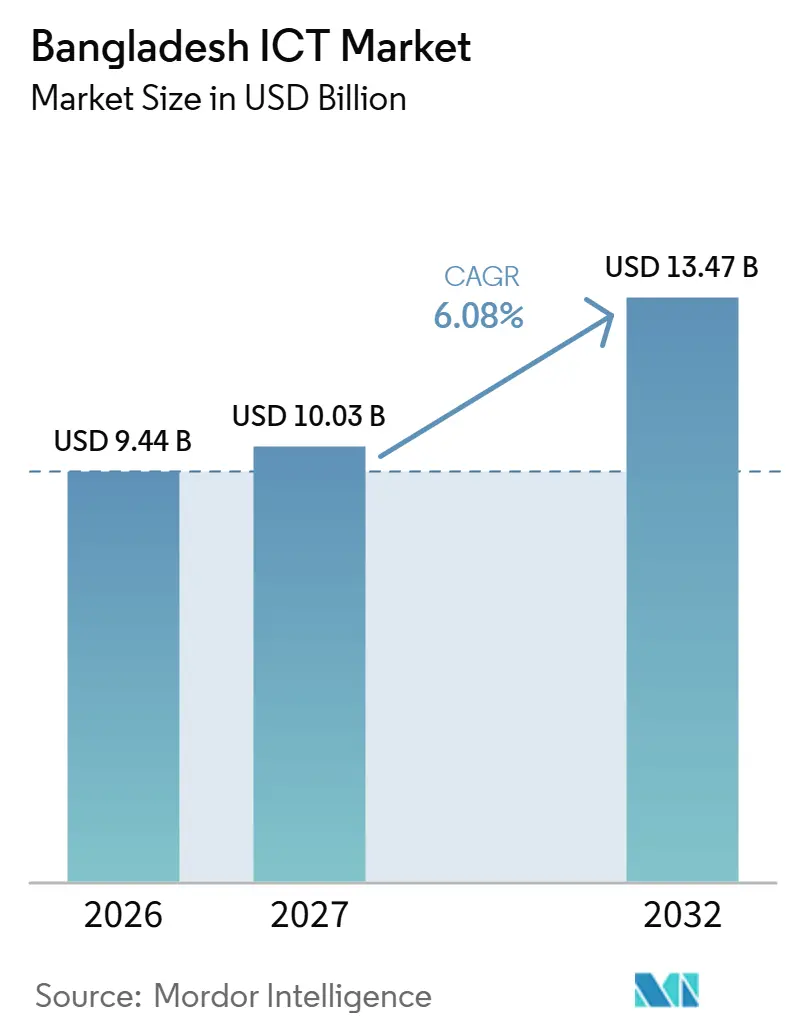
The Bangladesh ICT market size is expected to grow from USD 9.44 billion in 2026 to USD 10.03 billion in 2027 and is forecast to reach USD 13.47 billion by 2032 at 6.08% CAGR over 2027-2032.
Growth in Bangladesh depends on turning connectivity and computing capacity into services that businesses and public institutions can use repeatedly. Public cloud procurement and paid mobile data services create openings for implementation firms and connectivity providers. Locally hosted cloud services broaden enterprise offerings, while rural fiber gaps and scarce cybersecurity leaders can increase the effort needed to make applications usable. This combination favors implementation offers matched to the buyer's connection and security staffing, since additional cloud capacity alone cannot resolve those deployment constraints.
Key Report Takeaways
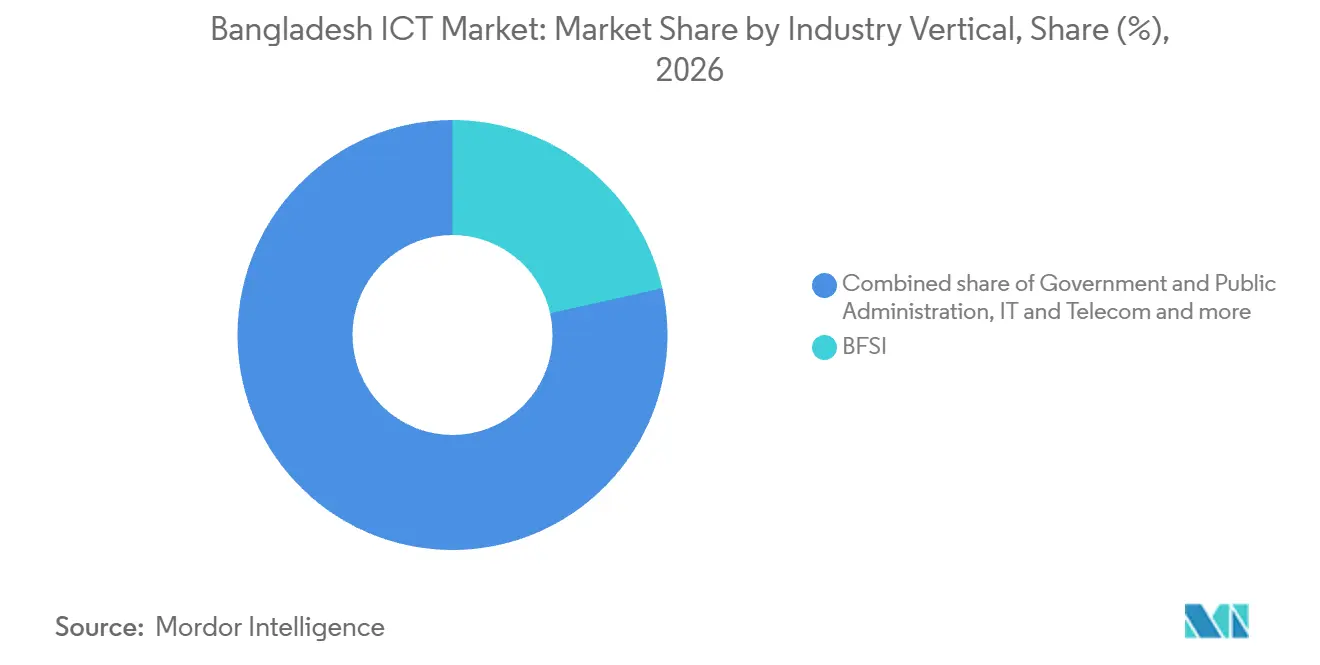
- By product type, IT services led with a 32.81% Bangladesh ICT market share in 2026 and are forecast to be the fastest-growing segment at a 6.9% CAGR over 2027-2032.
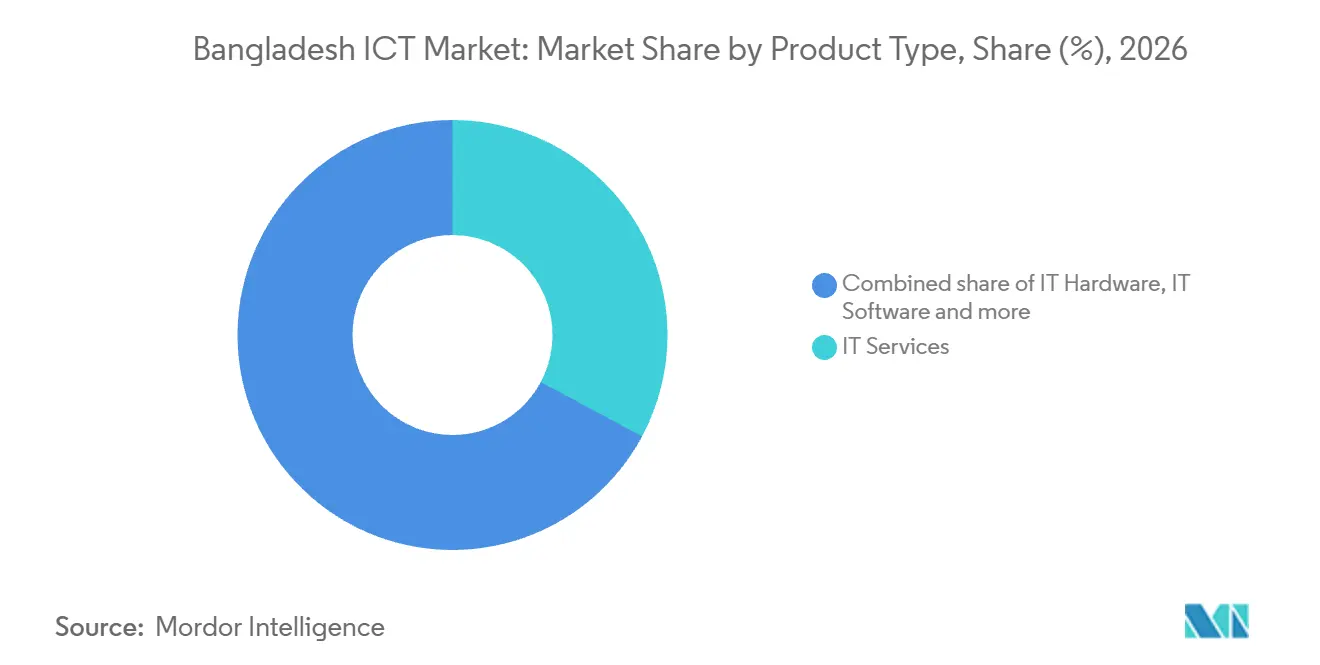
- Large enterprises led the enterprise-size categories with a 56.95% share of the Bangladesh ICT market size in 2026, while small and medium-sized enterprises (SMEs) are forecast to grow fastest at a 7% CAGR over 2027-2032.
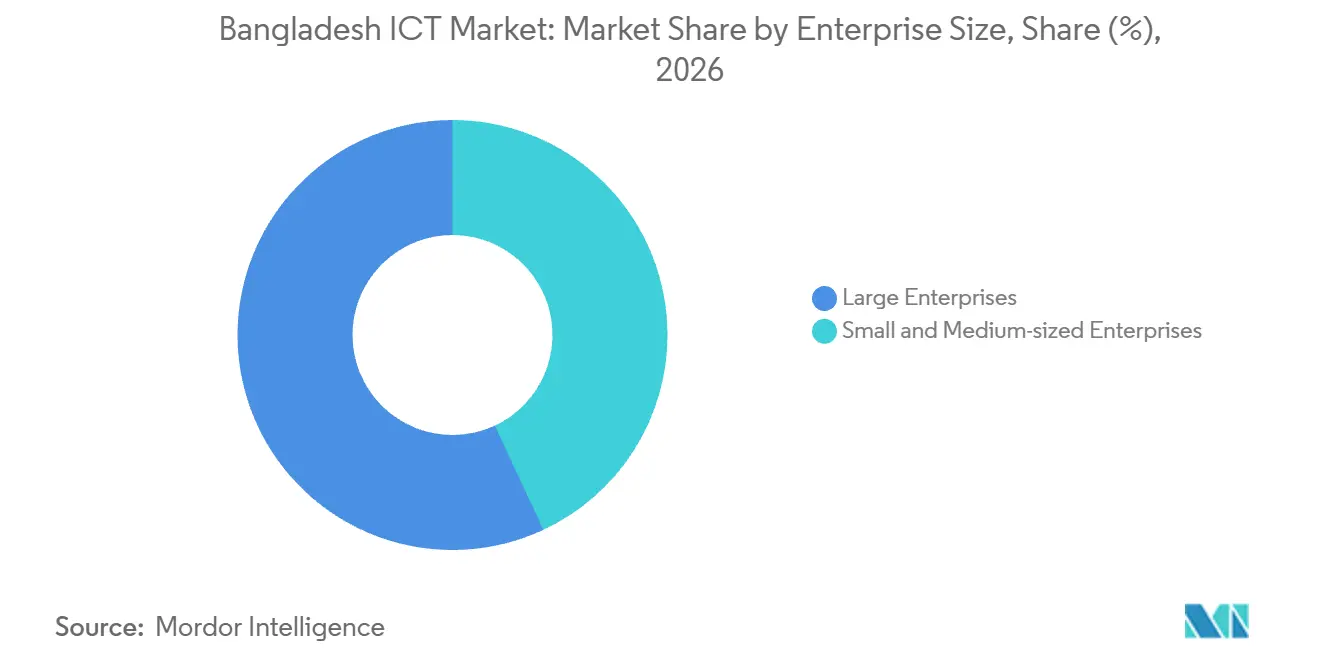
- Across industry verticals, banking, financial services, and insurance (BFSI) held the largest share at 21.51% in 2026, while healthcare and life sciences is forecast to expand fastest at a 7.95% CAGR over 2027-2032.
- Geographically, Dhaka and Chittagong jointly accounted for 65% of national ICT spending in 2026.
Note: Market numbers in this report are based on Mordor Intelligence's proprietary estimation framework, which combines nine months of actuals with Q4 projections for base year 2026.
Bangladesh ICT Market Trends and Insights
Drivers Impact Analysis*
| Driver | (~) % Impact on CAGR Forecast | Geographic Relevance | Impact Timeline |
|---|---|---|---|
| Government's Smart Bangladesh Vision 2041 Investments | +2% | Nationwide | Medium term (2-4 years) |
| Rapid Growth of Mobile Internet Subscribers | +2.3% | Nationwide | Short term (≤ 2 years) |
| Rising Demand for Cloud and Platform Services Among SMEs | +1.4% | Nationwide | Medium term (2-4 years) |
| Expansion of 4G and Ongoing 5G Network Rollout | +1.5% | Nationwide | Medium term (2-4 years) |
| Emergence of Bangladesh's Hi-Tech Parks as Domestic Tech Manufacturing Hubs | +0.6% | Kaliakair Hi-Tech Park, Gazipur | Long term (≥ 4 years) |
| Increasing Adoption of Islamic FinTech Solutions Within BFSI Sector | +0.4% | Nationwide | Short term (≤ 2 years) |
| Source: Mordor Intelligence | |||
Government's Smart Bangladesh Vision 2041 Investments
Public investment supports ICT demand when funding translates into defined implementation work for suppliers. Bangladesh's FY2026-27 budget allocated BDT 20.49 billion (USD 166.9 million) to the Information and Communication Technology Division. On February 26, 2026, Bangladesh Computer Council's EDGE Project signed a USD 6.62 million contract with Smart Technologies (BD) Limited.[1] The agreement covered advanced development of the National Data Center cloud computing platform in Dhaka, including supply, installation, and commissioning. The combined scope makes implementation capability part of the commercial value of public cloud contracts, expanding suppliers' role beyond platform supply.
Rapid Growth of Mobile Internet Subscribers
Mobile internet's commercial weight comes from the combination of a broad subscription base and paid data use. The Bangladesh Telecommunication Regulatory Commission (BTRC) reported 121.5 million mobile internet subscriptions in Bangladesh in July 2026. Robi Axiata PLC's data revenue grew 13.6% in H1 2026 compared with H1 2025. For mobile service suppliers, subscription reach defines distribution potential, while data revenue measures the commercial return from delivering one part of that service. Paid data use gives operators a way to monetize subscription reach, so commercial growth can come from the connected base as well as new subscriptions.
Rising Demand for Cloud and Platform Services Among SMEs
An SME can approach cloud spending as an application subscription, with the commercial decision tied to a defined operating task. A task-specific application, for example, can give the buyer a narrower service scope than a company-wide systems replacement. That narrower scope can make initial implementation more contained, while recurring access creates a reason for the provider to maintain the service. A single-task subscription can give suppliers an entry into smaller firms, but renewal would depend on that application's continued value for the chosen workflow.
Expansion of 4G and Ongoing 5G Network Rollout
Peak demand makes network capacity commercially relevant to the continuity of mobile-delivered services. Grameenphone Ltd. launched nationwide deployment of its 700 MHz spectrum band in Bangladesh in June 2026, a move the company says will enhance 4G performance.[2] In a separate Q2 2026 result, Grameenphone reported its highest-ever data traffic during the Argentina versus Austria FIFA World Cup match. Traffic was more than 2 times normal levels while the company reported a stable customer experience. That event illustrates the delivery requirement created by unusually high traffic over a short period. Improved 4G performance can give application providers a stronger delivery base for services exposed to concentrated traffic peaks.
Restraints Impact Analysis*
| Restraint | (~) % Impact on CAGR Forecast | Geographic Relevance | Impact Timeline |
|---|---|---|---|
| Inadequate Rural IT Infrastructure | -0.9% | Nationwide | Long term (≥ 4 years) |
| Shortage of Advanced Cybersecurity Talent | -0.6% | Nationwide | Medium term (2-4 years) |
| Persistent Underinvestment in Local Data Center Redundancy | -0.4% | Nationwide | Long term (≥ 4 years) |
| Import Tariff Volatility on ICT Hardware Components | -0.2% | Nationwide | Short term (≤ 2 years) |
| Source: Mordor Intelligence | |||
Inadequate Rural IT Infrastructure
Extending rural ICT services requires a commercially viable connection to the buyer as well as a useful application. The World Bank's 2025 Bangladesh project concept note reported fixed broadband penetration of 1.4% of the population.[3] It identified weak middle-mile fiberization and missing last-mile fiber inside unions as constraints on deployment and adoption. For connectivity providers serving low-uptake areas, the assessment linked a low revenue base to a viability gap for new infrastructure. Until middle-mile and last-mile fiber become viable to build, connection-dependent applications in low-uptake unions will struggle to reach recurring revenue at scale.
Shortage of Advanced Cybersecurity Talent
Specialist staffing can constrain financial institutions' ability to use cybersecurity technology effectively. In April 2026, The Financial Express reported a shortage of trained cybersecurity experts in Bangladesh in the context of financial institutions. The report said Bangladesh Bank's framework required financial institutions to appoint qualified cybersecurity leadership, including dedicated information-security officers. Where the required expertise is scarce, buying security technology alone cannot fill the institution's leadership and oversight responsibilities. Meeting the leadership duty adds a recruitment dependency to security implementation, potentially delaying a bank's ability to put new systems under qualified oversight.
*Our forecasts treat driver/restraint impacts as directional, not additive. The impact forecasts reflect baseline growth, mix effects, and variable interactions.
Segment Analysis
By Product Type: Installed Systems Sustain Service Demand
IT services accounted for a 32.81% share of the Bangladesh ICT market size in 2026, ranking as the largest and fastest-growing segment, with a 6.9% CAGR forecast over 2027-2032. On July 9, 2026, BTRC awarded Mysoft Heaven (BD) Ltd. an update and annual maintenance contract for its Telecom Data Information System. Combining updates with annual maintenance can keep technical change and operating support within one engagement, creating a service purchase that extends the use of an installed system. Maintenance procurement offers service firms an entry into public-sector modernization through work on an installed system.
IT infrastructure demand included an EDGE project contract with Thakral Information Systems Private Limited signed on June 22, 2025. The agreement covered expansion of the National Data Center's Nutanix private cloud platform in Dhaka within a broader infrastructure-as-a-service expansion. The signed contract proposed completion by November 4, 2025. This purchase defines an infrastructure supplier's opportunity around a bounded project, tying the engagement to a specified platform and delivery schedule.

By Enterprise Size: Platform Expertise and Adoption Support Shape Demand
Large enterprises represented a 56.95% Bangladesh ICT market share in 2026, making them the largest segment. Integrated steel manufacturer GPH Ispat Limited signed an agreement with PwC on April 1, 2026, for long-term maintenance and support of its SAP S/4HANA enterprise resource planning system. PwC agreed to provide maintenance and support aimed at the platform's performance, optimization, and continuous enhancement. For service firms, that scope pairs routine support of the SAP system with enhancement work, so one agreement covers both keeping the platform running and improving it. The support term creates room for repeat service revenue tied to SAP-specific expertise.
Small and medium-sized enterprises are forecast to be the fastest-growing segment at a 7% CAGR over 2027-2032. A study published in 2025 associated perceived operational efficiency with cloud accounting adoption among Bangladeshi SMEs. It also identified insufficient IT skills, transition costs, and data security concerns as adoption obstacles. For service vendors, the task is to make accounting workflows usable on the cloud system while reducing the transition burden for smaller firms. Migration assistance, user support, and clear security responsibilities would make a cloud accounting offer address the study's adoption barriers alongside its operational-efficiency appeal.
By Industry Vertical: Banking Scale Meets Clinical Workflow Adoption
Banking, financial services, and insurance (BFSI) accounted for a 21.51% share of the Bangladesh ICT market size in 2026, making it the largest segment. Bangladesh Bank reported that all 11,503 bank branches in Bangladesh had online banking capability at end-December 2025. The branch footprint creates a potential buyer base for application maintenance, network management, and other services that keep online banking usable across locations. With online banking capability at every branch at end-December 2025, suppliers can target management of the existing estate rather than first-time online enablement.
Healthcare and life sciences is forecast to be the fastest-growing segment, with a 7.95% CAGR over 2027-2032. Bangladesh's national cervical and breast cancer screening dashboard recorded 430,380 case-based enrollments in its 2026 data. National HMIS (DHIS2) supplies the program's case-based data. Integration with the existing health-information platform would define implementation scope in this screening program.
Geography Analysis
Dhaka and Chittagong ICT Market
Dhaka and Chittagong jointly accounted for a 65% share of the Bangladesh ICT market size in 2026. Bangladesh Bank reported that, at end-June 2026, scheduled banks operated 1,007 sub-branches in Dhaka district and 470 in Chittagong district. The next districts listed, Cumilla, Narayanganj, and Gazipur, had 218, 170, and 168 sub-branches, respectively, placing Dhaka and Chittagong ahead on this measure. Serving the full sub-branch footprint in Dhaka would involve more than twice as many local service points as in Chittagong.
Rajshahi Hi-Tech Park was a Starlink ground-station construction site in 2025. Starlink, a satellite internet provider, leased a 1-acre plot at Rajshahi Hi-Tech Park in April 2025 and completed construction of a ground station there by July 2025. By July 2026, Starlink had established earth stations in Rajshahi, Kaliakair in Gazipur, and Jashore. Engineering and maintenance work for this footprint would need to cover several sites rather than concentrate at the Rajshahi park.
Khulna's example centers on public-service delivery through a regional digital application. Bangladesh Police launched online General Diary filing at all 64 police stations under Khulna Range in July 2025. The service was active across all 10 districts of Khulna Division at the launch. For the police authority, placing the same service across a defined set of stations can make the regional footprint part of the application's operating requirement. A rollout covering every station in a police range makes station-level availability the relevant delivery test for the shared filing service.
Regulatory Framework and Outlook
Selected jurisdictions are compared from the perspective of a fixed telecom service provider entering Bangladesh, with Dhaka covering the Dhaka North City Corporation area. The national comparison concerns connectivity licensing, while the local column covers the city tax and fee framework. Fixed telecom service provider (FTSP) applicants must document financial solvency and liquidity consistent with rollout obligations, supported by audited financial statements and valid bank certifications. FTSP financial documentation governs entry, while Section 84 of the City Corporation Act directs Dhaka North to use the government Model Tax Schedule for local taxes and fees.
Regulatory Table
| Decision factor | Bangladesh | Dhaka |
|---|---|---|
| Primary authority | Bangladesh Telecommunication Regulatory Commission | Dhaka North City Corporation |
| Key instruments or direction | Telecommunications Network and Licensing Policy, 2025; February 2026 FTSP guidelines | City Corporation Act, Section 84; government Model Tax Schedule |
| Commercial effect | New applicants use FTSP or District FTSP routes; FTSP applicants document finances against rollout obligations | City tax and fee decisions reference the government Model Tax Schedule |
| Current policy attractiveness | Medium | Medium |
| Future direction of policy attractiveness | No change | No change |
| Source: Mordor Intelligence | ||
National attractiveness is rated Medium because the framework provides defined application routes but requires FTSP applicants to substantiate financial capacity against rollout obligations. Existing internet service provider (ISP) licenses retain validity until their own expiry, while an August 2026 submission proposed nationwide and district ISP categories. The operative 2025 policy and February 10, 2026 FTSP guidelines support No change in entry planning, while the revision awaits approval without an effective date or transition terms. Dhaka's Medium rating reflects a defined reference for local tax and fee decisions under Section 84, with No change expected from the continuing government Model Tax Schedule.
Value Chain Stages
The value chain compares how infrastructure providers, connectivity operators, software developers, and service firms turn technical capacity into usable ICT services. EDOTCO Bangladesh, a subsidiary of EDOTCO Group, launched a modernized tower operations center in Dhaka on January 26, 2025, to monitor and manage towers nationwide. That operational layer illustrates why physical deployment also creates a requirement for continued management. Supplier earnings can extend from infrastructure services into connectivity, hosting, application development, and continuing support.
Value Chain Analysis Table
| Primary activity | Key participants | Value capture | Bottleneck | Resilience response |
|---|---|---|---|---|
| Operate telecom infrastructure | Telecom infrastructure providers such as EDOTCO Bangladesh | Infrastructure service revenue | Coordinating distributed tower operations | Centralize monitoring and prioritize field responses |
| Deliver connectivity | Mobile operators such as Grameenphone Ltd. and Banglalink Digital Communications Limited | Connectivity subscriptions and service fees | Dependence on underlying network availability | Provide alternative access paths for critical services |
| Supply hosted computing | Government cloud providers such as Bangladesh Computer Council | Cloud, hosting, and colocation fees | Matching computing resources to application requirements | Stage workloads and plan recovery capacity |
| Develop applications | Software developers such as Brain Station 23 PLC | Software development and implementation fees | Translating buyer workflows into deployed applications | Use staged delivery with explicit acceptance tests |
| Manage enterprise systems | Managed IT providers such as Aamra Networks Limited | Infrastructure management and managed-service fees | Coordinating operating dependencies across systems | Assign continuing responsibility for monitoring and support |
| Source: Mordor Intelligence | ||||
Government hosting and private software development occupy different parts of this delivery chain. Combining those services creates integration work even when the underlying capacity is already in place. Ongoing management can then capture recurring fees by resolving the operating dependencies between a buyer's connection, computing resources, and applications.
Competitive Landscape
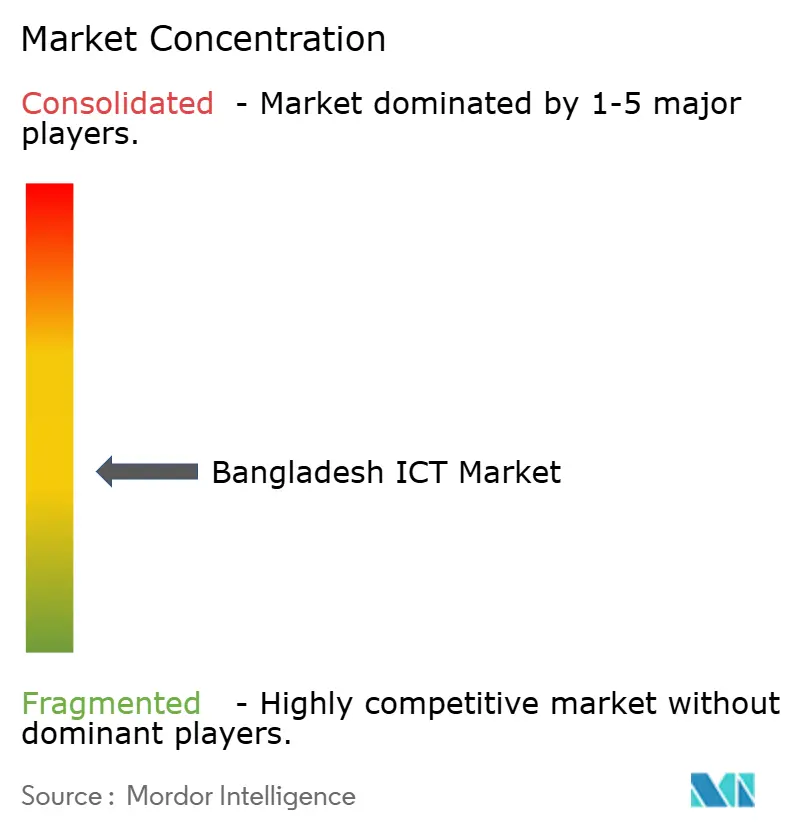
Competition is distributed across mobile networks, devices, and ICT infrastructure, creating a layered supplier structure. Major participants include Grameenphone Ltd., Robi Axiata PLC, Banglalink Digital Communications Limited, Samsung Electronics Company Limited, and Huawei Technologies Company Limited. The operators supply connectivity, while Samsung supplies smartphones and Huawei's global portfolio spans telecom networks, IT, cloud, and smart devices. Grameenphone Ltd.'s revenue declined 3.0% in Q2 2026 compared with Q2 2025, which it mainly attributed to challenging macroeconomic conditions. Grameenphone's 3.3% revenue growth in Q4 2025 compared with Q4 2024 preceded the decline, marking a reversal in its year-over-year top-line direction within 2 quarters.
On September 1, 2025, Robi Axiata PLC launched commercial 5G in selected areas of Dhaka, Chittagong, and Sylhet. Its Dhaka launch included Dhaka University, Moghbazar Chourasta, and Fakirapool. An institution's city address alone did not establish access at the September 2025 launch, making the selected coverage areas decisive for adoption.
Banglalink launched bCloud, a locally hosted cloud service supporting enterprise digitalization, in 2025. Local hosting makes the delivery location part of the commercial offer, linking the cloud service to infrastructure within Bangladesh. Banglalink also launched Bangladesh's first VoWiFi service in 2025 to improve indoor coverage and connectivity. Its 2025 expansion of fixed wireless access strengthened its home broadband offering. Indoor calling, home broadband, and locally hosted cloud services broaden the operator's competitive reach across household and enterprise needs.
Bangladesh ICT Industry Leaders
-
Grameenphone Ltd.
-
Robi Axiata PLC
-
Banglalink Digital Communications Limited
-
Samsung Electronics Company Limited
-
Huawei Technologies Company Limited
- *Disclaimer: Major Players sorted in no particular order
Key Opportunities for Market Participants
The opportunities compare 3 ways ICT suppliers can support merchant digitization, from terminal deployment to assisted software use and security support. Bangladesh Bank reported 16,399 rural point-of-sale (POS) terminals in 2025, up 30%. Urban areas had 126,374 terminals, an 8-to-1 urban-rural gap that the bank described as a structural constraint. That uneven distribution creates an opening to combine equipment with the services needed to put payment access into use.
Market Opportunities Table
| Opportunity | Why now | Buyer / lead segment | Recommended play | Main barrier | Likely beneficiaries |
|---|---|---|---|---|---|
| Rural POS deployment packages | Rural terminal deployment gap | Banks and rural merchants | Bundle terminal installation, connectivity setup, and onboarding | Low user financial literacy | Terminal suppliers and ICT integrators |
| Assisted digital-finance applications | Low financial literacy and limited smartphone access | Banks and digital-finance service providers | Develop assisted onboarding and simple transaction interfaces | Designing a usable service around limited device access | Application developers and implementation firms |
| Security support for payment acceptance | Cybersecurity is a reported adoption barrier | Financial institutions and payment-service operators | Provide security configuration and continuing application support | Cost of continuing technical support | Managed security and IT-service providers |
| Source: Mordor Intelligence | |||||
Bangladesh Bank identified low financial literacy, cybersecurity, and limited smartphone access as barriers to digital financial services in 2025. Those constraints make deployment support and service design commercially relevant alongside the supply of terminals. Payment access can support an initial equipment sale followed by a continuing application and security-support relationship.
Recent Industry Developments
- Oct 2026: Banglalink Digital Communications Limited, VEON's Bangladesh operator, launched a Starlink-powered satellite-to-mobile service, giving customers access to essential apps and location services beyond conventional mobile coverage.
- Jun 2026: Grameenphone Ltd. launched nationwide deployment of its recently acquired 700 MHz spectrum band in Bangladesh.
Research Methodology Framework and Report Scope
Market Definition and Coverage
The Bangladesh ICT market measures annual spending in Bangladesh on information technology products and services and communication services used for connectivity, computing, and digital work. It covers purchases by households, businesses, and public-sector organizations.
Scope exclusions: Informal gray market device sales, DIY labor that is not billed through an identifiable ICT provider, ICT spending by end users outside Bangladesh, and non-ICT revenue of buyer industries are excluded.
Segmentation Overview
- By Product Type
- IT Hardware
- Computer Hardware
- Networking Equipment
- Peripherals
- IT Software
- IT Services
- IT Consulting and Implementation
- IT Outsourcing (ITO)
- Business Process Outsourcing (BPO)
- Managed Security Services
- Cloud and Platform Services
- IT Infrastructure
- IT Security/Cybersecurity
- Communication Services
- IT Hardware
- By Enterprise Size
- Small and Medium-sized Enterprises
- Large Enterprises
- By Industry Vertical
- Government and Public Administration
- BFSI
- IT and Telecom
- Energy and Utilities
- Retail, E-commerce, and Logistics
- Manufacturing and Industry 4.0
- Healthcare and Life Sciences
- Oil and Gas
- Other Industry Verticals
Data Sources, Market Sizing, and Validation
Desk Research
Local policy and procurement context comes from public sources such as the Industry Promotion Agency A IT-ITeS sector profile and the ICT Division's policy and program documents. Broadband conditions and financial digitization are checked against sources such as World Bank assessments and Bangladesh Bank annual reports.
Company filings, investor materials, procurement notices, and reputable Bangladesh press can be used to cross-check supplier revenues, contract timing, product prices, and changes in buyer investment. These sources are not exhaustive, and further sources inform collection, validation, and clarification.
Primary Interviews and Surveys
Structured interviews and surveys would include Bangladesh-based ICT providers, channel and service firms, and household, enterprise, and public-sector buyers, with respondents across executive, functional, and operational roles. Questions would test the secondary evidence on spending boundaries, procurement timing, subscription adoption, price changes, and the drivers behind product, enterprise-size, and industry demand. Analysts would investigate conflicting answers against public records and other respondent types, document unresolved gaps, and triangulate the resulting assumptions against independent market indicators.
Distribution of primary research fieldwork respondents
| Company type | Respondent position | Region |
|---|---|---|
| Top tier: 32% | CXOs: 15% | |
| Mid tier: 43% | Functional/Unit leaders: 35% | |
| Smaller Players: 25% | Managers: 50% |
Market-Sizing & Forecasting
The model estimates annual purchaser-price spending in US dollars for Bangladesh from a top-down total of end-user ICT purchases, then allocates that value across product type, enterprise size, and buyer industry using provider revenue evidence, procurement records, and buyer spending patterns. Useful indicators include internet subscriptions as a signal of connectivity demand, domestic IT services revenue as a measure of software and service activity, digital payment adoption as a proxy for technology use in finance and retail, public ICT programs as evidence of institutional demand, and hardware channel prices and sales volumes as a check on equipment spending. Selective bottom-up checks would roll up disclosed supplier revenues and test sampled hardware average selling prices against unit volumes. Missing observations would use the nearest relevant public proxy, with assumptions and scenario ranges recorded rather than treated as observed values. Scenario analysis would project demand under alternative paths for connectivity uptake, public procurement, enterprise adoption, and prices, while primary respondents would test each driver and its expected timing against operating and purchasing conditions in Bangladesh.
Data Validation & Update Cycle
Analysts would triangulate the estimate against independent connectivity, digital payment, public procurement, supplier, and buyer-demand signals, then investigate outliers and material variances before sign-off. They would re-contact a source when definitions, periods, or reported values conflict, and resolve the issue through source documents or an independent check. The evidence set would be refreshed annually, reviewed between cycles after material policy, technology, or macroeconomic events, and given a fresh pre-delivery review of calculations, source dates, and consistency across segments.
Mordor Intelligence's Bangladesh Ict Market Size Versus Other Published Estimates
Published estimates can differ in the transactions and products they count and the inputs used to model demand. The Bangladesh ICT market measures annual spending in Bangladesh on information technology products and services and communication services used for connectivity, computing, and digital work.
Key Gap Drivers include the study's defined coverage and market-specific modeling choices. Useful indicators include internet subscriptions as a signal of connectivity demand, domestic IT services revenue as a measure of software and service activity, digital payment adoption as a proxy for technology use in finance and retail, public ICT programs as evidence of institutional demand, and hardware channel prices and sales volumes as a check on equipment spending.
Benchmark comparison
| Source | Market Size | Gaps in Research Methodology |
|---|---|---|
| Mordor Intelligence | USD 10.03 B (2027) | |
| Market Research Publisher A | USD 8 B (2024) | At its 2024 base, this estimate is 20.2% below this report's 2027 value of USD 10.03 B, 3 years later. Its published 2024 total predates the comparison year, so it captures an earlier point in the market's development. |
| Industry Promotion Agency A | USD 2.11 B (2025) | At its 2025 base, this estimate is 79.0% below this report's 2027 value of USD 10.03 B, 2 years later. The published projection covers domestic IT services alone, a defined services category within total ICT spending. |
Mordor Intelligence's analysts would triangulate the estimate against independent connectivity, digital payment, public procurement, supplier, and buyer-demand signals, then investigate outliers and material variances before sign-off.
Key Questions Answered in the Report
What is the Bangladesh ICT market size and growth outlook?
The size is expected to be USD 10.03 billion in 2027 and reach USD 13.47 billion by 2032, with a 6.08% CAGR over 2027-2032.
What supports demand for ICT products and services in Bangladesh?
Public ICT procurement, mobile data services, and network upgrades support demand. Robi Axiata PLC's data revenue grew 13.6% in H1 2026 compared with H1 2025.
Which product category leads ICT spending in Bangladesh?
IT services led with a 32.81% share of the Bangladesh ICT market in 2026 and are forecast to grow fastest at a 6.9% CAGR over 2027-2032.
Which companies are major ICT participants in Bangladesh?
Major participants include Grameenphone Ltd., Robi Axiata PLC, Banglalink Digital Communications Limited, Samsung Electronics Company Limited, and Huawei Technologies Company Limited.
What can constrain growth in Bangladesh's ICT sector?
Rural fiber gaps and financial-sector cybersecurity staffing constraints can slow deployment. A 2025 World Bank assessment reported fixed broadband penetration of 1.4% of Bangladesh's population.
Which locations lead ICT activity in Bangladesh?
Dhaka and Chittagong jointly accounted for 65% of national ICT spending in 2026.