
Bahrain Real Estate Market Size and Share
Market Overview
| Study Period | 2020 - 2031 |
|---|---|
| Forecast Data Period | 2026 - 2031 |
| Base Year Market Size (2025) | USD 6.29 Billion |
| Market Size (2026) | USD 6.68 Billion |
| Market Size (2031) | USD 9.01 Billion |
| Growth Rate (2026 - 2031) | 6.18 % |
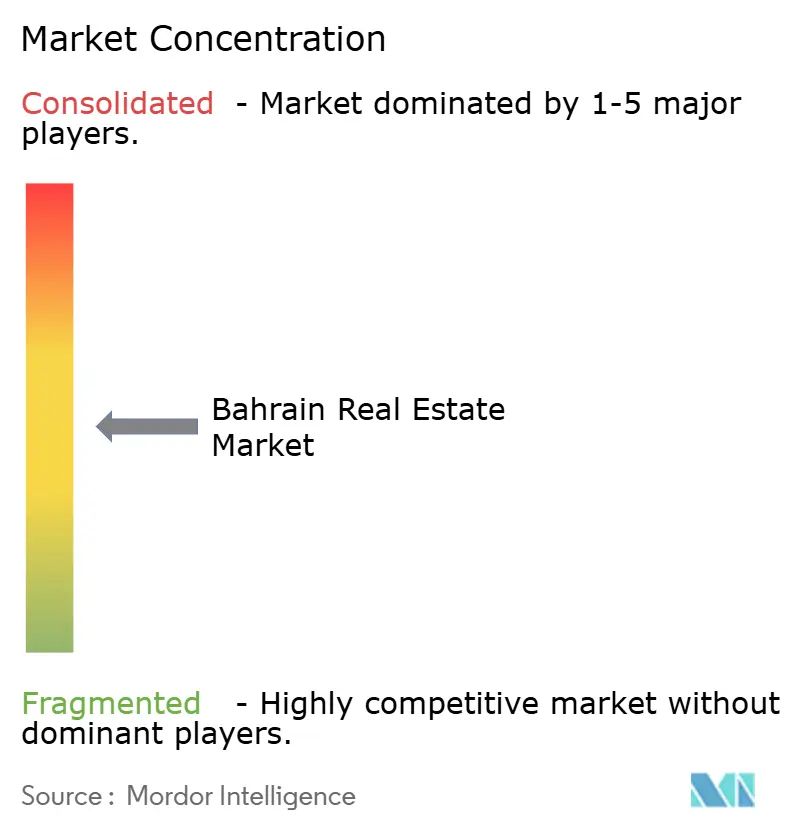
| Market Concentration | Medium |
Major Players *Disclaimer: Major Players sorted in no particular order Image © Mordor Intelligence. Reuse requires attribution under CC BY 4.0. | |
Bahrain Real Estate Market Analysis by Mordor Intelligence
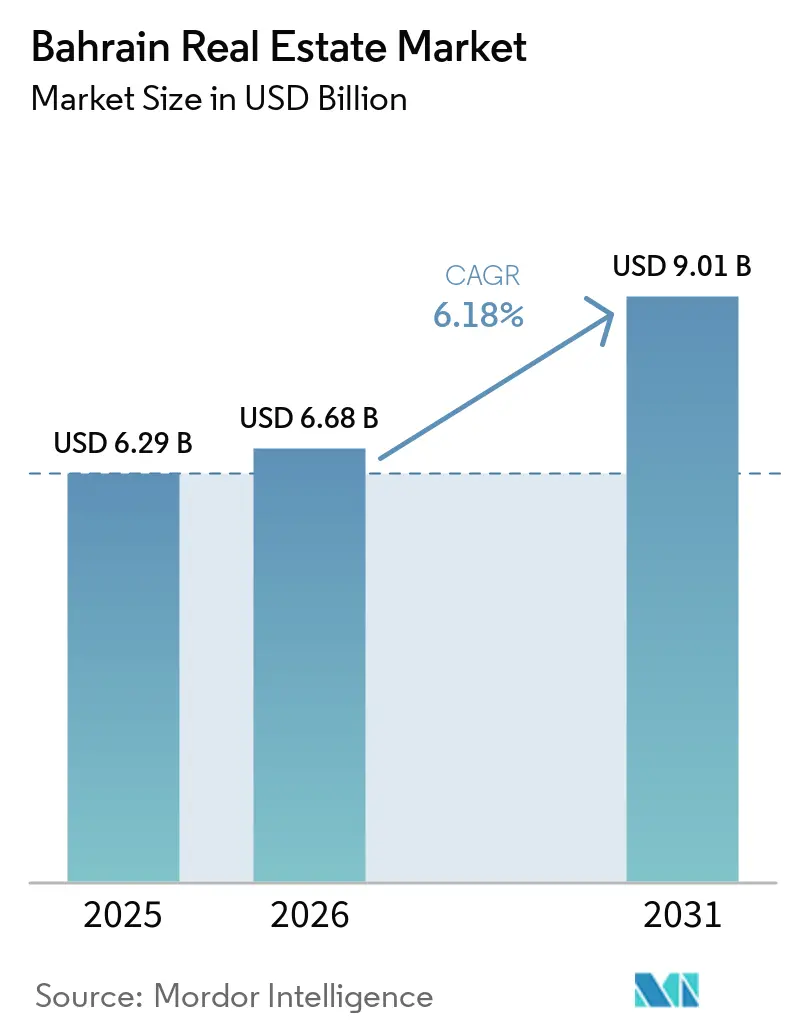
The Bahrain Real Estate Market size is projected to expand from USD 6.29 billion in 2025 and USD 6.68 billion in 2026 to USD 9.01 billion by 2031, registering a CAGR of 6.18% between 2026 and 2031.
The Bahrain real estate market is supported by the country’s non-oil economy, where real estate activity grew 4.3% in 2025, and non-oil activities represented 85.8% of gross domestic product at constant prices. Demand is increasingly shaped by housing programs, freehold communities, and logistics requirements near port-linked industrial areas. The Bahrain real estate market also benefits from electronic registration and other regulatory systems that are intended to make property transactions more efficient. Developers are responding with phased plot releases, mixed-use projects, and longer payment plans. Coastal development, financing conditions, and uneven demand across asset classes remain important limits on the Bahrain real estate market.
Key Report Takeaways
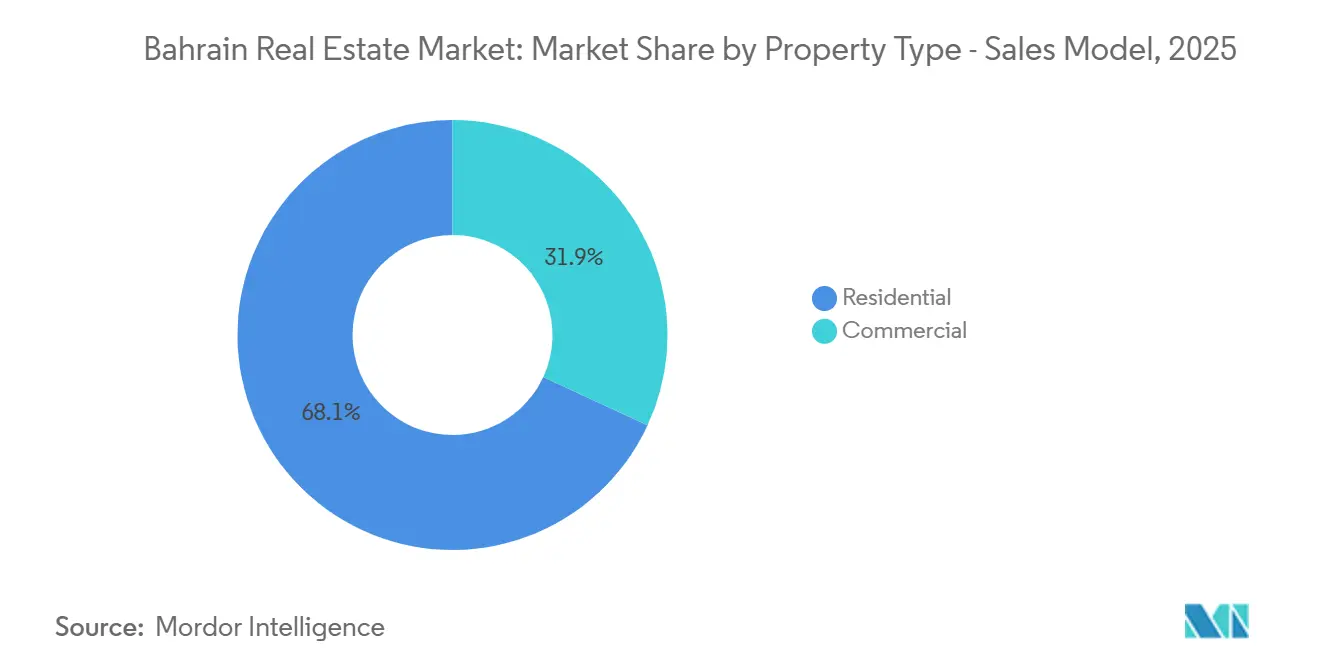
- By property type in the sales model, residential property held 68.1% of the Bahrain real estate market share in 2025, while commercial property is forecast to grow at a 6.89% CAGR through 2031.
- By city in the sales model, Manama held 36.6% of the Bahrain real estate market share in 2025, while Muharraq is forecast to grow at a 7.02% CAGR through 2031.
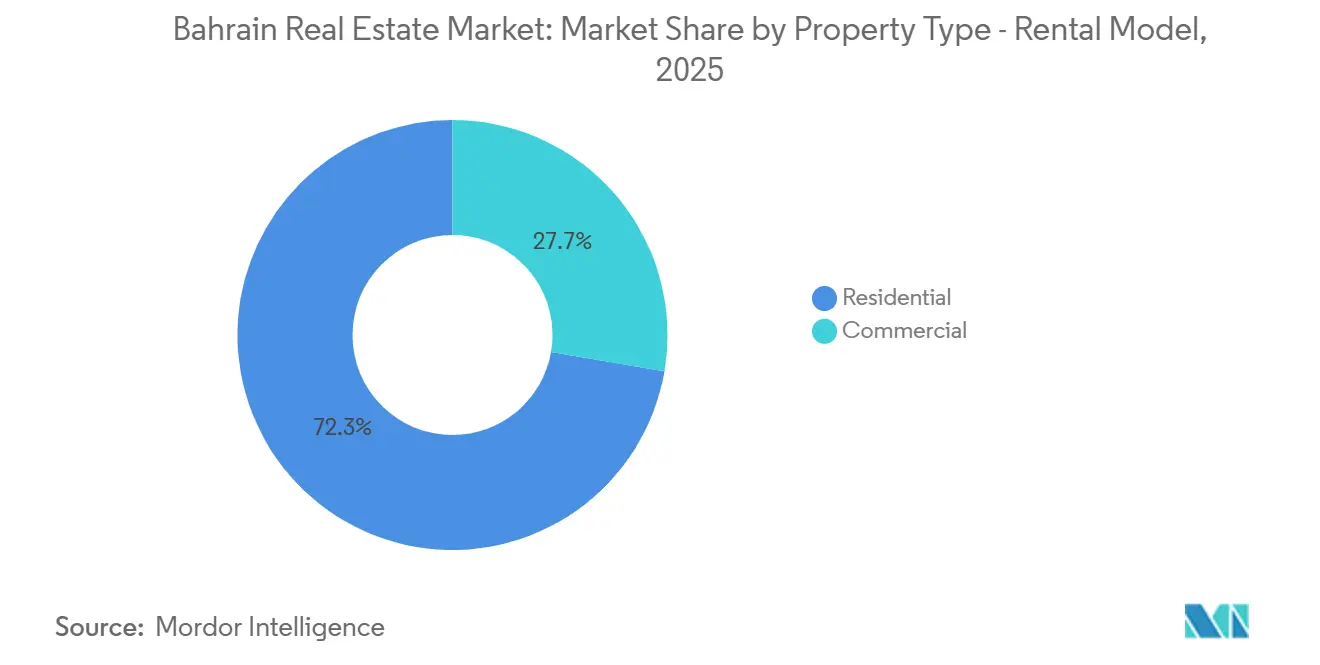
- By property type in the rental model, residential property held 72.3% of the Bahrain real estate market size in 2025, while commercial property is forecast to grow at a 7.21% CAGR through 2031.
- By city in the rental model, Manama held 38.7% of the Bahrain real estate market size in 2025, while Muharraq is forecast to grow at a 7.33% CAGR through 2031.
Note: Market size and forecast figures in this report are generated using Mordor Intelligence’s proprietary estimation framework, updated with the latest available data and insights as of January 2026.
Bahrain Real Estate Market Trends and Insights
Drivers Impact Analysis*
| Drivers | (~) % Impact on CAGR Forecast | Geographic Relevance | Impact Timeline |
|---|---|---|---|
| Non-Oil Economic Diversification and Foreign Direct Investment Inflows | +1.4% | Global, concentrated in Manama and Muharraq | Medium term (2-4 years) |
| Foreign Ownership Reform and Golden Visa Demand | +1.2% | Freehold zones in Diyar Al Muharraq, Amwaj Islands, Bilaj Al Jazayer, Riffa Views, Durrat Al Bahrain, and Marsa Al Seef | Short term (≤ 2 years) |
| Affordable and Mid-Market Housing Demand | +1% | National, concentrated in Northern and Southern Governorates, with gains in Muharraq and Riffa. | Medium term (2-4 years) |
| Waterfront Master-Planned Communities and Branded Residences | +0.9% | Muharraq and Capital Governorate | Long term (≥ 4 years) |
| E-Commerce-Led Logistics and Warehousing Requirements | +0.8% | Muharraq, Hidd Industrial Area, and the Khalifa Bin Salman Port corridor | Medium term (2-4 years) |
| Digital Land Registration and Data-Led Underwriting | +0.6% | National, with early gains in Manama transaction corridors | Short term (≤ 2 years) |
| Source: Mordor Intelligence | |||
Non-Oil Economic Diversification and Foreign Direct Investment Inflows
Bahrain’s shift toward non-oil activity is broadening the base of property demand. Real estate activities grew 4.3% in 2025, ahead of 4.1% growth in overall non-oil activities. Professional and technical services grew 6.4% in 2025, while financial and insurance activities grew 5.6%[1]. These activities support requirements for offices, employee housing, and related services in established urban districts. Non-oil sectors accounted for 85.8% of gross domestic product at constant prices in 2025. This composition gives the Bahrain real estate market a wider set of occupier demand drivers than a cycle based only on energy prices.
Foreign Ownership Reform and Golden Visa Demand
Foreign ownership reforms are widening the set of buyers that can consider freehold property in Bahrain. Freehold areas can broaden the location choices open to eligible overseas buyers. Bilaj Al Jazayer was added to the freehold zone map in April 2025, expanding the locations available for future development[2]. This framework can draw attention to mid-market apartments as well as premium homes. It also gives developers a larger group of buyer profiles to consider when planning projects. Housing supply in freehold areas must still match buyer affordability and delivery conditions. These factors can influence demand across the Bahrain real estate market.
Affordable and Mid-Market Housing Demand
Government-backed housing demand provides a stable source of residential activity. Bahrain committed USD 2.1 billion to deliver 50,000 new housing units. The program includes Ras Hayan Village and ownership flats in the Wahat project in Qalali. Housing finance programs such as Mazaya, Tas’heel, and Tas’heel Plus support eligible citizens through income-linked repayment terms. The Madinat Salman Island 14 project was tendered in February 2025 for 69 housing units[3]. These measures can support local developers and maintain demand across the Bahrain real estate market when private buyer conditions are less favorable.
E-Commerce-Led Logistics and Warehousing Requirements
Digital commerce and trade activity are increasing the need for modern logistics space. Bahrain ranked 1st globally for e-commerce legislation in the 2025 Network Readiness Index. This setting supports demand for fulfillment centers, bonded warehouses, and temperature-controlled facilities near Hidd and Khalifa Bin Salman Port. Commercial property in the rental model is forecast to expand at a 7.21% CAGR through 2031. Developers are also considering storage and service space within larger mixed-use communities. Such projects can widen the role of logistics property in the Bahrain real estate market beyond conventional industrial estates.
Restraints Impact Analysis*
| Restraints | (~) % Impact on CAGR Forecast | Geographic Relevance | Impact Timeline |
|---|---|---|---|
| Mortgage Affordability and Interest-Rate Sensitivity | -0.7% | National, most acute in the capital and Northern Governorates | Short term (≤ 2 years) |
| Oversupply And Price Correction in Selected Luxury Submarkets | -0.5% | Muharraq and Capital Governorate luxury and waterfront zones | Medium term (2-4 years) |
| Limited Developable Land and Coastal-Risk Costs | -0.4% | Coastal fringes of all governorates, particularly the Northern and Capital coastlines | Long term (≥ 4 years) |
| Secondary-Asset Obsolescence and Building Upgrade Costs | -0.3% | Older commercial stock in central Manama, Seef District, and secondary retail corridors | Medium term (2-4 years) |
| Source: Mordor Intelligence | |||
Mortgage Affordability and Interest-Rate Sensitivity
Mortgage affordability still affects households that rely on financing. Higher financing costs can limit demand in the mid-market residential tier. Loan-to-value requirements can also limit the borrowing capacity of nonresident purchasers. These conditions are relevant to buyers considering freehold property. Financing constraints may slow the response of eligible buyers to ownership reforms. This environment can limit demand in the Bahrain real estate market.
Oversupply and Price Correction in Selected Luxury Submarkets
Luxury residential and some retail locations face supply pressure. New waterfront and master-planned delivery in Muharraq can intensify competition across premium projects. Secondary retail assets can face a different demand profile from major destination developments. Projects positioned between affordable and ultra-luxury housing can face particularly uneven absorption. Developers need to align new supply with local demand and property-specific conditions. This restraint can affect development decisions across the Bahrain real estate market.
*Our forecasts treat driver/restraint impacts as directional, not additive. The impact forecasts reflect baseline growth, mix effects, and variable interactions.
Segment Analysis
By Property Type Sales Model Residential Anchors Volume as Commercial Accelerates
Residential property held 68.1% of the sales model in 2025, making it the largest property type in the Bahrain real estate industry. Apartments and condominiums serve expatriate investors and first-time local buyers. Tas’heel and Tas’heel Plus support eligible Bahraini buyers through housing finance structures. Villas and landed houses serve families that prioritize private space and larger homes. Villa values showed greater resilience on a per-unit basis even as average prices declined in 2025. Residential demand is also tied to the availability of government-backed ownership programs. This gives the Bahrain real estate market a substantial base of housing demand across several price points. It also leaves developers exposed to affordability conditions for privately financed purchases.
Commercial property is forecast to grow at a 6.89% CAGR through 2031 in the sales model. The category includes offices, retail space, logistics facilities, industrial assets, and hospitality properties. Grade A office demand is increasingly linked to tenants upgrading into pre-fitted and flexible space. Retail conditions differ by location, as waterfront destinations compete more effectively than secondary malls. Logistics facilities benefit from requirements near ports and industrial corridors. The Real Estate Regulatory Authority requires off-plan licensing, escrow arrangements, and phased approvals for applicable launches. These requirements favor developers who can sustain compliance and construction delivery. The commercial outlook gives the Bahrain real estate industry a growth path that is not limited to housing.
By City Sales Model Manama’s Primacy and Integrated Suburban Competition
Manama held 36.6% of the sales model in 2025, supported by Grade A offices, established retail districts, and dense residential areas. The capital includes locations such as Seef, the Diplomatic Area, Juffair, Reef Island, and Bahrain Bay. Its mix of commercial and residential stock gives buyers access to both investment and owner-occupier options. The Bahrain real estate market in Manama also benefits from its established transaction and service infrastructure. Muharraq is the fastest-growing city in the sales model at a 7.02% CAGR through 2031. This growth reflects the scale of master-planned community development and continued project releases in the city. Manama remains the reference point for sales activity within the country.
Muharraq is the strongest challenger to Manama through large master-planned development. Diyar Al Muharraq spans 12 sq km across 7 islands and 40 km of coastline. Its 2025 and 2026 releases included Suhail, Mozoon, and Al Nuzha plots. Naseej began infrastructure works for the Amwaj Avenue mixed-use project in August 2026. Riffa continues to serve mid-market national households, including buyers supported by housing programs. The Rest of Bahrain provides cost-sensitive options for buyers and commercial occupiers near industrial corridors. These locations broaden the supply choices available across the Bahrain real estate market. Their performance will depend on delivery schedules, infrastructure, and buyer affordability.
By Property Type Rental Model Commercial Leads Growth While Residential Remains Largest
Residential property held 72.3% of the rental model in 2025, the largest share across rental property types. Bahrain’s expatriate workforce supports the volume of apartment and condominium leasing. Juffair, Amwaj Islands, and Seef remain important locations for mid-range rental demand. Premium waterfront villas can attract corporate tenants and residents seeking branded residences. Average asking rents for residential units declined 1.4% in 2025. The Bahrain real estate market, therefore, combines a large rental base with varying performance by neighborhood and property quality. Newer branded stock competes with older urban apartments for tenant demand. Residential landlords need to differentiate through quality, location, and lease terms.
Commercial property is the fastest-growing rental property type, with a forecast CAGR of 7.21% through 2031. E-commerce operators, third-party logistics providers, and fast-moving consumer goods distributors need purpose-built facilities close to transport links. Demand centers include the port corridor and the Hidd Industrial Area. Grade A warehouse space can offer tenants specifications that older industrial stock does not provide. Prime office rents in Manama held steady in 2025 as tenants favored pre-fitted and environmentally certified buildings. Retail returns remained under pressure in legacy shopping centers. The Bahrain real estate market can therefore see stronger rental growth in commercial property than in residential property. Logistics facilities remain an important contributor to commercial demand near integrated infrastructure.

Geography Analysis
Manama held 36.6% of sales activity and 38.7% of rental value in 2025, making it Bahrain’s largest property geography. The Seef District and Bahrain Bay concentrate prime offices and high-end retail, while Juffair and Reef Island absorb substantial apartment leasing by expatriate households. Leasing in Manama during 2025 was shaped by tenants moving to pre-fitted and sustainably certified offices. The Survey and Land Registration Bureau expanded electronic property registration with geographic information system capabilities and data covering more than 300,000 properties. The Taakkad verification service attracted more than 5,700 users within 2 months of its 2025 launch, and Bilaj Al Jazayer adds a future beachfront development area to the wider capital governorate.
Muharraq is forecast to grow at a 7.33% CAGR in the rental model through 2031, the highest geographic rate in the Bahrain real estate market. Diyar Al Muharraq remains the largest supply catalyst, with 12 sq km across 7 islands and 40 km of coastline. The governorate is receiving plot releases, residential projects, and infrastructure work across its master-planned communities. Binaa Al Bahrain launched Marassi Views in September 2025 with 192 apartments and 6 retail units. Bahrain’s National Adaptation Investment Plan states that reclamation has modified more than 80% of the coastline, a consideration that can influence planning, costs, and timing for waterfront projects.
Riffa is a key mid-market residential location for Bahraini families using housing finance and affordable supply programs. The Madinat Salman project included 512 social apartment units tendered across plots in 2025. The Rest of Bahrain includes areas linked to Khalifa Bin Salman Port and the Hidd Industrial Area, making them relevant to logistics and light-industrial property. The Urban Planning and Development Authority expanded the protected area of Tubli Bay Reserve from 15.59 sq km to 16.03 sq km, and land and coastal planning conditions can affect project costs and development schedules.
Competitive Landscape
The Bahrain real estate market is moderately concentrated around government-linked developers and large private developers with major pipelines. Diyar Al Muharraq influences premium residential and mixed-use supply in Muharraq through its large master-planned city. Edamah develops mixed-use and leisure projects that support wider destination development. GFH Financial Group advanced a voluntary offer for Seef Properties shares, which would increase its stake to 27.98% as of September 2026. This group of developers can influence the timing and type of large projects in the country.
Developers are competing through staged releases, project design, and payment structures. Diyar Al Muharraq launched 126 Al Nuzha residential plots in May 2026 and completed secondary infrastructure works in Al Wasem in August 2026. These releases show how developers use staged supply and infrastructure completion to sustain buyer interest. The Bahrain real estate market is becoming more sensitive to financing terms, project delivery, and branded partnerships.
Regulation raises requirements for off-plan sales, escrow arrangements, and advertising approvals. The Real Estate Regulatory Authority tendered a digital services automation project in September 2025 for core regulatory services, while digitized registration rewards accurate title records and compliance. Seef Properties completed the Fraser Suites Seef refurbishment and installed solar systems across 4 assets during 2025. Its alliance with Majd Investment for a mixed-use project in Dammam signals a regional expansion strategy.
Bahrain Real Estate Industry Leaders
-
Diyar Al Muharraq
-
Edamah
-
Naseej B.S.C.
-
Bin Faqeeh Real Estate Investment Company W.L.L.
-
Seef Properties B.S.C.
- *Disclaimer: Major Players sorted in no particular order
Recent Industry Developments
- August 2026: Naseej B.S.C. broke ground on the infrastructure phase of the Amwaj Avenue mixed-use development at the entrance to Amwaj Islands, Muharraq Governorate. The 125,000 sq m project comprises 253 residential plots and 27 investment plots, marking Naseej's entry as a flagship integrated-community developer in Muharraq.
- August 2026: GFH Financial Group, through its vehicle Investment Growth Equity Seef, managed by GFH Fund Management Partners, advanced a voluntary offer for shares in Seef Properties B.S.C., with GFH's stake expanding to 27.98%. The transaction was submitted to regulatory authorities for approval, marking a significant consolidation in Bahrain's listed commercial real estate sector.
- August 2026: Diyar Al Muharraq completed secondary infrastructure works across the Al Wasem community in the North Islands, a key milestone in the build-out of the integrated master-planned city that spans 12 sq km and 7 islands.
Bahrain Real Estate Market Report Scope
| Residential | Apartments and Condominiums |
| Villas and Landed Houses | |
| Commercial | Office |
| Retail | |
| Logistics | |
| Other Commercial Property Types, Including Industrial and Hospitality |
| Manama |
| Muharraq |
| Riffa |
| Rest of Bahrain |
| By Property Type | Residential | Apartments and Condominiums |
| Villas and Landed Houses | ||
| Commercial | Office | |
| Retail | ||
| Logistics | ||
| Other Commercial Property Types, Including Industrial and Hospitality | ||
| By Governorate | Manama | |
| Muharraq | ||
| Riffa | ||
| Rest of Bahrain | ||
Key Questions Answered in the Report
What is the projected size of the Bahrain real estate market by 2031?
The Bahrain real estate market is forecast to reach USD 9.01 billion by 2031, expanding at a 6.18% CAGR from 2026.
Which property type has the largest sales share in Bahrain?
Residential property led the sales model with 68.1% share in 2025.
Which rental property type is forecast to grow the fastest in Bahrain?
Commercial property is forecast to expand at a 7.21% CAGR through 2031, supported by office, retail, logistics, industrial, and hospitality requirements.
Which governorate leads Bahrain’s rental activity?
Manama led the rental model with 38.7% share in 2025, while Muharraq has the fastest forecast growth at a 7.33% CAGR.
What is driving logistics property demand in Bahrain?
E-commerce, trade activity, and demand for facilities near Khalifa Bin Salman Port and Hidd Industrial Area are supporting logistics requirements.
How do foreign ownership reforms affect property demand in Bahrain?
Freehold areas can broaden the range of eligible overseas buyers and property choices.