
Bahrain Islamic Finance Market Size and Share
Market Overview
| Study Period | 2021 - 2032 |
|---|---|
| Forecast Data Period | 2027 - 2032 |
| Base Year Market Size (2026) | USD 97.90 Billion |
| Market Size (2027) | USD 103.90 Billion |
| Market Size (2032) | USD 142.30 Billion |
| Growth Rate (2027 - 2032) | 6.50 % |
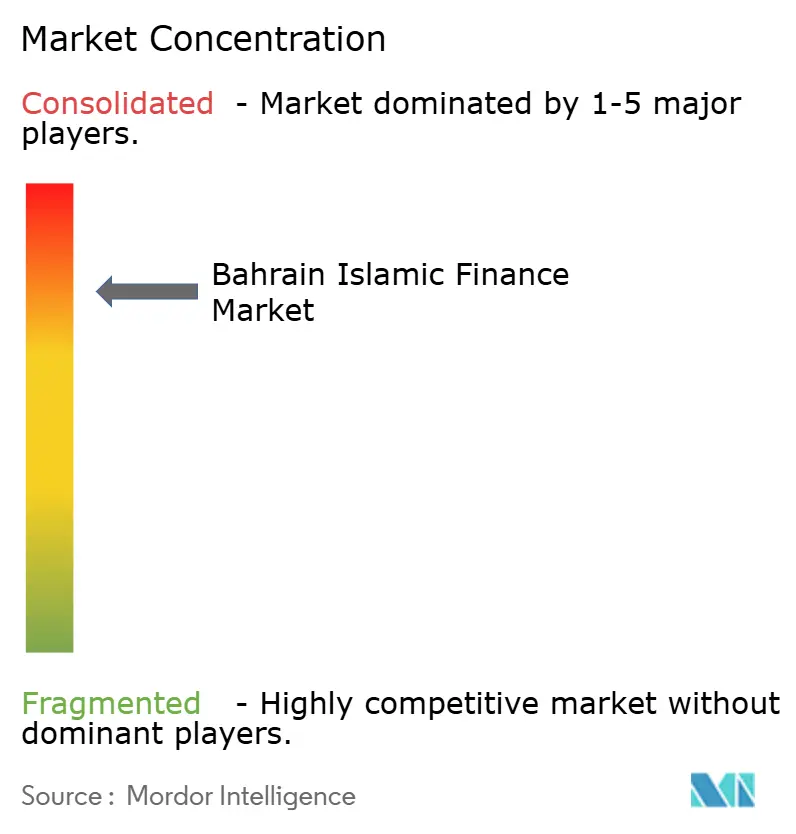
| Market Concentration | High |
Major Players *Disclaimer: Major Players sorted in no particular order Image © Mordor Intelligence. Reuse requires attribution under CC BY 4.0. | |
Bahrain Islamic Finance Market Analysis by Mordor Intelligence
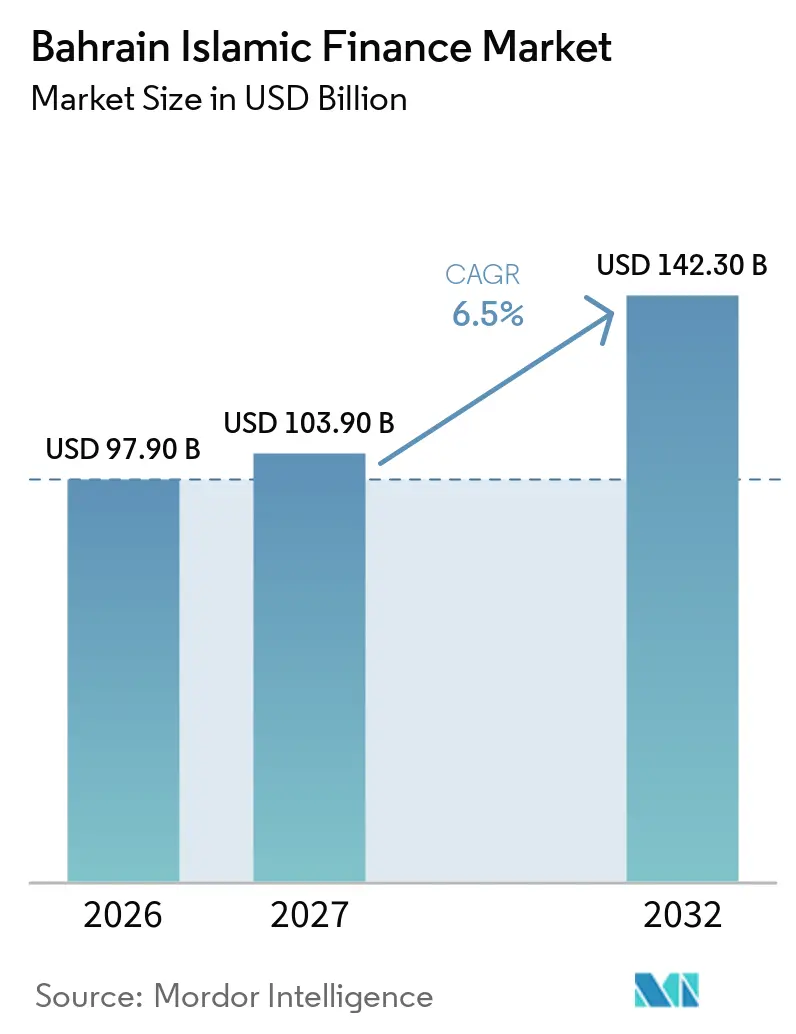
The Bahrain Islamic Finance Market size is expected to increase from USD 97.90 billion in 2026 to USD 103.90 billion in 2027 and reach USD 142.30 billion by 2032, growing at a CAGR of 6.5% over 2027-2032.
Bahrain hosts the Accounting and Auditing Organization for Islamic Financial Institutions and the International Islamic Financial Market, giving its financial system a central role in setting Sharia-compliant product and documentation practices. Islamic banks held 42% of domestic banking assets in May 2026, supported by 12% asset growth while conventional bank assets declined 0.6% over the same period. The Bahrain Islamic Finance market, therefore, benefits from a stronger domestic banking base, sovereign sukuk activity, and a growing digital delivery model. The Bahrain Islamic Finance market also faces a narrow corporate sukuk pipeline and a fiscal position that can direct bank balance sheets toward government financing. Consolidation among retail banks and wider access to national MSME financing can create room for new products and distribution partnerships.
Key Report Takeaways
- By financial sector, Islamic banking captured 74.2% of the Bahrain Islamic finance market share in 2026, while the Islamic capital market is projected to grow at 8.5% CAGR through 2032.
- By customer type, government and government-related entities held 26.7% of the Bahrain Islamic finance market in 2026, while MSMEs are projected to grow at 9.8% CAGR through 2032.
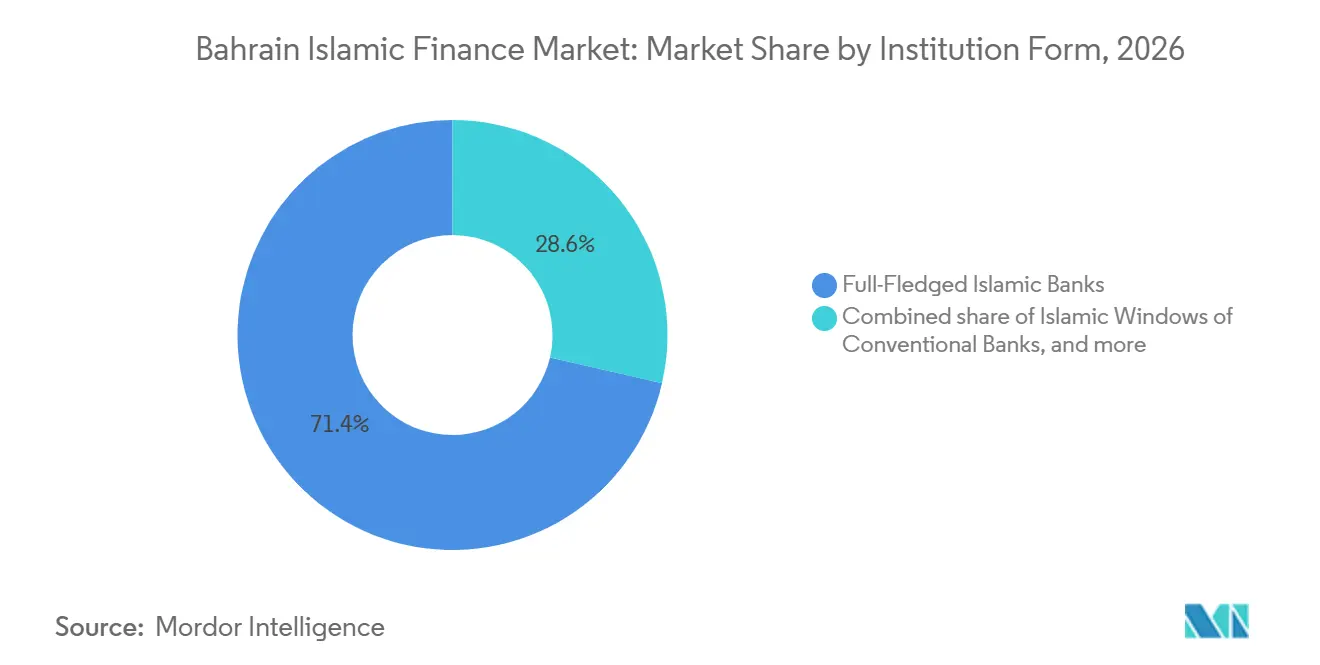
- By institution form, full-fledged Islamic banks accounted for 71.4% of the Bahrain Islamic finance market in 2026, while licensed Islamic non-bank institutions are projected to grow at 7.9% CAGR through 2032.
Note: Market numbers in this report are based on Mordor Intelligence's proprietary estimation framework, which combines nine months of actuals with Q4 projections for base year 2026.
Market Trends and Insights
Drivers Impact Analysis of Bahrain Islamic Finance Market*
| Driver | (~) % Impact on CAGR Forecast | Geographic Relevance | Impact Timeline |
|---|---|---|---|
| Public Demand for Sharia-Compliant Finance | +1.5% | National, with spillover to Gulf Cooperation Council diaspora clients | Medium term (2-4 years) |
| Islamic Banking Conversion and Consolidation | +1.2% | National, concentrated in the Manama banking hub | Short term (≤ 2 years) |
| Sovereign Sukuk Funding Requirements | +1.3% | National, with cross-border investor demand across the Gulf Cooperation Council and Southeast Asia | Medium term (2-4 years) |
| Digital Islamic Finance Adoption | +1.0% | National, with early gains in retail and MSME segments | Short term (≤ 2 years) |
| Gulf Cooperation Council Fund Passporting and Cross-Border Distribution | +0.8% | Gulf Cooperation Council-wide, with immediate benefits for Bahrain-domiciled Islamic collective investment undertakings | Medium term (2-4 years) |
| Embedded Islamic Finance Through Retail Partnerships | +0.7% | National, expanding through BenefitPay and open-banking rails | Short term (≤ 2 years) |
| Source: Mordor Intelligence | |||
Public Demand for Sharia-Compliant Finance Outpaces Institutional Capacity
Islamic banking continued to gain market share in Bahrain, accounting for approximately 42% of domestic banking assets at the end of May 2026, compared with 40.7% a year earlier[1]. Islamic bank assets grew 12% year-on-year, while conventional bank assets declined by 0.6%, highlighting the growing importance of Sharia-compliant banking within the domestic financial system. Fitch Ratings coverage also indicated that Bahrain's Islamic finance industry could exceed USD 100 billion by 2027. Bahrain Islamic Bank continues to expand its digital banking capabilities, while the country's national health insurance initiatives, including the Hakeem programme, may create opportunities for takaful providers, although the resulting impact on takaful enrolment remains unconfirmed. The Central Bank of Bahrain's regulatory framework and applicable Accounting and Auditing Organization for Islamic Financial Institutions standards support the industry's development, while continued growth will require providers to maintain competitive products, effective risk management, and accessible digital services.
Islamic Banking Consolidation Reshapes the Competitive Order
Al Salam Bank completed its acquisition of Kuwait Finance House Bahrain in May 2024, increasing its asset base by 30% and creating the largest Islamic retail bank in Bahrain by assets[2]. The transaction showed that scale can be a meaningful competitive advantage in the Bahrain Islamic Finance market, particularly for retail distribution and product investment. KFH-Bahrain reported a 20% share of business-sector financing in Bahrain at the end of 2025 and a net profit of USD 730.6 million for the full year. This could bring specialist Islamic lenders and financial technology firms into the licensed market. It could also shift more activity toward financing companies and other non-bank institutions.
Sovereign Sukuk Issuance Sustains Structural Market Depth
Bahrain's sovereign sukuk issuance supports the depth of its Islamic finance market by providing Sharia-compliant investment instruments for domestic and international investors. In May 2025, the Kingdom issued USD 1.75 billion in international Sukuk Ijara and Murabaha certificates alongside a USD 750 million conventional bond, with reported demand for the sukuk exceeding USD 4.4 billion. Domestically, the Central Bank of Bahrain issued a BHD 250 million (USD 664.9 million) Government Ijara Murabaha Sukuk in July 2025, which was listed on the Bahrain Bourse effective 3 August 2025. The Central Bank also permits eligible short- and long-term Bahraini dinar-denominated Ijara sukuk to be used as collateral under its Islamic Sukuk Liquidity Instrument, enabling retail banks to obtain one-week liquidity against their holdings. Regular sovereign issuance, therefore, expands the supply of investable Sharia-compliant assets, supports secondary-market activity, and strengthens Islamic banks' liquidity-management options, although the extent of banks' reliance on sovereign securities should be assessed using portfolio-level data.
Digital Islamic Finance Redefines the Cost-to-Serve Equation
Digital adoption is expanding retail access to the Bahrain Islamic Finance market and MSME services. Bahrain Islamic Bank launched the Al Murshid AI-powered Sharia advisory platform in November 2025 at the Accounting and Auditing Organization for Islamic Financial Institutions conference[4]. In 2026, it introduced BisB Business for corporate and MSME customers. Digital onboarding accounted for 91% of new customers in 2025, while digital platforms processed 80% of transactions. Benefit launched digital direct debit through Fawateer on BenefitPay in August 2026, offering Islamic finance providers an account-to-account repayment option. These developments can reduce delivery costs and simplify recurring financing payments. In April 2025, Visa launched Visa+ through BenefitPay with Bahrain Islamic Bank and Khaleeji Bank, enabling Gulf Cooperation Council customers to transfer funds using mobile numbers. This function can support a more connected retail finance experience.
Restraints Impact Analysis of Bahrain Islamic Finance Market*
| Restraint | (~) % Impact on CAGR Forecast | Geographic Relevance | Impact Timeline |
|---|---|---|---|
| Sovereign Credit and Fiscal Concentration | -0.8% | National, with sensitivity to oil prices and Gulf Cooperation Council support mechanisms | Medium term (2-4 years) |
| Limited Corporate Sukuk Issuance | -0.5% | National, constraining secondary-market depth and Islamic capital market breadth | Long term (≥ 4 years) |
| Sharia Standardization and Product Approval Friction | -0.5% | Global, particularly affecting cross-border product distribution | Long term (≥ 4 years) |
| Concentrated Banking Structure and Scale Constraints | -0.4% | National, affecting MSME and retail Islamic finance penetration | Medium term (2-4 years) |
| Source: Mordor Intelligence | |||
Sovereign Credit and Fiscal Concentration Compress the Headroom for Market Growth
The International Monetary Fund has called for well-designed, sustained medium-term fiscal consolidation to place public debt on a downward trajectory. This fiscal environment may increase domestic Islamic banks' demand for government sukuk. However, higher sovereign holdings may limit balance-sheet capacity for private-sector financing in the Bahrain Islamic finance market. Bahrain's fiscal break-even oil price is estimated at USD 137 per barrel in 2025, highlighting the sensitivity of public finances to oil revenue. The pace of fiscal consolidation will influence the scope for finance-specific public initiatives and domestic credit expansion.
Limited Corporate Sukuk Issuance Caps Secondary-Market Liquidity
Corporate and bank sukuk issuance remains limited relative to Bahrain's wider Islamic capital market ambitions. Many corporate sukuk are privately placed or unlisted, reducing secondary-market turnover. Higher structuring costs and the small scale of many listed businesses can limit corporate interest in sukuk issuance. FLOOSS Bahrain appointed SICO as lead manager for a proposed USD 10 million securitization sukuk in 2025. This proposal shows how Sharia-compliant receivables from financial technology firms could create a new form of domestic fixed-income asset. Limited corporate instruments also restrict the refinancing options available for banks that finance MSMEs and reduce the investment choices of domestic Islamic fund managers.
*Our forecasts treat driver/restraint impacts as directional, not additive. The impact forecasts reflect baseline growth, mix effects, and variable interactions.
Bahrain Islamic Finance Market Segment Analysis
By Financial Sector:
Sukuk and Non-Bank Channels Challenge Banking's DominanceIslamic banking held 74.2% of the Bahrain Islamic finance market share in 2026, supported by USD 67.1 billion in sector assets at the end of 2025. The sector's assets increased 5.8% during 2025, while domestic assets grew 17.5% and foreign assets declined 9.2%. Islamic windows at conventional banks held BHD 0.7 billion (USD 1.9 billion) in assets and had a 96.1% domestic orientation. These windows remain mainly local retail structures, while full-fledged banks have greater capacity to expand services. The Bahrain Islamic finance market continues to depend on banking as its largest financial-sector component.
The Islamic capital market is forecast to grow at 8.5% CAGR from 2027 to 2032. Outstanding sukuk exceeded USD 20 billion in the first half of 2026 after 16% growth from the prior year, while the Bahrain Islamic Index gained 31.7% during 2025. Sharia-compliant collective investment undertakings reached USD 2.5 billion in net asset value at the end of the first quarter of 2026, rising 24.5% year on year. Takaful assets exceeded USD 750 million at the end of the third quarter of 2025 and grew 28% from the previous year. Takaful accounted for 33% of the insurance industry's gross premiums, compared with 29% a year earlier, showing further space for non-bank financial products.
By Customer Type:
MSME Finance Emerges as the Highest-Growth SegmentGovernment and government-related entities accounted for 26.7% of the Bahrain Islamic Finance market in 2026. Their position reflects the role of domestic and international sukuk in government funding. Bahrain issued USD 1.75 billion in sukuk ijara and murabaha in May 2025 on behalf of the Ministry of Finance, and the sukuk tranche attracted more than 2.8 times oversubscription. Financial institutions and large corporates formed the next institutional tier. Eight wholesale Islamic banks were licensed in Bahrain at the end of 2025, serving clients across the Gulf Cooperation Council and the Middle East and North Africa region.
MSMEs are forecast to grow at 9.8% CAGR from 2027 to 2032, making them the fastest-growing customer type. SME loans outstanding reached BHD 538.2 million (USD 1.4 billion) at the end of 2025, representing 10.2% of total business lending. The national SME Fund totals USD 185 million, is managed by Bahrain Development Bank, and receives Tamkeen subsidies of up to 50% of the profit rate. The program had financed 46 enterprises with BHD 2.879 million (USD 7.7 million) in commitments by March 2026. The Bahrain Islamic Finance market can use dedicated mobile services and subsidized financing to reach businesses with more limited access to Sharia-compliant funding.
By Institution Form:
Non-Bank Institutions Challenge the Full-Bank ModelFull-fledged Islamic Banks accounted for 71.4% of the Bahrain Islamic Finance market in 2026. Bahrain had 7 retail Islamic banks and 8 wholesale Islamic banks at the end of 2025. These institutions use different business models, from Al Salam Bank's acquisitions to Bahrain Islamic Bank's digital services. The February 2026 consultation on paid-up capital could introduce specialist providers in Islamic SME lending and digital banking. Islamic windows provide a meaningful but more stable part of the sector, with narrower product development than full-service Islamic banks.
Licensed Islamic Non-Bank Institutions are forecast to grow at 7.9% CAGR from 2027 to 2032. This group includes takaful operators, Islamic fund managers, and licensed financing companies. Bahrain authorized 184 Islamic collective investment undertakings, both local and offshore, with a combined net asset value of USD 2.928 billion by mid-2026. Takaful operators can benefit from the Sehati health insurance requirement and demand for family protection connected to mortgage financing. Bahrain Islamic Bank's Save Plus offering included life takaful cover from Takaful International, showing how banking and insurance can be combined within the Bahrain Islamic Finance market.
Geography Analysis
Domestic Islamic banking assets represented 62.5% of Bahrain's USD 67.1 billion Islamic banking assets at the end of 2025. Domestic assets grew 17.5% during 2025, while foreign assets represented 37.5% of the total and declined 9.2%. This shift ties the Bahrain Islamic Finance market more closely to domestic credit, sovereign sukuk, and national MSME programs. The Bahrain Islamic Index rose 13.89% year-on-year in the third quarter of 2025, while the broader All-Share Index declined 3.21%. The domestic book gives Bahrain a base for testing and distributing locally relevant Sharia-compliant services.
Bahrain serves the Gulf Cooperation Council as a fund distribution and wholesale banking hub rather than as a resource-based economy. The Gulf Cooperation Council Fund Passporting Regime has been applied in Bahrain since January 1, 2025. It allows Bahrain-domiciled Islamic collective investment undertakings to be marketed across member states through harmonized registration. Islamic collective investment undertakings registered in Bahrain held USD 2.498 billion in net asset value in the first quarter of 2026. The presence of the Accounting and Auditing Organization for Islamic Financial Institutions and the International Islamic Financial Market supports Bahrain's position in product standards, market infrastructure, cross-border asset management, and wholesale services.
Bahrain's international role extends into the Middle East and North Africa region and South Asia through its locally headquartered groups. Investcorp raised USD 7 billion during its fiscal 2025 fundraising cycle and managed USD 60 billion in assets worldwide. Investcorp Strategic Capital Partners II closed with USD 1.1 billion in commitments and USD 155 million in co-investment capital in March 2026. Al Baraka Banking Group generated USD 357 million in total net income during 2025, while its assets reached USD 31.01 billion after 18% growth. These groups connect Bahrain's domestic financial base with regional investment activity.
Competitive Landscape
The Bahrain Islamic Finance market has a consolidated banking tier, while its non-bank layer remains more diverse. Al Salam Bank acquired Kuwait Finance House Bahrain in May 2024, increasing its asset base by 28% and strengthening its position in Bahrain's Islamic banking sector. KFH-Bahrain had reported a 20% share of business-sector financing at the end of 2025, although it was no longer an independent bank following the acquisition. GFH Financial Group became GFH Bank in April 2026 as it moved toward an integrated banking and investment model. GFH Bank recorded USD 35.11 million in net profit attributable to shareholders in the first quarter of 2026, compared with USD 30.14 million in the first quarter of 2025, an increase of 16.5%.
Technology is becoming a clearer competitive factor in the Bahrain Islamic Finance market. Bahrain Islamic Bank launched Al Murshid in November 2025 as an artificial intelligence-powered Sharia advisory platform. Its digital channels onboarded 91% of new customers and handled 80% of transactions in 2025. Al Baraka Banking Group increased total assets by 18% to USD 31.01 billion in 2025. Investcorp applies an artificial intelligence investment methodology across private equity, real estate, infrastructure, and credit investments.
Corporate sukuk origination and Islamic wealth management remain open areas for the Bahrain Islamic Finance market. FLOOSS Bahrain's proposed USD 10 million securitization sukuk, managed by SICO, provides an early example of financial technology-based Sharia-compliant securitization. Benefit added digital direct debit to BenefitPay in August 2026, improving recurring payment options for financing providers. Domestic sukuk support bank liquidity management through the Islamic Sukuk Liquidity Instrument.
Bahrain Islamic Finance Industry Leaders
-
Kuwait Finance House B.S.C.
-
Al Salam Bank B.S.C.
-
Bahrain Islamic Bank B.S.C.
-
Khaleeji Bank B.S.C.
-
Al Baraka Islamic Bank B.S.C.
- *Disclaimer: Major Players sorted in no particular order
Bahrain Islamic Finance Market Companies Covered in this Report
- Al Salam Bank B.S.C.
- Kuwait Finance House K.S.C.P.
- Bahrain Islamic Bank B.S.C.
- Khaleeji Bank B.S.C.
- Al Baraka Islamic Bank B.S.C.
- Bank ABC B.S.C.
- GFH Bank B.S.C.
- Ithmaar Holding B.S.C.
- Investcorp Holdings B.S.C.
- SICO B.S.C.
- Arcapita Group Holdings Limited
- Inovest B.S.C.
- Ajyad Capital B.S.C.
- Takaful International Company B.S.C.
- FLOOSS Bahrain B.S.C.
Recent Industry Developments in Bahrain Islamic Finance Market
- September 2026: The Central Bank of Bahrain's monthly Sukuk Al-Salam issue of BHD 50 million (USD 133 million) with a 91-day maturity received BHD 65.332 million (USD 173.8 million) in subscriptions and offered an expected return of 5.31%.
- September 2026: BBK reported that Bahrain’s SME Fund had provided BHD 2.879 million in Sharia-compliant financing to 46 businesses since March 2026. Launched in November 2025 and managed by Bahrain Development Bank, the fund supports micro, small, and medium-sized enterprises across multiple sectors. With support from Labour Fund (Tamkeen), eligible businesses can receive subsidies covering up to 50% of the financing profit rate.
- March 2026: Investcorp closed its second GP-staking fund with USD 1.1 billion in commitments and USD 155 million in co-investment capital. The close brought the GP-staking unit's assets under management above USD 2.4 billion.
- February 2026: BENEFIT launched Digital Direct Debit via Fawateer on BenefitPay. Bahrain's fintech transaction provider integrated digital direct debit into its BenefitPay application, enabling Islamic finance providers to process recurring repayments for Sharia-compliant financing products through account-to-account rails.
Bahrain Islamic Finance Market Report Scope
Segmentation Overview
| Islamic Banking | |
| Islamic Capital Market | Sukuk |
| Islamic Funds | |
| Islamic Non-Bank Financial Institutions | Takaful / Islamic Insurance |
| Others (Pension, Financing Companies, etc.) |
| Retail / Individual Customers |
| MSMEs |
| Large Corporates |
| Government & Government-Related Entities |
| Financial Institutions |
| Other Customer Types |
| Full-Fledged Islamic Banks |
| Islamic Windows of Conventional Banks |
| Licensed Islamic Non-Bank Institutions (Takaful, Fund Managers, and Other Licensed Non-Banks) |
| By Financial Sector | Islamic Banking | |
| Islamic Capital Market | Sukuk | |
| Islamic Funds | ||
| Islamic Non-Bank Financial Institutions | Takaful / Islamic Insurance | |
| Others (Pension, Financing Companies, etc.) | ||
| By Customer Type | Retail / Individual Customers | |
| MSMEs | ||
| Large Corporates | ||
| Government & Government-Related Entities | ||
| Financial Institutions | ||
| Other Customer Types | ||
| By Institution Form | Full-Fledged Islamic Banks | |
| Islamic Windows of Conventional Banks | ||
| Licensed Islamic Non-Bank Institutions (Takaful, Fund Managers, and Other Licensed Non-Banks) | ||
Key Questions Answered in the Report
What is the forecast growth rate for the Bahrain Islamic finance sector?
The Bahrain Islamic Finance market is forecast to grow at 6.5% CAGR from 2027 to 2032, increasing from USD 103.9 billion in 2027 to USD 142.3 billion by 2032. The outlook reflects banking, capital-market, and non-bank activity.
Which financial sector leads Islamic finance in Bahrain?
Islamic Banking led with 74.2% share in 2026, supported by USD 67.1 billion in sector assets at the end of 2025. It remains the largest part of the sector.
Which customer group is growing fastest in Bahrain's Sharia-compliant financial services?
MSMEs are projected to grow at 9.8% CAGR through 2032, supported by the USD 185 million national SME Fund and digital business services.
Why are sukuk important to Bahrain's financial system?
Sukuk support government funding and bank liquidity management, while the May 2025 USD 1.75 billion issuance drew more than USD 4.5 billion in sukuk demand. These securities also expand domestic investment options.
What is driving digital Islamic banking in Bahrain?
Bahrain Islamic Bank used digital channels to onboard 91% of new customers and process 80% of transactions in 2025, while BenefitPay introduced digital direct debit in 2026. These tools make access and repayment processes easier.
How concentrated is Bahrain's Sharia-compliant financial sector?
The sector is moderately concentrated in banking, with Full-Fledged Islamic Banks holding 71.4% by institution form in 2026 and a more diverse non-bank segment. Consolidation is most visible among larger retail banks.