
Market Overview
| Study Period | 2020 - 2031 |
|---|---|
| Forecast Data Period | 2026 - 2031 |
| Base Year Market Size (2025) | USD 3.68 Billion |
| Market Size (2026) | USD 4.29 Billion |
| Market Size (2031) | USD 9.18 Billion |
| Growth Rate (2026 - 2031) | 16.45 % |
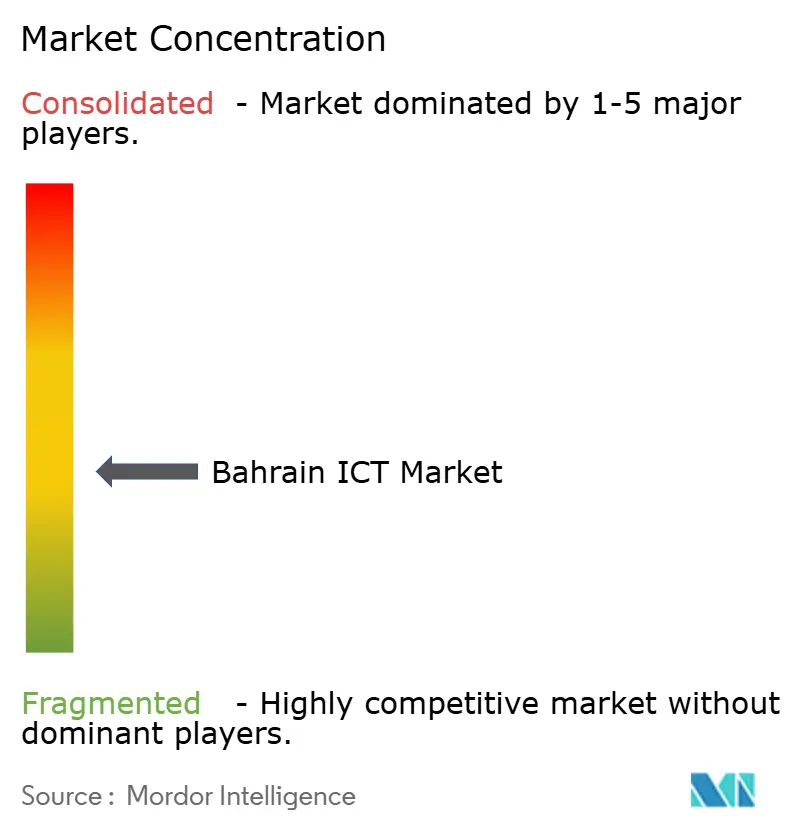
| Market Concentration | Medium |
Major Players *Disclaimer: Major Players sorted in no particular order Image © Mordor Intelligence. Reuse requires attribution under CC BY 4.0. | |
Bahrain ICT Market Analysis by Mordor Intelligence
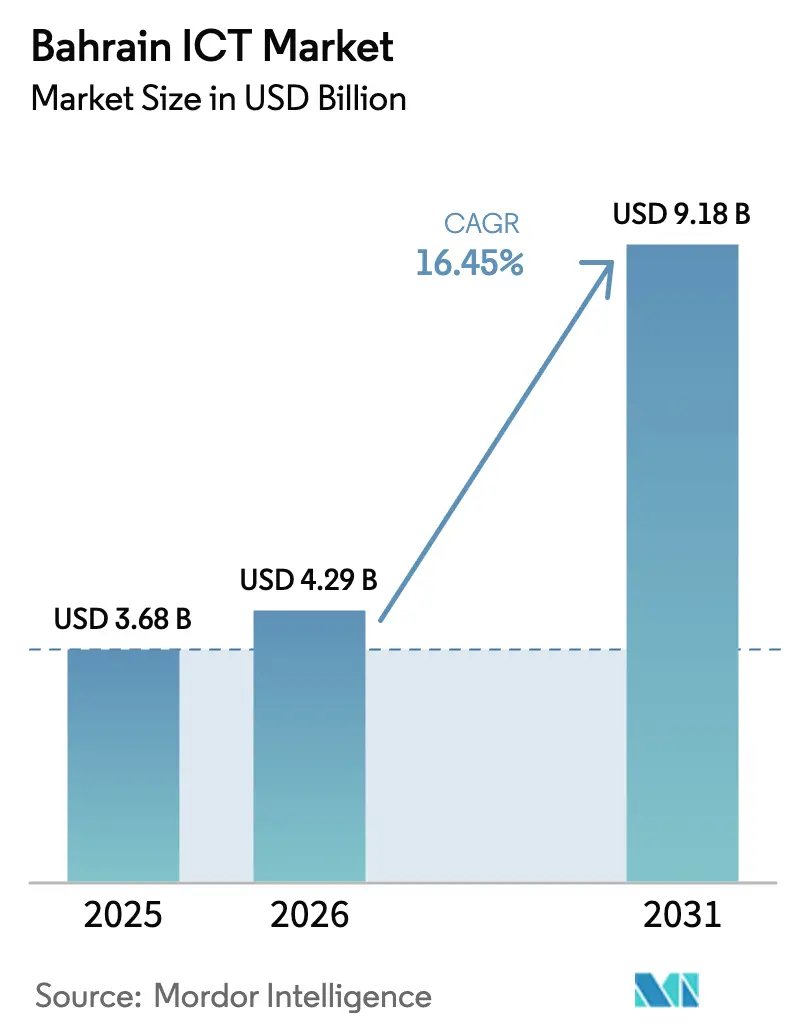
Bahrain ICT market size in 2026 is estimated at USD 4.29 billion, growing from 2025 value of USD 3.68 billion with 2031 projections showing USD 9.18 billion, growing at 16.45% CAGR over 2026-2031. Strong 5G and fiber roll-outs, a Cloud-First public-sector mandate, and vibrant fintech regulation continue to pull international vendors into the Kingdom. Demand accelerates across hardware, software, IT services, and telecom services as enterprises pursue cost-efficient digitization while the government targets 100% household fiber coverage by 2026[2]. Investment momentum is reinforced by AWS, Microsoft, and Oracle regional cloud nodes, which guarantee data-residency compliance for regulated industries. Telecom operators leverage private 5G and edge architectures to unlock low-latency use cases in metals, banking, and logistics. Meanwhile, SME digital adoption gains pace, aided by Tamkeen grants and an expanding venture-capital pipeline that lifts local SaaS start-ups.
Key Report Takeaways
- By component, telecom services led with 39.46% of Bahrain ICT market share in 2025; IT services are on track for the fastest 10.92% CAGR through 2031.
- By enterprise size, large enterprises controlled 58.05% of the Bahrain ICT market size in 2025, while SMEs are growing at a 11.85% CAGR to 2031.
- By industry vertical, BFSI captured 35.92% revenue share in 2025; retail and e-commerce is projected to expand at 13.25% CAGR through 2031.
Note: Market size and forecast figures in this report are generated using Mordor Intelligence’s proprietary estimation framework, updated with the latest available data and insights as of 2026.
Bahrain ICT Market Trends and Insights
Drivers Impact Analysis*
| Driver | (~) % Impact on CAGR Forecast | Geographic Relevance | Impact Timeline |
|---|---|---|---|
| Robust 5G roll-out and fibre backhaul densification | +2.8% | National, with concentration in Manama and industrial zones | Medium term (2-4 years) |
| Cloud-First public-sector mandate accelerates enterprise migration | +2.1% | National, with spillover to GCC markets | Short term (≤ 2 years) |
| Fintech sandbox attracting foreign SaaS vendors | +1.7% | National, with regional expansion potential | Medium term (2-4 years) |
| National data-centre build-out lowers latency and improves data-residency compliance | +1.9% | National, with regional connectivity benefits | Long term (≥ 4 years) |
| Growing local cybersecurity talent pool through Tamkeen incentives | +1.4% | National, with regional talent export potential | Long term (≥ 4 years) |
| Mandated Arabic e-service accessibility standards (2025) spur GovTech spend | +1.2% | National, with potential GCC standardization | Short term (≤ 2 years) |
| Source: Mordor Intelligence | |||
Robust 5G Roll-out and Fibre Backhaul Densification
Private 5G networks already power Aluminium Bahrain’s smart-factory program after Batelco and Nokia completed the Kingdom’s first industrial 5G site in 2025. STC Bahrain’s 5G New Calling upgrade expands enterprise voice, while BNET is targeting 95% home fiber penetration by 2026, lifting average fixed speeds 2.5-fold. Ultra-low-latency links attract high-frequency traders and real-time IoT applications across ports and logistics hubs. Operators expect densification to cut edge-compute latency below 10 ms, sharpening Bahrain’s regional competitiveness.
Cloud-First public-sector mandate
More than 30% of ministries migrated core workloads to AWS since 2019, cutting project lead times by 60% and operating costs by up to 90%. Success stories in justice and education accelerate private-sector migrations, helped by training subsidies that address skill shortages. Sovereign data guarantees also reassure foreign banks servicing GCC clients from Manama. The Bahrain ICT market benefits as cloud spending displaces legacy capex and opens subscription opportunities for managed-service partners.
Fintech sandbox draws foreign SaaS vendors
The Central Bank grants nine-month testing windows for novel fintech solutions, recently licensing crypto custodian Fasset under updated virtual-asset rules[3]. Bahrain FinTech Bay supplies co-working labs, while Open Banking rules enacted in 2024 spur API-driven payment and data-aggregation start-ups. International SaaS providers view the sandbox as a rapid-entry route to the wider GCC, boosting demand for cloud infrastructure, cybersecurity, and compliance tools.
National data-center build-out
Batelco’s Hamala facility offers 2.7 MW Tier III capacity over 12,236 m², providing low-latency colocation for banks and hyperscalers. Six submarine cables anchor Bahrain’s role as a Gulf interconnect node. Local hosting satisfies looming data-sovereignty mandates, cuts round-trip latency to <40 ms for key trading routes, and underpins edge AI and content-delivery services.
Restraints Impact Analysis*
| Restraint | (~) % Impact on CAGR Forecast | Geographic Relevance | Impact Timeline |
|---|---|---|---|
| Concentrated telecom market keeps broadband tariffs high | -1.8% | Nationwide | Medium term (2-4 years) |
| Dependence on expatriate tech workforce | -1.3% | Nationwide, GCC spillover | Long term (≥ 4 years) |
| Limited venture-capital depth beyond seed stage | -1.0% | Nationwide | Medium term (2-4 years) |
| Rising cyber-risk premiums for SMEs | -0.9% | Nationwide | Short term (≤ 2 years) |
| Source: Mordor Intelligence | |||
Concentrated telecom market keeps broadband tariffs high
Three operators—Batelco, Zain, and STC—dominate connectivity, and wholesale reforms have yet to unlock material retail price competition despite BNET’s structural separation. Elevated tariffs inflate TCO for cloud migration, deterring smaller enterprises even as internet penetration tops 99%.
Dependence on expatriate tech workforce
Expat professionals fill many advanced cloud, DevOps, and cybersecurity roles; visa churn and regional salary competition create project continuity risks. Tamkeen’s SANS cybersecurity academy and Hope Talents programs aim to certify Bahrainis, yet near-term shortages persist.
*Our forecasts treat driver/restraint impacts as directional, not additive. The impact forecasts reflect baseline growth, mix effects, and variable interactions.
Segment Analysis
By Component: Telecom services anchor digital ambitions
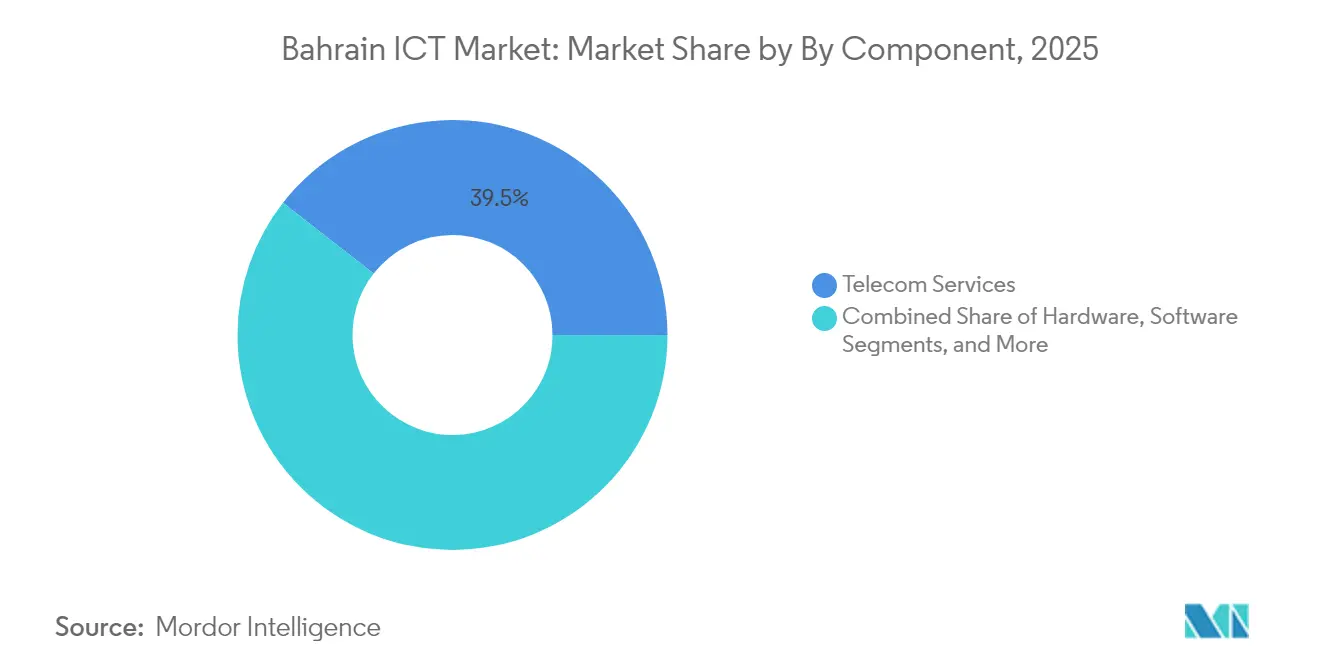
Telecom services held 39.46% Bahrain ICT market share in 2025 as nationwide 5G and fiber grids formed the backbone for data-intensive workloads. The Bahrain ICT market size for IT services is projected to rise at 10.92% CAGR, outpacing hardware and software as enterprises outsource cloud migrations, cybersecurity, and AI consulting. Operators explore tower carve-outs and wholesale fiber leasing to shift toward service-centric revenues. Meanwhile, hyperscalers stimulate local ISV ecosystems, driving software subscriptions across ERP, HR, and CX stacks. Hardware growth concentrates on data-center servers, edge appliances, and radio units, but margins compress amid global supply-chain normalization.
Second-order effects include growing cross-sell between managed security and connectivity, bolstering average revenue per enterprise line. Government e-service expansion—200+ digital services since 2007—creates predictable demand for application-maintenance contracts. Professional-services powerhouses such as KPMG leverage multi-year Microsoft alliances to bundle AI accelerators with compliance expertise.

By End-user Enterprise Size: SME digitization unlocks new revenue pools
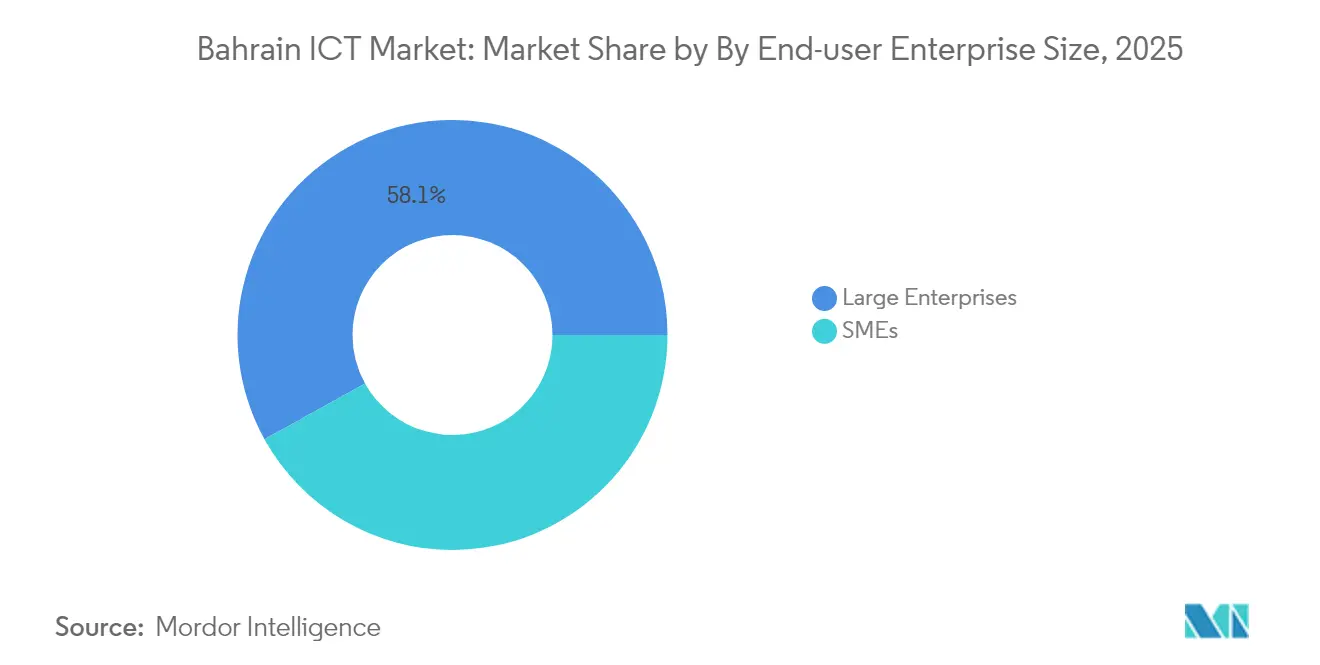
Large enterprises controlled 58.05% of spending in 2025 thanks to deep IT budgets and regulatory compliance needs. Yet SMEs deliver the fastest 11.85% CAGR as Tamkeen covers up to 80% of cloud adoption costs and Al Waha Fund injects USD 100 million into early-stage tech funds. Ninety-four percent of Bahraini SMEs now use at least one digital sales channel, accelerating demand for SaaS accounting, POS, and cybersecurity bundles.
As digital maturity grows, SMEs pivot from single-cloud to multi-cloud for price arbitration and resilience, often via MSPs. Large enterprises pursue SAP S/4HANA transformations and zero-trust architectures to meet Central Bank cyber directives. The Bahrain ICT industry thus faces a dual-track opportunity: standardized SaaS for small businesses and bespoke integration for corporates.
By Industry Vertical: BFSI anchors, retail races ahead
BFSI accounted for 35.92% of 2025 outlays, reflecting 190 shared-service centers and progressive fintech governance. Open Banking APIs spark payments competition, while crypto custody rules draw blockchain start-ups. Retail and e-commerce posts 13.25% CAGR as consumers migrate online; omnichannel chains embrace AI-driven inventory and loyalty engines. Government agencies intensify citizen-service digitization, pushing secure ID and e-payment infrastructure.
Healthcare investment spikes around telemedicine and e-pharmacies after pandemic lessons, yet insurance reimbursement gaps temper immediate scale. Manufacturing leans on private 5G and IoT for predictive maintenance at Alba and Gulf Industrial Investment Co. Energy and utilities deploy smart meters and grid analytics aligned with net-zero goals by 2060.
Geography Analysis
Bahrain leverages compact geography and six submarine cables to serve as a Gulf data interchange hub while posting the region’s highest telecom-maturity index score of 70. BNET’s fiber roll-out aims for universal gigabit access by 2026, lifting fixed-line speeds 150% since 2023 and underpinning national smart-city projects.
The Kingdom ranks 18th on the UN e-Government Development Index, backed by USD 250 million of digital-infrastructure capex from Beyon in 2023. Cost benchmarking finds ICT operating expenses 28% below GCC averages, aided by zero corporate tax outside hydrocarbons and one-day business-registration portals.
Human-capital metrics reinforce competitiveness: first globally in digital literacy and second among Arab states on the World Bank Human Capital Index. Tamkeen’s wage-support schemes plan to upskill 50,000 nationals annually, further strengthening the local talent pipeline.
Regulatory Landscape
Bahrain's ICT oversight is led by the Ministry of Transportation and Telecommunications (MTT), with the Telecommunications Regulatory Authority (TRA) responsible for licensing, competition, and sector rules, and policy direction framed through the Sixth National Telecommunications Plan (NTP6, 2023-2026). Digital-government mandates are coordinated by the Information and eGovernment Authority (iGA), including a Cloud First Policy that prioritizes cloud deployment for government workloads and establishes procurement and security expectations that cascade into regulated verticals such as BFSI.
In May 2025, the Ministerial Committee for Information and Communication Technology approved Bahrain's General Policy for the Use of Artificial Intelligence, requiring government entities to follow defined AI standards, ethics requirements, and applicable data protection laws when adopting AI systems. Bahrain also maintains a legal framework that enables the provision of cloud computing services to foreign parties, supporting data-residency-aligned commercial cloud and sovereign-cloud models that global vendors and local partners can operationalize in-country.
Value Chain Analysis
Bahrain's ICT value chain starts with international OEMs and software publishers supplying compute, networking, cybersecurity, and enterprise applications, and is reinforced by hyperscalers and major platforms (notably AWS and Microsoft) that support national cloud migration and local enablement initiatives. A differentiated midstream layer is anchored by domestic digital infrastructure and hosting, including Batelco's data-center footprint and expanding edge capability, while system integrators and MSPs deliver migration, managed security, and application modernization for government and regulated enterprises.
On the connectivity side, BNET functions as an independent fiber infrastructure provider created to support equitable access to wholesale fiber, which feeds retail broadband, enterprise connectivity, and 5G backhaul. Downstream, local distributors and service providers such as Riztech supply enterprise hardware and networking equipment and provide deployment and support services, bridging global vendors to end users across government, BFSI, and large enterprises as they standardize on cloud, security, and hybrid infrastructure stacks.
Competitive Landscape
Market structure is moderately fragmented: Batelco, Zain, and STC control connectivity while hyperscalers dominate IaaS, and global SIs chase transformation projects. Batelco collaborates with Nokia on industrial 5G and explores wholesale fiber monetization; STC pilots a Web3 Launchpad to future-proof revenue[4]. Zain’s cloud marketplace bundles SaaS for SMEs, intensifying service-layer rivalry.
Global vendors such as Microsoft, Oracle, and Google Cloud partner with regulators to ensure compliance, while cybersecurity specialists Palo Alto and Trend Micro localize SOC services. White-space remains in tower-company carve-outs and neutral-host indoor DAS, mirroring regional M&A patterns where digital-infra deals topped USD 92.3 billion in 2024.
Domestic start-ups capitalize on fintech sandbox flexibility, often exiting via regional acquirers seeking Bahraini licenses. Government funding plus expatriate know-how seed niches in GovTech, health-tech, and gaming, but scale-up capital gaps invite foreign VC participation, shaping a dynamic yet opportunity-laden competitive scene.
Bahrain ICT Industry Leaders
-
Oracle
-
Amazon
-
IBM
-
Microsoft Corporation
-
Wipro
- *Disclaimer: Major Players sorted in no particular order
Market Opportunities and Future Outlook
Government-led sector programs create clear whitespace for suppliers in cloud, AI governance, cybersecurity, and digital platforms. Bahrain's Telecommunications, ICT, and Digital Economy Sector Strategy 2022-2026 defines measurable targets, including a 20% increase in ICT startups, 35% growth in national sector employment, and training 20,000 citizens in cybersecurity by end-2026, which supports demand for training platforms, certification pathways, SOC services, and managed security bundles for SMEs and public entities.
Digital sovereignty and low-latency workloads are opening new build-and-operate opportunities across sovereign cloud, edge, and regulated-industry modernization. In January 2026, Batelco and Qareeb launched an edge data center at Beyon's Data Oasis in Southern Bahrain, providing 6,000 square meters of scalable space positioned for enterprise and AI-ready deployments; this strengthens the local hosting and edge stack for sectors such as BFSI, logistics, and government digital services. The National Digital Economy Strategy 2030 further elevates platform-building priorities (for trade, insurance, and contracting) and proposes a national authority to monitor emerging technologies (AI, IoT, blockchain, and digital twins), creating a defined route to productize compliance-aligned platforms and industry clouds inside the Kingdom.
Recent Industry Developments
- February 2026: The Information and eGovernment Authority (iGA) completed backup for 44 government entities using Microsoft 365 and Azure cloud services. The move highlights public sector cloud adoption with data residency and reinforces Bahrain's cloud-first governance framework. It strengthens Bahrain's digital sovereignty and cloud-enabled governance.
- November 2025: Beyon Solutions with iGA and Oracle launched Bahrain's first AI-ready Sovereign HyperCloud powered by Oracle Alloy. The launch signals a sovereign cloud platform for regulated workloads and enables authorities to operate with stricter data residency and compliance. It anchors the local cloud ecosystem and accelerates data-residency compliant services.
- November 2025: Beyon Solutions with Gulf Air Group and Oracle signed an MoU to deliver ERP using Oracle Alloy within Bahrain. The agreement enables unified enterprise cloud deployment for large enterprises and streamlines cross-functional processes across government-facing and private sectors. It expands Oracle Alloy adoption and strengthens regional cloud services ecosystem.
Research Methodology Framework and Report Scope
Market Definition and Coverage
For this report, the Bahrain ICT market covers the total value of technology and communication spending that supports connectivity and digitization in Bahrain, including telecom services, IT services, software, and related ICT hardware across public and private end users.
Scope exclusions: We exclude consumer electronics not purchased as ICT infrastructure, and we also exclude value from non-ICT business services that sit outside telecom and IT delivery.
Segmentation Overview
- By Type
- Hardware
- Computer Hardware
- Networking Equipment
- Peripherals
- IT Software
- IT Services
- Managed Services
- Business Process Services
- Business Consulting Services
- Cloud Services
- IT Infrastructure
- IT Security
- Communication Services
- Hardware
- By End-user Enterprise Size
- Large Enterprises
- SMEs
- By Industry Vertical
- BFSI
- Government and Public Sector
- ICT and Telecom
- Retail and E-Commerce
- Manufacturing
- Energy and Utilities
- Healthcare
Data Sources, Market Sizing, and Validation
Desk Research
Desk research started with public statistics that help explain demand drivers and adoption pace in Bahrain, and then it was mapped to ICT spending categories. We used sources such as the Bahrain Telecommunications Regulatory Authority publications for sector indicators, Central Bank of Bahrain releases for digital payments and BFSI activity signals, and the Information and eGovernment Authority dashboards for population and household context.
To anchor macro assumptions, we also reviewed sources such as the World Bank and IMF datasets for GDP, inflation, and exchange-rate patterns, and the International Telecommunication Union for broadband and mobile benchmarks. Company filings, annual reports, investor presentations, and trusted press coverage were used to check investment timelines, new service launches, and major contract announcements. We also referenced paid databases that support company financials and intelligence, news and financials, patent lookups, and shipment-level import and export checks where relevant to ICT hardware flows. The desk sources listed here are not exhaustive, and many other public and private references were used during data collection, validation, and clarification.
Primary Interviews and Surveys
Primary validation was done through expert interviews and structured surveys with telecom and IT service stakeholders, large enterprise buyers, and channel partners who observe pricing and demand shifts on the ground. We used these conversations to confirm what is counted as ICT spend in Bahrain, especially bundled telecom and managed services, to sanity-check usage trends like fiber upgrades and 5G monetization, and to align near-term assumptions with what procurement teams are budgeting for.
Distribution of primary research fieldwork respondents
| Company type | Respondent position |
|---|---|
| Top tier: 37% | CXOs: 17% |
| Mid tier: 44% | Functional/Unit leaders: 41% |
| Smaller Players: 19% | Managers: 42% |
Market-Sizing & Forecasting
Sizing was built using a mixed approach, where a top-down demand pool was first reconstructed from Bahrain macro indicators and telecom adoption signals, and then cross-checked with selective bottom-up approximations. In practice, we started from ICT-related spend capacity in the economy and connected it to measurable series like broadband and mobile penetration, enterprise digitalization pace, and public-sector technology programs, before the model was corrected using sampled pricing and volume checks.
Key inputs that shaped the model included mobile and fixed broadband subscriptions, 5G coverage and usage readiness, fiber rollout progress, telecom service revenue direction, and enterprise IT outsourcing appetite by major end-user groups (including BFSI and government). We also tracked pricing behavior where it mattered, including typical managed service bundling and software subscription shifts, since these change reported value even when usage grows steadily. For forecasting, scenario analysis was applied around policy and investment timing, and then refined with simple multivariate relationships between ICT spend growth and macro and connectivity indicators that interviewees said were the most sensitive.
Where bottom-up signals were incomplete, gaps were handled through peer benchmarks within similar GCC demand patterns and through step-down allocation rules by service type, and these were re-tested during follow-up calls before finalizing the totals.
Data Validation & Update Cycle
Validation was done by comparing model outputs with independent signals, and then checking whether the story still made sense at a service and end-user level. Large variances triggered a deeper review of assumptions behind adoption, pricing, and currency conversion timing, followed by re-contact with interviewees when the gap could not be explained by a known event.
Before sign-off, the model and write-up go through multi-step analyst reviews, including consistency checks across the time series and the implied growth by category. Reports are refreshed annually, and interim updates are made when material developments happen, such as major regulatory changes, large infrastructure investments, or sudden demand shocks. Right before delivery, a final pass is completed so clients receive the latest updated view available at that point.
Mordor Intelligence's Bahrain Ict Market Size Versus Other Published Estimates
Published ICT market values for Bahrain do not always match, mainly because the term ICT is used differently across sources and because the reported year and conversion choices can shift the final number. The table helps show how these differences appear when the same country and broad topic are discussed.
The table points to a spread that is largely explained by what gets bundled into ICT and how fast assumptions are refreshed, and in Mordor Intelligence's model the total is built from telecom services plus IT services, software, and ICT hardware, rather than telecom-only revenue or narrower IT spending lines.
Benchmark comparison
| Source | Market Size | Gaps in Research Methodology |
|---|---|---|
| Mordor Intelligence | USD 3.68 B (2025) | |
| Industry Publication A | USD 3.80 B (2022) | Uses an older reference year and a broad sector valuation that may not consistently separate telecom services, IT services, and hardware, which can also miss recent 5G and fiber monetization effects. |
| Industry Publication B | USD 6.30 B (2026) | The figure is presented as a forward-looking value with less clarity on whether it includes adjacent digital-economy items or aggressive uplift assumptions, which can inflate totals versus a category-based ICT spend build. |
Overall, the comparison shows that year selection and category boundaries create most of the gap, and the cleanest way to read the market is to track a repeatable set of spend buckets linked to connectivity and enterprise IT demand. By tying the numbers back to observable indicators like subscriptions, rollout progress, and service pricing direction, the estimate stays traceable and can be rechecked when conditions change.
Key Questions Answered in the Report
How large is the Bahrain ICT market in 2026?
The Bahrain ICT market size equals USD 4.29 billion in 2026.
What CAGR is projected for Bahrain’s ICT spending to 2031?
Spending is forecast to expand at a 16.45% CAGR between 2026 and 2031.
Which component grows fastest through 2031?
IT services record the highest 10.92% CAGR, driven by cloud, cybersecurity, and consulting demand.
Why are SMEs key to future ICT growth in Bahrain?
Subsidies and simplified SaaS adoption push SME ICT outlays at a 11.85% CAGR, outpacing large enterprises.
What deployment model is gaining momentum among regulated firms?
Hybrid/multi-cloud is the fastest-growing mode at 14.62% CAGR, balancing residency and flexibility.