
Babywear Market Size and Share
Market Overview
| Study Period | 2021 - 2031 |
|---|---|
| Market Size (2026) | USD 67.70 Billion |
| Market Size (2031) | USD 93.05 Billion |
| Growth Rate (2026 - 2031) | 6.57 % |
| Fastest Growing Market | Asia-Pacific |
| Largest Market | Asia-Pacific |
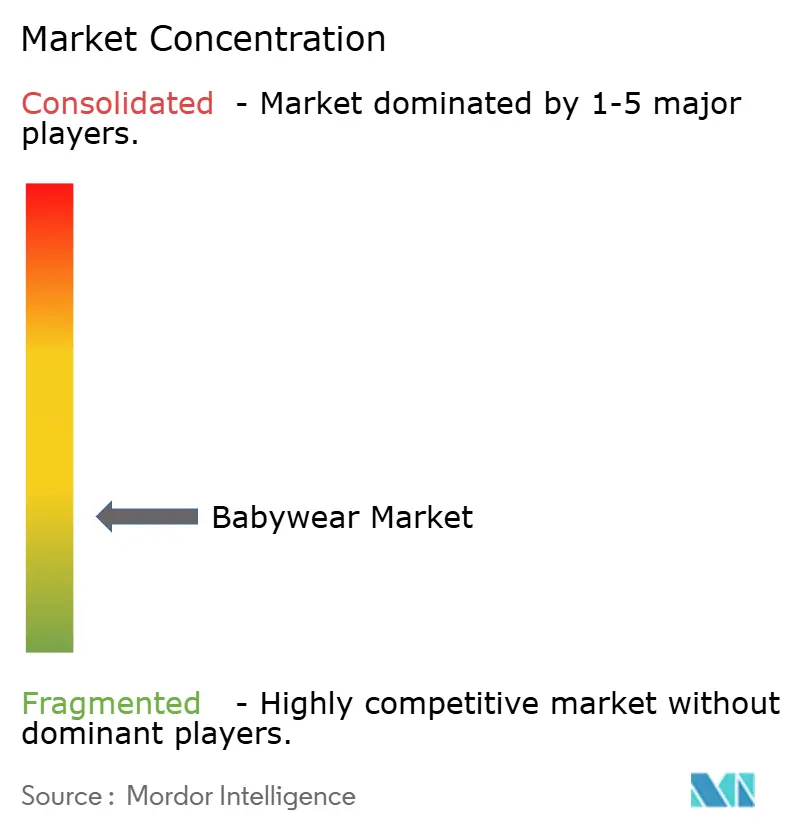
| Market Concentration | Low |
Major Players
*Disclaimer: Major Players sorted in no particular order Image © Mordor Intelligence. Reuse requires attribution under CC BY 4.0. |
|
Babywear Market Analysis by Mordor Intelligence
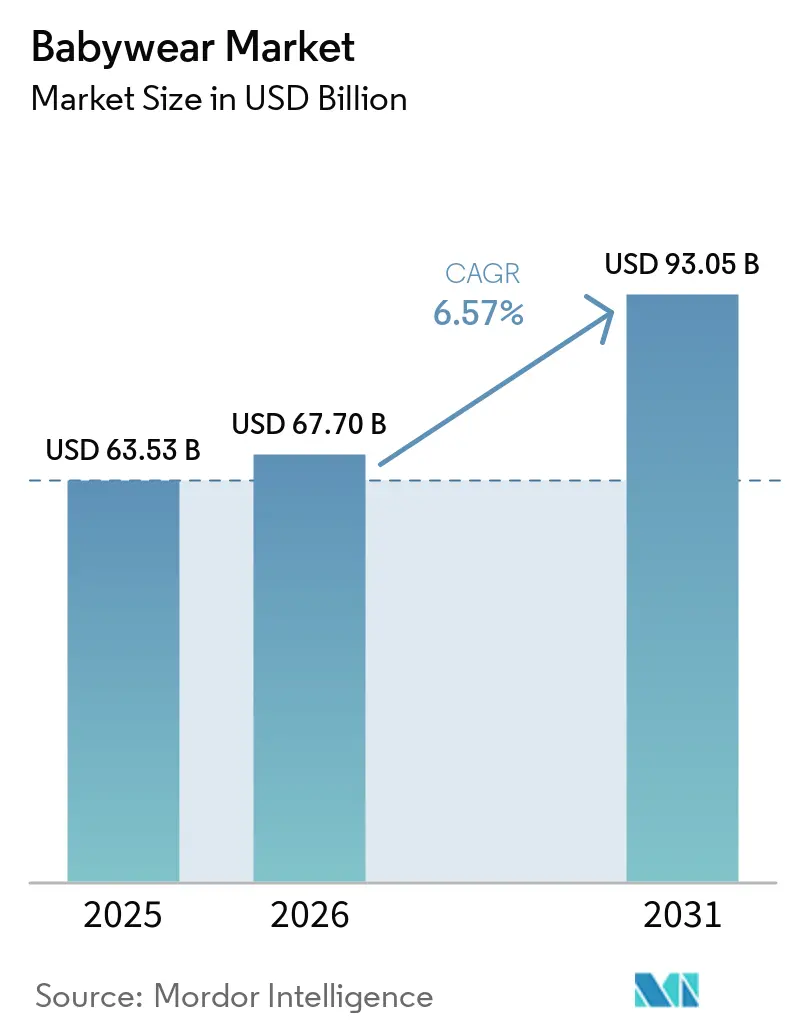
The babywear market size is expected to grow from USD 63.53 billion in 2025 to USD 67.70 billion in 2026 and is forecast to reach USD 93.05 billion by 2031 at a 6.57% CAGR over 2026-2031. The market is supported by steady demand from continued births, changing household spending patterns, and growing parental focus on comfort, quality, and style. Rapid child growth also drives recurring purchases as parents frequently replace garments and update wardrobes across different stages of early childhood. Product innovation is increasingly centered on soft fabrics, functional designs, versatile styles, and premium materials, while gifting and coordinated outfits continue to influence purchasing decisions. Online shopping and social commerce are gaining importance as parents increasingly discover products through digital content, reviews, and creator-led recommendations. The market remains diverse, with established apparel companies, babywear specialists, premium brands, and digital-first players competing across different price points and consumer preferences. Sustainability, product safety, sizing consistency, and evolving consumer expectations are also shaping product development and purchasing decisions.
Key Report Takeaways
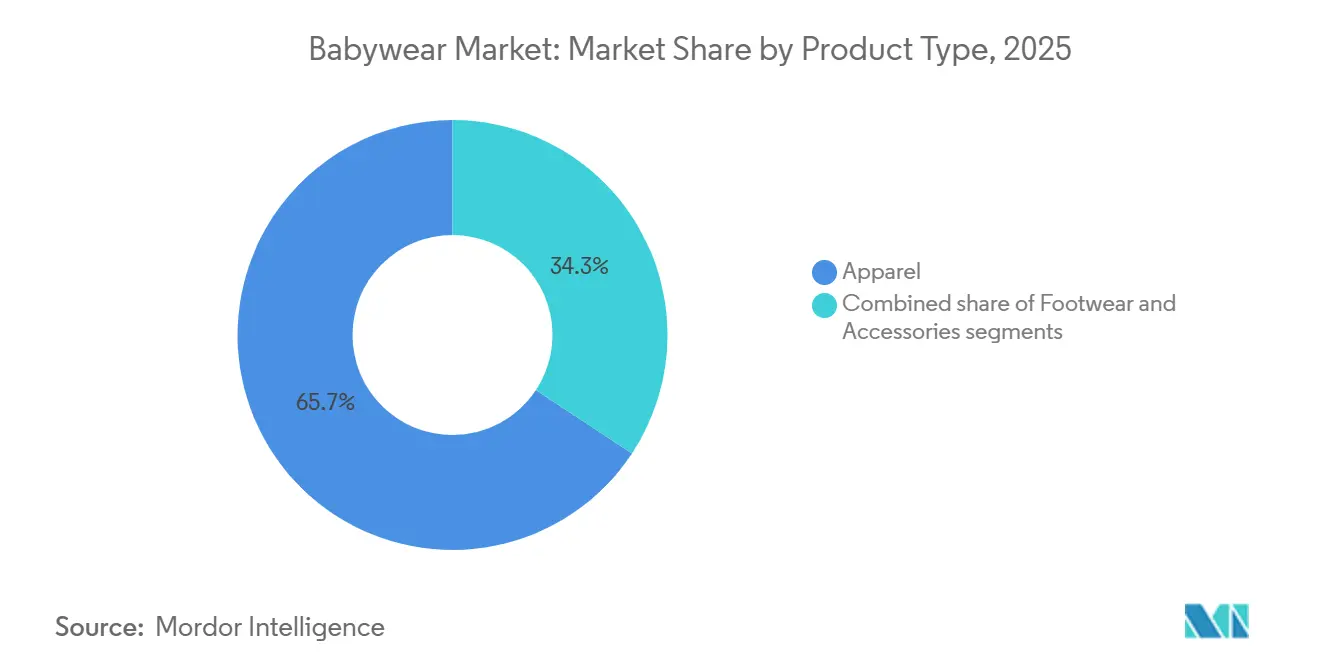
- By product type, apparel held 65.72% of 2025 babywear market share, while accessories are forecast to grow at a 7.25% CAGR during 2026-2031.
- By age group, toddler clothing held 54.14% of 2025 babywear market share and is forecast to grow at a 7.05% CAGR during 2026-2031.
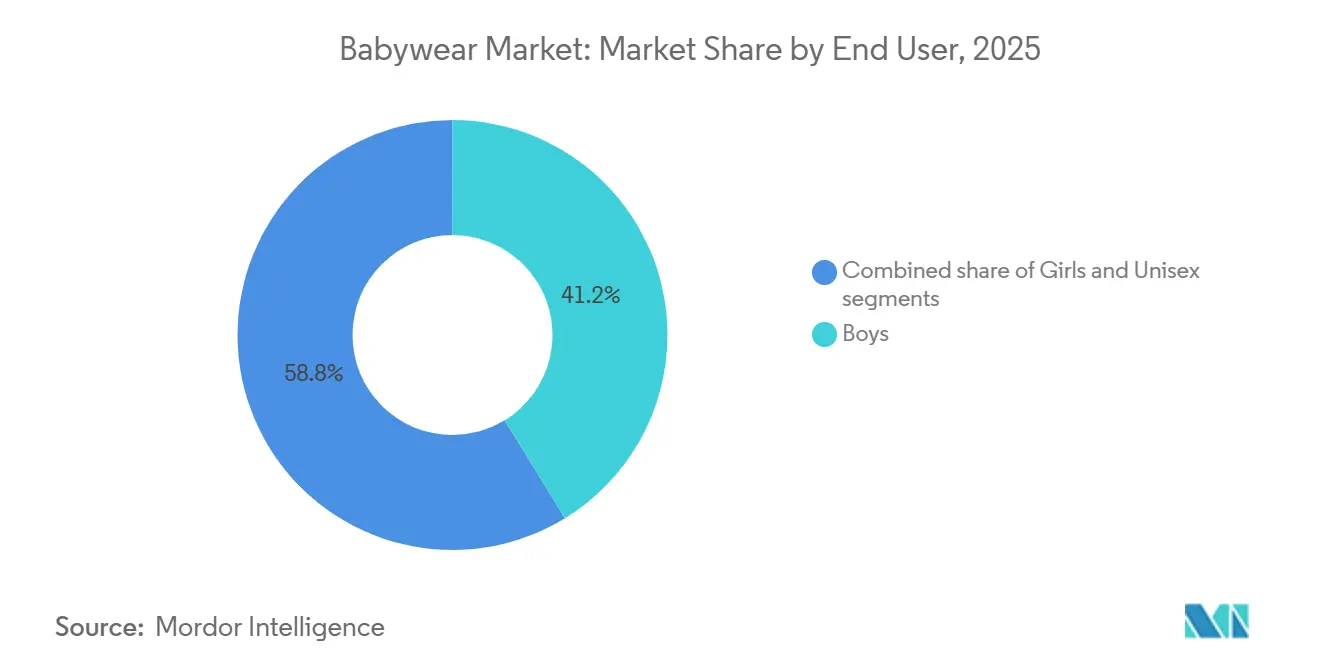
- By end user, boys held 41.23% of 2025 revenue, while unisex clothing is forecast to grow at a 7.43% CAGR during 2026-2031.
- By category, mass products held 78.26% of 2025 revenue, while premium products are forecast to grow at an 8.13% CAGR during 2026-2031.
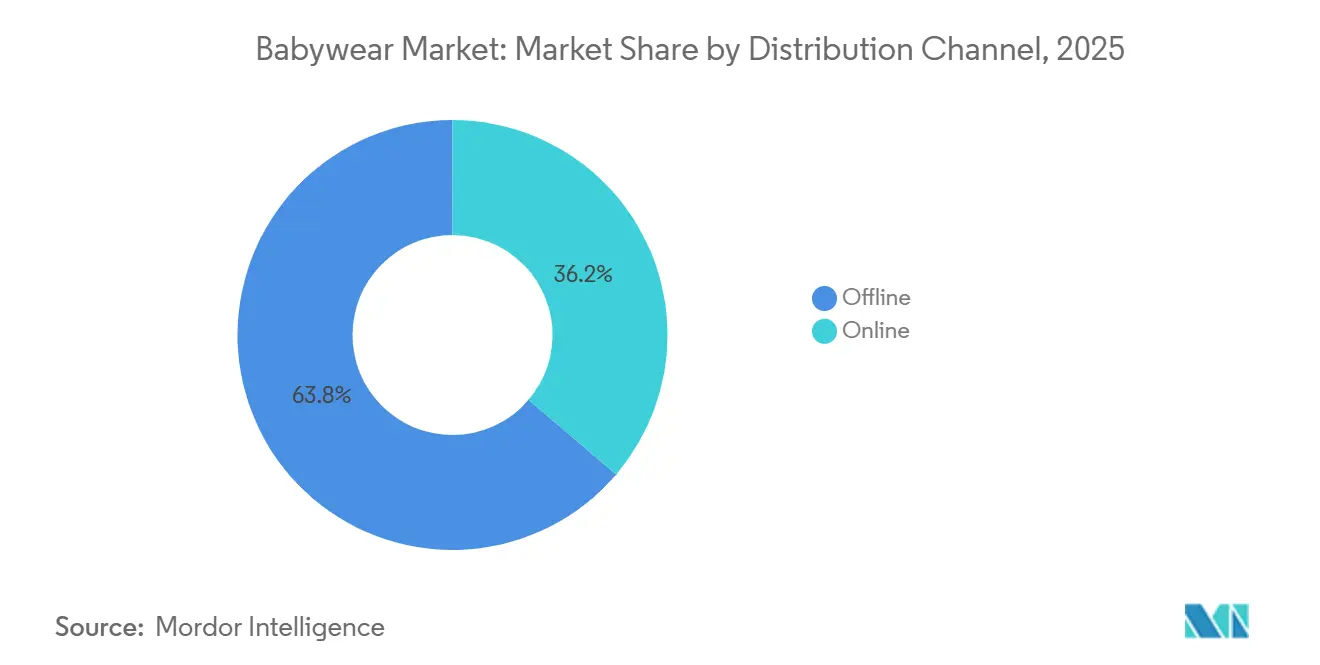
- By distribution channel, offline sales held 63.77% of 2025 revenue, while online sales are forecast to grow at an 8.02% CAGR during 2026-2031.
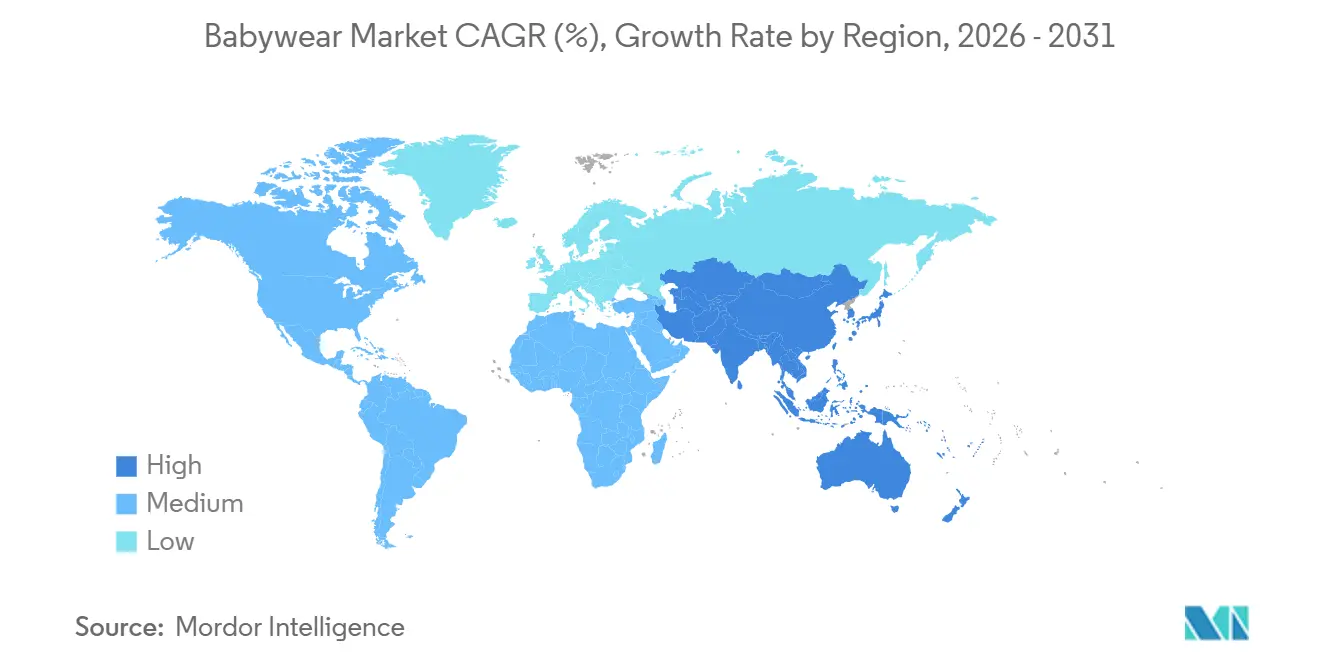
- By geography, Asia-Pacific held 40.83% of 2025 revenue and is forecast to grow at a 7.63% CAGR during 2026-2031.
Note: Market size and forecast figures in this report are generated using Mordor Intelligence’s proprietary estimation framework, updated with the latest available data and insights as of January 2026.
Global Babywear Market Trends and Insights
Drivers Impact Analysis*
| Driver | (~) % Impact on CAGR Forecast | Geographic Relevance | Impact Timeline |
|---|---|---|---|
| Birth rates and frequent infant clothing replacement | +1.1% | Global, concentrated in South and Southeast Asia, Sub-Saharan Africa | Long term (≥ 4 years) |
| Rising popularity of premium, designer, and fashion-forward babywear | +1.0% | North America, Western Europe, East Asia (China, Japan, South Korea) | Medium term (2–4 years) |
| Expansion of omnichannel retail and social commerce | +0.9% | Global, accelerating in Asia-Pacific, North America | Medium term (2–4 years) |
| Growing preference for certified, safe, and branded babywear | +0.7% | North America, Europe, Japan, South Korea | Medium term (2–4 years) |
| Growing demand for gender-neutral and fashion-oriented babywear | +0.5% | North America, Western Europe | Short term (≤ 2 years) |
| Rising gift purchases for baby showers and seasonal occasions | +0.4% | North America, Europe, Asia-Pacific urban centres | Short term (≤ 2 years) |
| Source: Mordor Intelligence | |||
Birth Rates and Frequent Infant Clothing Replacement
The babywear market benefits from the consistently large number of births worldwide, which provides a stable base of new consumers each year. According to the United Nations' World Fertility 2024 report, approximately 132 million babies were born globally in 2024, reflecting sustained annual demand for babywear[1]Source : United Nations, "World Fertility 2024", un.org. The report also states that the global total fertility rate stood at 2.25 births per woman in 2024, indicating continued addition of large annual birth cohorts despite long-term demographic shifts[2]Source : United Nations, "World Fertility 2024", un.org. Unlike most apparel categories, babywear sees high replacement frequency because infants rapidly outgrow multiple clothing sizes during their first two years of life. The United Nations projects that annual births will remain close to current levels, with a peak of around 136 million births expected around 2040 [3]Source : United Nations, "World Fertility 2024", un.org. Parents make repeated purchases of bodysuits, sleepwear, rompers, and seasonal garments to accommodate changing sizes, weather conditions, and everyday wear, creating a recurring demand cycle for babywear.
Rising Popularity of Premium, Designer, and Fashion-Forward Babywear
Parents increasingly view babywear as more than a functional necessity, driving demand for premium, designer, and fashion-forward babywear that combines comfort, aesthetics, and quality. Growing awareness of fabric safety, skin sensitivity, and sustainability has led consumers to choose products made from organic cotton, bamboo blends, and other certified materials. Brands are responding by expanding premium collections with contemporary designs, enhanced durability, and value-added features such as soft-touch finishes, tag-free construction, and eco-friendly production practices. This is further supported by rising disposable incomes, increasing social media influence, and greater willingness among millennial and Gen Z parents to spend on premium infant products. Fashion-conscious parents are seeking coordinated outfits, seasonal collections, and personalized babywear for everyday use as well as gifting occasions. Retailers are also broadening their premium offerings through omnichannel platforms, making designer and high-quality babywear more accessible to a wider consumer base and supporting continued market growth.
Expansion of Omnichannel Retail and Social Commerce
The rapid expansion of omnichannel retail is improving the accessibility and convenience of babywear purchases, enabling consumers to shop across physical stores, brand websites, marketplaces, and mobile applications. Retailers are integrating services such as click-and-collect, home delivery, and unified loyalty programs to enhance the shopping experience while maintaining consistent product availability across channels. The growing digital presence of babywear brands has also expanded product visibility and simplified comparison of styles, materials, and prices. Social commerce has emerged as an important sales channel, with parents increasingly discovering and purchasing babywear through social media platforms, influencer recommendations, and live shopping events. Short-form videos, user-generated content, and personalized product recommendations are driving impulse purchases and strengthening consumer engagement. In response, brands are investing in digital marketing, AI-powered personalization, and streamlined checkout experiences to improve customer acquisition and retention, supporting sustained growth in the babywear market.
Rising Gift Purchases for Baby Showers and Seasonal Occasions
Gift purchases for baby showers, newborn celebrations, birthdays, religious ceremonies, and seasonal occasions continue to support demand across the babywear market. Products such as clothing, footwear, bibs, hats, socks, blankets, bags, and accessories are increasingly purchased as coordinated gifts or curated sets. Brands and retailers are expanding bundled offerings, personalized products, and occasion-specific collections that combine multiple babywear categories. Consumer preference for practical yet visually appealing gifts encourages the selection of products that serve everyday functions. Online gifting platforms and omnichannel retail have broadened access to babywear products across different price points. The recurring nature of gifting occasions throughout early childhood supports continued purchases across apparel, footwear, and accessories.
Restraints Impact Analysis*
| Restraint | (~) % Impact on CAGR Forecast | Geographic Relevance | Impact Timeline |
|---|---|---|---|
| Short product usage cycle due to rapid infant growth | -0.8% | Global | Long term (≥ 4 years) |
| Sizing inconsistencies across brands and regional markets | -0.6% | Global, acute in cross-border e-commerce | Medium term (2–4 years) |
| Growing adoption of second-hand, rental, and hand-me-down babywear | -0.7% | North America, Western Europe, East Asia | Medium term (2–4 years) |
| Stringent chemical safety and product compliance requirements | -0.4% | North America, Europe, Japan, South Korea | Long term (≥ 4 years) |
| Source: Mordor Intelligence | |||
Sizing Inconsistencies Across Brands and Regional Markets
The absence of standardized sizing across babywear brands and regional markets presents a significant challenge for both consumers and retailers. Variations in sizing charts, fit specifications, and labeling practices make it difficult for parents and gift buyers to select the appropriate garment and footwear size, particularly when purchasing from multiple brands or through cross-border e-commerce platforms. These inconsistencies reduce consumer confidence and complicate purchase decisions. This challenge is further amplified by the growth of online retail, where consumers cannot physically assess the fit or dimensions of garments before purchase. Inconsistent sizing contributes to higher product return and exchange rates, increasing logistics costs for retailers and creating inventory management challenges. Although many brands are introducing detailed size guides, digital fit tools, and standardized product descriptions, the absence of globally uniform sizing standards continues to restrain market growth.
Growing Adoption of Second-Hand, Rental, and Hand-Me-Down Babywear
The growing adoption of second-hand, rental, and hand-me-down babywear is limiting demand for new infant clothing in several markets. As parents become more cost-conscious and environmentally aware, many are opting for pre-owned garments that remain in good condition due to their relatively short period of use. The growing acceptance of circular fashion has further encouraged the resale, exchange, and reuse of baby clothing through dedicated resale platforms, thrift stores, and community-based sharing networks. This is particularly evident in value-conscious households, where purchasing pre-owned babywear offers a practical way to reduce expenses without compromising functionality. The expansion of online resale marketplaces and peer-to-peer commerce has made second-hand babywear more accessible, while rental services are gradually gaining traction for premium and occasion-specific infant apparel. As these alternative consumption models continue to expand, they are reducing replacement demand for newly manufactured babywear and creating competitive pressure on brands operating in the mass-market segment.
*Our forecasts treat driver/restraint impacts as directional, not additive. The impact forecasts reflect baseline growth, mix effects, and variable interactions.
Segment Analysis
By Product Type: Apparel Anchors Demand, Accessories Gain Share
Apparel accounted for 65.72% of babywear market revenue in 2025, making it the largest product segment. Its leading position is supported by frequent purchases and replacement needs as infants and toddlers rapidly outgrow clothing. Demand is also supported by greater interest in comfortable, functional, fashionable, and occasion-oriented babywear. Increasing adoption of coordinated outfits and versatile designs further reinforces apparel's role as the core component of babywear purchases. Growing demand for seasonal collections and everyday essentials also encourages recurring purchases across different stages of early childhood. The availability of apparel across a broad range of price points further supports its widespread adoption among consumers.
Accessories represent the fastest-growing product segment, registering a 7.25% CAGR through 2031. Growth is supported by rising demand for complementary products such as hats, socks, bibs, bags, blankets, and other functional accessories. Gifting occasions and the expansion of coordinated sets are encouraging consumers to purchase accessories alongside apparel and footwear. Personalization, convenience, and visually appealing designs are further supporting accessory demand across everyday and occasion-based purchases. The growing availability of accessories in bundled and personalized formats is also encouraging higher-value purchases and broader product adoption.



By Age Group: Toddler Dominates as Fashion Engagement Deepens
The Toddler (1–3 Years) segment accounted for 54.14% of market revenue in 2025 and is also the fastest-growing segment, with a 7.05% CAGR through 2031. Its dominant position is supported by frequent wardrobe updates as children grow, alongside increasing demand for comfortable, functional, and fashionable babywear. Parents tend to purchase a broader range of apparel, footwear, and accessories as toddlers become more active and require products suited to different activities and occasions. This combination of recurring replacement needs and expanding product requirements supports continued demand in the segment.
The Newborn (0–3 Months) and Infant (3–12 Months) segments remain important parts of the babywear market, driven primarily by essential clothing, footwear, and accessory purchases during the early stages of childhood. Newborn demand is driven by initial wardrobe purchases and gifting occasions, while the Infant segment benefits from frequent sizing changes and replacement needs as children grow. Both segments also support demand for practical products such as bodysuits, sleepwear, socks, bibs, and other everyday essentials. Brands offering comfortable, adaptable, and easy-care products are better positioned to maintain engagement across these early-life stages.
By End User: Unisex Disrupts the Traditional Boys-Girls Binary
The Boys segment accounted for the largest share of the babywear market at 41.23% in 2025, driven by steady demand for everyday apparel, footwear, and accessories. Demand is further supported by casual and sportswear-inspired styles, character-themed designs, and practical products suited to active children. Parents increasingly seek versatile and durable babywear that can withstand frequent use and replacement. These factors support the segment's continued contribution to overall market demand. Demand is also supported by a broad range of products designed for different activities, seasons, and occasions, encouraging recurring purchases as children grow. The availability of boys' babywear across mass-market and premium price points further strengthens segment penetration.
The Unisex segment is the fastest-growing end-user segment, registering a 7.43% CAGR through 2031. Growth is driven by increasing parental preference for gender-neutral designs, versatile products, and styles that can be reused across siblings. Brands are expanding unisex offerings across apparel, footwear, and accessories, with greater emphasis on neutral colors, adaptable silhouettes, and functional designs. The broader adoption of gender-inclusive product ranges is supporting faster growth in this segment. Unisex collections also provide greater flexibility for gifting and household purchases, as products can be selected without being tied to traditional gender-specific preferences. This is encouraging brands to broaden their unisex assortments across different age groups and product categories.
By Category: Mass Provides Value, Premium Drives Revenue Growth
The Mass category accounted for 78.26% of babywear market revenue in 2025, making it the largest category. Its dominance is supported by the essential nature of babywear purchases and strong demand for affordable apparel, footwear, and accessories. Consumers often prioritize comfort, practicality, durability, and value when purchasing products for rapidly growing children. Gifting occasions also support mass-market demand, as accessible price points allow consumers to purchase multiple products or coordinated sets. The broad availability of mass-market babywear through supermarkets, specialty retailers, and online platforms further improves accessibility across consumer groups. Frequent replacement needs also encourage continued purchases of affordable products as children progress through different growth stages.
The Premium category is the fastest-growing category, registering an 8.13% CAGR through 2031. Growth is supported by increasing parental willingness to invest in higher-quality products featuring premium materials, distinctive designs, and enhanced functionality. Social media exposure and growing interest in aspirational babywear are also encouraging purchases of premium apparel, footwear, and accessories. Premium products additionally benefit from gifting occasions, where consumers may place greater emphasis on perceived quality, brand appeal, and presentation. Growing interest in sustainable materials, personalized products, and distinctive brand offerings is further supporting premium purchasing. The expansion of premium collections across multiple babywear categories is also encouraging consumers to purchase coordinated products rather than individual items.
By Distribution Channel: Offline Anchors, Online Accelerates
The offline channel accounted for 63.77% of babywear market revenue in 2025, making it the largest distribution channel. This position is supported by consumers' preference to physically assess the quality, fit, comfort, and safety of babywear before purchase. Specialty stores, department stores, supermarkets, and other physical retailers provide access to a broad range of apparel, footwear, and accessories. In-store shopping also remains relevant for gifting occasions, where consumers often prefer to evaluate products and packaging directly.
The online channel is the fastest-growing distribution channel, registering an 8.02% CAGR through 2031. Growth is driven by convenience, wider product assortments, easy price comparison, and increasing use of social commerce for product discovery. Online platforms also provide greater access to specialized babywear brands and coordinated apparel, footwear, and accessory collections. The expansion of digital payments, home delivery, personalized recommendations, and online gifting is further encouraging parents and gift buyers to shift purchases toward digital channels.
Geography Analysis
Asia-Pacific accounted for 40.83% of the global babywear market in 2025 and is projected to register the fastest CAGR of 7.63% during 2026–2031. The region's position is supported by its large infant population, expanding middle-class consumer base, and increasing expenditure on baby care products. China and India remain the principal markets, while improving retail infrastructure, rising disposable incomes, and expanding e-commerce continue to support demand across several emerging economies in the region. Growing interest in branded, fashionable, and premium babywear is also encouraging consumers to expand spending beyond basic products.
North America and Europe represent mature markets characterized by high consumer awareness, strong demand for branded and premium babywear, and well-established retail networks. Consumers in these regions increasingly prioritize product quality, comfort, certified materials, and sustainable manufacturing practices when purchasing babywear. Product innovation, premiumization, and the expansion of omnichannel retail are supporting stable market growth across both regions. Growing demand for convenient online purchasing and personalized babywear is further supporting product adoption across these established markets.
South America and the Middle East and Africa are emerging markets with growing long-term opportunities for babywear manufacturers. Rising urbanization, expanding organized retail, improving internet penetration, and increasing consumer spending on infant products are contributing to market development in these regions. The growing availability of international brands alongside domestic manufacturers is broadening product accessibility and supporting the gradual expansion of the babywear market. Increasing adoption of digital commerce is also enabling consumers to access a wider range of apparel, footwear, and accessories beyond traditional local retail channels.

Competitive Landscape
The global babywear market is fragmented, with multinational companies, specialty children's clothing manufacturers, and regional brands competing across different price segments and distribution channels. Competition is driven by product quality, brand recognition, pricing, material innovation, and retail presence. The leading companies in the market include Carter's, Inc., H&M Hennes & Mauritz AB, Industria de Diseño Textil, S.A., Gap Inc., and Gerber Childrenswear LLC, all of which maintain extensive product portfolios and established distribution networks across key markets.
Leading players continue to strengthen their market positions through new product launches, expansion of babywear collections, sustainability initiatives, and digital retail investments. Companies are increasingly introducing collections featuring organic and skin-friendly materials while expanding their omnichannel capabilities to improve consumer accessibility. They are also enhancing their e-commerce platforms and broadening product assortments to address evolving consumer preferences for premium, fashionable, and functional babywear.
Alongside established companies, emerging brands are gaining market presence by focusing on direct-to-consumer business models, affordable pricing, and digital-first retail strategies. Many of these companies leverage social commerce, online marketplaces, and influencer marketing to reach younger parents and caregivers. Their focus on niche product offerings, personalized designs, and flexible online distribution is intensifying competition and contributing to the continued evolution of the global babywear market.
Babywear Industry Leaders
-
Carter's, Inc.
-
H&M Hennes & Mauritz AB
-
Industria de Diseño Textil, S.A.
-
Gap Inc.
-
Gerber Childrenswear LLC
- *Disclaimer: Major Players sorted in no particular order

Recent Industry Developments
- May 2026: H&M partnered with Laura Ashley to launch a Spring/Summer 2026 kidswear collection featuring apparel and accessories for babies and children, expanding its collaborative children's fashion portfolio.
- May 2026: Janie and Jack partnered with Lilly Pulitzer to launch a limited-edition children's apparel collection featuring 25 styles for babies, boys, and girls. The collaboration incorporates Lilly Pulitzer's archival prints into coordinated family outfits, including matching styles for adults. This expands Janie and Jack's premium babywear portfolio and reflects the growing trend toward family-coordinated fashion collections.
- April 2026: Hanna Andersson partnered with Lisa Says Gah to launch a limited-edition family apparel collection featuring babywear, sleepwear, swimwear, and everyday apparel with coordinated styles for infants, children, and adults, expanding its premium children's apparel portfolio.
- March 2026: Janie and Jack launched the TH!NK P!NK capsule collection in collaboration with Lauren Luyendyk, Caitlin Covington, and Brittney Fusilier. The 18-piece collection includes newborn and children's apparel such as rompers, dresses, tops, swimwear, and coordinated accessories, expanding the brand's premium childrenswear offerings through a limited-edition, family-oriented collection.


Global Babywear Market Report Scope
The babywear market comprises apparel, footwear, and accessories designed for newborns, infants, and toddlers, covering products intended for everyday use, special occasions, and early childhood needs. The market is evaluated across key product, demographic, category, distribution, and geographic segments. The market is segmented by product type into apparel, footwear, and accessories; by age group into newborn, infant, and toddler; by end user into boys, girls, and unisex; by category into mass and premium; by distribution channel into online and offline; and by geography into North America, Europe, Asia-Pacific, South America, and Middle East and Africa. Market. For each segment, the market sizing and forecasting have been done in value terms (USD billion).
| Apparel |
| Footwear |
| Accessories |
| Newborn (0-3 Months) |
| Infant (3-12 Months) |
| Toddler (1-3 Years) |
| Boys |
| Girls |
| Unisex |
| Mass |
| Premium |
| Online |
| Offline |
| North America | United States |
| Canada | |
| Mexico | |
| Rest of North America | |
| Europe | Germany |
| United Kingdom | |
| Italy | |
| France | |
| Spain | |
| Netherlands | |
| Poland | |
| Belgium | |
| Sweden | |
| Rest of Europe | |
| Asia-Pacific | China |
| India | |
| Japan | |
| Australia | |
| Indonesia | |
| South Korea | |
| Thailand | |
| Singapore | |
| Rest of Asia-Pacific | |
| South America | Brazil |
| Argentina | |
| Colombia | |
| Chile | |
| Peru | |
| Rest of South America | |
| Middle East and Africa | South Africa |
| Saudi Arabia | |
| United Arab Emirates | |
| Nigeria | |
| Egypt | |
| Morocco | |
| Turkey | |
| Rest of Middle East and Africa |
| By Product Type | Apparel | |
| Footwear | ||
| Accessories | ||
| By Age Group | Newborn (0-3 Months) | |
| Infant (3-12 Months) | ||
| Toddler (1-3 Years) | ||
| By End User | Boys | |
| Girls | ||
| Unisex | ||
| By Category | Mass | |
| Premium | ||
| By Distribution Channel | Online | |
| Offline | ||
| By Geography | North America | United States |
| Canada | ||
| Mexico | ||
| Rest of North America | ||
| Europe | Germany | |
| United Kingdom | ||
| Italy | ||
| France | ||
| Spain | ||
| Netherlands | ||
| Poland | ||
| Belgium | ||
| Sweden | ||
| Rest of Europe | ||
| Asia-Pacific | China | |
| India | ||
| Japan | ||
| Australia | ||
| Indonesia | ||
| South Korea | ||
| Thailand | ||
| Singapore | ||
| Rest of Asia-Pacific | ||
| South America | Brazil | |
| Argentina | ||
| Colombia | ||
| Chile | ||
| Peru | ||
| Rest of South America | ||
| Middle East and Africa | South Africa | |
| Saudi Arabia | ||
| United Arab Emirates | ||
| Nigeria | ||
| Egypt | ||
| Morocco | ||
| Turkey | ||
| Rest of Middle East and Africa | ||


Key Questions Answered in the Report
Which babywear product type has the largest share?
Apparel led with 65.72% of 2025 revenue, supported by frequent replacement needs and broad use across infant and toddler wardrobes.
Which sales channel is growing fastest for babywear?
Online sales are forecast to grow at an 8.02% CAGR during 2026-2031, supported by convenience, product discovery, and repeat ordering.
Which region leads babywear sales and growth?
Asia-Pacific held 40.83% of 2025 revenue and is forecast to grow at a 7.63% CAGR during 2026-2031.
Why are premium baby clothes gaining demand?
Parents are seeking differentiated designs, certified materials, and gift-ready products. Premium products are forecast to grow at an 8.13% CAGR during 2026-2031.
Page last updated on:


 Your data is secure and never sold or shared.


