
Aviation High-Speed Motor Market Size and Share
Market Overview
| Study Period | 2020 - 2032 |
|---|---|
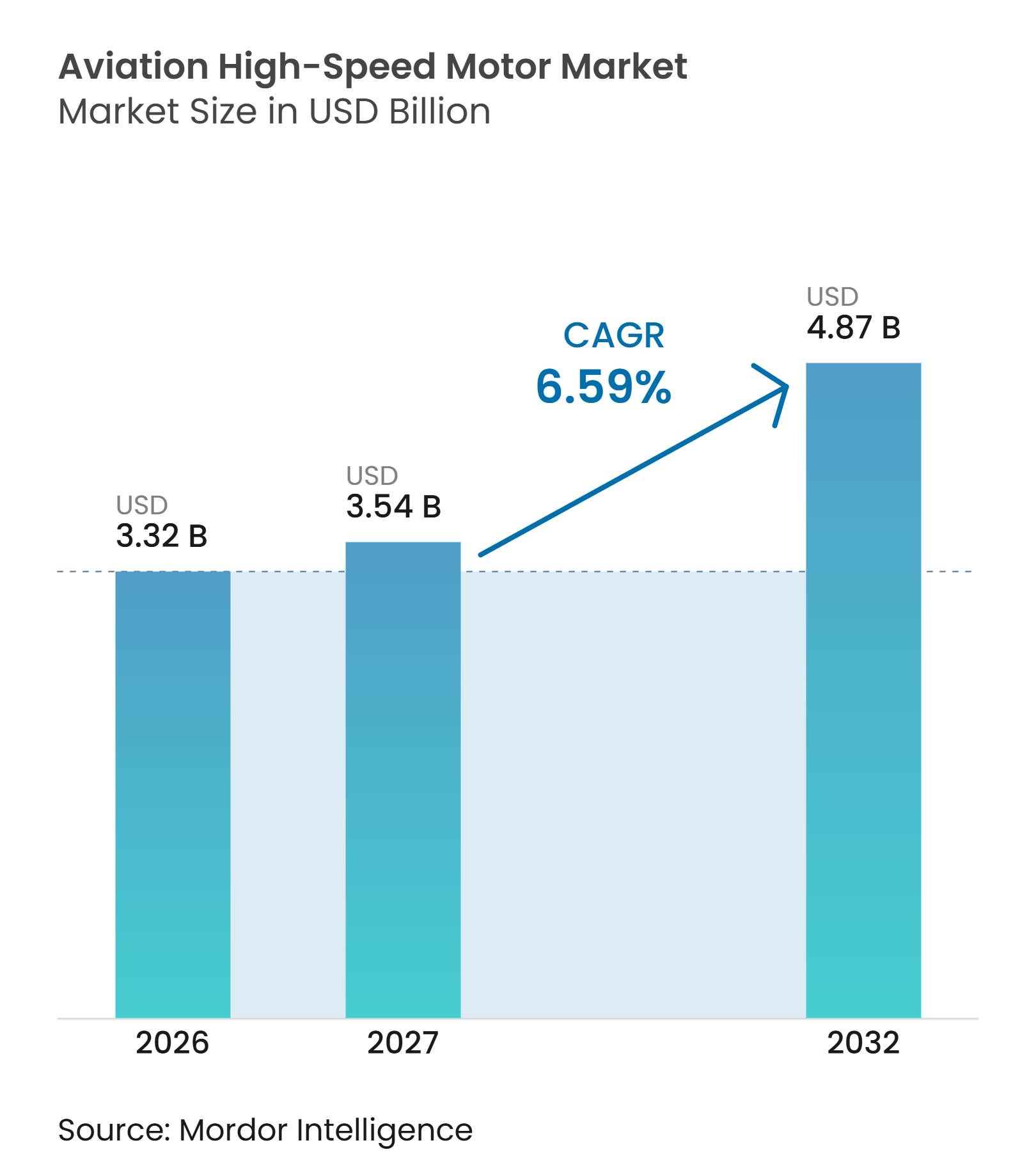
| Market Size (2027) | USD 3.54 Billion |
| Market Size (2032) | USD 4.87 Billion |
| Growth Rate (2027 - 2032) | 6.59 % |
| Fastest Growing Market | Asia-Pacific |
| Largest Market | North America |
| Market Concentration | Medium |
Major Players *Disclaimer: Major Players sorted in no particular order Image © Mordor Intelligence. Reuse requires attribution under CC BY 4.0. | |
Aviation High-Speed Motor Market Analysis by Mordor Intelligence
The aviation high-speed motor market size was valued at USD 3.32 billion in 2026 and is forecast to grow from USD 3.54 billion in 2027 to reach USD 4.87 billion by 2032, at a 6.59% CAGR during the forecast period (2027-2032). The market is moving toward electric systems that replace hydraulic and pneumatic functions in commercial and military aircraft. This change increases demand for motors in propulsion, actuation, fuel handling, environmental control, and flight systems. Hybrid-electric demonstrators and unmanned aircraft are driving demand for higher-output machines, while certified suppliers retain an advantage in established programs. Supply security for permanent magnets and the pace of aviation certification remain important limits on production planning. The aviation high-speed motor market also benefits from tighter fuel-efficiency and noise requirements, which make lighter, more efficient electrical systems more relevant to aircraft design.
Key Report Takeaways
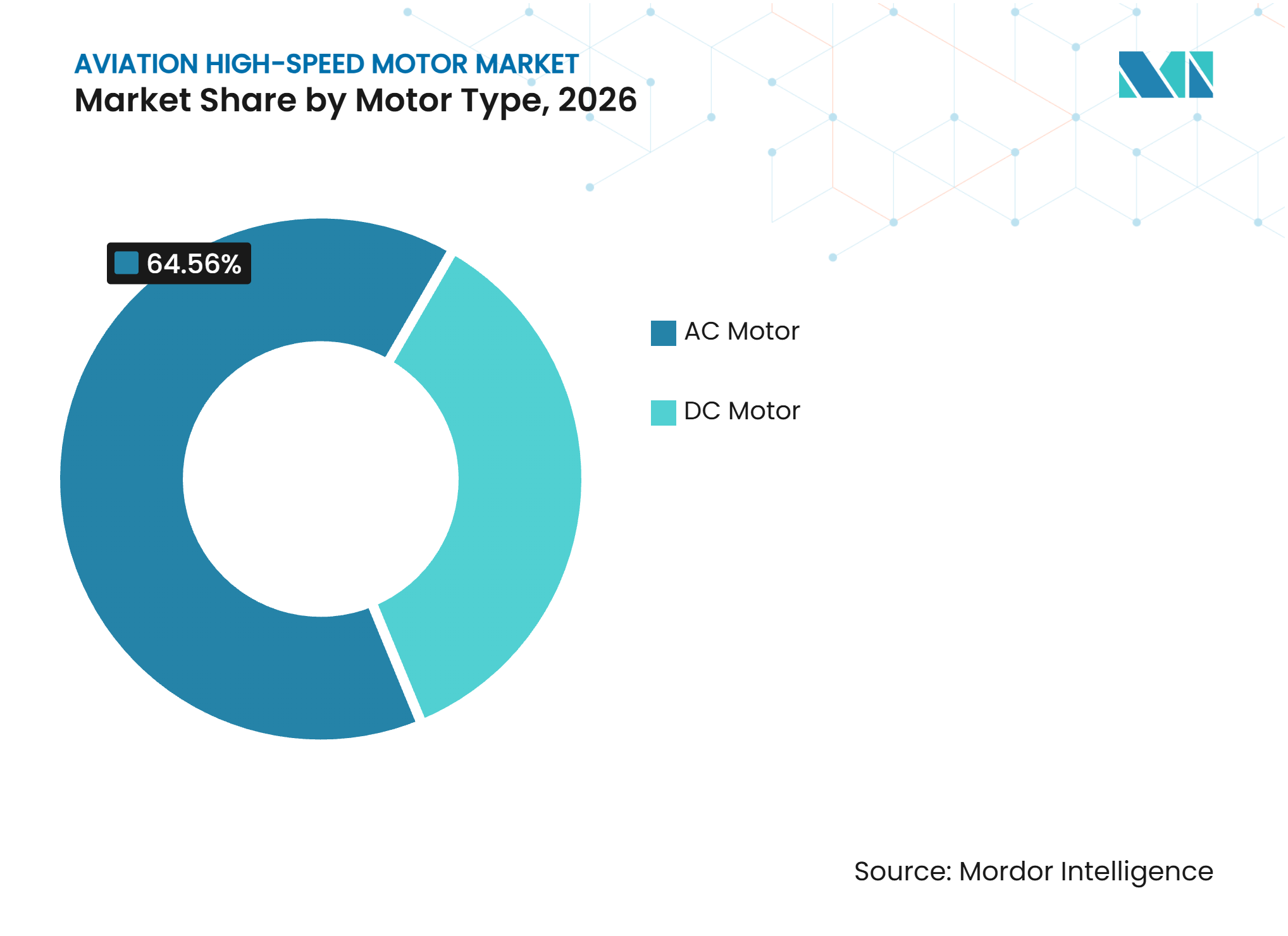
- By motor type, AC motors held 64.56% of the aviation high-speed motor market share in 2026, while DC motors are forecast to grow at a 7.24% CAGR through 2032.
- By output power, the 10 to 200 kW segment held 27.65% of the aviation high-speed motor market share in 2026, while the above 200 kW segment is forecast to grow at a 7.56% CAGR through 2032.
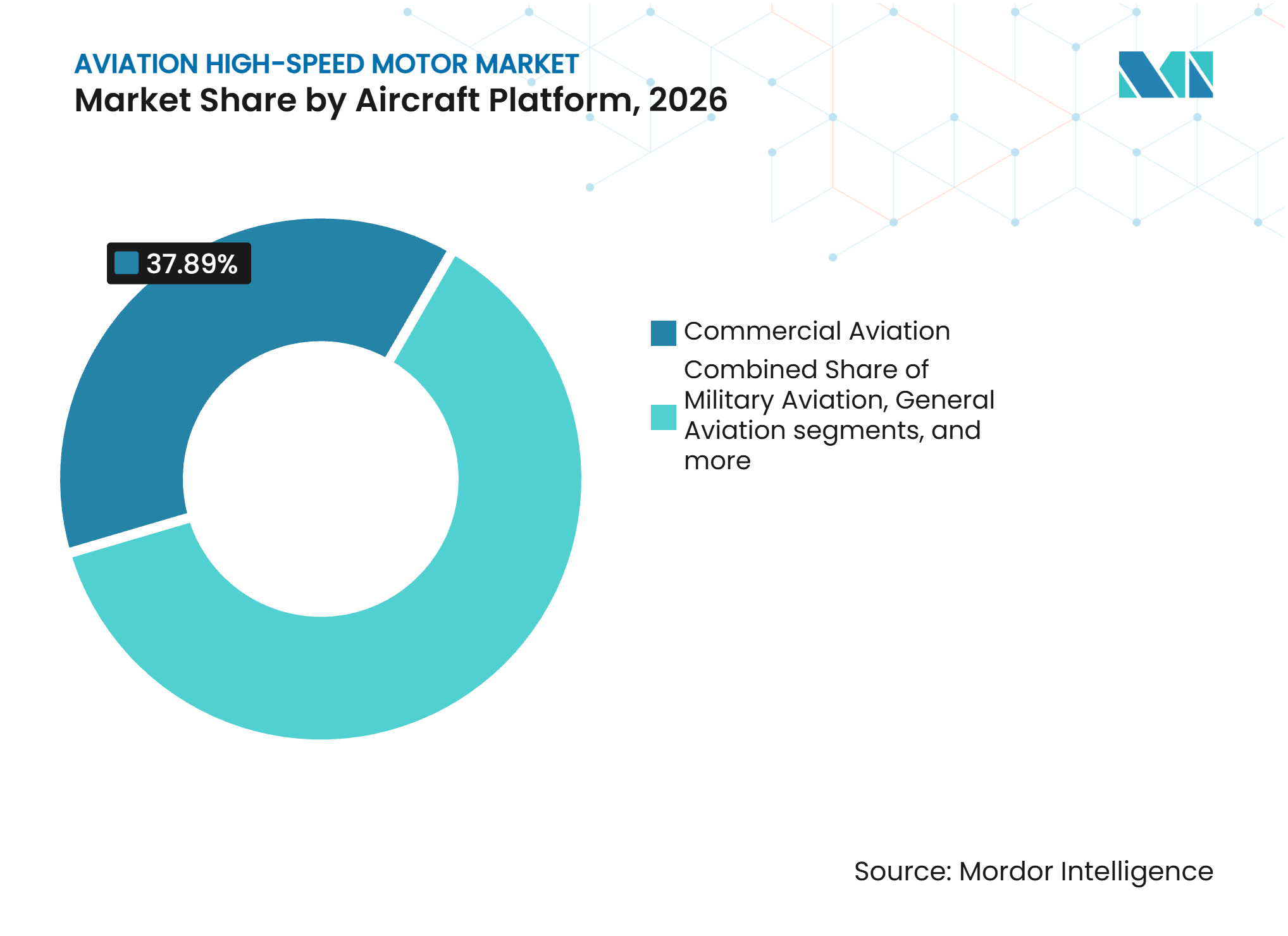
- By aircraft platform, commercial aviation held 37.89% of the aviation high-speed motor market share in 2026, while unmanned aerial systems are forecast to grow at a 9.01% CAGR through 2032.
- By application, propulsion systems held 43.24% of the aviation high-speed motor market share in 2026, while fuel management systems are forecast to grow at an 8.45% CAGR through 2032.
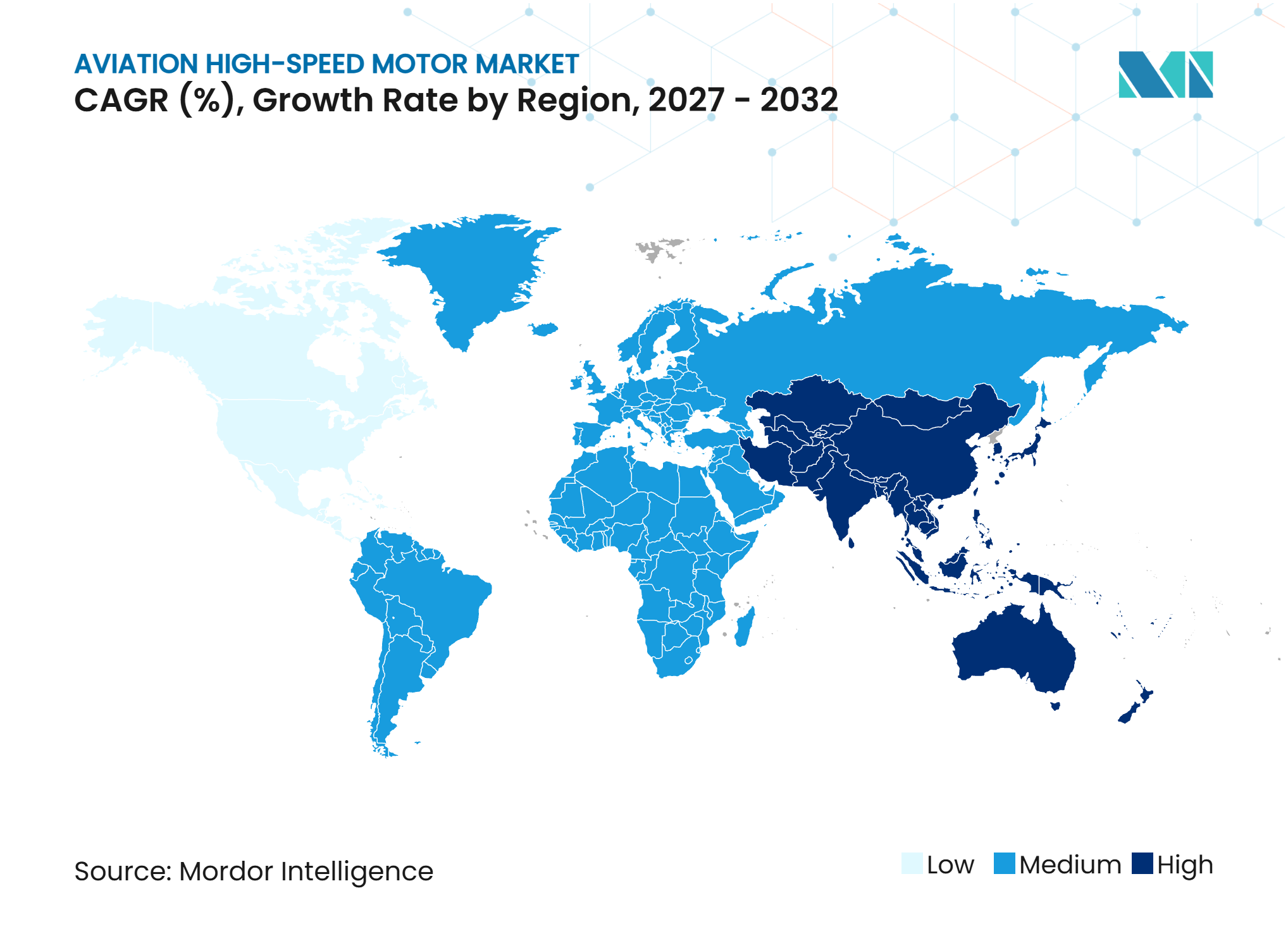
- By geography, North America held 36.75% of the aviation high-speed motor market share in 2026, while Asia-Pacific is forecast to grow at an 8.21% CAGR through 2032.
Note: Market numbers in this report are based on Mordor Intelligence's proprietary estimation framework, which combines nine months of actuals with Q4 projections for base year 2026.
Market Trends and Insights
Drivers Impact Analysis of Aviation High-Speed Motor Market*
| Driver | (~) % Impact on CAGR Forecast | Geographic Relevance | Impact Timeline |
|---|---|---|---|
| More-electric aircraft architectures | +1.10% | Global, with early adoption in North America and Europe | Medium term (2-4 years) |
| Expansion of electric and hybrid-electric propulsion | +1.30% | North America and Europe, with expansion into Asia-Pacific | Medium term (2-4 years) |
| Growing deployment of UAS across various applications | +1.20% | Global, concentrated in North America, Asia-Pacific, and the Middle East and Africa | Short term (≤ 2 years) |
| Aircraft weight, efficiency, and emissions targets | +0.90% | Global, shaped by ICAO, EU, and national standards | Long term (≥ 4 years) |
| Certification of aviation-grade electric motors | +0.70% | North America and Europe | Medium term (2-4 years) |
| Integrated motor, inverter, and controller architectures | +0.60% | Global, led by the US, the UK, France, and Germany | Medium term (2-4 years) |
| Source: Mordor Intelligence | |||
More-Electric Aircraft Architectures as a Systemic Demand Creator
More electric aircraft designs increase the number of electrical functions required on each airframe. Engine starting, environmental control, anti-icing, and flight controls are shifting from hydraulic and pneumatic equipment to electric systems. A bipolar three-wire direct-current grid can improve electromagnetic compatibility and fault tolerance in future aircraft electrical networks. A 48 V low-voltage bus could reduce wiring weight by 20% when compared with legacy 28 V arrangements. This configuration can simplify the transition to higher-voltage electrical architectures in new aircraft designs. Work conducted under the EU-funded ORCHESTRA program showed that nanofluid-based impinging-jet cooling can reduce the peak temperature of an electric motor by 10% compared with oil-only cooling.
Expansion of Electric and Hybrid-Electric Propulsion
Electric and hybrid-electric aircraft programs are progressing from laboratory work toward component testing and flight preparation. In June 2025, Pratt & Whitney Canada completed full-power ground testing of its hybrid-electric flight demonstrator. The system combines a 1 MW electric motor from Collins Aerospace and a 200 kWh battery from H55 on a De Havilland Canada Dash 8-100 testbed.[1] The aviation high-speed motor market benefits because hybrid designs can use separate equipment for cruise, takeoff support, and distributed propulsion. NASA’s Electrified Powertrain Flight Demonstration is focused on megawatt-class hybrid-electric systems for transport category aircraft and regulatory learning. These programs support demand for high-output motors and integrated control equipment, even while large-scale all-electric aircraft remain constrained by battery capability.
Growing Deployment of UAS Across Various Applications
UAS are extending the aviation high-speed motor market into defense, logistics, inspection, and specialized transport uses. Electric propulsion is well suited to these aircraft because it offers fast response, compact installation, and distributed thrust options. India announced a three-year drone incentive program valued at INR 20 billion (USD 234 million) in July 2025 to support regional drone production and component demand. Archer Aviation also agreed in November 2025 to supply its electric powertrain for the Omen autonomous air vehicle developed with Anduril Industries and EDGE Group. The UAE Government committed to an initial order for 50 aircraft under that arrangement. Such cross-platform use can provide electric motor suppliers with a path from civil advanced air mobility programs to defense-oriented UAS platforms.
Aircraft Weight, Efficiency, and Emissions Targets
Aircraft manufacturers face tighter fuel-efficiency, noise, and emissions requirements that support electrical system upgrades. The ICAO Committee on Aviation Environmental Protection agreed in March 2025 to new standards requiring a minimum 10% improvement in fuel consumption at certification for certain commercial aircraft seeking type certificates after December 2031. The agreed noise standard also requires at least 6 dB quieter operation from January 2029. Aviation requires a 2% share of SAF at EU airports from 2025, rising to 70% by 2050. The aviation high-speed motor market benefits from this trend because electric drives can reduce reliance on bleed air and hydraulic equipment. Suppliers that combine high power density with thermal efficiency are better positioned for programs seeking verified aircraft-level efficiency gains.
Restraints Impact Analysis of Aviation High-Speed Motor Market*
| Restraint | (~) % Impact on CAGR Forecast | Geographic Relevance | Impact Timeline |
|---|---|---|---|
| Battery energy density and range constraints | -1.10% | Global, most acute where charging infrastructure is limited | Medium term (2-4 years) |
| Aviation certification and qualification bottlenecks | -0.80% | North America and Europe, with global spillover | Medium term (2-4 years) |
| High-RPM thermal management and cooling complexity | -0.70% | Global | Short term (≤ 2 years) |
| Rare-earth magnet and specialized material supply exposure | -0.90% | Asia-Pacific, with spillover into North America and Europe | Short term (≤ 2 years) |
| Source: Mordor Intelligence | |||
Battery Energy Density and Range Constraints
Battery performance remains a direct limit on the pace of all-electric aviation adoption. The current lithium-ion aviation packs deliver 150-260 Wh/kg at the system level. A 90-seat battery-electric aircraft could support a 750 km battery-only range at 320 Wh/kg pack energy density, while still requiring a fuel-based reserve system. This limitation delays major production commitments for full-electric propulsion architectures and moderates near-term order volumes for high-output motors. Hybrid systems reduce this limitation, but the combined mass of batteries and thermal engines narrows the operational benefit for some aircraft categories.
Rare-Earth Magnet and Specialized Material Supply Exposure
Permanent magnet synchronous machines depend on materials that are concentrated within a limited global supply base. China expanded rare-earth export licensing in December 2025, increasing supply risk for defense-related applications and other magnet-dependent products. China’s rare-earth magnet shipments fell 6.1% in September 2025 from August, which highlighted the immediate sensitivity of downstream supply chains. Lynas Rare Earths and Noveon Magnetics formed a supply partnership in October 2025 to support the availability of permanent magnets for US defense and commercial applications. USA Rare Earth also signed a joint development agreement with ePropelled for sintered neo magnets used in advanced motor systems.[2] These arrangements show why secured non-Chinese sourcing can become a competitive requirement alongside motor performance and aviation qualification.
*Our forecasts treat driver/restraint impacts as directional, not additive. The impact forecasts reflect baseline growth, mix effects, and variable interactions.
Aviation High-Speed Motor Market Segment Analysis
By Motor Type:
AC Installed Base Faces Accelerating DC CompetitionAC motors accounted for 64.56% of the aviation high-speed motor market share in 2026 because they are well established in certified commercial aircraft systems. They are used across flight controls, fuel-pump drives, environmental control equipment, and other established onboard electrical functions. Their position reflects long certification histories and compatibility with variable-frequency generation systems used on modern aircraft. The Boeing 787 and Airbus A350 use 230 V alternating-current architectures operating at 360 to 800 Hz, which support continued use of established AC equipment. The market size associated with this installed base is supported by maintenance demand, long aircraft program cycles, proven supply relationships, and the low replacement risk of already-qualified systems.
DC motors are forecast to expand at 7.24% CAGR through 2032, making them the fastest-growing motor type. Battery compatibility, simplified wiring, compact packaging, and electronic commutation suit eVTOL, UAS, and general aviation propulsion designs. Silicon-carbide inverters reduce losses when converting battery power for motor use and enable more flexible electrical integration. The aviation high-speed motor market is therefore likely to see DC equipment gain relevance in new aircraft programs. In contrast, AC equipment remains important in established fleets and mature power architectures.


By Output Power:
Above 200 kW Segment Emerges as the Structural Growth EngineThe 10 to 200 kW segment accounted for 27.65% of the aviation high-speed motor market share in 2026. This range fits commercial actuators, fuel pump drives, smaller electric aircraft, and upper-tier UAS platforms. It also aligns with the early stages of more-electric aircraft conversion, where individual subsystems are electrified before full propulsion changes occur. The segment serves a broad customer base across commercial, defense, and general aviation programs with differing performance and cost requirements. Its breadth makes it a practical entry point for suppliers that balance performance, qualification requirements, production cost, fleet support, and product adaptation across multiple aircraft categories.
The above-200 kW segment is forecast to grow at a 7.56% CAGR through 2032, supported by hybrid propulsion demonstrators and heavy-lift UAS. H3X Technologies began building its HPDM-350 under a US Air Force contract in March 2025. The machine delivers 350 kW of continuous power in a 50 kg package and can scale to 1.5 MW through its multisector design.[3] Collins Aerospace also presented a 1 MW motor for the RTX hybrid-electric demonstrator in June 2025. The market size in this range depends on flight validation, thermal performance, power electronics integration, and aircraft-level certification of megawatt-class powertrains.
By Aircraft Platform:
UAS Disrupts the Hierarchy While Commercial Aviation Anchors RevenueCommercial aviation accounted for 37.89% of the aviation high-speed motor market share in 2026. More-electric aircraft programs are replacing hydraulic pumps, pneumatic actuators, and starter-generators with electrical equipment across narrowbody, widebody, and regional fleets. Commercial platforms offer long production runs, strict qualification standards, substantial aftermarket demand, and reliable supply expectations. These characteristics favor suppliers that can support original equipment manufacturers throughout long aircraft service lives and across global maintenance networks. Electrified flight-control and fuel-management systems are extending the use of motors into functions historically handled by hydraulic or bleed-air systems, helping to create demand beyond primary propulsion.
UAS are forecast to grow at 9.01% CAGR through 2032, the highest rate among aircraft platforms. Defense and commercial uses are expanding simultaneously across North America, Asia-Pacific, and the Middle East, with missions ranging from logistics to surveillance. Woodward agreed in April 2025 to provide precision electromechanical position sensors for Moog pylon-conversion actuators on the US Army's Future Long Range Assault Aircraft program. The Diamond Aircraft eDA40 became the first all-electric training aircraft to use Safran's EASA-certified ENGINeUS 100 motor, establishing a useful precedent for certification. Evolito's D250 axial-flux motor delivers 18.5 kW/kg in a 13 kg package and was selected for the Flying Whales LCA60T airship.


By Application:
Fuel Management Systems Outpace Propulsion in Growth RatePropulsion systems held 43.24% of the aviation high-speed motor market share in 2026. Demand includes distributed propulsors in eVTOL aircraft, main drives in electric and hybrid-electric platforms, and starter-generators in conventional aircraft. Propulsion accounts for the largest share because motor power requirements are highest at the aircraft’s primary motive system. The market serves new propulsion concepts and upgrades to established aircraft electrical architectures across both civil and defense programs. Suppliers must demonstrate high power density, heat control, reliability, and integration with inverters, controllers, power distribution equipment, and other electrical systems.
Fuel management systems are forecast to grow at an 8.45% CAGR through 2032. Combined air- and electric-driven fuel systems could achieve 60% energy savings compared with a conventional bleed-air arrangement. These results support greater use of electric pumps and actuation hardware as aircraft manufacturers seek fuel savings and improved thermal control. Woodward’s selection to supply 12 of 14 A350 spoiler actuation systems also shows the move of electric motor demand into highly critical flight functions. Cabin environmental control, avionics cooling, and electric braking provide further application opportunities as more-electric designs become more common.
Geography Analysis
North America: Integrated Motor Ecosystem Sustains Market Leadership
North America held 36.75% of the aviation high-speed motor market share in 2026. Its position rests on a large commercial aircraft base, active defense procurement, a broad maintenance network, and a concentration of electric propulsion developers. ZeroAvia received an FAA G-1 issue paper in February 2025 for its 600 kW electric propulsion system, which established the certification basis for a direct-drive system operating at 2,200 RPM. The FAA’s AC 21.17-4 provides a pathway for type, production, and airworthiness certification of battery-powered powered-lift aircraft, reducing uncertainty for eVTOL supply agreements. Defense procurement adds a second demand base, while domestic sourcing, certification capability, and compliance requirements remain important for suppliers targeting military platforms.
Asia-Pacific: Policy-Driven Demand Exceeds Near-Term Supply Capacity
Asia-Pacific is forecast to grow at an 8.21% CAGR through 2032, the highest regional rate in the aviation high-speed motor market. China has directed more than RMB 100 billion (USD 15.04 billion) in industry funding across more than 20 provinces and municipalities toward the low-altitude economy. This investment supports a growing regional base for eVTOL motors, controllers, battery integration, and related equipment. Mitsubishi Heavy Industries and Yamaha Motor completed flight tests of a hybrid UAV with a 200 kg payload and a 200 km range in April 2025, showing continued regional work on hybrid propulsion. India’s drone incentive program supports demand for components, although access to rare-earth magnet materials, qualified suppliers, and local certification capacity remains an important supply-chain consideration.
European and Emerging Regions Add Breadth to Global Demand
Europe remains a technology and certification center for the aviation high-speed motor market. EASA granted the first type certificate for an aviation electric motor, Safran’s ENGINeUS 100, in February 2025 after 1,500 hours of certification testing and more than 100 flight hours. Safran is preparing 4 semi-automated lines in France and the United Kingdom to produce more than 1,000 motors annually from 2026, while Evolito has obtained AS/EN 9100 accreditation and supply agreements with Flying Whales, Electra, and Vertical Aerospace. South America, the Middle East, and Africa are driving earlier-stage demand through fleet renewal, UAS logistics, survey work, investment in advanced air mobility, and regional interest in electric and hybrid aircraft.
Competitive Landscape
Market Concentration

The aviation high-speed motor market is moderately fragmented, with established aerospace groups competing alongside specialized electric propulsion developers. Large suppliers benefit from certified supply chains, long original equipment manufacturer relationships, established aftermarket service capabilities, and broad program experience. Smaller companies compete through power density, compact designs, additive manufacturing, and integrated motor-drive systems. AS/EN 9100 accreditation and EASA design-organization approvals are important market-access requirements because qualification delays can slow entry to aircraft programs. Axial-flux motors can use less iron, copper, and permanent magnet material than radial configurations, which improves their appeal when material availability is uncertain.
Safran expanded its actuation portfolio by completing the acquisition of Collins Aerospace flight control and actuation activities in July 2025. The acquired business covered 180 platforms and recorded USD 1.55 billion in revenue in 2024, combining electric propulsion expertise with hydraulic and electromechanical actuation capabilities. RTX Corporation advanced its hybrid-electric demonstrator around a 1-MW motor and a 200-kWh battery system. Evolito expanded its position through supply agreements for airships, hybrid-electric aircraft, and eVTOL applications. These moves show that suppliers are seeking positions across propulsion, actuation, integrated electrical architectures, production capability, and long-term customer relationships.
Competition is particularly active in the 10 to 200 kW range, where UAS and general aviation applications require high performance at manageable cost. Some available products are adapted industrial motors, while other options are premium aerospace units that are not widely affordable for general aviation use. This creates space for purpose-built motors that meet aviation qualification requirements without the cost profile of large commercial programs, and are supported by government-backed development contracts. Secure rare-earth sourcing arrangements can also protect delivery commitments and reduce material uncertainty. The aviation high-speed motor market therefore rewards certification readiness, thermal performance, power density, and reliable access to materials.
Aviation High-Speed Motor Industry Leaders
-
H3X Technologies Inc.
-
Calnetix Technologies LLC
-
ARC Systems Inc.
-
MGM COMPRO
-
Allient, Inc.
- *Disclaimer: Major Players sorted in no particular order
Aviation High-Speed Motor Market Companies Covered in this Report
- Safran SA
- H3X Technologies Inc.
- Moog Inc.
- Parker-Hannifin Corporation
- RTX Corporation
- H3X Technologies Inc.
- MGM COMPRO
- Magnomatics Limited
- Allient, Inc.
- Maxon International AG
- ARC Systems Inc.
- Regal Rexnord Corporation
- Calnetix Technologies LLC
Recent Industry Developments in Aviation High-Speed Motor Market
- July 2026: Electra and Safran Helicopter Engines announced a life-of-program production agreement for the TG600 turbogenerator, which will power Electra’s groundbreaking EL9 Ultra Short hybrid-electric aircraft. The TG600 will incorporate two GENeUS™ high-speed smart motor/generators supplied by Safran Electrical & Power, designed for aviation applications and offering a maximum overspeed of 42,000 rpm.
- October 2025: Nikkiso Co., Ltd. successfully completed performance testing of the second prototype of its liquefied hydrogen pump for hydrogen aircraft. In this test, the pump maintained high-speed rotation at 30,000 rpm while doubling suction performance, increasing the flow rate by 1.2, and boosting the discharge pressure by 1.4.
- September 2025: H3X Technologies introduced the HPDM-180D, a direct-drive variant of the HPDM-180. This high-power-density integrated motor drive features a 20,000 RPM shaft speed and is designed for aviation high-speed motor-generator applications.
Global Aviation High-Speed Motor Market Report Scope
The aviation high-speed motor market comprises electric motors designed to operate at rotational speeds exceeding 10,000 revolutions per minute (RPM) and to support propulsion, flight control, fuel management, and other aircraft systems across commercial, military, and general aviation, as well as unmanned aerial systems (UAS). The scope includes aviation-grade high-speed electric motors supplied for new aircraft production, aircraft electrification programs, system modernization, and retrofit applications. The market exclusively covers electric motors with a rated or specified operating speed above 10,000 RPM, excluding motors operating at or below this threshold, conventional combustion engines, and complete propulsion systems beyond the attributable electric motor value.
The aviation high-speed motor market is segmented by motor type, output power, aircraft platform, application, and geography. By motor type, the market is segmented into AC motors and DC motors. By output power, the market is segmented into up to 10 kW, 10 to 200 kW, and above 200 kW. By aircraft platform, the market is segmented into commercial aviation, military aviation, general aviation, and unmanned aerial systems (UAS). By application, the market is segmented into propulsion systems, flight control systems, fuel management systems, and others. The report also covers the market sizes and forecasts for the aviation high-speed motor market in major countries across different regions. For each segment, the market size is provided in terms of value (USD).
Segmentation Overview
| AC Motor |
| DC Motor |
| Up to 10 kW |
| 10 to 200 kW |
| Above 200 kW |
| Commercial Aviation | Narrowbody |
| Widebody | |
| Regional Jets | |
| Military Aviation | Fixed-Wing Aircraft |
| Rotorcraft | |
| General Aviation | |
| Unmanned Aerial Systems (UAS) |
| Propulsion Systems |
| Flight Control Systems |
| Fuel Management Systems |
| Others |
| North America | United States | |
| Canada | ||
| Mexico | ||
| Europe | United Kingdom | |
| France | ||
| Germany | ||
| Italy | ||
| Russia | ||
| Rest of Europe | ||
| Asia-Pacific | China | |
| India | ||
| Japan | ||
| South Korea | ||
| Australia | ||
| Rest of Asia-Pacific | ||
| South America | Brazil | |
| Rest of South America | ||
| Middle East and Africa | Middle East | Saudi Arabia |
| United Arab Emirates | ||
| Rest of Middle East | ||
| Africa | South Africa | |
| Rest of Africa | ||
| By Motor Type | AC Motor | ||
| DC Motor | |||
| By Output Power | Up to 10 kW | ||
| 10 to 200 kW | |||
| Above 200 kW | |||
| By Aircraft Platform | Commercial Aviation | Narrowbody | |
| Widebody | |||
| Regional Jets | |||
| Military Aviation | Fixed-Wing Aircraft | ||
| Rotorcraft | |||
| General Aviation | |||
| Unmanned Aerial Systems (UAS) | |||
| By Application | Propulsion Systems | ||
| Flight Control Systems | |||
| Fuel Management Systems | |||
| Others | |||
| By Geography | North America | United States | |
| Canada | |||
| Mexico | |||
| Europe | United Kingdom | ||
| France | |||
| Germany | |||
| Italy | |||
| Russia | |||
| Rest of Europe | |||
| Asia-Pacific | China | ||
| India | |||
| Japan | |||
| South Korea | |||
| Australia | |||
| Rest of Asia-Pacific | |||
| South America | Brazil | ||
| Rest of South America | |||
| Middle East and Africa | Middle East | Saudi Arabia | |
| United Arab Emirates | |||
| Rest of Middle East | |||
| Africa | South Africa | ||
| Rest of Africa | |||
Key Questions Answered in the Report
What is the 2026 value of the aviation high-speed motor market?
The aviation high-speed motor market is valued at USD 3.32 billion in 2026 and is forecast to reach USD 4.87 billion by 2032 at a 6.59% CAGR.
Which motor type holds the largest share?
AC motors hold 64.56% of revenue in 2026, supported by their established use in certified commercial aircraft systems.
Which output-power band is growing fastest?
The above 200 kW segment is forecast to grow at a 7.56% CAGR through 2032, supported by hybrid propulsion demonstrators and heavy-lift UAS.
Why are UAS important for aviation high-speed motor demand?
UAS is the fastest growing aircraft platform at a 9.01% CAGR through 2032 because it serves defense, logistics, inspection, and specialized transport uses.
Which application has the highest growth rate?
Fuel management systems are forecast to grow at an 8.45% CAGR through 2032 as electric pumps and actuation support aircraft efficiency and thermal control.
Which region is expanding fastest?
Asia-Pacific is forecast to grow at an 8.21% CAGR through 2032, supported by low-altitude economy investment and growing regional UAS activity.