
AUV and ROV For Offshore Inspection, Repair, and Maintenance (IRM) Market Size and Share
Market Overview
| Study Period | 2022 - 2032 |
|---|---|
| Market Size (2027) | USD 16.71 Billion |
| Market Size (2032) | USD 50.23 Billion |
| Growth Rate (2027 - 2032) | 24.62 % |
| Fastest Growing Market | Europe |
| Largest Market | Asia-Pacific |
| Market Concentration | Medium |
Major Players *Disclaimer: Major Players sorted in no particular order Image © Mordor Intelligence. Reuse requires attribution under CC BY 4.0. | |
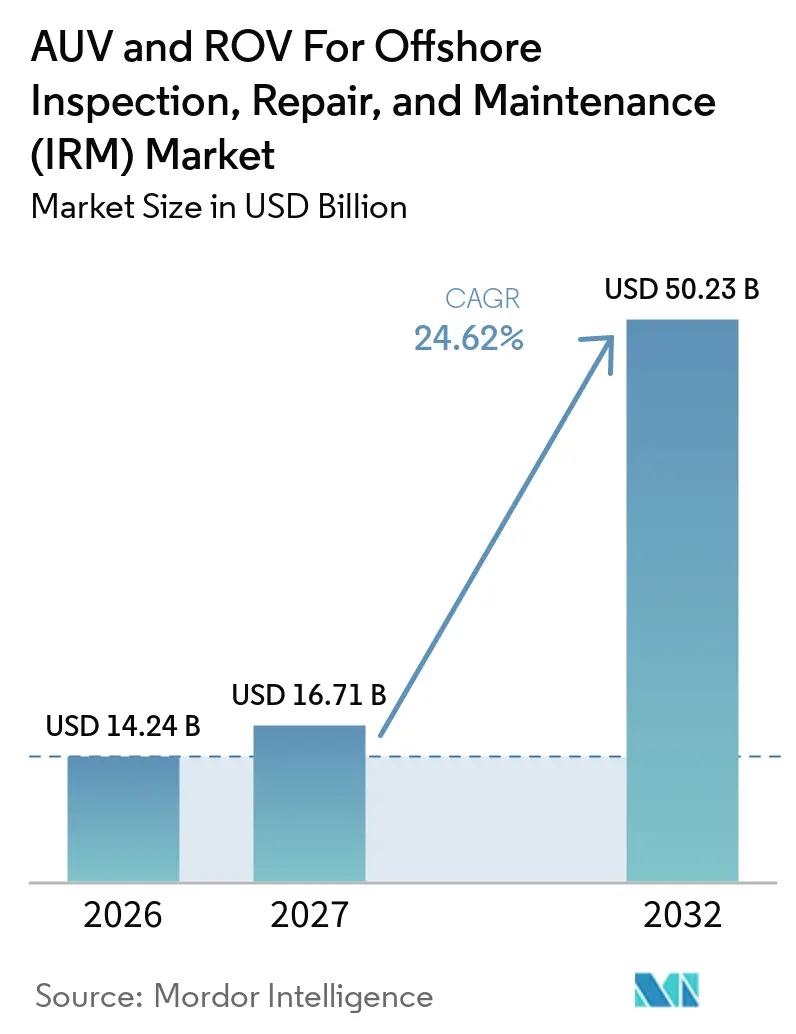
AUV and ROV For Offshore Inspection, Repair, and Maintenance (IRM) Market Analysis by Mordor Intelligence
The AUV and ROV for offshore inspection, repair, and maintenance market size is expected to increase from USD 14.24 billion in 2026 to USD 16.71 billion in 2027 and reach USD 50.23 billion by 2032, growing at a CAGR of 24.62% over 2027-2032. The market is growing as operators shift more inspection and intervention work away from crewed offshore campaigns. Deepwater activity, offshore wind construction, and aging subsea equipment are increasing the need for reliable asset inspection and repair. Long-term service agreements are becoming more important as they provide operators with continued access to vehicles, tools, and trained crews. Remote control centers and resident systems can reduce vessel use for routine tasks, changing how service providers structure contracts. The market also faces pressure from high equipment costs, specialist labor shortages, and limited availability of deep-rated batteries.
Key Report Takeaways
- By vehicle type, ROVs held 90.2% of the AUV and ROV for offshore IRM market share in 2026, while AUVs recorded the highest projected CAGR at 25.2% through 2032.
- By propulsion system, electric propulsion accounted for 80.3% of the market size in 2026, while hybrid propulsion is projected to expand at a 25.6% CAGR through 2032.
- By IRM activity, inspection accounted for 31.5% of revenue share in 2026, while repair is forecast to grow at a 24.8% CAGR through 2032.
- By end user, oil and gas operators held 84.3% of revenue share in 2026, while offshore wind operators are projected to grow at a 26.4% CAGR through 2032.
- By geography, Asia-Pacific led with 46.4% of revenue share in 2026, while Europe is projected to grow at a 25.1% CAGR through 2032.
Note: Market numbers in this report are based on Mordor Intelligence's proprietary estimation framework, which combines nine months of actuals with Q4 projections for base year 2026.
Market Trends and Insights
Drivers Impact Analysis of AUV and ROV For Offshore Inspection, Repair, and Maintenance (IRM) Market*
| Driver | (~) % Impact on CAGR Forecast | Geographic Relevance | Impact Timeline |
|---|---|---|---|
| Aging Offshore Subsea Infrastructure | +4.5% | Global, with peak intensity in North Sea, Gulf of Mexico, and Southeast Asia | Medium term (2-4 years) |
| Expansion of Deepwater and Ultra-Deepwater Assets | +3.8% | South America, APAC, MEA; spill-over to West Africa | Long term (≥ 4 years) |
| Offshore Wind and Marine Renewable Build-Out | +4.2% | Europe (core), APAC (growth), with early gains in Denmark, Netherlands, UK | Short term (≤ 2 years) |
| Remote and Resident Robotics Reducing Vessel Days | +3.5% | Norwegian Continental Shelf, Brazil, APAC brownfields | Medium term (2-4 years) |
| AI-Enabled Predictive Integrity Management | +3.0% | Global, with first-mover gains in Norway, UK, and the Gulf of Mexico | Long term (≥ 4 years) |
| Seabed Infrastructure Protection and Security Demand | +2.5% | Europe (Baltic, North Sea), North America, Indo-Pacific | Medium term (2-4 years) |
| Source: Mordor Intelligence | |||
Aging Offshore Subsea Infrastructure
Subsea equipment installed before 2000 in the North Sea, Gulf of Mexico, and Southeast Asia has exceeded its original design life. This installed base supports regular inspection and repair work, as operators cannot defer integrity checks without compliance consequences. Required checks of pipelines and wellheads continue even when commodity prices weaken. The AUV and ROV for offshore inspection, repair, and maintenance (IRM) market benefits when inspections identify defects that require prompt intervention. The repair segment is projected to grow at a 24.8% CAGR, reflecting the rising need to address deferred work on mature assets. The National Robotarium and Senai Cimatec developed a tentacle-like underwater robot for pipeline inspection at depths near 3,000 meters, demonstrating the need for tools capable of reaching difficult areas of aging infrastructure.
Deepwater and Ultra-Deepwater Asset Expansion
Deepwater projects create demand for vehicles that can inspect, support installation work, and carry out interventions far from shore. Operators require reliable ROV support for production systems, wells, risers, and pipeline networks at these sites. The AUV and ROV for offshore IRM market therefore benefits from new subsea infrastructure as well as later-stage maintenance requirements. Brazil, Guyana, the South China Sea, and parts of Africa are key areas, as each is adding or sustaining deepwater activity. China Oilfield Services Limited completed field verification of its FCV4000 work-class ROV in South China Sea oilfields in April 2025, demonstrating domestic capability rated for deepwater operations. This development indicates that local equipment supply could become more important in markets that previously depended on foreign vehicle providers.
Offshore Wind and Marine Renewable Build-Out
Offshore wind assets require regular checks of foundations, inter-array cables, scour conditions, and J-tubes. These requirements create recurring work that differs from the project-based pattern common in oil and gas. The AUV and ROV for offshore IRM market can serve this demand with observation vehicles, survey AUVs, and work-class systems. Japan supported trials for AUV-led inspection of floating offshore wind facilities at Numazu in October 2025, and the participating group published a roadmap in March 2026 targeting commercial readiness by 2030.[1] This work connects offshore wind maintenance needs with domestic development of unmanned inspection systems. Renewable projects also favor compact systems where vessel availability and mobilization time affect campaign planning.
Remote and Resident Robotics Reducing Vessel Days
Resident and shore-controlled systems can complete routine monitoring without maintaining a crewed vessel at the asset. This approach reduces offshore exposure and shortens the time required for selected subsea tasks. Aker BP ASA and DeepOcean Group completed a shore-controlled ROV operation from Haugesund that reduced a job previously requiring 14 days offshore to 12 hours.[2] The AUV and ROV for offshore IRM market is adopting these operating models to shift some work from vessel-day contracts toward longer service arrangements. Norway's petroleum safety authority assessed several nonconventional ROV-IMR concepts in 2025, including uncrewed surface vessels and seabed garage systems, and found them under active qualification. The assessment supports continued work to establish acceptable operating practices for vessel-light subsea services.
Restraints Impact Analysis of AUV and ROV For Offshore Inspection, Repair, and Maintenance (IRM) Market*
| Restraint | (~) % Impact on CAGR Forecast | Geographic Relevance | Impact Timeline |
|---|---|---|---|
| High Vehicle, Tooling, and Mobilization Costs | -2.8% | Global, most acute in West Africa, Southeast Asia, and frontier deepwater basins | Short term (≤ 2 years) |
| Shortage of Subsea-Qualified Personnel | -2.2% | Global, with highest severity in APAC and MEA emerging markets | Medium term (2-4 years) |
| Deep-Rated Battery and Specialty-Component Constraints | -1.5% | APAC deepwater, ultra-deepwater basins globally | Medium term (2-4 years) |
| Acoustic Communications Congestion in Brownfields | -0.8% | North Sea, Gulf of Mexico mature brownfield clusters | Medium term (2-4 years) |
| Source: Mordor Intelligence | |||
High Vehicle, Tooling, and Mobilization Costs
A work-class ROV system, including the vehicle, umbilical, launch and recovery equipment, and tools, can exceed USD 10 million per unit. Mobilizing a system to a remote asset can add substantial logistics costs before work begins. These expenses present challenges for smaller operators and national oil companies that do not manage large fleets. The AUV and ROV for offshore inspection, repair, and maintenance (IRM) market remains more accessible to providers that can spread equipment costs across multiple contracts. Electric systems can lower operating costs over time, but their purchase price can be higher than that of legacy hydraulic systems. TechnipFMC has described fleet modernization as an operating-cost decision, although the required investment remains difficult to justify for budget-constrained regional operators.
Shortage of Subsea-Qualified Personnel
The market requires ROV pilots, subsea engineers, and marine technicians capable of managing complex intervention work. Training pipelines contracted after the 2015 to 2016 oil downturn, contributing to gaps in experienced personnel. Vietnam, India, and Nigeria face particular pressure as offshore activity increases faster than local workforce capacity. The AUV and ROV for offshore IRM market is responding by increasing the use of shore-based operations and resident robotics. Fugro completed a 330-day remote inspection campaign for Petrobras that eliminated more than 15,000 offshore exposure hours without requiring offshore personnel. The project also required coordination with Brazil's Directorate of Ports and Coasts on the NORMAM-205/DPC framework, demonstrating that remote operations require regulatory preparation in addition to technical capability.
*Our forecasts treat driver/restraint impacts as directional, not additive. The impact forecasts reflect baseline growth, mix effects, and variable interactions.
AUV and ROV For Offshore Inspection, Repair, and Maintenance (IRM) Market Segment Analysis
By Vehicle Type:
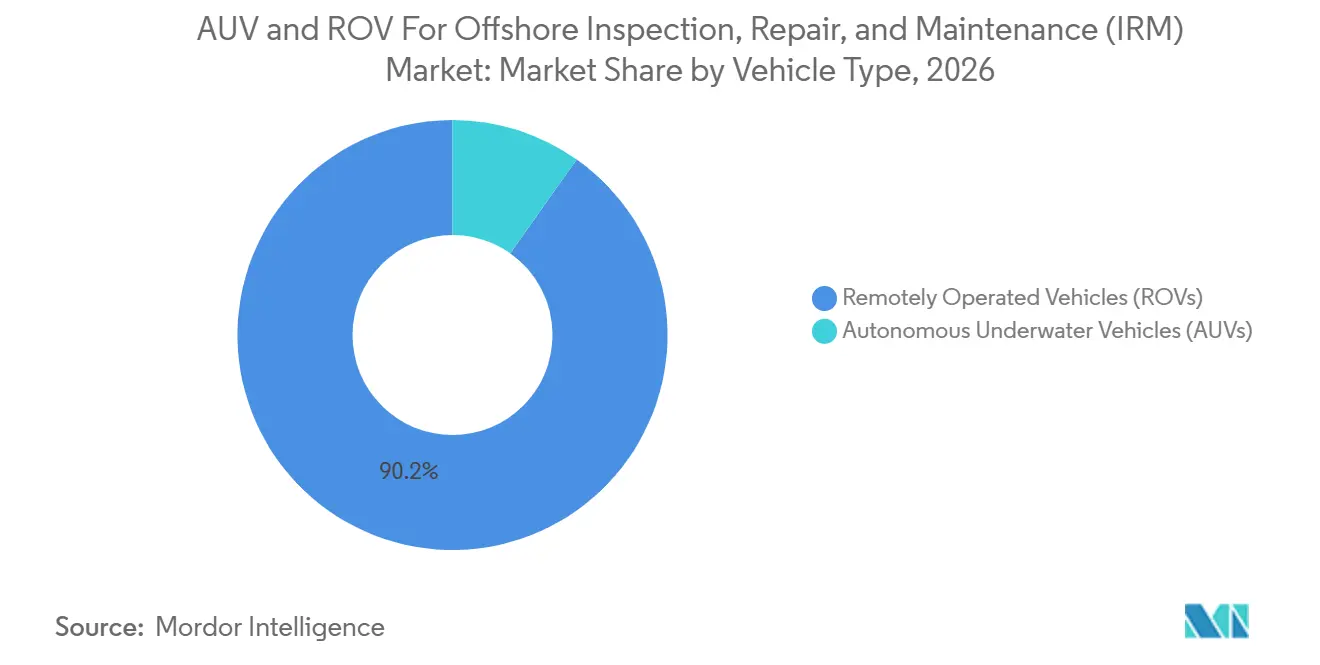
ROV Dominance and Faster AUV GrowthROVs held 90.2% of revenue in 2026, giving them the largest share in the AUV and ROV for offshore inspection, repair, and maintenance (IRM) market. Work-class systems conduct intervention work through manipulators and specialized tools, including welding, valve actuation, and pipeline repair that current AUVs cannot replicate. Oil and gas operators rely on tethered vehicles for production-critical work on FPSOs, subsea trees, risers, and related infrastructure. This gives the AUV and ROV for offshore IRM market a durable ROV service base despite growth in autonomous survey work. Electric drivetrains can provide more bollard force at comparable power, direct available energy toward flight thrust, and reduce umbilical size.[3]
AUVs are projected to expand at a 25.2% CAGR through 2032, making them the fastest-growing vehicle type. They are suited to pipeline surveys, cathodic protection assessments, and wind-farm scour monitoring, where repeated coverage matters more than direct intervention. Autonomous operation removes tether drag and may reduce vessel requirements for suitable repeat surveys. The FCV4000 field work in South China Sea oilfields demonstrates local development of deep-rated vehicle capability. Observation-class ROVs and lightweight AUVs are useful for foundation checks, where vessel size and mobilization timing influence contractor choice.

By Propulsion System:
Electric Fleets Lead the Replacement CycleElectric propulsion held 80.3% of revenue in 2026, the largest share within the AUV and ROV for offshore IRM market. Operators favor electric systems because they avoid hydraulic fluid discharge and support continuous condition monitoring. DeepOcean announced in June 2025 that it would add 8 electric ROVs, with 3 delivered immediately, 5 scheduled over 4 years, and 13 units on option. This program indicates that large providers are treating hydraulic replacement as a planned capital cycle. Allseas acquired TechnipFMC Schilling Robotics' hybrid-electric heavy-duty fleet in September 2026 to replace legacy hydraulic systems.
Hybrid propulsion is forecast to grow at a 25.6% CAGR through 2032, the fastest rate among propulsion types. It combines electric precision with hydraulic torque support for operators that cannot quickly replace legacy-compatible tools. Hydraulic systems are losing share in new orders but remain relevant for selected ultra-deepwater work-class assignments. The AUV and ROV for offshore IRM market still requires high power density in difficult subsea conditions. Kraken Robotics offers the SeaPower modular battery system with up to 1 MWh of subsea capacity in configurable arrays.
By IRM Activity:
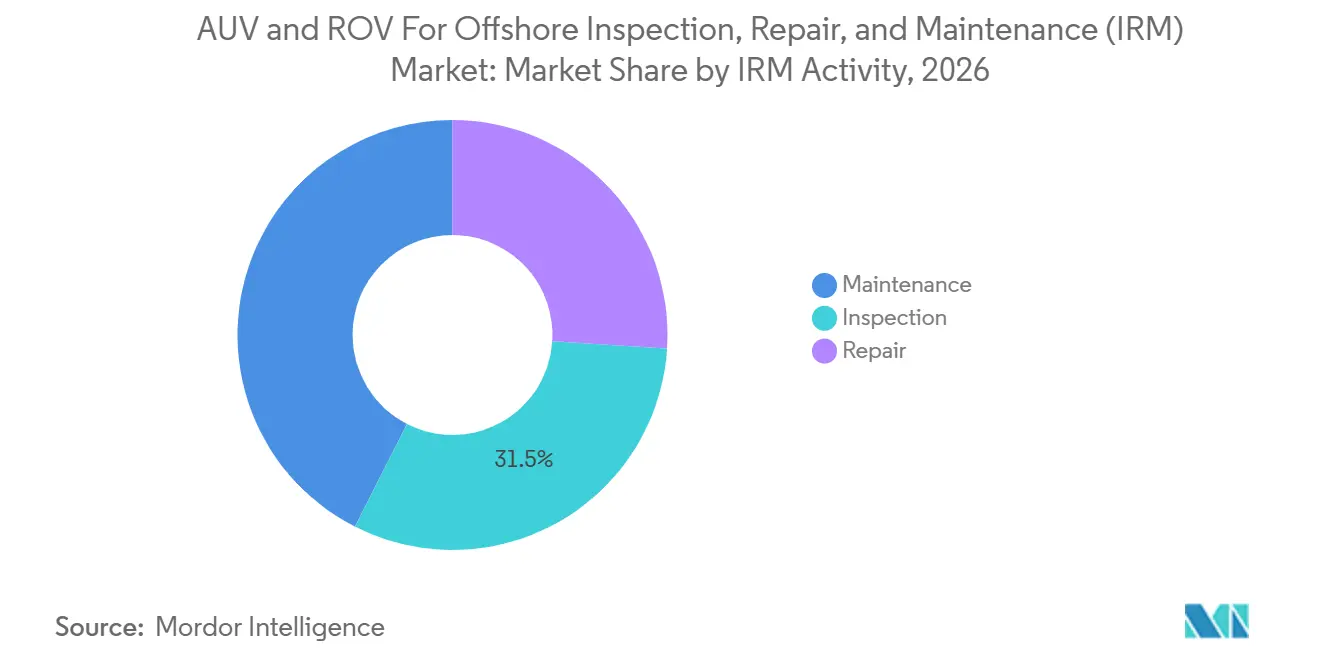
Inspection Leads While Repair ExpandsInspection held 31.5% of revenue in 2026, making it the largest activity segment in the AUV and ROV for offshore IRM market. Integrity cycles require checks of structures, pipelines, moorings, and subsea equipment, and operators face safety, insurance, and liability obligations. High-resolution sonar, photogrammetric 3D modeling, and cathodic protection tools can increasingly be deployed during a single AUV pass, reducing the need for separate follow-up campaigns where survey conditions are appropriate. Oceaneering's Freedom AUV supports autonomous pipeline inspection operations.
Repair is projected to grow at a 24.8% CAGR through 2032, the strongest rate among IRM activities. Aging assets and repeat inspections are identifying deferred intervention needs from earlier low-investment periods. Work-class ROVs support underwater welding, hyperbaric intervention, and pipeline clamp installation through robotic tools, reducing saturation-diving use in suitable assignments. Resident programs also provide preventive maintenance access for production systems, umbilicals, and marine-growth cleaning without repeated vessel mobilization. This shifts some maintenance from scheduled campaigns toward continuous services and longer availability agreements.
By End User:
Oil and Gas Operators Anchor Demand and Offshore Wind Leads GrowthOil and gas operators held 84.3% of end-user revenue in 2026, reflecting the large installed base of wells, FPSOs, pipelines, and subsea production systems. Deepwater construction also generates subsequent IRM demand as new infrastructure enters service. The AUV and ROV for offshore IRM market remains tied to multi-year commitments for vehicle support and related services. Oceaneering announced USD 180 million in Petrobras subsea robotics contracts during 2025 for work-class ROV services, tooling, and surveys. The awards covered IRM, FPSO hook-ups, mooring inspections, and decommissioning support.
Offshore wind operators are forecast to grow at a 26.4% CAGR through 2032, the fastest rate among end-user segments. Foundations and cables require recurring inspection over long operating lives, creating demand for survey vehicles, compact ROVs, and shore-controlled systems. Subsea engineering providers and EPC contractors reinforce this demand when vehicle capability is included in turnkey delivery scopes. Government and defense bodies are also emerging customers for autonomous undersea systems. Kongsberg and Oceaneering were selected in 2026 to support the CAMP program for an Extra-Large Uncrewed Undersea Vehicle.
Geography Analysis
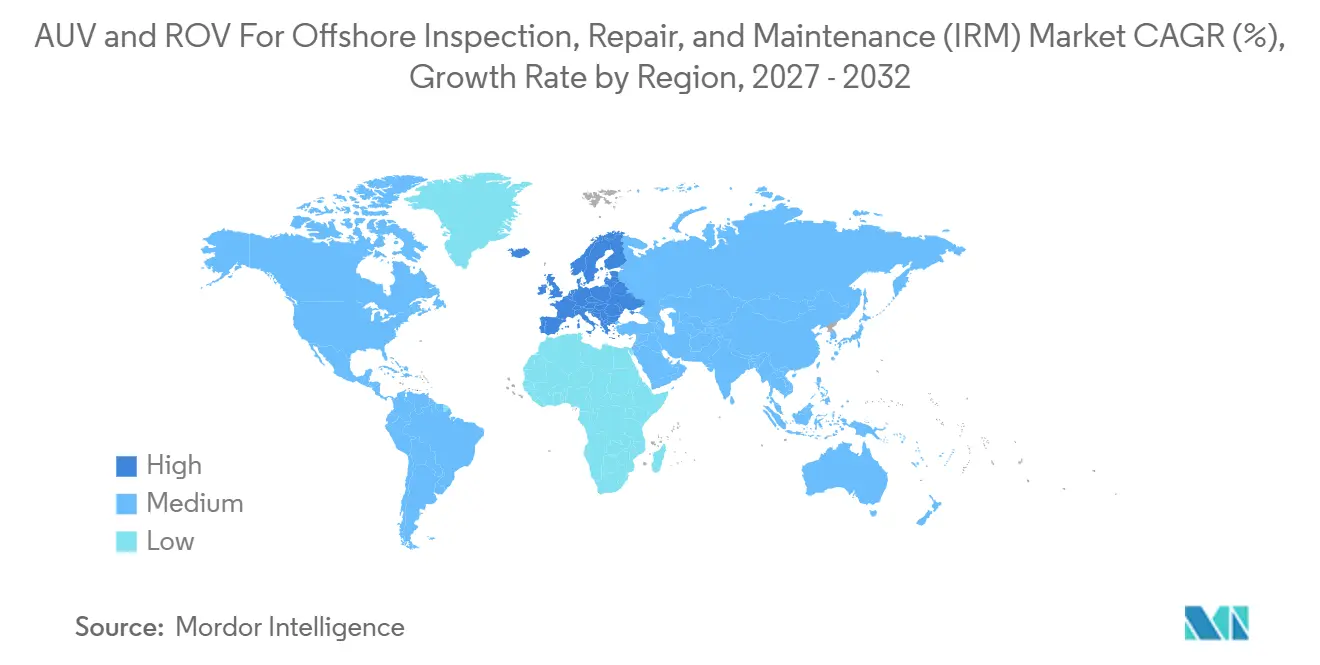
Asia-Pacific held a 46.4% revenue share in 2026, the largest regional position in the AUV and ROV for offshore inspection, repair, and maintenance (IRM) market. Demand is supported by China's South China Sea activity, Australian offshore gas development, and Southeast Asian brownfield pipelines. CNOOC's FCV4000, rated to 4,000 meters, completed field operations in several South China Sea oilfields in 2025, indicating a stronger domestic equipment base in China.[4] Fugro received a three-year deepwater ROV contract in August 2026 for ONGC operations in India at water depths up to 3,000 meters. Japan's AUV inspection roadmap for offshore wind represents an additional source of future demand. Together, these developments reflect a combination of mature oil and gas requirements and emerging renewable maintenance needs.
Europe is projected to grow at a 25.1% CAGR through 2032, the fastest regional growth rate in the AUV and ROV for offshore IRM market. Offshore wind inspection, seabed protection, and remote ROV operations on the Norwegian Continental Shelf support the regional outlook. Installed wind assets require regular inspection of turbine foundations and cables. Providers are developing vessel-light systems to reduce offshore personnel exposure. GEOxyz launched the ORCAS project in July 2026 to combine autonomous surface and underwater platforms with AI data fusion for North Sea asset protection. Security requirements may generate additional work for commercial AUV and ROV capabilities. European operators also favor systems capable of sharing data with remote control centers and integrity management processes.
North America remained the second-largest region, supported by U.S. Gulf of Mexico and Canadian Atlantic operations. Brazil remained a major South American demand center as Petrobras continued awarding large robotics contracts. Oceaneering International secured a four-year Petrobras ROV services contract in July 2026 covering two work-class ROVs and tooling packages. Guyana's deepwater resource base is adding subsea equipment that will require structured IRM programs. The Middle East and Africa are supported by Arabian Gulf and Angolan activity. Oceaneering International began a three-year ROV and integrated solutions contract with Esso Exploration Angola in July 2025. These regions favor providers with deepwater experience, multiple vehicle classes, and long-duration operational capacity.
Competitive Landscape
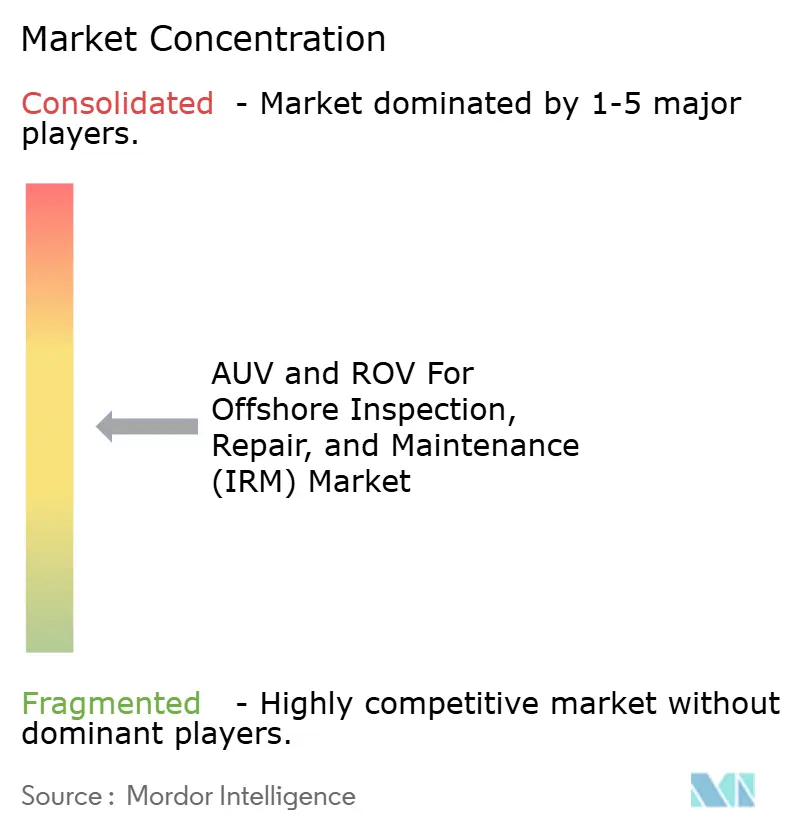
The AUV and ROV for offshore IRM market is moderately consolidated in work-class ROV services. Oceaneering International, Subsea 7, Fugro, and TechnipFMC hold established positions through fleet scale, subsea experience, and long-term client relationships. Competition is more dispersed in observation-class vehicles, lightweight AUVs, and resident robotics, where Nauticus Robotics, Ocean Infinity, and Saipem's resident drone operations are active. Larger providers are expanding electric fleets and integrating remote control with vehicle and vessel operations. DeepOcean's addition of eight electric ROVs in 2025, with 13 further units on option, illustrates this investment approach. The market rewards providers that combine vehicles, crews, tools, and data delivery within a single service arrangement.
Oceaneering International expanded its position in Brazil with a Petrobras contract announced in July 2026 for two work-class ROVs and tooling packages over four years beginning in 2027. Allseas acquired hybrid-electric heavy-duty ROV assets from TechnipFMC Schilling Robotics in September 2026 to replace legacy hydraulic equipment. These actions indicate that fleet modernization remains central to provider strategy. Kongsberg combines sonar, navigation, and digital capabilities with vehicle programs, supporting analytics and data services. TechnipFMC continues electric drivetrain development through Schilling Robotics. Tooling compatibility during fleet transitions is an important consideration for clients operating mixed equipment. Proven uptime and clear responsibility for the operating spread remain key selection factors.
Opportunities exist in autonomous inspection for unpiggable pipelines, resident systems for brownfield assets, and shore-controlled offshore wind work. These applications are relevant in West Africa and Southeast Asia, where vessel days are costly, and in Europe, where renewable inspection demand is growing. Eelume's all-terrain AUV is being deployed by Equinor for mapping and close visual inspection. Clients are seeking open data delivery and digital-twin compatibility to connect inspection results with broader asset records, and suppliers are responding accordingly. The market has room for specialists, although larger contract awards require reliable operations and sufficient fleet capacity. The market is neither controlled by a single provider nor fully fragmented. The available information does not include a verified combined market share for the top companies, which limits a precise concentration calculation.
AUV and ROV For Offshore Inspection, Repair, and Maintenance (IRM) Industry Leaders
-
Oceaneering International, Inc.
-
TechnipFMC plc
-
Fugro N.V.
-
Subsea 7 S.A.
-
Saipem S.p.A.
- *Disclaimer: Major Players sorted in no particular order
AUV and ROV For Offshore Inspection, Repair, and Maintenance (IRM) Market Companies Covered in this Report
- Aker Solutions ASA
- Baker Hughes Company
- DeepOcean Group Holding B.V.
- DOF Group ASA
- Exail Technologies
- Forum Energy Technologies, Inc.
- Fugro N.V.
- General Dynamics Mission Systems, Inc.
- Helix Energy Solutions Group, Inc.
- IKM Gruppen AS
- Kongsberg Gruppen ASA
- Modus Subsea Services Ltd.
- Nauticus Robotics, Inc.
- Ocean Infinity Group Limited
- Oceaneering International, Inc.
- Reach Subsea ASA
- ROVOP Ltd.
- Saab AB
- Saipem S.p.A.
- Subsea 7 S.A.
- TechnipFMC plc
- Teledyne Technologies Incorporated
Recent Industry Developments in AUV and ROV For Offshore Inspection, Repair, and Maintenance (IRM) Market
- September 2026: Allseas acquired a fleet of TechnipFMC Schilling Robotics hybrid-electric Heavy Duty (eHD) ROVs and announced plans to replace its legacy hydraulic ROV fleet. The new vehicles combine electric propulsion with hydraulic tooling compatibility, allowing a single platform to support offshore wind, subsea construction, inspection, repair, and maintenance activities.
- August 2026: Fugro was awarded a three-year deepwater ROV contract by Vantage International Management Company to support Oil and Natural Gas Corporation's offshore drilling operations in India. The contract uses Fugro's FCV3000 work-class ROV system aboard the Platinum Explorer drillship and covers water depths of up to 3,000 meters, reflecting continued demand for deepwater inspection and intervention services.
- July 2026: Oceaneering International secured a four-year ROV services contract from Petrobras for offshore Brazil operations. The award includes deployment of two work-class ROV systems and associated tooling packages onboard AKOFS Offshore's Aker Wayfarer vessel.
- July 2026: GEOxyz launched the ORCAS project under Belgium's Defence Innovation Strategy. The initiative integrates autonomous surface vessels, autonomous underwater vehicles, remotely operated vehicles, and AI-driven data fusion technologies for continuous monitoring and protection of North Sea subsea infrastructure.
Global AUV and ROV For Offshore Inspection, Repair, and Maintenance (IRM) Market Report Scope
Autonomous Underwater Vehicles (AUVs) and Remotely Operated Vehicles (ROVs) are underwater robotic systems used for inspection, repair, and maintenance (IRM) activities in offshore oil and gas, renewable energy, and subsea infrastructure operations. These vehicles enable monitoring, surveying, and maintenance of pipelines, subsea equipment, offshore platforms, and underwater assets without requiring direct human intervention. AUVs operate autonomously using onboard navigation systems, while ROVs are controlled remotely from a surface vessel. They help improve operational efficiency, reduce inspection costs, enhance safety, and support asset integrity management in offshore environments.
The global AUV and ROV for offshore inspection, repair, and maintenance (IRM) market is segmented by vehicle type into remotely operated vehicles (ROVs) and autonomous underwater vehicles (AUVs). By propulsion system, the market is segmented into electric propulsion, hydraulic propulsion, and hybrid propulsion. By IRM activity, the market is segmented into inspection, repair, and maintenance. By end user, the market is segmented into oil and gas operators, offshore wind operators, subsea engineering and service providers, EPC contractors, marine contractors, government and defense organizations, and research and academic institutions. The report also covers market size and forecasts for the global AUV and ROV for offshore IRM market across 27 countries in key regions. For each segment, market sizing and forecasts are provided on the basis of value (USD).
Segmentation Overview
| Remotely Operated Vehicles (ROVs) |
| Autonomous Underwater Vehicles (AUVs) |
| Electric Propulsion |
| Hydraulic Propulsion |
| Hybrid Propulsion |
| Inspection |
| Repair |
| Maintenance |
| Oil and Gas Operators |
| Offshore Wind Operators |
| Subsea Engineering and Service Providers |
| EPC Contractors |
| Marine Contractors |
| Government and Defense Organizations |
| Research and Academic Institutions |
| North America | United States |
| Canada | |
| Mexico | |
| Europe | United Kingdom |
| Italy | |
| Spain | |
| Norway | |
| Denmark | |
| Netherlands | |
| Russia | |
| Rest of Europe | |
| Asia-Pacific | China |
| India | |
| Japan | |
| South Korea | |
| Australia | |
| Singapore | |
| Vietnam | |
| Thailand | |
| Rest of Asia-Pacific | |
| South America | Brazil |
| Argentina | |
| Guyana | |
| Chile | |
| Rest of South America | |
| Middle East and Africa | Saudi Arabia |
| United Arab Emirates | |
| Kuwait | |
| South Africa | |
| Nigeria | |
| Rest of Middle East and Africa |
| By Vehicle Type | Remotely Operated Vehicles (ROVs) | |
| Autonomous Underwater Vehicles (AUVs) | ||
| By Propulsion System | Electric Propulsion | |
| Hydraulic Propulsion | ||
| Hybrid Propulsion | ||
| By IRM Activity | Inspection | |
| Repair | ||
| Maintenance | ||
| By End User | Oil and Gas Operators | |
| Offshore Wind Operators | ||
| Subsea Engineering and Service Providers | ||
| EPC Contractors | ||
| Marine Contractors | ||
| Government and Defense Organizations | ||
| Research and Academic Institutions | ||
| By Geography | North America | United States |
| Canada | ||
| Mexico | ||
| Europe | United Kingdom | |
| Italy | ||
| Spain | ||
| Norway | ||
| Denmark | ||
| Netherlands | ||
| Russia | ||
| Rest of Europe | ||
| Asia-Pacific | China | |
| India | ||
| Japan | ||
| South Korea | ||
| Australia | ||
| Singapore | ||
| Vietnam | ||
| Thailand | ||
| Rest of Asia-Pacific | ||
| South America | Brazil | |
| Argentina | ||
| Guyana | ||
| Chile | ||
| Rest of South America | ||
| Middle East and Africa | Saudi Arabia | |
| United Arab Emirates | ||
| Kuwait | ||
| South Africa | ||
| Nigeria | ||
| Rest of Middle East and Africa | ||
Key Questions Answered in the Report
What is the forecast for the AUV and ROV offshore IRM market?
The AUV and ROV for offshore inspection, repair, and maintenance (IRM) market is projected to reach USD 50.23 billion by 2032, expanding at a 24.62% CAGR from 2027.
Why do ROVs retain the leading position in offshore IRM?
ROVs held 90.2% of revenue in 2026 because they can perform intervention tasks such as valve actuation, welding, and pipeline repair.
Which vehicle type is growing fastest for subsea inspection?
AUVs are projected to grow at a 25.2% CAGR through 2032 because they are suited to repeat surveys, pipeline corridor inspections, and offshore wind monitoring.
What is driving demand from offshore wind operators?
Offshore wind operators are forecast to grow at a 26.4% CAGR through 2032 as foundations, cables, scour conditions, and J-tubes require regular inspection.
Which region leads demand for offshore AUV and ROV services?
Asia-Pacific held 46.4% of revenue in 2026, supported by South China Sea projects, Australian offshore gas activity, and Southeast Asian brownfield operations.
What limits wider adoption of remote subsea systems?
High vehicle and mobilization costs, shortages of qualified personnel, battery constraints, and acoustic communications congestion can restrict adoption in certain operations.