
Autonomous Mobile Robot Vision Systems Market Size and Share
Market Overview
| Study Period | 2020 - 2031 |
|---|---|
| Market Size (2026) | USD 302.61 Million |
| Market Size (2031) | USD 903.79 Million |
| Growth Rate (2026 - 2031) | 24.46 % |
| Fastest Growing Market | Middle East and Africa |
| Largest Market | Asia-Pacific |
| Market Concentration | Medium |
Major Players *Disclaimer: Major Players sorted in no particular order Image © Mordor Intelligence. Reuse requires attribution under CC BY 4.0. | |
Autonomous Mobile Robot Vision Systems Market Analysis by Mordor Intelligence
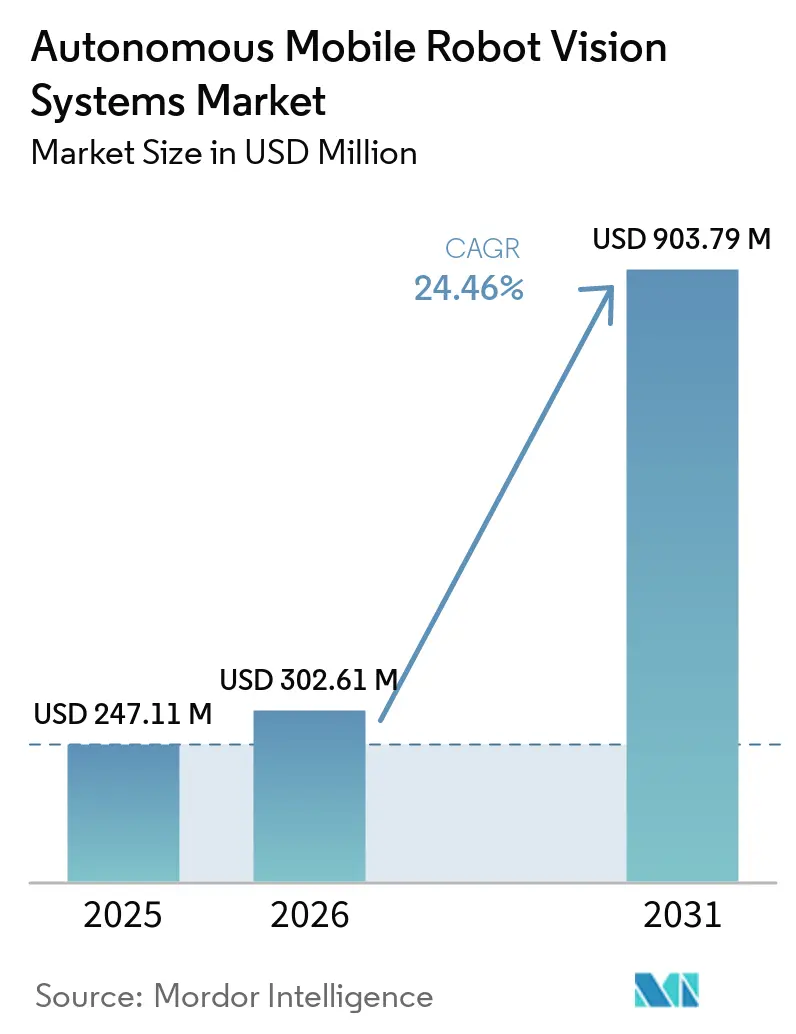
The autonomous mobile robot vision systems market size is projected to expand from USD 247.11 million in 2025 and USD 302.61 million in 2026 to USD 903.79 million by 2031, registering a CAGR of 24.46% between 2026 to 2031. Rising order volumes are making reliable robot navigation more important in warehouses and factories. Labor availability and labor costs are also increasing the value of automation that can operate across multiple shifts. Buyers increasingly assess systems by their ability to maintain throughput, adapt to changing layouts, and connect with existing software. Competition is shifting toward integrated perception, fleet management, and deployment support, while lower-cost suppliers are placing pressure on hardware pricing. The autonomous mobile robot vision systems market, therefore, offers opportunities for suppliers that can improve interoperability, performance in difficult environments, and operating reliability.
Key Report Takeaways
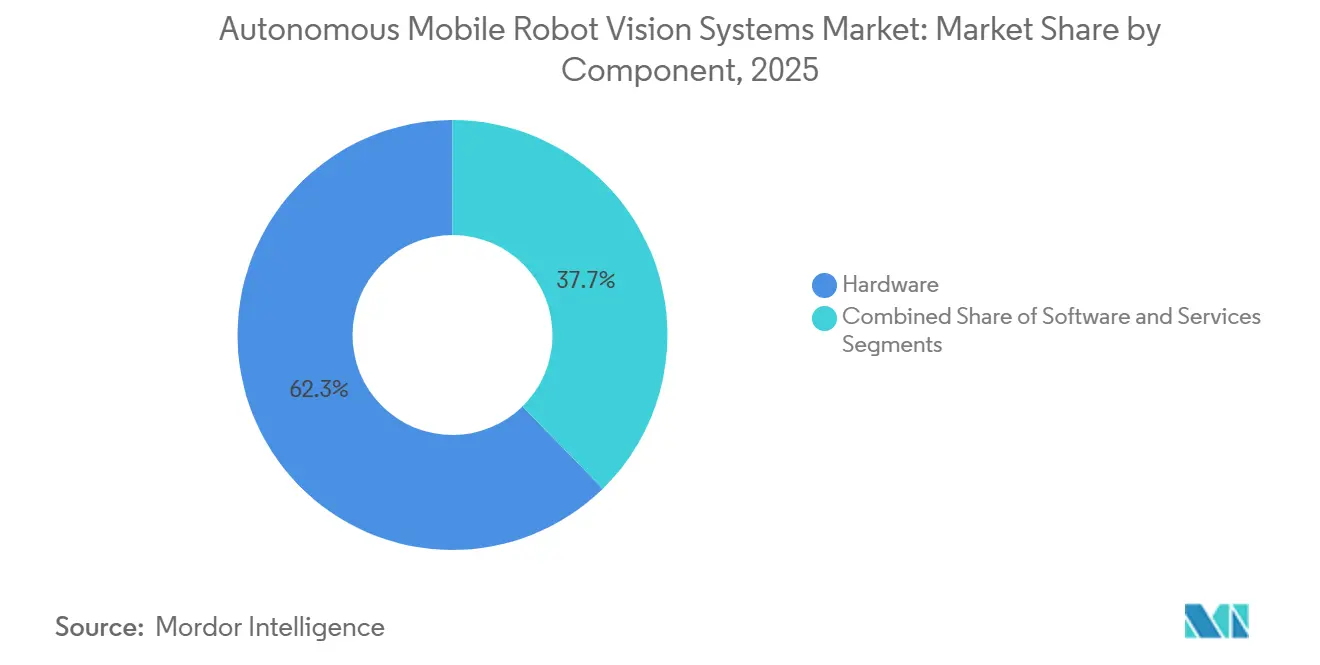
- By component, hardware held 62.33% revenue share in 2025, while software is projected to expand at a 24.92% CAGR through 2031.
- By vision technology, 3D LiDAR and laser vision accounted for 27.78% share in 2025, while structured-light 3D vision is expected to expand at a 25.11% CAGR through 2031.
- By function, navigation and localization held 29.98% share in 2025, while object detection and recognition are projected to expand at a 25.23% CAGR through 2031.
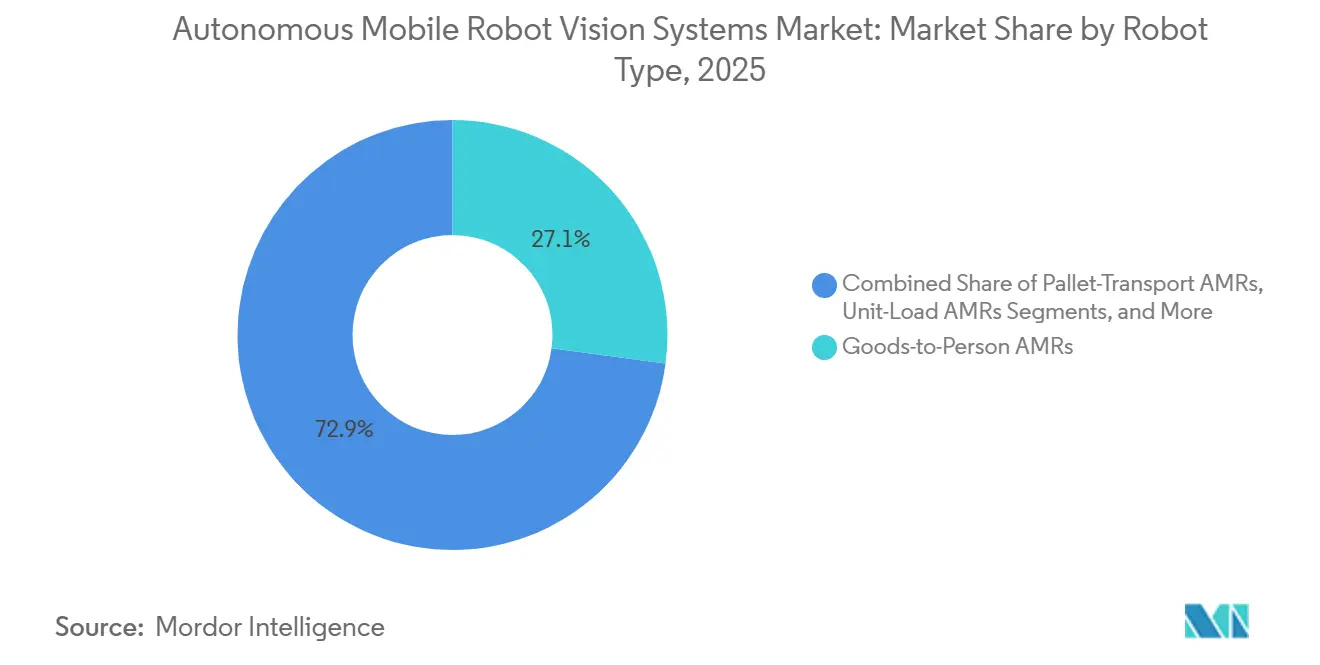
- By robot type, goods-to-person AMRs accounted for 27.11% share in 2025, while autonomous picking AMRs are expected to expand at a 24.86% CAGR through 2031.
- By end-user industry, warehousing and logistics held 35.18% share in 2025, while pharmaceuticals and healthcare are projected to expand at a 24.77% CAGR through 2031.
- By geography, Asia-Pacific accounted for 38.65% share of the autonomous mobile robot vision systems market in 2025, while the Middle East and Africa is expected to expand at a 25.16% CAGR through 2031.
Note: Market size and forecast figures in this report are generated using Mordor Intelligence’s proprietary estimation framework, updated with the latest available data and insights as of January 2026.
Global Autonomous Mobile Robot Vision Systems Market Trends and Insights
Drivers Impact Analysis*
| Driver | (~) % Impact on CAGR Forecast | Geographic Relevance | Impact Timeline |
|---|---|---|---|
| E-Commerce Fulfillment Automation | +5.8% | Global, with highest intensity in North America, China, and Western Europe | Short term (≤ 2 years) |
| Warehouse Labor Shortages and Rising Workforce Costs | +5.2% | North America and Europe primarily, with spillover to Japan and South Korea | Short term (≤ 2 years) |
| Edge AI Reducing Vision Latency and Bandwidth Requirements | +4.3% | Global, with early adoption in North America and Asia-Pacific | Medium term (2-4 years) |
| Flexible Manufacturing and Industry 4.0 Adoption | +3.6% | Europe and Asia-Pacific core, with spillover to North America | Medium term (2-4 years) |
| Marker-Free Navigation Through Visual SLAM | +2.8% | Global, accelerating in brownfield facilities across Europe and North America | Medium term (2-4 years) |
| Standardized Perception Modules Enabling Brownfield Retrofits | +2.1% | North America and Europe, with early gains in Japan and South Korea | Long term (≥ 4 years) |
| Source: Mordor Intelligence | |||
E-Commerce Fulfillment Automation
E-commerce volume has sustained demand for vision-equipped AMRs in competitive fulfillment operations. North American warehousing firms purchased a substantial volume of robots during the first half of 2026. These purchases represented a significant market value and exceeded the level recorded during the corresponding period in 2025. This trend also increases demand for components that can support continuous operations.[1]Information Technology and Innovation Foundation, “Fact of the Week: Robot Purchases in North American Warehousing Industry Totaled USD 1.2B in First Half of 2026,” Information Technology and Innovation Foundation, itif.org. Denser goods-to-person operations require navigation systems that distinguish adjacent shelf positions with precision. This requirement favors advanced 3D vision over barcode-guided systems in complex facilities. Maersk’s Singapore facility began operations in early 2026 with a large fleet of A42T systems and AMRs from Hai Robotics. Year-round fleet use also increases demand for components that can support continuous operations.
Warehouse Labor Shortages and Rising Workforce Costs
Warehouse labor constraints are strengthening the business case for autonomous equipment. Average U.S. warehousing wages increased in June 2026, while a substantial number of positions remained unfilled across transportation, warehousing, and utilities. The number of unfilled positions was higher than in the corresponding period of 2025. High employee turnover also creates recurring training and onboarding costs for large distribution centers. Geekplus completed a large-scale deployment of mobile AMRs across several Toyota plants in Japan by June 2026.[2]Geekplus Technology Co., Ltd., “Geekplus Deploys 400+ AMRs Across Multiple Toyota Plants,” Geekplus News, geekplus.com. The deployment reflected Japan’s declining working-age population and restrictions on truck-driver working hours. These pressures are extending adoption from e-commerce facilities to demanding intralogistics operations.
Edge AI Reducing Vision Latency and Bandwidth Requirements
On-device inference is bringing perception and robot response closer together in the autonomous mobile robot vision systems market. A 2025 study reported 92% path-tracking accuracy and 88% obstacle-avoidance success for a ResNet-18 model on an NVIDIA Jetson Nano. The study also recorded a maximum perception-to-action latency of 150 milliseconds in semi-structured warehouse settings.[3]Frontiers in Robotics and AI, “ResNet-18 Based Multi-Task Visual Inference and Adaptive Control for an Edge-Deployed Autonomous Robot,” Frontiers in Robotics and AI, frontiersin.org. Embedded computing can reduce dependence on remote processing for routine vision tasks. Cognex launched the In-Sight 6900 Vision Controller in April 2026 with NVIDIA Jetson processing. It launched the Qualcomm Dragonwing-powered In-Sight 3900 in May 2026. These products support centralized model training and deployment across distributed fleets.
Flexible Manufacturing and Industry 4.0 Adoption
Vision systems help AMRs operate in manufacturing environments with changing material flows. Unlike fixed-path vehicles, vision-equipped AMRs can adjust routes when production schedules or cell layouts change. This capability is useful in mixed-model electronics and EV battery assembly operations. Geekplus integrated fleet management with plant MES and PLC systems in its Toyota deployment. The deployment supported just-in-time intralogistics without human dispatching intervention. Flexible plants increasingly need equipment that can respond to changes without rebuilding physical navigation infrastructure. This places greater emphasis on visual localization and connected fleet-control software.
Restraints Impact Analysis*
| Restraint | (~) % Impact on CAGR Forecast | Geographic Relevance | Impact Timeline |
|---|---|---|---|
| High Integration and Calibration Costs | -3.2% | Global, most pronounced for mid-market operators in North America and Europe | Short term (≤ 2 years) |
| Safety Validation in Dynamic Human-Robot Environments | -2.6% | Global, with compliance complexity highest in the EU and North America | Medium term (2-4 years) |
| Dataset Shift Across Lighting, Surface, and Warehouse Conditions | -1.8% | Global, with severity highest in retrofitted brownfield facilities | Medium term (2-4 years) |
| Cybersecurity Exposure of Vision-Derived Localization Data | -1.2% | Global, with regulatory exposure accelerating in the EU and South Korea | Long term (≥ 4 years) |
| Source: Mordor Intelligence | |||
High Integration and Calibration Costs
Integration can be a larger barrier than hardware procurement for mid-market operators. A robot fleet in a large facility can require substantial initial capital investment. Vision systems also need facility mapping, warehouse management system integration, charging infrastructure, and service support. Each camera needs calibration against the robot’s kinematic reference frame. Hardware servicing or replacement can require calibration again. Multi-vendor fleets raise the burden because vendors commonly use different calibration frameworks. Standardized perception modules can reduce deployment engineering work where they remove sensor-specific setup requirements.
Safety Validation in Dynamic Human-Robot Environments
Safety validation remains difficult when workers and mobile robots share an active workspace. ISO 3691-4 specifies safety requirements for driverless industrial trucks and related systems. ANSI/A3 R15.08 also addresses safety requirements for industrial mobile robots. The EU Machinery Regulation 2023/1230 will apply additional cybersecurity and AI safety provisions from August 2027. Testing can take three to six months in safety-critical facilities. Vision systems using neural networks also present failure behaviors that are harder to assess with frameworks developed for deterministic sensors.
*Our forecasts treat driver/restraint impacts as directional, not additive. The impact forecasts reflect baseline growth, mix effects, and variable interactions.
Segment Analysis
By Component: Software Orchestration Redefines the Value Stack
Hardware held 62.33% of the autonomous mobile robot vision systems market share in 2025. Depth cameras, LiDAR modules, embedded processors, and supporting optics create a large upfront equipment requirement. Hardware remains essential because each AMR fleet needs physical perception capability at the robot level. Large deployments require consistent component availability and calibration support. Sensor architecture, therefore, continues to affect reliability, maintenance requirements, and replacement costs. Lower-cost competition is also placing pressure on margins for standardized hardware. Suppliers are responding by pairing sensors with proprietary processing, software, or service offerings. This approach can protect differentiation when basic components become more widely available. It also gives buyers a clearer view of whole-system accountability.
The software segment is projected to expand at a 24.92% CAGR through 2031. Model-management platforms enable centrally trained vision models to be deployed across multiple sites. Fleet orchestration software coordinates robot movement and connects vision outputs with operational systems. Cognex stated that its OneVision platform had exceeded 100 enterprise customers since its June 2025 beta launch. The platform supports a move from isolated pilots to multi-site implementations. Services are also gaining importance through robotics-as-a-service models. These models shift some integration, calibration, and maintenance work to vendors. The autonomous mobile robot vision systems industry is therefore placing more value on recurring software and support revenue. Buyers benefit when software reduces the disruption associated with updates and fleet expansion.



By Vision Technology: 3D LiDAR Leads, Structured Light Gains Ground in Precision Applications
3D LiDAR and laser vision held 27.78% of the autonomous mobile robot vision systems market share in 2025. The technology is widely used for navigation and obstacle detection in large logistics facilities. Its role is established where operations require reliable positional awareness across wide areas. RoboSense reported substantial year-over-year growth in robotics LiDAR sales volume during the period. Its E2 fully solid-state digital LiDAR entered full-scale production and customer delivery. Hesai’s JT128 offered a wide field of view in a compact format. Such designs support use in smaller AMR platforms. These developments indicate that higher performance and broader availability can occur together.
Structured-light 3D vision is expected to expand at a 25.11% CAGR through 2031. Pharmaceutical and electronics picking tasks need detailed surface mapping for accurate bin picking. The technology supports handling processes where object shape and placement vary. It can assist picking without relying on pre-programmed grasp paths. Stereo vision and time-of-flight sensors remain relevant where payload-level depth estimation is sufficient. These systems can serve deployments with tighter equipment budgets. Two-dimensional vision also remains useful for barcode identification and flat-surface inspection. Those applications often operate in relatively structured surroundings. The autonomous mobile robot vision systems market will retain several sensor types because operating needs differ by task, environment, and required precision.
By Function: Navigation Anchors Demand, Object Recognition Accelerates
Navigation and localization accounted for 29.98% of the autonomous mobile robot vision systems market size in 2025. This function is fundamental because AMRs must identify their position before executing other tasks. Buyers use navigation performance to assess route reliability and infrastructure requirements. ABB launched its Flexley Stack F712 autonomous forklift in July 2026. ABB stated that the platform achieved positioning accuracy of ±10 mm without floor markers or reflectors. Marker-free operation can reduce the need for fixed guidance infrastructure. It can also make changes to routes and facility layouts easier to manage. Navigation capability is becoming more comparable among advanced suppliers. Buyers are consequently paying closer attention to the total cost of localization infrastructure.
Object detection and recognition are projected to expand at a 25.23% CAGR through 2031. The function helps robots identify items and conditions in less structured picking environments. Zero-shot learning can reduce the need for training on every individual SKU. Geekplus introduced a robot arm picking station using a multi-camera vision array and its Geek+ Brain platform. The company reported high picking accuracy and throughput. Obstacle detection, mapping, environmental perception, and path planning connect sensor inputs with robot motion. These functions depend on software that can interpret changing warehouse conditions. The autonomous mobile robot vision systems market benefits when platforms support several functions through a shared perception layer.
By Robot Type: Goods-to-Person Dominates, Autonomous Picking Scales
Goods-to-person AMRs held 27.11% of autonomous mobile robot vision systems market share in 2025. Their position reflects mature use in e-commerce distribution facilities with dense SKU assortments. These systems reduce the distance that workers must travel to retrieve items. The operating model is familiar to large retailers and logistics providers. Vision systems improve their ability to position safely and efficiently within shared work areas. Goods-to-person fleets also support flexible workstation layouts. This helps operators allocate labor during peak demand periods. The installed base creates continuing demand for maintenance, upgrades, and software improvements. It also provides vendors with a foundation for introducing more automated picking functions.
Autonomous picking AMRs are expected to expand at a 24.86% CAGR through 2031. Mobile manipulator platforms are addressing work previously tied to stationary pick stations. Brightpick expanded its deployment with Dr. Max Group by 44 Autopicker robots in late 2025. The expansion brought the deployed fleet to 74 robots across Prague, Ostrava, and Bratislava. The robots supported stock replenishment and medicine picking with advanced 3D vision. Tugger and towing AMRs continue to serve kitting and inter-cell transport. Pallet-transport and unit-load systems serve heavier intralogistics tasks. ABB’s F712 shows how visual SLAM is also entering forklift and pallet-handling operations. The autonomous mobile robot vision systems market therefore spans mature transport workflows and newer robot-to-goods applications.
By End-User Industry: Warehousing Anchors Revenue, Pharma Scales on Compliance Demand
Warehousing and logistics held 35.18% of autonomous mobile robot vision systems market share in 2025. Third-party logistics providers and direct-to-consumer retailers have continued to invest in automated fulfillment. Their operations require systems that can manage high order volumes and shifting inventory locations. Vision-guided AMRs can respond to conditions that limit fixed-path equipment. E-commerce and retail represents another important end-user group. These users often face strong seasonal changes in throughput and SKU mix. Such conditions increase the value of adaptable navigation and task assignment. The sector also needs systems that can work safely around changing levels of human activity. Warehousing demand remains central to product design, deployment practices, and vendor service models.
Pharmaceuticals and healthcare are projected to expand at a 24.77% CAGR through 2031. The segment requires traceable material movement, cold-chain support, and controls that reduce cross-contamination risk. Vision systems can read serialized pharmaceutical codes under varying lighting conditions. They can also help maintain position records for regulatory audit requirements. These specifications favor structured-light and stereo-vision configurations in many applications. Automotive, electronics, and semiconductor sites need flexible transport as their production lines change. Food and beverage operations need sensor systems that meet hygienic-design requirements. These varied demands support specialized product configurations across the autonomous mobile robot vision systems industry. They also limit the value of a single sensor or robot architecture for every end use.
Geography Analysis
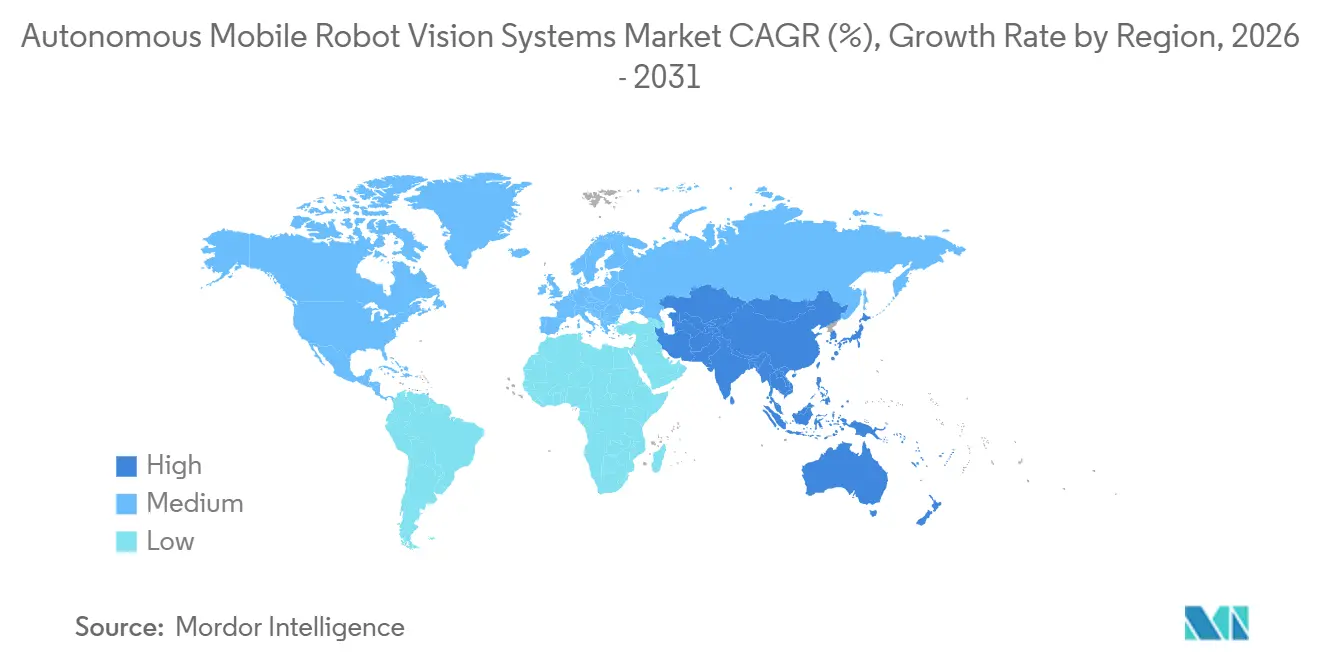
Asia-Pacific held 38.65% of the autonomous mobile robot vision systems market share in 2025. China combines a large AMR customer base with lower-cost production of vision hardware components. Hikvision Robot reached a significant cumulative AMR shipment milestone, with its most recent shipment cohort completed substantially faster than its initial cohort. Japan faces demographic and transport-labor pressures, as reflected in Geekplus’s large-scale Toyota deployment. India and ASEAN countries are emerging demand areas as domestic fulfillment capacity and smart-manufacturing investment expand.
North America and Europe command high per-unit revenue because enterprise contracts often include software and integration services. Warehouse purchases in North America remained strong, following substantial robot purchases in the previous year. Germany remains a key European demand center through automotive and machinery production. Geekplus presented RoboShuttle, and Locus Robotics presented Locus Array at LogiMAT in Stuttgart. The EU Machinery Regulation is making compliance costs more relevant to purchase decisions.
The Middle East and Africa is projected to expand at a 25.16% CAGR through 2031. Logistics infrastructure projects in the UAE and Saudi Arabia support this autonomous mobile robot vision systems market opportunity. A delegation from Abu Dhabi visited AMR Labs’ Dongwon iFarm facility in September 2026 to examine LiDAR-based SLAM and 3D vision capabilities for pharmaceutical manufacturing and distribution infrastructure. South Africa, Nigeria, and Egypt are receiving more attention as logistics density and manufacturing investment develop.

Competitive Landscape
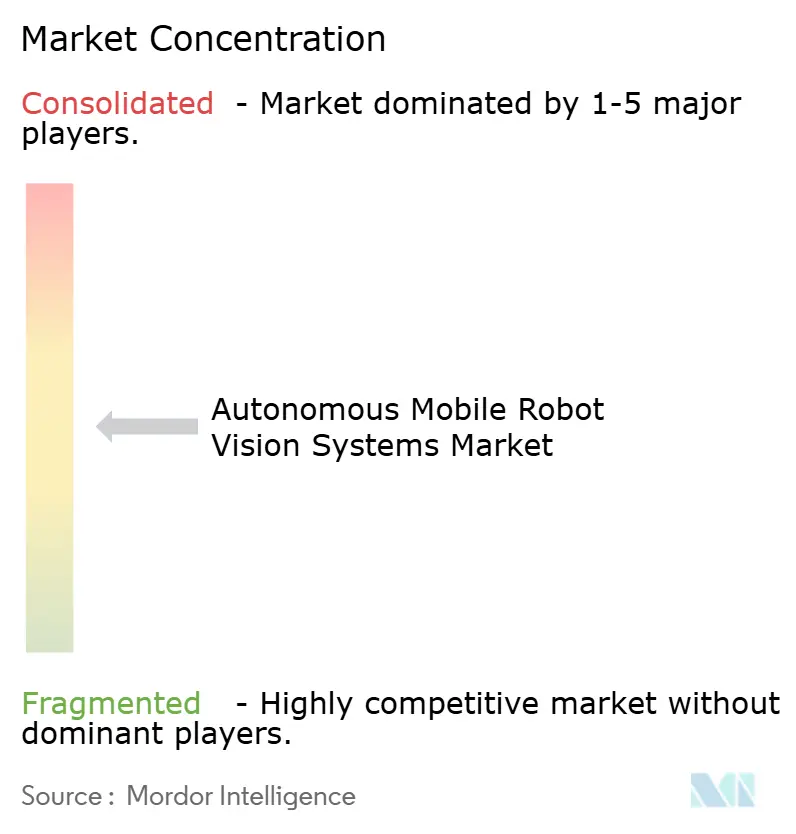
The autonomous mobile robot vision systems market is moderately fragmented at the platform level, while high-volume LiDAR supply is more concentrated. Cognex and Keyence compete through sensor resolution and edge-AI processing capability. Hesai and RoboSense compete through production scale, product performance, and delivery capacity. Hesai had surpassed 2 million cumulative deliveries by 2025 and planned annual capacity above 4 million units in 2026. Proprietary depth-sensing chip designs can create switching costs for structured-light suppliers.
Vendors also compete on deployment models and system integration. Locus Robotics and Geekplus offer subscription-based services that can reduce upfront capital requirements. These arrangements can accelerate fleet expansion but can increase dependence on a vendor’s software ecosystem. Brownfield retrofits and multi-vendor fleet middleware remain important opportunities because many warehouses have not adopted AMRs. Open protocols such as VDA 5050 can support more standardized system connections.
Geekplus deployed its Geek+ Brain platform at Schneider Electric’s Shanghai warehouse in 2026, where it stated that the system doubled manual throughput and became production-ready within 48 hours. ABB’s Flexley Stack F712 added an autonomous forklift to its Visual SLAM AMR portfolio in July 2026. RoboSense brought its E2 solid-state digital LiDAR into full-scale production during 2026. Platforms that maintain accuracy under changing lighting, reflective surfaces, and crowded aisles will have an advantage. Price accessibility will remain important as suppliers seek customers beyond large enterprise facilities.
Autonomous Mobile Robot Vision Systems Industry Leaders
SICK AG
Cognex Corporation
OMRON Corporation
Basler AG
Teledyne Technologies Incorporated
- *Disclaimer: Major Players sorted in no particular order

Recent Industry Developments
- September 2026: An Abu Dhabi healthcare and investment delegation visited AMR Labs' Dongwon iFarm logistics facility in South Korea, examining the facility's LiDAR-based SLAM and advanced 3D vision AMR systems for potential application in Abu Dhabi's pharmaceutical manufacturing and distribution infrastructure, with discussions focused on strategic investment structuring and the establishment of a smart logistics hub in the UAE.
- August 2026: Geekplus launched RoboShuttle Hyper, its next-generation tote-to-person climbing AMR solution optimized for ultra-high throughput and density, targeting fresh food logistics, B2C e-commerce, and micro-fulfillment center applications. The launch extends Geekplus's RoboShuttle portfolio across 3 distinct use-case profiles, Hyper, Air, and Flex, addressing a broader range of operational SKU mixes and throughput requirements.
- July 2026: ABB Robotics launched the Flexley Stack F712, a Visual SLAM-powered autonomous forklift completing its AI-powered AMR portfolio across tugs, movers, and forklifts on a single interoperable navigation platform. Powered by ABB Robotics' AMR Studio, the F712 achieves ±10 mm positioning accuracy and enables up to 20% faster commissioning, and customers can deploy mixed fleets sharing a common fleet management software layer.
- June 2026: Geekplus completed the deployment of 436 mobile AMRs across multiple Toyota manufacturing plants in Japan, with single-system scales reaching 200 units per facility. The deployment, driven by Japan's labor shortages and regulatory constraints on truck-driver working hours, integrates AMR fleet management with plant MES and PLC systems to enable just-in-time intralogistics without human dispatching intervention.


Global Autonomous Mobile Robot Vision Systems Market Report Scope
Autonomous Mobile Robot (AMR) Vision Systems Market refers to camera-based perception and navigation solutions that enable mobile robots to autonomously map, localize, and move through dynamic environments without fixed infrastructure.
The Autonomous Mobile Robot Vision Systems Market Report is Segmented by Component (Hardware, Software, and Services), Vision Technology (2D Vision, Stereo, Structured-Light 3D, ToF, 3D LiDAR, and Other Vision Technologies), Function (Navigation, Obstacle Detection, Object Recognition, Mapping, Path Planning, and Other Functions), Robot Type (Goods-to-Person AMRs, Autonomous Picking AMRs, Tugger / Towing AMRs, Pallet-Transport AMRs, Unit-Load AMRs, and Other Robot Types), End-User Industry (E-commerce, Warehousing, Automotive, Electronics, Food and Beverage, Pharmaceuticals and Healthcare, and Other End-User Industries), and Geography (North America, South America, Europe, Asia-Pacific, Middle East and Africa). The Market Forecasts are Provided in Terms of Value (USD).
| Hardware |
| Software |
| Services |
| 2D Vision Systems |
| Stereo Vision |
| Structured-Light 3D Vision |
| Time-of-Flight (ToF) |
| 3D LiDAR / Laser Vision |
| Other Vision Technologies |
| Navigation and Localization |
| Obstacle Detection and Avoidance |
| Object Detection and Recognition |
| Mapping and Environment Perception |
| Path Planning and Guidance |
| Other Functions |
| Goods-to-Person AMRs |
| Autonomous Picking AMRs |
| Tugger / Towing AMRs |
| Pallet-Transport AMRs |
| Unit-Load AMRs |
| Other Robot Types |
| E-commerce and Retail |
| Warehousing and Logistics |
| Automotive |
| Electronics and Semiconductors |
| Food and Beverage |
| Pharmaceuticals and Healthcare |
| Other End-User Industries |
| North America | United States | |
| Canada | ||
| Mexico | ||
| South America | Brazil | |
| Argentina | ||
| Rest of South America | ||
| Europe | Germany | |
| United Kingdom | ||
| France | ||
| Italy | ||
| Spain | ||
| Rest of Europe | ||
| Asia-Pacific | China | |
| Japan | ||
| India | ||
| South Korea | ||
| ASEAN | ||
| Rest of Asia-Pacific | ||
| Middle East and Africa | Middle East | Saudi Arabia |
| United Arab Emirates | ||
| Turkey | ||
| Rest of the Middle East | ||
| Africa | South Africa | |
| Nigeria | ||
| Egypt | ||
| Rest of Africa | ||
| By Component | Hardware | ||
| Software | |||
| Services | |||
| By Vision Technology | 2D Vision Systems | ||
| Stereo Vision | |||
| Structured-Light 3D Vision | |||
| Time-of-Flight (ToF) | |||
| 3D LiDAR / Laser Vision | |||
| Other Vision Technologies | |||
| By Function | Navigation and Localization | ||
| Obstacle Detection and Avoidance | |||
| Object Detection and Recognition | |||
| Mapping and Environment Perception | |||
| Path Planning and Guidance | |||
| Other Functions | |||
| By Robot Type | Goods-to-Person AMRs | ||
| Autonomous Picking AMRs | |||
| Tugger / Towing AMRs | |||
| Pallet-Transport AMRs | |||
| Unit-Load AMRs | |||
| Other Robot Types | |||
| By End-User Industry | E-commerce and Retail | ||
| Warehousing and Logistics | |||
| Automotive | |||
| Electronics and Semiconductors | |||
| Food and Beverage | |||
| Pharmaceuticals and Healthcare | |||
| Other End-User Industries | |||
| By Geography | North America | United States | |
| Canada | |||
| Mexico | |||
| South America | Brazil | ||
| Argentina | |||
| Rest of South America | |||
| Europe | Germany | ||
| United Kingdom | |||
| France | |||
| Italy | |||
| Spain | |||
| Rest of Europe | |||
| Asia-Pacific | China | ||
| Japan | |||
| India | |||
| South Korea | |||
| ASEAN | |||
| Rest of Asia-Pacific | |||
| Middle East and Africa | Middle East | Saudi Arabia | |
| United Arab Emirates | |||
| Turkey | |||
| Rest of the Middle East | |||
| Africa | South Africa | ||
| Nigeria | |||
| Egypt | |||
| Rest of Africa | |||


Key Questions Answered in the Report
What is the size of the autonomous mobile robot vision systems market?
The market size is projected to increase from USD 302.61 million in 2026 to USD 903.79 million by 2031, at a 24.46% CAGR.
What is driving adoption of autonomous mobile robot vision systems?
E-commerce fulfillment needs, warehouse labor constraints, edge AI, and flexible manufacturing are supporting adoption.
Which component leads revenue in autonomous mobile robot vision systems?
Hardware led with 62.33% revenue share in 2025, while software is projected to expand fastest at a 24.92% CAGR.
Which vision technology is expanding fastest for AMRs?
Structured-light 3D vision is expected to expand at a 25.11% CAGR through 2031, supported by precision picking needs.
Which end users are adopting vision-equipped AMRs most quickly?
Pharmaceuticals and healthcare is projected to expand at a 24.77% CAGR through 2031, while warehousing and logistics led 2025 revenue.
Which region is expanding fastest for autonomous mobile robot vision systems?
The Middle East and Africa is expected to expand at a 25.16% CAGR through 2031, supported by logistics infrastructure investment.
Page last updated on:





