
Automotive Tappet Market Size and Share
Market Overview
| Study Period | 2020 - 2032 |
|---|---|
| Market Size (2027) | USD 5.23 Billion |
| Market Size (2032) | USD 6.33 Billion |
| Growth Rate (2027 - 2032) | 3.89 % |
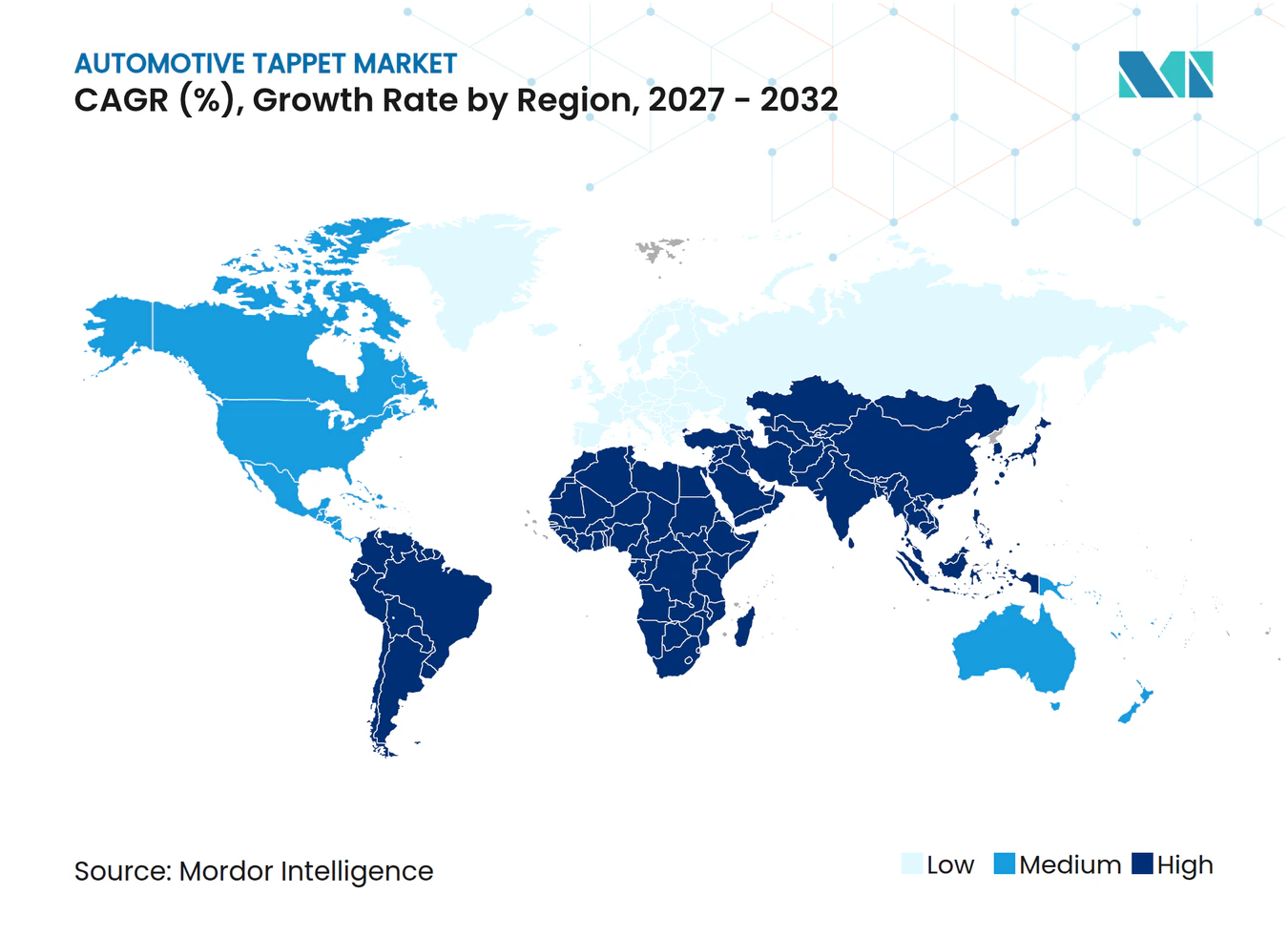
| Fastest Growing Market | South America |
| Largest Market | Asia-Pacific |
| Market Concentration | Medium |
Major Players *Disclaimer: Major Players sorted in no particular order Image © Mordor Intelligence. Reuse requires attribution under CC BY 4.0. | |
Automotive Tappet Market Analysis by Mordor Intelligence
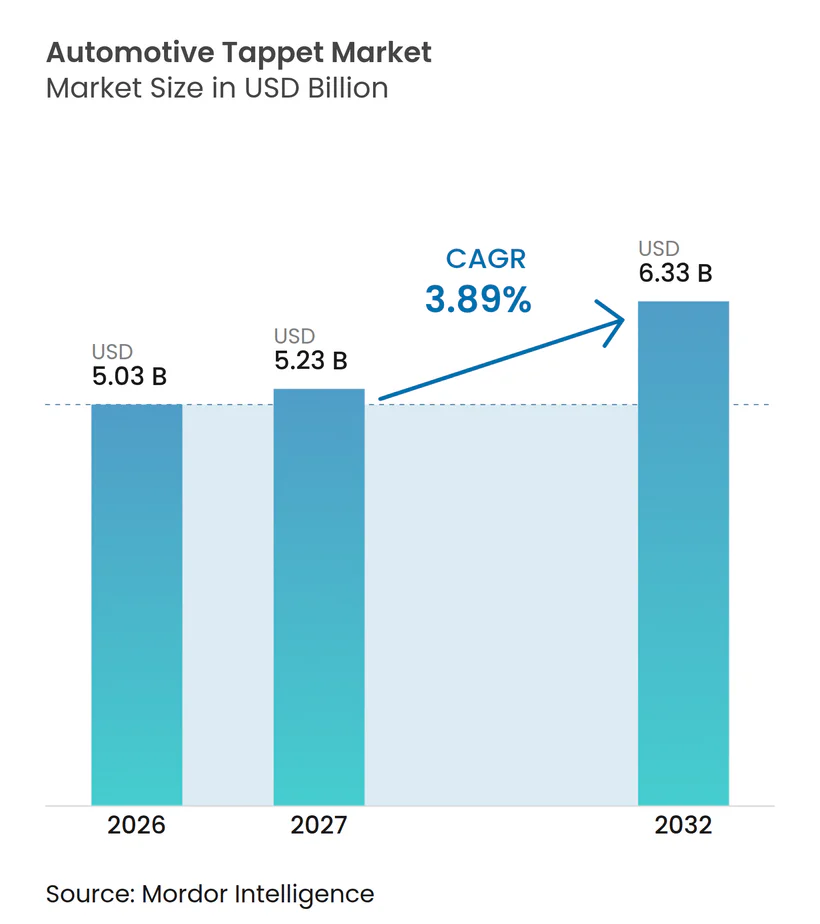
The automotive tappet market size was valued at USD 5.03 billion in 2026 and is expected to grow from USD 5.23 billion in 2027 to USD 6.33 billion by 2032, at a CAGR of 3.89% during 2027-2032. Demand remains linked to internal-combustion and hybrid vehicle production because both powertrains use valvetrain assemblies. Hybrid vehicles retain the engine hardware that requires tappets, even when the engine operates intermittently. Suppliers are therefore focusing on parts that can withstand frequent start-stop cycles, tighter emissions requirements, and longer service intervals. The opportunity is strongest where manufacturers can combine dependable quality with low-friction designs and efficient production. Battery-electric vehicle adoption limits demand in some applications, but hybrids, commercial vehicles, and the replacement channel continue to support the automotive tappet market.
Key Report Takeaways
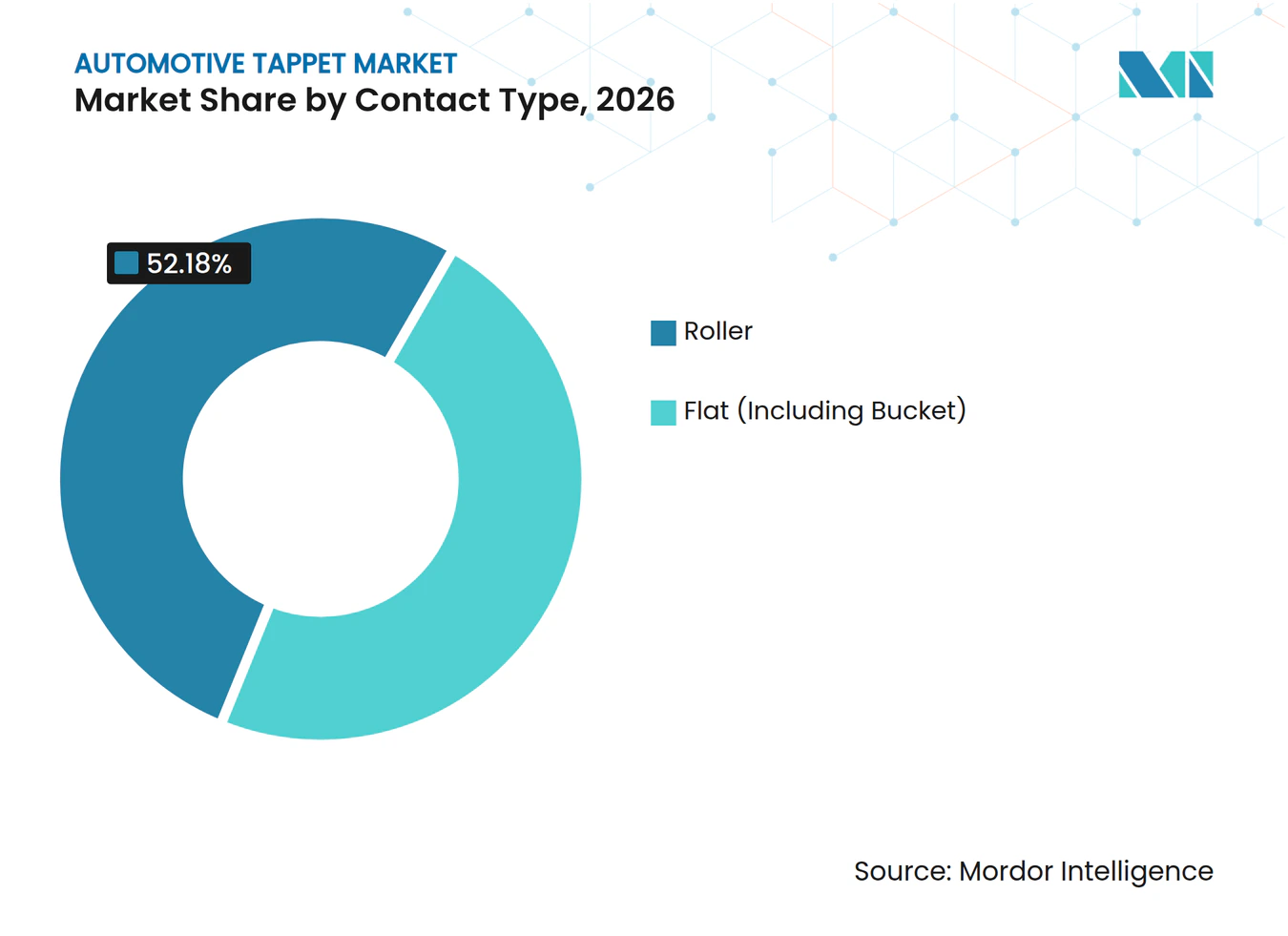
- By contact type, roller tappets held a 52.18% share in 2026 and are projected to grow at a 3.99% CAGR through 2032.
- By adjustment type, hydraulic tappets held a 41.37% share in 2026 and are projected to grow at a 5.19% CAGR through 2032.
- By engine type, gasoline engines held a 61.44% share in 2026, while alternative-fuel engines are projected to grow at a 6.31% CAGR through 2032.
- By valve train, DOHC held a 68.00% share in 2026 and is projected to grow at a 4.30% CAGR through 2032.
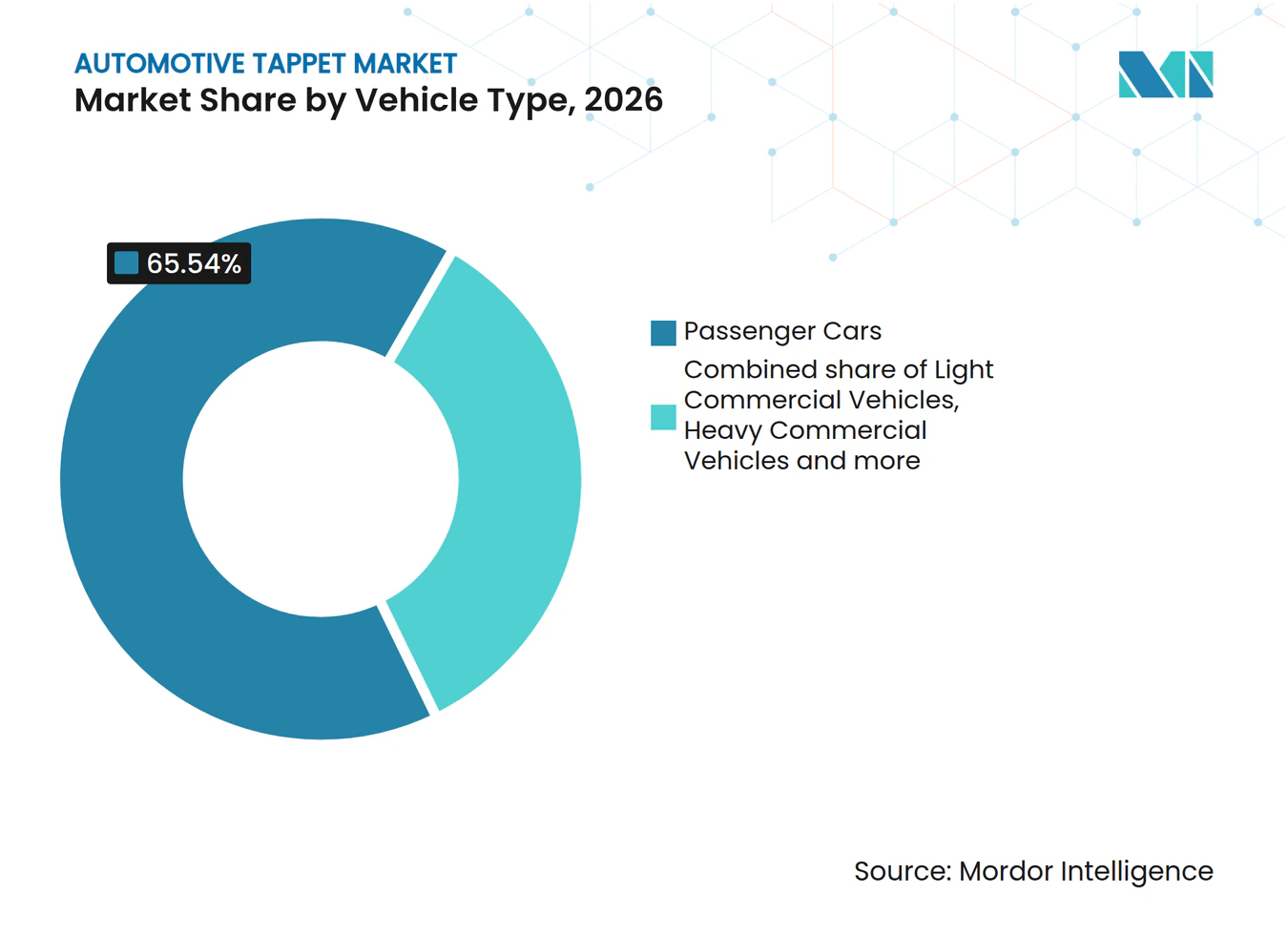
- By vehicle type, passenger cars held a 65.54% share in 2026, while heavy commercial vehicles are projected to grow at a 5.36% CAGR through 2032.
- By sales channel, OEMs held a 74.86% share in 2026, while the aftermarket is projected to grow at a 3.98% CAGR through 2032.
- By geography, Asia-Pacific held a 48.28% share in 2026, while South America is projected to grow at a 4.13% CAGR through 2032.
Note: Market numbers in this report are based on Mordor Intelligence's proprietary estimation framework, which combines nine months of actuals with Q4 projections for base year 2026.
Market Trends and Insights
Drivers Impact Analysis of Automotive Tappet Market*
| Driver | (~) % Impact on CAGR Forecast | Geographic Relevance | Impact Timeline |
|---|---|---|---|
| Rising Global ICE and Hybrid Engine Production | +1.1% | Global, with concentrated impact in Asia-Pacific and North America | Short term (≤ 2 years) |
| Tightening Emissions and Fuel-Economy Requirements | +0.8% | Global, with early gains in Europe and North America, extending to India and China | Short term (≤ 2 years) |
| OEM Migration Toward Hydraulic and Roller Tappets | +0.6% | Global | Long term (≥ 4 years) |
| Stop-Start and Hybrid Restart Durability Requirements | +0.5% | North America, Europe, and Japan core, with spillover to Asia-Pacific | Medium term (2–4 years) |
| Aftermarket Replacement and Engine-Rebuild Demand | +0.4% | Global, strongest in South America, Asia-Pacific, and the Middle East and Africa | Medium term (2–4 years) |
| Low-Friction Surface Engineering and DLC Adoption | +0.3% | Global, with technology origin in Europe, Japan, and China | Long term (≥ 4 years) |
| Source: Mordor Intelligence | |||
Rising Global ICE and Hybrid Engine Production
Hybrid production supports the automotive tappet market because a hybrid vehicle still depends on a combustion engine and its valvetrain. Combined sales of hybrids, plug-in hybrids, and battery electric vehicles reached 22% of total U.S. light-duty sales in 2025[1]. Engine shutdown and restart events can create different operating demands for internal components. Automakers need tappets that perform consistently through changes in oil pressure and temperature. Hybrid powertrains can also extend the use of combustion-engine programs while vehicle makers offer more electric models. This creates a mixed demand pattern across regions. Suppliers that serve original-equipment programs and the replacement needs of vehicles in service can better manage changing production patterns and benefit from the shift toward more demanding component specifications.
Tightening Emissions and Fuel-Economy Requirements
Emissions rules encourage automakers to reduce friction and improve the consistency of valve operation. Regulation (EU) 2024/1257 establishes the Euro 7 type-approval framework for vehicles and engines in the European Union[2]. These requirements increase the value placed on precise parts that help engines operate predictably under changing conditions. Suppliers can respond by carefully controlling dimensions, materials, and surface finish. Vehicle manufacturers often review tolerances, lubrication behavior, and thermal performance while updating engines for compliance. This can extend qualification cycles and increase attention to documented quality systems. It may also favor established suppliers that can collaborate closely with engine development teams and demonstrate repeatable process capability.
OEM Migration Toward Hydraulic and Roller Tappets
Hydraulic and roller designs address manufacturer priorities that include lower friction, reduced maintenance, and dependable valve motion. Roller tappets use rolling contact where suitable, while hydraulic versions use oil pressure to manage valve clearance. These features support their use in advanced gasoline, diesel, and hybrid engine programs. The shift does not remove demand for flat and mechanical designs because older engines, specialist vehicles, and replacement channels retain different requirements. Even so, higher-value opportunities increasingly favor products designed for more complex engine architecture. Material selection, coatings, and repeatable production are therefore more important in supplier selection. Companies that can validate their capability and assist with development work may build a stronger position in the automotive tappet market.
Stop-Start and Hybrid Restart Durability Requirements
Stop-start systems and hybrid operation increase the need for durability during engine restarts. A restart can briefly change lubrication conditions before full oil pressure is restored, placing added demands on tappet surfaces and movement. Vehicle manufacturers therefore seek designs that resist wear across varied temperatures and driving patterns. Stronger surface treatments, carefully managed lubrication paths, and suitable materials can help meet this need. A component that works well in a conventional engine may require further refinement for a hybrid application. This favors suppliers with testing capability and the capacity to support customer validation work. It can also distinguish certified products from lower-specification alternatives. As hybrid programs expand, restart performance will remain an important requirement in the automotive tappet market.
Restraints Impact Analysis of Automotive Tappet Market*
| Restraint | (~) % Impact on CAGR Forecast | Geographic Relevance | Impact Timeline |
|---|---|---|---|
| Battery-Electric Vehicle Penetration Reducing New ICE Tappet Content | -0.5% | Global, with near-term impact concentrated in China and Western Europe | Short term (≤ 2 years) |
| Steel, Alloy, and Precision-Manufacturing Cost Volatility | -0.3% | Global, amplified in North America following 2025 tariff changes | Short term (≤ 2 years) |
| Camless and Electro-Hydraulic Valvetrain Substitution | -0.2% | Europe and North America for premium applications | Long term (≥ 4 years) |
| Oil-Pressure Transients and Lubricant Compatibility Failures | -0.1% | Global, with higher risk in markets with older lubricant infrastructure | Medium term (2–4 years) |
| Source: Mordor Intelligence | |||
Battery-Electric Vehicle Penetration Reducing New ICE Tappet Content
Battery-electric vehicles do not use combustion-engine tappets, so their adoption reduces component content in vehicle applications that move fully to electric propulsion. The effect is strongest where manufacturers and customers shift away from combustion engines most quickly. This makes planning more difficult because the remaining engine programs may become shorter or more selective. Hybrid, commercial, and alternative-fuel applications provide some support, as does replacement demand from combustion vehicles still in service. The change can also alter competition because smaller suppliers may struggle to fund tooling and quality upgrades across a narrower engine base. Larger companies can draw on broader customer relationships and adjacent products. The transition does not remove near-term demand, but it limits the long-term opportunity for conventional tappet suppliers.
Steel, Alloy, and Precision-Manufacturing Cost Volatility
Tappets require carefully selected steel and alloy inputs because the operating environment demands hardness, wear resistance, and dimensional stability. Cost changes can pressure suppliers who cannot readily substitute materials or revise customer contracts. Smaller manufacturers may be especially exposed because they have less purchasing scale and limited inventory flexibility. Precision production adds further cost through specialized tooling, inspection, and process control. Vehicle manufacturers also expect reliable delivery, which limits aggressive material changes. These conditions can make production planning and working-capital management more difficult. Suppliers with established sourcing arrangements, integrated operations, and disciplined quality systems may handle these pressures more effectively than smaller regional competitors. The automotive tappet market remains exposed to these constraints even when vehicle demand is stable.
*Our forecasts treat driver/restraint impacts as directional, not additive. The impact forecasts reflect baseline growth, mix effects, and variable interactions.
Automotive Tappet Market Segment Analysis
By Contact Type:
Roller Designs Hold the Leading PositionRoller tappets held a 52.18% share of the automotive tappet market in 2026 and are projected to grow at a 3.99% CAGR through 2032. Their design uses rolling contact between the tappet and camshaft, which supports lower friction in suitable engine configurations. Vehicle manufacturers use this approach when they need reliable valve motion and better wear behavior. Roller designs are relevant to modern gasoline and diesel engines, particularly in applications with more demanding performance requirements. Their position also reflects the value that automakers place on components with consistent behavior over the engine life.
Flat tappets retain a role in older engine families, cost-sensitive applications, and parts replacement. Their simpler design can be appropriate where the original engine architecture was developed around sliding contact. Surface treatments and material improvements can help maintain performance in these applications. The competitive difference between contact types is therefore not only a question of friction, but also one of engine compatibility and service requirements. The automotive tappet market continues to support both designs because the global vehicle base includes many different engine generations. Purchasing decisions also depend on the availability of matching camshaft parts, established repair knowledge, and the practical cost of rebuilding an older engine. This keeps the contact-type mix varied across vehicle fleets and repair channels.



By Adjustment Type:
Hydraulic Systems Support Low-Maintenance OperationHydraulic tappets held a 41.37% share of the automotive tappet market in 2026 and are projected to grow at a 5.19% CAGR through 2032. They use engine oil pressure to adjust valve clearance, which can reduce the need for manual service. This makes them attractive to manufacturers that want stable operation over a long service interval. Hydraulic systems are commonly associated with passenger vehicles and other applications that prioritize convenience and reduced mechanical noise. Their growth reflects the gradual movement toward more refined engine designs.
Mechanical tappets remain important when a fixed-adjustment approach is preferred for the operating conditions of a specific engine. They can be used in performance applications, older designs, and heavy-duty settings where maintenance practices differ. The choice between hydraulic and mechanical systems depends on engine architecture, expected use, and the manufacturer’s service approach. Replacement demand also supports mechanical products because many existing vehicles were designed around them. As a result, the automotive tappet industry serves both modern low-maintenance platforms and the installed base of older engines. Manufacturers must protect consistent oil-flow performance and dimensional accuracy because small deviations can affect valve timing and operating noise. That requirement keeps technical capability relevant across both adjustment approaches.
By Engine Type:
Alternative-Fuel Engines Expand from a Smaller BaseGasoline engines held a 61.44% share of the automotive tappet market in 2026, while alternative-fuel engines are projected to grow at a 6.31% CAGR through 2032. Gasoline remains the largest application because it is widely used across passenger vehicle production. Alternative-fuel engines require valvetrain components that can handle varying combustion conditions and fuel characteristics. This can create a need for specialized materials and careful validation. The automotive tappet market therefore has exposure to both established gasoline programs and newer combustion pathways.
Diesel engines continue to matter in applications that require high torque, long operating periods, or established fleet service practices. Alternative-fuel vehicles, including those using gaseous or alcohol-based fuels, can extend the role of combustion technology in selected transport segments. The component requirements in these engines may differ because heat, corrosion, and lubrication conditions are not identical to those in gasoline engines. Suppliers that understand these differences can support a broader range of customer programs. This diversity lowers reliance on any single fuel type while keeping engineering requirements relevant. It also means that suppliers must understand the local fuel environment and the expected operating pattern of each vehicle category. Careful application engineering becomes important when engines are designed for different fuel properties.
By Valve Train:
DOHC Architecture Remains Central to Modern EnginesDOHC configurations held a 68.00% share of the automotive tappet market in 2026 and are projected to grow at a 4.30% CAGR through 2032. This architecture is widely used in modern engines because it supports flexible valve control and compact engine design choices. Its use in passenger cars and light commercial vehicles gives it a broad production base. A DOHC engine can also require a more elaborate valvetrain arrangement than some simpler alternatives. That makes the configuration an important source of demand for precision tappet components.
SOHC configurations continue to serve a wide range of compact and entry-level vehicle applications. OHV engines remain relevant in selected truck, sport utility vehicle, and specialty applications where packaging and torque characteristics are important. Each architecture creates different requirements for tappet design, durability, and manufacturing precision. Suppliers must therefore match products to the engine's technical needs rather than rely on a single approach. The automotive tappet market remains diverse because vehicle manufacturers continue to use multiple valvetrain layouts across their portfolios. The same supplier may need to support different tooling and inspection routines for each layout. That operational breadth can be a barrier for companies seeking to enter established original-equipment programs.
By Vehicle Type:
Passenger Cars Provide the Largest Demand BasePassenger cars held a 65.54% share of the automotive tappet market in 2026, while heavy commercial vehicles are projected to grow at a 5.36% CAGR through 2032. Passenger car demand reflects the large global fleet and the continued use of gasoline and hybrid engines. In this category, suppliers compete on quality, noise control, durability, and efficient manufacturing. The installed passenger car base also contributes to future replacement needs. This combination keeps the category important even as propulsion choices evolve.
Heavy commercial vehicles need durable engine components because they operate under demanding load conditions and long service cycles. Their transition away from combustion power is likely to follow a different pattern from passenger cars because vehicle duty, range needs, and refueling arrangements vary. Light commercial vehicles and two-wheelers also create demand in regions with active repair markets and large numbers of smaller engines. Each vehicle category has a different balance of original-equipment production and replacement activity. Suppliers that can adapt to these differences can access several demand pools within the automotive tappet market. They also need to recognize that fleet operators, private motorists, and vehicle assemblers make decisions on different time frames. Product durability and service availability can be as important as initial component cost.

By Sales Channel:
Original Equipment Remains the Primary Route to MarketOEM channels held a 74.86% share of the automotive tappet market in 2026, while the aftermarket is projected to grow at a 3.98% CAGR through 2032. Original-equipment business depends on supplier qualification, consistent quality, and dependable delivery. These requirements tend to favor companies that can meet strict production and validation standards. OEM relationships also give suppliers insight into new engine programs and changing technical requirements. This makes the channel central to long-term product development.
The aftermarket serves vehicles that need repair, engine rebuilding, or replacement parts during their operating life. Its demand is shaped by vehicle age, workshop practices, and the availability of compatible components. Customers in this channel may value improved coatings or durability features when they expect extended use. At the same time, price remains important in many replacement markets. The automotive tappet industry must therefore balance certified premium offerings with products that remain accessible for independent repair channels. Packaging, catalog coverage, and dependable local distribution can influence replacement purchases as strongly as product design. A broad service network can help a supplier retain relevance after an original vehicle warranty expires.
Geography Analysis
Asia-Pacific
Asia-Pacific held a 48.28% share of the automotive tappet market in 2026. The region combines large vehicle production bases with a broad range of engine types, from small passenger vehicles to commercial fleets. China and India support demand through their scale, while Japan contributes advanced component engineering and long-standing supplier capability. South Korea, Indonesia, and Thailand add manufacturing and replacement-market demand. The automotive tappet market in the region is supported by the coexistence of conventional engines, hybrids, and alternative-fuel applications. This variety gives suppliers several paths to serve vehicle manufacturers and repair customers. It also increases the importance of local production, technical support, and the ability to meet varied application requirements. Local suppliers can benefit when they understand the needs of regional assemblers and repair networks. International suppliers remain important when vehicle manufacturers require common specifications across several countries.
North America and Europe
North America remains important because trucks, sport utility vehicles, and commercial applications retain demand for durable engine parts. The region also has established replacement channels that support vehicles over extended service lives. Europe faces stronger pressure from battery-electric vehicle adoption, but it continues to influence component specifications through emissions rules and advanced engine engineering. Manufacturing centers in Germany and Central and Eastern Europe retain roles in the broader vehicle supply chain. Regional demand therefore varies by vehicle mix, regulatory direction, and the speed of propulsion change. Replacement networks remain particularly relevant where vehicles are kept in service for longer periods. Suppliers must also account for differences in climate, fuel quality, road use, and workshop practices when planning regional portfolios. These conditions influence service intervals and the products that distributors choose to stock. Strong technical communication can help suppliers adapt global designs to local operating conditions.
South America and Middle East and Africa
South America is projected to grow at a 4.13% CAGR through 2032. Brazil supports the region through its role in vehicle production and its use of flex-fuel technology. Argentina and Colombia add demand through commercial vehicles, repair activity, and local assembly. The Middle East and Africa are supported by fleet vehicles, established repair needs, and a growing base of aging vehicles. Across these regions, the automotive tappet market is shaped as much by replacement demand and service conditions as by new vehicle production. Vehicle owners and repair shops often prioritize a dependable fit and ready availability when choosing replacement components. These factors can support local distributors and established brands with good technical support. Fleet operators may also place a high value on predictable downtime and availability of replacement parts. That can make dependable service arrangements a significant source of differentiation in developing vehicle markets. Suppliers that maintain compatible product ranges, clear application information, and timely local delivery can build credibility with workshops and distributors.
Competitive Landscape
Market Concentration
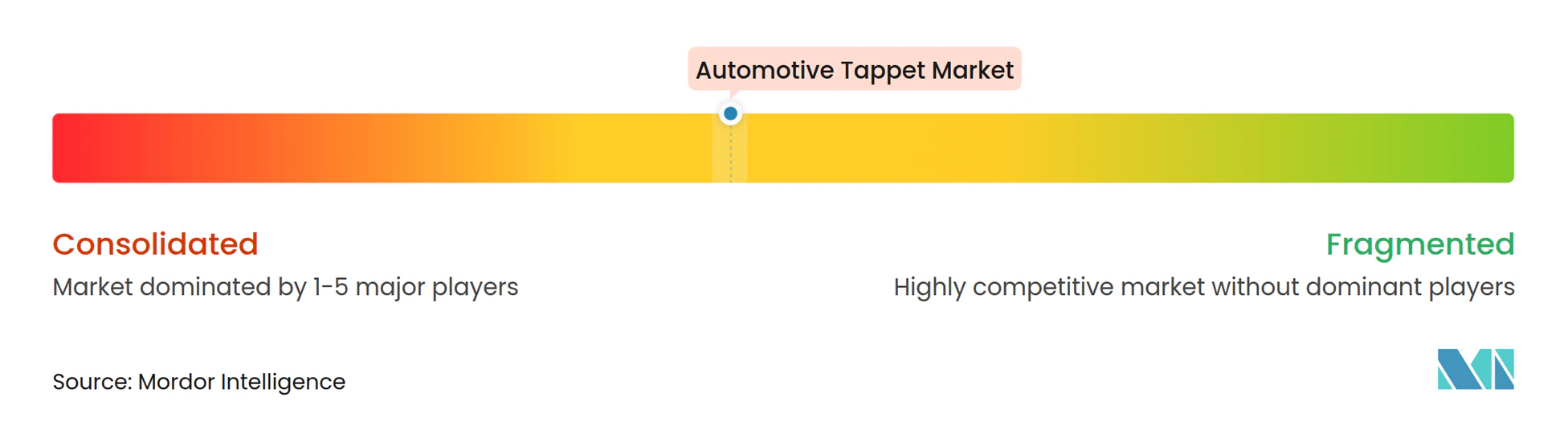
The automotive tappet market is moderately concentrated, with major suppliers serving original-equipment customers and smaller firms competing in regional or replacement channels. Leading companies include Schaeffler AG, Tenneco Inc., Eaton Corporation plc, MAHLE GmbH, and Otics Corporation. Competition is shaped by manufacturing accuracy, material capability, customer qualification, and the ability to supply large engine programs consistently. Smaller suppliers can compete effectively where cost, local availability, or specialist engine knowledge is important. Larger firms hold an advantage when customers need integrated valvetrain support and established quality systems. Their scale can support testing, documentation, and long-term supply planning across several vehicle programs. Regional specialists remain relevant where they offer close customer service or expertise in particular engine families. Their knowledge of local repair practices can be valuable in the aftermarket.
Schaeffler has continued to invest in valvetrain capability through its production network and product development work. In August 2026, the company said it had added Ingolstadt to support HEMI roller tappet production at its Hirschaid plant to address renewed demand, mainly from North America. The move illustrates how suppliers can adjust capacity when specific engine programs remain commercially important. It also shows the value of maintaining manufacturing flexibility across multiple facilities. Such investments can strengthen relationships with automakers that require dependable supply of specialized components. They can also make it easier to align production capacity with changes in customer demand without interrupting supply. The strategy illustrates the importance of operational continuity in the automotive tappet market. It reflects a competitive environment in which vehicle manufacturers expect suppliers to respond to program changes with limited disruption. Investment decisions are therefore closely tied to customer confidence and long-term supply commitments.
In April 2025, Tenneco completed a strategic investment by Apollo Funds and American Industrial Partners in its Clean Air and Powertrain businesses to fund growth and potential acquisitions. This type of funding can support engineering, production, and customer-service capabilities across the powertrain supply base. Companies also compete through coatings, hydraulic lash control, and product designs that suit cylinder-deactivation and hybrid engine applications. Competitive outcomes will depend on each company’s ability to support changing engine programs and provide dependable service. No single supplier controls the full range of vehicle applications or replacement channels. Product portfolios differ by engine type, customer region, and route to market. This leaves room for well-positioned competitors even when the largest firms hold important original-equipment relationships.
Automotive Tappet Industry Leaders
-
Schaeffler AG
-
Tenneco Inc.
-
Eaton Corporation plc
-
MAHLE GmbH
-
Otics Corporation
- *Disclaimer: Major Players sorted in no particular order
Automotive Tappet Market Companies Covered in this Report
- Schaeffler AG
- Eaton Corporation plc
- Tenneco Inc.
- Rane Holdings Limited
- Holley Inc.
- Crower Cams and Equipment Company, Inc.
- Competition Cams, Inc.
- Rhoads Lifters, Inc.
- Melling Engine Parts, Inc.
- Otics Corporation
- Wuxi Xizhou Machinery Co., Ltd.
- SM Motorenteile GmbH
- Hangzhou XZB Tech Co., Ltd.
- Mianyang Fulin Precision Co., Ltd.
- MAHLE GmbH
- NSK Ltd.
- Musashi Seimitsu Industry Co., Ltd.
- Tsubaki Nakashima Co., Ltd.
- GT Technologies, Inc.
Recent Industry Developments in Automotive Tappet Market
- September 2026: General Motors unveiled its sixth-generation Small Block V8 engines, the 5.7-liter L76 and 6.6-liter L78, to be built in Flint, Tonawanda, and St. Catharines for the 2027 Chevrolet Silverado 1500 and GMC Sierra 1500.
- August 2026: Schaeffler added its Ingolstadt plant to support HEMI roller tappet production at Hirschaid, which has made 160 million HEMI roller tappets over 25 years, to meet higher North American demand.
- January 2026: Eaton announced plans to spin off its Mobility Group, which includes its global valve actuation business, as an independent public company by the end of the first quarter of 2027.
- January 2026: Stellantis said it plans to build more than 100,000 HEMI V8 engines in 2026, over three times its 2025 output, raising demand for roller tappets.
Global Automotive Tappet Market Report Scope
The Automotive Tappet Market Report is Segmented by Contact Type (Flat (Including Bucket) and Roller), Adjustment Type (Hydraulic and Mechanical (Solid)), Engine Type (Gasoline, Diesel, and Alternative Fuel), Valve Train (OHV, SOHC, and DOHC), Vehicle Type (Passenger Cars, Light Commercial Vehicles, Heavy Commercial Vehicles, and Two-Wheelers), Sales Channel (OEM and Aftermarket), and Geography (North America, Europe, Asia-Pacific, South America, and Middle East and Africa). The Market Forecasts are Provided in Terms of Value (USD) and Volume (Units).
Segmentation Overview
| Flat (Including Bucket) |
| Roller |
| Hydraulic |
| Mechanical (Solid) |
| Gasoline |
| Diesel |
| Alternative Fuel |
| OHV |
| SOHC |
| DOHC |
| Passenger Cars |
| Light Commercial Vehicles |
| Heavy Commercial Vehicles |
| Two-Wheelers |
| OEM |
| Aftermarket |
| North America | United States |
| Canada | |
| Mexico | |
| Europe | Germany |
| United Kingdom | |
| France | |
| Italy | |
| Spain | |
| Russia | |
| Rest of Europe | |
| Asia-Pacific | China |
| India | |
| Japan | |
| South Korea | |
| Indonesia | |
| Thailand | |
| Rest of Asia-Pacific | |
| South America | Brazil |
| Argentina | |
| Colombia | |
| Rest of South America | |
| Middle East and Africa | Saudi Arabia |
| United Arab Emirates | |
| Turkey | |
| South Africa | |
| Egypt | |
| Rest of Middle East and Africa |
| By Contact Type | Flat (Including Bucket) | |
| Roller | ||
| By Adjustment Type | Hydraulic | |
| Mechanical (Solid) | ||
| By Engine Type | Gasoline | |
| Diesel | ||
| Alternative Fuel | ||
| By Valve Train | OHV | |
| SOHC | ||
| DOHC | ||
| By Vehicle Type | Passenger Cars | |
| Light Commercial Vehicles | ||
| Heavy Commercial Vehicles | ||
| Two-Wheelers | ||
| By Sales Channel | OEM | |
| Aftermarket | ||
| By Geography | North America | United States |
| Canada | ||
| Mexico | ||
| Europe | Germany | |
| United Kingdom | ||
| France | ||
| Italy | ||
| Spain | ||
| Russia | ||
| Rest of Europe | ||
| Asia-Pacific | China | |
| India | ||
| Japan | ||
| South Korea | ||
| Indonesia | ||
| Thailand | ||
| Rest of Asia-Pacific | ||
| South America | Brazil | |
| Argentina | ||
| Colombia | ||
| Rest of South America | ||
| Middle East and Africa | Saudi Arabia | |
| United Arab Emirates | ||
| Turkey | ||
| South Africa | ||
| Egypt | ||
| Rest of Middle East and Africa | ||
Key Questions Answered in the Report
What is driving demand for automotive tappets?
Continued combustion-engine and hybrid vehicle production supports demand because both use valvetrain components. Tighter emissions requirements also increase attention to precision, friction control, and repeatable performance through long service intervals. Hybrid restart cycles make durability and lubrication performance especially important.
How large is the automotive tappet market?
The automotive tappet market is expected to reach USD 6.33 billion by 2032, from USD 5.23 billion in 2027, at a CAGR of 3.89%. The outlook reflects continuing combustion and hybrid engine demand, alongside the limiting effect of battery-electric vehicle adoption in some applications.
Which tappet contact design leads demand?
Roller tappets lead by contact type, holding a 52.18% share in 2026. Their design supports lower friction and dependable operation in suitable engine platforms. Flat tappets remain relevant in older engine families, specialist applications, and replacement programs where compatibility is important.
Why are hydraulic tappets gaining attention?
Hydraulic tappets held a 41.37% share in 2026 and have the highest forecast growth in their category. They support automatic valve-clearance adjustment and lower maintenance needs. This makes them suitable for vehicle manufacturers that seek refined engine behavior and longer service intervals.