
Automotive Tailgate Market Size and Share
Market Overview
| Study Period | 2020 - 2032 |
|---|---|
| Market Size (2027) | USD 8.64 Billion |
| Market Size (2032) | USD 11.14 Billion |
| Growth Rate (2027 - 2032) | 5.21 % |
| Fastest Growing Market | Asia-Pacific |
| Largest Market | Asia-Pacific |
| Market Concentration | Medium |
Major Players *Disclaimer: Major Players sorted in no particular order Image © Mordor Intelligence. Reuse requires attribution under CC BY 4.0. | |
Automotive Tailgate Market Analysis by Mordor Intelligence
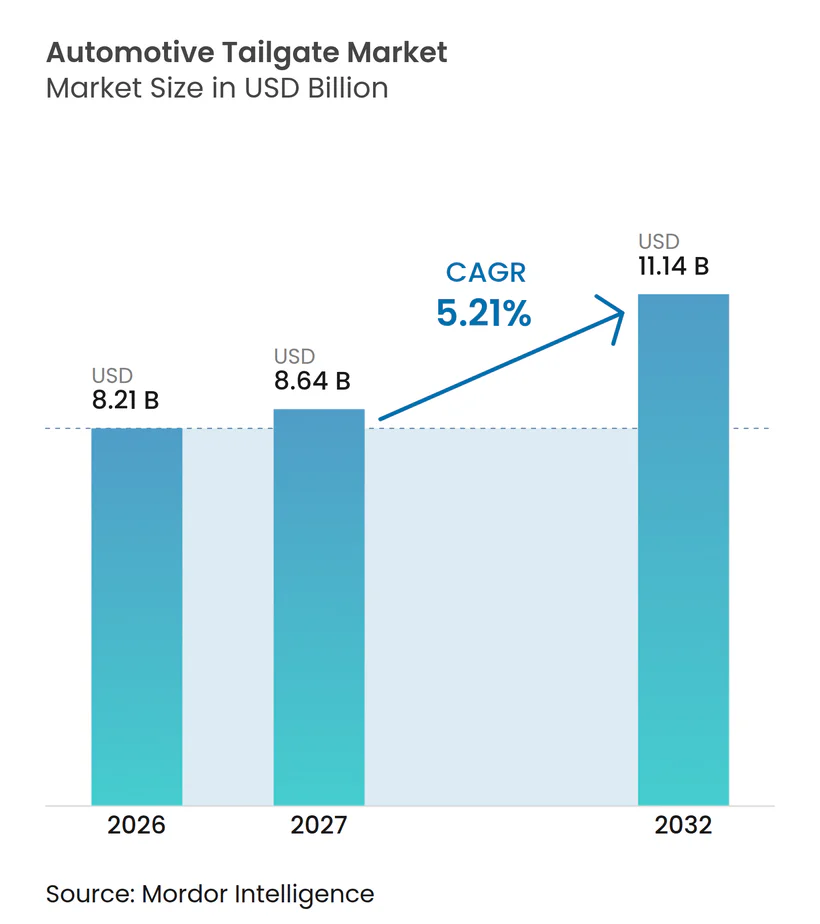
The automotive tailgate market size was valued at USD 8.21 billion in 2026 and is expected to grow from USD 8.64 billion in 2027 to USD 11.14 billion by 2032, at a CAGR of 5.21% during 2027-2032. The automotive tailgate market is moving from a structural body component to a system that integrates panels, latches, motion control, sensors, and electronic controls. Power-operated access is becoming more mainstream in SUV configurations, which increases system value even when vehicle output changes little. Electric vehicle programs also require closer coordination between rear-access hardware and body-control software. Suppliers that can combine mechanical engineering with electronics are better placed to win system-level work. Cost discipline and reliable operation remain essential, as manual solutions remain suitable for many entry-level vehicle programs across several global regions.
Key Report Takeaways
- By type, manual tailgates held a 55.45% share in 2026, while power tailgates, including hands-free systems, are forecast to grow at a 7.27% CAGR through 2032.
- By material, steel held a 62.92% share in 2026, while composites/thermoplastics, including SMC and PP-LGF, are forecast to grow at a 9.36% CAGR through 2032.
- By component, tailgate panels/modules held a 36.00% share in 2026, while actuators/ECUs are forecast to grow at a 6.97% CAGR through 2032.
- By vehicle type, SUVs and crossovers held a 60.92% share in 2026 and are forecast to grow at a 6.18% CAGR through 2032.
- By sales channel, OEM held a 73.83% share in 2026, while aftermarket is forecast to grow at a 6.77% CAGR through 2032.
- By geography, Asia-Pacific held a 44.62% share in 2026 and is forecast to grow at a 6.50% CAGR through 2032.
Note: Market numbers in this report are based on Mordor Intelligence's proprietary estimation framework, which combines nine months of actuals with Q4 projections for base year 2026.
Market Trends and Insights
Drivers Impact Analysis of Automotive Tailgate Market*
| Driver | (~) % Impact on CAGR Forecast | Geographic Relevance | Impact Timeline |
|---|---|---|---|
| Expansion of Power Tailgate Fitment Across SUVs and Crossovers | +1.4% | Global (Asia-Pacific core, spill-over to North America and Europe) | Short term (≤ 2 years) |
| Growth of Electric Vehicles Requiring Software-Integrated Rear Access | +1.1% | Asia-Pacific (China core), North America and Europe | Medium term (2–4 years) |
| Increasing Demand for Cargo Convenience and Hands-Free Access | +0.9% | North America, Europe, Asia-Pacific | Short term (≤ 2 years) |
| Rising Premium-Feature Content in Mid-Range Vehicles | +0.7% | Asia-Pacific, Europe | Medium term (2–4 years) |
| Growth of Pickup Multi-Function Tailgates and Utility Features | +0.5% | North America core, spill-over to Middle East and Africa | Long term (≥ 4 years) |
| Lightweighting of Tailgate Modules to Offset Battery and Safety Mass | +0.4% | Global (EV-dominant markets) | Medium term (2–4 years) |
| Source: Mordor Intelligence | |||
Expansion of Power Tailgate Fitment Across SUVs and Crossovers
Power tailgate fitment is extending beyond premium trims as manufacturers seek practical points of difference within crowded SUV and crossover lineups. The change reflects the everyday value of easier rear access for users carrying shopping, sports equipment, or child-care items. A power system also gives vehicle brands a visible convenience feature that can be offered across several trim levels. Brose presented a smart concept vehicle at Auto Shanghai in April 2025 that combines intelligent vehicle access with adaptive interior functions, including sensor-based opening of closures[1]. The automotive tailgate market benefits when these functions can draw on sensing hardware already used for digital keys or occupant detection. Broader fitment will still depend on suppliers delivering systems that meet vehicle cost and durability requirements.
Growth of Electric Vehicles Requiring Software-Integrated Rear Access
Electric vehicle programs foster a closer integration between rear-access systems and the vehicle's broader electronic architecture. Tailgate controls increasingly need to work with body-control software, digital access functions, and vehicle updates. This places more value on suppliers that can validate hardware and software together for a specific platform. Brose presented a concept that combines intelligent vehicle access with in-vehicle sensing, showing how vehicle software can reduce the amount of dedicated hardware needed. The automotive tailgate market therefore has opportunities in controllers and sensing systems, not only in physical liftgate structures. Manufacturers must also make sure that these systems remain easy to service after the vehicle is sold.
Increasing Demand for Cargo Convenience and Hands-Free Access
Hands-free access is becoming more relevant as drivers expect practical cargo access without handling keys or controls. This is especially useful when users approach a vehicle with both hands occupied. Sensor quality matters because poor detection can turn a convenience feature into a source of frustration. Huf announced a first series-production order in May 2025 for a 79 GHz radar kick sensor with a configurable detection range[2]. The announcement indicates that gesture recognition is moving toward more adaptable sensing for rear-access applications. The automotive tailgate market can benefit from sensors that operate reliably in rain and other challenging conditions.
Rising Premium-Feature Content in Mid-Range Vehicles
Vehicle makers are gradually bringing selected convenience features from flagship models into mid-range programs. Tailgate operation is a suitable example because it offers a clear user benefit without changing the vehicle's basic purpose. The move requires suppliers to offer simpler system configurations that keep the feature affordable. Shared electronics and modular actuators can help spread development costs across several vehicle programs. This pattern supports broader adoption of power tailgates while maintaining the role of manual designs in cost-sensitive models. The automotive tailgate market will remain shaped by the ability to balance equipment content with local vehicle price expectations.
Restraints Impact Analysis of Automotive Tailgate Market*
| Restraint | (~) % Impact on CAGR Forecast | Geographic Relevance | Impact Timeline |
|---|---|---|---|
| High System Cost and Limited Feature Affordability in Entry-Level Vehicles | -0.9% | Emerging markets (India, Southeast Asia, South America) | Short term (≤ 2 years) |
| Actuator, Sensor, and Electronic Reliability Under Temperature, Vibration, and Contamination | -0.7% | Global | Medium term (2–4 years) |
| Complex Calibration and Integration With Vehicle Body-Control Architectures | -0.5% | North America, Europe | Medium term (2–4 years) |
| Aftermarket Fitment, Repairability and Replacement-Part Fragmentation | -0.3% | Global | Long term (≥ 4 years) |
| Source: Mordor Intelligence | |||
High System Cost and Limited Feature Affordability in Entry-Level Vehicles
A powered tailgate requires more than a motor; it also needs electronic controls, sensors, latching, wiring, and vehicle integration. That makes it harder to include in entry-level vehicles with tightly controlled material budgets. The constraint is strongest where vehicle affordability is the main purchase consideration. Suppliers can reduce cost with shared modules and simplified configurations, but they must preserve safe operation and acceptable opening performance. Manual tailgates therefore continue to meet the needs of many high-volume programs. The automotive tailgate market will expand more evenly when cost-reduced systems become feasible across a wider range of vehicles.
Actuator, Sensor, and Electronic Reliability Under Temperature, Vibration, and Contamination
Rear closure systems work in a difficult location that is exposed to water, dirt, vibration, and changing temperatures. Actuators, sensors, and electrical connections must continue to work through repeated opening cycles over the life of the vehicle. Manufacturers also require safe obstacle detection and consistent closing behavior. These validation demands lengthen development work and can limit the speed at which new suppliers enter vehicle programs. Proven designs and careful vehicle-level testing remain important purchasing criteria. The automotive tailgate market depends on reliability because a failure affects both daily convenience and customer confidence in the vehicle.
*Our forecasts treat driver/restraint impacts as directional, not additive. The impact forecasts reflect baseline growth, mix effects, and variable interactions.
Automotive Tailgate Market Segment Analysis
By Type:
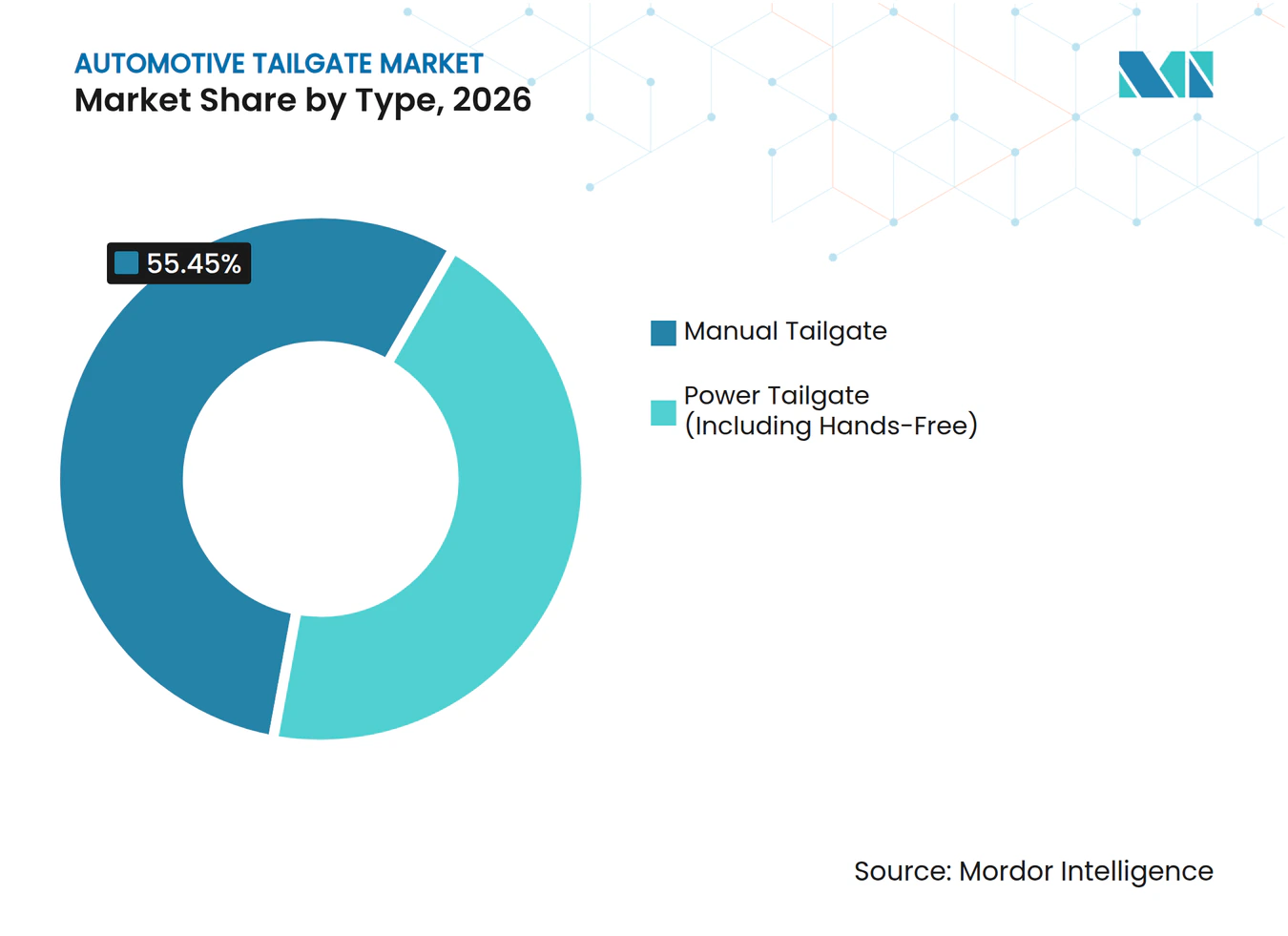
Manual Tailgates Maintain the Broadest Installed BaseManual tailgates held 55.45% of the automotive tailgate market share in 2026, while power tailgates, including hands-free systems, are forecast to grow at a 7.27% CAGR through 2032. Manual systems remain common because they are familiar, direct to operate, and suitable for vehicles with strict equipment budgets. Their mechanical layout supports a wide supplier base for panels, hinges, and latches. They also allow manufacturers to reserve powered access for trims where customers are more likely to value the feature. This gives vehicle brands flexibility when creating product ranges for different price points. The automotive tailgate market continues to need manual solutions because they address durability, cost, and service simplicity.
Power systems are changing the content of a tailgate from a basic closure into a coordinated access feature. They require controls that manage opening speed, load, latch behavior, obstacle detection, and user commands. This increases the importance of integration between component suppliers and vehicle engineering teams. A system must perform consistently despite varying cargo loads, weather conditions, and repeated use. Hands-free operation adds sensing requirements and can make the rear opening more useful in daily situations. The automotive tailgate market is therefore likely to reward suppliers that can make this added functionality dependable without making the system difficult to repair.


By Material:
Steel Retains a Strong Role While Composites Gain RelevanceSteel held 62.92% of the automotive tailgate market share in 2026, while composites/thermoplastics, including SMC and PP-LGF, are forecast to grow at a 9.36% CAGR through 2032. Steel remains established because vehicle makers know its forming behavior and can source it through mature supply networks. It also suits applications that require structural stiffness and repeated loading. Existing manufacturing lines and repair practices further support its continued use. These advantages make steel a practical option across a large part of the vehicle fleet. The automotive tailgate market will not move away from steel quickly because material decisions must consider cost, production methods, and vehicle requirements together.
Composite and thermoplastic systems offer a different approach to managing rear closure weight and part integration. They can enable complex shapes and can combine functions that might otherwise require several separate parts. OPmobility states that its thermoplastic tailgate assembly for Stellantis electric SUVs emits about 20% less carbon dioxide than a conventional steel structure, illustrating the weight and lifecycle benefits of composite designs. This can be useful for electric vehicles, where engineers seek to manage the mass added by batteries and safety equipment. Material choices must also account for repairability, finish quality, production scale, and recycling routes. The automotive tailgate market is likely to use a mix of materials rather than treating one material as suitable for every vehicle or region.
By Component:
Panels Lead Value as Actuators and ECUs Grow FastestTailgate panels/modules held 36.00% of the automotive tailgate market share in 2026, while actuators/ECUs, with about 26.00%, are forecast to grow at a 6.97% CAGR through 2032. Actuator and ECU growth reflects the central role of movement control and electronic coordination within a powered system. The actuator translates electrical input into controlled motion, while the controller manages commands and system behavior. These parts influence the speed, smoothness, safety, and perceived quality of rear access. They also need to communicate effectively with latches, sensors, and vehicle controls. The automotive tailgate market places considerable value on these components because they determine whether advanced access features work as intended.
Panels and modules hold the largest share because every tailgate needs them as the visible and structural part of the rear closure. Struts and spindles guide the motion of a liftgate and directly affect how refined the opening action feels. Latches and locks are also becoming more electronically connected as suppliers add diagnostic and safety functions. Component design needs to account for packaging limits, noise, service access, and the different body styles used by manufacturers. Suppliers that understand interfaces across the system can reduce work for vehicle assembly teams. The automotive tailgate market is becoming more integrated, yet each component category remains important to a vehicle's rear-access experience.
By Vehicle Type:
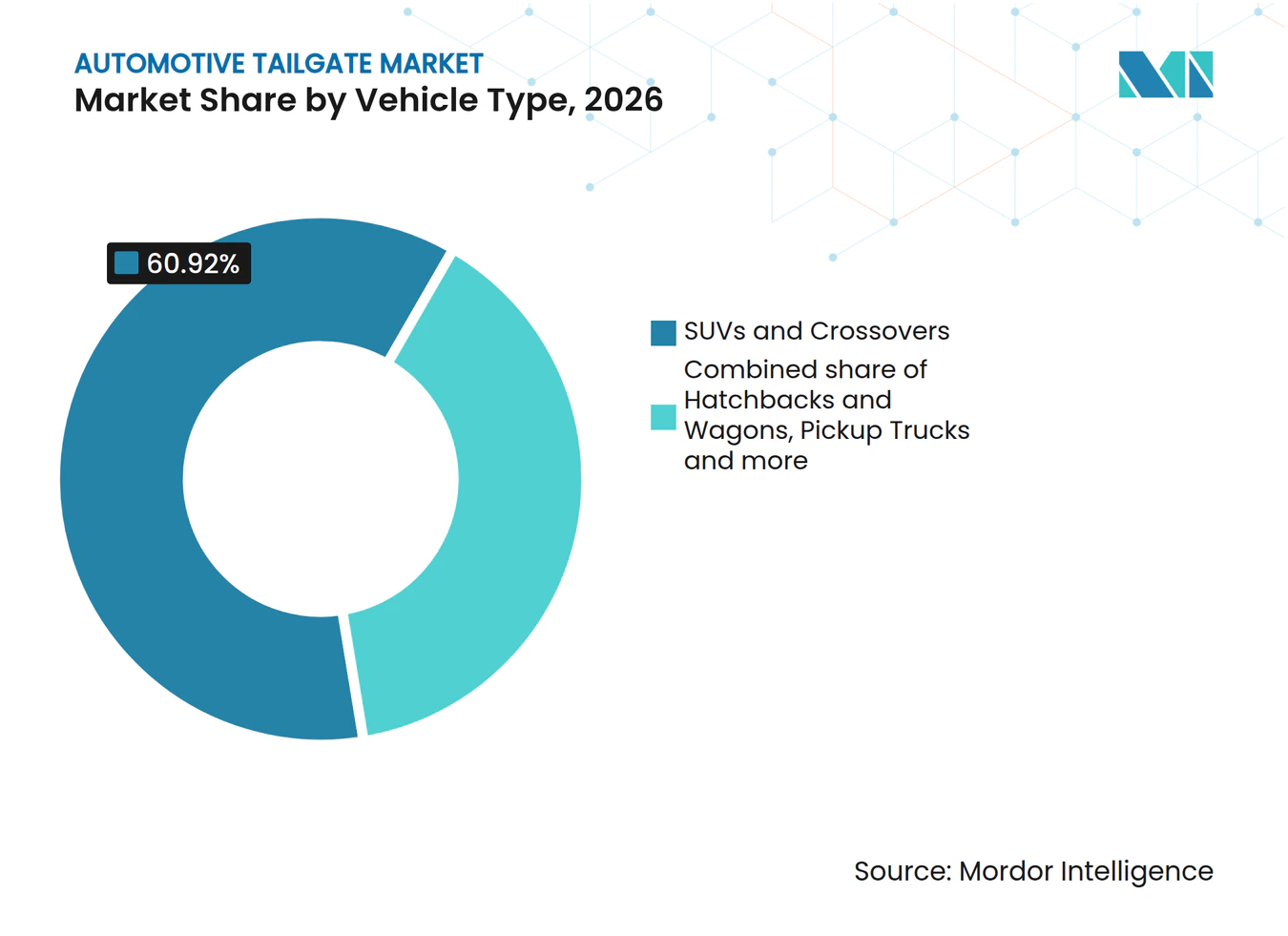
SUVs and Crossovers Set Demand ConditionsSUVs and crossovers held 60.92% of the automotive tailgate market share in 2026 and are forecast to grow at a 6.18% CAGR through 2032. These vehicles often place rear cargo access at the center of their everyday utility. Their body height and cargo use cases make powered opening and programmable lift height particularly relevant to drivers. They also give manufacturers space to offer convenience features across multiple trim levels. The strong role of this vehicle type encourages suppliers to develop scalable systems that can be adapted across related platforms. The automotive tailgate market is closely tied to SUV and crossover product planning because these vehicles combine volume with demand for practical access features.
Hatchbacks and wagons retain a role in markets where compact family vehicles and feature-rich electric models remain popular. Pickup trucks have different needs because their tailgates can include work surfaces, steps, split functions, and cargo-management features. Light commercial vehicles add another use case in which frequent loading can make rear-access design important. Other body styles can require unique closures, particularly where vehicle proportions or cargo layouts differ from conventional passenger vehicles. Suppliers must therefore adjust hardware, software, and opening geometry to the vehicle's intended use. The automotive tailgate market benefits from this diversity because it creates several paths for technology development beyond a single body style.


By Sales Channel:
OEM Programs Remain the Main Route to MarketOEM held 73.83% of the automotive tailgate market share in 2026, while aftermarket is forecast to grow at a 6.77% CAGR through 2032. Original equipment supply is important because tailgates are designed into vehicle platforms well before production begins. Manufacturers evaluate suppliers on engineering capability, quality systems, timing, and the ability to support production at scale. Long program cycles can give suppliers predictable demand, but they also require early involvement in vehicle development. This favors companies that can validate complete systems and coordinate with several vehicle subsystems. The automotive tailgate market remains anchored in original equipment relationships because design decisions shape the parts used throughout a vehicle program.
The aftermarket becomes more relevant as vehicles fitted with powered systems age and require replacement parts or service. A replacement can involve actuator hardware, gas springs, latches, sensors, controls, or related wiring. Electronic compatibility can make repair more complicated than with a conventional manual closure. This gives value to suppliers that can provide parts designed for the original vehicle architecture. Service providers also need clear procedures to restore calibration and safety functions after repair. The automotive tailgate market has an aftermarket opportunity, although reliable fitment and parts support will be important to realizing it.
Geography Analysis
Asia-Pacific
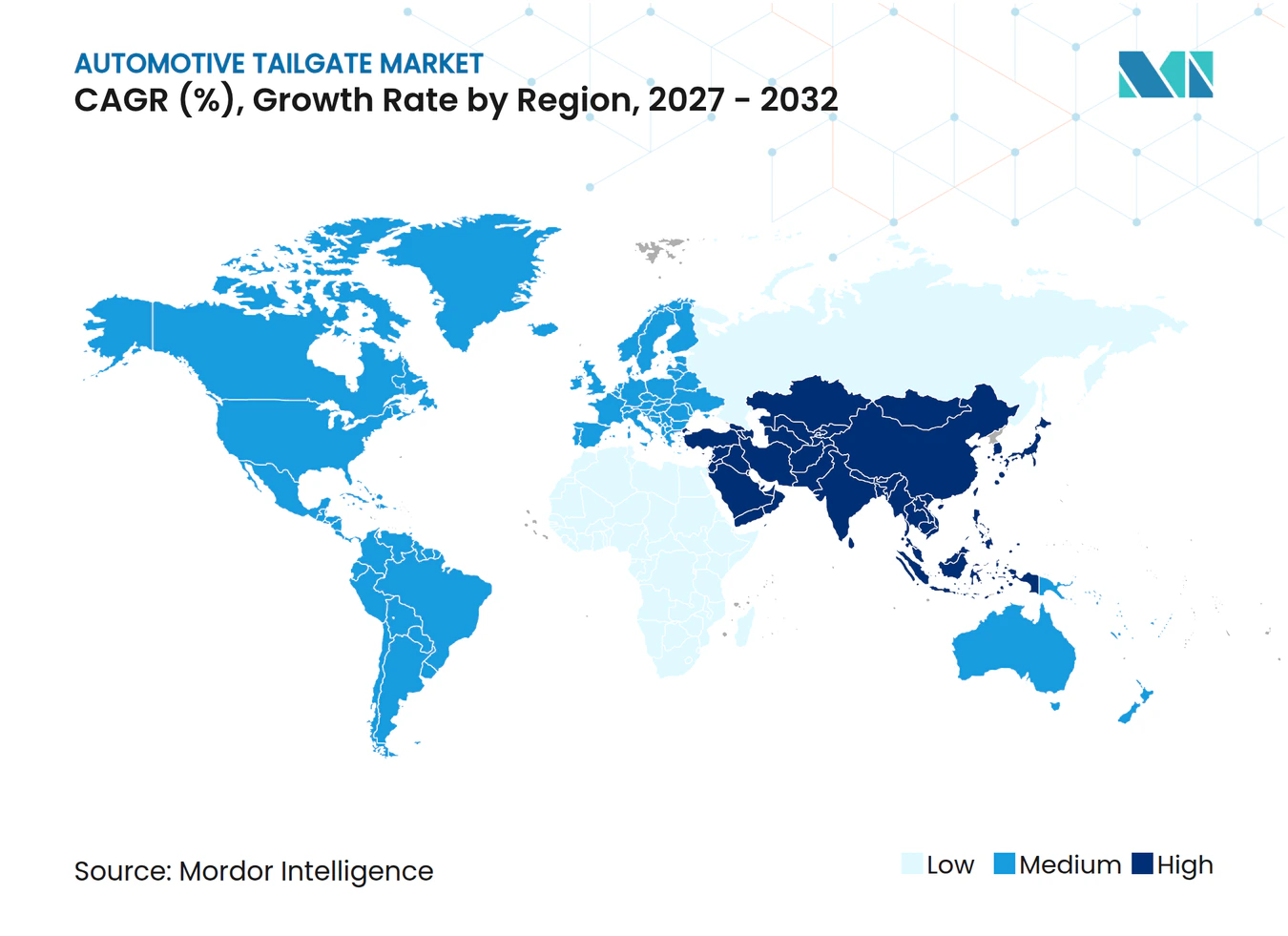
Asia-Pacific held 44.62% of the automotive tailgate market share in 2026 and is forecast to grow at a 6.50% CAGR through 2032. China supports regional demand as local vehicle makers compete on electric vehicle features and connected user experiences. Japan and South Korea contribute capabilities in compact actuators, controls, and system integration. India and Southeast Asian countries add volume potential as SUV programs broaden and manufacturers localize platforms. Brose’s smart concept vehicle at Auto Shanghai 2025 illustrates how rear access can link with wider sensing and digital-key functions. Suppliers need local validation and production support, while national safety and quality rules shape system testing. The automotive tailgate market in Asia-Pacific must balance advanced features with local cost expectations and service needs.
Europe
Europe remains a reference point for technical requirements, even as vehicle production conditions vary across the region. Premium manufacturers have long used programmable opening height, power cinching, and hands-free access, and these specifications influence global platforms. Regional suppliers retain important engineering roles in closure systems, actuation, and exterior modules. European circular-economy policies encourage attention to material choice and vehicle mass. Thermoplastic tailgates are gaining ground in Europe, as shown by OPmobility’s May 2026 Stellantis order for an integrated thermoplastic tailgate assembly for B-segment electric SUVs. Compliance factors include European vehicle type-approval rules and the end-of-life vehicle policy framework. These requirements raise validation needs but create a clear basis for suppliers that can demonstrate documented performance. The automotive tailgate market in Europe supports development in lightweight structures, electronics, and durable closure mechanisms.
North America, South America, and Middle East and Africa
North America is important for pickup trucks, where tailgates can include demanding utility and cargo functions. Vehicle makers differentiate models through powered operation, durable latches, and mechanisms for loading or work use. Gestamp’s Edscha unit presented a power sliding door system at Auto Shanghai 2025, reflecting continued work on powered closures. South America offers opportunities as global manufacturers introduce SUV platforms, although affordability favors cost-conscious configurations. In the Middle East, demand for premium vehicles supports well-equipped SUV models. Africa remains more dependent on basic configurations and replacement demand in many markets. The automotive tailgate market across these regions requires flexible supply plans because vehicle use, service networks, local production, and compliance requirements differ widely.
Competitive Landscape
Market Concentration
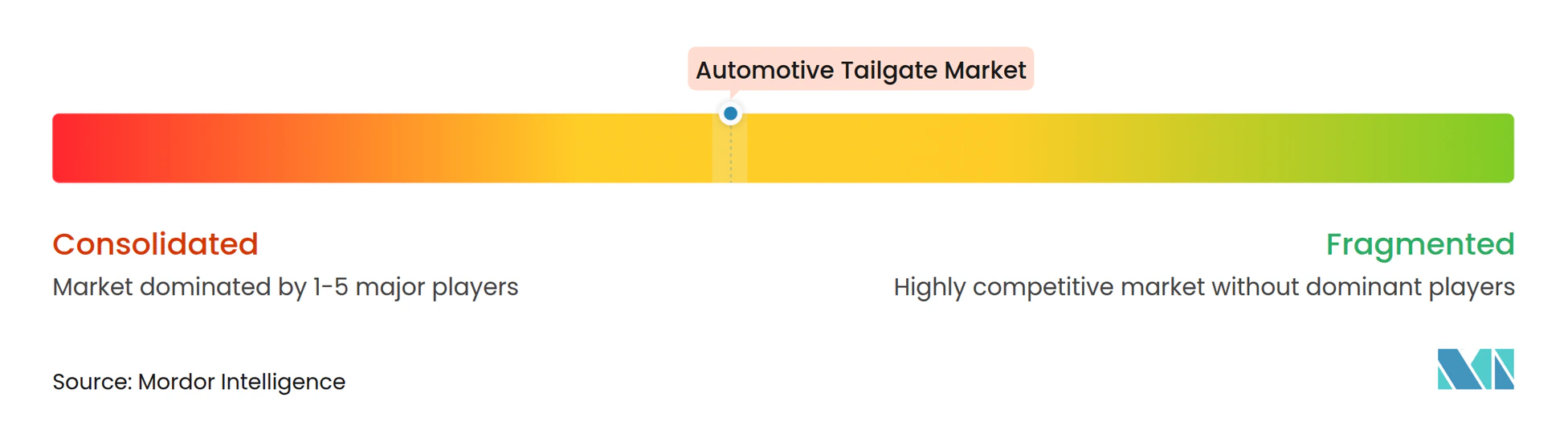
The automotive tailgate market is moderately concentrated, with an established top tier of system suppliers and meaningful opportunities for regional and specialist suppliers. Brose, Magna, Aisin, OPmobility, and Stabilus are among the companies associated with major elements of tailgate systems. Their capabilities span actuators, structural modules, latches, gas springs, and electronics. Competition is strongest where suppliers can combine several of these functions in one coordinated system. At the same time, component specialists can compete where a vehicle maker requires a particular material, sensor, or motion-control capability. The automotive tailgate market is therefore neither controlled by a single supplier nor fully open to firms without validated automotive experience.
Technology development is increasing the importance of complete system engineering. Suppliers are seeking to link sensors, software, and motion hardware so that manufacturers have fewer integration steps during vehicle development. Brose’s 2025 smart concept vehicle is an example of an approach that connects intelligent vehicle access with wider in-vehicle sensing. Huf's 2025 production order for a radar kick sensor shows that access sensing is also becoming a competitive area in its own right. These moves point to competition around reliable user interaction as well as mechanical design. The automotive tailgate market will continue to favor suppliers that can make added electronic content easy for manufacturers to validate.
Global suppliers also face competition from local companies that can offer close proximity to vehicle plants and rapid program support. Local production can matter where manufacturers want shorter supply lines and systems adapted to domestic models. OPmobility and Yanfeng expanded the activities of their Chinese joint venture in November 2025, adding module assembly and lighting-related capabilities for Chinese vehicle makers[3]. This type of cooperation can strengthen local responsiveness while combining international product experience with regional manufacturing. Quality management, vehicle approval, and validation requirements remain barriers that can slow entry for lower-cost competitors. The automotive tailgate market will remain competitive as suppliers balance price, local support, product integration, and proven performance.
Automotive Tailgate Industry Leaders
-
Brose SE
-
Magna International Inc.
-
Aisin Corporation
-
OPmobility SE
-
Stabilus SE
- *Disclaimer: Major Players sorted in no particular order
Automotive Tailgate Market Companies Covered in this Report
- Magna International Inc.
- OPmobility SE
- Brose SE
- Stabilus SE
- Aisin Corporation
- Samvardhana Motherson International Limited
- Inteva Products LLC
- Mitsuba Corporation
- Huf Hülsbeck & Fürst GmbH & Co. KG
- Hyundai Mobis Co., Ltd.
- Gestamp Automoción, S.A.
- Shiloh Industries, Inc.
- Minth Group Limited
- Ningbo Huaxiang Electronic Co., Ltd.
- STRATTEC Security Corporation
- WITTE Automotive GmbH
- Changchun FAWAY Automobile Trim Systems Co., Ltd.
- Johnson Electric Holdings Limited
- HI-LEX Corporation
- Flex-N-Gate Corporation
Recent Industry Developments in Automotive Tailgate Market
- June 2026: OPmobility won two contracts from Leapmotor International to supply bumpers and tailgates for passenger cars in Europe, with production at its Spanish plants from 2027.
- May 2026: OPmobility won a Stellantis order for an integrated thermoplastic tailgate assembly for next-generation B-segment electric SUVs, with about 20% lower carbon emissions than a steel structure.
- November 2025: OPmobility and Yanfeng added module assembly and lighting activities to their Chinese joint venture YFPO, which already supplies bumpers and tailgates.
- May 2025: Huf won its first series-production order for a 79 GHz radar kick sensor for hands-free tailgate opening from a European premium automaker.
Global Automotive Tailgate Market Report Scope
The Automotive Tailgate Market is segmented by Type, Material, Component, Vehicle Type, Sales Channel, and Geography. By Type, the market is segmented into Manual Tailgate and Power Tailgate (Including Hands-Free). By Material, the market is segmented into Steel, Aluminum, and Composites/Thermoplastics (SMC, PP-LGF). By Component, the market is segmented into Tailgate Panel/Module, Struts and Spindles, Latches and Locks, and Actuators/ECU. By Vehicle Type, the market is segmented into SUVs and Crossovers, Hatchbacks and Wagons, Pickup Trucks, Light Commercial Vehicles, and Others. By Sales Channel, the market is segmented into OEM and Aftermarket. By Geography, the market is segmented into North America (United States, Canada, and Mexico), Europe (Germany, France, United Kingdom, Italy, Spain, Russia, and Rest of Europe), Asia-Pacific (China, Japan, India, South Korea, Australia, Indonesia, and Rest of Asia-Pacific), South America (Brazil, Argentina, Chile, and Rest of South America), and Middle East and Africa (Saudi Arabia, United Arab Emirates, South Africa, Türkiye, and Rest of Middle East and Africa). Market forecasts are provided in terms of Value (USD) and Volume (Units).
Segmentation Overview
| Manual Tailgate |
| Power Tailgate (Including Hands-Free) |
| Steel |
| Aluminum |
| Composites/Thermoplastics (SMC, PP-LGF) |
| Tailgate Panel/Module |
| Struts and Spindles |
| Latches and Locks |
| Actuators/ECU |
| SUVs and Crossovers |
| Hatchbacks and Wagons |
| Pickup Trucks |
| Light Commercial Vehicles |
| Others |
| OEM |
| Aftermarket |
| North America | United States |
| Canada | |
| Mexico | |
| Europe | Germany |
| France | |
| United Kingdom | |
| Italy | |
| Spain | |
| Russia | |
| Rest of Europe | |
| Asia-Pacific | China |
| Japan | |
| India | |
| South Korea | |
| Australia | |
| Indonesia | |
| Rest of Asia-Pacific | |
| South America | Brazil |
| Argentina | |
| Chile | |
| Rest of South America | |
| Middle East and Africa | Saudi Arabia |
| United Arab Emirates | |
| South Africa | |
| Türkiye | |
| Rest of Middle East and Africa |
| By Type | Manual Tailgate | |
| Power Tailgate (Including Hands-Free) | ||
| By Material | Steel | |
| Aluminum | ||
| Composites/Thermoplastics (SMC, PP-LGF) | ||
| By Component | Tailgate Panel/Module | |
| Struts and Spindles | ||
| Latches and Locks | ||
| Actuators/ECU | ||
| By Vehicle Type | SUVs and Crossovers | |
| Hatchbacks and Wagons | ||
| Pickup Trucks | ||
| Light Commercial Vehicles | ||
| Others | ||
| By Sales Channel | OEM | |
| Aftermarket | ||
| By Geography | North America | United States |
| Canada | ||
| Mexico | ||
| Europe | Germany | |
| France | ||
| United Kingdom | ||
| Italy | ||
| Spain | ||
| Russia | ||
| Rest of Europe | ||
| Asia-Pacific | China | |
| Japan | ||
| India | ||
| South Korea | ||
| Australia | ||
| Indonesia | ||
| Rest of Asia-Pacific | ||
| South America | Brazil | |
| Argentina | ||
| Chile | ||
| Rest of South America | ||
| Middle East and Africa | Saudi Arabia | |
| United Arab Emirates | ||
| South Africa | ||
| Türkiye | ||
| Rest of Middle East and Africa | ||
Key Questions Answered in the Report
What is driving automotive tailgate demand?
Demand is supported by wider SUV adoption, more power-operated access, and the integration of sensing and control functions into rear closures.
Which tailgate type is expanding fastest?
Power tailgates, including hands-free systems, are forecast to grow at a 7.27% CAGR through 2032.
Why do vehicle makers use composite tailgates?
Composite and thermoplastic designs can support lower weight and more integrated shapes, especially in electric vehicle programs. The choice still depends on production needs, finish standards, repair requirements, and cost.
Which vehicle type creates the greatest tailgate opportunity?
SUVs and crossovers held 60.92% share in 2026 and are forecast to grow at a 6.18% CAGR through 2032.