
Automotive Steering Knuckle Market Size and Share
Market Overview
| Study Period | 2020 - 2032 |
|---|---|
| Market Size (2027) | USD 7.58 Billion |
| Market Size (2032) | USD 9.63 Billion |
| Growth Rate (2027 - 2032) | 4.92 % |
| Fastest Growing Market | Asia-Pacific |
| Largest Market | Asia-Pacific |
| Market Concentration | Low |
Major Players *Disclaimer: Major Players sorted in no particular order Image © Mordor Intelligence. Reuse requires attribution under CC BY 4.0. | |
Automotive Steering Knuckle Market Analysis by Mordor Intelligence
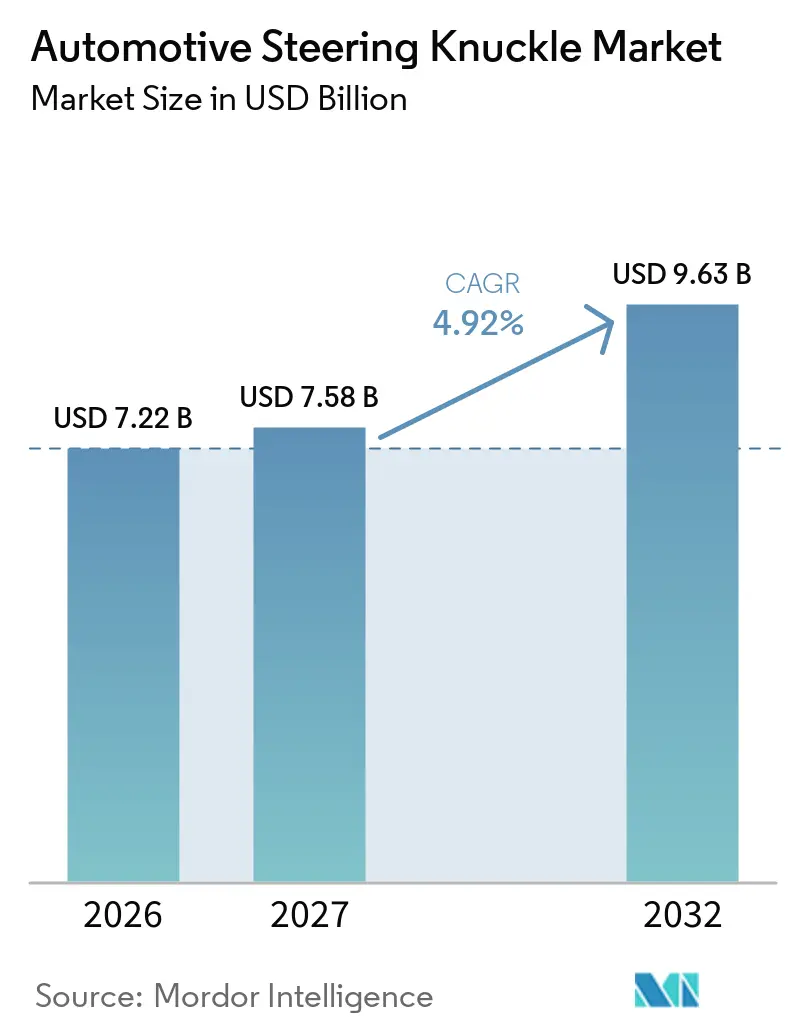
The automotive steering knuckle market size was valued at USD 7.22 billion in 2026, is estimated at USD 7.58 billion in 2027, and is projected to reach USD 9.63 billion by 2032, registering a CAGR of 4.92% between 2027 and 2032. Demand is tied to vehicle production, the replacement needs of aging fleets, and the increasing technical requirements placed on chassis parts that connect steering, braking, suspension, and hub systems. The automotive steering knuckle market is also being shaped by electric vehicle programs, which favor lighter parts, more complex suspension layouts, and closer coordination between chassis engineering teams and component manufacturers. Suppliers are responding by adding aluminum casting and forging capability while protecting established steel and iron programs that remain appropriate for commercial vehicles and cost-sensitive passenger vehicle applications. OEM qualification remains a major commercial advantage because the part is safety-critical, must fit the vehicle platform precisely, and is subject to detailed validation before it reaches production. Cost pressure from metals, tooling, testing, and logistics is likely to favor manufacturers that can serve several vehicle programs with reliable production quality, regional manufacturing access, and disciplined process control.
Key Report Takeaways
- By position, the front knuckle held 59.35% of the share of the automotive steering knuckle market in 2026, while the rear knuckle is forecast to grow at a 5.03% CAGR through 2032.
- By material, forged steel held 35.81% of the share of the automotive steering knuckle market in 2026, while cast/forged aluminum is forecast to grow at a 10.26% CAGR through 2032.
- By manufacturing process, casting held 53.21% of the share of the automotive steering knuckle market in 2026, while forging is forecast to grow at a 5.34% CAGR through 2032.
- By suspension type, MacPherson strut held 49.12% of the share of the automotive steering knuckle market in 2026, while multi-link is forecast to grow at a 6.18% CAGR through 2032.
- By vehicle type, passenger cars held 79.81% of the share of the automotive steering knuckle market in 2026, while light commercial vehicles are forecast to grow at a 5.44% CAGR through 2032.
- By sales channel, original equipment manufacturer held 83.91% of the share of the automotive steering knuckle market in 2026, while aftermarket is forecast to grow at a 5.86% CAGR through 2032.
- By geography, Asia-Pacific held 55.56% of the share of the automotive steering knuckle market in 2026 and is forecast to grow at a 5.34% CAGR through 2032.
Note: Market numbers in this report are based on Mordor Intelligence's proprietary estimation framework, which combines nine months of actuals with Q4 projections for base year 2026.
Market Trends and Insights
Drivers Impact Analysis of Automotive Steering Knuckle Market*
| Driver | (~) % Impact on CAGR Forecast | Geographic Relevance | Impact Timeline |
|---|---|---|---|
| EV Lightweighting and Unsprung-Mass Reduction | +1.4% | APAC core (China, South Korea), EU, North America | Medium term (2–4 years) |
| Rising Global Vehicle Production and Vehicle Parc Expansion | +1.2% | Global, Asia-led | Short term (≤ 2 years) |
| Growth of SUVs, Light Commercial Vehicles and Heavy Commercial Vehicles | +0.9% | Global, particularly APAC and North America | Short term (≤ 2 years) |
| Rising Demand for Safety-Critical Suspension Components | +0.6% | Global, with early gains in North America and EU | Medium term (2–4 years) |
| Corrosion-Driven Replacement Demand in Aging Vehicle Fleets | +0.4% | North America, Europe | Long term (≥ 4 years) |
| Integration of Wheel-End Sensing and Electrified Brake Interfaces | +0.3% | EU, North America (regulation-led), APAC core | Long term (≥ 4 years) |
| Source: Mordor Intelligence | |||
EV Lightweighting and Unsprung-Mass Reduction
Electric vehicle architectures are encouraging a shift from ductile iron toward aluminum steering knuckles where the vehicle design and cost structure support the change. Battery packs add mass to the vehicle and increase the need to manage ride, handling, braking loads, and tire contact carefully. A lighter knuckle can help reduce unsprung mass while retaining the stiffness required at the wheel end and protecting the integrity of the suspension connection points. The automotive steering knuckle market therefore benefits when OEMs redesign a platform around electric propulsion rather than adapting an existing internal combustion layout with limited packaging flexibility. Aluminum adoption also requires better alloy control, tooling, inspection, machining, and training, which raises the value of established chassis suppliers that can demonstrate consistent process quality. Linamar has expanded its aluminum chassis capability through the acquisition of North American assets from Aludyne, showing continued supplier interest in lightweight structural components[1].
Rising Global Vehicle Production and Vehicle Parc Expansion
New vehicle production remains the clearest source of first-fit steering knuckle demand because every assembly line requires qualified wheel-end components. Global vehicle production reached 96.4 million units in 2025, according to the International Organization of Motor Vehicle Manufacturers[2]. Each new vehicle requires chassis parts that are designed and qualified for its suspension arrangement, axle loads, brake package, and steering geometry. Production growth matters most where local assembly clusters bring OEMs and suppliers closer together and allow faster coordination on quality, deliveries, and engineering changes. That proximity reduces logistics risk and supports earlier supplier involvement during vehicle development, which can help a supplier win follow-on work on related platforms. A larger vehicle parc also supports replacement demand because knuckles can be affected by corrosion, impact damage, and fatigue over the life of the vehicle.
Growth of SUVs, Light Commercial Vehicles and Heavy Commercial Vehicles
SUVs, light commercial vehicles, and heavy commercial vehicles impose high loads on suspension components because they carry greater loads, operate under varied conditions, or are used intensively. Their size, cargo use, road conditions, and operating cycles can require larger or more robust steering knuckles than compact passenger cars. This supports demand for forged steel and durable cast designs even as aluminum use expands in other applications and price-sensitive vehicle categories. The automotive steering knuckle market can also benefit from the wider adoption of independent suspension in vans and electric delivery vehicles that require predictable handling under load. These layouts often require more complex wheel carriers and rear suspension components, creating a broader set of technical requirements for suppliers. The change in vehicle mix supports suppliers capable of serving both high-volume passenger programs and commercial vehicle customers without compromising cost or production reliability.
Rising Demand for Safety-Critical Suspension Components
The steering knuckle connects steering, braking, hub, and suspension functions at the wheel end, placing it at the center of several vehicle safety systems. Its role makes dimensional accuracy, fatigue resistance, material consistency, and reliable machining essential throughout the vehicle's life. New chassis systems increase the importance of careful packaging around sensors, brake hardware, steering interfaces, electrical connections, and mounting features. ZF has stated that its steer-by-wire system will enter European series production with Mercedes-Benz from 2026, illustrating the continued development of electronically controlled steering architectures[3]. These programs can require suppliers to work more closely with OEM engineering teams and to understand how small changes in geometry affect several connected systems. Manufacturers with established validation records are better positioned to compete for these safety-critical programs and manage the accompanying documentation.
Restraints Impact Analysis of Automotive Steering Knuckle Market*
| Restraint | (~) % Impact on CAGR Forecast | Geographic Relevance | Impact Timeline |
|---|---|---|---|
| Volatility in Steel, Aluminum and Alloy Input Costs | -0.5% | Global (most acute in North America and EU) | Short term (≤ 2 years) |
| High Validation Requirements for Safety-Critical Chassis Components | -0.4% | Global (North America and EU most stringent) | Long term (≥ 4 years) |
| Porosity, Machining and Scrap Sensitivity in Lightweight Castings | -0.3% | APAC core, EU | Medium term (2–4 years) |
| Platform-Specific Designs and Low Interchangeability in the Aftermarket | -0.2% | North America, Europe | Long term (≥ 4 years) |
| Source: Mordor Intelligence | |||
Volatility in Steel, Aluminum and Alloy Input Costs
Steering knuckle makers purchase large volumes of steel, iron, aluminum, and alloy inputs as part of every casting, forging, and machining program. Changes in these costs can affect margins when contracts do not allow immediate price adjustments or when material costs rise after an OEM price has been agreed. The issue is more difficult for smaller casting and forging firms that lack broad purchasing scale, long-term supply arrangements, or the ability to spread risk across several plants. Tariff uncertainty can add another layer of cost and sourcing risk for cross-border supply chains, particularly when raw material, machining, and vehicle assembly occur in different countries. Producers may respond by improving scrap recovery, revising material specifications where permitted, strengthening supplier agreements, or locating capacity closer to vehicle assembly plants. The automotive steering knuckle market is therefore exposed to metal price movements even when vehicle demand remains stable and customer schedules proceed as planned.
High Validation Requirements for Safety-Critical Chassis Components
Steering knuckles must pass extensive testing before they are approved for a vehicle platform, because failure can affect steering, braking, and wheel control. Testing includes load, fatigue, dimensional, corrosion, and vehicle-level evaluations that assess performance under normal use as well as demanding road conditions. New materials and altered geometry can lengthen that process because OEMs must confirm safety and performance across several operating conditions, vehicle variants, and production batches. The cost of this work can limit entry by suppliers without engineering resources, test capacity, or established quality documentation. It also makes long-term customer relationships valuable because requalification is time-consuming and vehicle makers are reluctant to accept avoidable program risk. The same barrier that slows new entrants supports established suppliers once a part is in production and has demonstrated consistent performance.
*Our forecasts treat driver/restraint impacts as directional, not additive. The impact forecasts reflect baseline growth, mix effects, and variable interactions.
Automotive Steering Knuckle Market Segment Analysis
By Position:
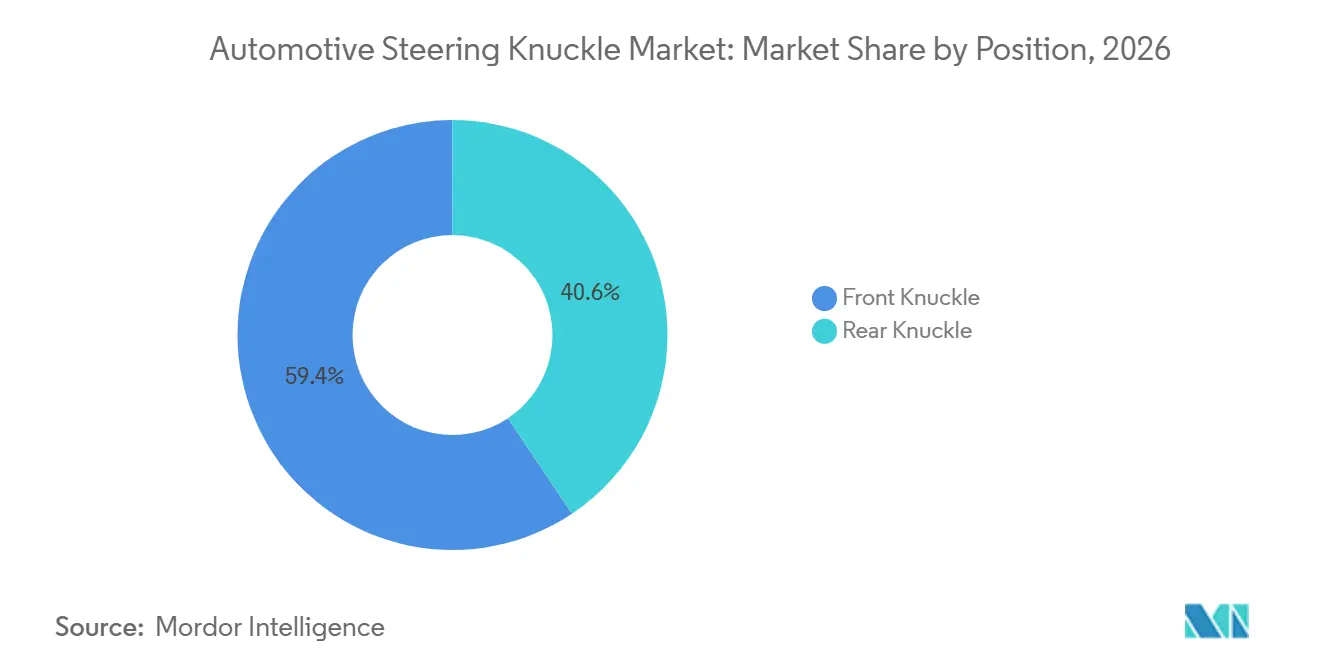
Rear Knuckle Demand Rises with Multi-Link EV ArchitecturesFront knuckle held 59.35% of the share of the automotive steering knuckle market in 2026 because the front axle combines steering, braking, and wheel-support functions in nearly every vehicle. This position makes the component necessary across passenger cars, vans, sport utility vehicles, and commercial vehicles with different load requirements. Front designs are shaped by brake-package size, steering angle, suspension geometry, axle load, and the space available for nearby components. Manufacturers must balance stiffness with weight while maintaining consistent mounting points and controlled wheel alignment. Established front-knuckle programs also benefit from deep OEM validation, manufacturing experience, and proven performance in high-volume vehicle use.
Rear knuckle is forecast to grow at a 5.03% CAGR through 2032 as multi-link rear suspension becomes more common in electric and higher-value vehicle platforms. A rear wheel carrier is important when the vehicle uses independent suspension rather than a torsion beam or a simpler axle design. Battery-electric vehicles can give engineers greater freedom to package a complex rear suspension while meeting ride and cargo-space expectations. This raises design, machining, and production requirements for the rear component. The automotive steering knuckle market gains from this shift because rear knuckles often require more specialized geometry, several attachment points, and close control of dimensional accuracy.
By Material:
Aluminum Displaces Iron Across EV Knuckle ProgramsForged steel accounted for 35.81% of the automotive steering knuckle market in 2026, supported by its strength, durability, and established production base. It remains suitable for applications that face high loads, demanding operating conditions, and extended service cycles. Commercial vehicles continue to support steel demand because durability is often prioritized over weight reduction in vehicles that carry cargo or operate on uneven roads. Forging also provides dependable grain flow and fatigue performance for safety-critical parts, supporting confidence in long-life applications. Steel suppliers can remain competitive by providing dependable quality, efficient machining, and strong technical support throughout vehicle development.
Cast/forged aluminum is forecast to grow at a 10.26% CAGR through 2032 as OEMs seek lighter chassis components for electric vehicle programs. Aluminum can support lower vehicle mass when the part is designed for the material and produced with effective control of alloy quality, casting soundness, and machining. The move requires investment in alloy handling, casting or forging equipment, heat treatment, and inspection capability. Suppliers that already work with aluminum may be better placed to meet next-generation chassis requirements and shorten development work for OEM customers. The automotive steering knuckle market is likely to see a wider mix of aluminum solutions rather than a complete replacement of steel or iron.
By Manufacturing Process:
Casting Leads, Forging Gains in Premium and EV ProgramsCasting accounted for 53.21% of the automotive steering knuckle market in 2026 because it can efficiently form detailed shapes at volume. The process supports complex passages, mounting features, and lightweight geometries used in many vehicle designs, including parts with several interfaces to the brake and suspension systems. Casting can also accommodate a range of metal types and vehicle applications, which helps producers serve different customer programs. Its cost position is useful for programs that require high output, repeatable quality, and consistent part dimensions. Process control is essential because porosity, machining variation, and scrap can affect the quality of lightweight cast components.
Forging is forecast to grow at a 5.34% CAGR through 2032, supported by applications where fatigue resistance and structural integrity are especially important. The process can offer favorable material properties for parts that face repeated heavy loads, harsh roads, or demanding commercial use. Forged components are relevant for commercial vehicles, premium vehicles, and selected electric vehicle designs where dependable mechanical performance is central to the specification. Near-net-shape processes can also reduce machining work, material waste, and some production variability. The automotive steering knuckle market retains space for both methods because vehicle platforms differ in their requirements for cost, shape complexity, weight, and strength.
By Suspension Type:
MacPherson Strut Entrenches in Volume, Multi-Link Accelerates in EVMacPherson strut held 49.12% of the share of the automotive steering knuckle market in 2026 because it provides a compact and cost-effective suspension arrangement for many vehicle makers. The configuration remains common in passenger cars and value-focused platforms, particularly where space efficiency and production cost are central design considerations. It uses fewer components than many more complex systems and is well understood by vehicle manufacturers, service networks, and component suppliers. This supports stable demand for knuckles designed for strut-mounting and front-wheel-drive layouts. Its widespread use also gives suppliers opportunities to standardize production methods and quality controls across high-volume programs.
Multi-link is forecast to grow at a 6.18% CAGR through 2032 because it provides greater flexibility in controlling wheel movement. The architecture is used where ride quality, handling, and vehicle weight distribution receive closer engineering attention. Dedicated electric platforms can make it easier to package this suspension type at the rear of the vehicle without relying on earlier internal-combustion layouts. Its adoption increases the need for parts with more mounting points, tighter tolerances, and more precise machining. The automotive steering knuckle market benefits where suppliers can manufacture these complex components consistently at scale.
By Vehicle Type:
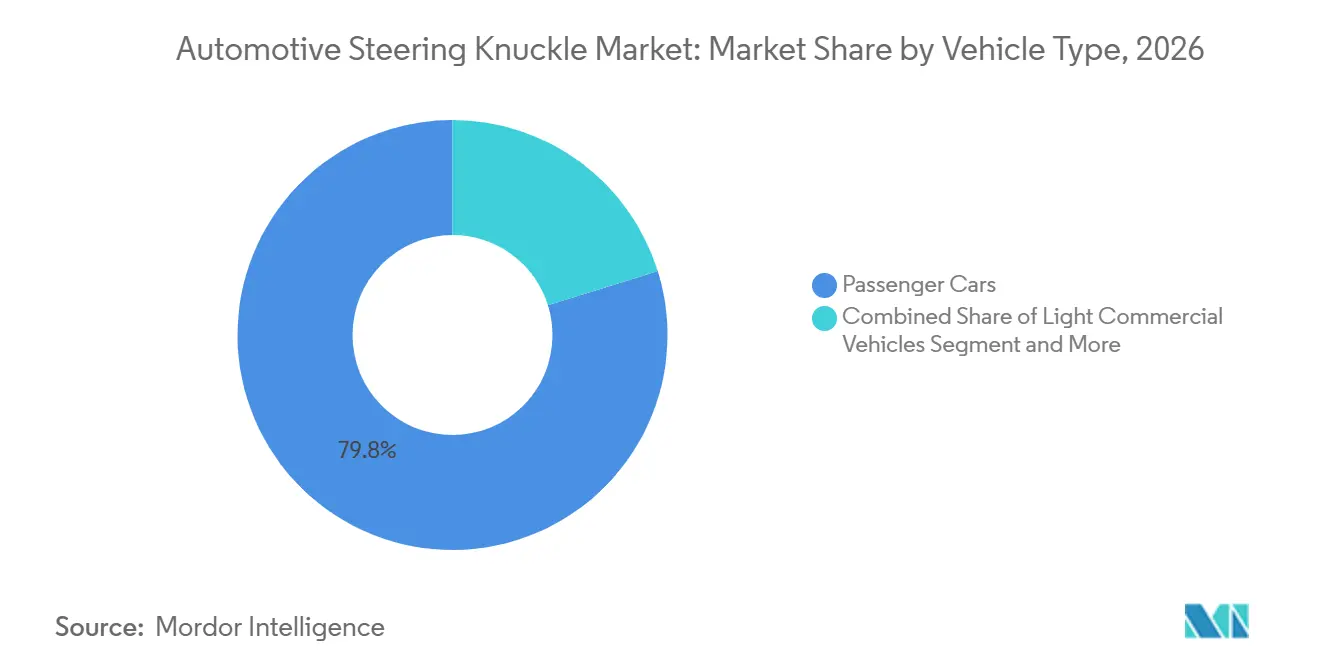
Passenger Cars Dominate, LCVs Emerge as the Next Expansion VectorPassenger cars held 79.81% of the share of the automotive steering knuckle market in 2026 due to their broad presence in global vehicle production. This segment includes a large variety of body styles, powertrains, price points, and suspension arrangements. It supports demand for both economical designs and higher-value lightweight components, depending on the vehicle's intended use and cost target. Platform consolidation can reduce the number of unique parts, but it can also extend the volume life of approved knuckle designs and create longer production runs. Passenger vehicle programs remain important for suppliers seeking stable, high-volume contracts across several regions.
Light commercial vehicles are forecast to grow at a 5.44% CAGR through 2032 as delivery fleets and urban service vehicles expand. Van and pickup applications must carry heavier loads, operate over demanding duty cycles, and remain available for daily commercial use. Electric LCVs also need chassis designs that account for battery mass, payload needs, and packaging limits around the wheel end. These factors can increase the need for stronger steering and suspension parts with dependable fatigue performance. The automotive steering knuckle market has an opportunity in suppliers that can meet commercial vehicle durability requirements without adding unnecessary weight.

By Sales Channel:
OEM Reflects Safety Criticality, Aftermarket Gains on Fleet AgingOEMs held 83.91% of the share of the automotive steering knuckle market in 2026 because steering knuckles are engineered for a specific vehicle platform and cannot be treated as simple universal replacement parts. The part must align accurately with the wheel hub, brake system, steering hardware, suspension arms, and the vehicle's defined wheel geometry. OEM suppliers also undergo lengthy qualification cycles before production begins, often coordinating with several vehicle-system teams. These requirements make direct replacement with a generic part difficult and can limit the number of suppliers able to support a new platform. First-fit contracts therefore remain the main route to volume for steering knuckle manufacturers.
The aftermarket is forecast to grow at a 5.86% CAGR through 2032 as vehicles remain in operation longer and owners seek reliable repairs. Replacement is needed when corrosion, impact damage, or accumulated fatigue affects a safety-critical wheel-end component. The opportunity is stronger in regions with older fleets, severe winter conditions, and long-distance vehicle use. Parts suppliers must offer dependable fit, material traceability, and clear catalog coverage because the knuckle connects to several other chassis systems. ZF expanded its TRW chassis range in North America during 2025, adding 176 chassis products and extending coverage to 54 million additional vehicles in operation
Geography Analysis
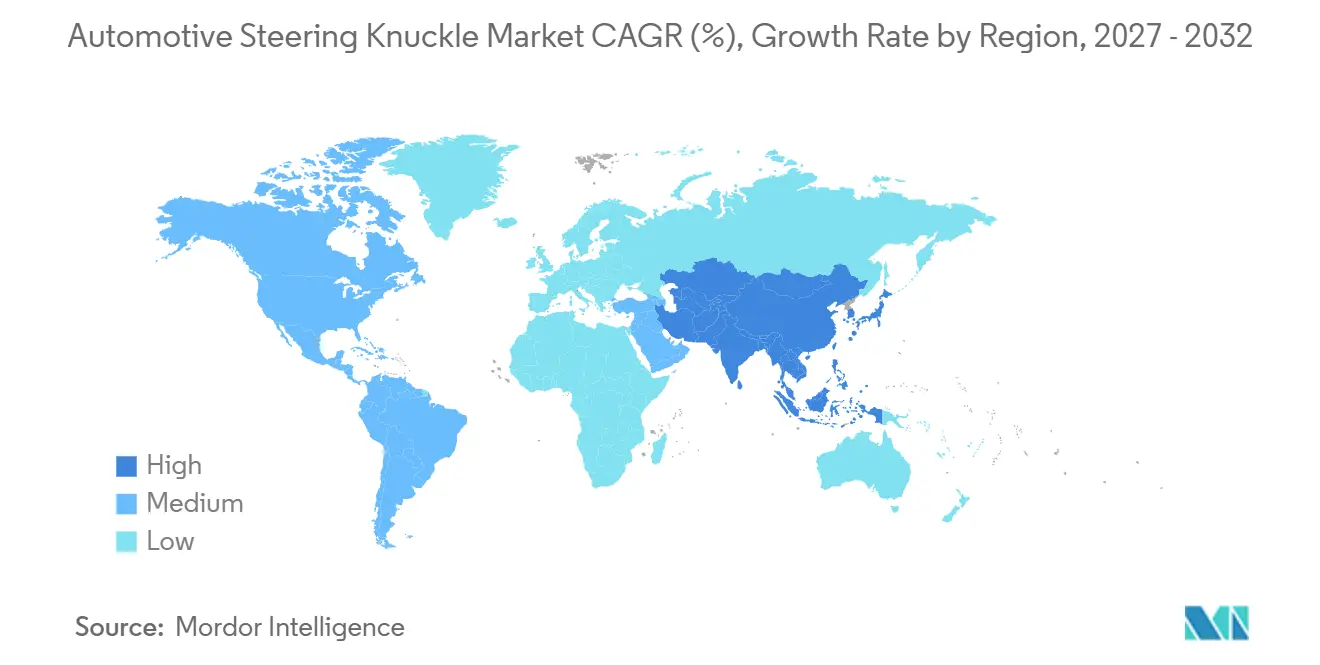
Asia-Pacific held 55.56% of the share of the automotive steering knuckle market in 2026 and is forecast to grow at a 5.34% CAGR through 2032. The region benefits from a large vehicle manufacturing base and close links between OEMs, casting companies, forgers, machining suppliers, and material processors. OICA reported that Asia produced 59.2 million vehicles in 2025, confirming the region's central position in global vehicle assembly. China supports demand through its scale in electric vehicle manufacturing and its growing focus on localized chassis supply. Japan and South Korea add technical depth through established vehicle producers, specialist component suppliers, and demanding quality systems. India, Thailand, and Indonesia extend the region's production base through passenger car manufacturing, commercial vehicle activity, and local supply networks. The combination of high vehicle output and evolving electric vehicle architectures supports continued demand for conventional, forged, cast, and lightweight knuckle designs.
North America combines a major vehicle production base with a large replacement opportunity. The United States produced 10.24 million vehicles in 2025, according to OICA, while regional supply decisions are increasingly shaped by local sourcing, trade rules, and metal-cost exposure. Mexico remains important for vehicle assembly and component exports, which helps maintain demand for nearby casting, forging, machining, and finishing capacity. The region's older vehicle fleet supports aftermarket sales, particularly where road salt, temperature changes, and demanding weather can shorten the service life of chassis parts. South America has a different demand profile, with commercial transport, road conditions, and freight activity supporting durable steel-based designs. Brazil remains important for light commercial and heavy vehicle manufacturing, creating demand across both original equipment and replacement channels. Manufacturers in both regions need to manage material sourcing, delivery reliability, and OEM qualification requirements while they develop lighter parts for electric vehicle programs.
Europe faces slower vehicle production growth, but it remains important for advanced chassis development and premium vehicle platforms. European vehicle production was 17.2 million units in 2025, according to OICA, and the region continues to influence material, safety, and emissions-related design choices. Suppliers serving Europe must meet demanding vehicle approval, quality, traceability, and environmental expectations as they support both conventional and electric vehicle programs. The Middle East and Africa offer varied conditions, with fleet renewal, commercial transport, and expanding vehicle ownership supporting demand in selected countries. Turkey and Gulf markets provide opportunities linked to assembly, imports, commercial fleets, and regional distribution activity. African vehicle demand is developing from a smaller base, which can support replacement activity and localized assembly over time where service networks improve. Oceania remains a mature market where aftermarket demand, durable parts supply, and vehicle servicing are more relevant than large-scale vehicle production.
Competitive Landscape
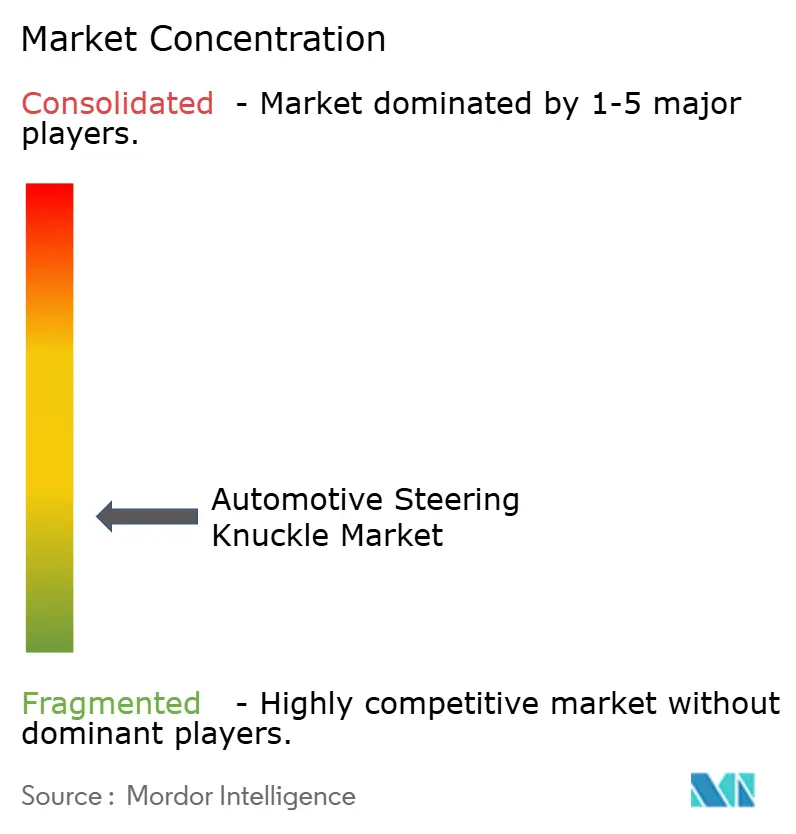
The automotive steering knuckle market is fragmented, with global chassis specialists, forging groups, casting suppliers, and aftermarket companies competing across regions and vehicle categories. Competition depends on the ability to meet vehicle-specific engineering requirements, maintain quality, provide reliable delivery, and respond when an OEM changes a platform design. Large suppliers have an advantage when they can serve OEMs across multiple production regions and offer multiple manufacturing processes. Regional manufacturers can still compete by offering specialized casting, forging, machining, or localized customer support that larger groups may not provide as efficiently. The balance between global reach and local production is likely to remain important as OEMs adjust supply networks, limit logistics risk, and seek shorter response times during program development.
Technology is becoming more important as steering, braking, and suspension systems become more integrated within the same wheel-end area. Suppliers that can support sensor mounts, brake interfaces, and complex aluminum geometries may gain access to higher-value programs where the part carries more functional requirements. At the same time, established steel and iron capabilities remain relevant for commercial vehicles and cost-sensitive passenger car platforms where durability and total cost are critical. Validation capability and IATF 16949 quality systems remain important entry conditions for many OEM programs, alongside stable process control and reliable documentation. These requirements can make it difficult for smaller firms to win new business without established customer relationships, engineering resources, and a history of successful production launches.
Strategic moves have focused on capability expansion, portfolio coverage, and access to regional OEM customers. Linamar completed the acquisition of a Leipzig casting facility from Georg Fischer in December 2025, adding large ductile-iron casting capability for industrial and vehicle-related applications. Bharat Forge completed the acquisition of AAM India Manufacturing Corporation in July 2025 after regulatory approval, expanding its commercial vehicle chassis and axle manufacturing base in India. These actions show that suppliers are seeking broader manufacturing capability, regional access, and stronger positions in structural components without depending on a single process or vehicle type. The competitive environment favors companies that can combine process knowledge, disciplined program execution, and the ability to manage quality across casting, forging, machining, and final assembly.
Automotive Steering Knuckle Industry Leaders
-
American Axle & Manufacturing Holdings, Inc.
-
thyssenkrupp AG
-
Magna International Inc.
-
Bharat Forge Limited
-
ZF Friedrichshafen AG
- *Disclaimer: Major Players sorted in no particular order
Automotive Steering Knuckle Market Companies Covered in this Report
- ZF Friedrichshafen AG
- Magna International Inc.
- BENTELER International AG
- Proterial, Ltd.
- Bharat Forge Limited
- thyssenkrupp AG
- AISIN CORPORATION
- Hyundai WIA Corporation
- Neapco Holdings LLC
- American Axle & Manufacturing Holdings, Inc.
- Grupo Industrial Saltillo, S.A.B. de C.V.
- CIE Automotive, S.A.
- Musashi Seimitsu Industry Co., Ltd.
- Gestamp Automoción, S.A
- CITIC Dicastal Co., Ltd.
- Ryobi Limited
- Linamar Corporation
- Dorman Products, Inc.
- Tenneco Inc.
- Hirschvogel Holding GmbH
- Fagor Ederlan, S. Coop.
- Happy Forgings Limited
- Georg Fischer AG
- Dana Incorporated
- JTEKT Corporation
Recent Industry Developments in Automotive Steering Knuckle Market
- September 2026: Toyota issued a safety recall for approximately 71 units of the 2026 model-year Lexus RX in Canada due to improperly manufactured front steering knuckles. Affected knuckles will be replaced at no cost.
- June 2026: Chery launched the Tiggo 8 Champion Family in China, featuring updated models with new assisted-driving functions, upgraded cockpit hardware, aluminum steering knuckles, nine airbags, and a 540-degree panoramic camera system.
- February 2026: Over 4,500 units of the Hyundai Kona were recalled in the United States due to steering knuckles that may crack and break, potentially causing a loss of steering control.
Global Automotive Steering Knuckle Market Report Scope
The Automotive Steering Knuckle Market is segmented by Position, Material, Manufacturing Process, Suspension Type, Vehicle Type, Sales Channel, and Geography. By Position, the market is segmented into Front Knuckle and Rear Knuckle. By Material, the market is segmented into Cast Iron (Ductile), Forged Steel, and Cast/Forged Aluminum. By Manufacturing Process, the market is segmented into Casting and Forging. By Suspension Type, the market is segmented into MacPherson Strut, Double Wishbone, Multi-Link, and Others. By Vehicle Type, the market is segmented into Passenger Cars, Light Commercial Vehicles, and Heavy Commercial Vehicles. By Sales Channel, the market is segmented into OEM and Aftermarket. By Geography, the market is segmented into North America (United States, Canada, and Mexico), Europe (Germany, France, United Kingdom, Italy, Spain, Russia, and Rest of Europe), Asia-Pacific (China, Japan, India, South Korea, Thailand, Indonesia, Australia, and Rest of Asia-Pacific), South America (Brazil, Argentina, Colombia, Chile, and Rest of South America), and Middle East and Africa (Saudi Arabia, United Arab Emirates, Turkey, Israel, South Africa, Egypt, Morocco, and Rest of Middle East and Africa). Market forecasts are provided in terms of Value (USD) and Volume (Units).
Segmentation Overview
| Front Knuckle |
| Rear Knuckle |
| Cast Iron (Ductile) |
| Forged Steel |
| Cast/Forged Aluminum |
| Casting |
| Forging |
| MacPherson Strut |
| Double Wishbone |
| Multi-Link |
| Others |
| Passenger Cars |
| Light Commercial Vehicles |
| Heavy Commercial Vehicles |
| Original Equipment Manufacturers |
| Aftermarket |
| North America | United States |
| Canada | |
| Mexico | |
| Rest of North America | |
| Europe | Germany |
| France | |
| United Kingdom | |
| Italy | |
| Spain | |
| Russia | |
| Rest of Europe | |
| Asia-Pacific | China |
| Japan | |
| India | |
| South Korea | |
| Thailand | |
| Indonesia | |
| Australia | |
| Rest of Asia-Pacific | |
| South America | Brazil |
| Argentina | |
| Colombia | |
| Chile | |
| Rest of South America | |
| Middle East and Africa | Saudi Arabia |
| United Arab Emirates | |
| Turkey | |
| Israel | |
| South Africa | |
| Egypt | |
| Morocco | |
| Rest of Middle East and Africa |
| By Position | Front Knuckle | |
| Rear Knuckle | ||
| By Material | Cast Iron (Ductile) | |
| Forged Steel | ||
| Cast/Forged Aluminum | ||
| By Manufacturing Process | Casting | |
| Forging | ||
| By Suspension Type | MacPherson Strut | |
| Double Wishbone | ||
| Multi-Link | ||
| Others | ||
| By Vehicle Type | Passenger Cars | |
| Light Commercial Vehicles | ||
| Heavy Commercial Vehicles | ||
| By Sales Channel | Original Equipment Manufacturers | |
| Aftermarket | ||
| By Geography | North America | United States |
| Canada | ||
| Mexico | ||
| Rest of North America | ||
| Europe | Germany | |
| France | ||
| United Kingdom | ||
| Italy | ||
| Spain | ||
| Russia | ||
| Rest of Europe | ||
| Asia-Pacific | China | |
| Japan | ||
| India | ||
| South Korea | ||
| Thailand | ||
| Indonesia | ||
| Australia | ||
| Rest of Asia-Pacific | ||
| South America | Brazil | |
| Argentina | ||
| Colombia | ||
| Chile | ||
| Rest of South America | ||
| Middle East and Africa | Saudi Arabia | |
| United Arab Emirates | ||
| Turkey | ||
| Israel | ||
| South Africa | ||
| Egypt | ||
| Morocco | ||
| Rest of Middle East and Africa | ||
Key Questions Answered in the Report
What is the projected value of the automotive steering knuckle market by 2032?
The automotive steering knuckle market is projected to reach USD 9.63 billion by 2032, from USD 7.57 billion in 2027. The forecast reflects demand from new vehicle production, replacement needs, and changing chassis designs.
What is driving demand for automotive steering knuckles?
Vehicle production, fleet replacement needs, electric vehicle lightweighting, and more complex suspension systems support demand. Suppliers also benefit when OEMs require stronger, more precise, or lighter wheel-end components.
Which position leads automotive steering knuckle sales?
Front knuckle led with a 59.35% share in 2026 because front wheel assemblies combine steering, braking, and suspension functions. It is needed across a broad range of passenger and commercial vehicle applications.
Which material is growing fastest for steering knuckles?
Cast/Forged aluminum is the fastest-growing material segment, with a forecast CAGR of 10.26% through 2032. Its growth is linked to OEM efforts to reduce weight while maintaining component strength and durability.