
Automotive Steer-by-Wire System Market Size and Share
Market Overview
| Study Period | 2020 - 2032 |
|---|---|
| Market Size (2027) | USD 1.40 Billion |
| Market Size (2032) | USD 4.21 Billion |
| Growth Rate (2027 - 2032) | 24.69 % |
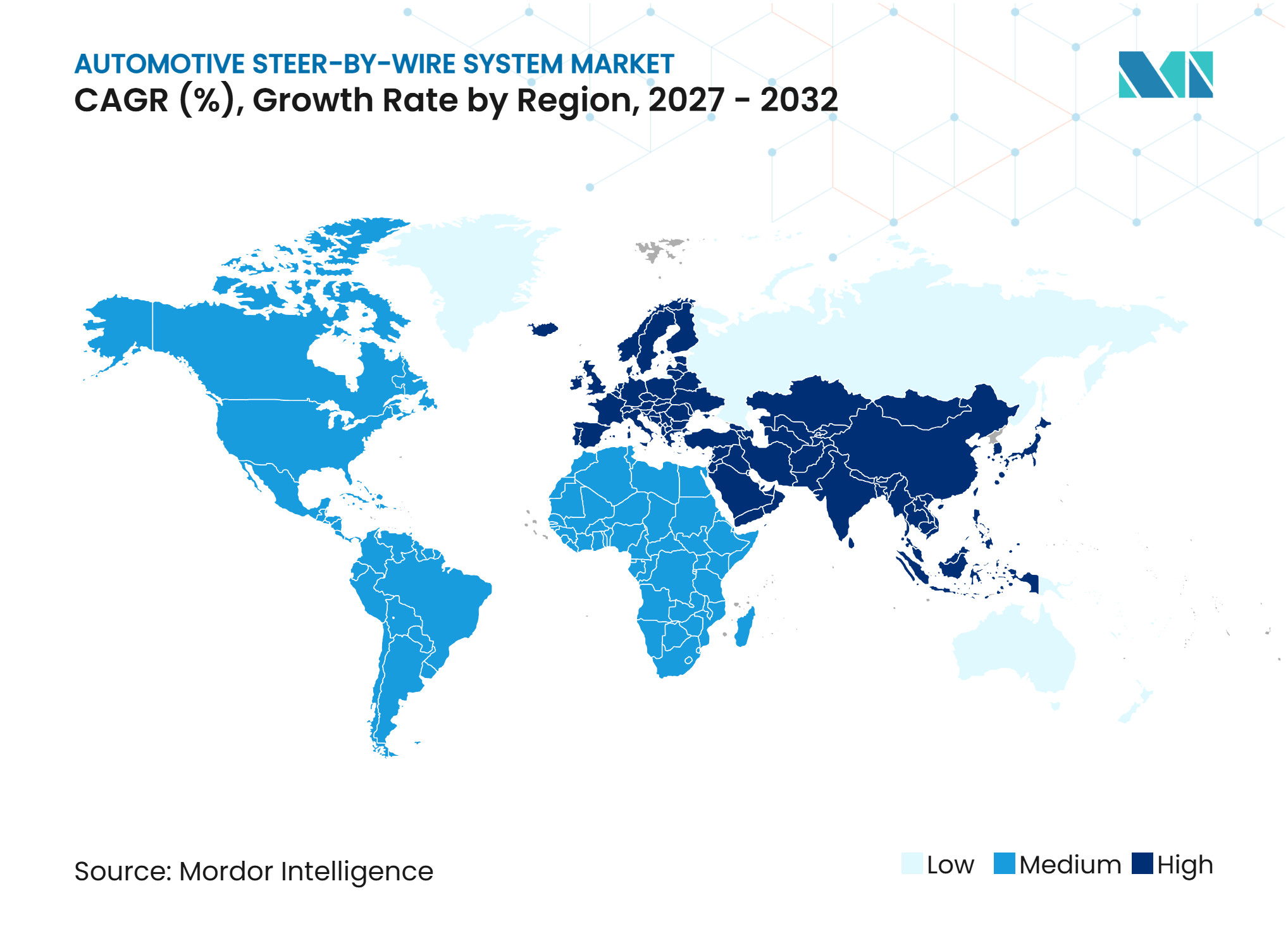
| Fastest Growing Market | Asia-Pacific |
| Largest Market | North America |
| Market Concentration | Medium |
Major Players *Disclaimer: Major Players sorted in no particular order Image © Mordor Intelligence. Reuse requires attribution under CC BY 4.0. | |
Automotive Steer-by-Wire System Market Analysis by Mordor Intelligence
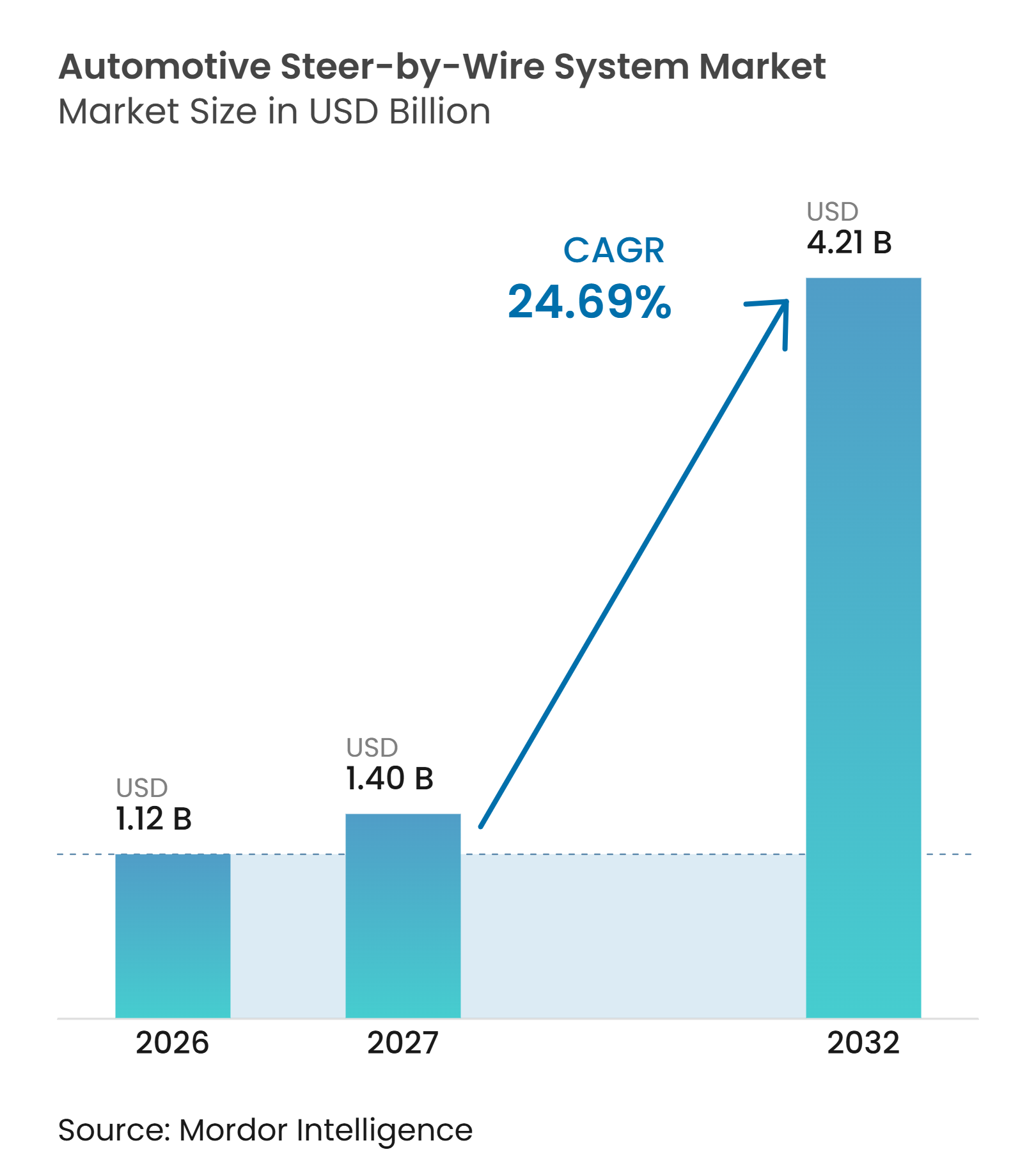
The automotive steer-by-wire system market size was valued at USD 1.12 billion in 2026 and is expected to grow from USD 1.40 billion in 2027 to USD 4.21 billion by 2032, at a CAGR of 24.69% during 2027-2032. The steer-by-wire system market is moving from validation programs into series production, supported by launches from ZF, Nexteer, and Mercedes-Benz. Software-defined vehicle designs give manufacturers greater control over steering response, feel, and post-delivery updates. Electric vehicle platforms also provide much of the electrical and computing infrastructure needed for a fully electronic steering system. Autonomous driving programs strengthen demand because a decoupled steering column can support new cabin layouts and driver handover functions. The steer-by-wire system market remains concentrated in premium vehicles because redundant safety systems, controls, and actuators add substantial cost.
Key Report Takeaways
- By component, steering wheel actuator/feedback units held a 36.12% share in 2026, while sensors are projected to grow at a 27.19% CAGR through 2032.
- By technology, full steer-by-wire held a 54.38% share in 2026 and is projected to grow at a 26.78% CAGR through 2032.
- By steering type, front-axle systems held an 86.31% share in 2026, while rear-axle steer-by-wire is projected to grow at a 28.22% CAGR through 2032.
- By vehicle type, passenger cars held a 92.00% share in 2026, while commercial vehicles are projected to grow at a 30.00% CAGR through 2032.
- By propulsion, battery electric vehicles held a 59.29% share in 2026 and are projected to grow at a 28.54% CAGR through 2032.
- By sales channel, OEMs held a 98.50% share in 2026, while the aftermarket is projected to grow at a 25.83% CAGR through 2032.
- By geography, North America held a 34.29% share in 2026, while Asia-Pacific is projected to grow at a 27.11% CAGR through 2032.
Note: Market numbers in this report are based on Mordor Intelligence's proprietary estimation framework, which combines nine months of actuals with Q4 projections for base year 2026.
Market Trends and Insights
Drivers Impact Analysis of Automotive Steer-by-Wire System Market*
| Driver | (~) % Impact on CAGR Forecast | Geographic Relevance | Impact Timeline |
|---|---|---|---|
| Electrification and Software-Defined Vehicle Architectures | +7.0% | Global | Medium term (2–4 years) |
| Autonomous Driving and ADAS Integration | +6.5% | Asia-Pacific, North America, Europe | Medium term (2–4 years) |
| Packaging Flexibility and Vehicle Interior Reconfiguration | +3.0% | Global | Long term (≥ 4 years) |
| Demand for Variable Steering Ratios and Enhanced Maneuverability | +2.5% | Europe, Asia-Pacific | Short term (≤ 2 years) |
| High-Voltage Platform Readiness for Fail-Operational Steering | +2.0% | Asia-Pacific, North America | Short term (≤ 2 years) |
| Reduced Dependence on Mechanical Steering Components | +1.5% | Global | Long term (≥ 4 years) |
| Source: Mordor Intelligence | |||
Electrification and Software-Defined Vehicle Architectures
Battery-electric vehicles already have high-voltage power systems, centralized controllers, and software update pathways. These features reduce the incremental integration work needed for fully electronic steering. The steer-by-wire system market benefits when vehicle makers treat steering behavior as a software-controlled vehicle function. Steering ratio, feedback, and response can then be adjusted through software rather than fixed mechanical geometry. China’s GB17675-2025 removes the mandatory mechanical-linkage requirement and introduces functional-safety provisions for steer-by-wire, creating a commercial path for deployment from July 2026. The regulation gives manufacturers a clearer basis for production programs built around electronic steering.
Autonomous Driving and ADAS Integration
A mechanically decoupled column supports vehicle control when automated systems manage lateral driving tasks. It can also make room for new steering wheel positions and clearer driver-monitoring layouts. This capability matters for Level 3 and higher automated driving systems, where driver handover must be managed smoothly. JTEKT’s linkless steering system in the Lexus RZ uses cooperative-control software to support a controlled handover between the driver and driver-assistance functions. Fully electronic steering also removes mechanical compliance that can affect control response. These requirements make autonomous driving programs an important source of demand for the steer-by-wire system market.
Packaging Flexibility and Vehicle Interior Reconfiguration
Removing the mechanical column can free cockpit space and remove a physical barrier between front occupants. It also allows flatter steering wheels and retractable designs that conventional systems cannot support. Mercedes-Benz offers steer-by-wire for the EQS with a flatter wheel and a 170-degree lock-to-lock steering input. The company prices the option at EUR 2,500 excluding VAT, which shows that packaging and steering feel can be positioned as premium features [1]. Software-generated feedback can also be tuned for different driving modes without changing physical parts. These advantages support adoption in high-value passenger vehicles before broader volume deployment.
Demand for Variable Steering Ratios and Enhanced Maneuverability
Mechanical steering ratios require a trade-off between low-speed agility and high-speed stability. Electronic steering can vary the ratio by vehicle speed and driving mode. ZF’s Twin Worm torque-feedback actuator uses two independently controlled worm drives and is designed for ASIL-D requirements. The design can reduce steering-wheel travel while retaining controlled feedback for the driver[2]. This feature supports tighter maneuvering at low speeds and stable vehicle behavior at higher speeds. It also makes electronic steering relevant to performance-oriented electric vehicles and dense urban use cases.
Restraints Impact Analysis of Automotive Steer-by-Wire System Market*
| Restraint | (~) % Impact on CAGR Forecast | Geographic Relevance | Impact Timeline |
|---|---|---|---|
| High Redundancy and Functional-Safety Cost | -3.5% | Global | Short term (≤ 2 years) |
| Limited Service Infrastructure and Technician Capability | -1.5% | Emerging markets, Middle East and Africa, South America | Medium term (2–4 years) |
| Battery-Energy Availability During Steering Faults | -1.0% | Global | Short term (≤ 2 years) |
| Consumer Acceptance of Artificial Steering Feedback | -0.8% | Europe, North America | Medium term (2–4 years) |
| Source: Mordor Intelligence | |||
High Redundancy and Functional-Safety Cost
Production steer-by-wire systems need redundant sensors, controllers, power supplies, and actuator paths. Each part must be designed so the vehicle can maintain steering after a single-component fault. Nexteer stated that its series-production system covers sensors, controllers, actuators, and communication links within an ASIL-D architecture. This layered design makes simplification difficult without affecting safety validation. The cost of redundant hardware limits early adoption to premium vehicle programs and high-value commercial applications. Cost reduction is expected to depend on higher production volumes, component integration, and established validation practices.
Limited Service Infrastructure and Technician Capability
Electronic steering requires diagnostic tools, calibration software, and trained technicians. Many independent workshops do not yet have these capabilities. The service challenge can be greater in emerging markets, where access to OEM diagnostic platforms and reliable connectivity can be limited. A fully electronic system also needs software-based alignment checks and fault-log retrieval. Mitsubishi Fuso and REE Automotive began a one-year evaluation of x-by-wire technology on an eCanter electric truck under a November 2025 memorandum of understanding, underlining how much validation work remains before such systems reach fleets. The need for authorized tools and trained service networks can slow adoption beyond factory-installed programs.
*Our forecasts treat driver/restraint impacts as directional, not additive. The impact forecasts reflect baseline growth, mix effects, and variable interactions.
Automotive Steer-by-Wire System Market Segment Analysis
By Component:
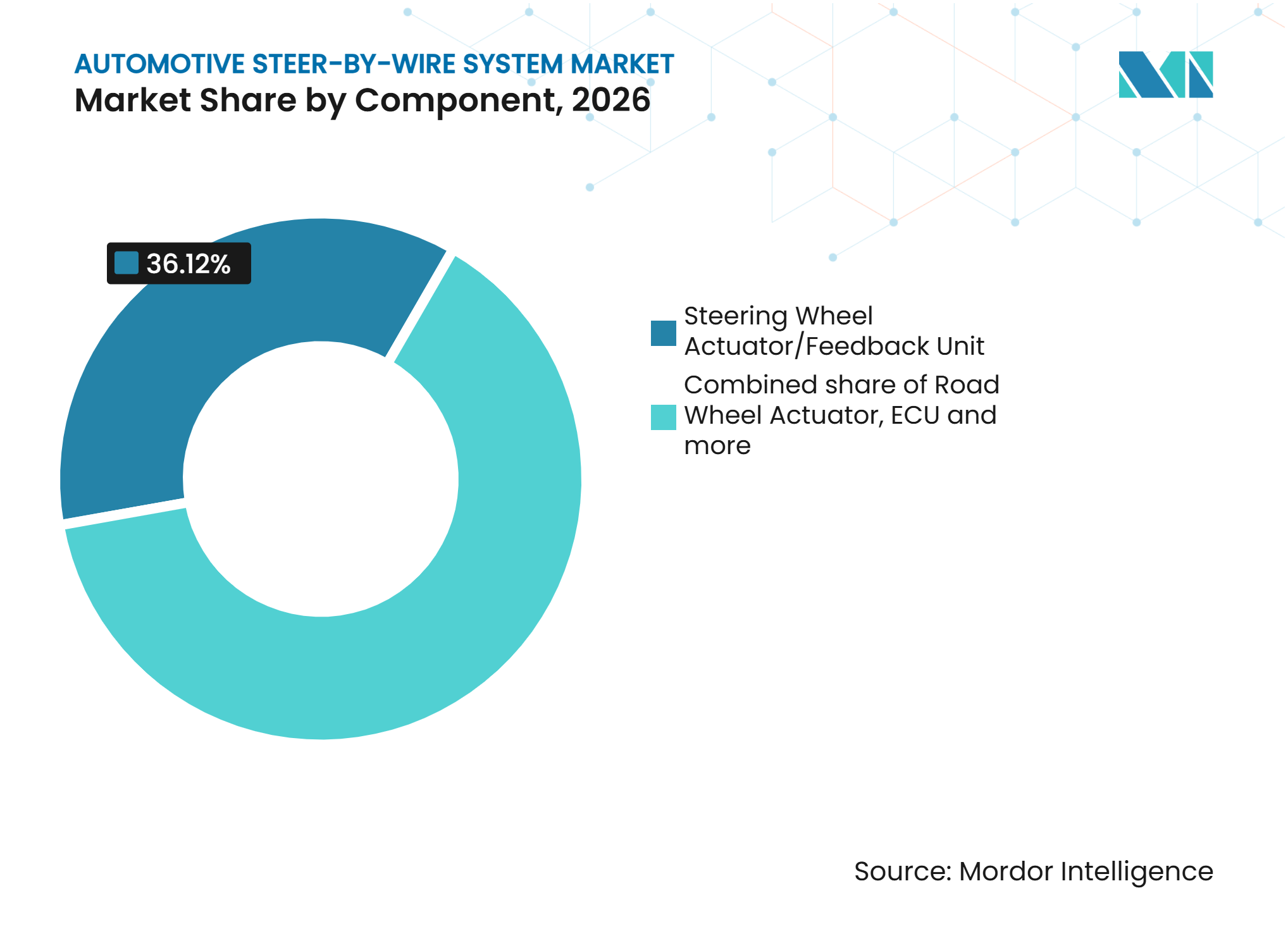
Actuator Dominance, Sensor Scale AcceleratingThe steering wheel actuator/feedback unit held a 36.12% share of the market in 2026. It is the largest component because it serves as the main driver interface and requires high mechanical precision. The unit must produce consistent feedback while meeting safety and durability requirements. Its development cycle can be lengthy because its performance directly affects the driving experience. Sensors are the fastest-growing component and are projected to expand at a 27.19% CAGR through 2032. Their growth reflects the need for torque, angle, and position data across redundant steering systems.
Non-contact inductive position sensors are increasingly relevant because they can maintain accuracy through thermal cycling and electromagnetic interference. They also support compact actuator designs that must meet demanding functional-safety requirements. Road-wheel actuators and electronic control units form the next revenue tier in the steer-by-wire system market. Road-wheel systems are moving toward dual-motor designs that preserve fail-operational capability without adding excessive axle bulk. Other components include sensor-fusion modules and power-distribution units as system architectures become more specialized. ISO 19725:2026 outlines safety goals related to self-steering, steerability, feedback torque, and synchronization faults.



By Technology:
Full Steer-by-Wire Locks in the Production TrajectoryFull steer-by-wire accounted for 54.38% of the market in 2026 and is forecast to grow at a 26.78% CAGR through 2032. This position indicates that many vehicle programs are moving toward complete mechanical decoupling. A hybrid system retains a mechanical backup path, but it also adds weight, cost, and additional failure points. Electronic redundancy can provide the safety basis for full-power steering when it meets relevant requirements. Demand for full steer-by-wire is therefore supported by programs that seek fewer mechanical constraints. These programs also want steering behavior that can be adjusted through software over a vehicle’s life.
ZF expanded steering capacity in China for up to 380,000 steer-by-wire sets annually, signaling a production commitment to the technology. This capacity can support several vehicle programs over successive product cycles. Hybrid and backup-mechanical systems remain relevant where regulatory pathways are still developing. They can also appeal to manufacturers with more cautious launch plans. Their role is likely to narrow as full electronic systems accumulate operational experience. The steer-by-wire system market is consequently placing greater value on proven redundancy, software integration, and production-scale validation.
By Steering Type:
Front-Axle Commands Volume, Rear-Axle Drives the PaceFront-axle steer-by-wire held an 86.31% share of the market in 2026 because the front axle remains the main direction-control axis. It is the natural first installation point as vehicle manufacturers introduce electronic steering. Rear-axle steer-by-wire is projected to grow at a 28.22% CAGR through 2032. Its growth is linked to variable rear steering angles in performance electric vehicles and urban mobility vehicles. Rear steering can support tighter low-speed turning and more stable vehicle behavior at speed. These operating benefits make it useful when manufacturers aim to differentiate vehicle dynamics.
Front and rear steering awards can create a broader relationship between an OEM and a supplier. A supplier selected for the front system may be well placed to support a rear extension on the same platform. ZF combines front-axle steer-by-wire with its AKC rear-axle system for vehicle dynamics applications. This approach allows vehicle makers to coordinate front and rear steering responses. It also supports integrated tuning rather than separate hardware decisions. The revenue role of front systems remains larger, while rear systems contribute the faster growth profile.
By Vehicle Type:
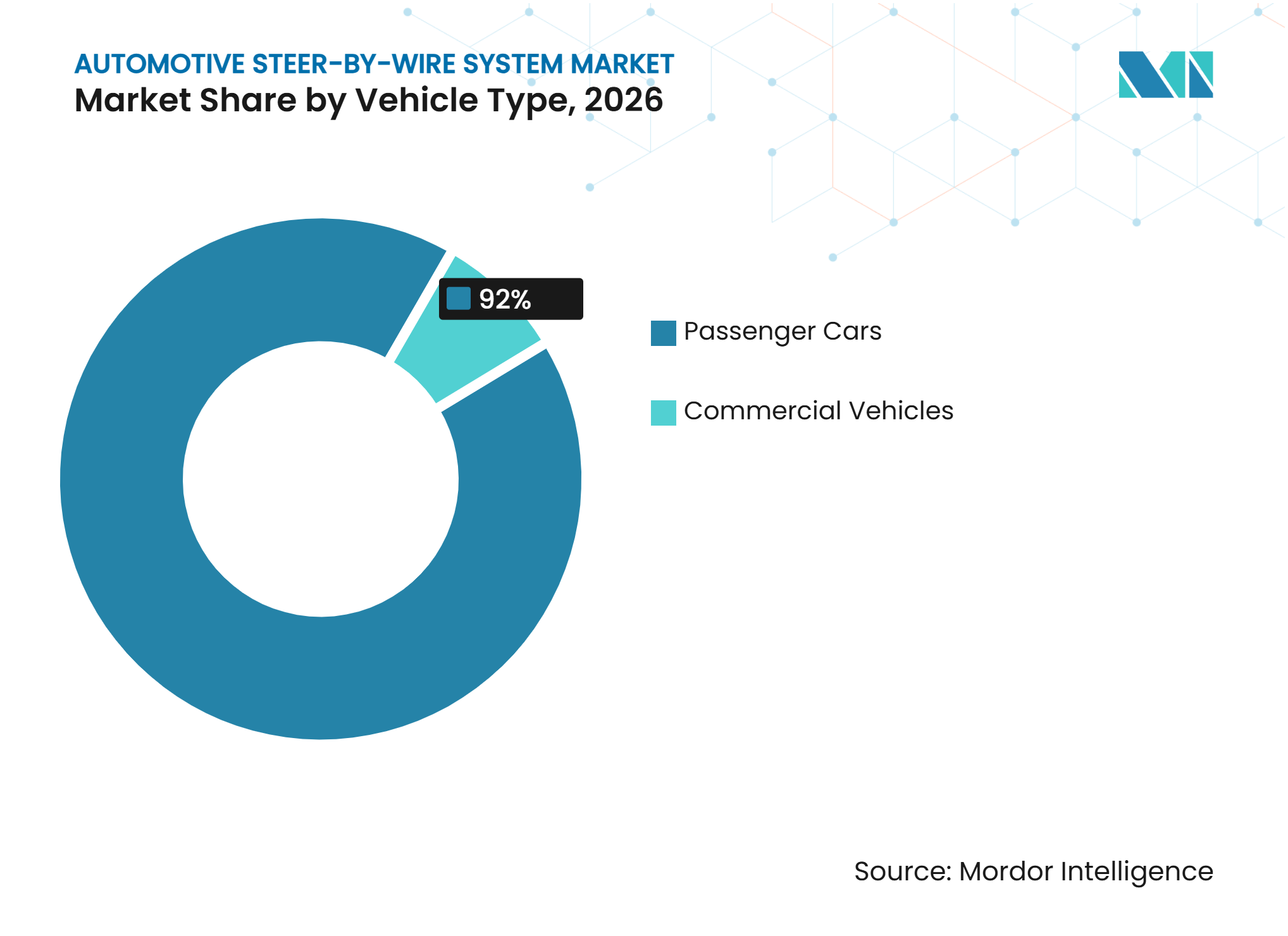
Passenger Cars Hold Share, Commercial Vehicles Signal the Next FrontierPassenger cars accounted for 92.00% of the market in 2026, supported by premium electric vehicle launches. Commercial vehicles are forecast to grow at a 30.00% CAGR through 2032. Commercial demand is driven by autonomous freight applications that require redundant by-wire chassis functions. Electric buses can also benefit from tighter turning radii through all-axle steering layouts. These applications make operational performance, rather than vehicle styling, an important reason for adoption. The steer-by-wire system market serves both passenger comfort requirements and commercial vehicle control requirements.
ZF began series production for the NIO ET9 in 2025, supplying a hand-wheel actuator, redundant road-wheel actuator, and related software. This shows how premium passenger programs remain an early production base. SANY and Pony.ai announced mass-production readiness for a fourth-generation autonomous heavy-duty truck with a redundant drive-by-wire chassis. Commercial programs place strong emphasis on redundancy because fleet operations depend on dependable control functions. Passenger cars provide scale, while commercial programs can speed demand for fail-operational architectures. These two paths broaden the applications served by the steer-by-wire system market.

By Propulsion:
BEV Architecture Shapes Market StructureBattery electric vehicles held 59.29% of the market in 2026 and are forecast to grow at a 28.54% CAGR through 2032. Their high-voltage systems, centralized electronic controls, and software update capabilities align with full electronic steering. This shared infrastructure can lower the incremental work needed to integrate a steer-by-wire system. Hybrid vehicles have higher-voltage systems than many conventional vehicles, but their fault-management requirements remain more complex. Internal combustion engine vehicles are the smallest and slowest-growing propulsion segment. Their adoption is mainly confined to high-performance and specialty vehicle applications.
Demand from battery electric vehicles is shaped by the way OEMs consolidate vehicle platforms. Platform consolidation can narrow the supplier field to companies that meet zonal controller, over-the-air update, and software integration requirements. This favors suppliers with existing electric vehicle relationships and validated safety cases. It can also make supplier nominations more closely tied to platform decisions than to individual steering projects. Manufacturers need compatible hardware, control software, and update capability across the vehicle. The result is a qualification barrier for suppliers without a broad electronic vehicle architecture offering.
By Sales Channel:
OEM Depth, Aftermarket EmergingOEMs held 98.50% of the market in 2026 because steer-by-wire is generally installed during vehicle production. Factory integration allows the system to be matched to vehicle controls, safety validation, and type-approval documentation. The aftermarket is projected to grow at a 25.83% CAGR through 2032. Its initial demand is linked to accessible-mobility adaptations, performance applications, and possible autonomous retrofit kits for commercial vehicles. Non-OEM installation remains difficult because the system needs vehicle-specific calibration and safety verification. This keeps the current steer-by-wire system market centered on original vehicle manufacturing.
The aftermarket could become more important as the installed base expands. Software updates may create recurring opportunities for steering response maps, adaptive feedback profiles, and parking precision functions. This depends on OEMs treating the steering system as an update-capable software platform. It also requires secure access, clear service procedures, and vehicle-specific validation. PARAVAN is an established example of using drive-by-wire controls for drivers with limited mobility. The channel is expected to develop gradually because safety, access rights, and service capability remain essential conditions.
Geography Analysis
North America: Premium Platform Base and Freight Autonomy Pull
North America held a 34.29% share of the market in 2026. The region benefits from an early installed base led by the Tesla Cybertruck, the first series-production steer-by-wire vehicle in North America, and from established engineering activity by major steering suppliers. It also has a clear commercial vehicle opportunity as autonomous freight programs develop. The region’s focus on high-value electric vehicles can support early use of advanced steering systems before they move into broader vehicle categories. Redundant steering is especially relevant for freight operations where automated vehicle control needs reliable chassis functions. Supplier engineering centers and established automotive testing networks provide practical support for further launches.
Regulatory influence comes from vehicle safety requirements and the international steering provisions of UNECE Regulation No. 79, which set a reference point for energy management in full-power steering. North American manufacturers are likely to use steering software and feedback tuning to differentiate premium products. The region also offers a path for commercial systems where operational safety can be valued more highly than simple component cost. Service readiness will remain important because commercial fleets need rapid diagnostics and predictable maintenance. This combination of premium passenger programs and freight applications gives the region a broad adoption base.
Asia-Pacific: Regulatory Catalyst Meets NEV Platform Density
Asia-Pacific is forecast to grow at a 27.11% CAGR through 2032, the fastest rate among regional segments. China’s large new-energy vehicle production base offers suppliers a dense set of potential programs for full-electronic steering. GB17675-2025 removed the mandatory mechanical connection requirement and introduced functional-safety specifications, effective from July 2026. The standard was developed with participation from several major vehicle manufacturers, reflecting a common technical direction. This regulatory structure provides a clearer route from development to mass-production approval. It also supports domestic suppliers seeking to meet the same functional-safety expectations as global competitors.
ZF began series production for the NIO ET9 during 2025. Nexteer subsequently put an ASIL-D-certified system into series production for a Chinese new energy vehicle manufacturer in 2026. These programs show how the region combines production volume, regulatory change, and shorter vehicle development cycles. High electric-vehicle density also helps manufacturers share electronic-architecture costs across multiple models. Competition is likely to focus on software integration, local supply capability, and proof of safety performance. These conditions make Asia-Pacific a central source of volume growth for the steer-by-wire system market.
Varied Adoption Pace Across Remaining Markets
Europe’s near-term demand is centered on premium battery-electric vehicles and engineering-led supplier programs. Mercedes-Benz opened orders for its steer-by-wire system on the EQS in October 2026, providing a high-profile production example in the region. Germany remains important because it has major capabilities in steering, chassis, and automotive software. European suppliers are also pursuing partnerships that can connect local engineering with Asian production scale. Thyssenkrupp Automotive Technology and Inovance Automotive signed a 2026 memorandum of understanding to develop and industrialize steer-by-wire systems, initially for China and later for international applications. This partnership shows how suppliers can seek access to new energy vehicle volumes while retaining an international role.
Other markets have a more gradual adoption path because their volume programs, regulatory readiness, and service networks are less developed. France, the United Kingdom, Sweden, and Italy contribute through vehicle programs and automated driving testing activities. South America, the Middle East, and Africa face a wider service-capability gap in advanced electronic steering. Adoption in these areas is expected to depend on access to practical workshops, diagnostic tools, and technician training. ISO 19725:2026 provides a shared safety reference to support broader international alignment. Mixed regional adoption will therefore reflect local production bases and the pace at which safety, servicing, and software systems mature.
Competitive Landscape
Market Concentration
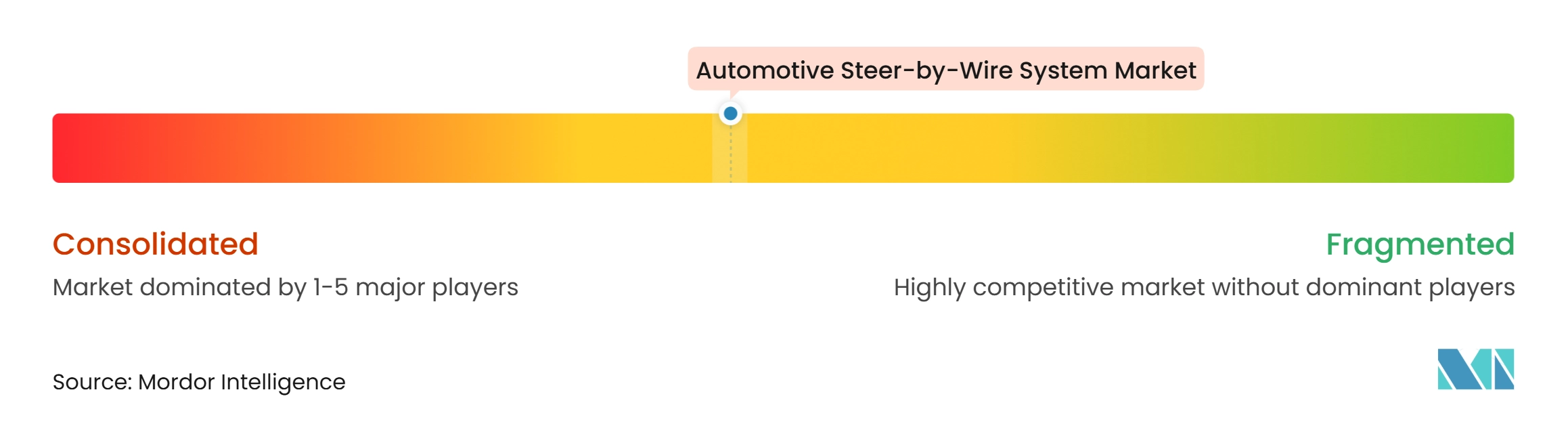
The automotive steer-by-wire system market is moderately concentrated, with established steering and chassis suppliers holding strong positions. ZF Friedrichshafen, Robert Bosch, JTEKT, Nexteer Automotive, and thyssenkrupp hold significant production awards and development programs. Astemo, then Hitachi Astemo, developed a steer-by-wire prototype in 2022 with duplicated power supplies and wiring and triple-circuit sensors and actuators to keep the vehicle steerable after a failure. Their competitive positioning increasingly depends on software integration and functional safety documentation. Suppliers must deliver systems compatible with zonal vehicle architectures and capable of supporting secure software updates. Production readiness also requires evidence that systems meet ASIL-D requirements. Consequently, certification, validation records, and OEM integration capabilities create significant barriers to entry.
Nexteer began series production of its ASIL-D-certified steer-by-wire system in April 2026 for a leading Chinese new energy vehicle maker. This development demonstrates how validated safety architectures can influence commercial nomination decisions. ZF uses its Twin Worm actuator design to integrate feedback control, redundancy, and compatibility with higher levels of automated driving. The company has also started series production for NIO’s ET9, providing a public reference program in China. thyssenkrupp’s partnership with Inovance combines steering expertise with electronics, software, and actuator manufacturing capabilities[3]. These developments indicate that scale, local manufacturing, and software capabilities are becoming increasingly interconnected.
Chinese suppliers and vertically integrated vehicle manufacturers are working to qualify systems under the new domestic compliance framework. Their strongest opportunities lie in cost-optimized platforms, modular actuators, and localized software integration. Established suppliers continue to benefit from long-standing OEM relationships and existing safety validation records. However, suppliers that lack over-the-air update capabilities, clear ASIL-D evidence, or participation in relevant standards development may lose access to premium nominations. Therefore, the competitive landscape is shifting from mechanical steering expertise toward electronics, software, and documented safety performance.
Automotive Steer-by-Wire System Industry Leaders
-
ZF Friedrichshafen AG
-
Nexteer Automotive Corporation
-
Robert Bosch GmbH
-
JTEKT Corporation
-
Astemo, Ltd.
- *Disclaimer: Major Players sorted in no particular order
Automotive Steer-by-Wire System Market Companies Covered in this Report
- ZF Friedrichshafen AG
- Robert Bosch GmbH
- JTEKT Corporation
- Nexteer Automotive Corporation
- thyssenkrupp AG
- Schaeffler AG
- Hyundai Mobis Co., Ltd.
- HL Mando Corporation
- NSK Ltd.
- Astemo, Ltd.
- AUMOVIO SE
- DENSO Corporation
- Infineon Technologies AG
- China Automotive Systems, Inc.
- Aptiv PLC
- KYB Corporation
- PARAVAN GmbH
- Danfoss A/S
Recent Industry Developments in Automotive Steer-by-Wire System Market
- October 2026: thyssenkrupp Automotive Technology and Inovance Automotive signed a memorandum of understanding to jointly develop and industrialize steer-by-wire systems, starting with the Chinese market.
- October 2026: Mercedes-Benz opened orders for steer-by-wire on the EQS in all EQS markets, priced at EUR 2,500 excluding VAT in Germany.
- July 2026: China's GB 17675-2025 steering-system standard took effect, removing the mandatory mechanical linkage and allowing full steer-by-wire systems with defined redundancy and functional-safety requirements.
- April 2026: Nexteer Automotive put its first steer-by-wire system into series production for a leading Chinese new energy vehicle maker, after receiving ASIL D functional-safety approval.
Global Automotive Steer-by-Wire System Market Report Scope
The Automotive Steer-by-Wire System Market Report is Segmented by Component (Steering Wheel Actuator/Feedback Unit, Road Wheel Actuator, ECU, Sensors (Torque, Angle, Position), and Others), Technology (Full Steer-by-Wire and Hybrid/Backup Mechanical), Steering Type (Front-Axle Steer-by-Wire and Rear-Axle Steer-by-Wire), Vehicle Type (Passenger Cars and Commercial Vehicles), Propulsion (ICE, Hybrid, and Battery Electric), Sales Channel (OEM and Aftermarket), and Geography (North America (United States, Canada, and Mexico), Europe (Germany, France, United Kingdom, Italy, Spain, Sweden, Russia, and Rest of Europe), Asia-Pacific (China, Japan, South Korea, India, Australia, and Rest of Asia-Pacific), South America (Brazil, Argentina, Chile, Colombia, and Rest of South America), and Middle East and Africa (Saudi Arabia, United Arab Emirates, Israel, Turkey, South Africa, Egypt, Morocco, and Rest of Middle East and Africa)). The Market Forecasts are Provided in Terms of Value (USD) and Volume (Units).
Segmentation Overview
| Steering Wheel Actuator/Feedback Unit |
| Road Wheel Actuator |
| ECU |
| Sensors (Torque, Angle, Position) |
| Others |
| Full Steer-by-Wire |
| Hybrid/Backup Mechanical |
| Front-Axle Steer-by-Wire |
| Rear-Axle Steer-by-Wire |
| Passenger Cars |
| Commercial Vehicles |
| ICE |
| Hybrid |
| Battery Electric |
| OEM |
| Aftermarket |
| North America | United States |
| Canada | |
| Mexico | |
| Europe | Germany |
| France | |
| United Kingdom | |
| Italy | |
| Spain | |
| Sweden | |
| Russia | |
| Rest of Europe | |
| Asia-Pacific | China |
| Japan | |
| South Korea | |
| India | |
| Australia | |
| Rest of Asia-Pacific | |
| South America | Brazil |
| Argentina | |
| Chile | |
| Colombia | |
| Rest of South America | |
| Middle East and Africa | Saudi Arabia |
| United Arab Emirates | |
| Israel | |
| Turkey | |
| South Africa | |
| Egypt | |
| Morocco | |
| Rest of Middle East and Africa |
| By Component | Steering Wheel Actuator/Feedback Unit | |
| Road Wheel Actuator | ||
| ECU | ||
| Sensors (Torque, Angle, Position) | ||
| Others | ||
| By Technology | Full Steer-by-Wire | |
| Hybrid/Backup Mechanical | ||
| By Steering Type | Front-Axle Steer-by-Wire | |
| Rear-Axle Steer-by-Wire | ||
| By Vehicle Type | Passenger Cars | |
| Commercial Vehicles | ||
| By Propulsion | ICE | |
| Hybrid | ||
| Battery Electric | ||
| By Sales Channel | OEM | |
| Aftermarket | ||
| By Geography | North America | United States |
| Canada | ||
| Mexico | ||
| Europe | Germany | |
| France | ||
| United Kingdom | ||
| Italy | ||
| Spain | ||
| Sweden | ||
| Russia | ||
| Rest of Europe | ||
| Asia-Pacific | China | |
| Japan | ||
| South Korea | ||
| India | ||
| Australia | ||
| Rest of Asia-Pacific | ||
| South America | Brazil | |
| Argentina | ||
| Chile | ||
| Colombia | ||
| Rest of South America | ||
| Middle East and Africa | Saudi Arabia | |
| United Arab Emirates | ||
| Israel | ||
| Turkey | ||
| South Africa | ||
| Egypt | ||
| Morocco | ||
| Rest of Middle East and Africa | ||
Key Questions Answered in the Report
What is the forecast growth rate for the automotive steer-by-wire system market through 2032?
The automotive steer-by-wire system market is projected to grow at a 24.69% CAGR from 2027 to 2032 and reach USD 4.21 billion by 2032. Growth is tied to series-production launches, software-defined vehicle programs, and demand for redundant control systems in advanced electric vehicles.
Which component leads steer-by-wire adoption?
Steering wheel actuator/feedback units held a 36.12% share in 2026, while sensors are the fastest-growing component at a 27.19% CAGR. The leading actuator supports driver feedback, while sensor demand reflects the need to measure torque, angle, and position across redundant system architectures.
Why are battery-electric vehicles important for steer-by-wire?
Battery electric vehicles held a 59.29% share in 2026 and have high-voltage systems, centralized controls, and software update pathways that support electronic steering. The steer-by-wire system market benefits because these vehicle platforms can share electrical, computing, and software infrastructure with the steering system.
Why are commercial vehicles adopting steer-by-wire?
Commercial vehicles are projected to grow at a 30.00% CAGR because automated freight and electric bus applications need redundant chassis control and improved maneuverability. The steer-by-wire system market can serve these use cases where reliable lateral control and operational performance are central to fleet deployment.
What limits wider adoption of steer-by-wire systems?
Redundant safety hardware, service capability, fault-energy validation, and acceptance of software-generated steering feedback remain important constraints. The steer-by-wire system market also remains closely tied to premium programs because early production systems require specialized integration, calibration, and documented functional-safety evidence.