
Automotive Steel Wheels Market Size and Share
Market Overview
| Study Period | 2020 - 2032 |
|---|---|
| Market Size (2027) | USD 15.11 Billion |
| Market Size (2032) | USD 17.67 Billion |
| Growth Rate (2027 - 2032) | 3.18 % |
| Fastest Growing Market | Asia-Pacific |
| Largest Market | Asia-Pacific |
| Market Concentration | Medium |
Major Players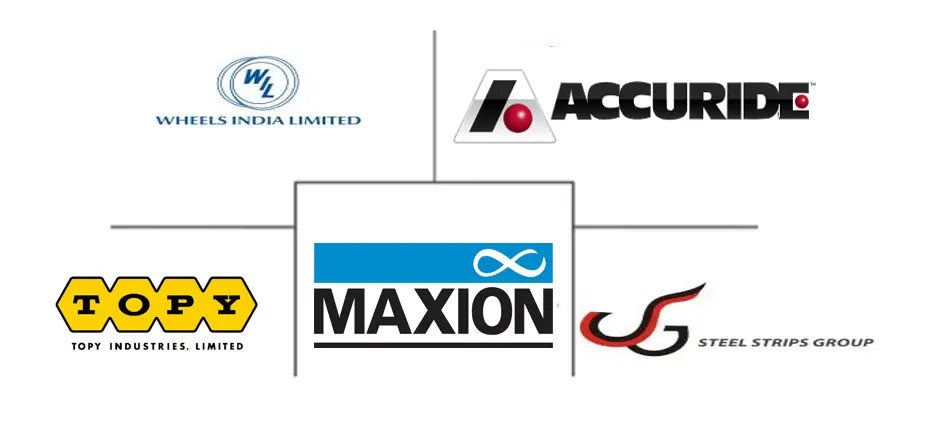 *Disclaimer: Major Players sorted in no particular order Image © Mordor Intelligence. Reuse requires attribution under CC BY 4.0. | |
Automotive Steel Wheels Market Analysis by Mordor Intelligence
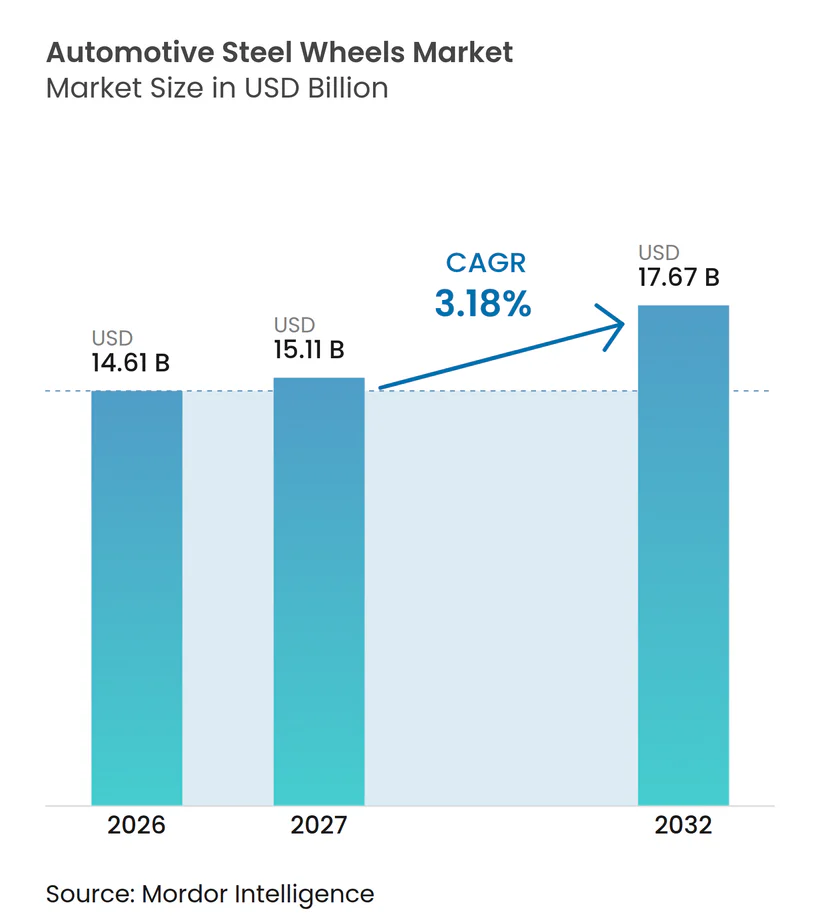
The automotive steel wheels market size was valued at USD 14.61 billion in 2026 and is expected to grow from USD 15.11 billion in 2027 to USD 17.67 billion by 2032, at a CAGR of 3.18% during 2027-2032. Steel wheels remain important in entry-level passenger vehicles, commercial fleets, and off-highway equipment because their purchase cost, repairability, and recyclability support fleet economics. The automotive steel wheels market also benefits from commercial vehicle replacement needs that continue even when new vehicle production slows. Battery-electric trucks create a separate demand area because heavier battery packs raise wheel-load requirements and support high-strength designs. At the same time, alloy adoption in passenger-car EVs and uneven steel, energy, and coating costs continue to limit demand in higher vehicle trims.
Key Report Takeaways
- By wheel type, stamped steel held a 63.73% share in 2026, while forged steel is projected to grow at a 4.83% CAGR through 2032.
- By rim size, 13–15 inch wheels held a 41.26% share in 2026, while 19–22.5 inch wheels are projected to grow at a 4.27% CAGR through 2032.
- By vehicle type, passenger cars held a 45.34% share in 2026, while heavy commercial vehicles are projected to grow at a 4.46% CAGR through 2032.
- By coating, painted wheels held a 46.57% share in 2026, while powder-coated wheels are projected to grow at a 4.13% CAGR through 2032.
- By sales channel, OEM held a 68.42% share in 2026, while aftermarket is projected to grow at a 4.28% CAGR through 2032.
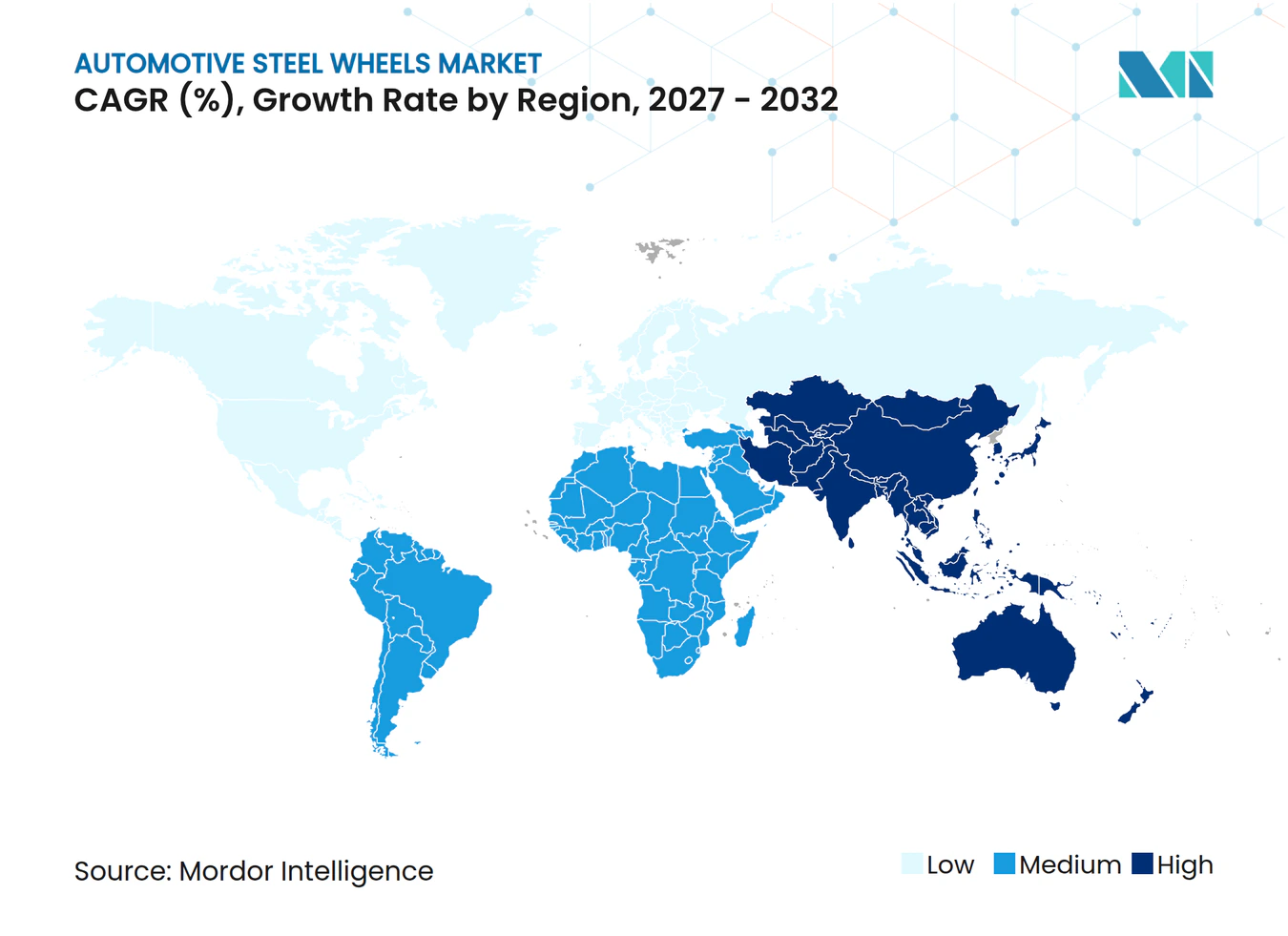
- By geography, Asia-Pacific held a 44.83% share in 2026 and is projected to grow at a 3.56% CAGR through 2032.
Note: Market numbers in this report are based on Mordor Intelligence's proprietary estimation framework, which combines nine months of actuals with Q4 projections for base year 2026.
Market Trends and Insights
Drivers Impact Analysis of Automotive Steel Wheels Market*
| Driver | (~) % Impact on CAGR Forecast | Geographic Relevance | Impact Timeline |
|---|---|---|---|
| Low-Cost Steel Specifications in Entry-Level and Compact Vehicles | +0.9% | Global, concentrated in Asia-Pacific, South America, and Sub-Saharan Africa | Short term (≤ 2 years) |
| Commercial Fleet Load Durability and Repairability | +0.8% | Global, strongest in North America, Europe, and East Asia logistics corridors | Medium term (2–4 years) |
| EV Commercial-Vehicle Payload and Wheel-Load Requirements | +0.6% | North America and Europe, extending to Asia-Pacific as electric truck programs scale | Medium term (2–4 years) |
| Expanding Emerging-Market Vehicle Production and Road Freight | +0.5% | Asia-Pacific, South America, and Middle East and Africa | Long term (≥ 4 years) |
| Aftermarket Replacement from Pothole, Curb, and Corrosion Damage | +0.4% | Global, with stronger relevance in India, Southeast Asia, and Sub-Saharan Africa | Short term (≤ 2 years) |
| Regional Localization and Steel-Wheel Plant Investments Near OEM Clusters | +0.3% | Asia-Pacific, South America, and Middle East and Africa OEM hubs | Long term (≥ 4 years) |
| Source: Mordor Intelligence | |||
Low-Cost Steel Specifications in Entry-Level and Compact Vehicles
Entry-level and compact vehicle programs remain a major source of OEM demand in the automotive steel wheels market. Stamped steel specifications remain relevant where manufacturers need to preserve affordability in high-volume vehicle lines. A steel wheel typically costs less per corner than a comparable cast alloy wheel, a material saving in low-priced passenger cars. That cost difference becomes material when a platform serves several million vehicles. India recorded domestic automotive production at record levels in FY 2024–25, supported by subcompact and compact passenger vehicles that commonly use steel wheels as standard equipment. Platform consolidation may reduce the number of bespoke wheel designs, but it can also preserve volume for standard steel fitments. Fewer derivative programs can limit the migration of alloy designs from premium trims to entry trims. This keeps steel as a practical default where pricing remains the central purchase factor. The automotive steel wheels market therefore remains tied to vehicle affordability as much as to technology choice. Suppliers that combine low-cost manufacturing with dependable OEM logistics are better placed to protect these volumes. Asia-Pacific, South America, and Sub-Saharan Africa are the main areas of relevance for this driver.
Commercial Fleet Load Durability and Repairability
Commercial fleet operators continue to choose steel wheels where repair access, operating continuity, and replacement cost matter. A damaged steel wheel can be repaired in workshops that do not have specialized equipment for alloy wheel restoration. This is particularly relevant on remote freight, construction, and agricultural routes. A standard 6×4 tractor unit uses 10 wheels, excluding the spare, so a 100-truck order creates demand for about 1,000 wheels. The automotive steel wheels market gains further support when fleets replace wheels through established approved suppliers. Fleet purchasing also values traceability, fitment consistency, and warranty documentation. These requirements help established wheel suppliers retain replacement business after the original vehicle sale. The relationship is less exposed to short-term changes in vehicle assembly than a supplier focused only on OEM orders. Fleet telematics is also starting to track wheel condition as a maintenance indicator. This change can move replacement decisions from visible damage to scheduled intervention. The resulting replacement cycle supports commercial-wheel demand across the forecast period.
EV Commercial-Vehicle Payload and Wheel-Load Requirements
Battery-electric trucks create a high-load application for the automotive steel wheels market. Battery packs add several tons to vehicle mass. Front axle loads on electric trucks can increase by as much as 500 kg per wheel. Maxion Wheels has developed a commercial-vehicle steel wheel for battery-electric trucks using higher-strength steel and topology optimization. The design provides a 250 kg load-capacity increase while maintaining wheel weight, reaching 4,250 kg per wheel[1]. In November 2025, EU member-state ambassadors endorsed a compromise allowing 44-ton cross-border operations for zero-emission trucks, with negotiations with the European Parliament to follow. Higher permitted weights would place greater attention on load-certified wheel designs. This creates a more specialized purchasing requirement than conventional diesel truck programs. Suppliers will need technical documentation and OEM validation before they can supply these applications. This makes high-load steel wheels a developing product category rather than a niche engineering project.
Expanding Emerging-Market Vehicle Production and Road Freight
The automotive steel wheels market is supported by the expansion of vehicle production and freight activity in emerging economies. India, Indonesia, Brazil, and other manufacturing locations combine growing assembly capacity with price-sensitive vehicle demand. Steel fitments remain suited to vehicles sold into applications where durability and repair access are more important than styling. Road freight growth also increases demand for commercial vehicles and replacement wheels. Wheels India reported that India’s agricultural tractor market grew 8% in FY 2024–25, adding to off-highway demand. This driver is longer term because it depends on vehicle production, road investment, and regional supply networks. It is not limited to passenger vehicles. Light commercial vehicles, agricultural machinery, and construction equipment can all use steel wheel designs. The automotive steel wheels market also benefits where wheel repair is more accessible than complete replacement. Localization near OEM plants can reduce delivery time and lower exposure to cross-border logistics disruptions. These conditions favor suppliers with regional manufacturing capacity and established customer approvals.
Restraints Impact Analysis of Automotive Steel Wheels Market*
| Restraint | (~) % Impact on CAGR Forecast | Geographic Relevance | Impact Timeline |
|---|---|---|---|
| Alloy-Wheel Substitution in Higher Trims and EV Passenger Cars | -0.7% | North America and Europe, with growing relevance in Asia-Pacific | Medium term (2–4 years) |
| Flat-Steel, Energy, and Coating Cost Volatility | -0.4% | Global, most acute in Europe and North America | Short term (≤ 2 years) |
| OEM Platform Consolidation Reducing Steel-Wheel SKU Variety | -0.2% | Global, with stronger effects on manufacturers serving bespoke tooling orders | Medium term (2–4 years) |
| Corrosion, Salt Exposure, and End-of-Life Coating Compliance Complexity | -0.2% | North America, Northern Europe, and markets with stricter end-of-life requirements | Long term (≥ 4 years) |
| Source: Mordor Intelligence | |||
Alloy-Wheel Substitution in Higher Trims and EV Passenger Cars
Alloy wheels are increasingly specified in higher passenger-car trims and electric vehicles, with manufacturers using lower unsprung mass and visual differentiation as selling points. This pressure is strongest where buyers place greater value on range, styling, and higher trim content. Aluminum wheels are gaining share in Europe’s commercial vehicle segment, although overall market growth is outpacing the substitution rate. The risk is more substantial in EV passenger cars than in heavy-duty trucks, as passenger-car OEMs often make alloy wheels standard in mid-range electric models. Steel wheel suppliers must respond with high-strength and lighter designs where performance requirements justify the added cost. However, commercial, off-highway, and entry-level vehicle applications continue to prioritize operating cost and serviceability, providing a buffer for the automotive steel wheels market. The restraint therefore changes the product mix more than it eliminates steel wheel demand across all categories.
Flat-Steel, Energy, and Coating Cost Volatility
Flat steel is the largest cost element in steel wheel manufacturing, making producers vulnerable to regional variations in steel and energy prices. These differences can place European and North American manufacturers at a cost disadvantage against lower-cost Chinese supply. Coating upgrades also require investment in spray booths, curing systems, and wastewater treatment, with these expenses difficult to pass through when OEM contracts fix prices for extended periods. The automotive steel wheels market can therefore experience margin pressure even where shipment volumes remain stable. Accuride emerged from restructuring in March 2025 after equitizing more than USD 400 million of funded debt and securing USD 165 million in new credit facilities, illustrating the pressure that debt and high operating costs can place on wheel manufacturers[2]. Cost volatility can also discourage smaller suppliers from investing in improved coatings and lightweight designs, while larger manufacturers can generally spread these investments across a wider customer base. This can increase concentration in OEM supply while competition in aftermarket segments remains broad, making careful purchasing and capital planning essential for suppliers to preserve profitability.
*Our forecasts treat driver/restraint impacts as directional, not additive. The impact forecasts reflect baseline growth, mix effects, and variable interactions.
Automotive Steel Wheels Market Segment Analysis
By Wheel Type:
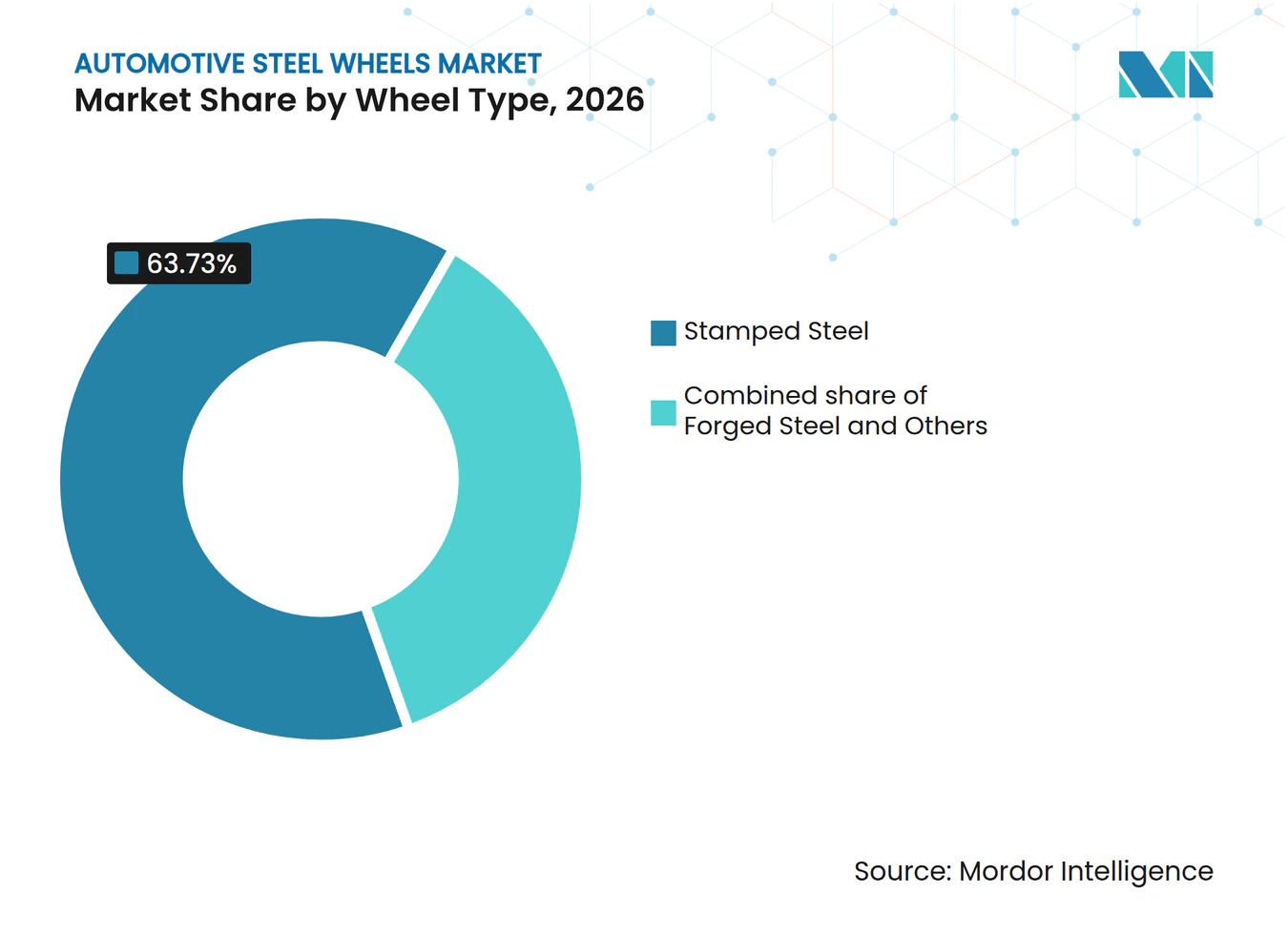
Stamped Steel Anchors Volume While Forged Steel Gains in Heavy-Duty UsesStamped steel held a 63.73% share in 2026. This wheel type remains common in mass-market passenger cars and light commercial vehicles because stamping supports high-volume output. Forged steel is forecast to grow at a 4.83% CAGR through 2032. The segment benefits from commercial vehicle and battery-electric truck applications where strength-to-weight performance is important. Other wheel designs include cast steel, wire-spoked, and multi-piece products for specialized off-highway and agricultural equipment.
Stamped wheels are supported by established OEM production lines and familiar repair practices. Their cost structure suits entry vehicles where alloy wheels would add material cost without a required performance gain. Forged products serve a different requirement because they can support demanding load conditions. Forged steel wheels are mainly specified for heavy trucks, buses, and trailers where high load ratings and fatigue strength are required. The automotive steel wheels market is therefore separating into a large standard wheel base and a smaller engineered segment for demanding vehicle loads.



By Rim Size:
Standard Diameters Retain Scale While Larger Wheels Grow FasterThe 13–15 inch category held a 41.26% share in 2026. These sizes remain integrated into passenger-car OEM programs where tire fitment and vehicle cost limit rapid specification changes. The 19–22.5 inch range is forecast to grow at a 4.27% CAGR through 2032. It is supported by medium and heavy commercial vehicles that need larger diameters for brake thermal management and axle-load compliance. The 16–18 inch category serves mainstream light commercial vehicles and mid-range passenger cars.
Wheels larger than 22.5 inches serve trailers, mining equipment, and off-highway platforms. They have lower unit volumes but can have greater unit value and limited alloy substitution risk. Electric truck designs are drawing attention to 22.5-inch and 24.5-inch specifications because higher axle mass requires new load and brake-clearance validation. The automotive steel wheels market size for large wheel applications is supported by these technical requirements rather than passenger-car styling. Manufacturers that can provide high-strength steel wheels with battery-electric vehicle load documentation can strengthen their access to new commercial programs. This makes engineering validation and type approval important alongside manufacturing capacity.
By Vehicle Type:
Heavy Commercial Vehicle Demand Offsets Passenger-Car PressurePassenger cars held a 45.34% share in 2026. The segment remains large because Asia-Pacific and South America continue to produce substantial volumes of entry-level and compact vehicles. Heavy commercial vehicles are forecast to grow at a 4.46% CAGR through 2032. Logistics expansion, urban bus electrification, and fleet renewal support this rate. Light commercial vehicles remain relevant to urban delivery and rural utility uses.
Off-highway vehicles create a smaller but valuable demand base across agriculture, construction, mining, and industrial activities. China’s commercial vehicle production reached 3.81 million units in 2024, down 5.8% year on year, although replacement demand continued to support wheel volumes. Each 6×4 tractor unit uses 10 wheels, excluding the spare. Heavy commercial vehicle demand has a multiplier effect because each vehicle requires multiple wheel positions. The automotive steel wheels market benefits when fleet production growth is paired with replacement demand. Passenger car volumes face alloy substitution, but price-sensitive vehicle programs continue to provide a substantial steel wheel base.
By Coating:
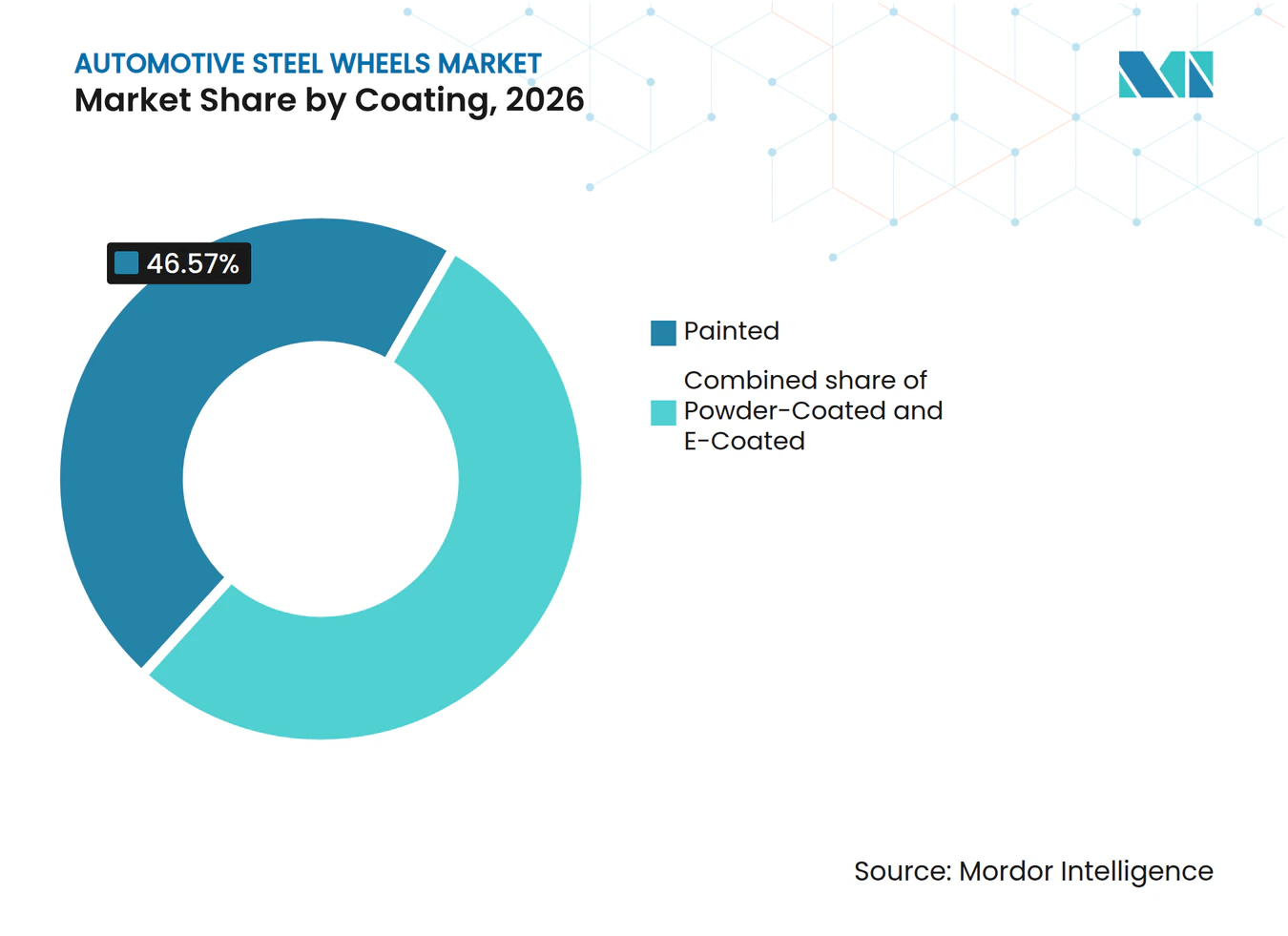
Painted Wheels Lead While Powder Coating Gains GroundPainted wheels held a 46.57% share in 2026. They remain widely used in entry-level OEM lines where single-coat liquid systems control cycle time and cost. Powder-coated wheels are forecast to grow at a 4.13% CAGR through 2032. The segment benefits from fleet demand for longer corrosion protection and from OEM efforts to meet emissions requirements. E-coated wheels also have relevance in North American commercial vehicle applications that require strong salt-fog resistance.
Coating choice increasingly depends on durability, environmental compliance, and vehicle noise requirements. Film-thickness consistency can also affect wheel resonance behavior in electric vehicles, where road and wheel noise can become more noticeable. Powder and e-coat systems can offer more controlled surface coverage than liquid paint. Accuride’s July 2025 update to Steel Armor shows how multi-layer coatings can create customer-specific approval requirements. These systems can reduce the effect of price-only competition in commercial fleets. They also raise investment needs for suppliers seeking to serve corrosion-sensitive applications.

By Sales Channel:
OEM Volume Is Larger While Aftermarket Demand Builds RecurrenceThe OEM channel held a 68.42% share in 2026. It is supported by high-volume supply agreements that connect wheel plants to vehicle assembly logistics. The aftermarket is forecast to grow at a 4.28% CAGR through 2032. The channel gains from aging fleets, road damage, and corrosion-related replacement needs. OEM contracts help fund investment in automated stamping, welding, and dimensional inspection.
Aftermarket supply requires a different operating model from just-in-sequence OEM delivery. Suppliers need regional inventory, distributor relationships, reverse logistics, and accurate fitment information. Steel Strips Wheels guided export revenue of about INR 600 crore (around USD 68 million) for FY 2026–27. The automotive steel wheels market benefits when fleet telematics identifies wheel condition before a visible failure occurs. This can create data-led replacement schedules and reward suppliers that can document fitment and performance. The result is a stronger role for service, distribution, and technical support in the aftermarket.
Geography Analysis
Asia-Pacific
Asia-Pacific held a 44.83% share in 2026 and is forecast to grow at a 3.56% CAGR through 2032. China supports regional output through vehicle manufacturing, commercial vehicle activity, and exports. China is the largest steel wheel producer and exporter, supplying both domestic commercial vehicle fleets and overseas aftermarkets. India provides a separate source of growth through vehicle assembly, compact vehicle production, and wheel exports. Regional competition centers on cost, production capacity, and location near OEM facilities. Xiamen Rizhong’s facilities in Vietnam and Indonesia indicate how manufacturers are building production footprints beyond China.
Europe
Europe faces supply-side changes in the automotive steel wheels market. The closure of Accuride Wheels Europe’s Ronneburg, Germany facility in May 2025 removed an off-highway steel wheel production site. The Solingen commercial vehicle steel wheel plant was sold to Asian strategic investors after insolvency proceedings in 2025 and now operates under the Kronprinz brand. European vehicle programs also face greater demand for corrosion resistance and technical approval. The possible increase in permitted weight for zero-emission commercial vehicles could produce demand for new load-certified wheel designs. Suppliers would need to meet OEM type-approval and service requirements before series production can start.
North America, South America, and Middle East and Africa
North America is consolidating around suppliers that can offer corrosion-resistant commercial vehicle wheels. Accuride emerged from restructuring in March 2025 with a renewed focus on its core North American steel and aluminum wheel business. Winter road salt supports replacement demand in northern United States states and Canadian provinces. Compliance factors also matter because coating systems must meet federal and state air and wastewater requirements. Mexico’s manufacturing expansion near United States border OEM clusters can add demand for suppliers that serve regional assembly networks.
Competitive Landscape
Market Concentration
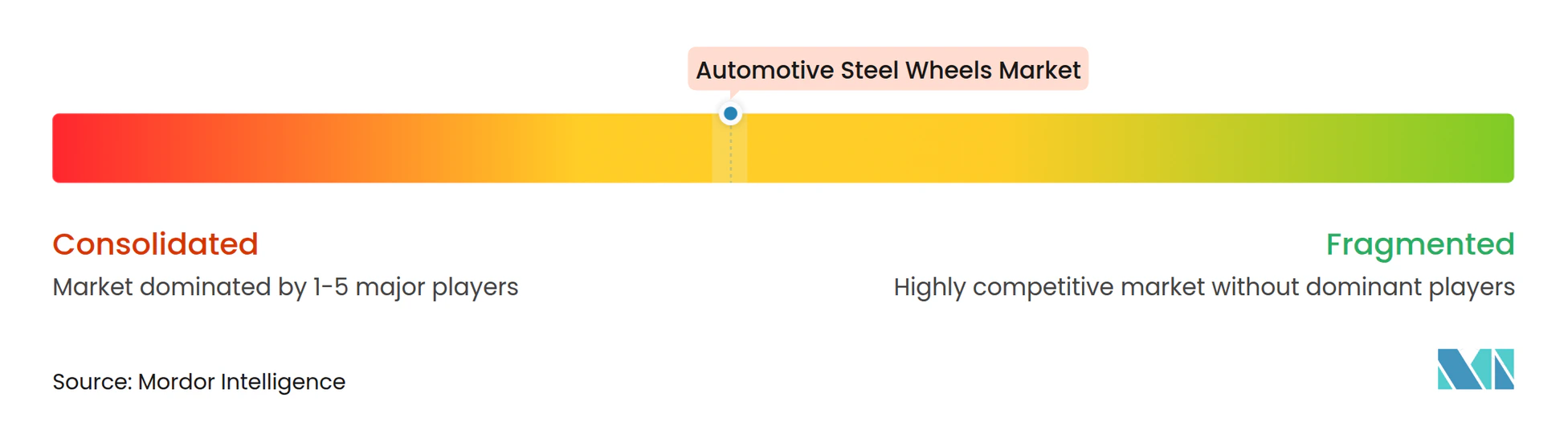
The automotive steel wheels market is moderately concentrated, with consolidated tier-1 OEM supply and fragmented commercial vehicle aftermarket and off-highway segments. Iochpe-Maxion, Topy Industries, and Steel Strips Wheels are among the leading suppliers, with Iochpe-Maxion operating one of the largest global wheel plant networks. The supply model centers on producing close to OEM assembly sites. This is necessary for just-in-sequence contracts and makes regional plant networks a competitive requirement.
Technology is becoming more important in commercial and electric vehicle applications. Maxion uses topology optimization in its battery-electric truck steel wheel program to improve load capacity without adding wheel weight. Accuride upgraded its Steel Armor coating system in July 2025, targeting sharper-edge corrosion protection. Steel Strips Wheels completed the acquisition of the assets of AMW Autocomponent Limited in Bhuj, Gujarat, in January 2024, expanding its western India steel wheel capacity. These actions show that capacity, coating performance, and engineering capability are central competitive tools.
The automotive steel wheels market has openings in high-load battery-electric truck wheels, corrosion-resistant fleet products, and digitally traceable replacement wheels. The Ronneburg closure has also left a gap in European off-highway steel wheel supply. Chinese producers, including Zhejiang Jingu, Shandong Zhengxing, Jiangsu Lizhong, and Xiamen Rizhong, are pursuing broader international footprints. Bharat Wheel, Jantsa Jant Sanayi, and new forged wheel entrants add pressure in regional and specialized segments. Competition remains strongest on price in standard products, while approvals and engineering data carry more weight in OEM and fleet applications.
Automotive Steel Wheels Industry Leaders
-
Iochpe-Maxion S.A.
-
Accuride Corporation
-
Topy Industries, Limited
-
Steel Strips Wheels Limited
-
Wheels India Limited
- *Disclaimer: Major Players sorted in no particular order
Automotive Steel Wheels Market Companies Covered in this Report
- Iochpe-Maxion S.A.
- Accuride Corporation
- Topy Industries, Limited
- Steel Strips Wheels Limited
- Wheels India Limited
- ALCAR HOLDING GMBH
- Central Motor Wheel of America, Inc.
- Zhejiang Jingu Co., Ltd.
- Xingmin Intelligent Transportation Systems Co., Ltd.
- Shandong Zhengxing Wheel Co., Ltd.
- Jiangsu Lizhong Wheel Co., Ltd.
- Titan International, Inc.
- Chuo Seiko Co., Ltd.
- Dongfeng Motor Wheel Co., Ltd.
- The Carlstar Group LLC
- Jantsa Jant Sanayi ve Ticaret A.Ş.
- Bharat Wheel Pvt. Ltd.
- Munjal Auto Industries Limited
Recent Industry Developments in Automotive Steel Wheels Market
- October 2026: Steel Strips Wheels approved an INR 1,400 crore plant in Chhatrapati Sambhajinagar, Maharashtra, with initial annual capacity of 2.5 million steel wheels and 1.3 million alloy wheels.
- July 2026: Steel Strips Wheels announced a 2-million-unit brownfield expansion of its steel wheel capacity near Chandigarh, expected to be commissioned before the end of 2026.
- April 2026: Maxion Wheels developed a low-carbon 22.5 × 9.00-inch steel truck wheel for Daimler Truck’s reECONIC vehicle, cutting its manufacturing carbon footprint by more than 50% to 61.4 kg of CO₂ per wheel.
- March 2026: The US Department of Commerce initiated circumvention inquiries, requested by Accuride and Maxion Wheels USA, into 22.5- and 24.5-inch steel truck wheels finished in Vietnam and Thailand from Chinese hot-rolled steel.
Global Automotive Steel Wheels Market Report Scope
The Automotive Steel Wheels Market Report is Segmented by Wheel Type (Stamped Steel, Forged Steel, and Others), Rim Size (13–15 Inches, 16–18 Inches, 19–22.5 Inches, and Above 22.5 Inches), Vehicle Type (Passenger Cars, Light Commercial Vehicles, Heavy Commercial Vehicles, and Off-Highway Vehicles), Coating (Painted, Powder-Coated, and E-Coated), Sales Channel (OEM and Aftermarket), and Geography (North America, South America, Europe, Asia-Pacific, and Middle East and Africa). The Market Forecasts are Provided in Terms of Value (USD) and Volume (Units).
Segmentation Overview
| Stamped Steel |
| Forged Steel |
| Others (Cast Steel, Wire-Spoked Steel, and Multi-Piece Steel) |
| 13–15" |
| 16–18" |
| 19–22.5" |
| Above 22.5" |
| Passenger Cars |
| Light Commercial Vehicles |
| Heavy Commercial Vehicles (Trucks, Buses, and Trailers) |
| Off-Highway (Agricultural, Construction, Mining, and Industrial Vehicles) |
| Painted |
| Powder-Coated |
| E-Coated |
| OEM |
| Aftermarket |
| North America | United States |
| Canada | |
| Mexico | |
| Europe | Germany |
| United Kingdom | |
| France | |
| Italy | |
| Spain | |
| Poland | |
| Russia | |
| Rest of Europe | |
| Asia-Pacific | China |
| India | |
| Japan | |
| South Korea | |
| Australia | |
| Indonesia | |
| Thailand | |
| Rest of Asia-Pacific | |
| South America | Brazil |
| Argentina | |
| Chile | |
| Colombia | |
| Rest of South America | |
| Middle East and Africa | Türkiye |
| Saudi Arabia | |
| United Arab Emirates | |
| Iran | |
| Israel | |
| Egypt | |
| South Africa | |
| Nigeria | |
| Morocco | |
| Rest of Middle East and Africa |
| By Wheel Type | Stamped Steel | |
| Forged Steel | ||
| Others (Cast Steel, Wire-Spoked Steel, and Multi-Piece Steel) | ||
| By Rim Size | 13–15" | |
| 16–18" | ||
| 19–22.5" | ||
| Above 22.5" | ||
| By Vehicle Type | Passenger Cars | |
| Light Commercial Vehicles | ||
| Heavy Commercial Vehicles (Trucks, Buses, and Trailers) | ||
| Off-Highway (Agricultural, Construction, Mining, and Industrial Vehicles) | ||
| By Coating | Painted | |
| Powder-Coated | ||
| E-Coated | ||
| By Sales Channel | OEM | |
| Aftermarket | ||
| By Geography | North America | United States |
| Canada | ||
| Mexico | ||
| Europe | Germany | |
| United Kingdom | ||
| France | ||
| Italy | ||
| Spain | ||
| Poland | ||
| Russia | ||
| Rest of Europe | ||
| Asia-Pacific | China | |
| India | ||
| Japan | ||
| South Korea | ||
| Australia | ||
| Indonesia | ||
| Thailand | ||
| Rest of Asia-Pacific | ||
| South America | Brazil | |
| Argentina | ||
| Chile | ||
| Colombia | ||
| Rest of South America | ||
| Middle East and Africa | Türkiye | |
| Saudi Arabia | ||
| United Arab Emirates | ||
| Iran | ||
| Israel | ||
| Egypt | ||
| South Africa | ||
| Nigeria | ||
| Morocco | ||
| Rest of Middle East and Africa | ||
Key Questions Answered in the Report
What is the projected value of the automotive steel wheels market by 2032?
The automotive steel wheels market is projected to reach USD 17.67 billion by 2032, from USD 14.61 billion in 2026, at a 3.18% CAGR during 2027–2032.
Why are steel wheels still used in passenger vehicles?
Steel wheels remain common in entry-level and compact vehicles because they support lower vehicle cost, high-volume production, and practical repairability.
Which wheel type is expected to grow the fastest through 2032?
Forged steel is forecast to grow at a 4.83% CAGR through 2032, supported by high-load commercial and battery-electric truck applications.
Which region leads demand for automotive steel wheels?
Asia-Pacific held a 44.83% share in 2026 and is forecast to grow at a 3.56% CAGR through 2032.