
Automotive Steel Market Size and Share
Market Overview
| Study Period | 2020 - 2032 |
|---|---|
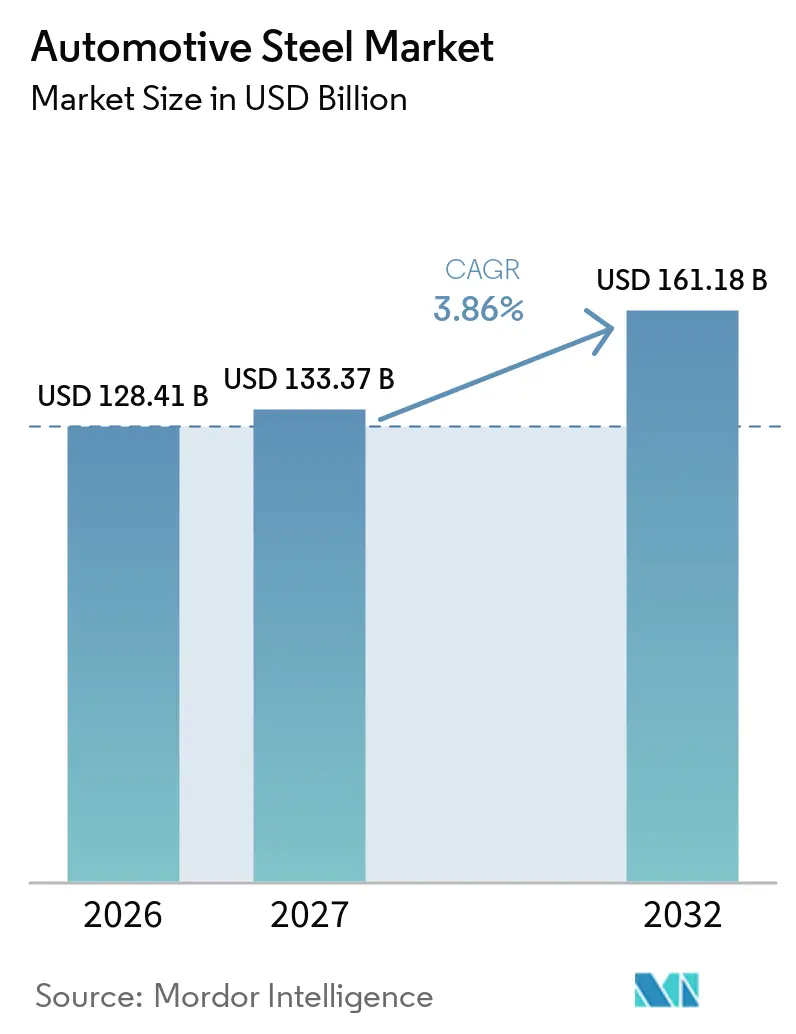
| Market Size (2027) | USD 133.37 Billion |
| Market Size (2032) | USD 161.18 Billion |
| Growth Rate (2027 - 2032) | 3.86 % |
| Fastest Growing Market | Asia-Pacific |
| Largest Market | Asia-Pacific |
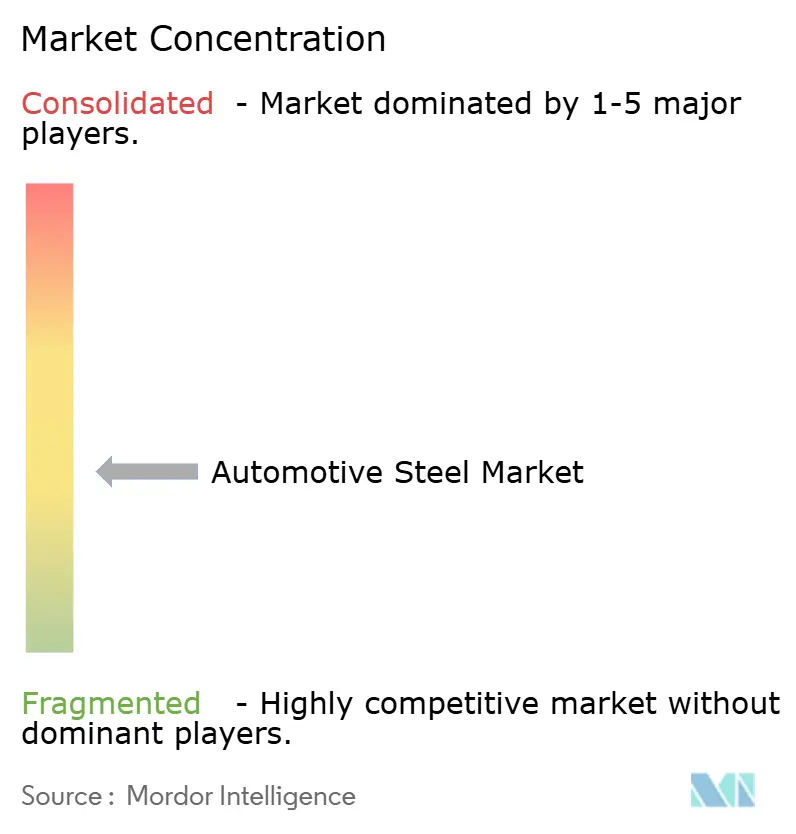
| Market Concentration | Medium |
Major Players *Disclaimer: Major Players sorted in no particular order Image © Mordor Intelligence. Reuse requires attribution under CC BY 4.0. | |
Automotive Steel Market Analysis by Mordor Intelligence
The automotive steel market size was valued at USD 128.41 billion in 2026 and is expected to grow from USD 133.37 billion in 2027 to reach USD 161.18 billion by 2032 at a 3.86% CAGR over 2027-2032. Steel remains important in vehicle production because it combines strength, forming capability, joining compatibility, recyclability, and broad manufacturing availability. The automotive steel market is changing as electric vehicle designs add demand for battery protection, structural floors, motor laminations, and reinforced side structures. Carmakers are also seeking materials that help meet safety and vehicle-efficiency requirements without disrupting established production methods. This keeps the automotive steel market tied to both high-volume vehicle programs and premium grades that require closer engineering support from steel suppliers. Competition increasingly depends on product development, reliable local supply, and lower-emissions production routes.
Key Report Takeaways
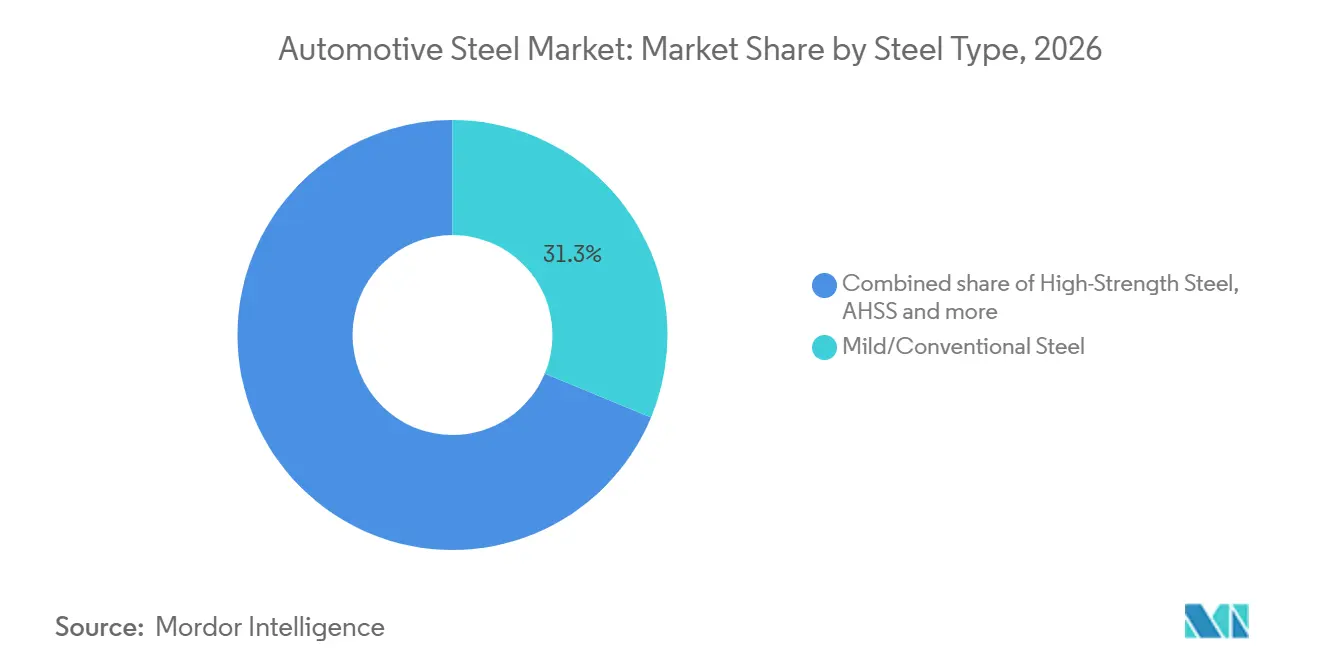
- By steel type, mild/conventional steel held 31.27% revenue share in 2026, while press-hardened/ultra-high-strength steel is forecast to expand at a 5.88% CAGR through 2032.
- By product form, flat automotive steel, including sheet, coil, coated, and galvanized products, held 76.18% revenue share in 2026, while automotive steel tubes are forecast to expand at a 3.97% CAGR through 2032.
- By application, body-in-white and structure held 41.27% revenue share in 2026, while other automotive steel applications, including exhaust, EV battery enclosures, and motors, are forecast to expand at a 7.46% CAGR through 2032.
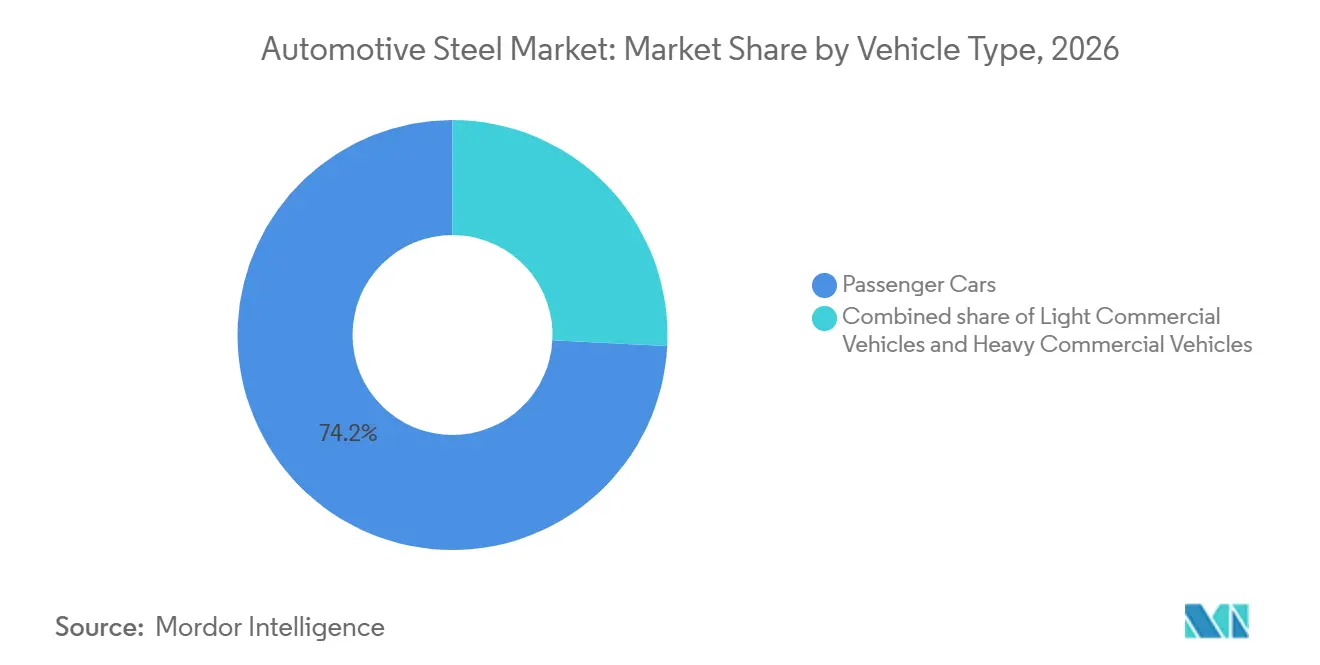
- By vehicle type, passenger cars held 74.18% revenue share in 2026, while light commercial vehicles are forecast to expand at a 4.07% CAGR through 2032.
- By propulsion, internal combustion engine vehicles held 72.63% revenue share in 2026, while electric and hybrid vehicles are forecast to expand at a 6.33% CAGR through 2032.
- By geography, Asia-Pacific held 52.18% revenue share in 2026 and is forecast to expand at a 4.65% CAGR through 2032.
Note: Market numbers in this report are based on Mordor Intelligence's proprietary estimation framework, which combines nine months of actuals with Q4 projections for base year 2026.
Global Automotive Steel Market Trends and Insights
Drivers Impact Analysis*
| Driver | (~) % Impact on CAGR Forecast | Geographic Relevance | Impact Timeline |
|---|---|---|---|
| AHSS and UHSS Lightweighting Adoption | +1.2% | Global, led by EU and Asia-Pacific | Medium term (2–4 years) |
| Vehicle Production and Electric Vehicle Platform Expansion | +1.0% | Asia-Pacific, North America | Medium term (2–4 years) |
| Stringent Crash-Safety and Fuel-Efficiency Requirements | +0.8% | Global (EU, North America, Japan) | Long term (≥ 4 years) |
| EV Battery-Protection and Structural-Integration Demand | +0.6% | Asia-Pacific, North America, EU | Medium term (2–4 years) |
| Steel Recyclability and Circular-Material Demand | +0.3% | EU, North America | Long term (≥ 4 years) |
| Regionalization of Automotive Supply Chains and Localization Incentives | +0.3% | North America, India, ASEAN | Short term (≤ 2 years) |
| Source: Mordor Intelligence | |||
AHSS and UHSS Lightweighting Adoption
The broader use of advanced and ultra-high-strength grades supports demand across the automotive steel market. These grades let vehicle engineers select different strength and ductility combinations for specific structural locations. The result can be fewer parts, less material use, and a simpler assembly sequence without weakening crash performance. WorldAutoSteel reported that the available advanced high-strength steel portfolio expanded from 38 grades in 2017 to nearly 70 grades by late 2025[1]. Nippon Steel and Mazda applied joint development work to the All-New Mazda CX-5, combining body weight reduction with required rigidity and crash performance[2]. The automotive steel market therefore rewards suppliers that can support forming, welding, coating, and production validation, not just material supply.
Vehicle Production and Electric Vehicle Platform Expansion
Vehicle production continues to provide the core demand base for the automotive steel market. Dedicated electric vehicle platforms add structural locations that require carefully selected high-strength grades. Battery sills, protective frames, and reinforced underfloor areas increase the need for materials that perform under impact. Carmakers must manage these new requirements while retaining production efficiency across internal combustion, hybrid, and electric models. This favors suppliers with a wide automotive sheet portfolio and established ties to original equipment manufacturers. It also creates room for regional capacity that can meet local quality, lead-time, and supply-security needs.
Stringent Crash-Safety and Fuel-Efficiency Requirements
Stricter crash protection requirements sustain interest in higher-grade steel solutions across the automotive steel market. Reinforced pillars, roof rails, and side structures need materials that absorb energy and limit passenger-compartment intrusion. Lightweighting also remains relevant because vehicle makers must improve efficiency while adding safety and comfort equipment. Advanced grades can help achieve these aims within familiar stamping and joining processes. Regulatory requirements influence material choices over long vehicle-development cycles rather than through immediate changes in purchasing. This gives qualified suppliers a durable role once their grades are approved for a vehicle platform.
EV Battery-Protection and Structural-Integration Demand
Battery-electric vehicles create new protection requirements for the automotive steel market. Battery enclosures must withstand side impacts, road debris, and deformation around the vehicle floor. High-strength grades can provide protective performance in thin sections where packaging space is limited. Carmakers are also considering designs that combine floor structures and battery-case functions. Such integration can reduce component count while increasing the importance of consistent forming and joining performance. The opportunity favors producers that secure material approval early in the vehicle-program cycle.
Restraints Impact Analysis*
| Restraint | (~) % Impact on CAGR Forecast | Geographic Relevance | Impact Timeline |
|---|---|---|---|
| Aluminum, Composites, and Gigacasting Substitution | -0.6% | Global, led by EU and China | Long term (≥ 4 years) |
| Raw-Material and Energy-Price Volatility | -0.4% | Global | Short term (≤ 2 years) |
| Scrap Quality Constraints for Automotive Flat Steel | -0.2% | EU, North America | Medium term (2–4 years) |
| Qualification Lead Times and Forming Complexity for Third-Generation Grades | -0.2% | Global | Medium term (2–4 years) |
| Source: Mordor Intelligence | |||
Aluminum, Composites, and Gigacasting Substitution
Aluminum, composites, and large die-cast parts remain important alternatives for selected automotive steel market applications. Gigacasting can reduce the number of components in certain front and rear vehicle structures. This approach is most relevant where production volumes and capital investment support dedicated tooling. Steel continues to compete through improved forming performance, corrosion protection, and high-strength designs. Cleveland-Cliffs reported a 2025 production trial in which exposed steel was stamped on existing aluminum-forming equipment without surface defects. The competitive outcome depends on cost, repairability, supply reliability, and the needs of each vehicle design.
Raw-Material and Energy-Price Volatility
Input-cost volatility can constrain investment and pricing stability in the automotive steel market. Blast-furnace production is exposed to changes in iron ore and coking coal costs. Electric-arc furnace production reduces some primary raw-material exposure but raises sensitivity to scrap availability and electricity costs. Contract terms can delay the pass-through of cost changes from mills to automakers. Maintaining high-quality recycled material is also important for automotive flat products with tight performance specifications. Closed-loop scrap arrangements can help suppliers manage quality while supporting vehicle makers' material-circularity objectives.
*Our forecasts treat driver/restraint impacts as directional, not additive. The impact forecasts reflect baseline growth, mix effects, and variable interactions.
Segment Analysis
By Steel Type: Conventional Steel Retains a Broad Production Role
Mild/conventional steel held 31.27% of the automotive steel demand share in 2026. Its position reflects long-standing use in applications where cost, familiar processing, and dependable supply are central requirements. Vehicle manufacturers can use these grades with established press-shop equipment and common welding practices. This makes conventional steel relevant across a wide range of vehicle programs and regional manufacturing bases. High-strength steel sits between conventional products and more advanced grades in the material selection process. It provides a practical option where designers need stronger parts without extensive changes to manufacturing methods.
Press-hardened/ultra-high-strength steel is forecast to record a 5.88% CAGR through 2032. These grades are suited to vehicle locations where intrusion resistance and crash-energy management are critical. Their use requires close control of heating, forming, and cooling during production. Advanced High-Strength Steel grades also widen the choices available for body structures and reinforcements. WorldAutoSteel describes a growing set of advanced grades that supports more tailored material selection in vehicle design. The automotive steel market will continue to rely on suppliers that can translate these grades into repeatable manufacturing results.

By Product Form: Flat Products Remain the Main Automotive Input
Flat automotive steel held 76.18% of the automotive steel demand share in 2026. Sheet, coil, coated, and galvanized products are widely used because stamped parts remain central to vehicle-body manufacturing. These products serve visible panels, structural parts, and corrosion-sensitive areas. Coatings help manufacturers meet durability expectations across different operating environments. Higher-strength base steel and improved coatings also allow flat products to address more demanding vehicle applications. This established manufacturing role keeps flat products central to the automotive steel industry.
Automotive steel tubes are forecast to grow at a 3.97% CAGR through 2032. Tubes are used where their geometry supports stiffness and load management with efficient material use. Hydroformed chassis parts, crash systems, and battery-pack perimeter structures are relevant applications. Long automotive steel products continue to support springs, fasteners, and other components with demanding fatigue requirements. Product choice depends on how a component must be formed, joined, protected, and serviced. The automotive steel market benefits when producers can supply several forms that meet these different engineering needs.
By Application: Body Structures Provide the Largest Demand Base
Body-in-white and structure held 41.27% of the automotive steel demand share in 2026. Vehicle bodies require materials that can manage forces from frontal, side, and rear collisions. They also need repeatable production performance across high-volume assembly lines. This supports continued use of coated flat steel, high-strength grades, and press-hardened components. Closures require consistent surface quality and forming behavior because they are visible to vehicle buyers. Chassis, suspension, powertrain, and wheel applications also retain specific needs for strength, durability, and precision.
Other automotive steel applications are forecast to expand at a 7.46% CAGR through 2032. This category includes exhaust systems, electric-vehicle battery enclosures, and motor laminations. Battery structures increase the need for grades that protect high-voltage components without taking excessive space. Motor applications raise the importance of electrical steel quality and consistent magnetic performance. ArcelorMittal's VAMA venture introduced a multi-part integration solution for automotive uses in 2025, reflecting ongoing interest in fewer and more integrated steel components. The automotive steel market is consequently extending into applications that are more closely linked to electrified vehicle architecture.
By Vehicle Type: Passenger Cars Provide the Largest Volume Base
Passenger cars held 74.18% of the automotive steel demand share in 2026. Their broad production base creates steady demand across body structures, closures, chassis parts, and powertrain components. Material requirements vary by vehicle price point, safety rating, and propulsion system. Premium models often use more specialized grades in selected structural areas. Heavy commercial vehicles use steel where payload, durability, and operating conditions restrict substitution options. Together, these vehicle groups support a diverse automotive steel market with different qualification and service needs.
Light commercial vehicles are forecast to expand at a 4.07% CAGR through 2032. Urban delivery activity and fleet electrification increase attention on vehicle weight, durability, and safety. Commercial vehicles need structures that can support heavier loads and frequent use. This makes high-strength steel valuable in frames, crash structures, and suspension-related components. Tata Steel introduced HyperFlange in 2025 for chassis, ladder-frame, and suspension applications, focusing on forming reliability in higher-strength parts. Steel suppliers that help vehicle makers balance strength and manufacturability can strengthen their position in this segment.
By Propulsion: Internal Combustion Vehicles Remain the Largest Source of Demand
Internal combustion engine vehicles held 72.63% of the automotive steel demand share in 2026. They use steel throughout body structures, closures, chassis systems, powertrain components, and exhaust systems. Their large installed production base supports continuing demand during the early forecast years. Hybrid systems can add electrical components while retaining many established structural requirements. Material suppliers must therefore serve internal combustion, hybrid, and electric platforms at the same time. This broad requirement helps sustain the automotive steel market during changes in propulsion preferences.
Electric and hybrid vehicles are forecast to grow at a 6.33% CAGR through 2032. These vehicles reduce demand for certain engine and exhaust components but add needs for battery protection and motor laminations. Their floor structures and side sections often require carefully engineered crash performance. Low-emissions material sourcing is becoming part of the procurement discussion for electric vehicle programs. SSAB and Volvo Cars announced a 2025 agreement for SSAB Zero steel in serial production for future electric vehicle programs. The automotive steel market can benefit when electrification raises the technical value of the steel used in each vehicle.
Geography Analysis
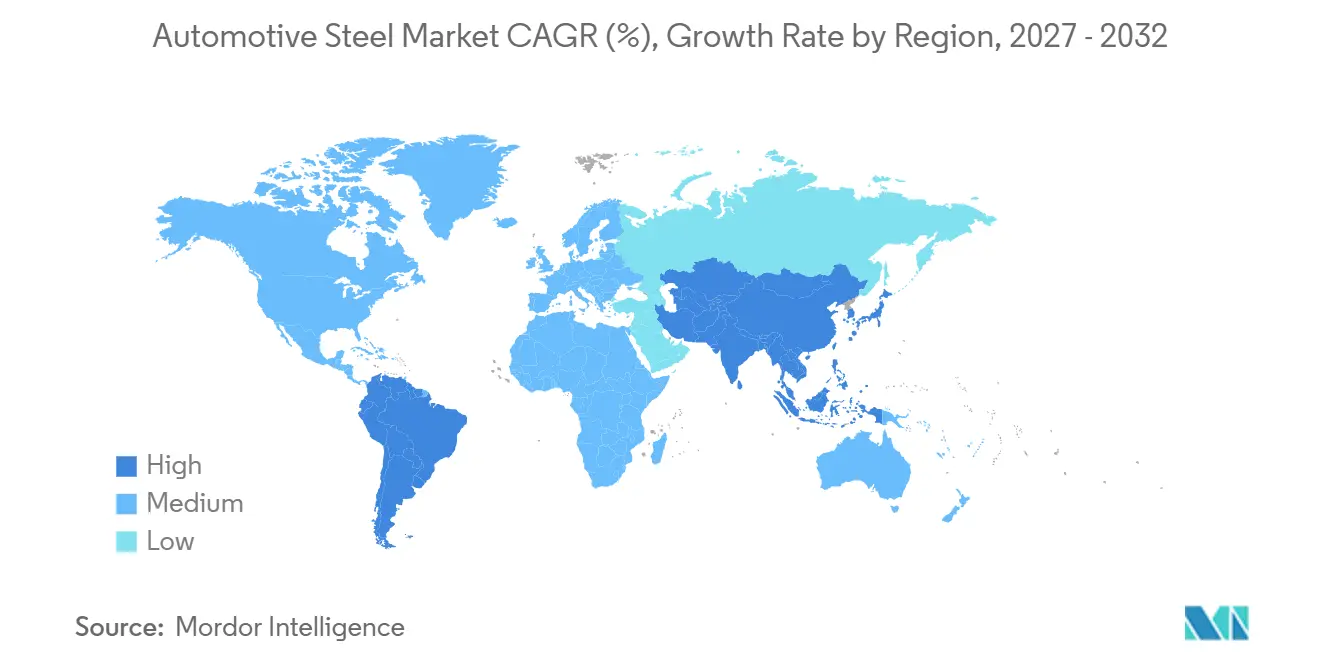
Asia-Pacific held 52.18% of automotive steel demand in 2026 and is forecast to grow at a 4.65% CAGR through 2032. China provides a large base of internal combustion, hybrid, and electric vehicle production. Its vehicle makers need a broad range of sheet, coated products, structural grades, and electrical steel. South Korean producers have established capabilities in higher-grade automotive products and technical work with vehicle manufacturers. Their export relationships also connect regional mills with vehicle programs outside Asia-Pacific. India is strengthening its automotive steel capacity, including coated and advanced grades. AM/NS India commissioned a continuous galvanizing line at Hazira in 2025 for advanced automotive steel production[3]. The investment supports a more local supply option for automotive manufacturers. ASEAN assembly activity adds demand for regionally sourced flat products. Japanese vehicle production remains important for premium grades and close supplier relationships. These factors keep Asia-Pacific at the center of the automotive steel market. The region combines very large vehicle output with a wide supplier base. It also contains markets at different stages of electric vehicle adoption. This gives steel suppliers several channels for growth.
North America has a strong need for localized supply that can serve vehicle assembly plants with consistent quality and short delivery times. Regional sourcing is relevant as automakers evaluate supply security and domestic-content requirements. Producers must also meet exact specifications for exposed panels, safety structures, and coated components. Electrical steel is gaining attention because electric vehicle motors require specialized materials. ArcelorMittal announced a facility in Alabama in 2025 to supply non-grain-oriented electrical steel for automotive applications. This planned capacity addresses a material need that differs from conventional sheet production. Europe continues to focus on vehicle safety, carbon reporting, and lower-emissions steel production. Carmakers in the region seek material traceability as well as technical performance. Suppliers are responding through changes to production routes and product certification. The automotive steel market in these regions depends on suppliers that can meet technical specifications and evolving sourcing requirements.
South America relies on Brazil's vehicle production base and Argentina's commercial vehicle manufacturing activity. Vehicle makers in the region use regional supply where cold-rolling, coating, and customer service are available. Regional suppliers compete through capabilities that align with local assembly requirements. Import exposure can influence the availability and delivered cost of specialized grades. The Middle East and Africa remains varied, with some markets centered on imported vehicle kits and others serving export-oriented production. Turkey supplies European-linked vehicle programs as well as regional commercial vehicle manufacturers. Its supplier base benefits from trade links and manufacturing experience. South Africa's automotive cluster has demand for flat steel but continues to rely on imported material for part of its requirements. Other markets have smaller automotive production footprints and more limited local processing. The automotive steel market, therefore, has different growth paths across regions, shaped by local production, trade patterns, and supplier capabilities.
Competitive Landscape
The automotive steel market includes global producers, regional mills, and suppliers with close relationships to vehicle manufacturers. Competition is based on grade quality, production consistency, engineering support, and the ability to meet automaker qualification requirements. Large producers have advantages in scale, product breadth, and global customer coverage. They can serve vehicle programs that operate across several regions. Regional suppliers can compete by providing shorter supply lines and adapting products to local vehicle programs. This can be particularly valuable where vehicle makers need rapid technical support. Suppliers are investing in advanced sheet, coated products, electrical steel, and lower-emissions production routes. Product development requires close coordination among mills, stampers, and vehicle engineers.
Partnerships help suppliers establish a role before a new vehicle platform enters production. Nippon Steel and Mazda reported a co-development result for the All-New Mazda CX-5 in 2025, supporting reduced steel use while maintaining body rigidity and crash performance. The result shows the value of early discussion between a material supplier and a vehicle manufacturer. Suppliers also seek to place galvanizing, coating, and finishing capabilities near major assembly clusters. This helps reduce lead times and improves coordination with automotive production schedules. It can also help address routine changes in production volumes and vehicle specifications. The automotive steel market relies on this mix of engineering collaboration and dependable industrial execution. Co-development can help ensure a product is suited to a specific part geometry. It can also identify manufacturing issues before a vehicle enters volume production. Long supplier relationships can be valuable when vehicle makers update existing platforms.
The automotive steel market has opportunities in battery protection, traction-motor electrical steel, and certified recycled-content supply. These areas require specialized knowledge and high confidence in product performance. Battery enclosures require materials that protect cells without using unnecessary space. Electrical steel must meet precise requirements that affect motor efficiency and production consistency. New entrants face long qualification periods because vehicle makers test materials across forming, joining, corrosion, and crash conditions. Existing suppliers can protect their position through technical collaboration and reliable quality performance. At the same time, aluminum and large die-cast structures create pressure in some visible-panel and structural uses. Vehicle makers may select different materials for different parts rather than choose a single solution across the vehicle. Successful companies will need to show that steel solutions meet performance targets while supporting cost, manufacturing, and sourcing priorities. This leaves room for both established producers and focused suppliers with strong technical capabilities.
Automotive Steel Industry Leaders
-
ArcelorMittal
-
Nippon Steel Corporation
-
POSCO
-
China Baowu Steel Group Corporation Limited
-
JFE Steel Corporation
- *Disclaimer: Major Players sorted in no particular order
Recent Industry Developments
- October 2026: Canadian Prime Minister Mark Carney and Ontario Premier Doug Ford announced a CAD 8.7 billion joint plan for the steel, automotive, and critical minerals sectors, including a Joint Steel Action Fund to help steel mills upgrade machinery and expand into markets beyond the United States.
- September 2026: Hyundai Steel Company held a groundbreaking ceremony for its USD 5.8 billion electric arc furnace-based integrated steel mill in Louisiana, the first of its kind in North America, to be operated by joint venture HYUNDAI-POSCO Louisiana Steel LLC (HPLS), with production scheduled to begin in 2029.
- March 2026: A European consortium led by Tata Steel Nederland with Volkswagen Group announced progress in developing zinc-coated ultra-high-strength hot-forming steels for automotive crash structures under the EU-funded WarP-AHSS project, which runs from 2023 to 2027.
Global Automotive Steel Market Report Scope
The Automotive Steel Market is segmented by Steel Type, Product Form, Application, Vehicle Type, Propulsion, and Geography. By Steel Type, the market is segmented into Mild/Conventional Steel, High-Strength Steel (HSLA, Bake-Hardening), Advanced High-Strength Steel (Dual-Phase, TRIP, Complex-Phase), Press-Hardened / Ultra-High-Strength Steel, and Other Automotive Steel Types (Stainless, Electrical Steel). By Product Form, the market is segmented into Flat Automotive Steel (Sheet, Coil, Coated and Galvanized), Long Automotive Steel (Bars, Wire), and Automotive Steel Tubes. By Application, the market is segmented into Body-in-White and Structure, Closures, Chassis and Suspension, Powertrain, Wheels, and Other Automotive Steel Applications (Exhaust, EV Battery Enclosures and Motors). By Vehicle Type, the market is segmented into Passenger Cars, Light Commercial Vehicles, and Heavy Commercial Vehicles. By Propulsion, the market is segmented into Internal Combustion Engine Vehicles and Electric and Hybrid Vehicles. By Geography, the market is segmented into North America (United States, Canada, and Mexico), Europe (Germany, France, Italy, Spain, United Kingdom, Russia, and Rest of Europe), Asia-Pacific (China, Japan, India, South Korea, Thailand, Indonesia, and Rest of Asia-Pacific), South America (Brazil, Argentina, and Rest of South America), and Middle East and Africa (Saudi Arabia, United Arab Emirates, South Africa, Turkey, and Rest of Middle East and Africa). Market forecasts are provided in terms of Value (USD) and Volume (Tons).
| Mild/Conventional Steel |
| High-Strength Steel (HSLA, Bake-Hardening) |
| Advanced High-Strength Steel (Dual-Phase, TRIP, Complex-Phase) |
| Press-Hardened / Ultra-High-Strength Steel |
| Other Automotive Steel Types (Stainless, Electrical Steel) |
| Flat Automotive Steel (Sheet, Coil, Coated and Galvanized) |
| Long Automotive Steel (Bars, Wire) |
| Automotive Steel Tubes |
| Body-in-White and Structure |
| Closures |
| Chassis and Suspension |
| Powertrain |
| Wheels |
| Other Automotive Steel Applications (Exhaust, EV Battery Enclosures and Motors) |
| Passenger Cars |
| Light Commercial Vehicles |
| Heavy Commercial Vehicles |
| Internal Combustion Engine Vehicles |
| Electric and Hybrid Vehicles |
| North America | United States |
| Canada | |
| Mexico | |
| Europe | Germany |
| France | |
| Italy | |
| Spain | |
| United Kingdom | |
| Russia | |
| Rest of Europe | |
| Asia-Pacific | China |
| Japan | |
| India | |
| South Korea | |
| Thailand | |
| Indonesia | |
| Rest of Asia-Pacific | |
| South America | Brazil |
| Argentina | |
| Rest of South America | |
| Middle East and Africa | Saudi Arabia |
| United Arab Emirates | |
| South Africa | |
| Turkey | |
| Rest of Middle East and Africa |
| By Steel Type | Mild/Conventional Steel | |
| High-Strength Steel (HSLA, Bake-Hardening) | ||
| Advanced High-Strength Steel (Dual-Phase, TRIP, Complex-Phase) | ||
| Press-Hardened / Ultra-High-Strength Steel | ||
| Other Automotive Steel Types (Stainless, Electrical Steel) | ||
| By Product Form | Flat Automotive Steel (Sheet, Coil, Coated and Galvanized) | |
| Long Automotive Steel (Bars, Wire) | ||
| Automotive Steel Tubes | ||
| By Application | Body-in-White and Structure | |
| Closures | ||
| Chassis and Suspension | ||
| Powertrain | ||
| Wheels | ||
| Other Automotive Steel Applications (Exhaust, EV Battery Enclosures and Motors) | ||
| By Vehicle Type | Passenger Cars | |
| Light Commercial Vehicles | ||
| Heavy Commercial Vehicles | ||
| By Propulsion | Internal Combustion Engine Vehicles | |
| Electric and Hybrid Vehicles | ||
| By Geography | North America | United States |
| Canada | ||
| Mexico | ||
| Europe | Germany | |
| France | ||
| Italy | ||
| Spain | ||
| United Kingdom | ||
| Russia | ||
| Rest of Europe | ||
| Asia-Pacific | China | |
| Japan | ||
| India | ||
| South Korea | ||
| Thailand | ||
| Indonesia | ||
| Rest of Asia-Pacific | ||
| South America | Brazil | |
| Argentina | ||
| Rest of South America | ||
| Middle East and Africa | Saudi Arabia | |
| United Arab Emirates | ||
| South Africa | ||
| Turkey | ||
| Rest of Middle East and Africa | ||
Key Questions Answered in the Report
What is the projected value of the automotive steel market by 2032?
The automotive steel market is forecast to reach USD 161.18 billion by 2032, growing at a 3.86% CAGR from 2027.
Which steel type is expected to grow the fastest through 2032?
Press-hardened/ultra-high-strength steel is forecast to record the fastest growth, with a 5.88% CAGR through 2032. Its use is supported by the need for crash protection in vehicle structures and battery-related applications, where vehicle engineers need high strength, reliable processing, and predictable performance from parts produced at volume.
Why are electric vehicles important for automotive steel demand?
Electric vehicles need battery protection, reinforced floor structures, and motor laminations, which increase demand for specialized steel grades. These applications require consistent performance in forming, joining, and crash situations, so vehicle makers depend on steel suppliers that can provide engineering support from initial design work through serial manufacturing.
Which product form has the largest role in vehicle manufacturing?
Flat automotive steel is the largest product form, with a 76.18% share in 2026, because sheet and coated products are widely used in vehicle bodies.