
Automotive SoC Market Size and Share
Market Overview
| Study Period | 2020 - 2032 |
|---|---|
| Market Size (2027) | USD 25.41 Billion |
| Market Size (2032) | USD 43.56 Billion |
| Growth Rate (2027 - 2032) | 11.38 % |
| Fastest Growing Market | Asia-Pacific |
| Largest Market | Asia-Pacific |
| Market Concentration | Medium |
Major Players *Disclaimer: Major Players sorted in no particular order Image © Mordor Intelligence. Reuse requires attribution under CC BY 4.0. | |
Automotive SoC Market Analysis by Mordor Intelligence
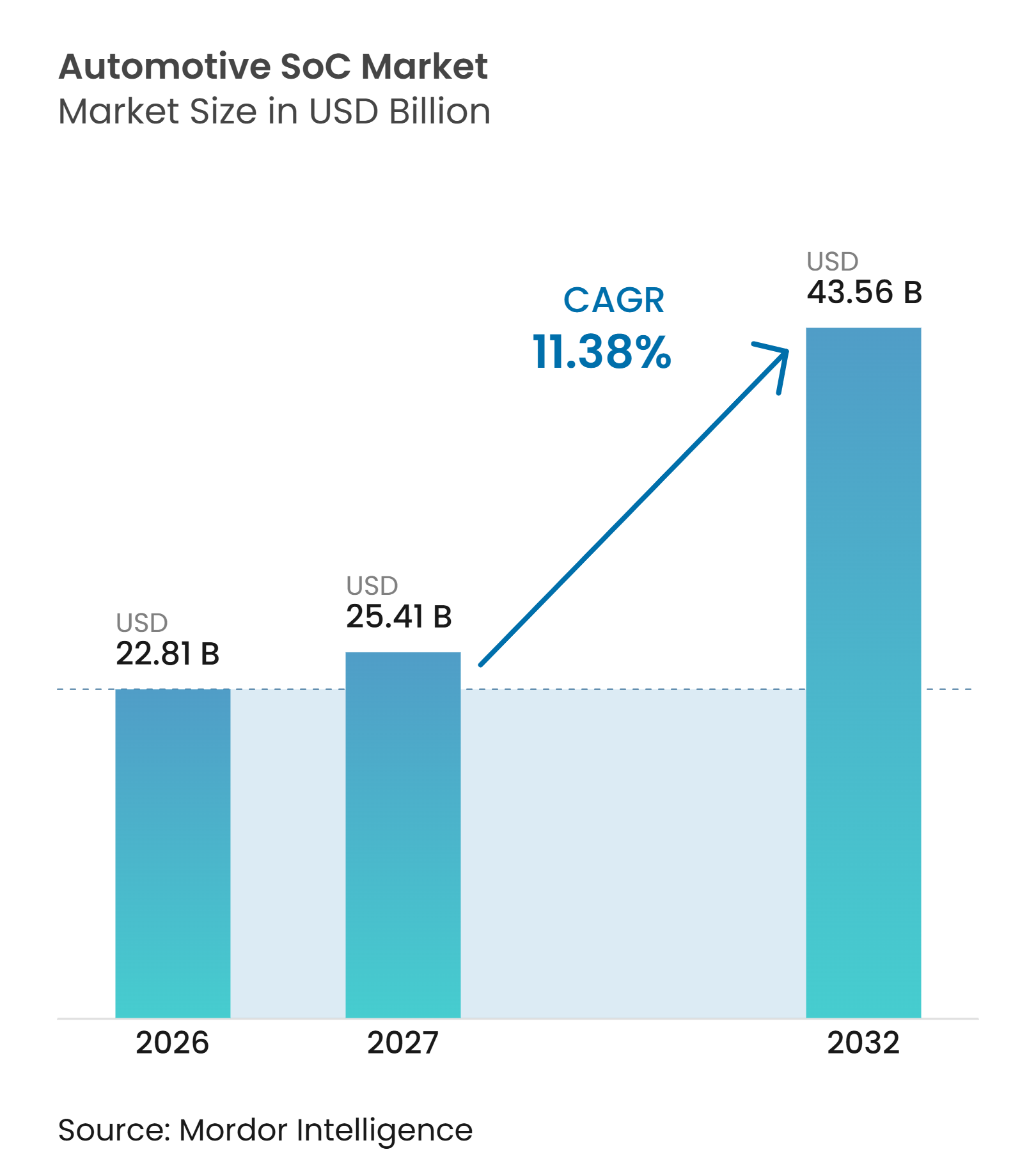
The automotive SoC market size was valued at USD 22.81 billion in 2026 and is expected to grow from USD 25.41 billion in 2027 to USD 43.56 billion by 2032, at a CAGR of 11.38% during 2027-2032. Rising compute requirements are changing vehicle electronics from many separate controllers to a smaller number of more capable processing platforms. Advanced driver assistance, digital cockpit functions, connectivity, and vehicle control now compete for more computing capacity within the same vehicle. Suppliers are responding with integrated hardware and software offerings that can be validated for automotive use. This approach can reduce integration effort for automakers, but it also makes supplier selection more consequential over a vehicle program's life. The automotive SoC market therefore benefits from stronger content per vehicle, even where overall vehicle production changes slowly.
Key Report Takeaways
- By SoC type, infotainment and cockpit held a 46.16% share in 2026, while ADAS/autonomous driving is projected to grow at a 15.90% CAGR through 2032.
- By process node, 28 nm and above held a 55.15% share in 2026, while up to 4 nm is forecast to expand at a 19.75% CAGR through 2032.
- By architecture, ARM-based designs held a 91.92% share in 2026, while others, including RISC-V, are forecast to grow at a 21.40% CAGR through 2032.
- By vehicle type, passenger cars held a 69.45% share in 2026, while commercial vehicles are projected to grow at an 11.88% CAGR through 2032.
- By propulsion, internal combustion engines held a 63.32% share in 2026, while electric vehicles are forecast to grow at a 12.87% CAGR through 2032.
- By geography, Asia-Pacific held a 38.81% share in 2026 and is projected to grow at a 12.60% CAGR through 2032.
Note: Market numbers in this report are based on Mordor Intelligence's proprietary estimation framework, which combines nine months of actuals with Q4 projections for base year 2026.
Market Trends and Insights
Drivers Impact Analysis of Automotive SoC Market*
| Driver | (~) % Impact on CAGR Forecast | Geographic Relevance | Impact Timeline |
|---|---|---|---|
| Rising ADAS and Autonomous-Driving Compute Content | +3.2% | Global, with concentrated near-term gains in Asia-Pacific and North America | Short term (≤ 2 years) |
| Software-Defined Vehicle Architecture Adoption | +2.5% | Global, led by Europe, North America, and China | Medium term (2–4 years) |
| Automotive-Qualified AI Performance per Watt | +1.8% | Global; highest intensity in premium-segment markets of Europe and North America | Medium term (2–4 years) |
| Electrification-Driven Vehicle Compute Expansion | +1.4% | Global, with core gains in China, Europe, and emerging EV markets | Long term (≥ 4 years) |
| Increasing Digital Cockpit and Multi-Display Integration | +1.0% | Global, accelerated in China and South Korea | Short term (≤ 2 years) |
| Mixed-Criticality Central-Compute Consolidation | +0.7% | Global, with core gains in Asia-Pacific and spillover to Europe and North America | Long term (≥ 4 years) |
| Source: Mordor Intelligence | |||
Rising ADAS and Autonomous-Driving Compute Content
ADAS functions are moving beyond premium vehicles and into broader vehicle ranges. That change requires processors that can handle perception, sensor fusion, graphics, and real-time control in a controlled thermal environment. The automotive SoC market gains when these functions become part of standard vehicle equipment rather than optional features. Euro NCAP's 2026 rating protocols assess vehicles across safe driving, crash avoidance, crash protection, and post-crash safety, which supports the wider use of driver assistance electronics[1]. Suppliers must also support functional safety work in accordance with ISO 26262 when their products are used in safety-related vehicle functions. The result is greater demand for automotive processors with established software, safety, and validation support.
Software-Defined Vehicle Architecture Adoption
Software-defined vehicle programs are prompting automakers to reduce the number of separate electronic controllers. Zonal and centralized layouts bring functions such as body control, gateways, and vehicle dynamics closer together on shared compute platforms. This shift supports the automotive SoC market because more integration requires capable processors and adaptable software foundations. NXP introduced its S32N family as a central vehicle-processor approach for software-defined vehicles, describing support for multiple vehicle domains on a single platform. Arm introduced Zena Compute Subsystems for automotive workloads, positioning the platform as a pre-integrated basis for automotive silicon development[2]. Suppliers with mature software tools and safety documentation are better positioned, as vehicle makers require shorter integration cycles.
Automotive-Qualified AI Performance per Watt
Vehicle modules operate with tight power and heat limits, especially where active cooling is limited. For the automotive SoC market, this makes performance per watt a practical design requirement rather than a simple product comparison. Heterogeneous processors combine central processing, graphics, neural processing, and signal processing elements so each task can run on a suitable engine. The automotive SoC market benefits as automakers seek to run richer driver assistance and cockpit functions without raising thermal complexity. Modular silicon designs can also help suppliers adjust compute capacity for different vehicle programs without redesigning the entire platform. These designs can make it easier to carry a common software base across several vehicle grades.
Electrification-Driven Vehicle Compute Expansion
Electric vehicle platforms require coordinated control of battery, thermal, powertrain, and charging functions. These requirements add to demand for reliable real-time computing and secure vehicle communication. The automotive SoC market is supported when automakers design electric platforms around centralized electronics from the outset. Such programs can avoid some of the controller additions that accumulated over earlier vehicle generations. Longer vehicle program cycles also increase the importance of software update capability and assured component availability. Suppliers that can offer a scalable product path are therefore more useful to automakers developing several electric models from a shared platform.
Restraints Impact Analysis of Automotive SoC Market*
| Restraint | (~) % Impact on CAGR Forecast | Geographic Relevance | Impact Timeline |
|---|---|---|---|
| High Automotive SoC Validation and Software-Integration Costs | -1.8% | Global; most acute for new entrants in North America and Europe | Medium term (2–4 years) |
| Functional-Safety and Cybersecurity Qualification Complexity | -1.4% | Global, with the most demanding compliance in Europe and Japan | Long term (≥ 4 years) |
| Advanced-Node Capacity and Packaging Allocation Constraints | -0.9% | Global, with concentration in Taiwan, South Korea, and the United States | Short term (≤ 2 years) |
| OEM Dependence on Proprietary Software and Silicon Roadmaps | -0.6% | North America, Europe, Japan | Medium term (2–4 years) |
| Source: Mordor Intelligence | |||
High Automotive SoC Validation and Software-Integration Costs
A processor cannot enter a vehicle program after hardware testing alone. Automakers and suppliers need to validate it with operating systems, middleware, sensors, networking, and vehicle-specific software. This work can take a long time and adds cost for every new platform. The automotive SoC market faces a constraint because smaller suppliers may struggle to fund the required engineering and support teams. Existing suppliers can reduce this burden by offering software development kits, reference designs, and established integration partners. Their advantage is often based on the quality of the full platform rather than processor performance alone.
Functional-Safety and Cybersecurity Qualification Complexity
Functional safety and cybersecurity are linked but require different engineering evidence and processes. ISO 26262 addresses functional safety, while ISO/SAE 21434 addresses cybersecurity in road vehicles. Vehicle makers also need to manage software updates under UNECE rules where those requirements apply. These obligations lengthen the path from a promising processor design to an approved production component. They can slow the entry of new suppliers into safety-critical applications, particularly in regions with demanding compliance expectations. The resulting qualification burden favors suppliers that have already built automotive safety and security capabilities.
*Our forecasts treat driver/restraint impacts as directional, not additive. The impact forecasts reflect baseline growth, mix effects, and variable interactions.
Automotive SoC Market Segment Analysis
By SoC Type:
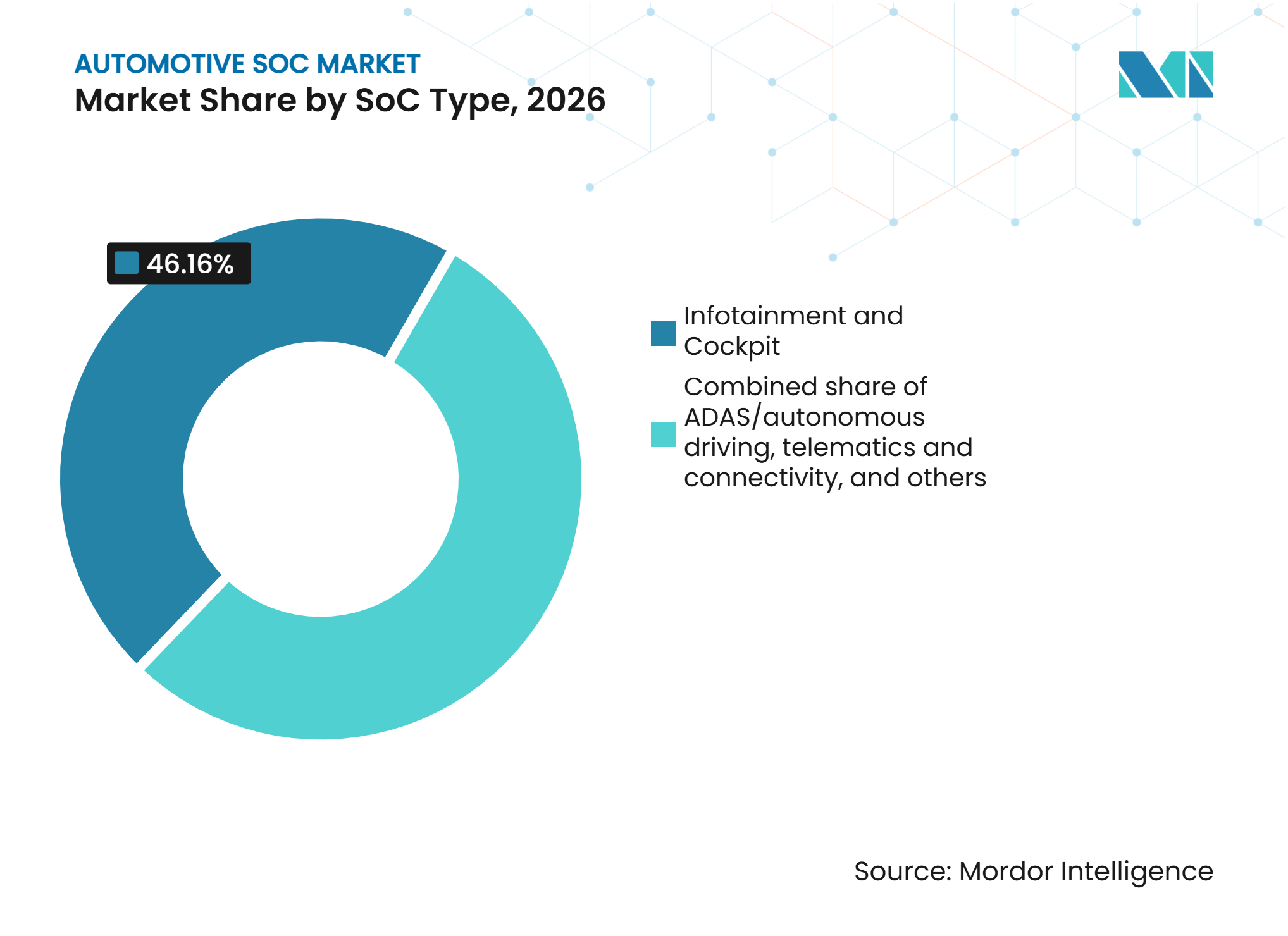
Digital Cockpit Demand Leads While ADAS Compute ExpandsInfotainment and Cockpit held a 46.16% share in 2026. Digital instrument clusters, central displays, rear-seat systems, voice interfaces, and in-cabin sensing have expanded the role of cockpit processors. Automakers increasingly expect these systems to support frequent software improvements during a vehicle's life. This makes stable software support as important as graphics and computing capability. The segment remains important because digital user experiences now influence vehicle selection across a broader range of price points. Suppliers must balance fast response times, visual quality, security, and power use within an automotive-grade design.
ADAS/autonomous driving is forecast to grow at a 15.90% CAGR through 2032. Centralized driver assistance computers must process camera, radar, and other sensor inputs while running perception and planning software within automotive power limits. Automakers are extending advanced assistance features to more models, which raises compute requirements per vehicle. The automotive SoC market is therefore expected to see demand for processors capable of managing mixed workloads with varying timing and safety requirements. Zonal designs also bring together functions that were once managed by separate body and gateway controllers. NXP has described its S32K5 family as supporting zonal software-defined vehicle architectures and the CoreRide platform[3]. Suppliers that can make this transition easier for vehicle makers should have a stronger position in new platform programs.



By Process Node:
Mature Manufacturing Remains Important While Advanced Nodes ScaleThe 28 nm and above segment held a 55.15% share in 2026. Mature nodes remain suitable for body control, gateway functions, and entry-level infotainment because these applications prioritize dependable supply, proven yields, and manageable cost. Automotive programs need parts that remain available throughout a long production cycle. Mature manufacturing also supports established qualification processes and reduces the risk associated with shifting a proven design. The segment remains relevant even as advanced applications gain attention. Vehicle makers will continue to use different node generations for different functions rather than replacing mature nodes all at once.
Up to 4 nm is forecast to grow at a 19.75% CAGR through 2032. Advanced nodes are better suited to high-performance driver assistance and centralized computing where many processing blocks need to operate within a limited power envelope. They can combine central processing, graphics, neural processing, and memory interfaces more tightly than older node generations. This can support large inference workloads and high-resolution cockpit graphics in a single vehicle platform. The automotive SoC market faces a supply consideration because advanced-node production and packaging capacity must serve several technology sectors. Automakers therefore seek suppliers with clear manufacturing plans and product roadmaps for long-lived vehicle programs.
By Architecture:
ARM-Based Platforms Lead While RISC-V Builds OptionsARM-Based designs held a 91.92% share in 2026. Their position reflects a broad ecosystem of development tools, operating systems, middleware, and automotive safety support. Automakers can use familiar software environments when building cockpit, assistance, and vehicle-control applications. Arm states that its Zena Compute Subsystems are intended for automotive applications including ADAS, in-vehicle infotainment, and vehicle control. This established software base lowers adoption risk for both semiconductor suppliers and vehicle makers. The architecture will remain central where compatibility, developer availability, and prior validation matter most.
Others, including RISC-V, are projected to grow at a 21.40% CAGR through 2032 from a small base. RISC-V gives chip designers a more open instruction set approach and permits customization for specific workloads. This can appeal to suppliers that want greater control over their processor design and software stack. Interest is rising in applications where companies seek more choice in their intellectual property sources. The Chips Joint Undertaking funds the Bosch-coordinated CHASSIS project, launched in November 2025 to develop chiplet-based hardware architectures for software-defined vehicles. Wider adoption will still depend on safety evidence, tool maturity, and the availability of automotive-grade software support.
By Vehicle Type:
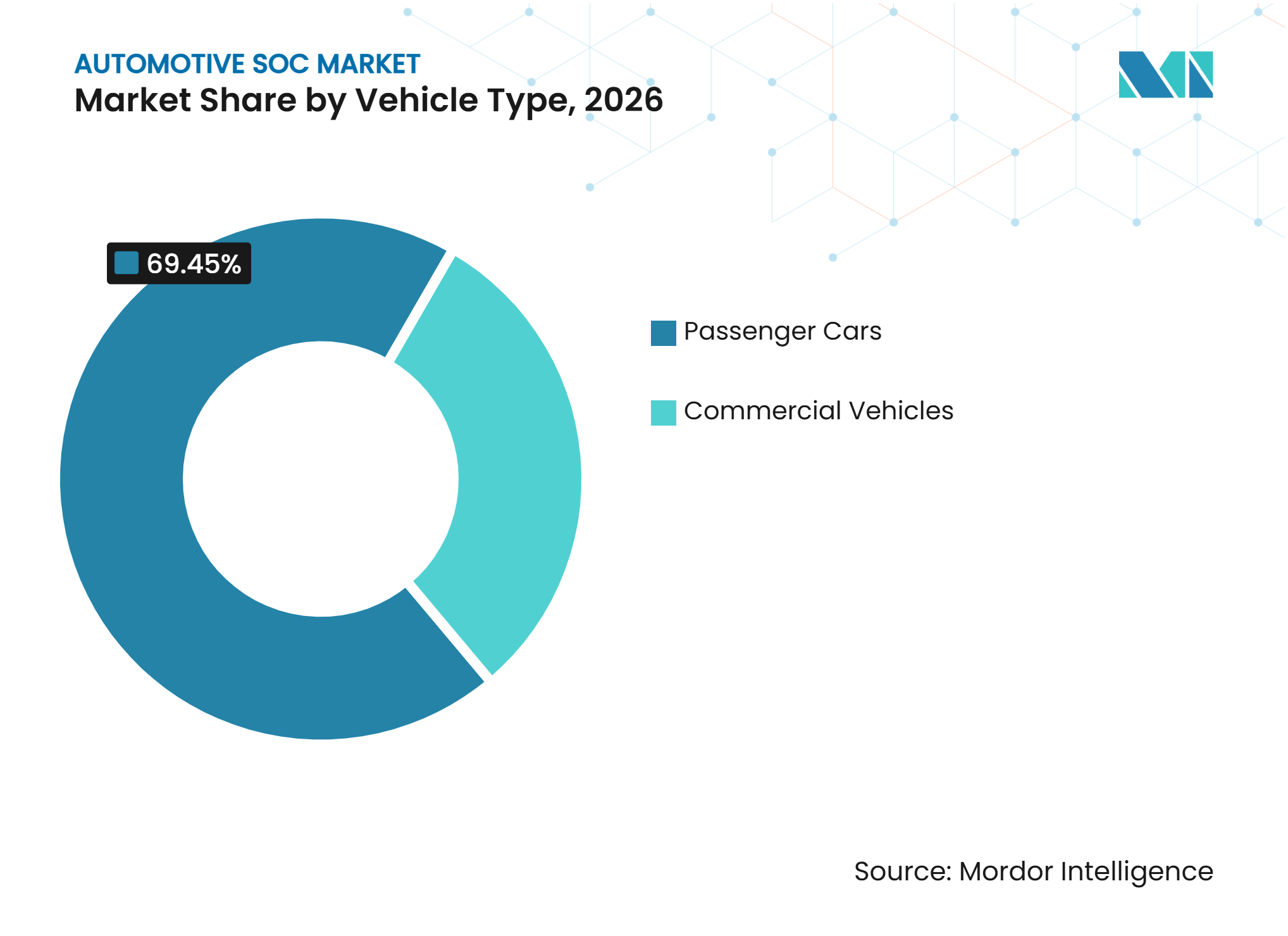
Passenger-Car Programs Supply Scale While Fleets Add DemandPassenger cars held a 69.45% share in 2026. This vehicle group gives semiconductor suppliers access to large model portfolios and broad use of digital cockpit functions. Driver assistance features are also spreading through more passenger-car trims as manufacturers compete on safety and convenience. The scale of these programs allows common processor platforms to be used across several models. That can help automakers control development effort while still differentiating vehicles through software. The automotive SoC market remains closely tied to how quickly these shared platforms are adopted across passenger-car lineups.
Commercial vehicles are forecast to grow at an 11.88% CAGR through 2032. Fleet operators prioritize functions that support safety, uptime, vehicle monitoring, and operating efficiency. These needs encourage investment in driver assistance, connected services, and reliable vehicle computing. Commercial platforms must also handle longer duty cycles and demanding operating environments. A 2025 collaboration among NVIDIA, Aurora, and Continental on driverless truck systems powered by NVIDIA DRIVE technology underscores the importance of high-performance computing in this vehicle category. Suppliers that can offer redundancy, software support, and dependable lifecycle management are likely to be preferred.

By Propulsion:
Internal Combustion Vehicles Retain Scale While Electric Platforms AdvanceInternal combustion engines held a 63.32% share in 2026. These vehicles continue to use more electronics as automakers add connectivity, displays, and assistance features across established model ranges. Their installed manufacturing base means they remain a material source of processor demand. The transition to more advanced electronic systems does not depend only on a change in propulsion type. Vehicle makers also update internal combustion platforms to meet safety expectations and retain consumer appeal. This keeps demand for cockpit, gateway, and driver assistance processors active across conventional vehicle programs.
Electric vehicles are projected to grow at a 12.87% CAGR through 2032. Electric platforms require coordinated management of battery, thermal, traction, and charging functions. They are often designed with more centralized electronics because the vehicle architecture is developed as an integrated system. This creates an opportunity for processors that can scale across vehicle control, connectivity, and user-facing functions. The automotive SoC market benefits when electric platforms use shared hardware foundations across several models. Suppliers selected early in an electric program can become embedded in the broader software and electronics plan for that platform.
Geography Analysis
Asia-Pacific Automotive SoC Market
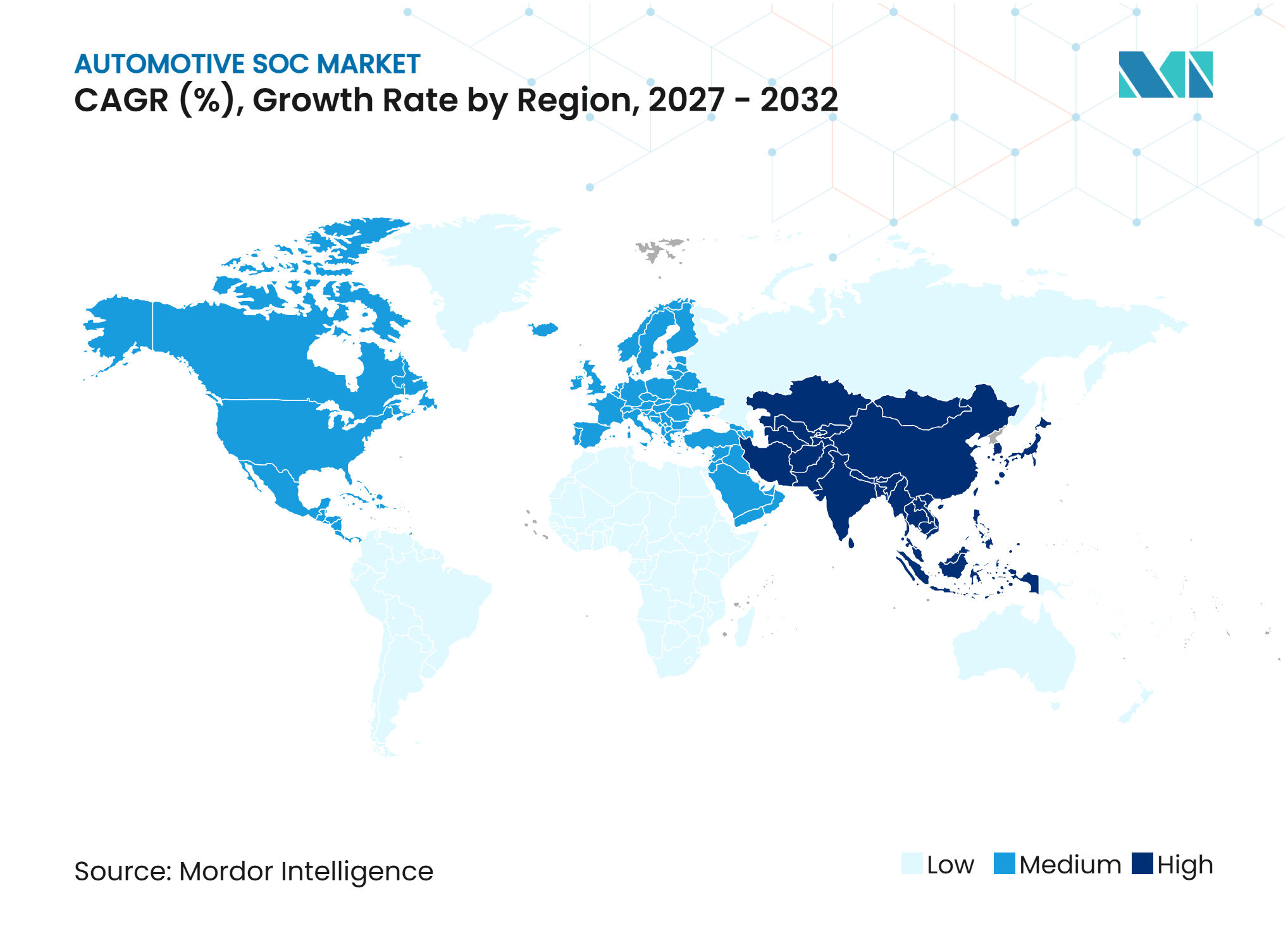
Asia-Pacific held a 38.81% share in 2026 and is forecast to grow at a 12.60% CAGR through 2032. China combines high vehicle production, rapid electric vehicle development, and a growing group of domestic chip designers. Vehicle makers in the region are placing digital cockpits, connected features, and driver assistance functions into a wider range of models. Japan and South Korea add demand through established vehicle and semiconductor supply chains. Taiwan remains important to the regional supply base because of its role in advanced semiconductor manufacturing. The region's scale encourages suppliers to offer locally relevant software, support, and sourcing strategies.
Europe Automotive SoC Market
Europe is forecast to grow at an 11.60% CAGR through 2032. European vehicle makers are investing in software-defined vehicle platforms while also responding to active-safety expectations. Euro NCAP continues to set out safety assessment priorities that encourage the wider deployment of driver assistance technology. European compliance factors also include functional safety, cybersecurity, and managed software updates. CHASSIS reflects regional interest in stronger automotive semiconductor capabilities. This environment favors suppliers that can combine technical performance with well-supported compliance processes.
North America, South America, and Middle East and Africa Automotive SoC Market
North America is supported by strong demand for driver assistance, connected vehicle functions, and autonomous trucking development. Commercial vehicle programs in the United States can create demand for processors that support sensing, decision-making, and dependable operation. South America relies more heavily on vehicle assembly and imported electronics, so adoption generally follows global vehicle platform decisions. Middle East and Africa demand is centered on imported vehicles, although connected mobility projects may support longer-term use of advanced vehicle electronics. In North America, the Aurora, Continental, and NVIDIA driverless-truck collaboration announced in January 2025 illustrates how autonomous freight programs can raise demand for high-performance vehicle compute. Across these regions, the opportunity depends on how vehicle makers adapt global compute platforms to local regulations, infrastructure, and vehicle mix.
Competitive Landscape
Market Concentration
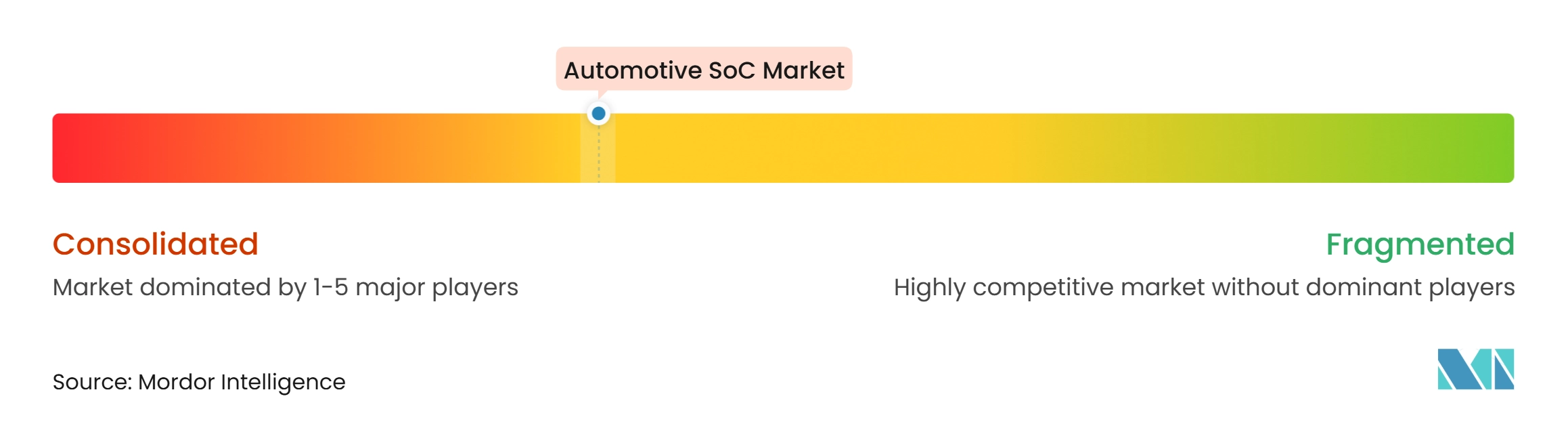
The automotive SoC market has a moderate concentration because a small group of global suppliers has strong positions across driver assistance, cockpit, and centralized vehicle-computing programs. Qualcomm, NVIDIA, NXP Semiconductors, Renesas Electronics, Mobileye, Infineon Technologies, STMicroelectronics, and Texas Instruments serve different parts of the automotive processor and electronics landscape. Competition increasingly centers on the value of a usable platform, not on raw chip specifications alone. Suppliers need to provide development tools, operating-system support, reference designs, security features, and functional safety materials. For the automotive SoC market, this creates a practical advantage for companies that have worked with vehicle makers across several program cycles. It also raises the cost of switching suppliers after a vehicle platform has entered development.
NXP has expanded its automotive software position through the acquisition of TTTech Auto and continues to develop the CoreRide approach for software-defined vehicles. The company also introduced the S32N central vehicle processor family to support integration across vehicle domains. Arm introduced Zena Compute Subsystems to give chip developers a more integrated starting point for automotive processors. These moves show how suppliers are trying to reduce the time required to develop and validate a vehicle compute platform. The commercial value lies in making hardware and software easier to adopt together. Companies that can simplify this process may secure longer relationships with automakers and Tier-1 suppliers.
Chinese chip developers are adding competitive pressure by pursuing domestic vehicle design wins and broader partnerships. Their challenge is not limited to processor capability because they also need software support, manufacturing access, and credible safety processes. RISC-V and chiplet approaches can give newer entrants more architectural choice and may lower some development barriers. At the same time, ISO 26262, ISO/SAE 21434, and regional vehicle regulations remain meaningful entry requirements for safety-related applications. Infineon's August 2025 completion of its acquisition of Marvell's automotive Ethernet business illustrates the importance of high-bandwidth connectivity as vehicle systems become more centralized. The competitive field will therefore reward suppliers that can combine processors, connectivity, software, and compliance support in a dependable product path.
Automotive SoC Industry Leaders
-
Qualcomm Incorporated
-
NVIDIA Corporation
-
NXP Semiconductors N.V.
-
Renesas Electronics Corporation
-
Mobileye Global Inc.
- *Disclaimer: Major Players sorted in no particular order
Automotive SoC Market Companies Covered in this Report
- NVIDIA Corporation
- Qualcomm Incorporated
- NXP Semiconductors N.V.
- Renesas Electronics Corporation
- Texas Instruments Incorporated
- Infineon Technologies AG
- STMicroelectronics N.V.
- Samsung Electronics Co., Ltd.
- MediaTek Inc.
- Advanced Micro Devices, Inc.
- Mobileye Global Inc.
- Horizon Robotics, Inc.
- Black Sesame Technologies Inc.
- Huawei Technologies Co., Ltd.
- SemiDrive Technology Co., Ltd.
- Ambarella, Inc.
- Microchip Technology Incorporated
- Socionext Inc.
- Telechips Inc.
- SiEngine Technology Co., Ltd.
Recent Industry Developments in Automotive SoC Market
- October 2026: Axera's ADAS SoC entered the European market in Leapmotor's new global compact electric hatchback.
- October 2026: Volvo Cars expanded its partnership with NVIDIA to build next-generation automated driving on the NVIDIA Hyperion architecture with the Halos operating system and Alpamayo software.
- October 2026: LG Electronics partnered with Bosch, BOS Semiconductors, and Hana Micron to develop chiplet-based automotive semiconductors under a Korean government-supported R&D project.
- September 2026: Tata Consultancy Services (TCS) launched custom SoC design services for automotive OEMs targeting software-defined vehicles, covering design, verification, implementation, and validation.
Global Automotive SoC Market Report Scope
The Automotive SoC Market is segmented by SoC Type, Process Node, Architecture, Vehicle Type, Propulsion, and Geography. By SoC Type, the market is segmented into ADAS/Autonomous Driving, Infotainment and Cockpit, Telematics and Connectivity, and Others (Body, Gateway, Zonal). By Process Node, the market is segmented into Up to 4 nm, 5 to 7 nm, 8 to 22 nm, and 28 nm and Above. By Architecture, the market is segmented into ARM-Based, x86, and Others (RISC-V). By Vehicle Type, the market is segmented into Passenger Cars and Commercial Vehicles. By Propulsion, the market is segmented into Internal Combustion Engines (ICEs) and Electric. By Geography, the market is segmented into North America (United States, Canada, and Rest of North America), Europe (Germany, United Kingdom, France, Italy, Spain, Russia, Netherlands, Sweden, and Rest of Europe), Asia-Pacific (China, Japan, South Korea, Taiwan, India, Australia, Southeast Asia, and Rest of Asia-Pacific), South America (Brazil, Argentina, Chile, Colombia, and Rest of South America), and Middle East and Africa (Turkey, Saudi Arabia, United Arab Emirates, Israel, South Africa, Morocco, Egypt, and Rest of Middle East and Africa). Market forecasts are provided in terms of Value (USD).
Segmentation Overview
| ADAS/Autonomous Driving |
| Infotainment and Cockpit |
| Telematics and Connectivity |
| Others (Body, Gateway, Zonal) |
| Up to 4 nm |
| 5 to 7 nm |
| 8 to 22 nm |
| 28 nm and Above |
| ARM-Based |
| x86 |
| Others (RISC-V) |
| Passenger Cars |
| Commercial Vehicles |
| Internal Combustion Engines (ICEs) |
| Electric |
| North America | United States |
| Canada | |
| Rest of North America | |
| Europe | Germany |
| United Kingdom | |
| France | |
| Italy | |
| Spain | |
| Russia | |
| Netherlands | |
| Sweden | |
| Rest of Europe | |
| Asia-Pacific | China |
| Japan | |
| South Korea | |
| Taiwan | |
| India | |
| Australia | |
| Southeast Asia | |
| Rest of Asia-Pacific | |
| South America | Brazil |
| Argentina | |
| Chile | |
| Colombia | |
| Rest of South America | |
| Middle East and Africa | Turkey |
| Saudi Arabia | |
| United Arab Emirates | |
| Israel | |
| South Africa | |
| Morocco | |
| Egypt | |
| Rest of Middle East and Africa |
| By SoC Type | ADAS/Autonomous Driving | |
| Infotainment and Cockpit | ||
| Telematics and Connectivity | ||
| Others (Body, Gateway, Zonal) | ||
| By Process Node | Up to 4 nm | |
| 5 to 7 nm | ||
| 8 to 22 nm | ||
| 28 nm and Above | ||
| By Architecture | ARM-Based | |
| x86 | ||
| Others (RISC-V) | ||
| By Vehicle Type | Passenger Cars | |
| Commercial Vehicles | ||
| By Propulsion | Internal Combustion Engines (ICEs) | |
| Electric | ||
| By Geography | North America | United States |
| Canada | ||
| Rest of North America | ||
| Europe | Germany | |
| United Kingdom | ||
| France | ||
| Italy | ||
| Spain | ||
| Russia | ||
| Netherlands | ||
| Sweden | ||
| Rest of Europe | ||
| Asia-Pacific | China | |
| Japan | ||
| South Korea | ||
| Taiwan | ||
| India | ||
| Australia | ||
| Southeast Asia | ||
| Rest of Asia-Pacific | ||
| South America | Brazil | |
| Argentina | ||
| Chile | ||
| Colombia | ||
| Rest of South America | ||
| Middle East and Africa | Turkey | |
| Saudi Arabia | ||
| United Arab Emirates | ||
| Israel | ||
| South Africa | ||
| Morocco | ||
| Egypt | ||
| Rest of Middle East and Africa | ||
Key Questions Answered in the Report
What is driving demand for automotive system-on-chip solutions?
Demand is supported by wider use of driver assistance, digital cockpit functions, connectivity, and centralized vehicle computing. The automotive SoC market is projected to grow at an 11.38% CAGR from 2027 to 2032.
Which automotive SoC application leads in 2026?
Infotainment and cockpit leads by share in 2026 at 46.16%, supported by demand for digital displays, interfaces, and connected in-vehicle experiences.
Which automotive SoC application is expected to grow the fastest?
ADAS/autonomous driving is projected to grow at a 15.90% CAGR through 2032 as centralized driver assistance compute spreads across more vehicle models.
Why are advanced process nodes relevant to vehicle computing?
Advanced nodes support high-performance driver assistance and centralized compute workloads where processors must combine several functions within tight power and thermal limits. Up to 4 nm is forecast to grow at a 19.75% CAGR through 2032.