
Automotive Refinish Coatings Market Size and Share
Market Overview
| Study Period | 2021 - 2031 |
|---|---|
| Market Size (2026) | USD 13.65 Billion |
| Market Size (2031) | USD 18.91 Billion |
| Growth Rate (2026 - 2031) | 6.73 % |
| Fastest Growing Market | Asia-Pacific |
| Largest Market | Asia-Pacific |
| Market Concentration | Medium |
Major Players *Disclaimer: Major Players sorted in no particular order Image © Mordor Intelligence. Reuse requires attribution under CC BY 4.0. | |
Automotive Refinish Coatings Market Analysis by Mordor Intelligence
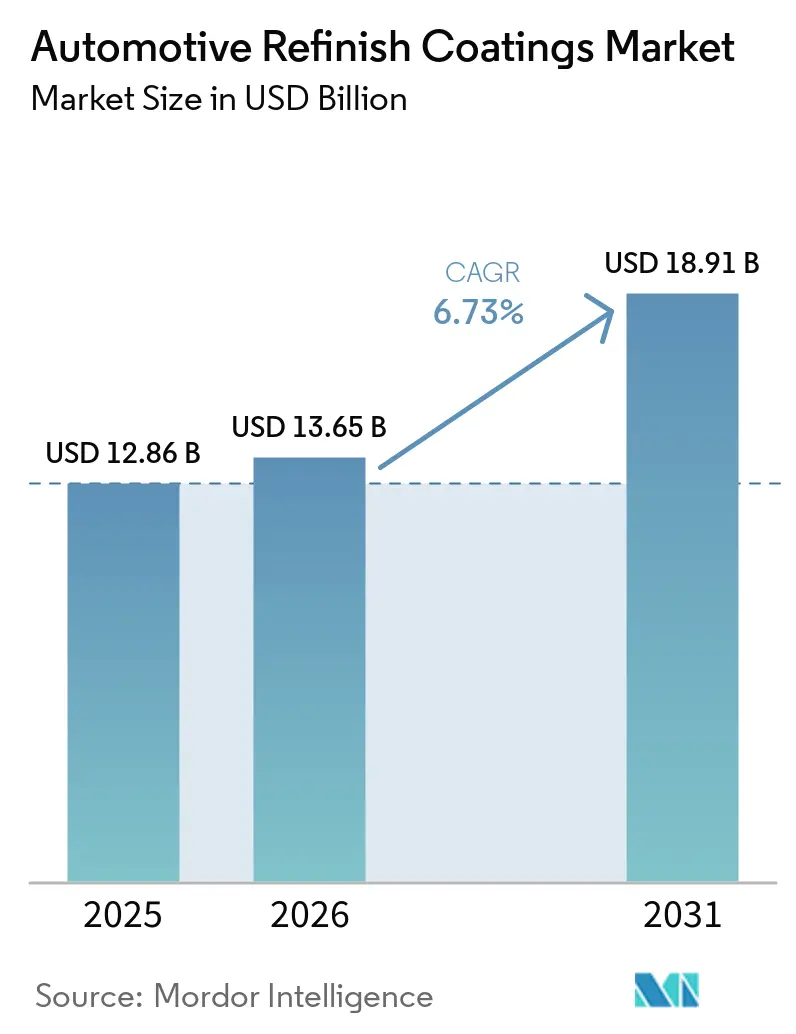
The automotive refinish coatings market size was valued at USD 12.86 billion in 2025 and is estimated to grow from USD 13.65 billion in 2026 to reach USD 18.91 billion by 2031, at a CAGR of 6.73% during the forecast period from 2026 to 2031. The automotive refinish coatings market is supported by an aging vehicle base, which drives repeat demand for collision repair, surface preparation, color matching, and repainting services as vehicles remain in use longer. Longer vehicle ownership cycles make repair networks, insurers, distributors, and approved product systems more important to coating suppliers seeking reliable demand. Waterborne conversion is changing product selection in regulated regions and increasing the need for compatible equipment, technician training, controlled application conditions, and localized technical support. Digital color tools, automated dispensing, and workflow systems are becoming part of supplier relationships with larger repair groups, as they can reduce rework and improve process consistency. Competitive activity focuses on distribution coverage, product systems, color data, service support, and supplier agreements, not just coating chemistry, creating opportunities for providers that can support the full body shop workflow.
Key Report Takeaways
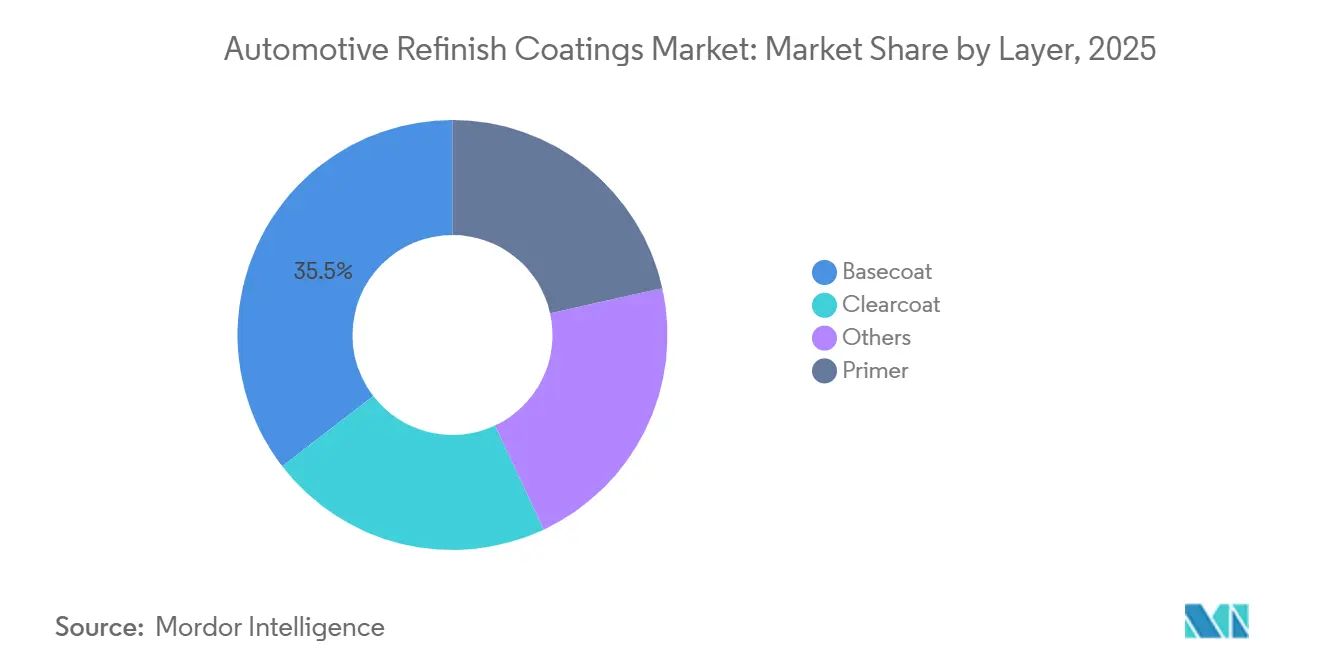
- By layer, basecoat held 35.45% of the automotive refinish coatings market share in 2025, while clearcoat is forecast to grow at a 7.34% CAGR through 2031.
- By resin type, polyurethane accounted for 40.34% of revenue in 2025, while acrylic resins are forecast to expand at a 7.53% CAGR through 2031.
- By technology, solventborne coatings accounted for 48.12% of revenue in 2025, while waterborne technology is forecast to grow at a 7.68% CAGR through 2031.
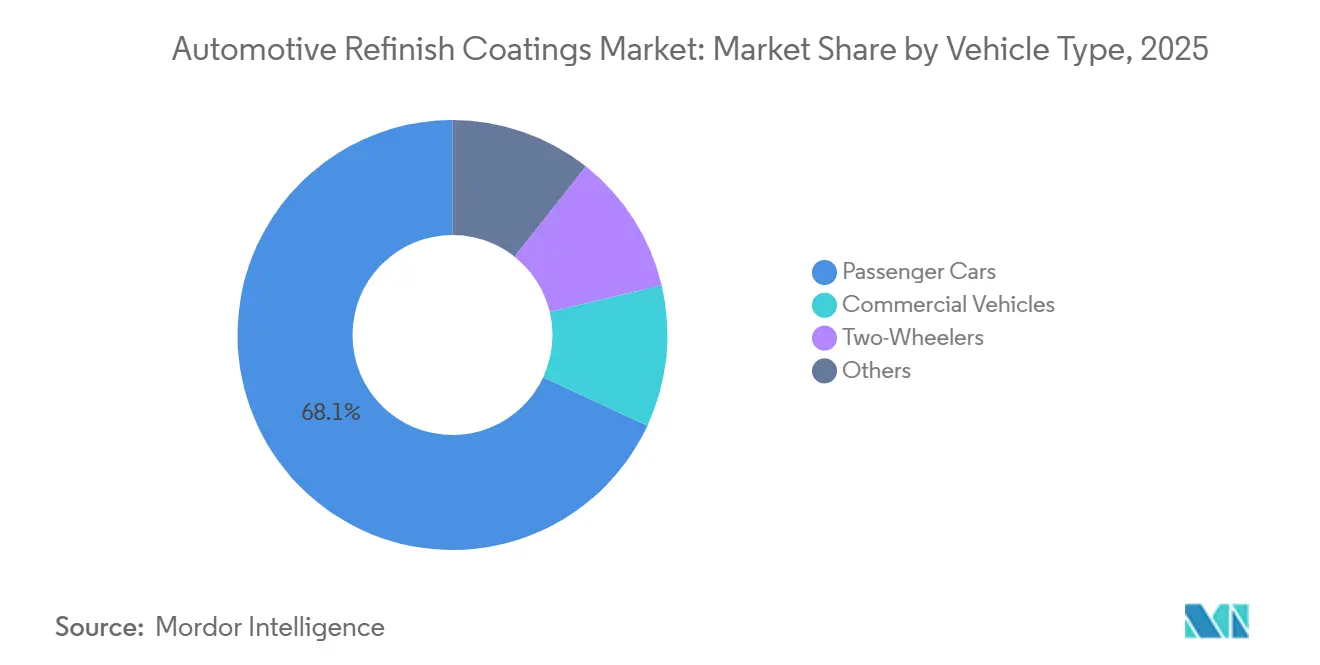
- By vehicle type, passenger cars accounted for 68.07% of revenue in 2025, while commercial vehicles are forecast to grow at a 7.83% CAGR through 2031.
- By geography, Asia-Pacific held 42.93% of revenue in 2025 and is projected to expand at a 7.71% CAGR through 2031.
Note: Market size and forecast figures in this report are generated using Mordor Intelligence’s proprietary estimation framework, updated with the latest available data and insights as of January 2026.
Global Automotive Refinish Coatings Market Trends and Insights
Drivers Impact Analysis*
| Drivers | (~) % Impact on CAGR Forecast | Geographic Relevance | Impact Timeline |
|---|---|---|---|
| Expanding Vehicle Parc and Recurring Collision Repairs | +1.8% | Global, with large volume gains in Asia-Pacific and the Middle East | Long term (≥ 4 years) |
| Growth of Organized Collision Repair Networks and Insurance Integration | +1.2% | North America and Europe, with expansion in the Asia-Pacific urban markets | Medium term (2-4 years) |
| Transition Toward Waterborne and Low Volatile Organic Compounds (VOC) Coating Systems | +1.5% | North America and Europe, with spillover to Northeast Asia | Long term (≥ 4 years) |
| Digital Color Matching and Automated Body Shop Workflows | +0.7% | Global, with early adoption in North America and Western Europe | Medium term (2-4 years) |
| Rising Demand for Premium Finishes and Vehicle Customization | +0.8% | Global, with concentration in North America, Western Europe, and China | Medium term (2-4 years) |
| Source: Mordor Intelligence | |||
Expanding Vehicle Parc and Recurring Collision Repairs
The global vehicle parc exceeded 1.47 billion registered units in 2024, supporting sustained demand for automotive refinish coatings. Older vehicles remain in service for longer periods, increasing the pool requiring collision repair, surface restoration, corrosion treatment, and repainting. The average age of vehicles in the United States reached 12.6 years in 2024, while 38% of Europe's passenger car fleet was more than 10 years old. These conditions make the automotive refinish coatings market less exposed to short-term swings in new-vehicle sales, as repair needs persist after the original sale. Older vehicles can also require more extensive surface preparation before refinishing, particularly where corrosion, prior damage, or bare metal is present. China's vehicle parc of more than 340 million units further supports Asia-Pacific's role as a major source of repair demand, distribution activity, and coating consumption.
Growth of Organized Collision Repair Networks and Insurance Integration
Organized repair networks are consolidating coating purchases into larger, more predictable procurement programs. This favors suppliers that can provide product availability, technical training, color tools, and local service across multiple repair locations. In January 2026, PPG named Quality Collision Group as its exclusive refinish partner, covering more than 95 repair centers across 13 U.S. states. As a result, the automotive refinish coatings market places increasing value on supplier contracts that span a repair group rather than a single independent shop. Insurer-directed repair activity can further influence which facilities receive repair work, which coating systems are approved, and how repair standards are applied. Larger agreements also encourage suppliers to bundle digital tools, mixing equipment, and technician training with coating products, strengthening customer retention.
Transition Toward Waterborne and Low-VOC Coating Systems
VOC regulations are pushing body shops toward waterborne systems in markets with strict air-quality requirements. South Coast Air Quality Management District (AQMD) Rule 1151, effective May 1, 2025, introduces revised automotive coating limits for coatings used on motor vehicles and mobile equipment in the Los Angeles air basin. In March 2025, Canada proposed amendments to align automotive refinishing VOC limits with the Ozone Transport Commission (OTC) Model Rule 2011 and to review certain per- and polyfluoroalkyl substances (PFAS)-related components. In August 2026, PPG introduced its Quickline waterborne refinish system for the United States and Canada, designed to support compliance, color accuracy, and productivity. Waterborne conversion provides revenue support to the automotive refinish coatings market, as shops require compatible basecoats, primers, ancillary materials, spray equipment, and revised application procedures. The transition also increases the importance of technical support for application, flash time management, drying, and curing.
Digital Color Matching and Automated Body Shop Workflows
Digital color matching reduces rework by helping technicians select formulas that match complex vehicle finishes. These tools combine spectrophotometers, color databases, formulation software, tint dispensing equipment, and repair workflow information. In February 2026, Axalta partnered with aspaara to use simulation and planning software for vehicle repair and refinish operations[1]Axalta Coating Systems, “Axalta Announces Partnership with aspaara,” Axalta Coating Systems, axalta.com. These connected systems increasingly shape the automotive refinish coatings market, as product selection is tied to a supplier's color data, equipment, and workflow processes. In September 2026, MIPA presented its Smart Mixing concept at Automechanika Frankfurt, combining artificial intelligence with automated mixing technology. Suppliers that integrate hardware, software, and coatings make it more difficult for a repair center to replace one element of the system independently without disrupting established processes.
Restraints Impact Analysis*
| Restraints | (~) % Impact on CAGR Forecast | Geographic Relevance | Impact Timeline |
|---|---|---|---|
| Regulatory Compliance and Conversion Costs for Small Body Shops | -0.6% | North America and the European Union, with spillover to South America, the Middle East, and Africa | Medium term (2-4 years) |
| Raw Material and Specialty Pigment Price Volatility | -0.7% | Global, with high concentration in China and the Asia-Pacific | Short term (≤ 2 years) |
| Technician Shortages and Waterborne Application Complexity | -0.5% | Global, concentrated in North America and Europe, where waterborne compliance is mandated | Long term (≥ 4 years) |
| Source: Mordor Intelligence | |||
Regulatory Compliance and Conversion Costs for Small Body Shops
Small body shops face higher conversion costs when replacing solvent-borne products with compliant waterborne systems. In the Los Angeles region, Rule 1151 includes volatile organic compound (VOC) limits and phase-out dates extending through January 2028. The required transition can include waterborne-compatible spray booths, high-pressure and low-pressure equipment, forced-air drying equipment, revised maintenance practices, and operator training. This creates a wider operating gap between large repair networks and smaller independent facilities in the automotive refinish coatings market. A multi-location repair group can spread capital costs across more repair orders, while a small shop has fewer opportunities to recover the investment through utilization. Compliance testing and certification requirements can also limit smaller suppliers' ability to offer niche grades at competitive prices.
Raw Material and Specialty Pigment Price Volatility
Raw material volatility can limit suppliers' and body shops' ability to manage operating costs. Titanium dioxide is used in primer, basecoat, and clearcoat applications where opacity and coverage are required. Specialty pigments, including aluminum flakes and mica-based effects, add further cost exposure for complex vehicle colors and multi-layer repair systems. The automotive refinish coatings market can face margin pressure when material costs rise faster than product prices or contractual price adjustments. Body shops with narrow margins may delay adopting premium products as coating costs rise, particularly for repairs with limited insurer reimbursement. This constraint runs counter to the broader shift toward effect finishes, larger toner inventories, and higher-value color systems.
*Our forecasts treat driver/restraint impacts as directional, not additive. The impact forecasts reflect baseline growth, mix effects, and variable interactions.
Segment Analysis
By Layer: Clearcoat Growth, Reshaping Premium Refinish Demand
Basecoat held 35.45% of revenue in 2025 and remained the largest layer in the automotive refinish coatings market. Its position reflects the need to match original vehicle colors, including metallic, pearlescent, and multi-angle finishes. Basecoat selection has become more complex as original equipment manufacturers use a wider range of effects, color combinations, and multi-stage paint systems. Primer demand remains tied to corrosion protection and adhesion on damaged, repaired, or exposed substrates, especially on older vehicles with more extensive surface damage. Specialty fillers, sealers, and activators also remain necessary for system compatibility across metal, plastic, high-strength steel, and mixed-material body panels.
Clearcoat is forecast to record a 7.34% CAGR from 2026 to 2031, the fastest rate among layer types. Clearcoats support gloss, durability, weather resistance, and surface protection after a repair. PPG launched Deltron D8178 Rapid Low Energy clearcoat in EMEA in March 2026, which can air dry at 20°C or reach dust-dry status in 5 minutes at 50°C. Faster drying can help body shops use spray booths more efficiently, reduce energy use, and shorten the time a repaired vehicle remains in the facility. Clearcoat demand is therefore driven by products that combine finish protection with faster processing times and more consistent application results.



By Resin Type: Acrylic Systems Gaining on Dominant Polyurethane
Polyurethane accounted for 40.34% of revenue in 2025, leading the resin category. The material is used across coating layers because it offers abrasion resistance, gloss retention, and compatibility with solvent-borne and waterborne carrier systems. Epoxy resins continue to play an important role in primers, especially where strong adhesion and corrosion resistance are required on bare metal surfaces that have undergone significant oxidation or mechanical damage. Alkyd resins remain relevant in cost-sensitive locations where enforcement of volatile organic compound (VOC) regulations is less stringent and purchasing decisions place greater weight on price. These options allow formulators to balance performance, application needs, durability, and cost across varied body shop conditions.
Acrylic resins are forecast to grow at a 7.53% CAGR between 2026 and 2031. Their waterborne compatibility, ultraviolet resistance, and lower-temperature curing characteristics align with environmental requirements and shorter repair cycles. The move to waterborne basecoats supports a gradual shift from polyurethane-led solvent-borne formulations to acrylic-rich waterborne products. Donglai Coating Technology filed a patent in June 2026 for a 2K high-temperature clearcoat composition that uses acrylic resin and reported a distinctness-of-image value of 92. Resin choice in the automotive refinish coatings market may become more closely linked to waterborne system requirements, premium clearcoat performance, and lower-energy curing conditions.
By Technology: VOC Rules Tighten as Waterborne Conversion Deepens
Solvent-borne technology held 48.12% of revenue in 2025, making it the largest technology segment. It remains widely used because it requires less equipment investment, offers broad operating-temperature tolerance, and is less sensitive to humidity-related flash issues. These features are important for independent shops in areas with limited VOC enforcement or limited access to waterborne-capable spray booths. UV-curable and high-solids products serve narrower needs where cure speed, durability, or commercial fleet throughput is important. The market size for solvent-borne products remains substantial, even as waterborne conversion progresses in regulated regions.
Waterborne technology is projected to grow at a 7.68% CAGR from 2026 to 2031. Regulation is a central driver, as waterborne systems help shops comply with tighter VOC requirements and make longer-term equipment conversion more necessary. U.S. national VOC emission standards for automobile refinish coatings establish requirements for coating manufacturers and importers. Canada's proposed amendments also show how regulatory attention is extending beyond the United States. Greater output can encourage investment in waterborne formulation, technician training, dedicated distribution, and equipment support.
By Vehicle Type: Commercial Fleet Refinish Outpacing Passenger Segment
Passenger cars accounted for 68.07% of revenue in 2025 and formed the largest vehicle type segment. Their scale reflects the large number of passenger vehicles on the road and the need for color matching after collision repairs. Passenger vehicle repairs can carry high coating value when they involve premium finishes, multiple layers, original equipment manufacturer color requirements, and premium clearcoat systems. Two-wheelers create additional output in parts of Asia, although their per-unit coating value is lower than that of a passenger vehicle repair. The automotive refinish coatings market continues to depend on passenger cars for its broad repair base and demand for color-specific products.
Commercial vehicles are forecast to grow at a 7.83% CAGR through 2031. Fleet operators often prioritize products that minimize turnaround time because vehicles generate revenue while in service. Axalta reported USD 545 million in refinish net sales in the second quarter of 2026, up 6% year over year, supported by net new collision repair facilities. Commercial fleet repairs may require durable finishes that withstand intensive use, frequent cleaning, and demanding operating conditions. The automotive refinish coatings market may gain value per commercial repair as fleet vehicles become more complex and include more aluminum-intensive structures.
Geography Analysis
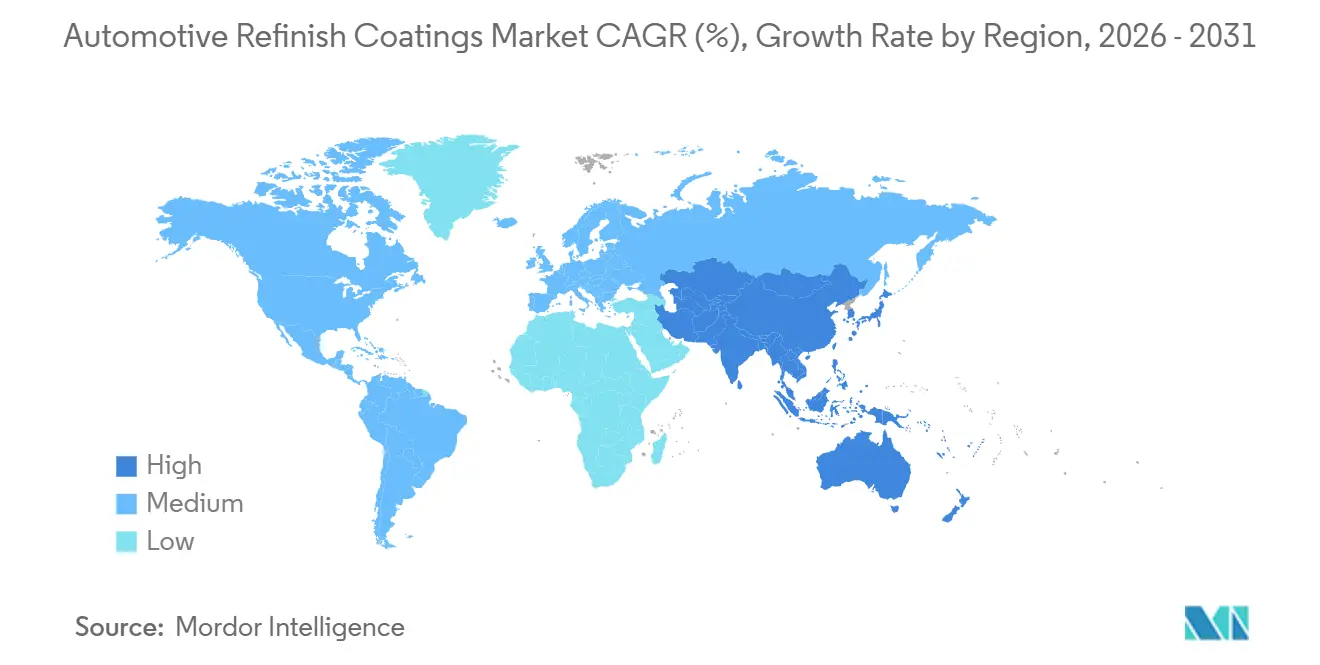
Asia-Pacific accounted for 42.93% of revenue in 2025 and grew at a 7.71% CAGR through 2031, the fastest rate among all regions. The region benefits from a large vehicle parc, expanding repair capacity, increasing urban vehicle use, and growing demand for compliant coating systems. China's vehicle parc of more than 340 million units supports high repair activity across a wide geographic area, even as new-vehicle growth moderates. The automotive refinish coatings market in Asia-Pacific is further supported by India's growing passenger vehicle base, which is expanding the future repair pool. Regional suppliers are investing in color matching, precision formulation, and waterborne technologies as they compete with global coating producers.
North America is the second-largest region and has a mature insurer-linked repair system. High insurance penetration, direct-repair programs, and established distributors channel repair activity toward organized body shops. The region's aging vehicle parc provides a continuing repair base, while advanced driver assistance systems raise repair order values and increase the need for certified repair processes. Waterborne products, certified clearcoats, and connected color tools offer suppliers opportunities to improve product value, even as vehicle maintenance needs evolve.
In South America, demand is concentrated in Brazil, where an older vehicle base supports refinish activity and repair frequency. Manufacturing investment and vehicle production are broadening the installed base, requiring repair services over time. In the Middle East and Africa, demand is driven by high temperatures, which increase the importance of ultraviolet-stable and heat-resistant finishes for exposed vehicles. Rising insurance penetration and urbanization are bringing more collision work into formal repair channels, creating demand for professionally distributed coating systems.

Competitive Landscape
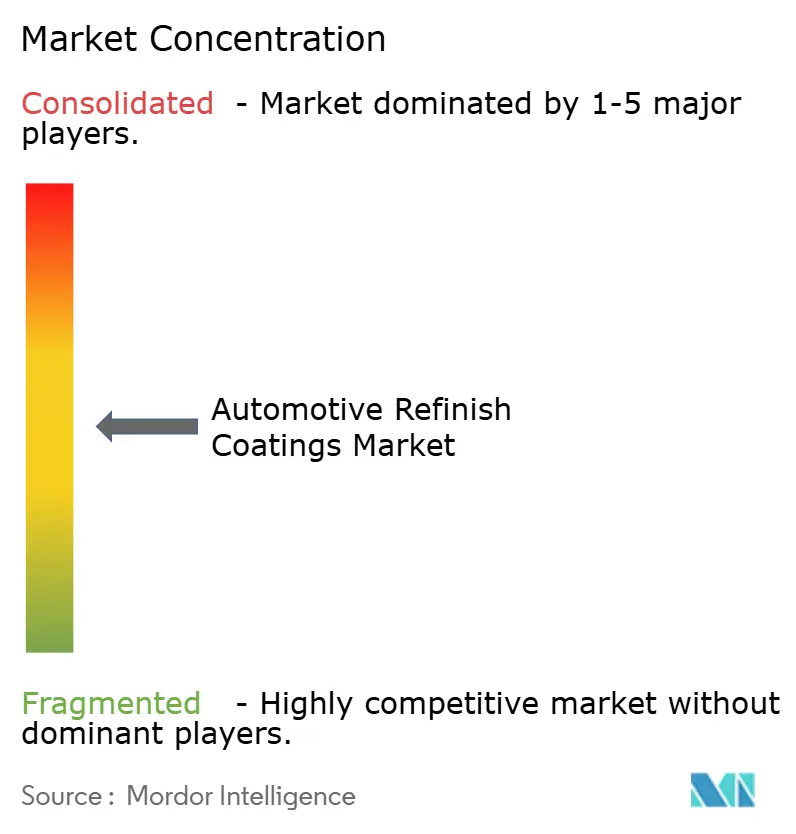
The automotive refinish coatings market is moderately fragmented among large suppliers, including PPG Industries, Axalta Coating Systems, AkzoNobel, and Sherwin-Williams. These companies compete through professional distribution, product systems, training, body shop support, and strong relationships with repair networks. A proposed USD 25 billion all-stock combination of Axalta and AkzoNobel received shareholder approval on August 5, 2026, while regulatory approvals remain pending. The transaction would combine Axalta brands such as Cromax, Standox, Spies Hecker, and Nason with AkzoNobel brands including Sikkens, Lesonal, and Wanda. If completed, the transaction would reduce the number of large global suppliers in the automotive refinish coatings market.
PPG has used supply agreements and product development to strengthen its presence in the repair network. Its January 2026 arrangement with Quality Collision Group pairs its coating supply with digital tools and technical training across more than 95 centers. Axalta's partnership with aspaara demonstrates how suppliers are adding operational planning tools to their coating offerings and seeking to improve shop throughput. MIPA's Smart Mixing launch reflects a similar focus on automated formulation, consistent dispensing, and reduced operator error[2]MIPA SE, “MIPA Presents the Future of Digital Colour Mixing at Automechanika,” MIPA SE, mipa-paints.com. The automotive refinish coatings market rewards suppliers that make body shop operations more consistent, predictable, and easier to manage across multiple locations.
Nippon Paint has expanded its automotive coating capabilities by reacquiring its European automotive coatings business from Wuthelam Group for EUR 47 million (~USD 53.97 million). The company is developing formulations that maintain sensing accuracy in autonomous vehicle systems and meet newer vehicle construction requirements. Donglai Coating Technology reported 2025 automotive refinish revenue of CNY 312 million (USD 43 million), up 24.97%. Qualification requirements, including quality management systems, technical approval, and original equipment manufacturer certification, remain barriers for new suppliers.
Automotive Refinish Coatings Industry Leaders
Axalta Coating Systems
PPG Industries, Inc.
Akzo Nobel N.V.
The Sherwin-Williams Company
Nippon Paint Holdings Co., Ltd.
- *Disclaimer: Major Players sorted in no particular order

Recent Industry Developments
- September 2026: Axalta Coating Systems unveiled "Redefined," a saturated ruby red, as its 2027 Global Automotive Color of the Year at Automechanika Frankfurt. Advances in effect pigment technology enabled greater color depth and dimensional character for both OEM design studios and custom refinish applications.
- August 2026: PPG broke ground on a USD 280 million expansion of its automotive coatings manufacturing site in Delaware, Ohio, adding 100,000 square feet of production space and new waterborne basecoat and primer capacity, with full operations expected in 2028.


Global Automotive Refinish Coatings Market Report Scope
Automotive refinish coatings are specialized paints and protective layers used by body shops and vehicle owners to repair, restore, or customize a vehicle's original finish. These coatings are applied after a vehicle has been damaged, aged, or modified, and they serve both functional and aesthetic purposes.
The automotive refinish coatings market is segmented by layer, resin type, technology, vehicle type, and geography. By layer, the market is segmented into primer, basecoat, clearcoat, and others. By resin type, the market is segmented into polyurethane, acrylic, epoxy, alkyd, and other resin types. By technology, the market is segmented into solventborne technology, waterborne technology, and other technologies. By vehicle type, the market is segmented into passenger cars, commercial vehicles, two-wheelers, and others. The report also covers market size and forecasts for automotive refinish coatings across 15 countries in major regions. The market sizes and forecasts are provided in terms of value (USD).
| Primer |
| Basecoat |
| Clearcoat |
| Others |
| Polyurethane |
| Acrylic |
| Epoxy |
| Alkyd |
| Other Resin Types |
| Solventborne Technology |
| Waterborne Technology |
| Other Technologies |
| Passenger Cars |
| Commercial Vehicles |
| Two-Wheelers |
| Others |
| Asia-Pacific | China |
| India | |
| Japan | |
| South Korea | |
| ASEAN Countries | |
| Rest of Asia-Pacific | |
| North America | United States |
| Canada | |
| Mexico | |
| Europe | Germany |
| United Kingdom | |
| France | |
| Italy | |
| NORDIC Countries | |
| Rest of Europe | |
| South America | Brazil |
| Argentina | |
| Rest of South America | |
| Middle East and Africa | Saudi Arabia |
| South Africa | |
| Rest of Middle East and Africa |
| By Layer | Primer | |
| Basecoat | ||
| Clearcoat | ||
| Others | ||
| By Resin Type | Polyurethane | |
| Acrylic | ||
| Epoxy | ||
| Alkyd | ||
| Other Resin Types | ||
| By Technology | Solventborne Technology | |
| Waterborne Technology | ||
| Other Technologies | ||
| By Vehicle Type | Passenger Cars | |
| Commercial Vehicles | ||
| Two-Wheelers | ||
| Others | ||
| By Geography | Asia-Pacific | China |
| India | ||
| Japan | ||
| South Korea | ||
| ASEAN Countries | ||
| Rest of Asia-Pacific | ||
| North America | United States | |
| Canada | ||
| Mexico | ||
| Europe | Germany | |
| United Kingdom | ||
| France | ||
| Italy | ||
| NORDIC Countries | ||
| Rest of Europe | ||
| South America | Brazil | |
| Argentina | ||
| Rest of South America | ||
| Middle East and Africa | Saudi Arabia | |
| South Africa | ||
| Rest of Middle East and Africa | ||


Key Questions Answered in the Report
What is current market size of Automotive Refinish Coatings Market?
The automotive refinish coatings market size was valued at USD 12.86 billion in 2025 and is estimated to grow from USD 13.65 billion in 2026 to reach USD 18.91 billion by 2031, at a CAGR of 6.73% during the forecast period from 2026 to 2031.
Which vehicle type is growing fastest for automotive refinish demand?
Commercial vehicles are forecast to expand at a 7.83% CAGR through 2031 as fleets seek faster repair turnaround times, durable finishes, and reduced time out of service. Repair products that improve both throughput and turnaround times are particularly relevant for fleet operators.
Which region leads the automotive refinish coatings demand?
Asia-Pacific held 42.93% of revenue in 2025 and is forecast to grow at a 7.71% CAGR through 2031. Its large vehicle parc, developing repair infrastructure, and demand for compliant coatings underpin regional repair activity.
What are the main constraints on automotive refinish coating adoption?
Conversion costs for small shops, raw material volatility, and shortages of trained collision technicians can slow the use of new coating systems. These factors can increase operating pressure during waterborne conversion and limit the pace of body shop output and repair completion during peak repair periods.
Page last updated on:


 Your data is secure and never sold or shared.


