
Automotive Motor Lamination Market Size and Share
Market Overview
| Study Period | 2020 - 2032 |
|---|---|
| Market Size (2027) | USD 11.11 Billion |
| Market Size (2032) | USD 19.33 Billion |
| Growth Rate (2027 - 2032) | 11.71 % |
| Fastest Growing Market | Asia-Pacific |
| Largest Market | Asia-Pacific |
| Market Concentration | Medium |
Major Players *Disclaimer: Major Players sorted in no particular order Image © Mordor Intelligence. Reuse requires attribution under CC BY 4.0. | |
Automotive Motor Lamination Market Analysis by Mordor Intelligence
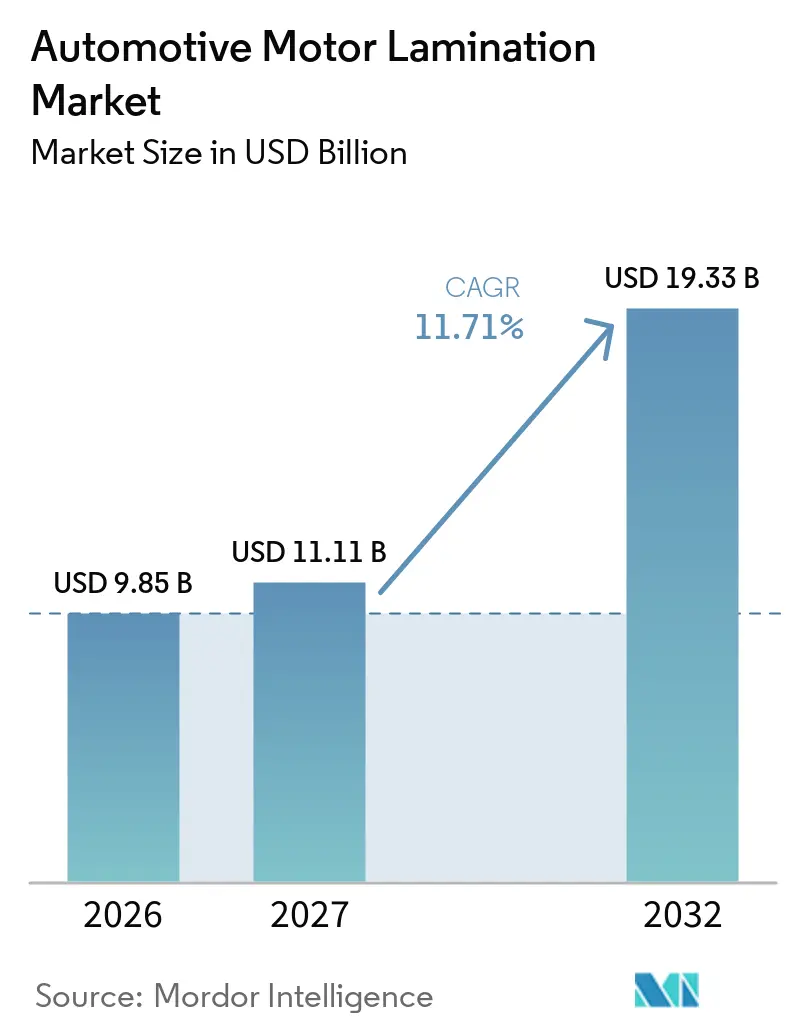
The automotive motor lamination market size was valued at USD 9.85 billion in 2026 and is expected to reach USD 11.11 billion in 2027 and USD 19.33 billion by 2032, growing at a CAGR of 11.71% over 2027-2032. Demand is tied to the continued expansion of electric powertrains, which require precision-stamped stator and rotor cores. The automotive motor lamination market is also shifting toward thinner electrical steel, higher motor speeds, and joining methods that support demanding traction applications. Suppliers are placing capacity closer to vehicle assembly plants and investing in bonding, tooling, and inspection capabilities that are difficult to replicate. The commercial opportunity depends on vehicle mix because battery electric vehicle core sets carry higher value than hybrid core sets, while ICE demand remains relevant through auxiliary motors.
Key Report Takeaways
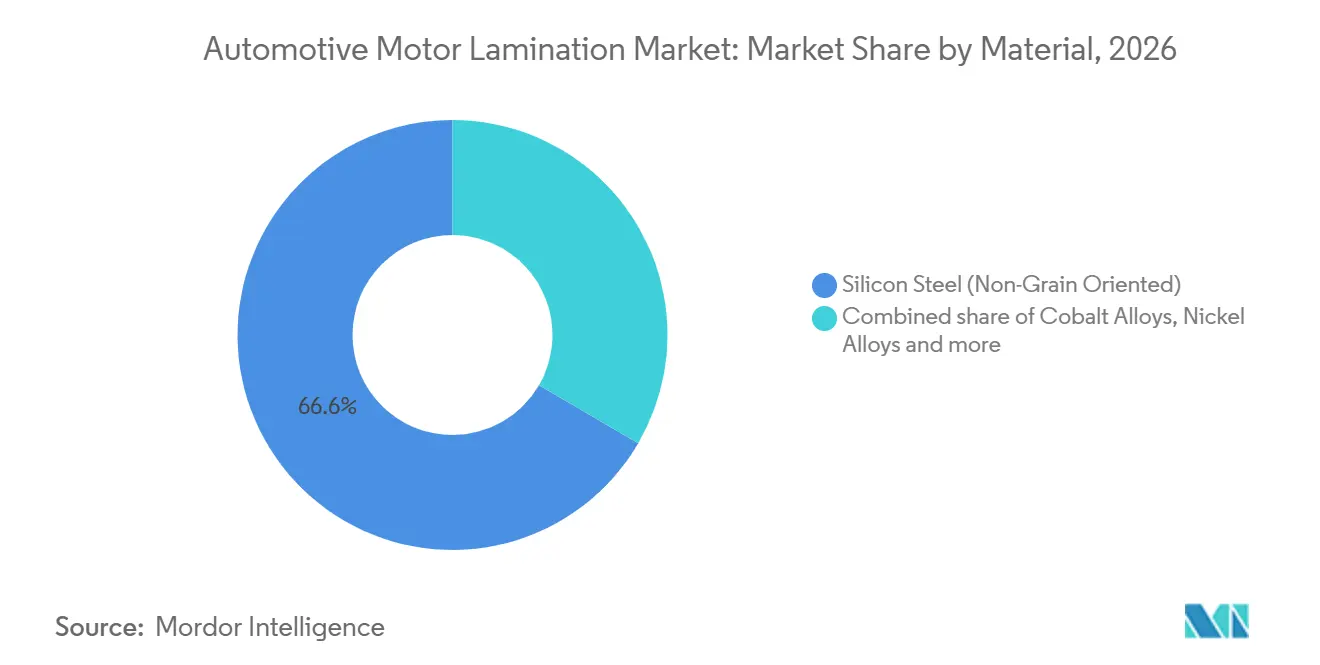
- By material, non-grain-oriented silicon steel held a 66.63% share of the automotive motor lamination market in 2026, while nickel alloys are forecast to expand at a 12.78% CAGR through 2032.
- By lamination thickness, the 0.2-0.35 mm band held a 61.26% share in 2026, while less than 0.2 mm is forecast to expand at a 13.05% CAGR through 2032.
- By cutting process, stamping held a 78.73% share in 2026 and is forecast to expand at a 13.01% CAGR through 2032.
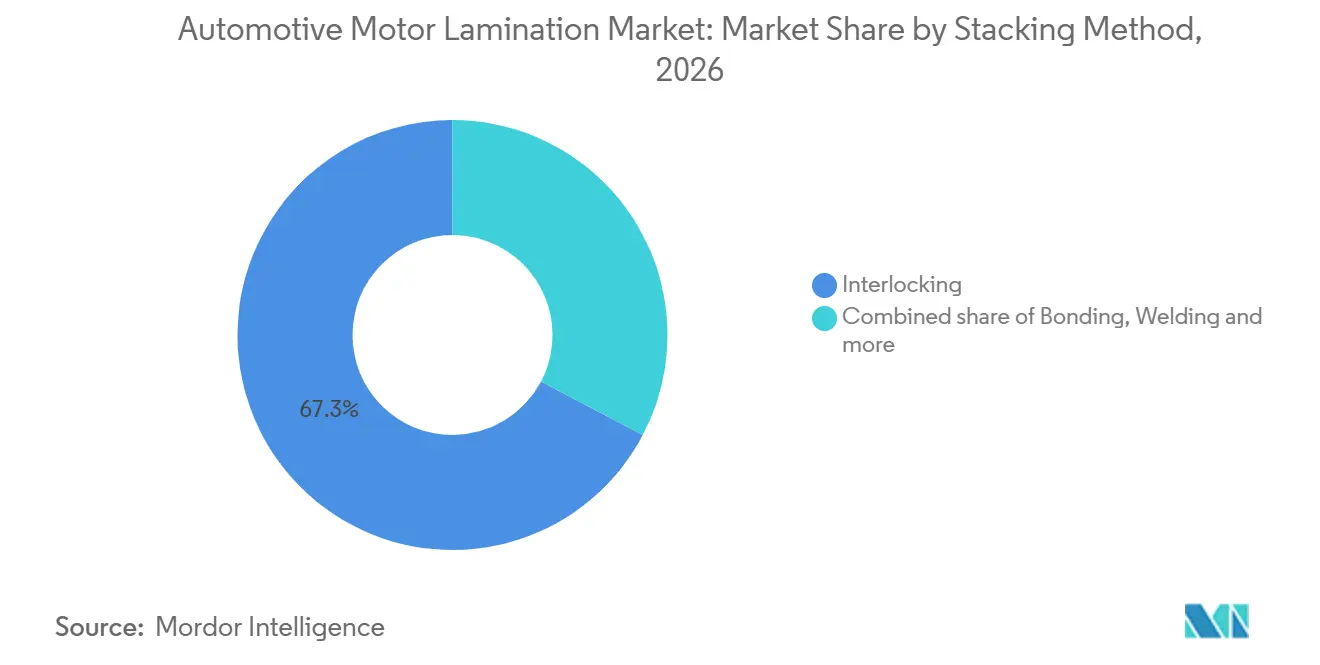
- By stacking method, interlocking held a 67.28% share in 2026, while welding is forecast to expand at a 13.15% CAGR through 2032.
- By motor type, traction motors held a 65.48% share in 2026, while auxiliary motors are forecast to expand at a 13.32% CAGR through 2032.
- By component, stator lamination held a 71.23% share in 2026, while rotor lamination is forecast to expand at a 13.37% CAGR through 2032.
- By vehicle type, battery electric vehicles held a 58.36% share in 2026 and are forecast to expand at a 13.26% CAGR through 2032.
- By geography, Asia-Pacific held a 47.83% share in 2026 and is forecast to expand at a 13.28% CAGR through 2032.
Note: Market numbers in this report are based on Mordor Intelligence's proprietary estimation framework, which combines nine months of actuals with Q4 projections for base year 2026.
Market Trends and Insights
Drivers Impact Analysis of Automotive Motor Lamination Market*
| Driver | (~) % Impact on CAGR Forecast | Geographic Relevance | Impact Timeline |
|---|---|---|---|
| Global Electrified-Vehicle Motor Production Expansion | +4.0% | Global; highest volume in China, Europe, and North America | Short term (≤ 2 years) |
| Higher Motor Speed and Power Density Requirements | +1.8% | Global; premium traction programs in Europe, the United States, and Japan | Medium term (2–4 years) |
| Shift Toward Thinner Non-Grain-Oriented Electrical Steel | +1.5% | Europe, East Asia; first movers on grades below 0.25 mm | Medium term (2–4 years) |
| Rising Auxiliary-Motor Content per Vehicle | +1.2% | Global; China and Europe leading multi-motor platforms | Medium term (2–4 years) |
| Localized Motor-Core Sourcing and Supply-Chain Resilience | +1.0% | North America, Europe; driven by trade-policy requirements | Medium term (2–4 years) |
| Automated High-Precision Stamping and Bonding Adoption | +0.9% | Global; scalable with advanced manufacturing base | Long term (≥ 4 years) |
| Source: Mordor Intelligence | |||
Global Electrified-Vehicle Motor Production Expansion
Electric-vehicle motor production is increasing the addressable volume for precision motor cores. The GEM Detroit Region projects U.S. e-motor output will rise from 3.2 million units in 2024 to 14.1 million units by 2030. It also expects e-motors to account for 61% of U.S. vehicle output by 2030 [1]. This expansion supports the automotive motor lamination market because each traction motor requires a stator and rotor core set. The opportunity is narrower for independent suppliers where vehicle makers retain or build captive drive-unit capacity. Local production investments can therefore expand core demand while also intensifying competition for third-party nominations. The practical result is that capacity growth does not automatically translate into equal access for all lamination suppliers. Companies that already meet program quality and timing requirements are better positioned to receive the resulting work.
Higher Motor Speed and Power Density Requirements
Traction motors operating above 15,000 rpm require electrical steel with controlled core loss at higher frequencies. This raises the value of stamping accuracy, stack geometry, and joining quality for hairpin motor programs. RWTH Aachen University reports that hairpin stator lines run at 150,000 to 200,000 units per year, with continuous hairpin processes reaching mechanical slot fill factors of up to 90% [2]. A 2025 IEEE review identifies lamination stack geometry as a constraint on further efficiency gains in continuous hairpin winding [3]. The automotive motor lamination market therefore favors suppliers that work with motor engineers early in program development. Early technical involvement also gives a supplier time to align die design, material behavior, insulation needs, and stack tolerances before production begins. This reduces the risk that a core design will need costly changes after a vehicle program is approved. Feintool states that its glulock technology supports laminations as thin as 0.1 mm and can improve motor efficiency by up to 15% within the same motor envelope.
Shift Toward Thinner Non-Grain-Oriented Electrical Steel
Vehicle makers are pursuing thinner non-grain-oriented steel to reduce core losses and help extend electric driving range. thyssenkrupp Steel commissioned an annealing and isolating line in Bochum in January 2025 as part of a EUR 300 million site investment. The line can produce more than 200,000 metric tons of NGO electrical steel annually, including 0.2 mm sheets with a minimum yield strength of 420 MPa. ArcelorMittal’s Mardyck electrical-steel line has 200,000 tons of annual capacity, and its USD 1.2 billion Calvert, Alabama line, with up to 150,000 tons per year, remains under construction, with first production expected in the second half of 2027. In the automotive motor lamination market, the shift below 0.25 mm requires changes to progressive-die tooling and strengthens the case for adhesive bonding. These requirements may favor suppliers with proven thin-gauge processes over firms dependent on legacy interlocking methods.
Rising Auxiliary-Motor Content per Vehicle
Electrified vehicles use more auxiliary motors for electric power steering, pumps, cooling fans, HVAC compressors, and brake boosters. Auxiliary motors are expected to grow at a 13.32% CAGR through 2032, reflecting this broader motor count per vehicle. The APC UK expects European electric motor demand to more than triple during the next decade and projects permanent magnet synchronous motors to retain more than 60% share. IEC 60034-30-1:2025 introduced the IE5 efficiency class in December 2025, reinforcing demand for efficient motor systems. The automotive motor lamination market can gain volume from these systems even when traction-motor production differs across vehicle platforms. Feintool’s work on cooling-fan motor cores also shows that precision auxiliary-core capability can serve adjacent applications using similar manufacturing assets.
Restraints Impact Analysis of Automotive Motor Lamination Market*
| Restraint | (~) % Impact on CAGR Forecast | Geographic Relevance | Impact Timeline |
|---|---|---|---|
| Volatility and Limited Availability of High-Grade Non-Grain-Oriented Electrical Steel | -1.8% | Global; most acute in North America and Europe | Medium term (2–4 years) |
| Capital Intensity of Progressive Dies, High-Speed Presses, and Inspection Systems | -1.4% | Global; most severe for smaller stampers and new entrants | Medium term (2–4 years) |
| Thin-Gauge Processing Yield Losses and Scrap from Complex Motor Geometries | -0.8% | Global; proportional to sub-0.25 mm adoption rate | Medium term (2–4 years) |
| Design Uncertainty from Axial-Flux and Non-Laminated Magnetic-Core Architectures | -0.6% | Europe, North America; active OEM R&D pipelines | Long term (≥ 4 years) |
| Source: Mordor Intelligence | |||
Volatility and Limited Availability of High-Grade Non-Grain-Oriented Electrical Steel
High-grade NGO electrical steel remains a material constraint for suppliers serving electric-drive programs. The requirement for low core loss and thin gauges limits the number of suitable steel grades for high-speed motors. The IEC 60034-30-1:2025 IE5 efficiency class adds a compliance factor that favors premium electrical steel. Price changes in silicon and alloy inputs also affect the economics of supply agreements when contracts allow material pass-through. New capacity in Germany, France, and the United States can improve regional availability but does not remove the need for qualified grades. The automotive motor lamination market is exposed when limited material supply constrains production schedules or narrows supplier margins. This is especially relevant where a motor program depends on a qualified steel grade and cannot readily switch materials without renewed testing. It increases the value of long-term material relationships and supply planning.
Capital Intensity of Progressive Dies, High-Speed Presses, and Inspection Systems
Modern traction-core programs need purpose-built progressive dies, high-speed presses, automated handling, and inline measurement. These investments are made before production revenue begins and are tied closely to a specific motor design. Hairpin-compatible core production also requires tight dimensional control and repeatable stack performance. Suppliers may need controlled-atmosphere annealing and additional inspection equipment to meet automotive requirements. The investment burden makes it harder for small firms to enter the automotive motor lamination market. It also increases the value of long production runs and stable vehicle-program nominations.
*Our forecasts treat driver/restraint impacts as directional, not additive. The impact forecasts reflect baseline growth, mix effects, and variable interactions.
Automotive Motor Lamination Market Segment Analysis
By Material:
NGO Silicon Steel Dominates While Specialty Alloys Gain in Premium ApplicationsNon-grain-oriented silicon steel accounted for 66.63% of the automotive motor lamination market share in 2026. Its position reflects an established balance of performance, cost, and compatibility with high-speed progressive-die stamping. The material serves a range of auxiliary and traction motor applications. Cobalt alloys remain concentrated in extreme-performance uses that require saturation magnetization above 2.3 T. Nickel alloys are the fastest-growing material segment at a 12.78% CAGR through 2032. Their use is linked to 800 V traction motors where standard NGO steel can face unacceptable eddy-current losses.
The material mix is becoming more specialized as motor speed and power density increase. A 0.10 mm B10AHV900M ultra-thin grade was introduced for traction motors above 15,000 rpm in May 2025, indicating the direction of material development. Thin grades can improve high-frequency performance but require capable stamping and joining processes. This makes material selection a manufacturing decision as well as a motor-design decision. A grade that performs well magnetically must also run reliably through the die, insulation, stacking, and handling steps. Suppliers need to assess both considerations before committing to a production method. The automotive motor lamination industry has opportunities in premium applications where grade qualification and processing know-how are decisive. Standard NGO grades are likely to remain the largest-volume option because they meet broad application requirements at a workable cost.

By Lamination Thickness:
Mid-Gauge Leads While Ultra-Thin Gauges Grow FastestThe 0.2-0.35 mm band held 61.26% of the automotive motor lamination market share in 2026. This gauge range remains a common engineering choice for current traction motors and premium auxiliary systems. It balances manageable processing with core-loss performance. Less than 0.2 mm is the fastest-growing thickness segment, with a 13.05% CAGR through 2032, as high-speed traction designs adopt ultra-thin grades. More than 0.35 mm remains relevant for lower-speed auxiliary motors where standard gauges are suitable.
The thickness mix does not move in one direction across all motor types. HVAC systems, pumps, and cooling fans add core volume that can continue to use thicker gauges. Thin material has a higher risk of yield loss during stamping, especially for complex geometries. Feintool states that its adhesive-based process allows series production at 0.1 mm and can improve efficiency by up to 15%. This makes adhesive joining a practical route for the thin-gauge part of the automotive motor lamination market. Suppliers need to manage scrap and tooling life while meeting the tighter tolerances required by these grades.
By Cutting Process:
Stamping Retains the Scale Advantage While Bonding Becomes More IntegratedStamping accounted for 78.73% of the automotive motor lamination market share in 2026 and is forecast to grow at a 13.01% CAGR through 2032. Its lead reflects the scale and repeatability of progressive-die production. A new motor design generally requires a dedicated die set. Re-sourcing during production is difficult after a process has been validated by an OEM. Laser cutting and other methods serve prototypes and low-volume applications where dedicated die investment is not justified.
Stamping increasingly includes bonding as part of the production process rather than a separate downstream activity. Worthington Steel’s Tempel introduced FSB Full Surface Bonding in October 2025. The company says the process applies adhesive at 2-4 microns compared with 5-14 microns in conventional bonding and has received production approval at multiple automotive OEMs. This improves the relevance of high-volume stamping for quiet and efficient motor designs. The automotive motor lamination market rewards suppliers that combine tooling expertise with process control for adhesive application. Cost-effective prototype methods will remain necessary, but they do not challenge stamping’s high-volume position.
By Stacking Method:
Interlocking Leads in Scale While Welding and Bonding AdvanceInterlocking held 67.28% of the automotive motor lamination market share in 2026. It remains widely used because it fits established progressive-die tooling and supports high production rates. Bonding gains relevance as material gauges move below 0.25 mm. Mechanical interlocking can be less reliable for thin laminations exposed to demanding operating loads. Welding is the fastest-growing stacking method at a 13.15% CAGR through 2032. It supports segmented-core arrangements and post-stack joining requirements that interlocking cannot always meet.
The stacking-method choice depends on motor geometry, grade thickness, and noise or loss requirements. Nippon Steel received U.S. Patent 12,261,482 in March 2025 for adhesive regions on lamination teeth that provide axial tensile strength above 20 MPa for high-speed rotor use. POSCO International began mass production in December 2025 at its Brzeg facility in Poland using self-bonding adhesive lamination technology. These developments show that bonding is becoming a key option for automotive core programs. The automotive motor lamination market will retain interlocking at scale while expanding alternative methods for thinner and more complex core designs.
By Motor Type:
Traction Motors Anchor Volume While Auxiliary Motors Broaden Revenue SourcesTraction motors held 65.48% of the automotive motor lamination market share in 2026. Every electrified drivetrain needs at least one primary drive motor with a stator and rotor core set. This ensures a large core requirement across battery electric and hybrid platforms. Auxiliary motors are forecast to grow at a 13.32% CAGR through 2032. Their growth is linked to increasing use of electric power steering, oil pumps, cooling fans, HVAC compressors, and brake boosters. The automotive motor lamination market size for auxiliary motors expands as vehicle electrification adds these systems.
Motor suppliers are applying stricter efficiency expectations to auxiliary systems. IEC 60034-30-1:2025 adds the IE5 efficiency class to the motor-efficiency framework. This reduces the scope for lower-grade material choices in some auxiliary applications. It also creates demand for consistent core quality across several smaller motor designs. Feintool’s cooling-fan motor core work demonstrates that automotive-grade auxiliary-core capability can be used in nearby industrial markets. The automotive motor lamination industry benefits from this wider equipment base because it can improve asset utilization beyond traction programs.
By Component:
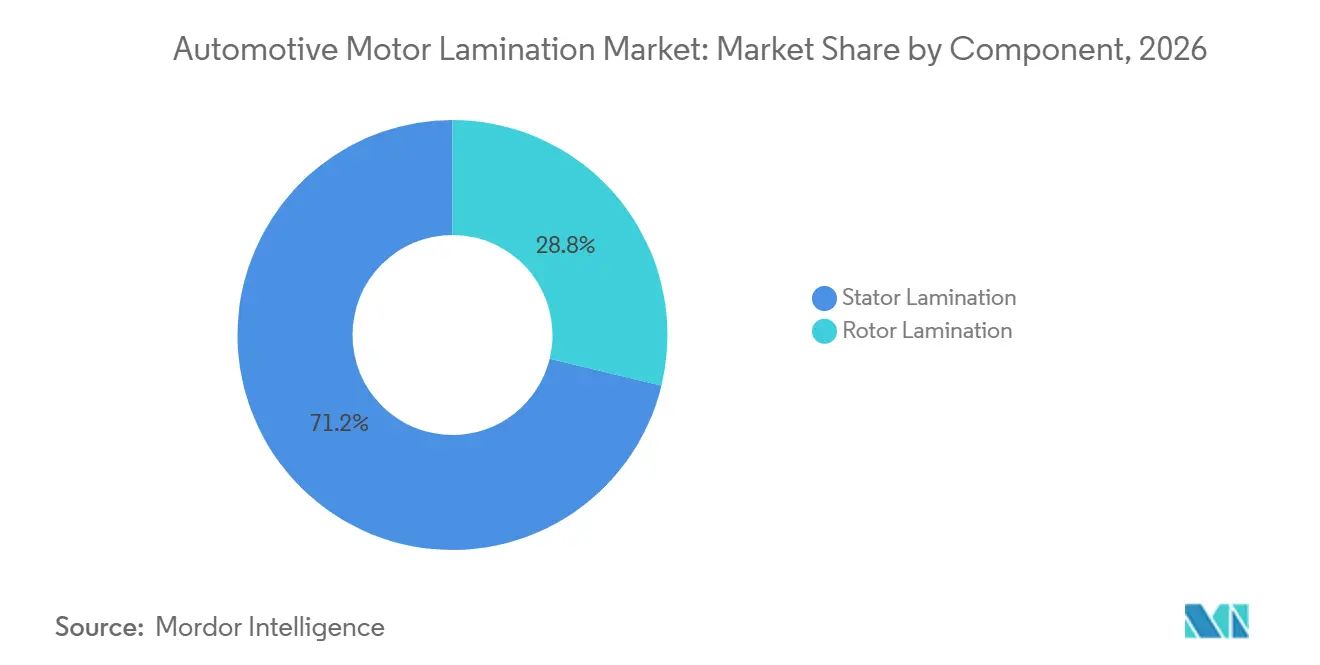
Stator Mass Supports Revenue While Rotor Complexity Drives GrowthStator lamination held 71.23% of the automotive motor lamination market share in 2026. The stator contains a larger annular structure and tooth array than the rotor in many motor designs. This higher material content supports its revenue position. Rotor lamination is forecast to grow at a 13.37% CAGR through 2032. Buried permanent magnet topologies at higher speeds require thin bridges and web features with close dimensional tolerances. The automotive motor lamination market size for rotor lamination is therefore closely tied to high-performance traction designs.
Rotor design creates a different manufacturing challenge from stator production. A 2026 Frontiers review identifies the lamination stack as a combined magnetic and production challenge in hairpin motors. Early cooperation between motor designers and stampers can reduce downstream production risks. The automotive motor lamination market therefore gives added strategic value to suppliers that can support rotor design validation. Stator volume will continue to dominate, but rotor complexity can determine the required technology level.
By Vehicle Type:
Battery Electric Vehicles Lead Value While ICE Retains an Auxiliary BaseBattery electric vehicles held 58.36% of the automotive motor lamination market share in 2026 and are forecast to grow at a 13.26% CAGR through 2032. ICE vehicles accounted for 16.52%, with demand mainly associated with auxiliary motors for steering, pumps, cooling fans, and starters rather than traction cores. A dual-motor battery electric vehicle needs traction-core sets that contain many individual electrical steel laminations. Hybrid and plug-in hybrid platforms continue to support demand as manufacturers manage fleet carbon dioxide compliance.
Vehicle mix has a direct effect on supplier revenue per core set. Battery electric core sets carry higher value than hybrid core sets, so higher hybrid volumes may not generate equivalent value growth for premium suppliers. The automotive motor lamination market benefits most when higher-content battery electric platforms expand. ICE volume continues to provide a meaningful base through auxiliary cores. Suppliers should therefore balance programs across conventional, hybrid, and battery electric platforms rather than assess demand using vehicle count alone.
Geography Analysis
North America
North America held 21.46% of the automotive motor lamination market share in 2026. The region is supported by established OEM assembly activity and an increasing focus on domestic electrical steel sourcing. The GEM Detroit Region projects U.S. e-motor output will increase from 3.2 million units in 2024 to 14.1 million units by 2030. ArcelorMittal’s USD 1.2 billion Calvert, Alabama electrical steel line, with up to 150,000 tons of annual capacity, remains under construction, with first production expected in the second half of 2027. Regional supply can reduce dependence on imported NGO grades and improve sourcing choices for stampers. Worthington Steel’s Tempel is expanding its Apodaca, Mexico operation for traction-motor laminations serving USMCA vehicle programs. Program timing remains important because the company expects the full production ramp to extend to fiscal 2029. Local-for-local capacity and automotive quality systems will remain central to the automotive motor lamination market in this region.
Asia-Pacific
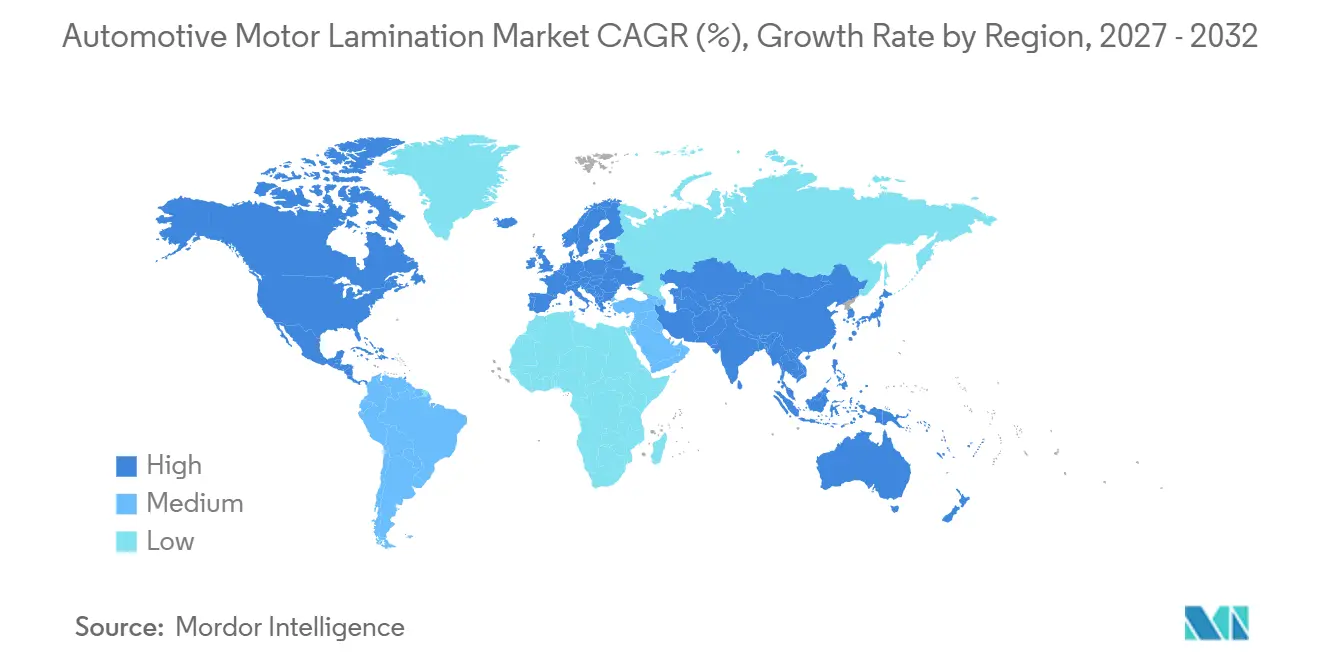
Asia-Pacific held 47.83% of the automotive motor lamination market share in 2026, the largest regional share, and is forecast to grow at a 13.28% CAGR through 2032, making it the fastest-growing regional segment of the automotive motor lamination market. China provides the principal production base, while India, South Korea, and Thailand add manufacturing depth. This scale supports demand for traction cores but also encourages captive drive-unit supply chains. India is expanding its stamping base. Feintool opened its first Indian plant in Pune in July 2026, with series production scheduled from Q1 2027 and later expansion into e-motor cores. Japan remains an important technology center in electrical steel development and bonded-core intellectual property. The automotive motor lamination market in Asia-Pacific combines large vehicle output with rapid progress in local materials and forming capacity.
Europe, South America, and Middle East and Africa
Europe has a technology-led automotive motor lamination market, while South America and Middle East and Africa remain smaller and more import-dependent. thyssenkrupp Steel’s Bochum line supports thin NGO grades for electric-mobility applications, strengthening Europe’s material base. POSCO International started mass production in Brzeg, Poland, in December 2025, with annual capacity for 1.2 million motor cores and an initial order for 1.03 million units for Hyundai and Kia in Europe. Feintool expanded its Tokod, Hungary plant with a EUR 34.1 million investment to supply e-motor components for Volvo’s electric vehicles. European producers need to meet automotive quality requirements and product-carbon documentation, including ISO 14067 where requested by customers. Brazil supports ICE and hybrid auxiliary-motor demand through its OEM assembly base, while localized EV traction-core manufacturing remains limited. Turkey, Saudi Arabia, and the UAE contribute incremental demand through vehicle-assembly plans, but their lamination supply remains largely imported.
Competitive Landscape
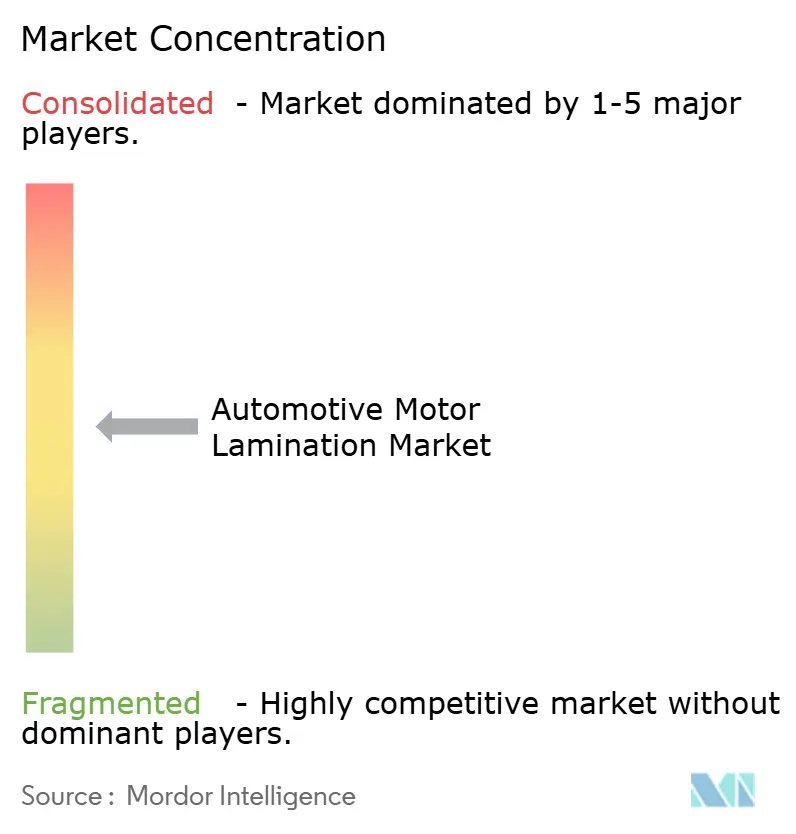
The automotive motor lamination market is moderately concentrated in precision traction applications and fragmented in lower-specification applications. A limited group of suppliers has the stamping, bonding, metrology, and quality-system infrastructure needed for OEM traction nominations. Leading suppliers are pursuing local capacity near OEM sites, stronger access to NGO steel, and proprietary joining or tooling processes. These capabilities reduce the risk of re-sourcing after a program has been validated. Long-term Tier 1 supply agreements can secure volumes across vehicle-platform lifecycles.
Technology differentiation is a key competitive factor in the automotive motor lamination market. Tempel’s FSB technology addresses adhesive thickness and bonding performance in automotive production. Feintool reports that glulock MD is in automotive series production and supports thin laminations with higher efficiency potential. Nippon Steel’s adhesive-core patent supports a joining architecture for high-speed rotor duty cycles. These examples show how product performance is increasingly linked to proprietary manufacturing steps. Suppliers without validated tooling and bonding processes may face higher qualification costs.
Competition also depends on traceability, material availability, and the ability to meet customer documentation requirements. IATF 16949 quality management expectations remain relevant for automotive component suppliers. ISO 14067 can guide product-carbon footprint reporting where customers request lifecycle data. Integrated suppliers can offer electrical steel sourcing, core production, and traceability in one package. Smaller regional stampers may compete in standard parts but can face pressure in complex hairpin-compatible designs. The automotive motor lamination industry has scope for suppliers that reduce scrap, improve bonded stator manufacturing, or support integrated cooling-channel designs. These areas can provide differentiation without requiring a broad commodity-scale footprint.
Automotive Motor Lamination Industry Leaders
-
EuroGroup Laminations S.p.A.
-
Mitsui High-tec, Inc.
-
Worthington Steel, Inc.
-
POSCO International Corporation
-
R. Bourgeois S.A.
- *Disclaimer: Major Players sorted in no particular order
Automotive Motor Lamination Market Companies Covered in this Report
- EuroGroup Laminations S.p.A.
- Mitsui High-tec, Inc.
- Worthington Steel, Inc.
- POSCO International Corporation
- R. Bourgeois S.A.
- Sumitomo Electric Industries, Ltd.
- voestalpine AG
- JFE Steel Corporation
- Nippon Steel Corporation
- thyssenkrupp AG
- China Baowu Steel Group Corporation Limited
- Kuroda Precision Industries Ltd.
- Motherson Yutaka Giken Co., Ltd.
- Pitti Engineering Pvt. Ltd.
- Polaris Laser Laminations
- Wingard & Co., Inc.
- Lamination Specialties, Inc.
- Suzhou Fine-Stamping Co., Ltd.
- Brandauer Limited
- Feintool International Holding AG
Recent Industry Developments in Automotive Motor Lamination Market
- August 2026: Feintool reported in its H1 2026 results that its first Indian plant in Pune had opened, with a first production order secured and series production starting in Q1 2027.
- July 2026: ArcelorMittal advanced construction of its USD 1.2 billion, 150,000-ton-per-year non-grain-oriented electrical steel line in Calvert, Alabama, with first production expected in the second half of 2027.
- March 2026: EuroGroup Laminations reported 2025 e-mobility revenue of EUR 514.3 million and an e-mobility order backlog of about EUR 2.7 billion, while focusing on new OEM hybrid programs.
- October 2025: POSCO International opened its drive motor core plant in Brzeg, Poland, with annual capacity of 1.2 million cores and an initial order of 1.03 million units for Hyundai and Kia European production; mass production began in December 2025.
- October 2025: Worthington Steel’s Tempel launched FSB Full Surface Bonding, which applies adhesive at 2–4 microns compared with 5–14 microns in conventional bonding and has received production approval at multiple automotive OEMs.
Global Automotive Motor Lamination Market Report Scope
The automotive motor lamination market report is segmented by material (non-grain-oriented silicon steel, cobalt alloys, nickel alloys, and others), lamination thickness (less than 0.2 mm, 0.2-0.35 mm, and more than 0.35 mm), cutting process (stamping, and laser cutting and others), stacking method (interlocking, bonding, welding, and others), motor type (traction motors and auxiliary motors), component (stator lamination and rotor lamination), vehicle type (battery electric, hybrid and plug-in hybrid, and ICE), and geography (North America, South America, Europe, Asia-Pacific, and Middle East and Africa). The market forecasts are provided in terms of value (USD) and volume (tons).
Segmentation Overview
| Silicon Steel (Non-Grain Oriented) |
| Cobalt Alloys |
| Nickel Alloys |
| Others |
| Less than 0.2 mm |
| 0.2-0.35 mm |
| More than 0.35 mm |
| Stamping |
| Laser Cutting and Others |
| Interlocking | |
| Bonding | Self-Bonding |
| Glue | |
| Welding | |
| Others |
| Traction Motors | |
| Auxiliary Motors | Electric Power Steering |
| Pumps | |
| Cooling Fans | |
| HVAC Compressors | |
| Others |
| Stator Lamination |
| Rotor Lamination |
| Battery Electric |
| Hybrid and Plug-in Hybrid |
| ICE |
| North America | United States |
| Canada | |
| Mexico | |
| South America | Brazil |
| Argentina | |
| Rest of South America | |
| Europe | Germany |
| Italy | |
| France | |
| United Kingdom | |
| Spain | |
| Russia | |
| Rest of Europe | |
| Asia-Pacific | China |
| Japan | |
| South Korea | |
| India | |
| Thailand | |
| Indonesia | |
| Rest of Asia-Pacific | |
| Middle East and Africa | Turkey |
| Saudi Arabia | |
| United Arab Emirates | |
| South Africa | |
| Rest of Middle East and Africa |
| By Material | Silicon Steel (Non-Grain Oriented) | |
| Cobalt Alloys | ||
| Nickel Alloys | ||
| Others | ||
| By Lamination Thickness | Less than 0.2 mm | |
| 0.2-0.35 mm | ||
| More than 0.35 mm | ||
| By Cutting Process | Stamping | |
| Laser Cutting and Others | ||
| By Stacking Method | Interlocking | |
| Bonding | Self-Bonding | |
| Glue | ||
| Welding | ||
| Others | ||
| By Motor Type | Traction Motors | |
| Auxiliary Motors | Electric Power Steering | |
| Pumps | ||
| Cooling Fans | ||
| HVAC Compressors | ||
| Others | ||
| By Component | Stator Lamination | |
| Rotor Lamination | ||
| By Vehicle Type | Battery Electric | |
| Hybrid and Plug-in Hybrid | ||
| ICE | ||
| By Geography | North America | United States |
| Canada | ||
| Mexico | ||
| South America | Brazil | |
| Argentina | ||
| Rest of South America | ||
| Europe | Germany | |
| Italy | ||
| France | ||
| United Kingdom | ||
| Spain | ||
| Russia | ||
| Rest of Europe | ||
| Asia-Pacific | China | |
| Japan | ||
| South Korea | ||
| India | ||
| Thailand | ||
| Indonesia | ||
| Rest of Asia-Pacific | ||
| Middle East and Africa | Turkey | |
| Saudi Arabia | ||
| United Arab Emirates | ||
| South Africa | ||
| Rest of Middle East and Africa | ||
Key Questions Answered in the Report
What is the forecast growth rate for automotive motor laminations?
The sector is forecast to grow at an 11.71% CAGR from 2027 to 2032, reaching USD 19.33 billion by 2032.
Which material leads automotive motor lamination demand?
Non-grain-oriented silicon steel leads with a 66.63% share in 2026 because it balances performance, cost, and stamping compatibility.
Which vehicle type offers the strongest future value opportunity?
Battery electric vehicle applications are forecast to grow at a 13.26% CAGR through 2032 and use higher-value traction core sets.
Why are thinner electrical steel laminations becoming important?
Grades below 0.25 mm can reduce core losses in higher-speed motors, but they require advanced tooling and bonding processes.
Which region is growing fastest for automotive motor laminations?
Asia-Pacific is forecast to grow at a 13.28% CAGR through 2032, supported by China’s scale and expanding manufacturing capacity in India and other markets.
What manufacturing capability is most important for traction motor core suppliers?
Suppliers need validated progressive-die stamping, bonding, metrology, and automotive quality systems to serve demanding OEM traction programs.