
Automotive Interior Material Market Size and Share
Market Overview
| Study Period | 2020 - 2032 |
|---|---|
| Market Size (2027) | USD 67.58 Billion |
| Market Size (2032) | USD 83.29 Billion |
| Growth Rate (2027 - 2032) | 4.27 % |
| Fastest Growing Market | Asia-Pacific |
| Largest Market | Asia-Pacific |
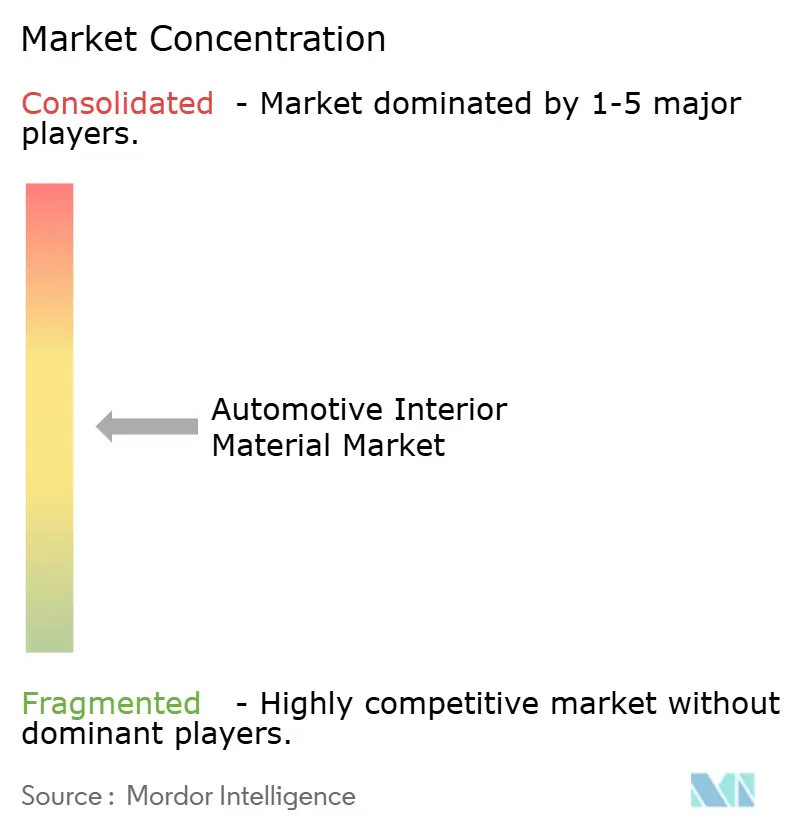
| Market Concentration | Medium |
Major Players *Disclaimer: Major Players sorted in no particular order Image © Mordor Intelligence. Reuse requires attribution under CC BY 4.0. | |
Automotive Interior Material Market Analysis by Mordor Intelligence
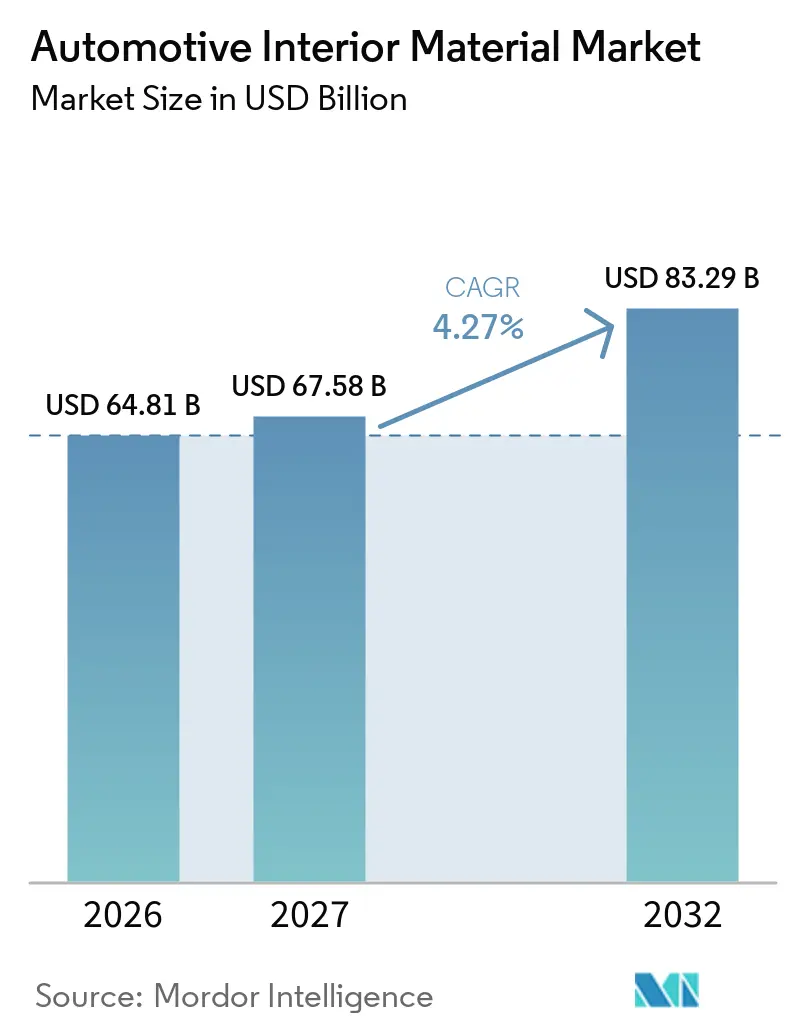
The automotive interior material market size was valued at USD 64.81 billion in 2026 and is expected to grow from USD 67.58 billion in 2027 to USD 83.29 billion by 2032, registering a CAGR of 4.27% between 2027 and 2032. The automotive interior material market is changing because interior surfaces now affect vehicle weight, cabin sound, thermal control, and digital controls. Vehicle electrification raises demand for acoustic and thermal systems designed for quieter cabins. Emissions rules also encourage lighter materials across interior components. The EU circularity rules make recycled plastic content a procurement requirement for vehicles sold in the region. These conditions favor suppliers that can qualify low-VOC, lighter, and traceable materials early in vehicle programs.
Key Report Takeaways
- By material type, polymers held 42.35% of the automotive interior material market share in 2026, while synthetic leather is projected to grow at a 6.13% CAGR through 2032.
- By application, seats accounted for 30.14% of the automotive interior material market share in 2026, while center consoles are forecast to advance at a 5.75% CAGR through 2032.
- By vehicle type, passenger cars held 82.33% of market value in 2026 and are projected to grow at a 4.86% CAGR through 2032.
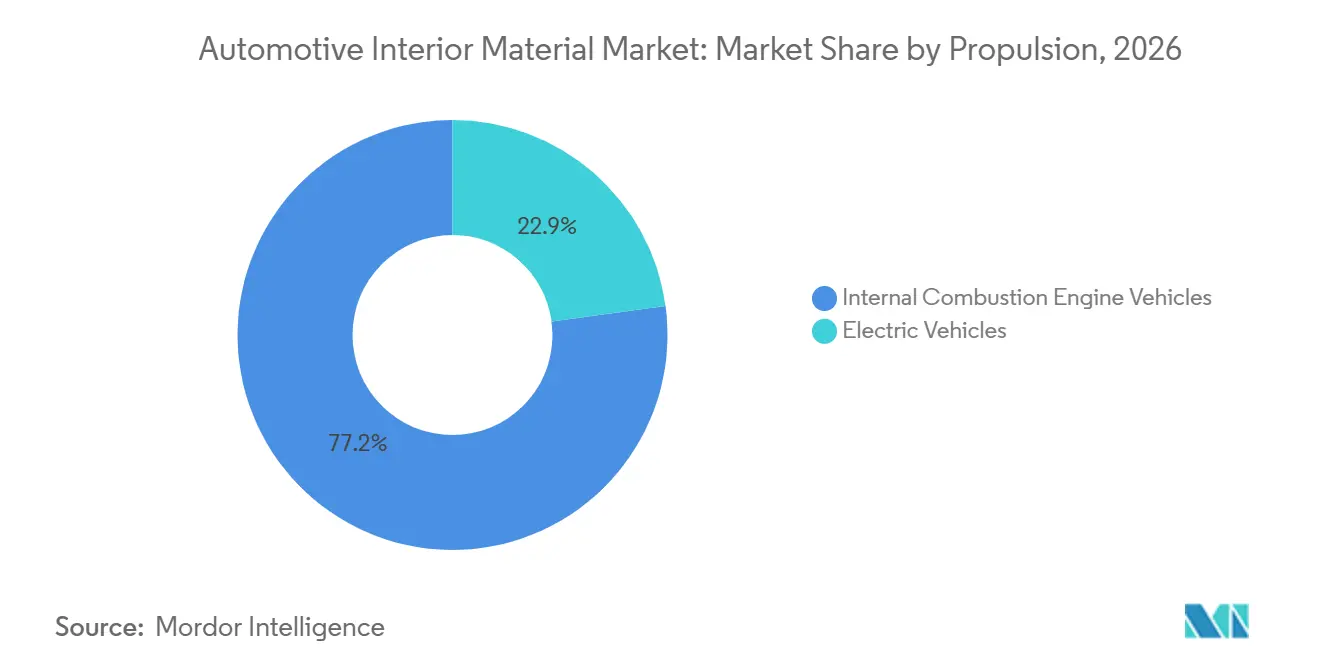
- By propulsion, ICE vehicles held 77.15% of market value in 2026, while electric vehicles are forecast to expand at an 8.55% CAGR through 2032.
- By sales channel, OEM supply held 87.24% of market value in 2026 and is projected to grow at a 4.36% CAGR through 2032.
- By geography, Asia-Pacific held 44.62% of market value in 2026 and is projected to grow at a 6.75% CAGR through 2032.
Note: Market numbers in this report are based on Mordor Intelligence's proprietary estimation framework, which combines nine months of actuals with Q4 projections for base year 2026.
Market Trends and Insights
Drivers Impact Analysis of Automotive Interior Material Market*
| Driver | (~) % Impact on CAGR Forecast | Geographic Relevance | Impact Timeline |
|---|---|---|---|
| Lightweighting and Energy-Efficiency Requirements | +1.1% | Global, highest intensity in Europe, China, and North America | Short term (≤ 2 years) |
| Premium Cabin Comfort and Material Customization | +0.9% | North America, Europe, and premium Asia-Pacific tiers | Medium term (2–4 years) |
| Electric Vehicle Cabin Redesign and Noise Management | +0.8% | China and Europe, with spillover to Southeast Asia and the Middle East and Africa | Medium term (2–4 years) |
| Recycled-Content and Circular-Material Requirements | +0.6% | Europe, with regulatory spillover to Asia-Pacific and North America | Long term (≥ 4 years) |
| Closed-Loop Material Traceability for Interior Components | +0.4% | Europe primarily, followed by Asia-Pacific and North America | Long term (≥ 4 years) |
| Smart-Surface and Functional-Material Integration | +0.4% | Global, led by Chinese OEMs and European premium brands | Medium term (2–4 years) |
| Source: Mordor Intelligence | |||
Lightweighting and Energy-Efficiency Requirements
Reducing interior mass is part of the material brief for new vehicle programs. European fleet CO2 rules, China Phase VI norms, and battery range requirements all support this direction. Engineering thermoplastics and natural-fiber composites are increasingly considered for instrument panels, door substrates, and headliners. Mono-material designs can support recycling while reducing mass compared with multi-layer laminates. A 2026 SAE paper reported a recycled polyester fiber floor decoupler with NVH performance comparable to polyurethane foam, with lower weight and carbon footprint characteristics. ISO 12219-11:2025 adds VOC characterization requirements that make material-level cabin air assessment part of these programs.
Premium Cabin Comfort and Material Customization
The automotive interior material market benefits as Chinese EV brands offer soft-touch and multi-texture interiors in vehicles priced below USD 30,000. This raises customer expectations that were previously associated with luxury sedans priced above USD 60,000. It also puts pressure on vehicle makers in other regions to improve material quality without raising vehicle prices sharply. Bio-designed leather alternatives are being developed with luxury vehicle partners. These materials can combine recycled inputs, plant proteins, and biopolymers. In November 2025, BASF and Hyundai Transys also unveiled a modular seat concept using Elastollan TPU and supercritical-fluid injection foaming to create a lightweight, low-VOC, recyclable foam without chemical blowing agents [1].
Electric Vehicle Cabin Redesign and Noise Management
Electric vehicle platforms change the acoustic demands placed on interior materials. Without engine noise, road, wind, and powertrain sounds are more noticeable to vehicle occupants. Sound packages must manage transmission loss, weight, and end-of-life separation at the same time. These combined requirements challenge conventional polyurethane foam systems. Flat-floor EV designs also increase upholstered cabin surface area across seats, doors, headliners, and flooring. The automotive interior material market therefore gains from EV growth because it requires reformulated and qualified materials rather than only additional volume.
Recycled-Content and Circular-Material Requirements
The European rules move recycled content from a voluntary claim to a vehicle design requirement. Regulation (EU) 2026/1738 requires 15% recycled plastic content for new vehicle types approved from 2032, rising to 25% by 2036. At least 20% of the recycled plastic fraction must come from end-of-life vehicles [2]. Covestro announced that its Bayblend T85X R35 CQ was adopted for selected Lexus ES interior components in June 2026. Dow and Adient commercially launched SPECFLEX REN in August 2026, using ISCC PLUS-certified renewable content attribution in seating foam. Because material qualification typically takes 18 to 24 months, suppliers and OEMs face a shorter preparation window before 2032.
Restraints Impact Analysis of Automotive Interior Material Market*
| Restraint | (~) % Impact on CAGR Forecast | Geographic Relevance | Impact Timeline |
|---|---|---|---|
| Volatility in Polymer, Leather, and Energy Costs | -0.6% | Global, with highest sensitivity in Asia-Pacific and the Middle East and Africa | Medium term (2–4 years) |
| VOC, Odor, Fogging, and Safety Qualification Requirements | -0.5% | Global, with stringent rules in China, Europe, Japan, and South Korea | Medium term (2–4 years) |
| Inconsistent Quality of Recycled Interior Feedstocks | -0.4% | Europe and Asia-Pacific, with spillover to North America | Long term (≥ 4 years) |
| Multi-Material Bonding and End-of-Life Separation Constraints | -0.3% | Europe primarily, with rising relevance globally | Long term (≥ 4 years) |
| Source: Mordor Intelligence | |||
Volatility in Polymer, Leather, and Energy Costs
Polypropylene, polyurethane precursors, and PVC are important feedstocks for interior polymers. Their costs can move with crude oil prices and energy tariffs rather than vehicle production schedules. Material pricing can therefore diverge from the fixed pricing in OEM supply agreements. Leather costs face separate pressure where lower beef consumption reduces hide availability in developed markets. Tier-1 suppliers can bear a large share of this risk because vehicle programs often lock material pricing for 3 to 5 years. This encourages lower-cost material substitution where suppliers cannot pass through input cost changes.
VOC, Odor, Fogging, and Safety Qualification Requirements
Cabin-air requirements add cost and time to material launches in the automotive interior material market. The REACH formaldehyde restriction sets a limit of 0.062 mg/m3 for new vehicle models placed on the European market after August 6, 2027 [3]. VDA 275, revised in July 2025, updates the formaldehyde test method for molded interior composites. GM, Volkswagen, and other OEMs also use company-specific cabin air and odor requirements. These separate approval programs can extend material introduction timelines by 6 to 18 months.
*Our forecasts treat driver/restraint impacts as directional, not additive. The impact forecasts reflect baseline growth, mix effects, and variable interactions.
Automotive Interior Material Market Segment Analysis
By Material Type:
Synthetic Leather Expands as EV Cabin Preferences ChangePolymers commanded 42.35% of the automotive interior material market share in 2026. Polypropylene, ABS, polyurethane, PVC, and polycarbonate serve many components across the cabin. Their broad use reflects mechanical strength, molding flexibility, finish options, and established supplier capability. Genuine leather remains important in premium programs, where its visual and tactile position remains valuable. It faces pressure from synthetic alternatives and from increased attention to tanning chemistry and formaldehyde emissions. Composites, fabrics, metals, wood trim, and natural fibers remain relevant where acoustic, visual, or tactile requirements justify their use.
Synthetic leather is forecast to be the fastest-growing material segment, with a forecast CAGR of 6.13% from 2027 to 2032. The automotive interior material market size for synthetic leather is growing as EV makers specify non-animal and low-VOC surface materials. Leather-free cabin strategies support demand for PU-based alternatives that can provide consistent appearance and processability. EV cabins also use wider, more continuous visual surfaces, which favor seamless soft-touch coverings. Suppliers must still meet durability, odor, abrasion, and heat-aging requirements before material adoption. The faster growth rate therefore reflects both design preference and the need for approved performance characteristics.
By Application:
Seats Remain Largest While Center Consoles Grow FastestSeats held 30.14% of the automotive interior material market share in 2026. A seat combines foam, trim covers, structural materials, and acoustic backing in a component that is highly visible to vehicle occupants. Each vehicle platform requires fresh seat material specifications, which maintains the importance of this application. In January 2026, FORVIA secured over USD 1 billion in new and extended business from a major European automaker across its Seating, Interiors, and Lighting groups, including complete seats, instrument panels, and natural-fiber door panels for North American production. The program shows that material sustainability is becoming part of mainstream tier-1 sourcing decisions.
Center consoles are projected to grow at a 5.75% CAGR between 2027 and 2032. Their role is changing from storage space to an important interaction area in EV cockpit layouts. This shift increases demand for decorative films, sensor-ready surfaces, tactile materials, and lighting integration. Antolin and UltraSense agreed in November 2024 to co-develop smart-surface HMI controls for panels, center consoles, and door controls. KURZ presented a Smart Display Center Console using rPET-based technical textile and capacitive multi-touch sensors at IAA 2025. These examples show why center consoles require materials that combine appearance, sensing, and durability.
By Vehicle Type:
Passenger Cars Set Demand PatternsPassenger cars held 82.33% of market value in 2026 and are projected to grow at a 4.86% CAGR. This position reflects the global vehicle production mix and the high material content used in consumer-facing vehicles. The automotive interior material industry depends heavily on passenger car launches because they drive broad interior refresh cycles. Material spend per passenger vehicle varies by brand position and vehicle size. The gap between volume and premium material spending is narrowing as Chinese new-energy vehicle makers improve cabin specifications in high-volume models. This raises average interior material content without limiting change to traditional luxury models.
Light commercial vehicles and medium-and-heavy commercial vehicles together accounted for a substantial share of market value in 2026. Their material choices prioritize durability, cleaning, and serviceability more than visual customization. LCV demand can rise as logistics fleets electrify and fleet operators require hard-wearing shared-mobility surfaces. Antimicrobial properties and wear resistance can become more important in these uses. Covestro’s Desmopan AIR TPU illustrates materials aimed at shared-mobility seating applications. The category remains smaller, yet it can absorb materials first developed for passenger vehicles where operating conditions require longer service life.
By Propulsion:
Electric Vehicles Raise Interior Content RequirementsICE vehicles held 77.15% of market value in 2026. They are expected to retain a significant share of volume during the forecast period, especially in South America, Southeast Asia, and Africa. Suppliers serving these platforms are adding recycled-content and low-odor improvements ahead of European compliance deadlines. This creates parallel qualification work across ICE and EV programs. Suppliers with limited technical resources can face difficult choices between legacy vehicle applications and future EV platforms. The automotive interior material market is expected to retain an important ICE base while EV programs capture more development attention.
Electric vehicles are forecast to grow at an 8.55% CAGR from 2027 to 2032. This is the highest growth rate among propulsion segments in the automotive interior material market. EVs require added acoustic treatment because the absence of engine masking noise exposes road and wind sounds. Cell-to-chassis architectures need a 5 to 40 dB improvement in sound transmission loss between 200 and 2,000 Hz compared with cell-to-pack layouts. Lightweight composites and premium surfaces also support vehicle range, cabin comfort, and visual differentiation. These requirements increase the need for specialized material formulation and validation.
By Sales Channel:
OEM Programs Provide Scale and Aftermarket Provides FlexibilityOEM supply accounted for 87.24% of market value in 2026 and is projected to expand at a 4.36% CAGR. The OEM channel is protected by VOC testing, mechanical approval, and company-specific vehicle interior air quality standards. Once a material grade is approved, switching suppliers can take time and can involve repeat validation. Vehicle programs commonly run for 5 to 7 years, supporting demand visibility after qualification. Recycled-content rules are likely to affect OEM supply first because vehicle makers must document compliance at the program level.
The aftermarket offers opportunities for synthetic leather, fabrics, carpets, and replacement trim with different pricing and margin conditions. This channel has fewer formal approval barriers than direct OEM supply. It may also face greater scrutiny where untested materials create cabin-air or odor concerns. Demand remains relevant in regions with older vehicle fleets and active repair markets. Its smaller scale does not remove its value as a channel for replacement, customization, and basic interior refurbishment.
Geography Analysis
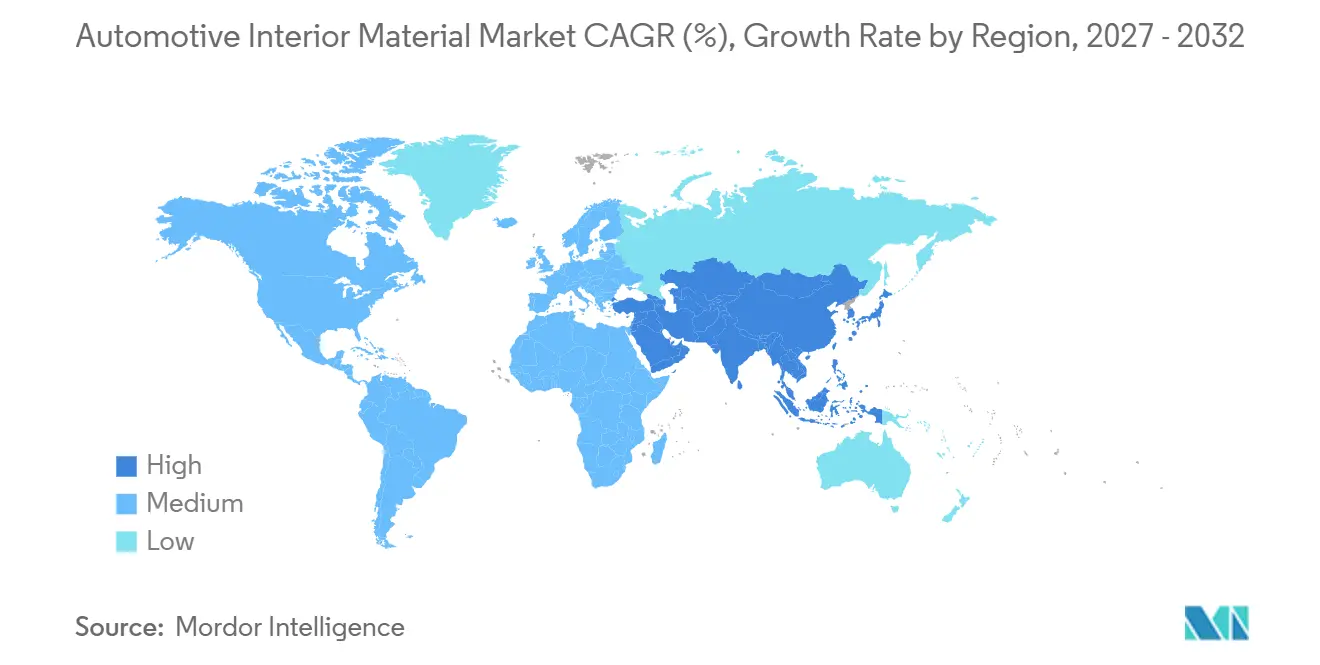
Asia-Pacific held 44.62% of the automotive interior material market share in 2026 and is forecast to grow at a 6.75% CAGR through 2032. The region combines high vehicle output with rapid adoption of EV cabin design features. Chinese brands such as BYD, NIO, Geely, and SAIC source premium synthetic leather, low-VOC polymer compounds, and smart-surface materials at high volumes. This demand changes capacity planning for tier-1 suppliers. Regional suppliers are advancing lower-carbon TPU options for automotive applications. Japan and South Korea contribute advanced sensor-integrated modules and high-grade synthetic leather for export programs.
India adds demand as tier-1 suppliers establish manufacturing capacity ahead of projected vehicle production growth. Europe remains highly influential because premium vehicle programs are concentrated in Germany, France, Italy, and the United Kingdom. European requirements shape adhesive, foam, and polymer reformulation across global supply chains. BMW reported that secondary materials account for one-third of the total material used in the iX3.
North America is supported by high interior content per vehicle in the United States and Canada, alongside a substantial tier-1 manufacturing base in Mexico. Toyota Boshoku opened its USD 225 million Western Kentucky (TBWK) smart plant in Hopkinsville in December 2025 to produce seat-frame mechanism parts. South America remains more aftermarket-focused, with Brazil and Argentina supporting polymer, fabric, and basic leather demand in ICE-dominant fleets. Premium material uptake is constrained by purchasing power. The Middle East and Africa remain early-stage opportunities as Saudi Arabia and the United Arab Emirates import more premium vehicles. South Africa and Egypt support regional aftermarket supply chains.
Competitive Landscape
The automotive interior material market is moderately concentrated among tier-1 integrators and fragmented among raw material suppliers. This structure distributes pricing power across chemical producers, compounders, component makers, and vehicle suppliers. BASF, Covestro, Dow, SABIC, LyondellBasell, Teijin, and Toray compete on formulations and certified sustainability credentials. Price remains important, but material approval and engineering support can be more decisive. The 18- to 36-month OEM qualification cycle encourages co-development relationships. Once a grade is qualified, that relationship can create a more durable revenue position for the supplier.
Suppliers are expanding recycled-content portfolios and pursuing closed-loop material programs. Covestro developed a polycarbonate program using material from end-of-life headlamps with Volkswagen and NIO. The program uses material performance and traceability to raise switching costs beyond a basic price comparison. Antolin and UltraSense are developing integrated smart-surface controls for a global vehicle platform. These actions show how suppliers are combining material development with system integration.
The leading suppliers are also positioning in high-growth locations and in design areas where qualification barriers are high. Traceable recycled-content materials that meet acoustic and VOC requirements remain an opening in the mid-volume vehicle segment. Bio-designed leather alternatives and polyolefin-based leather replacements also broaden competition in surface materials. The European circularity rules make certified recycled-content traceability more important during material qualification. The automotive interior material market therefore rewards suppliers that can provide technical validation, secure feedstocks, and documentation together.
Automotive Interior Material Industry Leaders
-
BASF SE
-
Covestro AG
-
Dow Inc.
-
SABIC
-
LyondellBasell Industries N.V.
- *Disclaimer: Major Players sorted in no particular order
Automotive Interior Material Market Companies Covered in this Report
- BASF SE
- Covestro AG
- Dow Inc.
- SABIC
- LyondellBasell Industries N.V.
- DuPont de Nemours, Inc.
- Toray Industries, Inc.
- Asahi Kasei Corporation
- Kuraray Co., Ltd.
- Teijin Limited
- Borouge International
- Continental AG
- Seiren Co., Ltd.
- Bader GmbH
- Lear Corporation
- Adient plc
- FORVIA SE
- Yanfeng Automotive Interiors
Recent Industry Developments in Automotive Interior Material Market
- August 2026: Dow and Adient commercially launched SPECFLEX REN, an ISCC PLUS-certified bio-circular polyurethane seating foam that uses mass-balance-attributed renewable feedstocks.
- June 2026: Covestro’s Bayblend T85X R35 CQ polycarbonate blend, with 35% post-consumer recycled content, was adopted for visible Lexus ES interior components developed with Toyota, Toyota Motor Kyushu, and Kojima Industries.
- May 2026: Teknor Apex launched Crealen R, a recycled polypropylene compound line with up to 70% post-consumer recycled content for visible and semi-visible interior trim and HVAC parts.
- February 2026: Adient launched Sculpted Soft Trim, a seat-trim product offering new design options, with several OEMs expected to adopt it in 2026-production vehicles.
- January 2026: FORVIA secured over USD 1 billion in new and extended business from a major European automaker across its Seating, Interiors, and Lighting groups, including complete seats, instrument panels, and natural-fiber door panels.
Global Automotive Interior Material Market Report Scope
The scope includes segmentation by material type (polymers (polypropylene, acrylonitrile butadiene styrene, polyurethane, polyvinyl chloride, polycarbonate), genuine leather, synthetic leather, fabrics/textiles, composites, and others (metals, wood, and natural fibers)), application (dashboard/instrument panel, seats, door panels and trim, headliners, floor covering and carpets, center console, pillars and trim, and other applications), vehicle type (passenger cars, light commercial vehicles, and medium and heavy commercial vehicles), propulsion type (internal combustion engine vehicles and electric vehicles), and sales channel (original equipment manufacturer and aftermarket). The analysis also covers regional-level segmentation, including North America, Europe, Asia-Pacific, South America, and the Middle East and Africa. Market size and growth forecasts are presented by value in USD.
Segmentation Overview
| Polymers | Polypropylene |
| Acrylonitrile Butadiene Styrene | |
| Polyurethane | |
| Polyvinyl Chloride | |
| Polycarbonate | |
| Genuine Leather | |
| Synthetic Leather | |
| Fabrics/Textiles | |
| Composites | |
| Others | Metals |
| Wood | |
| Natural Fibers |
| Dashboard/Instrument Panel |
| Seats |
| Door Panels and Trim |
| Headliners |
| Floor Covering and Carpets |
| Center Console |
| Pillars and Trim |
| Other Applications |
| Passenger Cars |
| Light Commercial Vehicles |
| Medium and Heavy Commercial Vehicles |
| Internal Combustion Engine Vehicles |
| Electric Vehicles |
| Original Equipment Manufacturer |
| Aftermarket |
| North America | United States |
| Canada | |
| Rest of North America | |
| Europe | Germany |
| France | |
| Italy | |
| Spain | |
| United Kingdom | |
| Russia | |
| Rest of Europe | |
| Asia-Pacific | China |
| Japan | |
| India | |
| South Korea | |
| Thailand | |
| Indonesia | |
| Rest of Asia-Pacific | |
| South America | Brazil |
| Argentina | |
| Colombia | |
| Rest of South America | |
| Middle East and Africa | Turkey |
| Saudi Arabia | |
| United Arab Emirates | |
| Iran | |
| South Africa | |
| Egypt | |
| Rest of Middle East and Africa |
| By Material Type | Polymers | Polypropylene |
| Acrylonitrile Butadiene Styrene | ||
| Polyurethane | ||
| Polyvinyl Chloride | ||
| Polycarbonate | ||
| Genuine Leather | ||
| Synthetic Leather | ||
| Fabrics/Textiles | ||
| Composites | ||
| Others | Metals | |
| Wood | ||
| Natural Fibers | ||
| By Application | Dashboard/Instrument Panel | |
| Seats | ||
| Door Panels and Trim | ||
| Headliners | ||
| Floor Covering and Carpets | ||
| Center Console | ||
| Pillars and Trim | ||
| Other Applications | ||
| By Vehicle Type | Passenger Cars | |
| Light Commercial Vehicles | ||
| Medium and Heavy Commercial Vehicles | ||
| By Propulsion | Internal Combustion Engine Vehicles | |
| Electric Vehicles | ||
| By Sales Channel | Original Equipment Manufacturer | |
| Aftermarket | ||
| By Geography | North America | United States |
| Canada | ||
| Rest of North America | ||
| Europe | Germany | |
| France | ||
| Italy | ||
| Spain | ||
| United Kingdom | ||
| Russia | ||
| Rest of Europe | ||
| Asia-Pacific | China | |
| Japan | ||
| India | ||
| South Korea | ||
| Thailand | ||
| Indonesia | ||
| Rest of Asia-Pacific | ||
| South America | Brazil | |
| Argentina | ||
| Colombia | ||
| Rest of South America | ||
| Middle East and Africa | Turkey | |
| Saudi Arabia | ||
| United Arab Emirates | ||
| Iran | ||
| South Africa | ||
| Egypt | ||
| Rest of Middle East and Africa | ||
Key Questions Answered in the Report
How large is the automotive interior material market?
The market was valued at USD 64.81 billion in 2026 and is forecast to grow from USD 67.58 billion in 2027 to USD 83.29 billion by 2032, at a 4.27% CAGR.
Which material category leads automotive interiors?
Polymers lead with 42.35% share in 2026, while synthetic leather is forecast to be the fastest-growing material at a 6.13% CAGR through 2032.
Why are electric vehicles important for interior material suppliers?
Electric vehicles are forecast to grow at an 8.55% CAGR and need enhanced acoustic, lightweight, and premium surface solutions.
Which region leads automotive interior material demand?
Asia-Pacific held 44.62% of 2026 market value and is forecast to record the highest regional growth rate, a 6.75% CAGR through 2032.