
Automotive Injector Nozzle Market Size and Share
Market Overview
| Study Period | 2020 - 2032 |
|---|---|
| Market Size (2027) | USD 6.59 Billion |
| Market Size (2032) | USD 7.62 Billion |
| Growth Rate (2027 - 2032) | 2.94 % |
| Fastest Growing Market | Asia-Pacific |
| Largest Market | Asia-Pacific |
| Market Concentration | Medium |
Major Players *Disclaimer: Major Players sorted in no particular order Image © Mordor Intelligence. Reuse requires attribution under CC BY 4.0. | |
Automotive Injector Nozzle Market Analysis by Mordor Intelligence
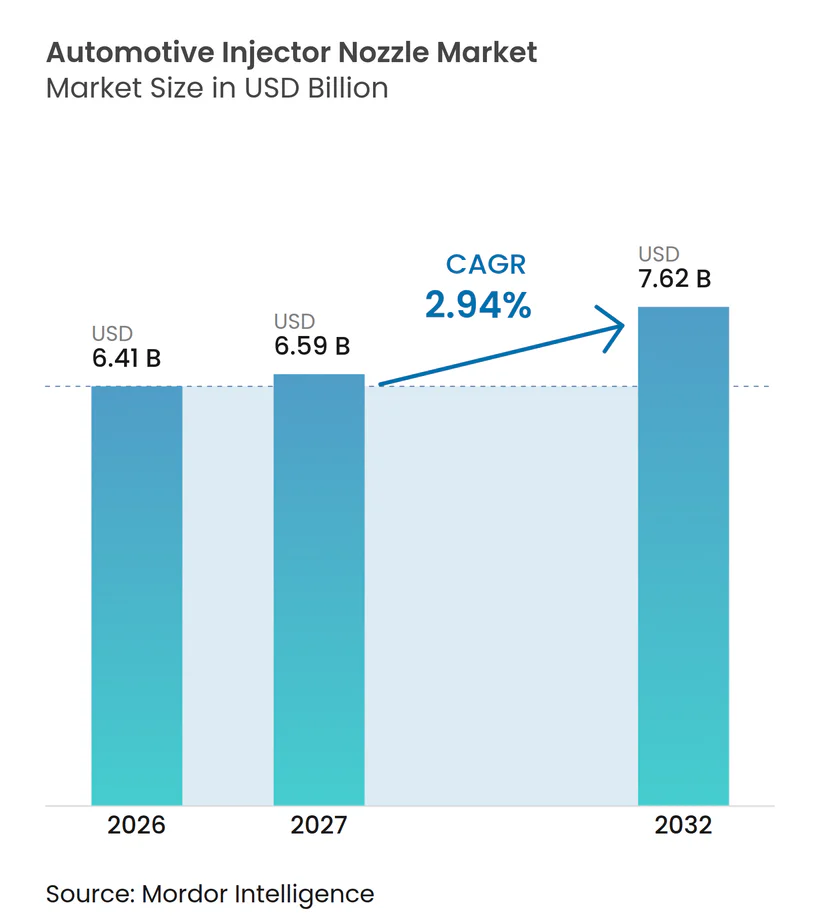
The automotive injector nozzle market size was valued at USD 6.41 billion in 2026 and is expected to grow from USD 6.59 billion in 2027 to USD 7.62 billion by 2032, at a CAGR of 2.94% during 2027-2032. The automotive injector nozzle market is moving toward higher-value components because emission rules require more accurate fuel delivery and more durable nozzle designs. Battery-electric vehicles reduce the long-term pool of engines that use injectors, yet hybrid vehicles retain complete fuel injection systems and continue to support demand. Global electric-car sales exceeded 20 million units in 2025 and are projected to reach 23 million units in 2026, making electrification a material constraint on future gasoline nozzle volumes. At the same time, tighter rules in Europe and China are increasing the technical specifications of remaining internal-combustion programs, which supports selling prices and replacement value. The automotive injector nozzle market therefore depends less on unit growth alone and more on precision, compliance, and the durability of the installed vehicle base.
Key Report Takeaways
- By nozzle type, multi-hole nozzles held a 65.45% share in 2026, while pintle nozzles are projected to grow at a 3.91% CAGR through 2032.
- By fuel type, gasoline held a 72.37% share in 2026, while diesel is projected to grow at a 4.05% CAGR through 2032.
- By injection technology, gasoline direct injection held a 51.80% share in 2026 and is projected to grow at a 4.10% CAGR through 2032.
- By vehicle type, passenger cars held a 73.90% share in 2026, while light commercial vehicles are projected to grow at a 4.24% CAGR through 2032.
- By sales channel, OEM held an 85.55% share in 2026, while the aftermarket is projected to grow at a 4.03% CAGR through 2032.
- By geography, Asia-Pacific held a 46.50% share in 2026 and is projected to grow at a 3.98% CAGR through 2032.
Note: Market numbers in this report are based on Mordor Intelligence's proprietary estimation framework, which combines nine months of actuals with Q4 projections for base year 2026.
Market Trends and Insights
Drivers Impact Analysis of Automotive Injector Nozzle Market*
| Driver | (~) % Impact on CAGR Forecast | Geographic Relevance | Impact Timeline |
|---|---|---|---|
| Tightening emission limits increase precision nozzle content per engine | +1.0% | Europe, China, India, with global spill-over | Short term (≤ 2 years) |
| High-pressure GDI and common rail adoption expands replacement value | +0.7% | Global, led by Asia-Pacific, Europe and North America | Medium term (2–4 years) |
| Vehicle parc aging sustains injector nozzle aftermarket demand | +0.6% | North America, Europe, mature Asia-Pacific markets | Medium term (2–4 years) |
| Asia-Pacific vehicle production supports high unit demand | +0.5% | China, India, ASEAN | Short term (≤ 2 years) |
| Alternative-fuel engine programs create new nozzle architectures | +0.3% | India (CNG), Brazil (ethanol), Global (H₂) | Long term (≥ 4 years) |
| Calibration and spray-pattern optimization improve fuel economy | +0.2% | Global, premium segments first | Medium term (2–4 years) |
| Source: Mordor Intelligence | |||
Tightening Emission Limits Increase Precision Nozzle Content per Engine
Euro 7 type approval starts in November 2026 for new M1 and N1 vehicle types under Regulation (EU) 2024/1257. The rule introduces a particle-number requirement for particles above 10 nm, which places greater emphasis on fuel atomization and consistent injection events. In the automotive injector nozzle market, this requirement supports multi-hole geometries and fine orifice control in GDI applications. A 2025 SAE study reported more than 90% soot reduction at the same nitrogen oxide level in a Euro VII-compliant light-commercial diesel concept that used optimized nozzle geometry [1]. China also raised the technical requirement for electronically controlled common rail diesel injectors through GB/T 25367-2024, which took effect in April 2025. These requirements raise the qualification threshold for suppliers and favor components that can maintain accurate spray performance over a longer operating life.
High-Pressure GDI and Common Rail Adoption Expands Replacement Value
GDI systems operate at materially higher pressure than port fuel injection systems, making the nozzle, needle, and valve-seat assembly more demanding to produce. The automotive injector nozzle market benefits when higher pressure leads to stronger materials, laser-drilled holes, and more extensive testing requirements. Stanadyne stated that BMW B58 Gen 2 applications can support 350-bar GDI system pressure, showing the specification increase within a current engine family [2]. These designs require controlled spray patterns to support combustion efficiency and lower particulate output. Precision requirements also make replacement parts more valuable than legacy PFI components. Suppliers with established machining and validation capability can retain an advantage as OEMs move to demanding direct-injection systems.
Vehicle Parc Aging Sustains Injector Nozzle Aftermarket Demand
An aging vehicle fleet extends demand for replacement fuel-system parts even as new vehicle production changes. Deposits on injector tips and wear at the seat can reduce spray quality, particularly in direct-injection engines where the tip faces combustion-chamber temperatures. The automotive injector nozzle market gains aftermarket demand when repair decisions favor tested components that restore calibrated fuel delivery. GDI fouling can be more damaging than port-injection fouling because deposits alter the spray pattern at the nozzle outlet. This makes diagnosis, coding, and flow testing more important for independent repair providers. It also makes low-cost substitutes less attractive in applications where poor atomization may affect drivability, fuel use, or emissions compliance.
Asia-Pacific Vehicle Production Supports High Unit Demand
Asia-Pacific combines high vehicle production with a broad installed base of gasoline, diesel, CNG, and hybrid vehicles. This keeps the automotive injector nozzle market exposed to both original-equipment demand and replacement demand. Alternative-fuel programs add another source of product development because gaseous fuels and hydrogen require different fuel delivery approaches from liquid gasoline or diesel. PHINIA reported first-quarter 2026 program wins for a CNG fuel rail assembly in India, a jet fuel direct injector for drone engines, and a direct-injection fuel rail for a dual-fuel V8 SUV in China. PROTON also described plans for an advanced powertrain hub in Malaysia, indicating continuing regional investment in powertrain capabilities. These programs give suppliers a route to develop specialized nozzle architectures while conventional engines remain important in regional fleets.
Restraints Impact Analysis of Automotive Injector Nozzle Market*
| Restraint | (~) % Impact on CAGR Forecast | Geographic Relevance | Impact Timeline |
|---|---|---|---|
| Battery-electric vehicle penetration erodes long-term ICE nozzle volumes | -0.8% | China, Europe; spill-over to North America | Short term (≤ 2 years) |
| Extreme pressure and tight tolerances raise manufacturing cost | -0.3% | Global, concentrated in mid-tier suppliers | Medium term (2–4 years) |
| Fuel contamination and deposit formation increase warranty and recall risk | -0.2% | Emerging markets: Brazil, India, Middle East and Africa | Medium term (2–4 years) |
| Platform consolidation and regional compliance complexity lengthen validation cycles | -0.2% | Global, concentrated in Asia-Pacific and Europe | Long term (≥ 4 years) |
| Source: Mordor Intelligence | |||
Battery-Electric Vehicle Penetration Erodes Long-Term ICE Nozzle Volumes
Battery-electric vehicles do not use fuel injectors, so their adoption directly reduces the long-term unit opportunity for nozzle suppliers. The IEA reported that electric-car sales exceeded 20 million in 2025 and are expected to reach 23 million in 2026. China and Europe face the strongest near-term exposure because electric vehicle adoption is more advanced in those markets. The automotive injector nozzle market still receives support from hybrid systems because they retain an internal-combustion engine and a full injection system. U.S. data showed that hybrid vehicles represented 16% of new light-duty sales in the third quarter of 2026, compared with 6% for battery-electric vehicles. The longer-term risk rises as lower-priced battery-electric models expand into passenger-car segments that have historically driven gasoline nozzle volume.
Extreme Pressure and Tight Tolerances Raise Manufacturing Cost
High-pressure injection requires tightly controlled manufacturing processes and extensive testing. Laser drilling, multi-axis machining, precision grinding, coatings, and flow testing add capital and operating cost to production. The automotive injector nozzle market faces margin pressure when input costs for specialty alloys or coatings increase during fixed-price OEM programs. More complex regional compliance rules also lengthen product validation, especially when a supplier supports several engine platforms across China, Europe, and India. The Chinese GB/T 25367-2024 standard raises the technical floor for common rail injector assemblies and makes lower-specification production less viable. These conditions can limit capacity expansion among smaller suppliers and make quality failures more expensive where fuel contamination or deposit formation is common.
*Our forecasts treat driver/restraint impacts as directional, not additive. The impact forecasts reflect baseline growth, mix effects, and variable interactions.
Automotive Injector Nozzle Market Segment Analysis
By Nozzle Type:
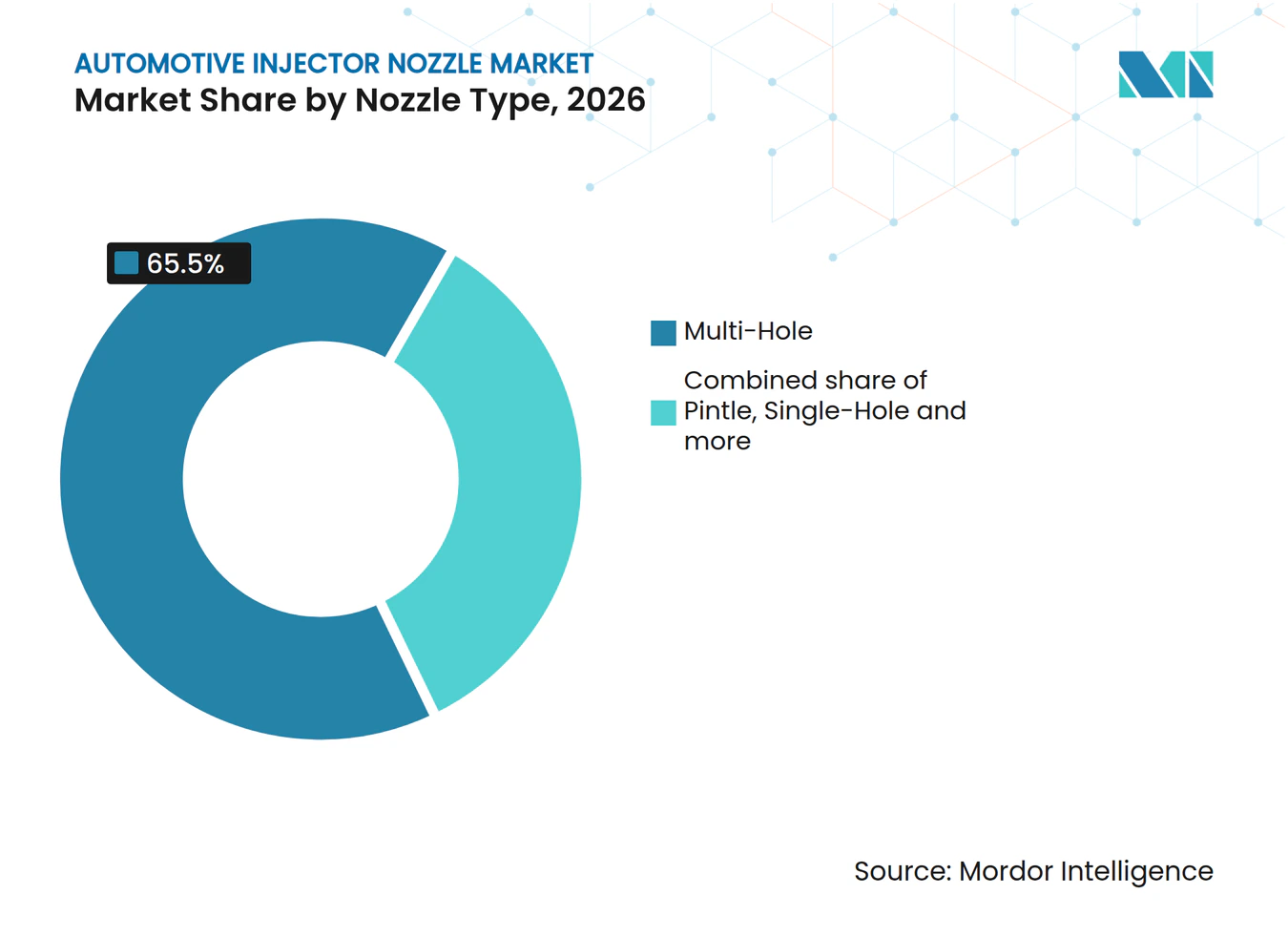
Multi-Hole Geometry Defines the Mass MarketMulti-hole nozzles held 65.45% of the automotive injector nozzle market share in 2026. Their leading position reflects their use in GDI gasoline and common rail diesel applications, where several small orifices improve atomization. Fine atomization helps reduce soot and particulate formation under stricter emissions requirements. The number, angle, and diameter of the holes determine the fuel plume and its interaction with air in the cylinder. This gives multi-hole products a broad role across modern passenger and commercial engines. The format also fits high-pressure designs that require repeatable performance over many injection cycles. The design must balance penetration, droplet size, and wall-wetting risk within a tight packaging space. Manufacturers also validate the hole pattern against the injector body, combustion chamber, and control software. Small changes in geometry can alter performance when pressure, fuel properties, or engine load changes. This makes the segment dependent on close coordination between nozzle producers and engine-development teams.
Single-hole nozzles remain relevant for legacy PFI and some smaller-engine applications, but their addressable volume declines as direct injection expands. Pintle nozzles are projected to grow at 3.91% through 2032, the fastest rate within the type segment. Their spray-cone geometry can suit alternative-fuel engines where the behavior of gaseous fuel differs from liquid hydrocarbons. The automotive injector nozzle industry continues to evaluate outward-opening pintle-style designs for hydrogen applications, although they remain a small part of current volume. Hydrogen concepts require careful mixture preparation because the fuel is delivered in a different state from gasoline or diesel. These requirements give pintle architectures a role in ongoing product development. Swirl and variable-geometry products serve specialized engine applications and remain lower-volume categories. Their value lies in applications where a particular combustion pattern matters more than broad unit scale. Suppliers typically treat these designs as targeted engineering programs rather than high-volume standardized products. Their future depends on the commercial progress of alternative-fuel engines and related fueling systems.



By Fuel Type:
Gasoline Leads, Diesel Rebound Driven by Commercial Fleet ComplianceGasoline nozzles accounted for 72.37% of revenue in 2026. Passenger cars form the largest base for gasoline injection systems, and the shift toward GDI raises the technical content of each nozzle. Higher-pressure gasoline systems require closely controlled spray patterns to support efficient combustion. Brazil’s PROCONVE L-8 rules are expected to broaden the use of direct injection in new cars, supporting a new demand pool for gasoline components. This creates an opportunity for suppliers that can localize production and meet regional validation requirements. Gasoline remains central to the automotive injector nozzle market because many hybrid systems also use gasoline engines. It also gives suppliers a large replacement base across existing passenger-car fleets. The installed base continues to require service parts long after original vehicle production slows. GDI applications generally place more importance on tip cleanliness and calibrated spray than older port-injection systems. These characteristics support demand for tested replacement components and specialized service capability.
Diesel nozzles are forecast to grow at 4.05% through 2032, the highest rate in the fuel-type segment. Commercial fleets in South and Southeast Asia continue to require durable diesel powertrains for freight and utility work. Tighter nitrogen oxide limits raise demand for precise pilot, main, and post-injection events. China’s revised common rail injector standard supports replacement of older, lower-specification assemblies. Diesel systems need consistent performance under sustained load and repeated operating cycles. This supports demand for durable components with controlled flow characteristics. Alternative fuels remain a smaller category, but CNG, ethanol blends, and hydrogen create different nozzle design requirements. Their progress depends on fuel infrastructure, vehicle programs, and reliable validation of long-term component performance. Each fuel type changes the balance between materials, sealing, spray formation, and calibration. Suppliers therefore need product portfolios that address more than a single conventional fuel system.
By Injection Technology:
Gasoline Direct Injection Leads Share and GrowthGDI held a 51.80% revenue share in 2026 and is the largest technology in the automotive injector nozzle market. It places fuel directly in the combustion chamber and gives engine designers more control over combustion timing and mixture formation. The technology supports tighter fuel metering and higher compression strategies in many gasoline engines. Euro 7 requirements reinforce the need for controlled particulate performance in new vehicle types. GDI also requires more demanding nozzle construction than conventional port injection. That higher component content supports revenue even where vehicle output is under pressure. The technology is closely linked to the broader shift toward precision combustion control. It requires suppliers to manage high pressure, heat exposure, deposits, and repeatable flow. These demands create a greater gap between basic hardware and qualified OEM-grade components. They also increase the importance of testing throughout development and service life.
GDI is also projected to grow at 4.10% through 2032, the fastest rate among injection technologies. PFI is projected to grow at 2.40% through 2032, as many gasoline engines use both technologies to manage performance and intake-valve deposit concerns. The two systems can increase injector content per engine rather than replace one another completely. This dual-system approach allows manufacturers to use different fuel-delivery modes across operating conditions. It also creates demand for two distinct injector sets within a single powertrain. Common rail diesel remains important in commercial vehicles that need accurate multi-stage fuel delivery. Advanced piezoelectric and fast-switching solenoid systems support repeatable injection events under high pressure. These systems make control strategy and hardware selection closely connected. Other technologies, including hydrogen direct injection and HCCI-related concepts, remain small but attract research because they could require different nozzle architectures. Their impact will depend on whether those powertrains move from development programs into sustained production.
By Vehicle Type:
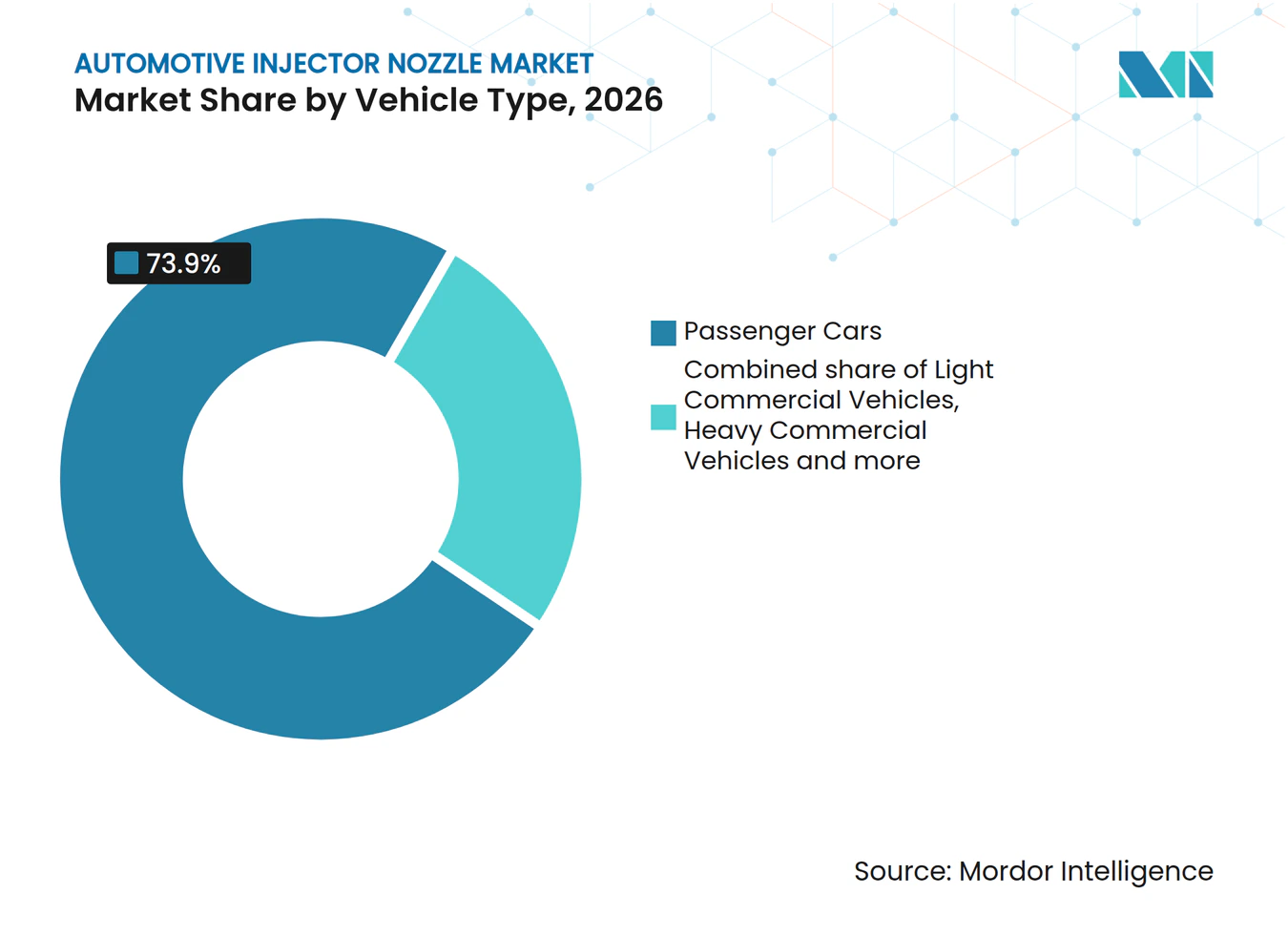
Passenger Cars Anchor Volume, LCVs Drive GrowthPassenger cars held a 73.90% revenue share in 2026, making them the largest vehicle-type base. Their scale reflects the global stock of gasoline, hybrid, and diesel passenger vehicles that use fuel injection. The automotive injector nozzle market is exposed to passenger-car electrification, particularly in China and Europe. Yet hybrid vehicle sales remain meaningful because each hybrid powertrain keeps an internal-combustion fuel system. U.S. third-quarter 2026 data showed hybrids at 16% of new light-duty sales. This gives suppliers continued access to passenger-car programs even as battery-electric adoption changes the mix. Passenger vehicles also create a large pool of out-of-warranty repairs as their fleets age. Replacement demand depends on the condition of the fuel system, local fuel quality, and the availability of qualified repair services. The mix between battery-electric, hybrid, and conventional vehicles will determine the pace of volume change. Suppliers with exposure to hybrid platforms can manage this transition more effectively.
Light commercial vehicles are projected to expand at 4.24% through 2032, the highest rate among vehicle types. Delivery, service, and regional freight fleets require payload and range that can keep combustion engines in use, especially in emerging markets. Diesel common rail systems remain important in these applications because they enable precise fuel delivery under high load. A 2025 SAE paper demonstrated the emissions potential of optimized diesel nozzle geometry in light-commercial vehicle combustion systems. Heavy commercial vehicles continue to demand durable nozzles for repeated injection events. Two-wheelers remain a high-volume Asia-Pacific application where emissions rules can increase the value of each fuel-system component. LCV operators also place importance on uptime, which makes consistent injector performance commercially important. Service intervals and fuel quality can affect replacement patterns more than in lightly used passenger vehicles. Fleet applications therefore support demand for parts that combine durability with accurate calibration. This maintains a practical role for precision diesel and alternative-fuel systems in the wider vehicle mix.

By Sales Channel:
OEM Commands Revenue, Aftermarket Builds Structural MomentumOEM captured 85.55% revenue share in 2026. The channel dominates because nozzle design is closely linked to the engine, injector body, calibration, and emissions certification process. Major vehicle programs often require long qualification cycles and stable supply relationships. The automotive injector nozzle market therefore has high entry barriers in original equipment. Suppliers must demonstrate consistent flow, leakage, durability, and spray performance before winning a program. This favors established Tier 1 companies and specialized precision manufacturers with proven validation capability. It also reduces the ability of new suppliers to compete solely on unit price. The commercial value of an OEM win extends beyond initial production because it can create replacement-part opportunities. Long program cycles can provide predictable demand, but they also require early investment in engineering and testing. Suppliers must balance that investment against the risk of shorter combustion-engine program lives.
The aftermarket is forecast to grow at 4.03% through 2032, the fastest channel rate. Direct-injection nozzle faults often require diagnostic work, coding, and spray-pattern checks before installation. This increases the value of repair networks that can test parts and confirm correct calibration. PHINIA reported two new European aftermarket customers and an expanded propulsion-agnostic aftermarket program in Asia-Pacific in its first-quarter 2026 results. Independent distributors are adding digital readers and test benches as direct-injection service becomes more complex. The channel can reduce reliance on new vehicle programs for suppliers that develop reliable replacement offerings. It also allows suppliers to serve vehicle fleets that remain in use after an OEM program ends. Product traceability and accurate coding become more important where a wrong part can affect engine performance. The channel favors companies that combine component supply with training and technical support. These factors raise the service standard for complex direct-injection repairs.
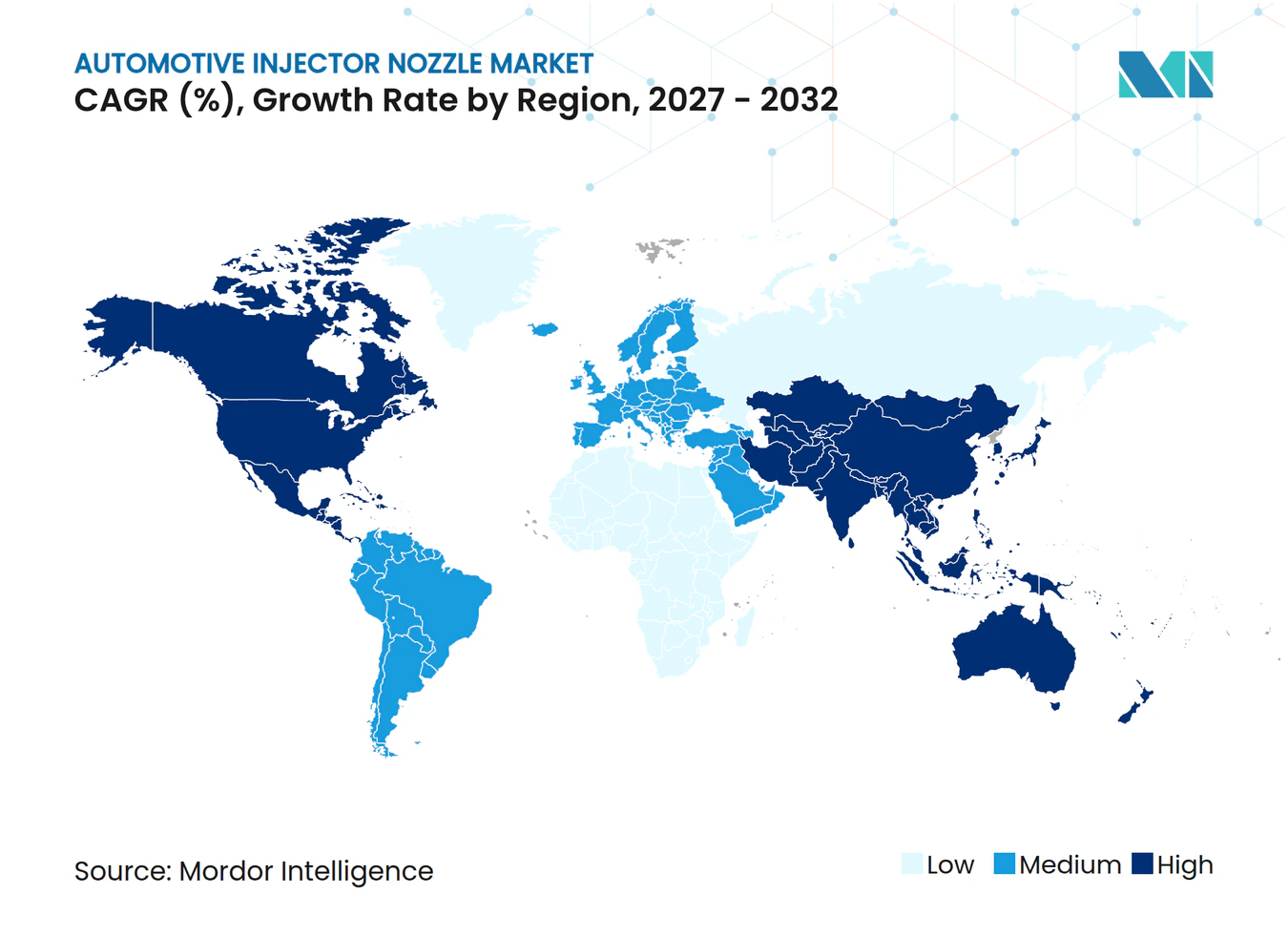
Geography Analysis
Asia-Pacific: Largest and Fastest-Growing Market, Dual Dynamics Converge
Asia-Pacific held 46.50% of the automotive injector nozzle market share in 2026 and is projected to grow at 3.98% through 2032. The region combines extensive vehicle manufacturing, large installed ICE fleets, and rising requirements for direct-injection and common rail components. China and India remain especially important because both support large passenger, commercial, and two-wheeler applications. China’s GB/T 25367-2024 standard raises the qualification threshold for common rail diesel injectors. PHINIA’s reported CNG and direct-injection program wins in India and China show active demand for alternative-fuel and premium fuel-system products. Malaysia’s powertrain investment plans also point to continuing regional interest in engine capability. The combination of local manufacturing and a large replacement base supports regional demand even as new-energy vehicle adoption accelerates [3].
Europe: Specification-Driven Value Despite Production Contraction
Europe faces lower combustion-engine production but has a strong role in high-precision fuel-system engineering. Euro 7 type approval begins for new M1 and N1 types in November 2026, and it introduces a PN10 requirement that increases attention to controlled injection quality. This regulatory influence supports higher-value multi-hole GDI and diesel common rail products. The IEA expects electric-car sales to continue increasing in Europe, putting pressure on conventional passenger-car nozzle volumes. Hybrid vehicles partly offset this effect because they still require complete injection systems. Bosch, PHINIA, FIRAD, and MOTORPAL represent a mix of high-precision and cost-competitive supply capability across the region. The automotive injector nozzle market share in Europe increasingly depends on specialized engineering content rather than broad engine-volume growth.
South America, North America, and MEA: Distinct Growth Vectors
North America benefits from continuing hybrid adoption and a large fleet of internal-combustion vehicles. U.S. data showed battery-electric vehicles at 6% of new light-duty sales in the third quarter of 2026, while hybrids reached 16%. Mexico remains a manufacturing corridor for suppliers serving vehicle platforms across North America. In South America, direct-injection localization is becoming more relevant as Brazil applies the PROCONVE L-8 program. PHINIA began producing 350-bar GDI injectors at Piracicaba in June 2026, replacing injectors previously imported from Mexico. MEA retains a longer combustion-engine demand profile because commercial diesel fleets remain important and electric-vehicle penetration is lower. Fuel-quality variation can increase injector wear, making quality replacement parts and service capability important across the region.
Competitive Landscape
Market Concentration
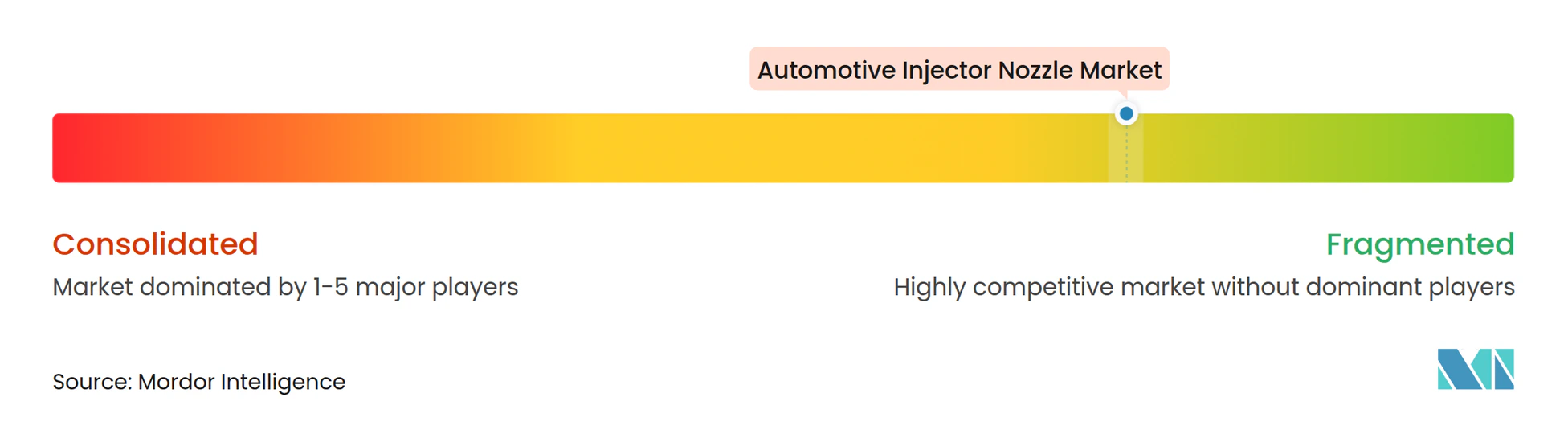
The automotive injector nozzle market is moderately concentrated at the Tier 1 level. Robert Bosch GmbH and DENSO Corporation have broad positions in GDI and diesel common rail applications, while PHINIA Inc., Astemo Ltd., Stanadyne LLC, and Weifu High-Technology Group compete across targeted technologies and channels. Bosch’s position is supported by precision manufacturing, integrated fuel-system development, and established OEM relationships. DENSO benefits from its automotive electronics and fuel-system capabilities. The automotive injector nozzle market also includes European and Chinese specialists that compete on regional supply, cost, and niche technology. Competition becomes more fragmented below the largest global suppliers. Regional manufacturers can be competitive when they meet current qualification standards and offer local service. Their role is strongest where customers value shorter supply chains, application knowledge, and flexible program support.
Technical capability is the central point of competition because direct-injection nozzles need controlled geometry, repeatable flow, and durability at high pressure. Piezoelectric systems and advanced solenoid systems support precise multi-pulse injection in GDI and diesel engines. This rewards companies that can validate the interaction between nozzle shape, injector control, and engine calibration. Stanadyne confirmed support for 350-bar BMW B58 Gen 2 applications in its 2025 GDI injector specification sheet. China’s GB/T 25367-2024 standard also strengthens the position of domestic suppliers that can meet the updated common rail requirements. Suppliers unable to reach these standards face a narrower role in OEM and higher-value replacement programs. Certification and validation capability are therefore practical barriers to entry, not merely technical preferences. The requirement for repeatable manufacturing also makes process control as important as component design.
Strategic moves show companies are preparing for a wider fuel mix and a more complex aftermarket. PHINIA reported CNG, jet fuel, and direct-injection program wins in 2026, which reduces its dependence on a single fuel or region. Stanadyne presented production-ready propane direct-injection technology in 2026 for commercial fleet applications. PHINIA also began GDI injector production in Brazil in June 2026, a localization step linked to regional direct-injection demand. Digital coding, spray-pattern diagnostics, and condition monitoring can further differentiate replacement offerings. Companies that pair hardware precision with calibration and service support can strengthen their position as repairs become more specialized. Alternative-fuel projects can also protect suppliers from dependence on a single combustion technology. Local production initiatives can shorten supply lines and align products with regional emissions requirements.
Automotive Injector Nozzle Industry Leaders
-
Robert Bosch GmbH
-
DENSO Corporation
-
PHINIA Inc.
-
Astemo, Ltd.
-
Cummins Inc.
- *Disclaimer: Major Players sorted in no particular order
Automotive Injector Nozzle Market Companies Covered in this Report
- Robert Bosch GmbH
- DENSO Corporation
- PHINIA Inc.
- Astemo, Ltd.
- Cummins Inc.
- Stanadyne LLC
- Woodward, Inc.
- Liebherr-International AG
- Weifu High-Technology Group Co., Ltd.
- Marelli Holdings Co., Ltd.
- Yanmar Holdings Co., Ltd.
- Heinzmann GmbH & Co. KG
- Nanyue Fuel Injection Systems Co., Ltd.
- Valeo SE
- Schaeffler AG
- Aisan Industry Co., Ltd.
- Mikuni Corporation
- Nikki Co., Ltd.
- FIRAD S.p.A.
- MOTORPAL, a.s.
- WUZETEM S.A.
- Shandong Kangda Precision Machinery Manufacturing Co., Ltd.
- Wuhan Lincontrol Automotive Electronics Co., Ltd.
- Zhejiang Jupeng Electronic Technology Co., Ltd.
Recent Industry Developments in Automotive Injector Nozzle Market
- June 2026: PHINIA opened a production line for 350-bar Delphi GDi injectors at its Piracicaba plant in Brazil, localizing injectors previously imported from Mexico.
- May 2026: Stanadyne showcased a production-ready propane direct-injection system, developed with PERC and Katech, at ACT Expo 2026.
- April 2026: PHINIA reported first-quarter program wins for a CNG fuel rail in India, a jet fuel direct injector, and a direct-injection fuel rail for a Chinese dual-fuel V8 engine.
- April 2026: PHINIA unveiled a 500-bar-plus gasoline direct-injection system and alternative-fuel injection technologies at Auto China 2026.
Global Automotive Injector Nozzle Market Report Scope
The Automotive Injector Nozzle Market Report is Segmented by Nozzle Type (Single-Hole, Multi-Hole, Pintle, and Others), Fuel Type (Gasoline, Diesel, and Alternative Fuels (CNG, LPG, Hydrogen, Ethanol)), Injection Technology (Port Fuel Injection, Gasoline Direct Injection, Common Rail Diesel, and Others), Vehicle Type (Passenger Cars, Light Commercial Vehicles, Heavy Commercial Vehicles, and Two-Wheelers), Sales Channel (OEM and Aftermarket), and Geography (North America, Europe, Asia-Pacific, South America, and Middle East and Africa). Market Forecasts are Provided in Terms of Value (USD) and Volume (Units).Segmentation Overview
| Single-Hole |
| Multi-Hole |
| Pintle |
| Others |
| Gasoline |
| Diesel |
| Alternative Fuels (CNG, LPG, Hydrogen, Ethanol) |
| Port Fuel Injection |
| Gasoline Direct Injection |
| Common Rail Diesel |
| Others |
| Passenger Cars |
| Light Commercial Vehicles |
| Heavy Commercial Vehicles |
| Two-Wheelers |
| OEM |
| Aftermarket |
| North America | United States |
| Canada | |
| Mexico | |
| Europe | Germany |
| France | |
| Italy | |
| United Kingdom | |
| Spain | |
| Russia | |
| Poland | |
| Turkey | |
| Rest of Europe | |
| Asia-Pacific | China |
| India | |
| Japan | |
| South Korea | |
| Thailand | |
| Indonesia | |
| Rest of Asia-Pacific | |
| South America | Brazil |
| Argentina | |
| Colombia | |
| Rest of South America | |
| Middle East and Africa | Saudi Arabia |
| United Arab Emirates | |
| South Africa | |
| Egypt | |
| Morocco | |
| Rest of Middle East and Africa |
| By Nozzle Type | Single-Hole | |
| Multi-Hole | ||
| Pintle | ||
| Others | ||
| By Fuel Type | Gasoline | |
| Diesel | ||
| Alternative Fuels (CNG, LPG, Hydrogen, Ethanol) | ||
| By Injection Technology | Port Fuel Injection | |
| Gasoline Direct Injection | ||
| Common Rail Diesel | ||
| Others | ||
| By Vehicle Type | Passenger Cars | |
| Light Commercial Vehicles | ||
| Heavy Commercial Vehicles | ||
| Two-Wheelers | ||
| By Sales Channel | OEM | |
| Aftermarket | ||
| By Geography | North America | United States |
| Canada | ||
| Mexico | ||
| Europe | Germany | |
| France | ||
| Italy | ||
| United Kingdom | ||
| Spain | ||
| Russia | ||
| Poland | ||
| Turkey | ||
| Rest of Europe | ||
| Asia-Pacific | China | |
| India | ||
| Japan | ||
| South Korea | ||
| Thailand | ||
| Indonesia | ||
| Rest of Asia-Pacific | ||
| South America | Brazil | |
| Argentina | ||
| Colombia | ||
| Rest of South America | ||
| Middle East and Africa | Saudi Arabia | |
| United Arab Emirates | ||
| South Africa | ||
| Egypt | ||
| Morocco | ||
| Rest of Middle East and Africa | ||
Key Questions Answered in the Report
What is the projected size of the automotive injector nozzle market by 2032?
The automotive injector nozzle market is forecast to reach USD 7.62 billion by 2032, rising at a 2.94% CAGR from 2027. The outlook reflects higher technical content per combustion engine, particularly where direct injection and emissions compliance require finer nozzle geometry and more controlled fuel delivery.
Which nozzle type holds the largest revenue position?
Multi-hole nozzles lead with a 65.45% share in 2026 because GDI gasoline and common rail diesel engines need finely atomized fuel. Multiple precisely positioned holes allow the component to shape the fuel plume, helping engines meet performance and particulate-control requirements under increasingly strict vehicle rules.
Which injection technology is growing fastest through 2032?
Gasoline direct injection is projected to grow at 4.10% through 2032, supported by tighter particulate rules such as Euro 7 and the shift toward high-pressure systems. Port fuel injection continues to benefit from dual PFI-GDI engine strategies that help manufacturers manage intake-valve deposit concerns in GDI-only applications.
Why do emissions rules matter for injector nozzles?
Euro 7 and China’s updated common rail standard increase the need for precise fuel metering, controlled atomization, and durable nozzle geometries. These rules encourage suppliers to use advanced machining, testing, and materials because poor flow control can affect particulate emissions, fuel consumption, and long-term engine performance.
Which region leads automotive injector nozzle demand?
Asia-Pacific leads with a 46.50% share in 2026 and is projected to grow at 3.98% through 2032. The region brings together large vehicle production bases, extensive installed fleets, alternative-fuel programs, and expanding local powertrain supply chains across China, India, ASEAN, Japan, and South Korea.
How do electric vehicles affect injector nozzle suppliers?
Battery-electric vehicles do not use injectors, so they reduce the addressable volume of conventional fuel-system parts over time. Hybrid vehicles preserve an internal-combustion engine and its injection system, however, which gives suppliers continued demand from vehicle programs during the transition to fully electric mobility.