
Automotive IGBT Module Market Size and Share
Market Overview
| Study Period | 2020 - 2032 |
|---|---|
| Market Size (2027) | USD 10.66 Billion |
| Market Size (2032) | USD 19.87 Billion |
| Growth Rate (2027 - 2032) | 13.26 % |
| Fastest Growing Market | Asia-Pacific |
| Largest Market | Asia-Pacific |
| Market Concentration | Medium |
Major Players *Disclaimer: Major Players sorted in no particular order Image © Mordor Intelligence. Reuse requires attribution under CC BY 4.0. | |
Automotive IGBT Module Market Analysis by Mordor Intelligence
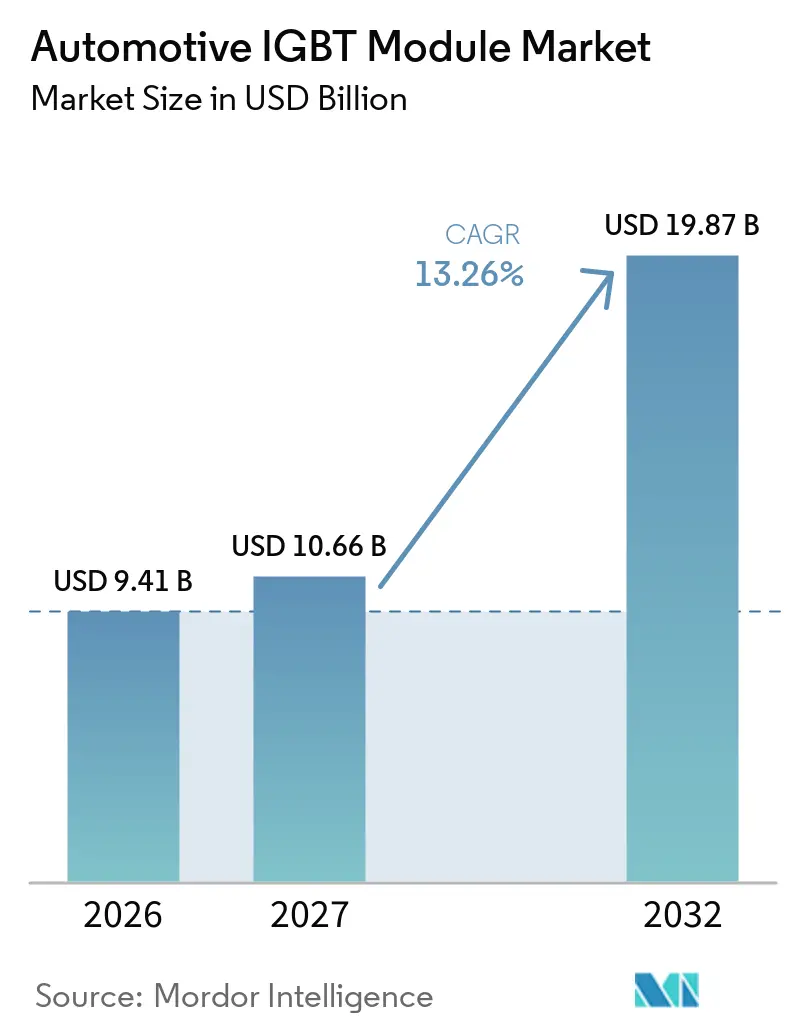
The automotive IGBT module market size was valued at USD 9.41 billion in 2026 and is expected to grow from USD 10.66 billion in 2027 to USD 19.87 billion by 2032, at a CAGR of 13.26% during 2027-2032. The automotive IGBT module market remains supported by the cost gap between silicon IGBT devices and silicon carbide devices in volume vehicle programs. IGBT modules continue to suit platforms where cost, proven reliability, and high-current performance matter more than maximum switching efficiency. Suppliers are adapting their portfolios for higher voltages, tighter thermal limits, and regional sourcing requirements. This creates room for hybrid IGBT-SiC products while preserving demand for established silicon-based modules.
Key Report Takeaways
- By module type, six-pack/full-bridge modules held a 43.18% share in 2026, while hybrid IGBT-SiC configurations are projected to grow at a 17.48% CAGR through 2032.
- By voltage rating, the 600–750 V class accounted for a 55.33% share in 2026, while the above-1,200 V class is projected to grow at a 16.23% CAGR through 2032.
- By application, traction inverters held a 69.03% share in 2026 and are forecast to expand at a 13.84% CAGR through 2032.
- By propulsion, battery electric vehicles accounted for a 62.41% share in 2026 and are projected to grow at a 15.03% CAGR through 2032.
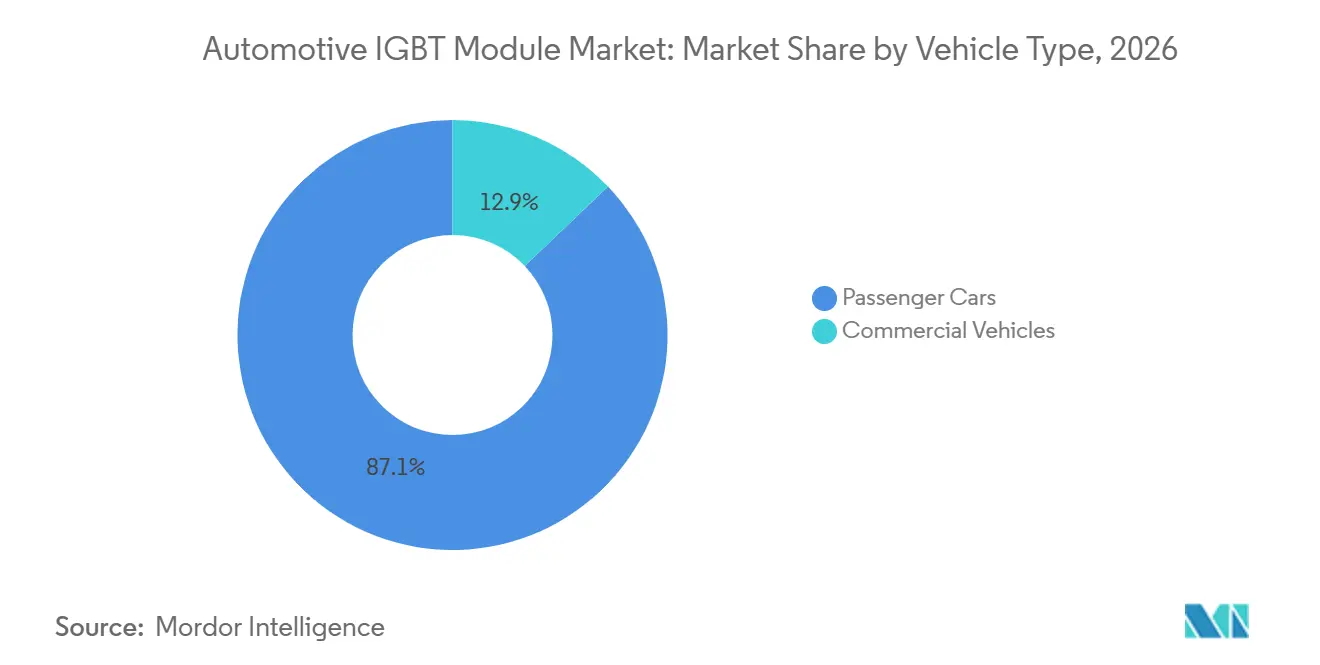
- By vehicle type, passenger cars held an 87.13% share in 2026, while commercial vehicles are projected to grow at a 14.75% CAGR through 2032.
- By cooling, direct liquid (pin-fin) cooling held a 52.00% share in 2026 and is projected to grow at a 14.30% CAGR through 2032.
- By geography, Asia-Pacific held a 66.12% share in 2026 and is forecast to expand at a 14.12% CAGR through 2032.
Note: Market numbers in this report are based on Mordor Intelligence's proprietary estimation framework, which combines nine months of actuals with Q4 projections for base year 2026.
Market Trends and Insights
Drivers Impact Analysis of Automotive IGBT Module Market*
| Driver | (~) % Impact on CAGR Forecast | Geographic Relevance | Impact Timeline |
|---|---|---|---|
| Rising EV, HEV, and PHEV Production | +4.5% | Global | Short term (≤ 2 years) |
| Expansion of 800 V and 1,200 V Vehicle Architectures | +3.2% | Global, with Asia-Pacific core and spill-over to Europe | Medium term (2–4 years) |
| Cost and Supply-Chain Advantages Over Full-SiC Power Modules | +2.4% | Global | Short term (≤ 2 years) |
| Demand for Higher Power Density Through Direct Liquid Cooling | +1.8% | Global | Medium term (2–4 years) |
| Regionalization of Automotive Power-Module Sourcing | +1.4% | Asia-Pacific core, spill-over to North America and Europe | Medium term (2–4 years) |
| Sticky OEM Platforms Created by Automotive Qualification and Reliability Data | +1.2% | Global | Long term (≥ 4 years) |
| Source: Mordor Intelligence | |||
Rising EV, HEV, and PHEV Production
Electric car sales exceeded 20 million units globally in 2025, rising about 20% from 2024 [1]. This wider electrified vehicle base supports the automotive IGBT module market across traction and supporting power functions. Battery electric vehicles require traction inverters, while hybrid vehicles also use power modules for motor-generator systems. IGBT technology remains well suited to operating conditions where a full SiC solution does not justify its added cost. The demand base therefore extends across battery electric, plug-in hybrid, and conventional hybrid vehicles. This broad application base reduces the automotive IGBT module market’s dependence on any single propulsion category.
Expansion of 800 V and 1,200 V Vehicle Architectures
Vehicle manufacturers are adopting 800 V architectures to support faster charging and higher power operation. This shift does not eliminate IGBT devices from high-voltage inverter designs within the automotive IGBT module market. Infineon introduced 1,200 V IGBT and RC-IGBT devices for electric vehicles in April 2025 [2]. The release shows that IGBT suppliers are developing products for the high-voltage transition. Higher-voltage platforms also require modules with suitable blocking voltage, cooling, and packaging performance. The automotive IGBT module market can therefore retain content in selected 800 V applications while higher-voltage commercial programs develop.
Cost and Supply-Chain Advantages Over Full-SiC Power Modules
Silicon carbide devices offer efficiency advantages in selected high-voltage applications, but their cost remains a limiting factor. Silicon carbide die remains considerably more expensive per unit area than silicon IGBT and diode technologies. That difference matters for high-volume passenger vehicles operating between 450 V and 750 V. Hybrid architectures can combine IGBT robustness at high current with silicon carbide performance in targeted operating conditions. This option gives manufacturers in the automotive IGBT module market an incremental route to efficiency improvement. It also supports continued use of silicon-based modules in cost-sensitive vehicle programs.
Demand for Higher Power Density Through Direct Liquid Cooling
Automotive manufacturers are seeking higher inverter output without proportionate increases in package size. Direct liquid pin-fin cooling reduces thermal resistance by eliminating the interface layer used in indirect cooling arrangements. Optimized pin-fin cooling can significantly reduce thermal resistance compared with indirect cooling. This supports higher current ratings within constrained module footprints. It also makes thermal design a more meaningful differentiator among module suppliers. The automotive IGBT module market benefits as cooling design becomes more closely integrated with inverter performance requirements.
Restraints Impact Analysis of Automotive IGBT Module Market*
| Restraint | (~) % Impact on CAGR Forecast | Geographic Relevance | Impact Timeline |
|---|---|---|---|
| Substitution by SiC MOSFET Modules in Premium BEV Traction Inverters | -2.8% | Global, concentrated in premium BEV segments in North America and Europe | Medium term (2–4 years) |
| High Automotive Qualification, Validation, and Warranty Costs | -1.5% | Global | Long term (≥ 4 years) |
| Export Controls, Tariffs, and Regional Standards Fragmentation | -1.2% | Asia-Pacific and North America, with secondary effects in Europe | Short term (≤ 2 years) |
| Thermal-Cycling and Packaging-Yield Constraints at High Current | -0.9% | Global | Medium term (2–4 years) |
| Source: Mordor Intelligence | |||
Substitution by SiC MOSFET Modules in Premium BEV Traction Inverters
Silicon carbide MOSFET modules are gaining ground in premium battery electric vehicle traction inverters. Their switching performance is especially relevant to high-voltage platforms and highway driving conditions. This creates a focused competitive constraint for IGBT suppliers serving premium full-electric models. The effect is less pronounced in plug-in hybrids, conventional hybrids, and many 400 V battery electric vehicles. Those vehicle types retain a stronger cost case for IGBT-based power electronics. The automotive IGBT module market therefore faces selective substitution rather than uniform replacement across all electrified vehicles.
High Automotive Qualification, Validation, and Warranty Costs
Automotive power modules must meet demanding reliability and validation requirements before series production. The ECPE AQG 324 framework covers thermal cycling, power cycling, humidity bias, and vibration testing. These programs require specialized infrastructure and long sampling processes. New entrants face a longer path to qualified supply than established suppliers with proven automotive records. The requirement can limit rapid product changes and increase development costs. It also protects validated supplier positions once an automotive platform enters production.
*Our forecasts treat driver/restraint impacts as directional, not additive. The impact forecasts reflect baseline growth, mix effects, and variable interactions.
Automotive IGBT Module Market Segment Analysis
By Module Type:
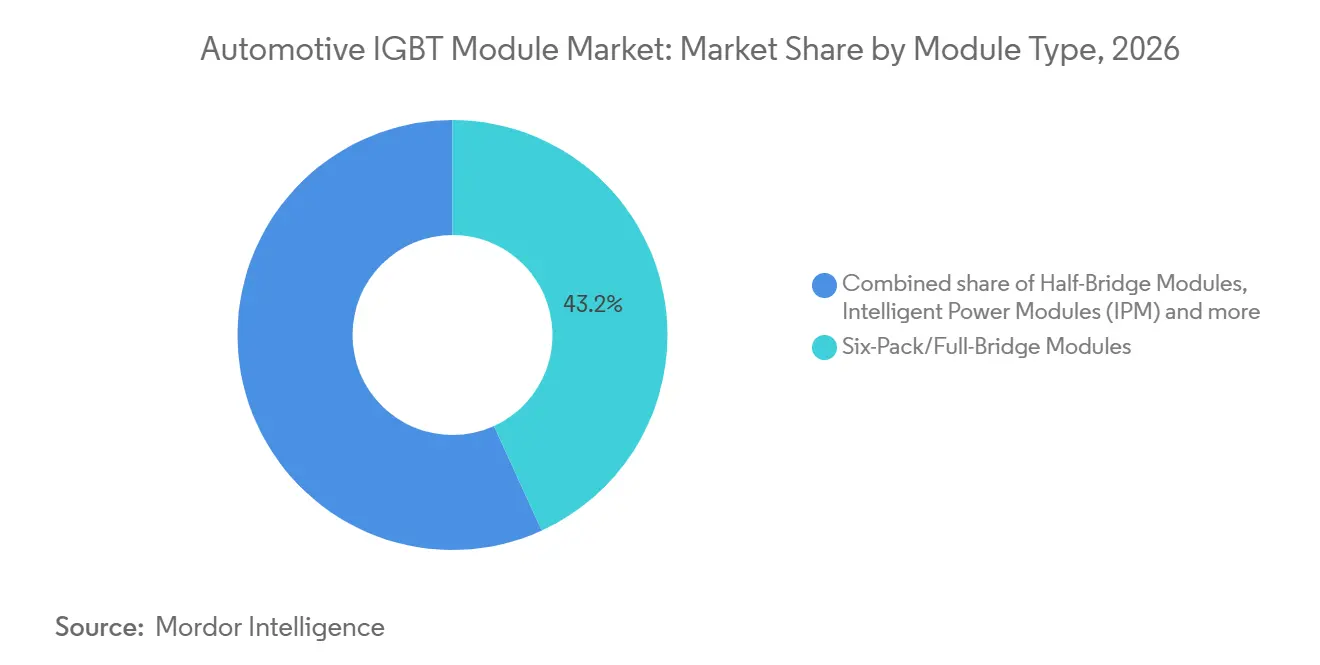
Six-Pack Architecture Anchors Volume, Hybrid Configurations Lead GrowthSix-pack/full-bridge modules held a 43.18% share in 2026. Their six-switch arrangement supports three-phase traction inverters in a compact, integrated configuration. The architecture reduces parasitic inductance and can simplify inverter assembly. Its established position on validated vehicle platforms supports recurring demand. Manufacturers value the topology because it combines function integration with a familiar qualification path.
Hybrid IGBT-SiC configurations are projected to grow at a 17.48% CAGR through 2032. They provide a practical middle route between established silicon modules and full-SiC designs. Infineon’s HybridPACK Drive G2 Fusion module, introduced in October 2024, combines silicon and silicon carbide devices within one automotive traction solution. This design can improve selected operating conditions without requiring a full technology change. The automotive IGBT module market can use these hybrid designs to serve OEMs pursuing measured efficiency improvements.

By Voltage Rating:
Mid-Range Segment Dominates, High-Voltage Class Grows FastestThe 600–750 V class accounted for 55.33% of the automotive IGBT module market share in 2026. This range aligns with the large installed base of 400 V vehicle architectures. Mid-range passenger cars, plug-in hybrids, and many commercial vehicles use these voltage levels. The segment benefits from mature module designs and established manufacturing processes. It remains important because vehicle makers still require cost-effective electrification at scale.
The above-1,200 V class is projected to grow at a 16.23% CAGR through 2032. Demand comes from high-voltage commercial vehicles and multi-motor truck systems. These applications need higher blocking voltage and more capable thermal management. Infineon’s 2025 IGBT and RC-IGBT device release spans 750 V and 1,200 V applications for electric vehicles. High-voltage module development expands the automotive IGBT module market’s reach into demanding vehicle architectures.
By Application:
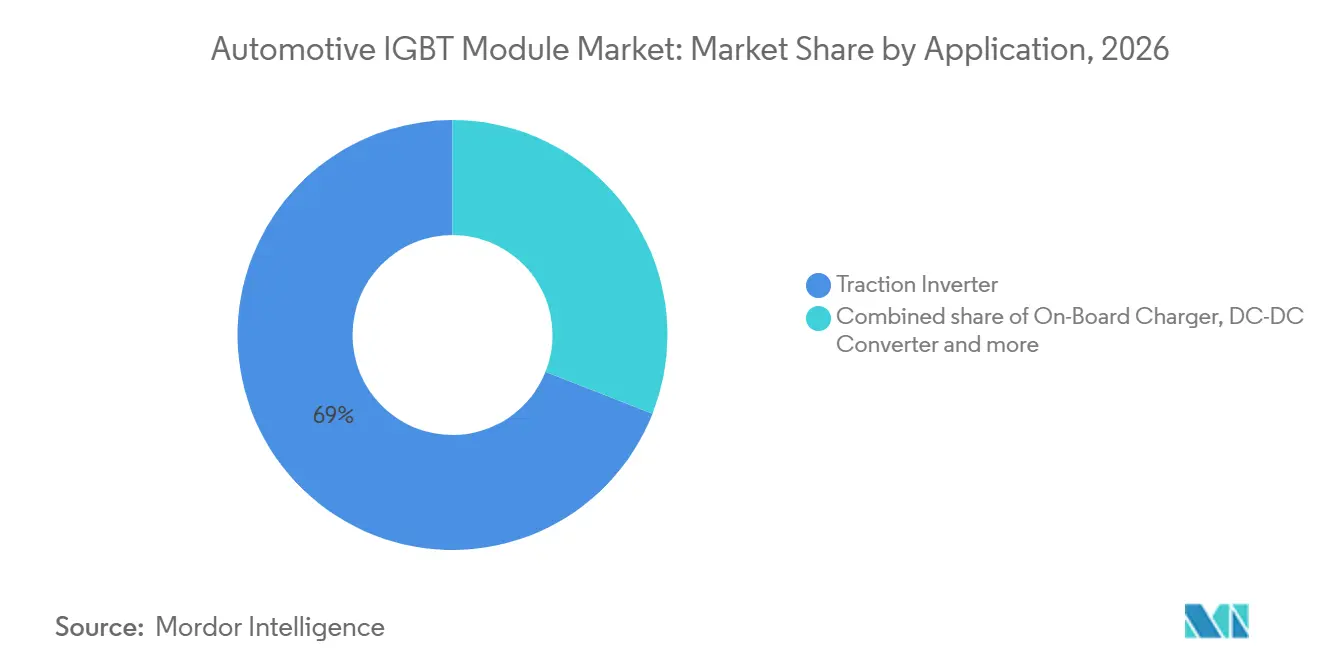
Traction Inverters Define the Market’s Commercial CenterTraction inverters accounted for 69.03% of the automotive IGBT module market share in 2026. The application is projected to grow at a 13.84% CAGR through 2032. Every electrified drivetrain requires an inverter to control power between the battery and electric motor. The IGBT module is a central switching component within that system. This makes traction inverters the main revenue base for power module suppliers.
Integrated powertrains are bringing the motor, reducer, and inverter into more compact vehicle assemblies. These systems place greater emphasis on packaging, cooling, and gate-drive integration. Suppliers with validated direct-cooled modules can address these requirements with less disruption to the OEM development process. On-board chargers and DC-DC converters add demand, although Infineon’s 750 V CoolSiC MOSFET G2 product shows stronger SiC pressure in charger applications. Auxiliary applications continue to require protected and compact power module formats.
By Propulsion:
Battery Electric Vehicles Consolidate Market LeadershipBattery electric vehicles accounted for 62.41% of the automotive IGBT module market share in 2026. They are projected to expand at a 15.03% CAGR through 2032. Their traction systems have the highest power-electronics content among mainstream electrified vehicle types. This makes growth in battery electric vehicle production particularly relevant for module revenue. Global electric car sales growth in 2025 reinforced this demand relationship.
Plug-in hybrid vehicles require an inverter for electric-only driving and regenerative braking. Conventional hybrids also use IGBT modules in motor-generator inverters. Silicon carbide has a narrower cost advantage in these lower-voltage and moderate-duty applications. These propulsion types therefore provide a continuing demand base beyond battery electric vehicles. The automotive IGBT module market retains support from this mix of hybrid and full-electric platforms.
By Vehicle Type:
Passenger Cars Lead, Commercial Segment AcceleratesPassenger cars held 87.13% of the automotive IGBT module market in 2026. Their volume leadership follows the larger scale of passenger vehicle electrification. Passenger programs also place strong weight on cost, package integration, and qualified supply. These conditions favor established IGBT module technologies. The segment remains central to the automotive IGBT module market’s revenue base through the forecast period.
Commercial vehicles are forecast to grow at a 14.75% CAGR through 2032. Electric buses, delivery vans, and heavy trucks need higher traction power than most passenger cars. Their multi-motor configurations can require high-current and high-voltage modules. This increases the power module value per vehicle. Commercial vehicle electrification can therefore raise the revenue contribution of this segment faster than its unit volume alone would suggest.
By Cooling:
Liquid Cooling Architecture Shapes Module Value and Design Lock-InDirect liquid (pin-fin) cooling held a 52.00% share of the automotive IGBT module market in 2026 and is projected to grow at a 14.30% CAGR through 2032. Mainstream traction inverter modules increasingly use pin-fin baseplates that bring coolant into direct contact with the module, removing the thermal interface layer used in indirect cooling arrangements. Pin-fin structures can improve heat transfer and enable higher current ratings in the same package area. More demanding inverter designs make cooling performance part of supplier selection. The automotive IGBT module market gains value as the cooling structure becomes more closely tied to vehicle-level thermal design.
Indirect liquid cooling held a 38.50% share in 2026 and is projected to grow at a 12.60% CAGR through 2032. It has an established position on validated vehicle platforms and can offer lower heatsink integration costs. Indirect cooling continues to serve systems where proven packaging is more important than the highest possible current density. Air cooling, which accounts for the remaining share, stays relevant for auxiliary systems and mild-hybrid applications with lower thermal loads.
Geography Analysis
Asia-Pacific held 66.12% of the automotive IGBT module market share in 2026 and is forecast to expand at a 14.12% CAGR through 2032. China is the main contributor because its electric vehicle production base has substantial scale and manufacturing depth. The country’s electric car sales are expected to remain substantial, supporting regional demand for traction power electronics. Japan contributes established IGBT manufacturing capability, while South Korea adds demand through vehicle exports and electrified platform development. India and Southeast Asia also add emerging demand for modules suited to local vehicle costs and operating conditions.
Europe remains an important center for automotive engineering, vehicle programs, and OEM procurement decisions. Its manufacturers continue to develop high-voltage battery electric and plug-in hybrid platforms across several vehicle categories. The automotive IGBT module market benefits from Europe’s continuing need for qualified power electronics across these platform types. North America, South America, and the Middle East and Africa represent smaller demand pools. North American demand depends on the pace of electric vehicle adoption and the scale of local manufacturing investment.
South America is gaining relevance as electric vehicle activity increases in Brazil. The Middle East and Africa add import demand through fleet electrification and domestic vehicle production initiatives. Long-term demand in these regions will depend on OEM platform commitments and locally available supply chains. Regional sourcing requirements can make qualified multi-source module strategies more important across these markets.
Competitive Landscape
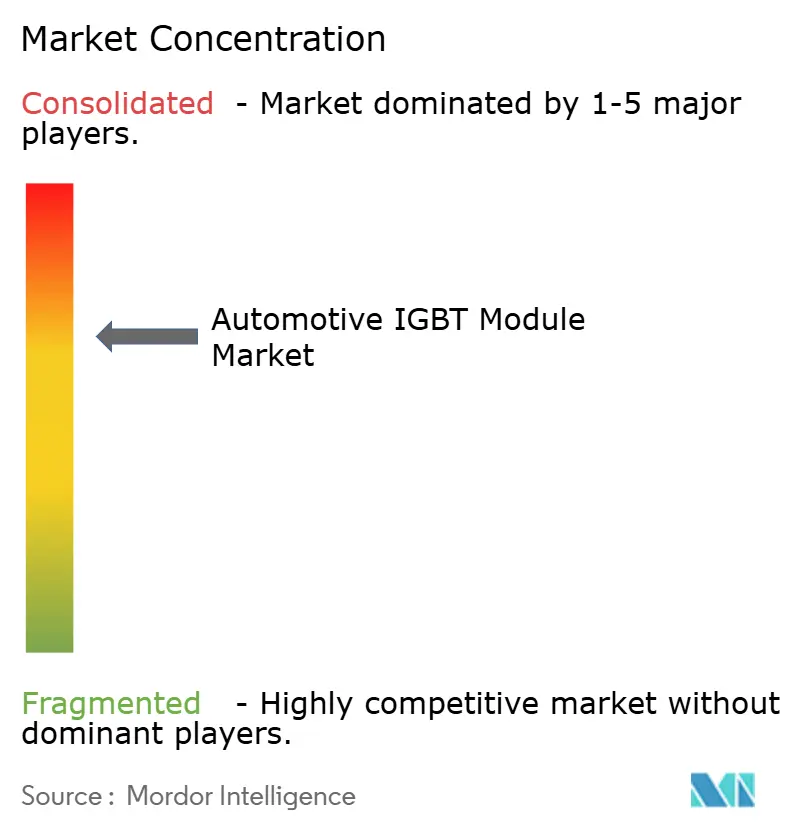
The automotive IGBT module market is moderately concentrated, with established global suppliers that have long histories of automotive qualification. Infineon Technologies, Mitsubishi Electric, Fuji Electric, onsemi, and STMicroelectronics offer chip design, module packaging, and vehicle program support. Chinese suppliers such as BYD Semiconductor and StarPower Semiconductor have scaled rapidly on the back of domestic electric vehicle production. Their position reflects the lengthy process needed to qualify power modules for automotive use. Competition centers on thermal performance, system integration, voltage capability, reliability, and dependable supply. These factors create meaningful barriers for suppliers without an established record in automotive applications.
Infineon is pursuing higher-voltage and hybrid product development for electric vehicle applications. Its Si/SiC Fusion platform provides a route toward hybrid traction solutions. Mitsubishi Electric released samples of its J3 Series SiC and Si power modules for xEV traction inverters in 2024, extending its automotive portfolio across both silicon IGBT and silicon carbide technologies [3].
Competition is also shaped by direct-cooled substrates, sintered die attach, and double-sided cooling. Suppliers with validated thermal solutions can become more closely embedded in customer inverter designs. Hybrid IGBT-SiC architectures offer another path to differentiation without a complete transition to silicon carbide. Qualified automotive supply cannot be replaced quickly, so qualification history remains commercially important.
Automotive IGBT Module Industry Leaders
-
Infineon Technologies AG
-
BYD Semiconductor Co., Ltd.
-
Mitsubishi Electric Corporation
-
StarPower Semiconductor Ltd.
-
Fuji Electric Co., Ltd.
- *Disclaimer: Major Players sorted in no particular order
Automotive IGBT Module Market Companies Covered in this Report
- Infineon Technologies AG
- Mitsubishi Electric Corporation
- Fuji Electric Co., Ltd.
- onsemi
- STMicroelectronics N.V.
- BYD Semiconductor Co., Ltd.
- StarPower Semiconductor Ltd.
- Danfoss A/S
- Renesas Electronics Corporation
- Vishay Intertechnology, Inc.
- Littelfuse, Inc.
- CRRC Corporation Limited
- Hangzhou Silan Microelectronics Co., Ltd.
- United Nova Technology Co., Ltd.
- MacMic Science and Technology Co., Ltd.
- Hefei Cpower Technology Co., Ltd.
- Zhixin Semiconductor Co., Ltd.
- Zhejiang Grecon Semiconductor Co., Ltd.
Recent Industry Developments in Automotive IGBT Module Market
- August 2026: ROHM introduced automotive-grade 650 V IGBTs qualified to AEC-Q101 for electric compressors and high-voltage heaters, with a collector-emitter saturation voltage of 1.55 V.
- June 2026: Infineon introduced a 1,300 V silicon carbide module in its HybridPACK Drive family rated for continuous operation at 205°C, keeping the footprint and interfaces of existing HybridPACK Drive designs used for IGBT-based traction inverters.
- April 2026: ROHM, Toshiba, and Mitsubishi Electric were reported to be planning a joint power semiconductor unit combining their power device businesses to serve electric vehicle and industrial demand.
- February 2026: United Nova Technology signed a global strategic partnership with Horse Powertrain to co-develop IGBT and SiC power modules for Horse Powertrain’s Super Hybrid DHT system, planned for about 10 hybrid models over five years.
Global Automotive IGBT Module Market Report Scope
The scope includes segmentation by module type (half-bridge modules, six-pack/full-bridge modules, intelligent power modules [IPM], and others [hybrid IGBT-SiC]), voltage rating (600–750 V, 1,200 V, and above 1,200 V), application (traction inverter, on-board charger, DC-DC converter, and others [e-compressor and auxiliary]), propulsion (battery electric, plug-in hybrid, and hybrid), vehicle type (passenger cars and commercial vehicles), cooling (direct liquid [pin-fin], indirect liquid, and others [air-cooled]), and geography (North America [United States, Canada, and Rest of North America], Europe [Germany, France, United Kingdom, Italy, Spain, Russia, and Rest of Europe], Asia-Pacific [China, Japan, South Korea, India, Southeast Asia, Australia, and Rest of Asia-Pacific], South America [Brazil, Argentina, Colombia, and Rest of South America], and Middle East and Africa [Turkey, Saudi Arabia, United Arab Emirates, Egypt, South Africa, and Rest of Middle East and Africa]). Market size and growth forecasts are presented by value in USD and volume in units.
Segmentation Overview
| Half-Bridge Modules |
| Six-Pack/Full-Bridge Modules |
| Intelligent Power Modules (IPM) |
| Others (Hybrid IGBT-SiC) |
| 600-750 V |
| 1,200 V |
| Above 1,200 V |
| Traction Inverter |
| On-Board Charger |
| DC-DC Converter |
| Others (E-Compressor, Auxiliary) |
| Battery Electric |
| Plug-in Hybrid |
| Hybrid |
| Passenger Cars |
| Commercial Vehicles |
| Direct Liquid (Pin-Fin) |
| Indirect Liquid |
| Others (Air-Cooled) |
| North America | United States |
| Canada | |
| Rest of North America | |
| Europe | Germany |
| France | |
| United Kingdom | |
| Italy | |
| Spain | |
| Russia | |
| Rest of Europe | |
| Asia-Pacific | China |
| Japan | |
| South Korea | |
| India | |
| Southeast Asia | |
| Australia | |
| Rest of Asia-Pacific | |
| South America | Brazil |
| Argentina | |
| Colombia | |
| Rest of South America | |
| Middle East and Africa | Turkey |
| Saudi Arabia | |
| United Arab Emirates | |
| Egypt | |
| South Africa | |
| Rest of Middle East and Africa |
| By Module Type | Half-Bridge Modules | |
| Six-Pack/Full-Bridge Modules | ||
| Intelligent Power Modules (IPM) | ||
| Others (Hybrid IGBT-SiC) | ||
| By Voltage Rating | 600-750 V | |
| 1,200 V | ||
| Above 1,200 V | ||
| By Application | Traction Inverter | |
| On-Board Charger | ||
| DC-DC Converter | ||
| Others (E-Compressor, Auxiliary) | ||
| By Propulsion | Battery Electric | |
| Plug-in Hybrid | ||
| Hybrid | ||
| By Vehicle Type | Passenger Cars | |
| Commercial Vehicles | ||
| By Cooling | Direct Liquid (Pin-Fin) | |
| Indirect Liquid | ||
| Others (Air-Cooled) | ||
| By Geography | North America | United States |
| Canada | ||
| Rest of North America | ||
| Europe | Germany | |
| France | ||
| United Kingdom | ||
| Italy | ||
| Spain | ||
| Russia | ||
| Rest of Europe | ||
| Asia-Pacific | China | |
| Japan | ||
| South Korea | ||
| India | ||
| Southeast Asia | ||
| Australia | ||
| Rest of Asia-Pacific | ||
| South America | Brazil | |
| Argentina | ||
| Colombia | ||
| Rest of South America | ||
| Middle East and Africa | Turkey | |
| Saudi Arabia | ||
| United Arab Emirates | ||
| Egypt | ||
| South Africa | ||
| Rest of Middle East and Africa | ||
Key Questions Answered in the Report
What is the projected value of the automotive IGBT module market by 2032?
The automotive IGBT module market is projected to reach USD 19.87 billion by 2032, with a 13.26% CAGR from 2027 to 2032.
Which automotive IGBT module application has the largest share?
Traction inverters lead with 69.03% share in 2026 and are projected to grow at a 13.84% CAGR through 2032.
Which voltage class is growing fastest in automotive IGBT modules?
The above-1,200 V class is projected to grow at a 16.23% CAGR through 2032, supported by high-voltage commercial vehicle applications.
Which region leads demand for automotive IGBT modules?
Asia-Pacific leads with 66.12% share in 2026 and is forecast to grow at a 14.12% CAGR through 2032.