
Automotive Gateway Market Size and Share
Market Overview
| Study Period | 2020 - 2032 |
|---|---|
| Market Size (2027) | USD 4.34 Billion |
| Market Size (2032) | USD 7.26 Billion |
| Growth Rate (2027 - 2032) | 10.84 % |
| Fastest Growing Market | Asia-Pacific |
| Largest Market | Asia-Pacific |
| Market Concentration | Medium |
Major Players *Disclaimer: Major Players sorted in no particular order Image © Mordor Intelligence. Reuse requires attribution under CC BY 4.0. | |
Automotive Gateway Market Analysis by Mordor Intelligence
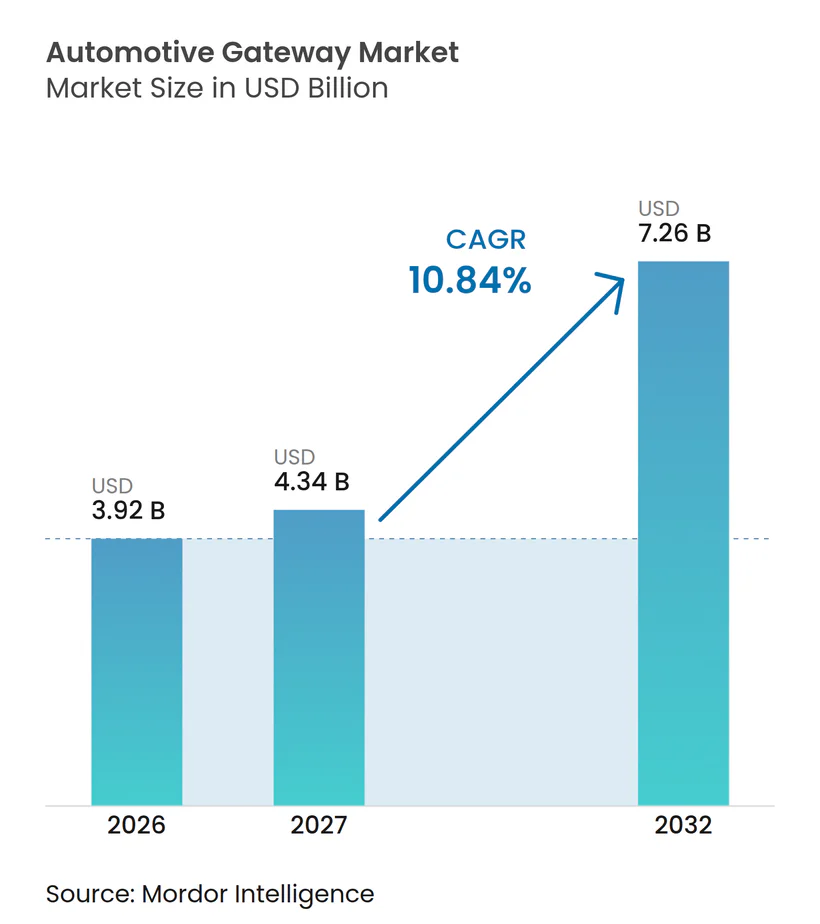
The automotive gateway market size was valued at USD 3.92 billion in 2026 and is expected to grow from USD 4.34 billion in 2027 to USD 7.26 billion by 2032, at a CAGR of 10.84% during 2027-2032. Software-defined vehicle programs are increasing the computing, routing, and security duties assigned to a gateway. Automotive Ethernet is also moving gateway designs beyond basic protocol translation and toward high-bandwidth network control. Cybersecurity and software-update rules make secure update delivery, integrity checks, and rollback functions more important in new vehicle platforms. Competition is shifting toward Tier 1 suppliers with integrated hardware and software capabilities, while semiconductor suppliers are gaining influence through reference designs and platform partnerships.
Key Report Takeaways
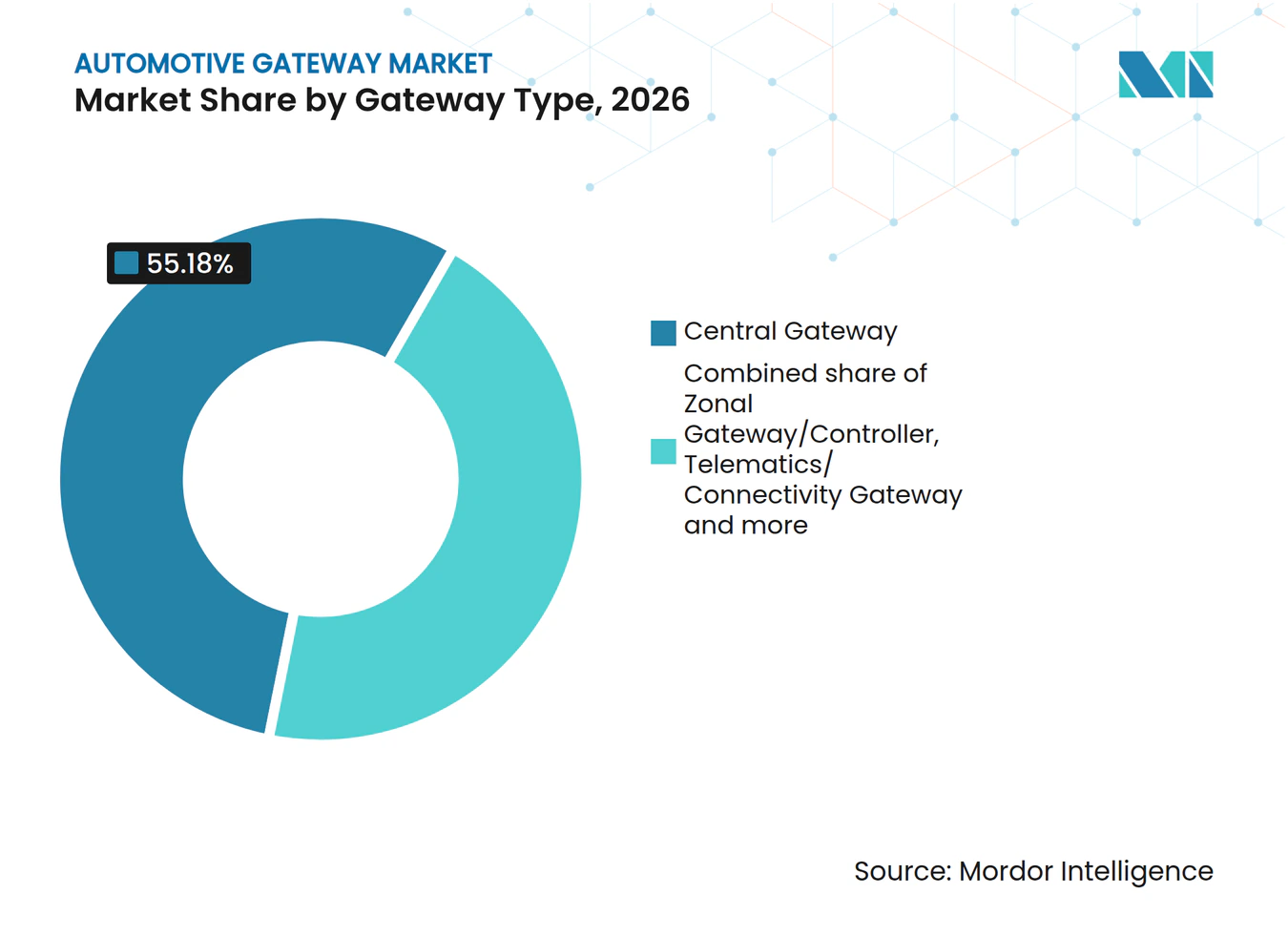
- By gateway type, central gateway held 55.18% of the automotive gateway market share in 2026, while zonal gateway/controller is forecast to expand at a 13.68% CAGR through 2032.
- By component, hardware held 69.24% of the automotive gateway market share in 2026, while software is forecast to expand at a 13.05% CAGR through 2032.
- By vehicle type, passenger cars held 79.33% of the automotive gateway market share in 2026, while medium and heavy commercial vehicles are forecast to expand at a 12.41% CAGR through 2032.
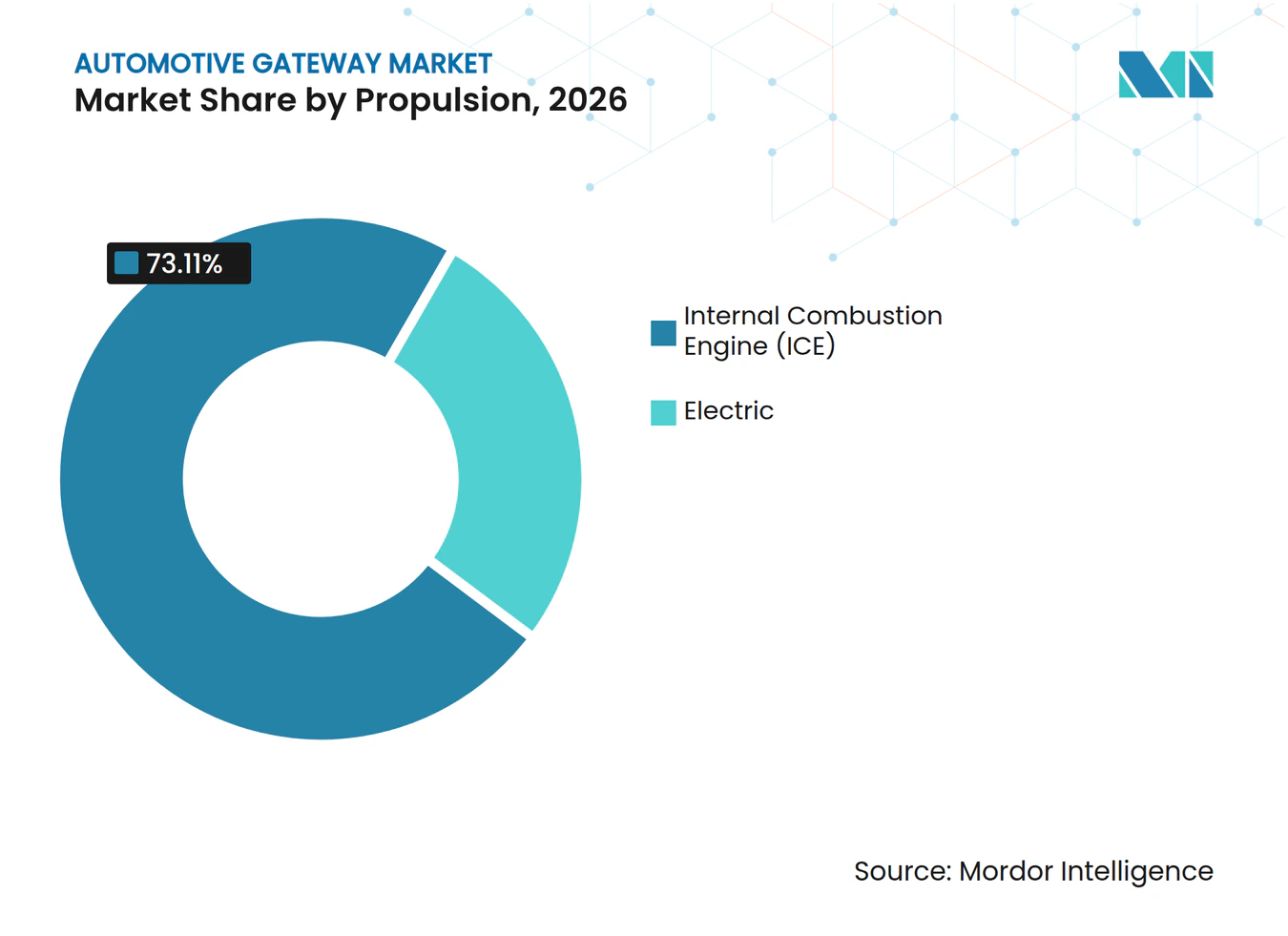
- By propulsion, ICE held 73.11% of the automotive gateway market share in 2026, while electric propulsion is forecast to expand at a 15.12% CAGR through 2032.
- By sales channel, OEM held 93.04% of the automotive gateway market share in 2026, while aftermarket is forecast to expand at an 11.84% CAGR through 2032.
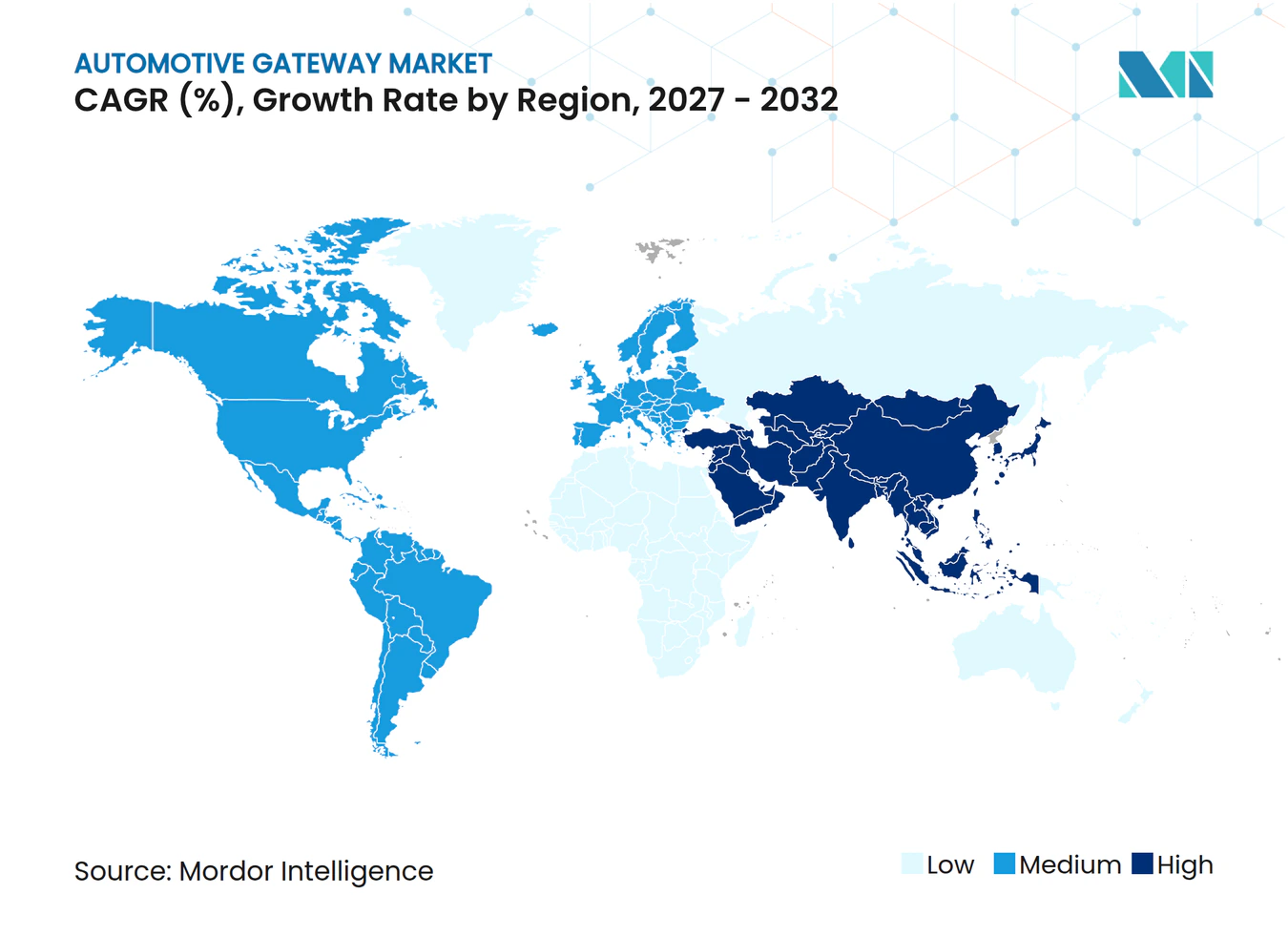
- By geography, Asia-Pacific held 44.12% of the automotive gateway market share in 2026 and is forecast to expand at an 11.15% CAGR through 2032.
Note: Market numbers in this report are based on Mordor Intelligence's proprietary estimation framework, which combines nine months of actuals with Q4 projections for base year 2026.
Market Trends and Insights
Drivers Impact Analysis of Automotive Gateway Market*
| Driver | (~) % Impact on CAGR Forecast | Geographic Relevance | Impact Timeline |
|---|---|---|---|
| Software-Defined Vehicle Architectures Increase Gateway Content | +2.8% | Global | Medium term (2–4 years) |
| Automotive Ethernet Backbone Migration Raises Gateway ASPs | +2.0% | Global, with early momentum in Europe and Asia-Pacific | Long term (≥ 4 years) |
| OTA and Connected-Service Requirements Expand Gateway Functions | +1.5% | Global, with core rollouts in North America and Europe | Medium term (2–4 years) |
| Zonal Consolidation Reduces ECU Count and Wiring Complexity | +1.3% | Global, led by Asia-Pacific and European premium programs | Long term (≥ 4 years) |
| Gateway Security Becomes a Vehicle-Approval Requirement | +1.0% | Europe, Japan, South Korea, and China (UN R155 and GB 44495) | Short term (≤ 2 years) |
| Gateway Workloads Shift Toward High-Performance, Multi-Protocol Computing | +0.8% | Global, accelerating in premium and electric vehicle segments | Long term (≥ 4 years) |
| Source: Mordor Intelligence | |||
Software-Defined Vehicle Architectures Increase Gateway Content
Software-defined vehicle architectures move the gateway from a network hub to a vehicle-level software control point. The change raises the need for computing capacity, multi-protocol routing, and secure execution within the same unit. NXP introduced its S32N7 processor in January 2026 to consolidate propulsion, vehicle dynamics, body, gateway, and safety functions that had often used separate hardware nodes [1]. This design direction supports higher gateway content per vehicle, even where vehicle shipments show limited growth. Gateways that cannot support modern software execution environments are less likely to qualify for next-generation vehicle platforms.
Automotive Ethernet Backbone Migration Raises Gateway ASPs
Automotive Ethernet adoption is increasing the networking capability required of gateway hardware. A gateway supporting Ethernet backbones needs switching, timing, and security functions that are not central to a CAN-only configuration. NXP introduced its S32J Ethernet switch family in October 2024 for safe and secure vehicle networking in its CoreRide platform. This migration raises the value of the gateway even when vehicle production grows slowly. Suppliers that complete Ethernet qualification earlier can compete for platforms whose sourcing decisions are set several years before production.
OTA and Connected-Service Requirements Expand Gateway Functions
Over-the-air updates make the gateway a central point for software campaign control, encrypted delivery, integrity verification, and recovery from an unsuccessful update. UN R156 requires a software update management system for eligible new vehicle types, which strengthens the importance of these functions [2]. China's GB 44496 standard similarly requires software update management and security protection for over-the-air (OTA) updates in intelligent connected vehicles. The resulting work increases software and security content in the automotive gateway market. OEMs also need these capabilities to support connected services over the vehicle life cycle.
Zonal Consolidation Reduces ECU Count and Wiring Complexity
Zonal architectures concentrate functions that had been distributed across many electronic control units into a smaller number of higher-capability nodes. Marelli introduced its ProZone zone control unit in 2025 as part of its work on software-defined vehicle architectures. This approach can reduce wiring complexity while increasing the capability required in each zonal controller. Cybersecurity requirements add another layer of gateway content because the gateway must help protect networked vehicle systems. The updated UN R155 framework provides a common approval basis for vehicle cybersecurity management systems in Europe[3].
Restraints Impact Analysis of Automotive Gateway Market*
| Restraint | (~) % Impact on CAGR Forecast | Geographic Relevance | Impact Timeline |
|---|---|---|---|
| Long Vehicle Validation Cycles Slow Gateway Platform Replacement | -1.2% | Global | Long term (≥ 4 years) |
| Cybersecurity Liability Raises Lifecycle Engineering Costs | -0.8% | Global | Medium term (2–4 years) |
| Mixed Legacy Networks Complicate Zonal Migration | -0.7% | Global, pronounced in emerging markets | Medium term (2–4 years) |
| Processor, Ethernet-Switch, and Software Supply Constraints Limit Scale-Up | -0.6% | Global | Short term (≤ 2 years) |
| Source: Mordor Intelligence | |||
Long Vehicle Validation Cycles Slow Gateway Platform Replacement
Automotive validation of a new gateway platform against functional safety, cybersecurity, and diagnostic requirements typically requires 18-36 months before the start of production. ISO 26262 and ISO/SAE 21434 expectations add testing and documentation demands for suppliers and OEMs. Legacy OEM development cycles can run about five years, while some newer entrants iterate in 12–18 months. This validation inertia can lock legacy gateway architectures into vehicle programs already under production planning. Suppliers with zonal gateway hardware qualified in 2025-2026 may not see meaningful production revenue until 2028-2030 model year vehicles reach volume start of production.
Cybersecurity Liability Raises Lifecycle Engineering Costs
Gateway cybersecurity obligations extend across the vehicle life cycle under ISO/SAE 21434 and its Threat Analysis and Risk Assessment methodology. This requires continuous post-sale vulnerability monitoring, security patch planning, and coordinated update delivery. UN R155 requires manufacturers to demonstrate cybersecurity management for type approval and maintain appropriate lifecycle controls. These responsibilities add fixed engineering costs that can compress margins for suppliers with hardware-led business models. Smaller Tier 2 suppliers and new entrants face a greater relative cost burden when they lack established security engineering practices.
*Our forecasts treat driver/restraint impacts as directional, not additive. The impact forecasts reflect baseline growth, mix effects, and variable interactions.
Automotive Gateway Market Segment Analysis
By Gateway Type:
Zonal Migration Reshapes Network ArchitectureCentral gateway held 55.18% of the automotive gateway market share in 2026, while zonal gateway/controller is forecast to grow at a 13.68% CAGR through 2032. Central gateways remain important because many current vehicle programs use a single network management point to link powertrain, body, infotainment, and diagnostic domains. Zonal controllers are receiving more program spending because OEMs are organizing electronic functions around physical areas of the vehicle. This transition changes the gateway from a message-routing device into local computing, secure switching, and communication management hardware. The automotive gateway market size for zonal controllers benefits from the larger set of tasks performed by each unit.
NXP’s S32N7 launch shows how gateway capability can be combined with propulsion, body, and safety functions on a common processor platform. The S32K5 family also targets zonal software-defined vehicle architecture and the CoreRide platform. Telematics and connectivity gateways remain necessary for fleet operations, remote services, diagnostic access, and communication with external networks. Security and diagnostic gateways remain relevant in architectures that have not fully moved to centralized or zonal control. The practical outcome is coexistence between central and zonal designs, rather than an immediate replacement of central gateway volume.



By Component:
Hardware Scale Masks Software Value MigrationHardware held 69.24% of the automotive gateway market share in 2026 because processors, transceivers, switches, and qualified electronic components remain central to each system. Software is forecast to record a 13.05% CAGR through 2032, faster than the broader automotive gateway market. Hardware capability is increasing as gateways add Ethernet switching, secure processing, network timing, and higher compute workloads. Firmware, security stacks, diagnostic logic, and OTA middleware also account for a larger share of the development work needed for every platform. This combination changes where suppliers create value, even though hardware remains the largest revenue component.
Bosch described integrated hardware and software solutions for the new vehicle world at IAA Mobility 2025. Hardware consolidation can reduce the number of separate electronic modules, connectors, and communication paths used in a vehicle. Software remains essential to coordinate functions across consolidated modules and maintain update and cybersecurity capabilities after sale. This creates recurring opportunities for update support, lifecycle maintenance, system integration, and security services. It also places pressure on component suppliers whose product plans lack a software, security, and long-term support proposition.
By Vehicle Type:
Passenger Car Volume, Commercial Vehicle Connectivity UpsidePassenger cars represented 79.33% of the automotive gateway market share in 2026 because they account for the largest production base across the major automotive manufacturing regions. Medium and heavy commercial vehicles are forecast to grow at a 12.41% CAGR through 2032. Commercial vehicles require telematics, diagnostics, maintenance, fleet management, and remote-service functions that can increase gateway content per unit. A single commercial vehicle can run multiple connected modules for operations and compliance, even though overall unit volumes are lower than passenger cars. This supports growth in the automotive gateway market size for commercial applications.
Fleet operators use connected systems to monitor vehicle status, maintenance needs, location, uptime, and operational performance across dispersed vehicles. These applications make dependable data handling, secure remote access, and diagnostic communication essential for commercial gateway designs. Marelli’s ProZone product demonstrates a design approach that brings several vehicle domains into a zonal control unit. Such designs can address the more complex body, thermal management, chassis, and power requirements of larger vehicles. Passenger cars are expected to remain the largest demand base, while commercial vehicles provide a faster path for connectivity-led value growth.
By Propulsion:
ICE Baseline Volume, EV Architecture PremiumInternal Combustion Engine (ICE) held 73.11% of the automotive gateway market share in 2026, while electric propulsion is forecast to expand at a 15.12% CAGR through 2032. Internal-combustion models continue to form the volume foundation for gateway demand in many regions, especially where affordable passenger vehicles dominate sales. Electric vehicles require gateways that manage software-defined battery systems, regenerative braking, charging communication, and powertrain updates. These tasks increase computing, security, diagnostic, and network bandwidth requirements for every relevant vehicle. Electric propulsion therefore supports higher gateway content than a comparable conventional vehicle.
BYD launched a smartphone-car connectivity feature in 2025 that linked its vehicle lineup with devices from Huawei, Xiaomi, OPPO, and Vivo. This type of feature positions the gateway as an ecosystem integration point rather than only an internal vehicle network component. Electric vehicle platforms can include these digital functions earlier because their electrical systems are often designed around centralized software control from the outset. Conventional OEMs must add similar capabilities while keeping older powertrain, network, and diagnostic systems operational. The resulting architecture premium supports continued value growth for gateway systems in electric vehicle programs.

By Sales Channel:
OEM Lock-In, Aftermarket Broadens AccessOEMs held 93.04% of the automotive gateway market share in 2026 because gateways are selected during vehicle platform design and retained across the production cycle. The aftermarket channel is forecast to grow at an 11.84% CAGR through 2032. OEM sourcing requires extensive validation and aligns a gateway with the electrical architecture, software stack, safety process, and service strategy of a vehicle program. This creates high entry barriers for suppliers that have not secured an early design win and completed the relevant validation work. The OEM channel is expected to remain the primary source of value in the automotive gateway market.
Aftermarket growth is centered on telematics, diagnostics, connectivity add-ons, and security upgrades for fleet and passenger vehicles. Demand is strongest where OEM connectivity penetration remains limited or older vehicle fleets need additional remote-service functions. Hardware security module upgrades can also be relevant for vehicles that lack more current cybersecurity capabilities. Lower qualification barriers allow IoT and connected-device providers to participate in selected aftermarket applications. This broadens customer access, although it can create pricing pressure in entry-level gateway products.
Geography Analysis
Asia-Pacific
Asia-Pacific accounted for 44.12% of the automotive gateway market share in 2026 and is expected to grow at an 11.15% CAGR through 2032. China combines large-scale vehicle production, a rapidly advancing electric vehicle base, and locally developed electronic architectures, which support stronger demand for high-capability gateways. Volkswagen Group China’s China Electronic Architecture demonstrates how established OEMs can use local technology partnerships to move software-defined vehicle programs toward production. The region is also an important proving ground for designs that combine tight cost control with advanced connected services, Ethernet networks, and centralized software functions. India’s emerging telematics and cybersecurity requirements, as well as South Korea’s centralized platform updates, broaden the regional opportunity beyond China.
Europe
Europe’s gateway ecosystem is shaped by premium vehicle production, long product support cycles, and rules that make cybersecurity capability a baseline design requirement. The European Union published the updated UN Regulation No. 155 in January 2025, setting approval provisions for vehicle cybersecurity and cybersecurity management systems. BMW’s Neue Klasse architecture and Volkswagen’s zonal development efforts show the importance of next-generation electrical designs in European vehicle programs. Volkswagen’s work with Rivian also reflects the effort by established European OEMs to develop new software and zonal architecture capabilities, including common zonal silicon. Suppliers that can provide semiconductor capability, systems integration, security evidence, and regulatory support are well positioned in this region.
North America, South America, and Middle East and Africa
North America is influenced by the connected vehicle rule issued by the United States Bureau of Industry and Security, which became effective in March 2025. The rule adds sourcing and security considerations for connected vehicle hardware and software and can favor suppliers with compliant supply chains. South America develops from a lower connected-vehicle base, where fleet telematics provides a steady source of gateway demand despite slower adoption of high-value zonal systems. In the Middle East and Africa, smart mobility programs, vehicle imports, and Morocco’s production role for European OEMs are creating select openings for telematics and security gateway modules.
Competitive Landscape
Market Concentration
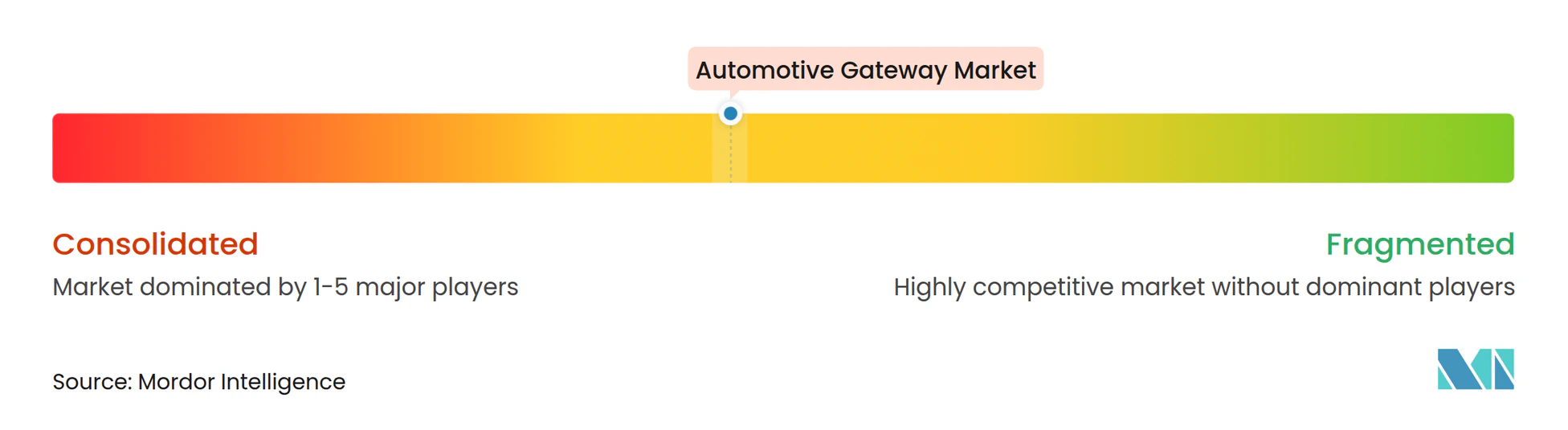
The automotive gateway market is moderately concentrated among global Tier 1 automotive electronics suppliers and automotive-grade semiconductor companies. Tier 1 suppliers compete through systems integration, program management, validation, and long-standing OEM relationships. Semiconductor companies are extending their influence through processors, Ethernet switches, reference designs, software platforms, and partner ecosystems. NXP’s S32N7 program illustrates this strategy because it brings multiple vehicle functions together on a single processor platform. The shift can reduce the distinction between a component supplier and a vehicle systems architect.
Bosch was named as the first Tier 1 supplier to deploy the S32N7 platform, supported by common reference designs and safety frameworks. This move shows how silicon partnerships can help suppliers defend gateway positions before competing supply chains complete qualification. FORVIA identified electronics and zonal modules as strategic areas in its 2026 capital markets communication. Marelli’s ProZone launch provides another example of a supplier targeting zonal control products that combine several vehicle domains. These actions show a focus on fewer, higher-capability modules rather than growth through conventional electronic control units alone.
Software-focused entrants are targeting telematics and connectivity gateways with products designed around remote services and cloud integration. Aptiv described its LINC software-defined vehicle platform in 2026 as a means to separate vehicle software functions from underlying hardware. This approach responds to OEM demand for more control over applications and a lower dependence on proprietary hardware stacks. Specialized software providers can also enter by embedding their products into semiconductor reference platforms. Competitive advantage therefore depends on hardware capability, software integration, cybersecurity evidence, and the ability to support a platform over its full production and service life.
Automotive Gateway Industry Leaders
-
AUMOVIO SE
-
Robert Bosch GmbH
-
Lear Corporation
-
Denso Corporation
-
Aptiv PLC
- *Disclaimer: Major Players sorted in no particular order
Automotive Gateway Market Companies Covered in this Report
- AUMOVIO SE
- Robert Bosch GmbH
- Aptiv PLC
- Denso Corporation
- Lear Corporation
- Visteon Corporation
- Hyundai Mobis Co., Ltd.
- Marelli Holdings Co., Ltd.
- ZF Friedrichshafen AG
- FORVIA SE
- NXP Semiconductors N.V.
- Infineon Technologies AG
- Renesas Electronics Corporation
- TTTech Auto AG
- Neusoft Corporation
- Valeo SE
Recent Industry Developments in Automotive Gateway Market
- May 2026: NXP Semiconductors and Quanta partnered to offer a validated deterministic zonal networking platform for software-defined vehicles that combines NXP S32 processors with MotionWise middleware.
- March 2026: Vantron Technology launched the AG605 automotive gateway at Embedded World 2026, built on the NXP i.MX 94 processor with six Gigabit Ethernet ports, 5G/4G LTE, Wi-Fi 6, and OBD-II diagnostics.
- January 2026: Aptiv presented its LINC software platform, which provides communications middleware, software-defined networking, and container management for software-defined vehicles, at CES 2026.
- January 2026: NXP Semiconductors launched the S32N7 processor series to centralize vehicle functions, including gateway, with Bosch as the first Tier 1 supplier to deploy it.
Global Automotive Gateway Market Report Scope
The scope includes segmentation by gateway type (central gateway, zonal gateway/controller, telematics/connectivity gateway, and others [diagnostic and security]), component (hardware [processors and transceivers] and software [firmware, security, and OTA]), vehicle type (passenger cars, light commercial vehicles, and medium- and heavy commercial vehicles), propulsion type (internal combustion engine [ICE] and electric), and sales channel (OEM and aftermarket). The analysis also covers North America (United States, Canada, and Rest of North America), Europe (Germany, France, United Kingdom, Italy, Spain, Russia, and Rest of Europe), Asia-Pacific (China, Japan, South Korea, India, Southeast Asia, Australia, and Rest of Asia-Pacific), South America (Brazil, Argentina, Colombia, Chile, and Rest of South America), and the Middle East and Africa (Saudi Arabia, United Arab Emirates, Israel, South Africa, Egypt, Morocco, and Rest of Middle East and Africa). Market size and growth forecasts are presented by value in USD and volume in Units.
Segmentation Overview
| Central Gateway |
| Zonal Gateway/Controller |
| Telematics/Connectivity Gateway |
| Others (Diagnostic, Security) |
| Hardware (Processors, Transceivers) |
| Software (Firmware, Security, OTA) |
| Passenger Cars |
| Light Commercial Vehicles |
| Medium and Heavy Commercial Vehicles |
| Internal Combustion Engine (ICE) |
| Electric |
| OEM |
| Aftermarket |
| North America | United States |
| Canada | |
| Rest of North America | |
| Europe | Germany |
| France | |
| United Kingdom | |
| Italy | |
| Spain | |
| Russia | |
| Rest of Europe | |
| Asia-Pacific | China |
| Japan | |
| South Korea | |
| India | |
| Southeast Asia | |
| Australia | |
| Rest of Asia-Pacific | |
| South America | Brazil |
| Argentina | |
| Colombia | |
| Chile | |
| Rest of South America | |
| Middle East and Africa | Saudi Arabia |
| United Arab Emirates | |
| Israel | |
| South Africa | |
| Egypt | |
| Morocco | |
| Rest of Middle East and Africa |
| By Gateway Type | Central Gateway | |
| Zonal Gateway/Controller | ||
| Telematics/Connectivity Gateway | ||
| Others (Diagnostic, Security) | ||
| By Component | Hardware (Processors, Transceivers) | |
| Software (Firmware, Security, OTA) | ||
| By Vehicle Type | Passenger Cars | |
| Light Commercial Vehicles | ||
| Medium and Heavy Commercial Vehicles | ||
| By Propulsion | Internal Combustion Engine (ICE) | |
| Electric | ||
| By Sales Channel | OEM | |
| Aftermarket | ||
| By Geography | North America | United States |
| Canada | ||
| Rest of North America | ||
| Europe | Germany | |
| France | ||
| United Kingdom | ||
| Italy | ||
| Spain | ||
| Russia | ||
| Rest of Europe | ||
| Asia-Pacific | China | |
| Japan | ||
| South Korea | ||
| India | ||
| Southeast Asia | ||
| Australia | ||
| Rest of Asia-Pacific | ||
| South America | Brazil | |
| Argentina | ||
| Colombia | ||
| Chile | ||
| Rest of South America | ||
| Middle East and Africa | Saudi Arabia | |
| United Arab Emirates | ||
| Israel | ||
| South Africa | ||
| Egypt | ||
| Morocco | ||
| Rest of Middle East and Africa | ||
Key Questions Answered in the Report
What is the projected growth rate for automotive gateways?
The automotive gateway market is forecast to grow at a 10.84% CAGR from 2027 to 2032, reaching USD 7.26 billion by 2032.
Which automotive gateway type is growing fastest?
Zonal gateway/controller is forecast to grow at a 13.68% CAGR through 2032 as OEMs adopt zonal electrical architectures.
Which vehicle propulsion type creates the strongest gateway opportunity?
Electric propulsion is forecast to expand at a 15.12% CAGR through 2032 because EVs require more computing, security, diagnostics, and connectivity functions.
Which region leads demand for automotive gateways?
Asia-Pacific held 44.12% share in 2026 and is forecast to grow at an 11.15% CAGR through 2032.